Friday
Friday saw me back in Rockhampton. I am enjoying fishing up here, whenever I can, but I am also missing the Bribie Island flathead fishing. I have completely missed the busy months of September and October. I hope to get this job finished and be back out there soon.
Rocky is warming up and by 3.00 pm, its usually over 35 degrees and extremely humid. There have been a few more storms and the Fitzroy River is looking murkier and murkier. I arrived in town just after lunch. I had a few meetings, dumped my kit in the motel and headed across the bridge to the north side of the river.
I wanted to see if I could find any more giant herring, grunter or tarpon. The locals insist the last few hours of the run out tide are the best time to fish here, especially when they coincide with dawn or dusk. Full moon had passed on Thursday, so their would be plenty of tidal flow. The sun was dropping, as was the tide and it was hot and sticky. I arrived at about 5.30pm and wandered out under the railway bridge, to the edge of the rocks. Low tide would be at about 9.00pm. It had rained the night before and there were rumbling grey clouds on the horizon with a few, far away lightning flashes. I could smell the rain but it was not falling yet.
There were a few prawns jumping, so I started with a GULP 4″ Shrimp in the Banana Prawn colour. I had rigged it on a 1/8th ounce, size 1 hook jighead and I was using 12lb fluorocarbon leader. I was using my new 6′ Shimano Catana rod and the 2500 size Shimano Stradic reel.I was casting along the edge of the rocks, so I did not need a long rod – the fish are usually close to the shore, lurking around the rock bars and overhangs.
As the sun dropped the surface activity picked up and there were small jelly prawns scattering, each time I pulled the soft plastic up close to the rocks. After about 15 minutes, I decided to let it drop down right next to the rocks. Once I was sure it was on the bottom, I paused for a good ten seconds. I then jigged the soft plastic shrimp up and down few times and paused again. It was third time lucky and something fairly powerful grabbed the plastic and headed off. It quickly surfaced – a barramundi, about 45 to 50 cm long. It tail walked on the surface a couple of times, trying to spit the lure. After a short fight, I lifted it out of the water. Although I was delighted to catch a decent Fitzroy barramundi, it is currently the closed season for barramundi, so after a quick picture, I released the fish unharmed and decided to moved round to the next set of rocks. You are not supposed to target these fish at this time of year and whilst you cannot decide which fish is going to eat your lure, it was a fair bet that there would be more than one barramundi lurking at the base of those rocks, so I moved on.

Run out tide on the north side of the Fitzroy

The rocks are gradually revealed

The barramundi were sitting close to the rocks

A couple of photos then straight back

There were a few prawns around in the river

About 10 minutes later I found another one

Suddenly the barramundi were all around the base of the rocks

I changed sides to try to avoid the barra

The rain had brought the grunters out

2″ Shrimp gets a Tarpon

Fitzroy Tarpon

Lots of small fish around

No idea what this is

Low tide on the south side
The jelly prawns were all over the place but there was nothing much feeding, close in. I lobbed the soft plastic a little further out, and let it sink again. As I lifted it off the bottom, I felt a tentative bite but did not hook up. I kept casting and put in some long pauses, close to the base of the rocks. The sun had set and the rain and thunder was close. At about 6.15 pm, something slammed my shrimp at the base of the rocks. I knew it was another barramundi straight away. It soon surfaced and made a couple of leaps. I let it settle and pulled it gently out of the water. It was a little bigger than the first. I photographed and released it.
I moved to another location, about 10 metres further south for a few more casts. It was now about 6.30 pm and pretty much dark. The rain was imminent and the wind was gusting in all directions. I continued with the soft plastic lure that was catching fish – GULP 4″ Shrimp. In a carbon copy of the two previous captures, a third barramundi grabbed the lure at the base of the rocks. It was also about 45cm long. I released just as the rain started spitting and decided it was time to go. By the time I reached the car I was soaked to the skin.
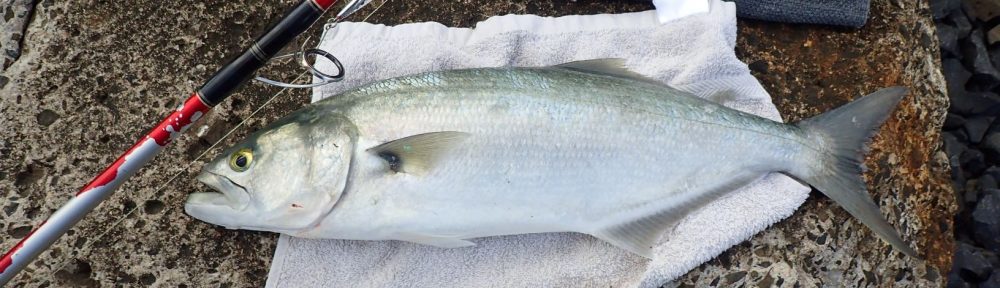
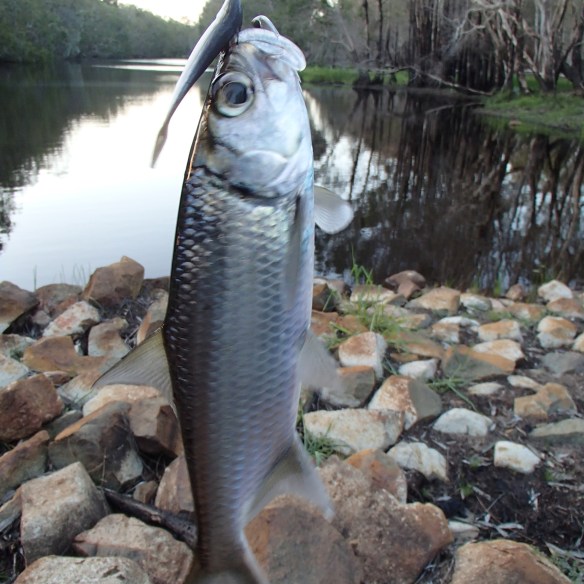
The session confirmed all the local advice I had been given – fish during a big falling tide, at dawn and dusk. I think the humidity and pending storm also helped. The next morning, I swapped sides to avoid the barramundi and found a few small fish, some of which I have never caught before. The rain seemed to have fired up the small grunter and tarpon and I caught a few of each, in the hour around dawn.
That was it for Rocky for a while – hopefully I will get back around March, when those barramundi will have grown big enough to keep.




 Landangler's Blog