Bribie Island – White Patch – 11 December 2015

Friday

The flats in front of the old oyster jetty at the Sandstone Point Hotel had not produced much action during my last fishing session. So on Friday I decided to fish somewhere else on Bribie. Wild weather was forecast and it was very hot – 33 C. There was a strong northerly wind blowing and there was plenty of cloud around. A storm seemed likely in the late afternoon.  I decided to give White Patch a try. This is a stretch of shore on the inside of Bribie Island where the 2 to 3 metre coffee rock drop off into the Pumicestone Passage, is quite pronounced. I have caught just about everything here over the years – snapper, trevally, queenfish, flathead, bream, whiting, estuary cod, moses perch, pike, long toms, tailor and jewfish. Flathead, whiting, bream and pike are by far my most common catches.

I wanted to fish the falling/ low tide. As regular readers will be aware, I much prefer fishing a run out tide at Bribie. That is not to say fish do not bite on the run in. I am just more confident of where to find them when the tide is running out. Fish, (especially flathead) move back in surprisingly fast with the run in tide. Both flathead and whiting love to eat soldier and other small crabs. As the tide runs into the shallows, they have a very good chance of finding them. If you are fishing with children over the holidays, soldier crabs are a great bait. They are plentiful, fun to collect and if you slide two or three on to a #4/#6 hook, at the end of a lightly weighted 6 to 10 lb line, you should find a few fish in the shallows.

Low tide would be at about 4 pm. I arrived at about 2.30 pm and wandered down the steps to the beach. The shoreline has a mixture of weed, sand and flat rocky areas. The edge of the main channel is only exposed on the very lowest of tides. I like to fish on top of the ledge, in the shallows before later casting over it, as the tide recedes.

This is a beautiful spot but this afternoon the fishing was very tough. I walked up and down casting everything I had in the tackle bag without much luck. At about 3.00 pm I caught a very grumpy bream who slammed my GULP 3” Lime Tiger coloured soft plastic minnow. I had dropped right down to 8lb fluorocarbon leader in the clear water.

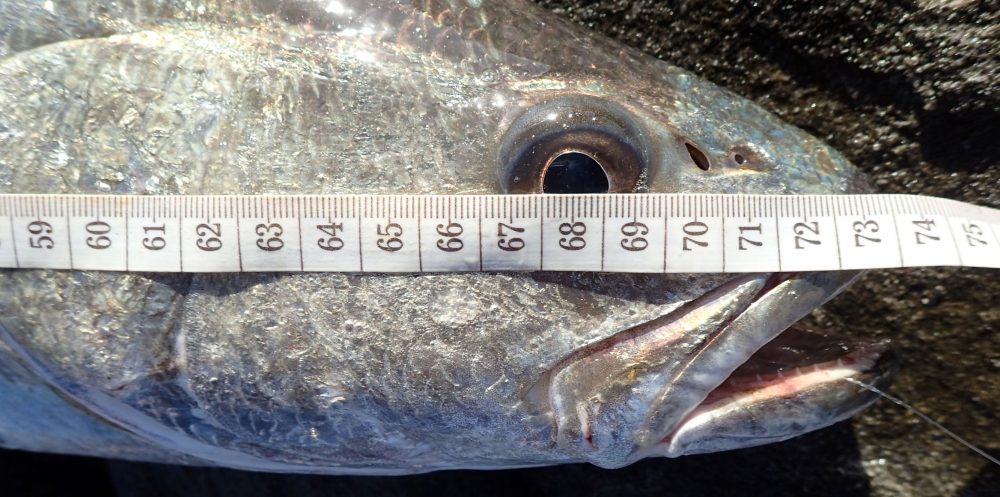
I waded a long way along the shore almost to the south end. At this point there was plenty of bait in the shallows and each time I cast, it would scatter as the lure passed overhead. It was now about 4.30 pm and the tide was starting to slowly run in. There was a big surge about 5 metres in front of me and the bait scattered in all directions. I was now fishing with a bigger GULP Jerkshad in the Cajun Chicken colour. I cast in the direction of the surge. After about five casts something grabbed the soft plastic and took off at a tremendous pace. Fortunately the drag was not set too tight so it could easily take line. It stripped off about 20 metres of line in a solid fast run. Then after just a few seconds, it was gone. It looked like it had just dropped the soft plastic. I suspect it was a trevally, which I have caught in this area before.

I carried on casting but it did not come back. The sky got blacker and blacker, so at about 5.00 pm I decided to retire. Fishing in our estuaries is tough in the summer months but persistence is the key.

Bribie Island – Bongaree and White Patch – 22 August 2013

Thursday

Clear skies and 10 knot south-westerly winds – it would be cold but quite reasonable fishing weather. Low tide would be 4.17 am, about an hour before first light and the moon had been full the day before.

I decided I would start on Bribie Island at the Seaside Museum drain at Bongaree, again. I waded out into the shallows at about 5.30 am and the big moon was still high and bright. There was a cold breeze and a bit of chop on the water.

There were some cormorants swimming around and there were a few surface bust ups, as the sky gradually lightened. I started with a big soft plastic – a GULP 5” Jerkshad in the Lime Tiger colour. The water was already running fast – it would be a powerful tide, so close to the full moon. I was back to 8lb fluorocarbon leader, as I genuinely believe fishing light can make a difference when chasing bream – which were the main target.

It did not take long. At 6.15 am I had a solid bite and the fish ran with the lure for about a metre, but then I lost it. A few casts later I hooked another. It must have been sitting just below the edge. It grabbed the lure and ran off to the north, with the current. After a few runs, I got it over the ledge and walked it back to the sand. It was a good bream – over 30 cm. I have not caught large numbers of bream in this spot, this year, but almost all the fish I have caught have been over 30 cm.

The tide was getting too high to fish over the ledge so I opted to switch locations. I grabbed a hot cup of coffee at Scoopys and drove up to White Patch. This time I went up to the north end to fish around the weed beds.

The water was clear and it was well past dawn so I opted for a natural coloured, 2” GULP Minnow in the Banana Prawn colour. I chose a fine wire 1/8th ounce, #1/0 hook jighead and stuck with the 8lb leader. It was now about 8.15 am. I was casting into the incoming tide and hopping the lure back towards me. I would put in about three or four casts from one location, then move a few metres south and repeat the process.

At about 9.00 am I connected with a flathead and got a look at it, but it wriggled off before I could land it. I stayed in the same spot and methodically covered the area with casts. At about 9.15 am I hooked another fish and this time I set the jighead firmly. I pulled it up to the shoreline – it was a keeper flathead at 45 cm. Using the same plastic, same technique, in the same area, I caught another bigger flathead, about 50cm long, ten minutes later.

Five minutes later, I thought I had another small flathead but it was pulling very hard. It put up a tremendous fight and as it came into view I was surprised to see it was a whiting. It was probably the fattest whiting I have ever caught and measured 36cm.

At this point I had the makings of a good fish pie in my bag, so I gave up and went off to clean my catch.

Bribie Island – Whiting & Flathead – 11 Sept 2011

Sunday

The weather was going to be a challenge again. I wanted to fish at Bribie but the tides would be far from perfect. I like to fish my favorite Bribie Island haunts in the 6 hours around low tide. This is because the best land-based fishing spots are most accessible during this period. There are still usually plenty of fish around at high tide but, by then, I cannot reach the structures that form their permanent cover.

On Sunday, low tide would be just after 3.00am and this meant that by first light at about 5.15am, I would probably only have about an hour before I would be forced out of reach of the best areas, by the incoming tide. It also looked like the wind would blow up again soon after dawn.

I decided to fish the area around the old oyster jetty on the mainland side. I soon realized I had made a mistake. The fierce westerly winds from Saturday had obviously stirred up all the weed and sediment and as the water flooded in over the flats it lifted it all up. It was a mucky swamp of weed and mud and I could not cast without catching a large clump of debris.

I went back to the car and drove back across to the mouth of the tidal lagoon, at Bongaree, in front of Buckley’s Hole. The wind was now howling. The tide had moved up and I could only fish above the drop off, on the sand flats. After a couple of hits in the same spot, I pulled up a very ambitious Whiting – which had attacked my GULP 4” Pearl Watermelon Minnow. I moved further along the sand banks to the south. I was fishing with a 1/6th 1/0 jighead and 12lb fluorocarbon leader. Finally, I caught a 44cm Flathead on a GULP 3” Pumpkinseed Jigging Grub. With the wind now up around 20 knots I decided to give up and head for home.