Iluka – Middle Bluff – 30 September 2014

Tuesday – Morning

I had not given up on finding a keeper size mulloway at Iluka, so at 4.45 am on Tuesday, I walked along the beach towards Middle Bluff. I surprised a couple of Kangaroos who were up on the rocks. Conditions were similair to the day before (light northerly) but the sea seemed a little more stirred up and foamy. Low tide would be at about 5.20 am – just on sunrise. The beginning of the run in tide offers good fishing in this spot, so I was hopeful.

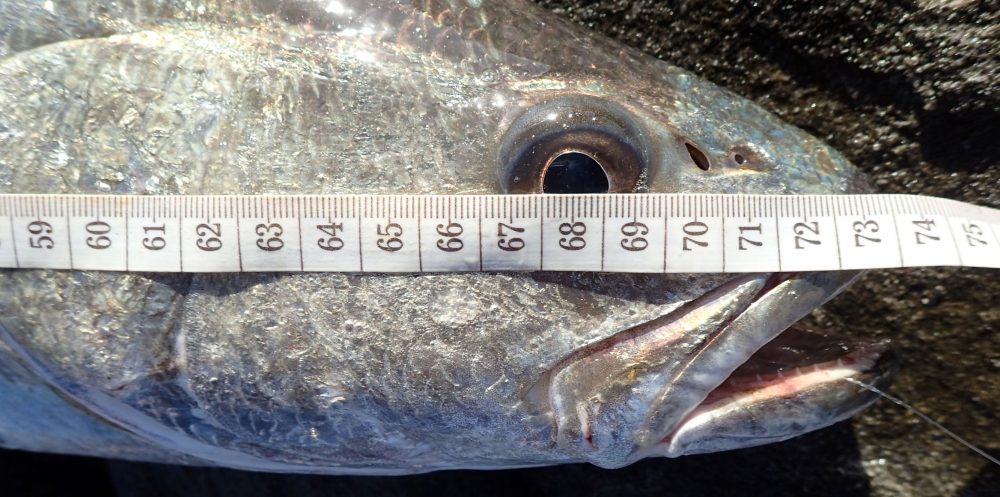
I started with my big rod and a big GULP Crazylegs Jerkshad in the Curry Chicken colour, on a ¼ ounce, size 1/0 jighead. I was fishing with 20lb fluorocarbon leader. I flicked this around, close to the base of the rocks and it soon came back minus its curly tail. I swapped to a GULP 4” Minnow in the Pearl Watermelon colour. The sun was up and the sky and water were very clear. After about 20 casts with the GULP Minnow I was getting pretty good at leaving it in the wash at the base of the rocks, without getting snagged. As I was about to lift it, at the end of a retrieve, I felt a grab. The fish swam for a bit with the plastic then let it go. A few casts later I connected with another fish. This time I dropped the rod tip as soon as I felt the resistance and paused. When I struck, the fish was hooked. Once more the light swell made things easy and I soon had a mulloway/ jewfish of about 48cm at my feet. I took a few pictures and threw it back.

I was starting to see a bit of bait jumping around close to the base of the rocks and it all looked pretty small.  I dropped down to my lighter rod and a 14lb fluorocarbon leader. I swapped down to a 2 inch GULP Shrimp soft plastic in the new Green Camo colour, but stuck with the ¼ ounce jighead.

A fish struck this hard on the first cast, but I did not hook up. About ten minutes later, I swapped to a 3 inch GULP Minnow in the New Penny colour. I had another hit on the first cast. This fish was not big but by the way it started pulling, I knew it was a tailor. They thrash about very hard and never give up. It was only small, about 35 cm long. It was good to see they are around. I took a picture and threw it back.

It had mashed up the plastic so I put the 2 inch GULP Shrimp in Green Camo on again. The tailor had obviously moved on. But after about 20 minutes of cast into the wash, I felt a good bite and was onto another fish.  This time it was another solid bream – a little over 34cm. I decided to keep this one for supper.

I continued fishing and kept felling small bites. Eventually I pulled up a butter bream. I had caught no trophy fish but had found great variety. The session had been a good example of how changing soft plastics can often produce results. At about 9.30 am I gave up and walked back to the car.

Tuesday  – Afternoon

In the afternoon I waded back out on to the flats beside the Clarence River, at dusk. They are covered in yabby holes which is a good sign for a fisherman. I flicked around a GULP Jerkshad in the Pearl Watermelon colour. I caught three flathead – the first would have been big enough to keep, the rest were too small. The sun dropped behind the trees on the horizon at about 5.40 pm and the midges and mozzies became unbearable, so I waded back to the cabin.

Bribie Island – The old oyster jetty flats – 11 August 2014

Monday

After a disappointing outing on Friday I was up earlier on Monday.  It was full moon. In fact, it was a super moon. That is probably why I could not sleep. I did not have much time, so I drove up to Bribie Island for a quick morning session.

The fish are always out there somewhere, so when they are elusive, it is not a bad idea to go back to basics. I decided to drop the leader down to 8lb fluorocarbon, use the fine wire Bream Pro 1/8th ounce, #1 hook jigheads and start with 2” and 3” GULP soft plastics in natural colours – Peppered Prawn, Banana Prawn, Smelt, Pearl Watermelon, etc. This set up should at least attract a few pike and bream.

I started under the bridge lights, on the mainland side of the Bribie Bridge. There was a very light south-westerly wind blowing and the moon was amazing. It was so bright that the fish would certainly have been confused by it. It was just after 5.00 am and low tide had passed at 3.53 am. It had been one of the years lowest at 0.2 metres. The tide was running in fast but there was no sign of any bait under the bridge lights. I cast around with a GULP 2” Shrimp in the Banana Prawn colour. I felt a couple of grabs and half hooked a couple of pike, but they both wriggled off. I had one solid bite, that might have been a small flathead, but it let go before I could find out.

At about 5.30 am, I decided to swap back to the mainland side of the bridge. I drove back over and waded out into the shallows. I stayed about 10 metres north of the bridge and cast towards it. I soon found the pike hiding in amongst the weed clumps and rocks.

I gradually moved south, under the bridge. The mad moon was creating a fantastic bright orange sky, as dawn was breaking. I think the sunrises on the east coast of Australia are the best in the world and this one was as good as they get. My camera does not do it justice – but I am sure if you are as mad about fishing as I am, you will have seen a few of these.

The tide was moving in quickly and the water coming in from the bay was very cold.  I made my way south to the fast disappearing sand bank and fished around this area. It is tough to fish here when the sun is low in the sky, as you cannot see where the sandy patches and weed beds are. You just have to slowly and methodically cover the ground.

I swapped up to slightly bigger GULP Jerkshad in the Cajun Chicken colour. After just a few casts this produced results with a definite hit. I paused but there was no fish there. It was just about 7.00 am. I did not have much more time in this spot as the tide was running in very quickly. I slowed everything down and tried to put the next cast back in exactly the same spot. I left the lure on the bottom for a good ten seconds. I hopped it slowly back towards me – nothing. I cast about a metre to the left and repeated the process. This time after my second pause on the bottom, whack, another solid flathead bite. This time I dropped the rod tip and counted (fairly quickly) to ten. When I lifted the rod the fish was hooked. It felt much bigger than it was (about 45cm) but it was a relief to finally get one.

As the morning progressed the wind picked up a little. The scenery was fantastic and the weather very good but I just could not find the fish. I swapped from small plastics to big plastics, jerkshads to paddletails to grubtails. I tried my DUO hard bodies but nothing worked.

At about 9.00 am I had to give up. It looks like I am going to have to put in a lot of practice to find my form again!

Bribie – the old oyster jetty flats – 4 April 2014

Friday

There had been a few showers and more were forecast. There was also a cyclone forming, up north. The new moon, four days earlier had not really made any difference to the fishing but it had coincided with some heavy rain, which may have limited its effect.

I set off back to Bribie Island. For the last two months I have fished here, exclusively. I apologise to readers who would like a change. But it has been good to fish through a few moon cycles and big weather changes and notice how they the effect what I catch.

Since the first week in March, I have been catching a lot of flathead from the sand flats, on the mainland size of the Pumicestone Passage, to the south of the Bribie Island Bridge. The fish were probably most numerous and at their most aggressive, in the run up to the full moon on the 16th March. The size of the fish and the numbers then gradually dropped off, after the full moon.  We then had some heavy rain which may have pushed them out to saltier water.

Looking back over my archive of fishing reports, I see I have had a number of excellent flathead sessions at this time of the year, in this particular spot.  The large numbers, the aggressive feeding and the fact that a good proportion of the legal size fish I have kept are full of roe, suggests they had gathered to spawn. It seems unlikely that the flathead only schooled up in this one location and I have seen many reports of good flathead catches, through early March, in the fishing press.

According to the sparse research that has been undertaken on flathead (principally in New South Wales – see ‘Reproduction and growth of dusky flathead (Platycephalus fuscus) in NSW estuaries’ – July 2008. NSW Department of Primary Industries – Fisheries Final Report Series No.101 ), they spawn between – September and March.

This would put this particular spawning session right at the end of the window. This is interesting because most fishing pundits will suggest the end of the cooler months – September / November is when you more reliably catch large numbers of spawning flathead. Hopefully I will have time to fish then, as well and I will compare the results.

Back to Friday – low tide would be at 6.28 am and it would be a fairly high low tide, at 0.7 m. I arrived just before first light, at about 5.15 am. It was still warm and I had driven through a couple of showers on the way up from Brisbane. The wind, if there was any, was form the south east.

I waded out into the shallows beside the bridge and cast around with a GULP 4” Minnow soft plastic in the Smelt colour. It was still dark and a few fish were feeding under the bridge lights. On my second or third cast I felt a solid bite, paused and hooked a good fish. I steered it out of the rocks, which dot the area and dragged it to the shore. It was a solid 50 cm flathead.

The next fish came about twenty minutes later, just to the north of the oyster jetty. I was then treated to a really fantastic sunrise which lit up a rain squall that was coming my way. It was now about 6.00 am. I caught a few more flathead in this spot, but they were all under 40 cm.

I moved to the south of the jetty and pulled out another new favourite of mine. The Lucky Craft 4” Mad Scientist Optishad soft plastic lure, in the Pearl Vairon colour. This is the ultimate shape for a flathead soft plastic. It is a Jerkshad with a huge paddle tail. The slim body accentuates the paddle tail and you can really feel the lure moving as you hop it along the bottom. Thanks to the guys at Jones Tackle for introducing me to these – http://jonestackle.com.au/.  It did not take long to find the fish. Between 6.30 am and 8.15 am, I caught 8 more flathead on this soft plastic. However, only two of these fish were over 40 cm.

At about 8.30 am I was soaked by a rain squall and decided to give up.  There are still plenty of fish out there, but the bigger ones are getting harder to find.