Bribie – the old oyster jetty flats – big flathead – 27 February 2016

Saturday

By my standards I have hardly fished in February. The two main reasons for lack of a fish supper have been wild weather and work – both equally annoying. For the last weekend in February I had time to fish but ex-tropical cyclone Winston that had flattened Fiji was still hovering off the Queensland coast and threatening big winds and swell.

I woke at about 4.00 am hoping the forecast would be wrong and I was surprised to not hear too much rustling in the trees. I was awake now so I decided to give it a try. I drove up to Bribie, arriving on the mainland side of the bridge just before 5.00 am. Low tide would be at 5.46 am. The wind was already blowing at about 20 knots from the south. I waded out into the stirred up water, south of the bridge. Unfortunately I promptly fell over a submerged rock, dunked my rod and reel and chest bag and filled my waders with murky water. At least it was warm water.

I put the poor start behind me as I hooked a good flathead just on first light, under the bridge lights. It was 53cm long and it went in the bag for supper. I was fishing with the GULP Jerkshad in the Satay Chicken colour. After catching a very big flathead earlier in the month and given the wild and windy conditions, I had swapped to a 12lb fluorocarbon leader.

As the sun came up so did the wind. By about 6.00 am it was well over 25 knots. The mangrove island provides a partial wind break and fortunately I was casting with the wind. At the foot of the big drain that runs round the corner from Sandstone Point, I caught a 45cm flathead. I could hardly feel the soft plastic as the wind was blowing the line around so much. I am sure I missed a few fish. About half way out to the channel marker I caught another flathead, about 43cm long.

Now the wind was getting ridiculous. The water was very cloudy and covered in loose sea grass, so I turned for home. I swapped to the GULP Jerkshad in the Lime Tiger colour and loaded it onto a 1/6th ounce, 1/0 jighead. I felt the slightly heavier jighead might hold the bottom better. The Lime Tiger swap stirred things up and I caught another good flathead – just over 60 cm long.

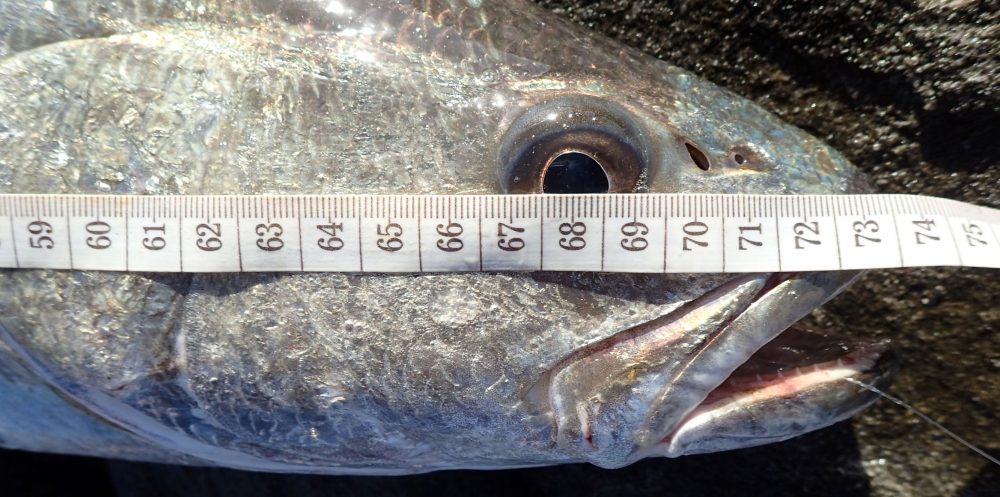
By now I was about 30 metres to the south of the old oyster jetty. I was casually casting as I waded back towards the car. The soft plastic struck hard and I thought it had lodged in the weed. I gave it a yank and it slowly moved about a metre towards me. Then line started peeling, slowly at first then much more quickly. I was on to a big fish. I checked my drag and let it take line. In three long runs it took over 30 metres of line. I wound against it each time but made no progress. Then it just stopped. I tightened the drag just a little and started to get line back. It now swam slowly back along the 30 metres, towards me. I kept up the line tension and slowly started walking backwards towards the big sandbank. As it reached about 30 cm of water it turned and made another long run. I turned its head and kept slowly winding and walking. Now it was tired and all I needed to do was steer it gently up on to the sand bank. It was a beautiful 86cm female flathead. I measured her and took a few photos. I then pushed here back in to the water and swam her through the water until her tail started waving and she took off unaided.

It was certainky worth braving the wild weather.


Bribie Island – Sandstone Point – Monster Flathead – 2 May 2011

Monday – Labour Day

10 to 12 knot winds forecast and even though there would be a big swell offshore, the estuaries would be good for fishing. Back up to Bribie, to the Sandstone Point flats where I have been getting some good Flathead.

At about 5.00 am I waded out under the bridge – on the mainland side, to cast around under the lights. The tide was running in, so I was casting from the north side of the bridge, under the bridge, into the shadows and hopping my lure across the bottom, along with the current, back towards me. Theoretically, the Flathead will be lying facing the current flow, waiting for their prey to be washed towards them. After a couple of casts with the GULP 4” Pearl Watermelon soft plastic, I had a fish. This area can be tricky, as there are loads of prominent rocks to trip over and lose the fish on. Unfortunately just as I got a look at a decent 50cm + Flathead, it lunged down behind one, bumped the jighead out of its mouth and slowly swam away.

As the horizon started to glow I walked south and then around the corner onto the Sandstone Point flats. On my way, I caught a small Flathead in the weed beds, about 20 metres from the shore. It was only just 40cm long, so I released it.

I moved past the jetty to the point where the shoreline turns right, casting as I went. I waded over the big sandbar that runs roughly north to south; onto the area I call the Sandstone Point flats. This area is very rocky initially and then softens to sandy weed beds with some central channels and drains. It holds plenty of fish, especially at the top of the tide. The Flathead lie between the rubble and the weed beds waiting to pounce, while the Bream cruise over the top.

I was still fishing with the same soft plastic, but as the water was less than a metre deep, I was only using a 1/8th 1/0 jighead. The tide was still running in and this meant I was casting directly in front of me, as I waded across the flats. Because I had missed a fish on the rocks earlier, I had switched up from a 10lb to a 16lb leader. I was retrieving the lure fairly quickly with very short pauses to avoid getting snagged. I felt a bit of resistance and thought I was snagged. I jerked the jighead up and what felt like a rock, rolled towards me a little and then felt like it was free. I wound in my line and as I was about to lift the plastic from the water, the line went tight again and the ‘rock’, which I now realise was a fish, swam straight past me. Line started peeling at a steady pace and then, as the fish realised it had eaten something sharp, it took off on a powerful initial run, with the current.

My Loomis GL2 6’6 Light spin rod is very sensitive and amazingly flexible but it is not designed for power. If you get a big fish on, patience is the key. I let it run. Then I recovered some line and let it run again. It was obviously nicely hooked, but at the beginning of each run, it would put in a series of angry headshakes. I realised now it was a very big Flathead. I identified a break in the Mangroves and started to steer the fish in that direction. It must have made five or six long, determined runs for freedom and after each one, I had tightened the drag slightly, with little effect. Even 16lb leader will not last forever and the longer the fight goes on, the more likely the fish is to find a conveniently placed rock or snag. I tightened the drag and got the fish into the slacker water close to the shore. There was another short run but it was tired now and had no current to help it. With one long last heave I pulled it up onto the sand. The leader snapped as soon as its weight hit the sand but it was clear of the water.

This slideshow requires JavaScript.

It was a monster female Flathead – well over 75cm. I measured it as best I could with my tape, took a few pictures and released it. I am settling on 75cm for the length, which makes it this year’s ‘personal best ‘Flathead for me.
Ironically, I still had no fish to eat, so I waded on. I caught a few undersize bream cruising over the weed and then in a small sandy depression, I finally picked up a 42cm Flathead. It was a good end to a great mornings fishing.