Bribie – the old oyster jetty to the channel marker – 21 April 2014

Monday

I am disappointed to report that once more the curse of paid employment has slowed down my posting and fishing. If the current government has its way, I shall be doing more work, for a lot longer than I had planned. I understand that when the pension was first introduced around 1910, the qualifying age was 65 and life expectancy was 58. So it was the ultimate healthy lifestyle bonus. Rarely did the government have to pay out for more than a few years. Now, most of us will get to our mid 80’s (especially if we eat plenty of fish). So we nearly all qualify for some portion of state funding for 15 years or more. Someone has to pay for it and the woeful performance of most people’s superannuation fund managers, means they will not be making much of a contribution. It’s a mess and it can only mean one thing – the current Australian age pension is probably as good as it will ever be.  So next time you see someone with more grey hair than you, whingeing about the cost of bait, remember you will be working long after they put their feet up, so ask them to shout you a beer. Of course, I can’t imagine who will employ me when I am 65 but that’s a whole another can of worms.

That’s enough social commentary. I was keen to see if the flathead glory days of early March would return. I drove up to Bribie on Monday, to fish the run out tide, which would be low at 8.00 am. It was still school holidays and during my last few visits, there has been plenty boat traffic. The wind has been changing between a light south-easterly and a northerly, with the occasionally cool westerly appearing, in the early morning. On Monday, it was light and cool from the south west. The overnight westerlies will start to bring the water temperature down quite quickly, if they persist. We were about half way between the full and the new moon.

I started in the dark and decided to head straight to the area to the south of the old oyster jetty, on the mainland side of the Pumicestone Passage. My last few sessions through the Easter Holidays had produced some quality fish, but the numbers were thinning out.  I decided to fish with neutral/ natural coloured soft plastics, just in case the fish were getting picky. I started with a GULP 2” Shrimp in the Peppered Prawn colour. I loaded it on to a 1/8th ounce, 1/0 jighead.  It was 5.30 am and the sky was just beginning to turn orange along the horizon. I cast the plastic a long  way out and after two hops, I felt a good bite. Then the line went slack. I wound up the slack and suddenly, I was in contact with a fish again. It was swimming towards me but now it turned away. As it pulled away, the hook struck home and it took off with a blistering first run. I gradually subdued it, but it was powerful and angry and this area has a big patch of rocky bottom, close to the shore, so I took it slowly. After a few minutes, I pulled the fish on to the sandy beach. It was a big female, just under 70 cm. After a few pictures, I let her go.

The sun came up and I waded further south, following the falling tide. It was pretty quiet and it was not until 6.25 am, that I got another bite. I had swapped to the GULP 2” Shrimp in the Banana Prawn colour and hooked another slurping, grunting, spiny puffer fish. I pushed it off the hook and continued fishing. I then caught a couple of undersized flathead in quick succession. Then things went quiet again. I swapped to a longer GULP Jerkshad in the Peppered Prawn colour and this soon attracted a few bites. About 10 minutes after the change, I caught a big (35cm) pike. I was now about half way to the green channel marker.

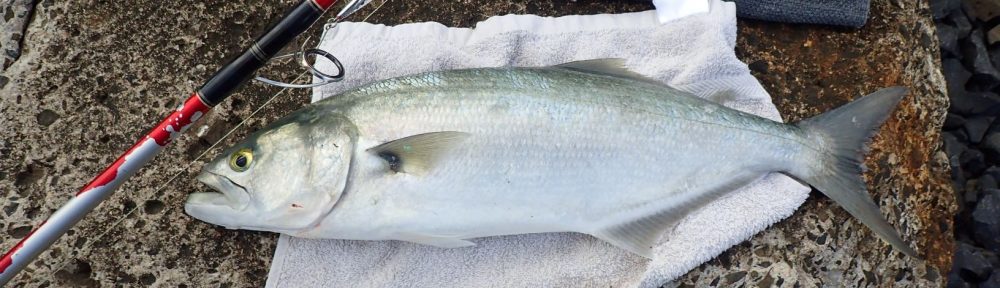
The water slowed and I turned back towards the jetty. At about 7.20 am I caught an almost legal size flathead, which I released. It was getting frustrating. By low tide at 8.15 am, I found myself back beside the old oyster jetty. I had swapped back to the Shrimp in the Banana Prawn colour. I put in a few last casts and then bang, a big fish grabbed the Shrimp soft plastic, just as it landed. The fish was lying in no more than 20 cm of water. It was big and powerful and as it was so near the surface, it immediately started shaking its head. It ran hard but after about four good runs, it was spent. I waded through the soft muddy weed and pulled it ashore. It was another 70 cm model, or perhaps it was the one I caught earlier. It looked a very different colour in full daylight, but you never know.

I had caught some good fish but I had released them all. It may be time to fish somewhere else for a while.

Bribie – the old oyster jetty flats – 16 April 2014

Wednesday

On Wednesday I drove up to Bribie and arrived just before first light at about 5.30 am. On Tuesday night we had a lunar eclipse and the full moon was huge and bright in the west. There was a surprisingly cool south-westerly wind blowing. Low tide had passed just after 4.00 am so by the time I waded out on to the flats, the tide was really running in.

Just before dawn there was some surface action under the bridge lights so I cast a GULP 3” Minnow in the Smelt colour around the pylons. This soon produced a couple of small Pike. I witnessed another beautiful sunrise and then continued wading south.

The big moon and meant a fairly big tide. The big tide had lifted all the storm debris from the previous week and it was soon clear that this would be the major obstacle to fishing the incoming tide. Seagrass, weed clumps, bait bags, floats and plastic bottles all started to passed by.

The only advantage of all the floating debris was that it allowed me to examine the water currents in the area. There is obviously a slightly sheltered area just to the south of the old oyster jetty and this is often where you find fish. It is protected by a couple of patches of rocky reef to the east and the tree line, on shore, to the west. At certain points in the tide cycle the water in this area slows right down and the debris gathers in a big clump.

I cast around the edges of this slow moving water looking for fish but I got virtually no bites. Just before 8.00 am it was getting too hard to fish into the strike zone, so I started back for the car. I was casting a GULP Jerkshad soft plastic in the Cajun Chicken colour on a 1/8th ounce , size 1/0 hook jighead. Suddenly the line went tight and the rod tip started to wriggle. I set the hook but the fish took a while to register – this often means it’s a big one. It swam towards me for a few seconds and then realised something was amiss. It took off with a long, blistering run towards the jetty. I let it take line and then gradually started to get some back. There were a couple more long runs but after a few more minutes I caught site of a very decent flathead. I steered her up to the beach and took a few photos.  She was just under 70 cm but I let her go. They really can be a bit tough to eat at this size and if I want to still be catching plenty of fish in future seasons, it makes sense to let these big breeding females go.

This final fish rescued what would have been a pretty dismal session. They seem to be far easier to find on the run out tide in this area. The sudden cool south westerly wind may also have put them off their food.

Bribie – the oyster jetty flats – again – 12 March 2014

Wednesday 12th

I paused, reluctantly, to dry out the fishing bag and finish filleting and skinning a few flathead, on Tuesday. By Wednesday I had spotted an opening for another fishing session. I was working around the low tide on the flats at Bribie.

I drove up to arrive at about 10.00am – very civilised. We had the same wind pattern as we have now had for about ten days – a 10 to 15 knot east-south easterly wind. It was a bright, sunny day and the wind was building. The water was clear and running out and the full moon would be on Saturday. Low tide would be at 1.10 pm.

I started to fish the small patch of reef just south of the Bribie Island Bridge, on the mainland side. The rocks were just visible above the receding tide. I started the day with a soft plastic. As you will have noticed I prefer to prospect with a soft plastic lure – once I find the fish I will then start to experiment. Today I chose the GULP Jerkshad in the Cajun Chicken colour. I was fishing with 12lb fluorocarbon leader and using a 1/8th ounce, size 1/0 hook, jighead.

I soon found a fish, just to the south of the bridge. This flathead was just below 40cm long. I would release everything I caught today – there is plenty of fish in the fridge. I cast back in the same area and found another, smaller fish.  I moved closer to the jetty and caught 3 more, before wading under the jetty.

As with the previous sessions, the fish kept coming. I swapped from soft plastics to hard bodies and these were even more successful. I caught a 60cm flathead on the MARIA 90 mm MJ Twitch suspending minnow and a 66 cm fish on a RIO Prawn lure, in the 13 g size. The DUO range chipped in with some good flathead on the DUO Tetraworks Toto and, my current favourite – the suspending DUO Realis Shad 59 MR. This one really is a flathead slayer – the action and rattle seems to drive them wild.

I fished from 10.30 am to about 1.30 pm and I rarely went 5 minutes without a fish. I finished the session with some good sized flathead on the Powerbait 5” Rippleshad paddle tail soft plastic, in the black and gold colour (which I usually reserve for chasing Jewfish).

For the fish to be here in such numbers I can only conclude that they are feeding up to spawn. A few of the fish I kept last week were full of roe. It is early but apparently flathead can choose to spawn at any time and do not do it on mass, like bream.

Whatever the reason, I hope they stay for a while –  it’s a great time to be out there fishing.

Bribie – the oyster jetty flats – 10 March 2013

Monday

I managed to stay away for Sunday, but by Monday the fish were calling again. It’s very hard to resist going back when you have had some great sessions. Fish don’t generally school up in one spot forever, so having found the Flathead, on the flats opposite Bribie Island – I wanted to make the most of it.

The productive spots I have been fishing can only be reached during the lower half of the tide.  This meant I had the luxury of starting fishing a bit later than usual. The wind was going to be a solid 10-15 knot south-easterly, and low tide would 0.9 m at 11.21 am, at Bongaree. I arrived on the mainland side of the Bribie Island Bridge at about 9.15 am.

I waded out to the old oyster jetty. The wind was blowing hard and it was quite cloudy. The area just to the south of the jetty is sheltered from the full thrust of the wind so this was where I started. To locate the fish, I decided to prospect with a GULP Jerkshad in the Cajun Chicken colour. I upped my leader to about a 1.5m length of 12lb fluorocarbon.  The 10lb leader is usually adequate, but I had had such a good catch rate in recent sessions that It was getting worn too quickly.

Once again I soon found the fish. I caught the first flathead at 9.24 am – it was about 50 cm and then another, about the same size, a few minutes later. The wind was creating quite a chop now and it was still a little too deep to reach the ideal target area – along the edge of the weed beds. I waded a little further south to the mouth of the drain that runs off the flats, in front of Sandstone Point.

When I first started fishing about 12 years ago, I went out with a guide on the Noosa River. This was the first time I had used lures.  One of the lures we used was the RIO Prawn. This lure is a very lifelike resin imitation of the typical Noosa river system prawn. It is Australian made, near Noosa. The guide positioned us over some likely looking hollows and weed beds and cast the lure out, into one of the sandy bottomed areas. He let it sink, raised it up in a long fluid movement then let it sink back down, to the sand. He counted to ten then repeated the process. He did this perhaps three times before the lure pulled up a flathead. I then had a go and managed to catch one, as well. I, like the fish was hooked!

I have caught plenty of fish on RIO lures since, but I rarely use them at Bribie – because of the weedy and rocky bottom. Today I decided I would give them an outing. I chose the 13 gram size RIO Prawn in the red colour. The water was clear and I could see the sandy patches. I repeated the process that I had been taught all those years ago and after a few tries, I was on to a fish. The first was a small Flathead about 45cm. On the next cast I caught another and on the third, I hooked up to another. The RIO Prawn caught about five more flathead over the next 30 minutes. Then I lost it to a 60cm + fish. The leader must have been damaged in some of the previous fights and it snapped just as I was walking the fish to shore.

Next I went down in size to the small DUO Tetraworks Bivi – a sinking bibless vibe lure, in a black /rainbow colour. This small vibe is always good for Flathead. It casts a long way and quickly falls into a tight action. The only problem with these smaller vibes is stopping the fish from swallowing them. This one also produced on its first cast. The fish were clearly not fussy today. I swapped again, this time to the DUO Koikakko tiny squid imitation. Once again this tiny lure caught the biggest fish of the day – a 63 cm flathead.

As we reached the bottom of the tide I pulled out another Charles Talmans soft plastics, which I called a ‘prong’. It is a split tail in a clear/ white colour. It is quite a chunky plastic so I put it on a 1/8th ounce 2/0 jighead and cast it out. After a few casts the fish found it and it pulled in another three or four fish to end the session. If you want to know more about Charles’ plastics drop him an email on ctalman@hotmail.com.

With the wind howling at noon, I walked back to the car. Another great session fishing the flats at Bribie.