Bribie Island – Buckleys Hole & Sandstone Point – 1 Sept 2010

Wednesday
I was off to a late start on Wednesday and arrived at Buckley’s Hole at Bongaree, on Bribie Island at about 9.30am. Low tide had passed at around 7.30 am and so it was getting on for half way into the run in tide. This gave me about an hour to wade out and fish over the coffee rock ledge that runs all along the edge of the Pumicestone Passage.
My first cast was hit on the drop –it was a Yellowfin Pike. I was fishing a GULP 3” Minnow soft plastic lure in the Banana Prawn colour on a 1/6th 1 jighead. The next cast produced the same result and so did the next, and the next. I moved along the ledge and the Pike moved with me – or they were resident all along the 50 metre stretch that I fished. I tried bigger plastics, heavier jigheads, but I just could not get past the Pike. After an hour or so, I retreated and decided to go back across the Bribie Bridge to the mainland and fish the second half of the run in tide on the sand flats around Sandstone Point.
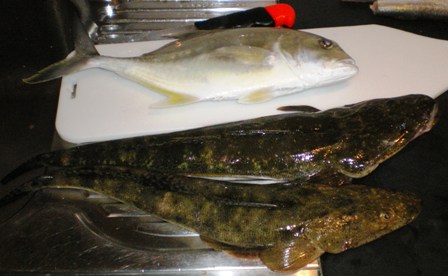
I parked up and wandered out past the old oyster jetty and carried on south to the mouth of a mini channel that has quite a good flow on a run in tide. I had my usual estuary fishing outfit. A Loomis GL2 6ft 6” Fast Action spin rod. I have matched it with a Shimano Stradic 2000 reel. I was using 2.8kg Fireline with just over a metre of 10lb fluorocarbon leader. I tie the main line to the leader using a uni to uni knot. I could probably fish lighter but if I am lucky enough to find the odd Snapper or Jewfish, I still have a chance of landing them with this set up. I switched to a GULP2” Shrimp soft plastic in the Peppered Prawn colour. I walked along the edge of the channel, casting up into the current and bumping the lure along the bottom back towards me. Third cast and I felt the definite dull thud of a fish. I paused and struck but there was nothing there. I cast back in the same spot and, in exactly the same position – thud. This time I wanted to be sure so with great patience, I counted to ten and then struck hard. Now I was on and even though it was not a huge flathead, I was delighted it wasn’t a Pike. I got it close and could see it was solidly hooked so I decided to grab it with the glove. That worked and I measure it against the 40cm tape marker on the rod – just legal – dinner at last. I did not take it to the bank to unhook as I didn’t want to lose my position. I have regularly dragged a nice fish back to the shore and then been unable to figure out where I need to get back to, to catch its mates. I put it in the keeper bag and cast out again in the same location. After a few more casts, I caught an almost identical size flathead, just a few feet to the left.
The tide was getting up now and there was a good 70cm of water around the base of the mangroves. I turned around and headed back towards the car casting in as close as I could to the edge of the new mangrove shoots. After 20 minutes or so this paid off with another just legal flathead. At around 1.00pm the westerly wind was really howling so I gave up and drove home.

Bribie Island – Whitepatch – 29 August 2010

Sunday Morning
The advantage of fishing from the shore is that provided you are prepared to wrap up, you can still fish in a 15 knot wind. Especially if you chose somewhere like the Pumicestone Passage which has a few, fairly sheltered areas. The other advantage of fishing at these times is there is almost zero boat traffic. All the wise boaties are tucked up in bed having lie in or just listening to Nugget’s fishing show and cursing the weather gods. I am not sure that I subscribe to the idea that there are less fish around in the estuaries than there were 20 years ago – but I do believe the massive increase in boat traffic and other noise and disturbance, has a big effect on our ability to find and catch the fish that are there.
On Sunday morning there was plenty of wind forecast but when I arrived at Whitepatch on Bribie Island, the water was reasonably calm. It was about 5.15 am and the wind had dropped away as the sun was about to come up. This hour around dawn nearly always produces slightly calmer weather. It was just on low tide and I started fishing on the slack water with virtually no tidal flow. I often find this is a slow time. I presume the fish are beginning to reposition themselves and are slightly confused as to where to lie in wait to ambush prey. Sunday was no exception and nothing of note happened until about 45 minutes later when the tide really started running in.
I was fishing a 3” GULP Minnow soft plastic lure in the Banana Prawn colour on a 1/6th 1 jighead. This is another great lure for bream but will tempt almost anything. There is a sizeable drop off all along the shoreline at Whitepatch – it is perfect to fish for about two hours either side of low tide. I had parked at the last car park before the entrance to the Bribie National Park and I was wading south, along the shore, casting up into the run in tide. I caught a few Pike and then a tiny Moses Perch and then I got a touch, a pause, another touch and then bang – the blistering run and head shakes that had to be a Snapper. Over the course of each year, in this spot, I catch perhaps two or three legal size snapper and many more just undersize. Unfortunately this one was in the latter category. He measured up at 28cm and I threw him back, after a quick mug shot. What is uncanny is the consistent way I get these fish when the start of the run in tide coincides with dawn.
I switched to a 2” GULP Shrimp plastic, also in the Banana Prawn colour. I was fishing with about a metre and a half of 10lb fluorocarbon leader, tied onto a spool of 1.8kg Fireline. About 40 minutes after catching the Snapper, I found a patch of Bream. I caught three fish in quick succession. The largest was approximately 30 cm long. Shortly afterwards I reached a large drain with weed beds on either side. These were now covered by approximately a metre of water. I cast out, methodically in a semicircle and caught several Pike and then a very small (25cm) Flathead. I moved on and about 30 minutes later reached a similar drain. I used the same tactics and was rewarded with another Flathead that was just on 40cm. Like all the other fish, I released it. By 9.30 am the water was now effectively too high to continue fishing over the edge of the drop off and the wind was steadily building, so gave up for the day.

Bribie Island – The Old Oyster Jetty – 26 Aug 2010

Thursday morning did not look that promising with gusty, cold, westerly winds. I decided to fish at Bribie as you can usually find some reasonably sheltered spots by swapping from one side of the Pumicestone Passage to the other, if necessary.
It was a late start and I waded out in to the water just to the south of the old Oyster Jetty at around 9.30 am. High tide was at around 10.00 am, so the tidal flow had almost stopped. There a couple of good drains in this location that often produce a few Flathead. However to maximise my chances I knew I really had to wait for the tide to start running out. The water was probably the coldest I have felt all year. I flicked various shrimp and minnow soft plastics around on a 1/6th 1/0 jighead. I didn’t get a touch for more than hour. I was so cold I retreated to the car for more clothes. I went out again this time to the north of the old oyster jetty. I was wading back towards the bridge, about 4 metres from the edge of the mangroves. I put on a fresh GULP 3” minnow in the Pearl Watermelon colour and cast it out towards the bridge at a 45 degree angle to the shore. I jerked it a couple of times and then felt the plastic stick. There are a few rocks on the bottom in this area and I thought I had snagged the line on one. As I lifted the rod to try and jerk the jighead free, it slowly started to come towards me. Then suddenly the line started peeling in a long, slow, deliberate rhythm. I knew it was a good size lizard. I started to wind and apply some pressure with no result. I thought the drag might have been set to light so I checked it, but it was good. I gradually tightened it and got a bit of line back, but the fish took off again. We went back and forth for a while like this – perhaps for 5 minutes or so. Big flathead can’t be rushed but they will eventually just saw through you leader, so you have decide on a plan pretty fast. I had a 12lb leader on but I was using my very light 6’6 Loomis GL2 spin rod so there was no way to force the pace. I just had to wear the fish out and keep her away from the mangroves and rocks. I gradually steered her towards a small gap in the mangroves and shortened the line down to about 3 metres. I then walked backwards, towards the gap, tightened the drag some more and in one long sweep, heaved her up onto the sand. The leader broke as I did that but fortunately, not until the fish was metre clear of the water.
It was a beautiful fish that measured in at 78cm. I took a few pictures and then sent her on her way. I cast around for a bit longer in the same area without a touch. I ended up fishing for 4 hours and apart from the monster flathead, I got no bites at all. The Pike, Bream and everything else just failed to show up. May it was the wind – maybe the water temperature – who knows?

Brisbane River – Pinkenba Rockwall – 25 Aug 2010

After a great week of fishing down at Iluka I was keen to get back out on my home patch around Brisbane. On Wednesday the weather was not too promising. With limited time and strong westerly winds I decided to try fishing along the Pinkenba rock wall on the north side of the Brisbane River. I usually access this spot by parking next to the QCL Cement Plant and walking around the plant to the river bank. There is a long stretch of rock wall that goes from the plant all the way to the mouth of Boggy Creek. It is fairly shallow all along here so I find it fishes best around high tide. My timing was good as I arrived right on high tide at around 9.45am. All along the rock wall there are areas where it has it has broken down and there is therefore plenty of structure at its base and as you move further out the lower rocks are completely covered in oysters.
My tactics here are to walk along the rock wall casting back up river and letting the soft plastic bump along the bottom with the current, with a few jerks every now and then. I have almost always caught fish right at the foot of this rock wall – I assume this is because the riverbed further out is fairly featureless and the bait stays close in. I walked slowly along the wall towards the river mouth but after an hour of casting, I had nothing to show for my efforts. I had been using my favourite GULP 4” Minnow soft plastic in the Pearl Watermelon colour on a 1/6th 1/0 jighead with a 10lb fluorocarbon leader. I decided to swap it for a ¼ oz blade lure in a silver rainbow colour. Sometimes the blades can be more effective at getting reluctant fish to bite. I think they annoy the fish into an attack. They have a great action and fish will feel their vibration in the water long before they see them.

Buy this time I had reached the spot where the rock wall has water on both sides. The north side is a shallow, tidal inlet next to the refinery tank farm. The bottom is mud and weed beds and as long as there are a couple of feet of water, there are nearly always flathead in here. After a few casts with the blade I finally found my first fish of the morning – a flathead just on 40cm – I took a picture and put him back (we are still finishing the Jewfish from Iluka at home). I carried on in this spot for a while but could not raise anymore. The water was very cloudy after the recent rain. I then put on a smaller, GULP 3” Pearl Watermelon Minnow and decided to walk back along the wall, up river. This is an excellent soft plastic for Bream – especially when lightly weighted. I swapped the jighead down to a 1/8th 1/0. The tide was really running out hard now and I started to get a few touches close into the oyster clad rocks. After another twenty minutes with no hook ups, the lure was slammed by a solid fish. The initial hit was very hard but it was only a 30cm Bream. I put him back assuming there would be more but despite trying a few other weights, plastics and putting the blade back on, I could not find them.

By now it was just past 1.00pm and even though it was warm and sunny, the wind was really blowing and there was less than a foot of water at the base of the rock wall, in places. I decided to stop for the day.

Iluka – Woody Head – 11 August 2010

Tuesday was a washout with 24 hours of almost solid rain. Fortunately the tent kept me dry throughout. By the lunchtime low tide on Wednesday, the sky was still overcast but things where brightening up. The ‘Barnacles’ at Woody Head, where I had been fishing the day before, were out of bounds due to the swell. I decided to try fishing the northern side of the Woody Head rock shelf which was a bit more sheltered. I started with the same terminal tackle as the day before – 3/8 3/0 jighead, 25lb fluorocarbon leader and a 4” Pearl Watermelon Minnow. Fishing these spots is always difficult. You need the plastic down in the water column, but leave it too long or weight it too heavily and you will just get snagged. On the first three casts I lost three jigheads to the rocks. This was the price of getting a feel for the swell and terrain. After a few more successful casts I felt a distinct hit but no hook up. Two more casts and just as I was about to jerk the jighead out of the water, at the end of the retrieve – bang! I had a solid fish. It tried to dip down and bury itself in the rocks but fortunately the swell was on my side. I tightened the drag and towed him straight up to my feet with the rising water. I had a nice trevally, about 45cm. I fished on for an hour or so and lost two similar fish to the barnacle covered rock ledges.
I then decided to clean the Trevally in a rock pool. I gutted the fish and started tidying it up when I noticed a splash a few feet away. A decent sized Wobbegong had turned up hoping for a free meal! I retreated, in case he mistook my foot for a fish and made a mental note to check the content of the next rock pool before I start gutting.

Bribie Island – Oyster Jetty to Sandstone Point – 26 July 2010

On Monday morning I looked at the forecast for the week and realised things were going downhill with showers set to increase as the days went on. I decided to go for a quick mid morning session wading the flats at Bribie, hopefully before the rain set in. I opted for the sand flats and weed beds to the south of the old oyster jetty in the direction of Sandstone Point, on the mainland side of the Pumicestone Passage.

I arrived at around 9.45 am just as the tide was beginning to run out. It was dull and overcast and the wind was getting up from the south west. I walked along the shore as far as the large sand bank to the south of the old oyster jetty. Then I waded out into about a metre of water and started with long casts northwards. With the wind behind me from the south west, I was able to put in long casts and retrieve my plastic with the outgoing tide. There are lots of gaps in the weed beds in that area and this is where the Flathead wait. I was fishing my favourite flathead lure – the GULP 4” Minnow in the Pearl Watermelon colour on a 1/6th 2/0 jighead. I had the rod spooled with 6lb Fireline and 10lb fluoro carbon leader.

The only problem fishing that area is the loose weed and the horrible slimy algae that seem to coat it in places. You have to be persistent as the plastic is constantly getting clogged. After twenty minutes or so of casting, I hooked a small flathead but dropped it as I tried to get it into the keeper bag without towing it all the way back to shore. I cast back in the same place and one of its friends took the plastic. This time I walked it all the way back to the shore – he was just on 42cm. I now had to try and remember where to go back to. When the water is clear you can follow your wader boot marks but the overnight rain had stirred it up a little, so I just had to guess where I had been. I waded back out and carried on moving to the north and just short of the oyster jetty; I got a very solid bite. I dropped the rod tip and counted to five – this is my favourite technique for Flathead – then struck hard. The fish took off and did a couple of good runs, then it calmed down a bit and so I gradually walked it back to the shore. Some wise old fisherman once told me that Flathead often snap at the lure or bait to stun it, then open their mouths and change the angle, to swallow it. If you strike as soon as you feel the bite you might just pull it out of their mouths. Not sure how true this is but my system certainly works. It gave me a few head shakes in the last few metres and then I had it. Once I got it up to the muddy shoreline it measured in at 62cm. Buy now the clouds were looking ominous so I beat a hasty retreat to the car and called it a day. I hope the weather does not ruin the rest of the week.

Brisbane River – Boggy Creek – 23 July 2010

If you have children of school age you will know that most officially classified biological weapons are far less toxic than the coughs and colds they bring home. I succumbed this week and I have been feeling like crap. I missed my usual fishing session on Thursday, so I decided to put in a couple of hours this morning, close to home, at Boggy Creek, on the Brisbane River.
For those of you who don’t know it, Boggy Creek is a small arm off the Brisbane River on the north side of the Pinkenba Shell oil terminal. You can fish all along the northern bank, but I usually start by the small pedestrian bridge that leads across to the refinery. You cannot fish on the bridge as it has a security gate and belongs to the refinery.
I find this creek fishes best for a couple of hours on either side of the high tide and it is a great spot pre-dawn. There is a small rock wall on either side of the bridge and the channel narrows significantly at this point. This has cut a fairly deep channel under the bridge. There is always plenty of bait under the lights and once the tide is running there are large swirls, eddies and sections of slack water where the big fish lurk.
I started around 9.00 am – the wind (from the southwest) was getting up and the run out tide was really moving. The water was fairly clear so I started with a 3” GULP Pearl Watermelon Minnow on a 1/6th 1 jighead on 10lb leader. My strategy was to cast out, upstream and let the plastic float with the current down under the bridge. I would jig it every 5 seconds or so to stop it getting snagged. There is plenty of manmade structure under that bridge ranging from tyres to shopping trolleys. After a few prospecting casts I switched to the GULP Pumpkinseed Minnow Grub. I find the paddle tail pattern is good when there is a strong current. The tail moves realistically even when the plastic is at rest on the bottom and it is almost irresistible as it sinks. Sure enough – second cast a hungry Pike wallops the plastic. This scenario played out a few more times and then I cast over towards the far rock wall. On the retrieve there were a few nudges and tickles and then a solid hit and hook up. As I brought the fish in, a great school of Pike scattered before it. It turned out to be a 28cm Bream with a Mohican fin! I released him after a picture or two and then decided to move up the bank towards the Brisbane River.
There are a number of openings all along the bank from which you can fish. I stopped at each one and did a semicircle of casts in each location. When I reached the mouth of a small drain I was a bit more thorough with my coverage and on about the 6th cast I pulled up a 35cm Flathead. I let him go and got another smaller one from exactly the same spot. The water was getting very shallow now and it was blowing a gale so decided to give up for the day.
It was good to get the rod in the water and find a few fish – even if there was nothing for dinner.

Bribie Island – Buckleys Hole – 15 July 2010

Thursday morning – I got up at 4.15 am and drove from Brisbane up to Bribie looking forward to a good fishing session. Low tide would be around 6.40 am and although the forecast was for moderate West to Southwest wind, it was pretty flat when I arrived.

I decided to start off under the Bridge lights on the island side. I find the bridge lights attract the bait and there is often something waiting to pounce on your lure/ bait from the dark water around the pylons. I loaded a 1/6th ounce, 1/0 jighead with Gulp 3” minnow soft plastic in the pearl watermelon colour and sure enough, first cast I pulled up a Pike and next cast 15cm Tailor. I moved up and down the weed banks, along the edge of the Passage, on either side of the bridge. After about half an hour I picked up a 45cm Flathead about 15 metres north of the bridge., right on the edge of the weed.

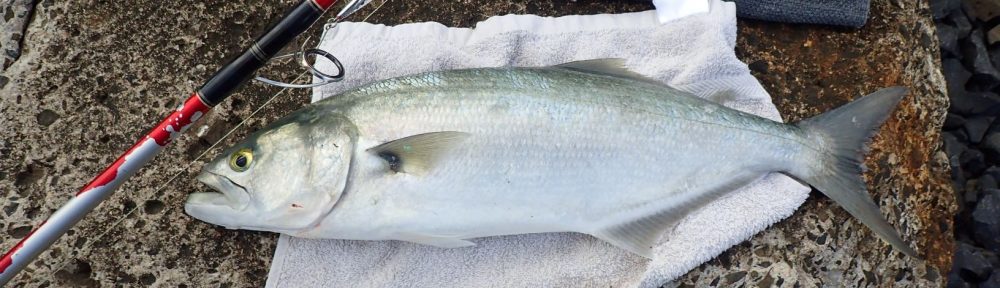
The first glow of dawn was showing so I decided to move down to the mouth of the tidal lagoon in front of Buckley’s Hole. This is an excellent Bream spot especially when they are schooling up to spawn. Using the same plastic and weight I cast up into the last of the run out tide and let it sink down along the coffee rock ledge – jigging every 5 seconds or so. After a few casts I caught an undersized Bream, followed by a few Pike and gradually I started to catch a few keeper Bream. Every third fish or so, was legal and after an hour I had 5 keepers between 25cm and 30cm.

At about 8.30am I called it quits and went to find a hot drink.

PASSAGE BREAM ARE BEGINNING TO FIRE
BREAM FROM BUCKLEY’S HOLE – BRIBIE ISLAND

Bribie Island – White Patch – 9 July 2010

It was hard to get out of bed at 4.15 am yesterday but I managed it – just. The outside temp was not too bad but as I put on my waders and wandered out under the Bribie Bridge but I noticed how much the water temp has dropped in the last couple of weeks. I usually find this is good news for estuary fishos like me.  Just before dawn I cast around under the bridge, on either side, but only manage a few pike on the Gulp Shrimp (2 inch Banana Prawn). There was plenty of evidence of school holidays with an abandoned cast net, plenty of terminal tackle with 50kg + breaking strain line, sinkers and enormous hooks stuck in the weed and shallow snags. Maybe they were trying for a Dugong!!

I sat out a rain shower and then moved up to White Patch. My first cast produced a tiny Flathead followed by more Pike. I walked up and down the flats flicking various plastics around. I generally target the sandy patches in between the weed. As the plastic comes over the edge of the weed that is when you get the dull thud of the Flathead attack – I then try to count to five (to let the fish get a good mouthful) then strike. The tide was running out and floating weed made things a bit tricky but after covering a bit of ground I got two keepers around 45cm.

As the tide got low enough I fished out over the coffee rock ledge and got a couple more Pike and then a solid hit and run that turned out to be a Trevally – I was using a 10lb leader,  1/6th 2/0 jighead and a 3” Gulp Minnow in Pearl Watermelon. I moved up and down the ledge and after a quiet period the tide started to run out  a bit faster and I caught a couple of undersize Snapper on the same rig. I am yet to find a keeper Snapper from the shore this season – but it will happen.

Miserable weather but reasonable fishing and I caught enough to feed the family!!

FLATHEAD & TREVALLY

BRIBIE FLATHEAD & TREVALLY