Unknown's avatar

About Landangler

I am a mad keen fisherman - but I am also a seasick one. So I fish the estuaries, beaches, rocks, bays and rivers of the Queensland and NSW coast - from the shore. I like to fish with soft plastics lures, but I will resort to anything to catch dinner!

The Jetty to Diamond Head – Caloundra – 17 January 2012

Tuesday

Finally, time for a fishing session and then the heavens opened. The rain just kept coming on Monday and more was forecast for Tuesday. It had to be Tuesday morning, so I drove up to Caloundra. High tide would be about 4.00 am, so I would have a few hours of fishing in the salty water, around dawn, before the run out tide, mixed with rain run-off, turned the water dirty and fresh.

It would be a big high tide for Caloundra at 1.8m. I decided to head straight for Diamond Head and to try my luck wading on the flats. I arrived, just after 5.00 am and watched the sun rise. The passage was lit up briefly but then the sun disappeared again behind some angry looking clouds.

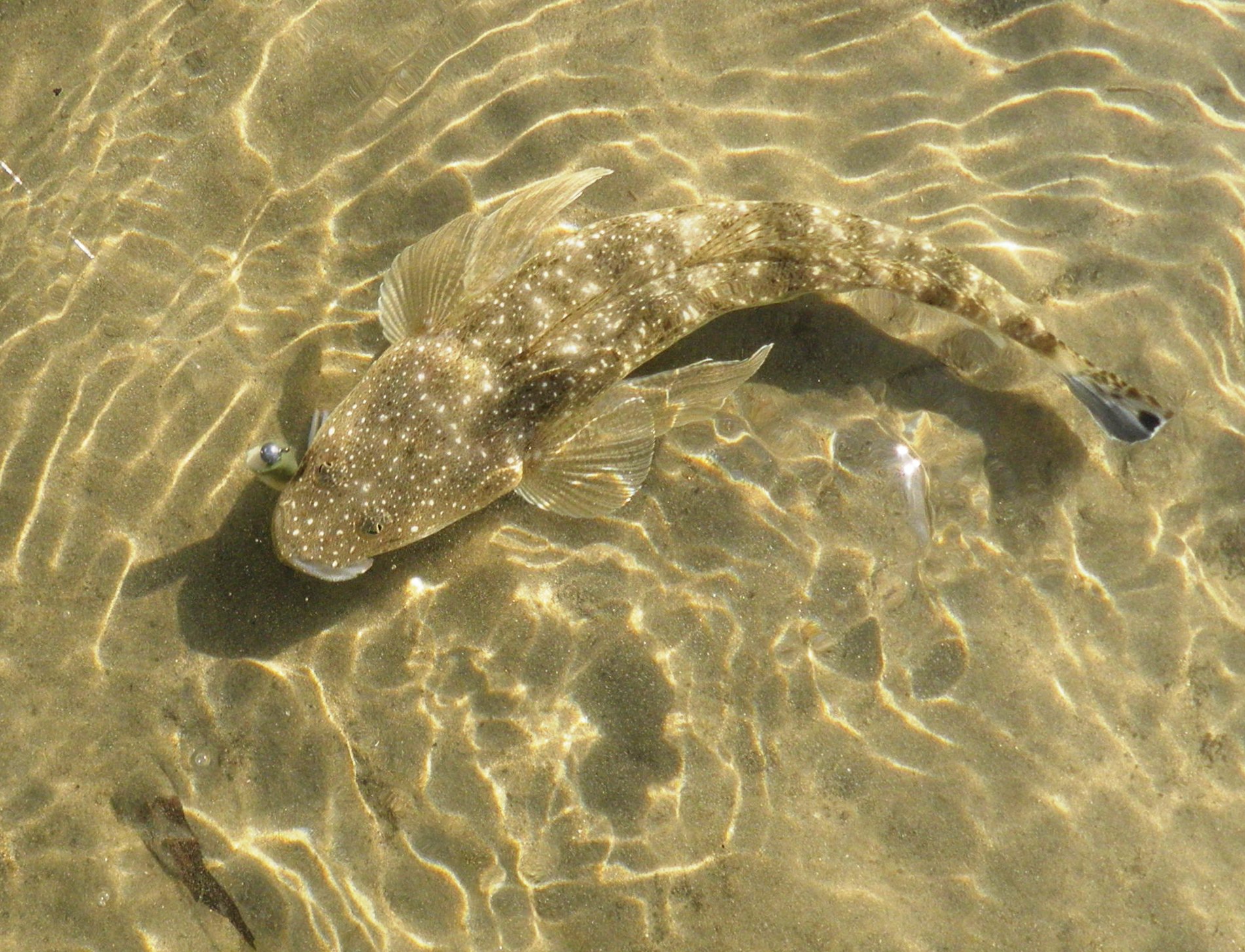
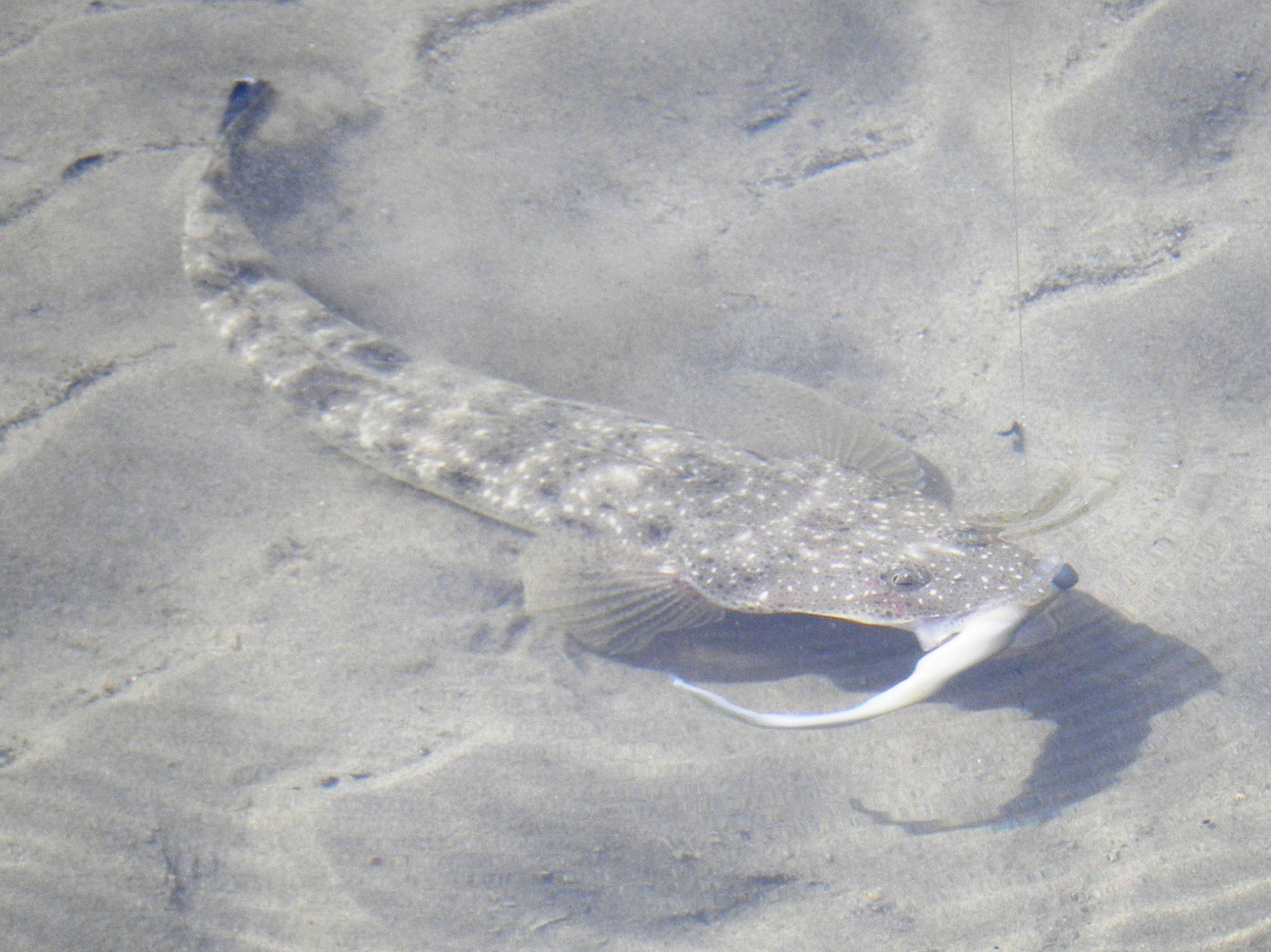
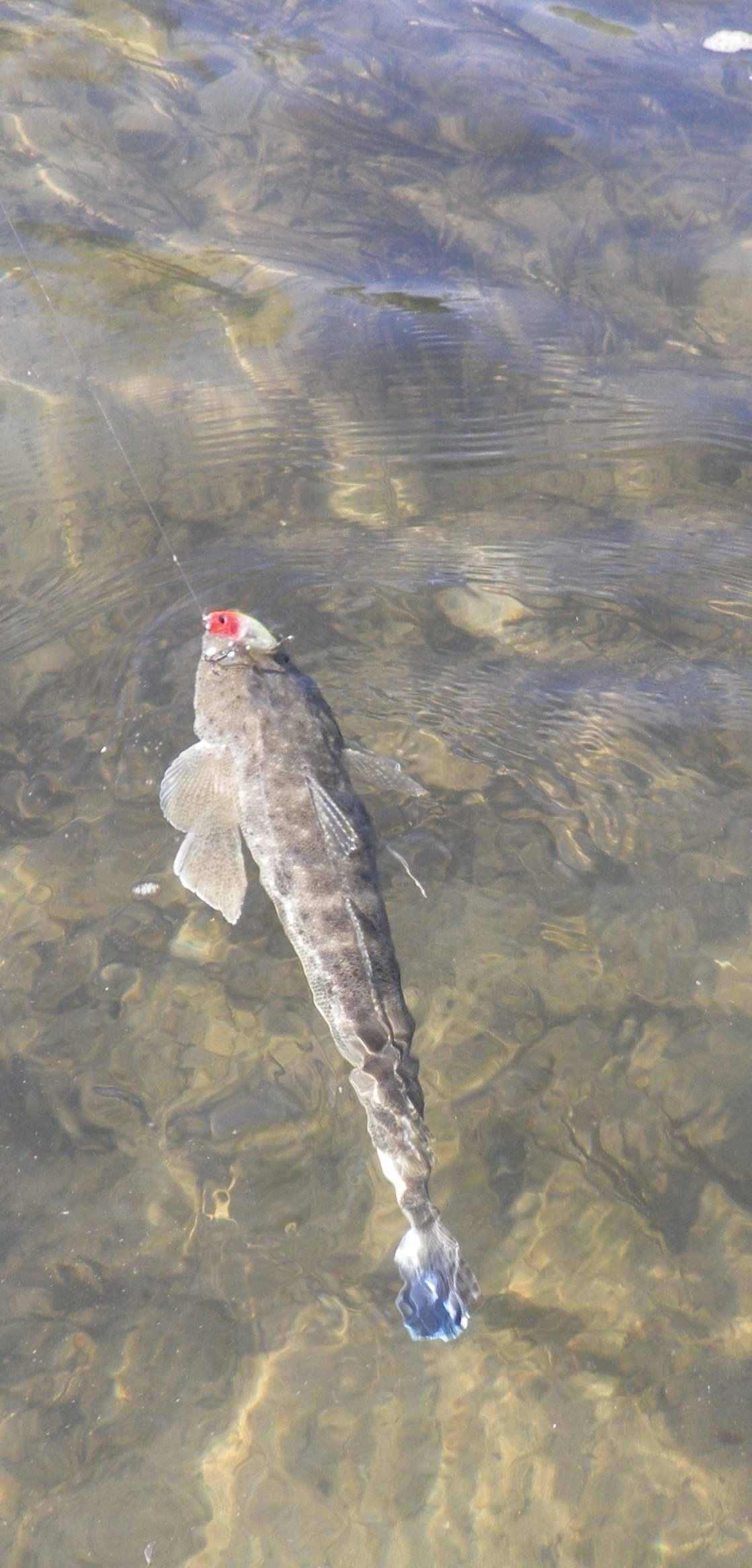
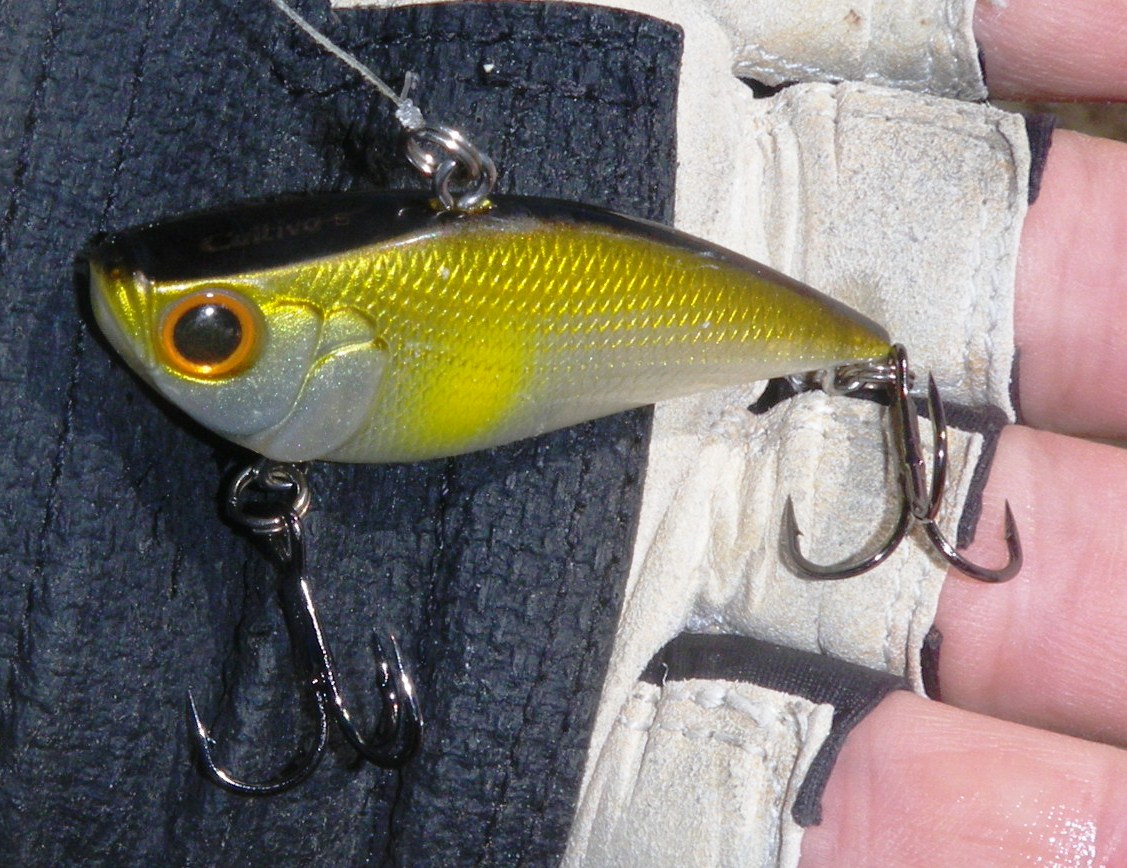
The water was already a dirty brown colour and pretty murky. I decided to use a hard body, as I thought a soft plastic would be hard to distinguish. I picked out a 14g Strikepro Vibe that looks like a Herring. It’s the loudest lure I own and it is far from subtle but it usually annoys the fish into biting.
The tide was running out so I decided wade from the Jetty back towards Diamond Head, casting into the run out tide and pulling the lure back along the bottom in jumps and jerks. It was hard work as the big tide had picked up plenty of sea grass. It is also harder to know when you get a bite on a hard bodied lure, as the way it sticks in the sea grass feels just like a fish.

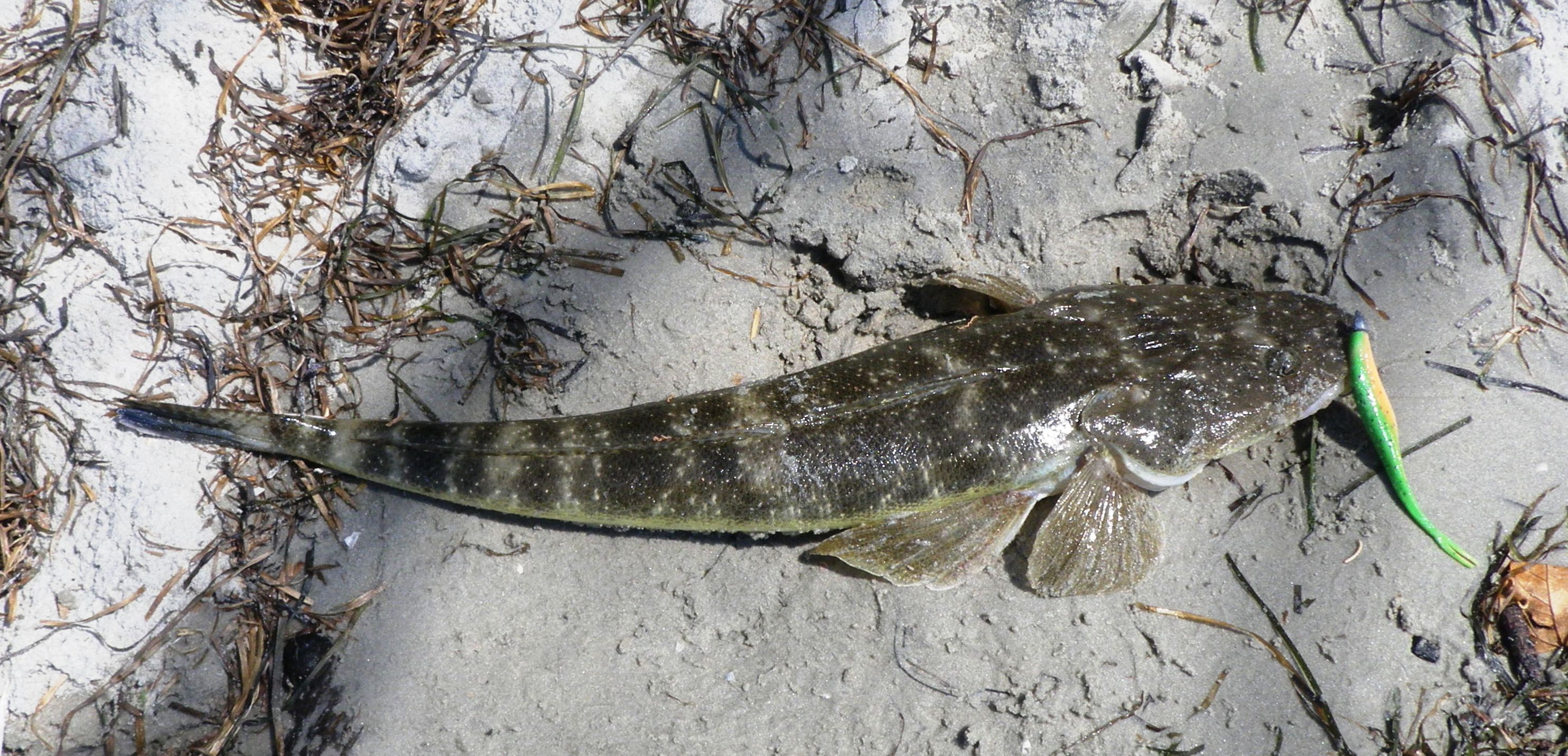
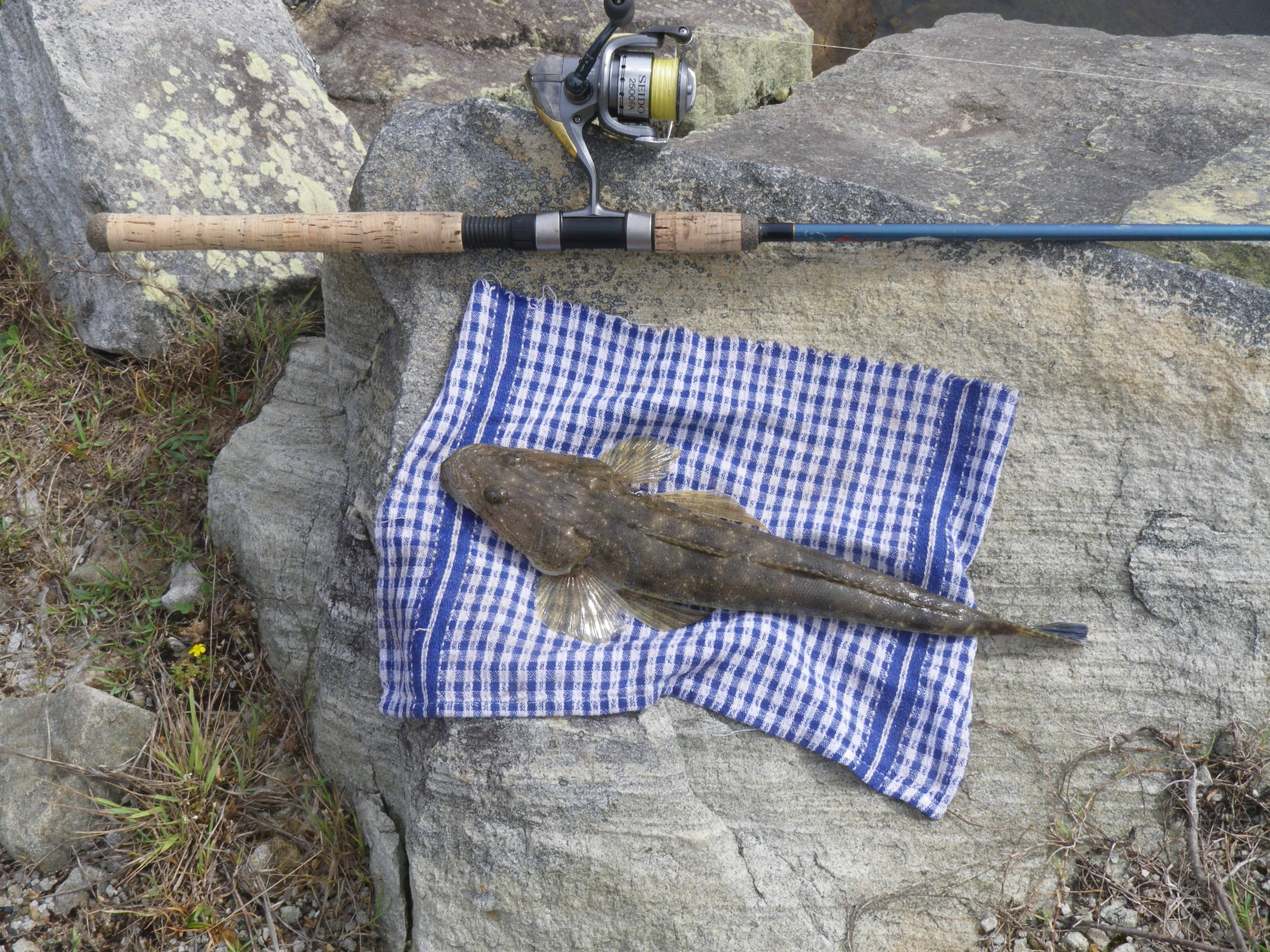
After about 40 minutes of slow wading and casting, I caught a Flathead on the Strikepro – just legal at 42cm – so it went in the bag for supper. I have been whacking on the kilos over Christmas – so a diet of steamed fish and vegetables is on the cards for a few weeks. Fortunately, catching them uses plenty of calories when it’s this hard.

I swapped to a 7g Berkly Frenzy Sinking Rattler in the Chrome Black colour. These lures look good but, so far they have not really produced the goods for me. I think their action is a little limited – which is often a problem with cheaper lures. They cast a good distance but seem to take a long time to find their rhythm on the retrieve. After a few casts, I felt a definite hit, so I persisted in the same area, on the edge of a weed bed. After about five casts in the same spot – I had a fish. It felt bigger than it was – a small bream, foul hooked through the back and above the eye. I released it and carried on.

I tried a 3″ Gulp Lime Tiger minnow soft plastic for half an hour and caught an undersized Flathead then switched back to the Strikepro, just as I reached the big drain at the mouth of the creek, by Diamond Head. The water was now a very dirty brown and getting cloudier as the tide got lower. I peppered the area with long, loud casts and eventually, after covering every inch of the area, the rod tip started wiggling. It certainly was not a trophy fish but it felt like it – another Flathead – this time a little bigger at 45cm.

I had dinner but it had been very, very hard work.

Caloundra – Golden Beach and Diamond Head – 9 January 2012

Monday

I was back in Brisbane and decided I needed to give the new Shimano Stella 2500 reel a saltwater workout. A warm northerly wind was forecast and it would be a big morning high tide. I decided to go for the top end of the Pumicestone Passage at Caloundra.

Start of another hot day at Caloundra

I waded out on to the sandbank in front of the Power Boat Club, just after dawn and fished a soft plastic all the away along it. I was using a GULP Jerkshad in the Lime Tiger colour, on a 1/8th, 1/0 jighead. After about 30 minutes, I caught a very small Flathead.

I carried on wading north, towards the Gemini Towers apartments. There was plenty of bait around, small schools of Garfish and bigger schools of Mullet. I swapped to a Halco Scorpion 35 hard bodied lure. I have a few of these left over from my recent Tasmanian Trout fishing adventure and they have a great action in about 1 metre of water. As the soft plastics were not proving very successful, I thought I would see what the Flathead made of them.

As I moved away from the edge of the sand bank and into the shallows I could see the Whiting following the Scorpion in on almost every cast. After a few minutes an angry splash broke the surface and another tiny Flathead latched on to the Scorpion. On the next cast, an even smaller Whiting grabbed it. I thought I had invented a new sport – micro-fishing!

It was now about 7.30am and already stinking hot – fortunately the northerly was beginning to pick up and it provided some relief. The top of the tide would be at about 8.15 am so I decided to move to another spot.

Pike are always suckers for the Halco Scorpion

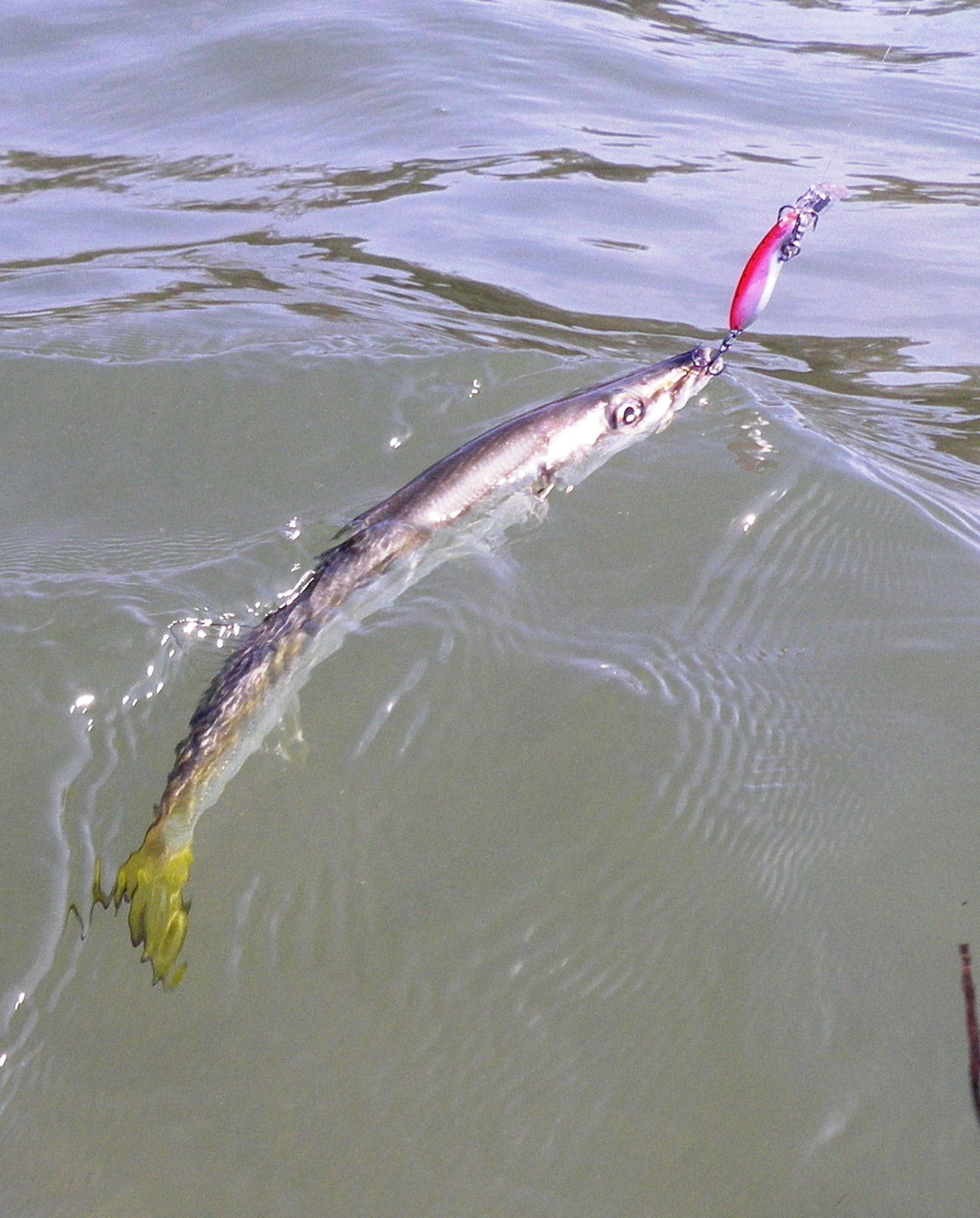
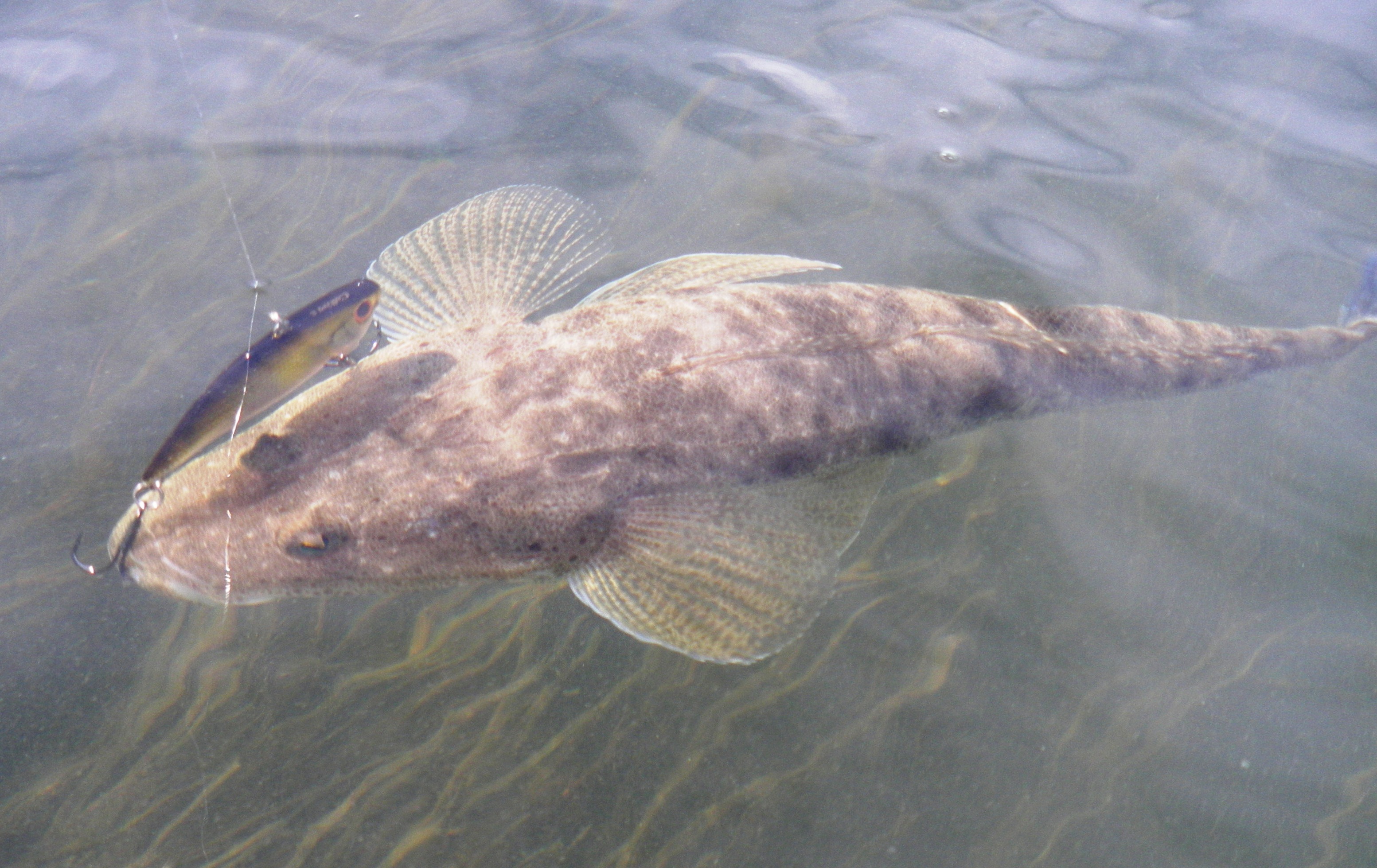
I drove down to Diamond Head and walked along the shore, casting along the edge of the weed banks with the Halco Scorpion. The big tide had thrown quite a bit of weed and the lure kept snagging. Then I started casting over the weed into the channel and on the second or third cast there was a tug and I caught a Pike.
I swapped back to a Lime Tiger Jerkshad soft plastic on a 1/8th 1/0 jighead. I was fishing with the 8lb Nanofil line and a 10lb Fluorocarbon leader. I waded out on to the big sand bar and cast into the lumps and bumps on its southern side. After about twenty minutes, I finally felt the solid crunch of a Flathead bite. It took some line and but there were no obstacles for it to swim at. It made a few good runs and as it came into the shallows, it shook its head in a last attempt to escape. I pulled it up onto the sand – it was 56cm long.

55cm Caloundra Flathead

It was now about 9.30 am and I was cooking in my waders so I took them off, had a swim and then drove home. It was good to catch something and see so much bait around. I think the key to catching a feed at this time of year is to get out early and keep moving. By 10.00 am the Passage looked like Pearl Harbour – with boats, skis, kayaks, windsurfers, paddlers and swimmers all over the place.

Tasmania – Mossie Swamp Lagoon – 4 January 2012

Wednesday

It would be my last day in Tasmania. It had taken me the best part of a week to get the hang of a new style of fishing and just as I was beginning to work it out, it was time to go. That’s fishing – it just means you have to come back again – soon.
I had looked over the map and had found a canal that links the Pump Pond to Mossie Swamp Lagoon – another dam, near Taraleah. I had been having success fishing in the faster moving water at the mouths of the lagoons and canals, so I decided to go and have a look.

The weather was windy and had cooled off dramatically overnight, as a front was moving through. It had rained in the morning but, by the time I set off to fish, at about 3.00 pm the wind was dropping and the sun was out again.

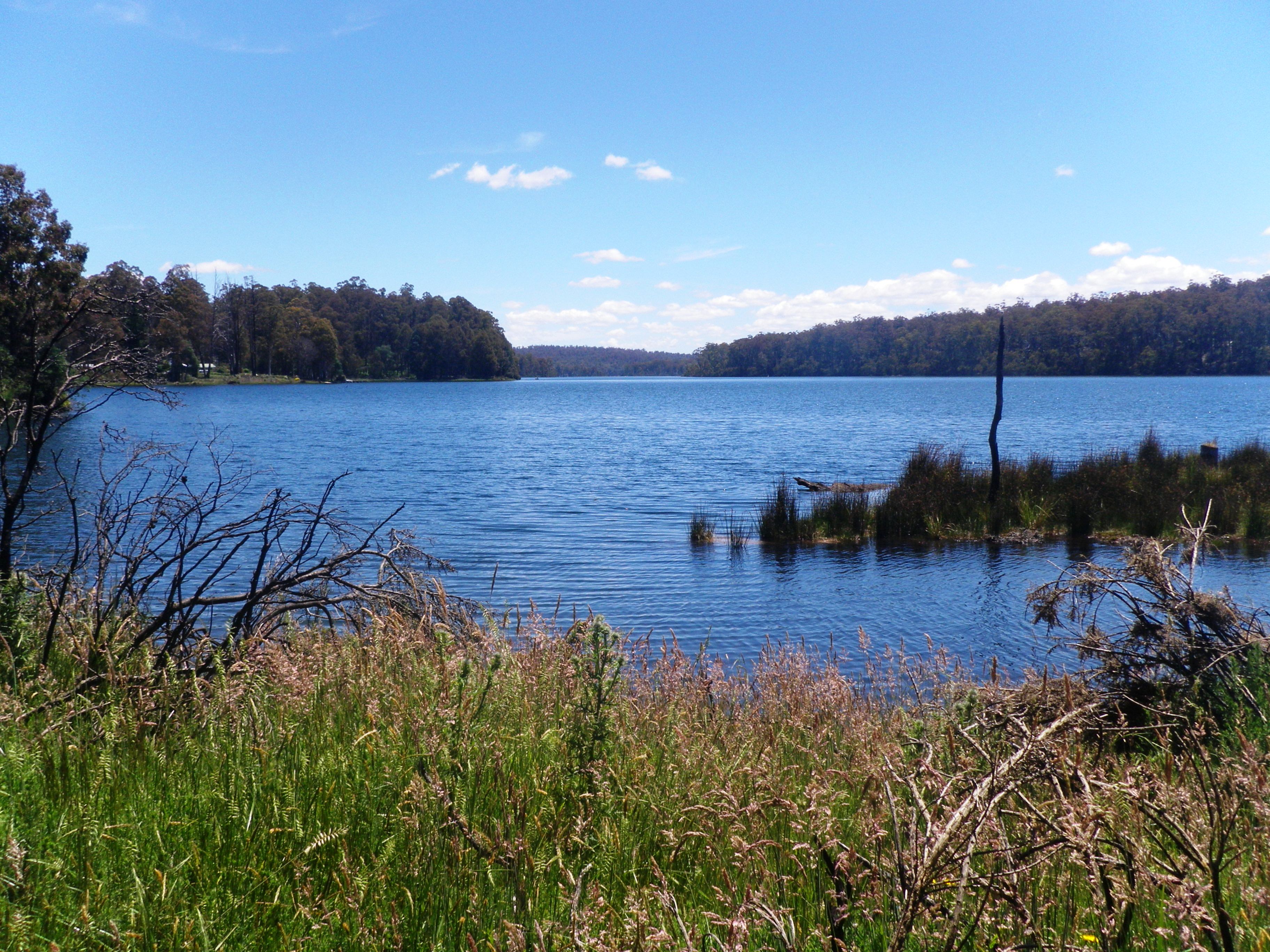
I headed up the road to Lake King William, then parked and walked for 15 minutes, along a track to Mossie Swamp Lagoon. This was another beautiful spot and I stopped well short of the edge, to observe what was going on. Predictably, I could see two Brown Trout rising in the shallows, at either end of the dam wall. I cast out a GULP 3” Minnow soft plastic in the Rainbow colour on a 1/12th oz jighead and watched through my Polaroid glasses, as one of the Trout followed my slow retrieve all the way into the bank. I stopped the lure right at the edge and the Trout just sat 10cm away, staring at it – but it would not strike. I switched to a grub tail soft plastic and the same thing happened.

I decided to move on. I walked along another track through the forest that brought me out next to a broad, fast flowing canal with a couple of weirs on it. The bottom was weedy and the wall lining had broken away in places, so that it looked more like a natural river bank. The water was fast moving but there were lots of eddies in the shallows, at the sides.

I had run out of the Peppered Prawn coloured Jigging Grub soft plastics, so I reverted to an old favorite – the GULP 3” Minnow Grub in the Pumpkinseed colour. I cast it forward, up stream into the canal and gave it a couple of jumps as it sped back in my direction. The response was instant. A small Brown Trout raced out from the darkness and attacked the lure. It took two bites and then fled. I reeled the soft plastic back in, less its tail. I put another on and moved another ten metres up the canal. I repeated the process and after a few more casts, came up tight on a fish. It was another nice Brown Trout, about 30cm long. I photographed and released it.

This slideshow requires JavaScript.

I walked along the river bank and past a weir. I kept casting and got plenty of bites from smaller fish and lost a few jigheads to the rubble and weed on the bottom. I worked my way through my soft plastics – the 3” Jigging Grub in the Camo colour, the 3” Fry on the Banana Prawn colour, the 3” Powerbait Minnow in the Pumpkinseed colour. They all got bites but the GULP Pumpkinseed Minnow Grub with its paddle tail, seemed to be the most attractive and I caught three more small Browns on this one and dropped two more, close to the bank.

I fished up and down this stretch of water until about 6.30 pm, when I simply had to leave. It had been a great afternoon and a suitable finale to a great week. I had spent a lot of time fishing for relatively few fish, but I learned a lot about the wily Tasmanian Brown Trout and I am already planning my next visit.

Tasmania – the Pump Pond Reservoir – 3 January 2011

Tuesday

Tuesday was a clear, still, hot morning. At about 7.00 am I drove back up to the Pump Pond and fished around the shore. The fish were there but they were not interested in the soft plastics in such clear, still water. I moved back down along the canal to the reservoir and fished the spot where I had found the fish the day before. I was now using the GULP 3” Jigging Grub soft plastic in the Peppered Prawn colour, I got a bite and a short run but the fish spat it out.

Swirling water in the Pump Pond Reservoir

I decided to try the other side of the mouth of the canal and moved around to a clear spot on the bank. I saw a fish rise and cast just up river of it. Before the soft plastic reached the bottom I felt the bite and then the line started peeling. This was a better fish than the day before and again it tried to get down into the weed.

The best Brown Trout of the trip - 42cm

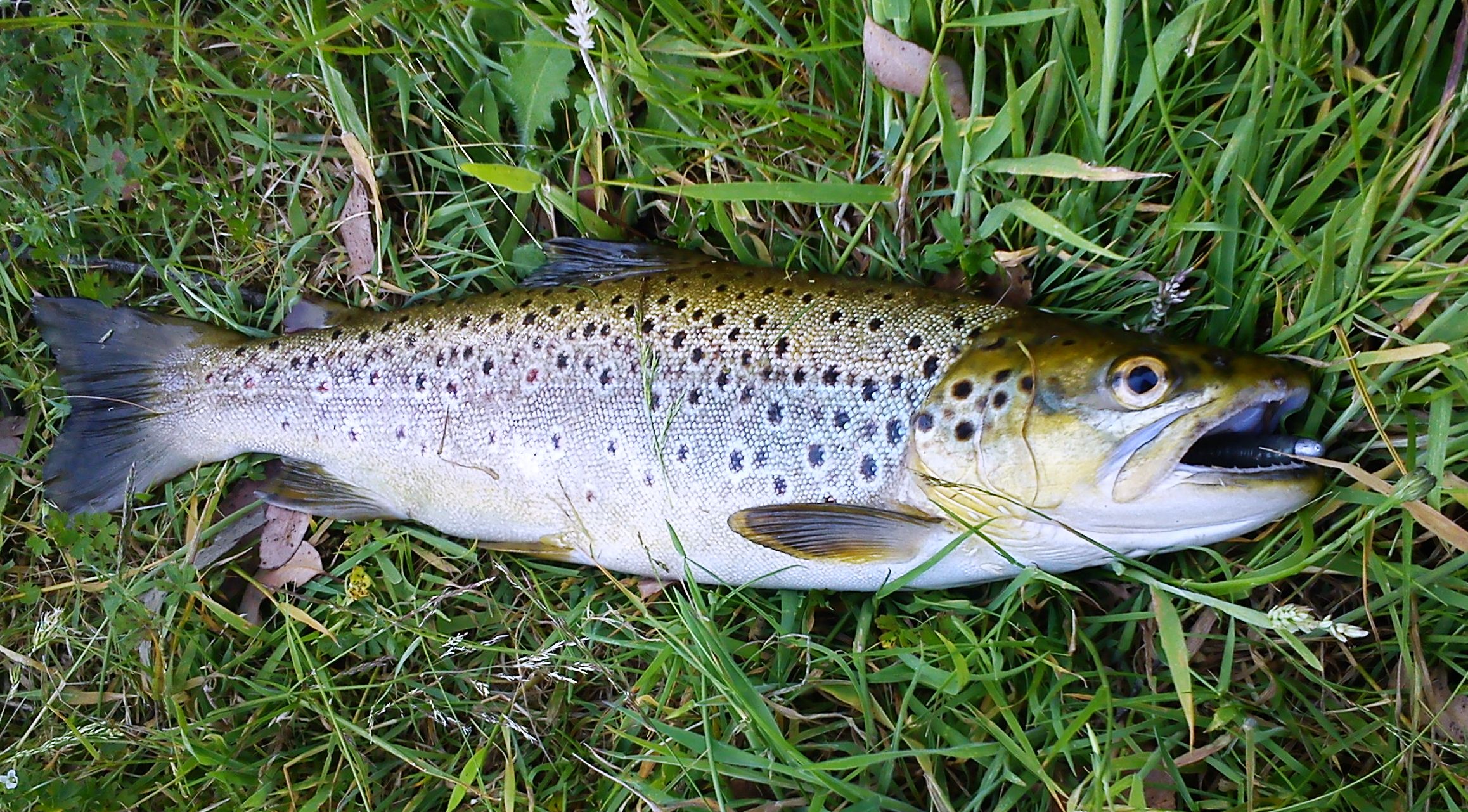
I already had the drag set reasonably tight and the 6lb leader had been strong enough the day before, so I was confident enough to pull the fish free of the weed and up the bank. It was my best fish of the trip so far at just over 2lbs.

I fished on in a few other spots around the reservoir but could not find any more Trout, so I gave up at around 9.00 am.

Tasmania – The Pump Pond Reservoir – 2 January 2012

Monday

I was up early on Monday, convinced that my soft plastic lures would have a basketful of fish on the table by lunchtime. I decided to go back to the southern end of Bronte Lagoon where I had missed a few trout on the fly, earlier in the week.

This area is close to the road, easy to access and has lots of fish holding terrain. The tree line is close to the shore, providing shade on hot days and also encouraging lots of insect life. There are also clumps of strap weed, tree stumps, boulders and fallen trees all along the bank. I had my waders on but started by fishing along the bank with various GULP soft plastic lures.

Bronte Lagoon - lots of structure but perhaps I was too early for the fish


I think I was a little too early at about 6.30am. As the week went on I began to realize that the Trout prefer a bit of warmth or sun, before they start actively feeding. I suppose that the warmth brings out the insects and that’s when they get going.

I walked up and down the bank but could not raise a bite, so I drove back to another small reservoir, just south of the Pump Pond, near Taraleah. This reservoir is fairly deep and is filled from two sides by canals. Where the water flows in, there are some good eddies and I thought they looked worth a try.

It was about 7.30 am and I decided I would try a hard bodied lure. I had picked up a couple of RAPALA XR4s in the Brown trout colour , before I left Brisbane so I tied one on and cast into an eddy where the water was running out of one of the canals, into the reservoir. I put in about five casts, retrieving the lure slowly with plenty of pauses and twitches. On the last one there was a great swirl and a good sized Brown trout knocked the lure flying out of the water as it struck. Unfortunately the fish and lure did not hook up and I was left standing there, replaying the scene in slow motion on the bank.

I cast around a bit more but the fish did not strike again. At about 10.00am I gave up again, resolving to try again later in the afternoon. I was gaining a healthy respect for these fish, they were far from easy to catch.

A 35cm Brown Trout from the Pump Pond Reservoir

That afternoon I came back to the same spot at about 5.00 pm. I decided to try a soft plastic lure and put on a GULP 3″ Jigging Grub in the Peppered Prawn colour. I rigged it on a 1/12th oz jighead and cast it into the swirling eddies again. A few casts produced nothing so I moved round the corner towards the slack water and put out a few more casts. On the third, there was a solid thud and I struck hard. Line started peeling and after a few lunges, I felt the line slow as the fish tried to bury itself in the strap weeds. I tightened the drag a little and pulled it free. I soon had it on the bank – a Brown Trout – just over 35cm long. Delighted, I kept this one for dinner and it certainly tasted sweet.

Trout are definitely harder to catch than I expected

Tasmania – the Pump Pond – 1 January 2012

Sunday

After 10 hours of guided fishing with a fly rod, I had seen plenty of Trout but I had failed to hook one. Now I recognize that 10 hours is hardly a fishing lifetime, but with only a few days of my Tasmanian holiday left, it was time to switch tactics and try some lures.

Our guide had suggested I try a small dam near Taraleah, called the Pump Pond. I walked up to it at around 7.30 am, just as the sun was beginning to burn through the morning mist. Santa brought me a new Shimano Stella 2500 reel which goes perfectly with my Loomis GL2 spin rod. I had loaded it with the new 8lb Nanofil fused line from Berkely and tied on a rod length of 6lb Fluorocarbon leader.

The Pump Pond - a small dam near Taraleah

All of the dams in the area are linked by canals and tunnels, so that water can be moved around the hydro-electric scheme. The canals between the dams are usually fast moving and you should take care when fishing them, as they are largely unfenced. One of these canals runs out of the base of the Pump Pond Dam, down to a small holding reservoir. As I walked along it, to reach the dam I decided to throw a cast in. I had rigged a Gulp 3” Minnow in the Rainbow colour on a 1/12th ounce, size 2 hook, jighead. I cast up stream into the current and gave the plastic a few jigs as it sped towards me. It was passed me in seconds, so I hauled it in and cast again. The canal is made of preformed concrete slabs with no structure at all. Just as I was thinking it would be difficult for a fish to hang out anywhere, I felt a solid bite and then line started peeling. It was a small Brown (my first Australian Trout and my first fish on the new Stella). It was soon safely on the bank. I removed the soft plastic from its mouth and released it.

A GULP Minnow in the Rainbow colour does the trick

Finally - my first Tasmanian Brown Trout

I moved up to the Pump Pond and waited until I saw another Trout break the surface to feed. I cast the plastic a few metres in front of it and let it sink. The water was crystal clear and as I slowly retrieved the minnow soft plastic, I watched another small Brown Trout follow it all the way in to the bank and then turn away. This happened again on the next cast, so I sped up the retrieve a little, with a few jumps and jerks. The fish followed closely again, but it would not strike.

Plenty of fish holding structure


I moved all along the dam wall, casting whenever I saw a fish and the same thing happened every time. They were curious but they would not eat the lure. I tried some different soft plastics – grub tails and fry shapes, but they all drew a blank. At about 10.00 am the sky was clear and there was no wind so I decided to give up.
A great morning in a spectacular location and most importantly – I got a fish.

Tasmania – Dee Lagoon Beetle Drop – 30 December 2011

Friday

Fly fishing again – we started at noon and our guide suggested Dee Lagoon. He explained that we would fish from his boat and try to take advantage of a ‘beetle drop’ to sight cast at rising trout.

Dee Lagoon - renowned for its beetle drop

A word of explanation for novice fly fisherman – self included. On warm days in the summer months Eucalyptus Beetles (which look a little like olive green ladybugs) hatch in the gum trees beside the lakes and fly around for a bit before dropping into the lakes where they sit on the surface frantically wiggling. The trout scout around below, popping up to snaffle them.

Our plan was to wait until we could see a Trout cruising along the forest fringed shores and cast a Eucalyptus Beetle patterned fly in to its path. We arrived at a likely spot on the north shore but we immediately realized there were a couple of problems with the plan. Firstly, it was a clear, still day with not even a ripple on the surface of the crystal clear water, so the fish would see us coming. Secondly, there were spent Eucalyptus Beetles all over the surface of the water. There were literally thousands of them and they were still falling.

The Trout were cruising the shore line

We cast at a few Trout but they were not interested in our flies. We would watch them turn towards the fly as it dropped, approach it and then turn away. We moved around the lake but the story was similar all over it – there was just too much food around and the fish were stuffed.

At the northern end of the lake we came into a corner called Station Bay where a few small Brown Trout were rising close to the bank. We came in close and put a few casts in their direction but again we could not tempt them.
We tied up against a semi- submerged stump to watch and see if they would continue feeding. A light breeze had blown the spent beetles into a slick with some other debris. I saw a big swirl at the end of it and then I saw a good sized Rainbow Trout – 3 or 4 lbs, just under the surface. It had not seen us and took a mouthful of dead beetles then swirled away. I put a cast to it and it swam in to inspect my fly, then slowly swam away.

Drop the fly between those stumps

For the next 30 minutes it came back time and again. Our guide put every fly he had on and each time the reaction was the same – immediate interest as the fly plopped on to the surface and then, after a quick inspection – rejection. Finally this beautiful fish disappeared.

My father decided on a more direct approach and tied on a wet fly – a small olive coloured sinking nymph. He started to prospect in the deeper water and eventually the line came up tight. But after a few minutes of playing a good fish, the line went slack. When he recovered the line the fly was gone – the 3lb leader was just not enough.

That was it for the day and whilst it had been fantastic to see how the Trout operate, I wanted to catch one. Back to soft plastics tomorrow!

Tasmania – Bradys Lake – 29 December 2011

Thursday

I have left the heavy swells and lumpy seas of Queensland behind and flown south. I am lucky enough to be staying at the Taraleah Lodge in the Tasmanian Highlands, where I am hoping to catch a few Trout.

I opted for a guide as I needed to know when to fish, where to fish and what to fish with. I brought the light spin rod and reel and a range of soft plastic and hard bodied lures, but I accept that in such beautiful country, fly fishing is really the method by which Trout should be caught. My father, who is is an accomplished fly fisherman, was with me and I am keenly aware that he considers prospecting with soft plastic lures rather similar to dynamite fishing.

I last picked up a fly rod when I was about twelve – and that is a very long time ago. Everyone says it’s just like riding a bike – you never forget, but today, as the trout were rising repeatedly less than 5 metres in front of me – I certainly felt like I was flailing the water with dental floss. After a bit of casting practice I remembered just how difficult it is. Trout fishing (like most fishing) is all about stealth but perfecting a fly cast is a messy business. You see a fish rise (break the surface to feed) and you lift your line out of the water to cast just ahead of it. What you intend to do is play out some line with a couple of dummy casts above the water, then drop the incredibly lightly weighted fly gently on to the surface about a metre in front of the fish. What actually happens is one of the following:

1 – Your fly catches in the undergrowth behind you, on the long grass or trees, on the first back swing.
2 – You fly hooks firmly into your ear on the second back swing.
3 – Your dummy cast skims the surface of the water with a loud splash, spooking every fish within ten metres.
4 – The line goes back nicely over your head but as you bring it forward it concertinas in front of you and the fly – lands less than a metre in front of you.

Finally, a full two minutes after the Trout has swum away you put the fly where you want it. Put simply, it’s hard and I really struggled.

Murray, our guide, took us to the Bronte system which consists of four lakes created in the 1950’s as part of the hydro-power scheme that sends power across Tasmania. He started us off on the western shore of Bradys Lake where trout can often be seen in the shallows. There was a light cool breeze ruffling the water at about 10.00 am.

Bradys Lake


There were various insects buzzing above the water, in the shallows and every now and then a small Dun would pop up on the surface. The Dun is a small winged insect and it emerges from a larva that has matured on the bottom of the lake. When it’s ready to hatch it floats up to the surface and the wings pop up like a little sail. They then blow around on the surface, drying out until they are ready to fly away. The Trout will eat them at all stages of this cycle, but they get particularly excited when there is a big hatch and the Duns are popping up all over the water. You can either target them with a fly that looks like the larval stages (nymph) and sinks – a ‘wet’ fly, or you can target them with a fly that sits on the surface – a ‘dry’ fly. If you want to cover both bases you can tie on a dry fly with a wet fly trailing underneath.

This was the set up my guide gave me. It has the added advantage of making it easier to spot a fish strike. When the dry fly (in this case a black foam bug with a red and yellow dot on its back called a ‘Chernobyl’) is pulled under, you strike. We fished for an hour at Brady’s Lake and then our guide suggested a move to the southern corner of Bronte Lagoon. This was another shallow area with weed clumps, tree stumps and fallen trees and it looked very promising. As we arrived a good size Brown Trout broke the surface to snaffle something. We started casting wherever we saw the fish rise. But my poor casting made it tricky.

A good guide saves time and can put you on to the fish

After another hour I was casting more effectively and I was able to put the fly close in to a clump of weed where a fish had been repeatedly feeding. Murray suggested I just let the fly float past – no need to strip line to move it – just let the wind push it past the weeds. I did this a couple of times and then to my surprise the Trout came to the surface and took a swipe at the Chernobyl, instead of the trailing wet fly. I jerked the rod up but I missed the fish.
We carried on until about 2.00pm but I never got any closer to catching one. It was a good introduction to how tricky this type of fishing can be.

Iluka – Woody Head – Finally a Snapper – 13 December 2011

Tuesday

The weather was so miserable the next day that I actually had a lie in. When I say lie in – I mean, I woke up at sunrise, rather than an hour before! The grey skies and rain meant that sunrise was a little hard to pin point. The rain was coming over in regular, but not very heavy showers. By now there had been enough to make the river very dirty. The wind was dropping off so the swell was easing. On Sunday I had walked round to Middle Bluff. It was a clear dawn and initially things looked promising. But as I rigged up a couple of big waves came crashing through and I realized that it was not going to work. Every 20 minutes or so a really massive set would come through and completely soak the rock platform!

By Tuesday I was ready to try again and the swell definitely seemed to have eased. I walked out on to the rocks in front of Woody Head at about 4.45 am, as the sky was beginning to lighten. The swell had dropped right back and there was a very light south easterly breeze. Low tide had been at about 4.30 am. So I had a couple of hours to fish left before the tide started to get too high. I started with 65g Raider metal slug and cast it out, all around the area known as ‘the Barnacles’, on the eastern side of the Woody Head platform. After 25 casts, I had not had a touch so I switched to a 5” Gulp Jerkshad in the Lime Tiger colour. I rigged it on a ½ oz, 3/0 hook jighead. I was fishing with my heavy rod – the 9’6” Daiwa Demon Blood with 30lb braid and a 30lb fluorocarbon leader on the Shimano Stradic 6000 reel. I could not find any fish here and the swell was still giving me a soaking every now and then, so I moved south, along the front of the rock platform. I cast wherever I could and, predictably lost plenty of jigheads to the rocks.

I stopped for a while at an area known as the ‘Jew hole’ and swapped down to a shorter GULP 4” Minnow soft plastic in the Pearl Watermelon colour. I was trying to put something out that was more similar to the Whitebait that I knew were everywhere. This got results almost instantly with a couple of solid bites and then a good run but no hook up. About ten minutes later I had a fish on, it was another Salmon and after a couple of jumps and a brief fight it shook itself off the hook.

I moved further south and rigged up a GULP 5” Crazylegs Jerkshad soft plastic in the Curry Chicken colour. I was still using the ½ oz, 3/0 jighead. I started to cast out as far as I could, to give the lure plenty of time on the bottom before it got washed in to the rocks. I felt a couple of grabs at the base of the rocks and then a solid bite but still no hook up. It was almost time to go and the swell was picking up again after the calm around dawn. I put in a long cast and counted to twenty. When I lifted the rod I felt a bit of resistance and then all hell broke loose and the reel was screaming. There was a long initial run, out to sea – and then it turned back towards the rocks and I had to wind hard to keep up. It was too fast for a Jew but not mad enough to be a Salmon or a Tailor.

This slideshow requires JavaScript.

It gradually slowed and after a few more runs, I tightened the drag and got it up on a ledge below with the help of the swell. Luckily it wedged itself into the rocks and did not wash back out with the receding wave. I looked to see what was coming and then slid down slowly, grabbed the leader and pulled it up. It was a good size Snapper – 3.8kg and somewhere between 60 and 70cm long. I was delighted. After almost a week of pretty mediocre weather and limited fishing opportunities I was holding the biggest Snapper I have ever caught. I am told they are often caught off this platform on fresh squid baits and early morning is always the most successful time.

That was enough for one day and with my heart still racing, knees wobbling and hands shaking. I gathered up my gear and walked back, noisily, through the camp site.

Iluka – The Harbour wall – 9 December 2011

Friday

The sea was too angry at Frazers Reef

I woke early to a very damp morning. There had been heavy rain during the night and I hoped it might have dampened the wind. I drove round to Frazer’s Reef, hoping to have a look for some Jewfish, from the rocks in that area. I stepped out on to the beach by the carpark and was greeted by a very angry sea. I gave up and drove down to the Iluka rockwall where the swell was also too lively to fish.

Still too much swell to fish the Iluka rock wall

I decided to give the Iluka harbour a try with a light spin rod and some soft plastic lures. It was now a couple of hours after dawn and the tide would be high around 8.00 am. I was fishing along the northern stretch of the rock wall that separates the harbour from the Clarence River. The water in the harbour was a dark, tea-tree stained colour but still clear and as the tide was running in strongly, the water on the river side was also quite clean.

The rock wall around the boat harbour

There were lots of Mullet in the shallows

Sometimes there are good Flathead in this corner - close to the wall

Small fish with a big appetite

I started with an almost see through Powerbait Minnow on a 1/8th oz, 1/0 hook jighead. This yielded a tiny Moses Perch and a 30 cm Flathead. There were a few good size mullet schools cruising up and down and a couple of dolphins came through the harbour entrance to chase them around. I swapped to a GULP 4” Minnow in the Pearl Watermelon colour. I walked along the rockwall casting into both the Clarence River and the harbour.

A small Flathead from inside the Harbour

Another small Flathead - this time from the Clarence River

After another hour, I had caught two more small Flathead – too small to keep. I tried a couple of hard bodied, sinking vibe lures – which produced nothing. I switched back to the soft plastic lures and finally caught a Flathead that was just over 40cm long. One small Flathead would not feed us, so I released it. At about 9.30 am I gave up. There was still nothing for dinner.

Iluka – Woody Head – More Salmon – 7 December 2011

Wednesday

Wednesday morning was windy again – a light south-easterly with squalling showers. I walked round to the rocks on the eastern side of Woody Head, at day break but the swell was still sending big sets crashing over the top.

I gave up on the mornings fishing and drove off into Maclean for breakfast and a chat with the helpful folk at Big River Bait & Tackle. They confirmed the presence of a few Jewfish around the rocks but also pointed out the weather would be my biggest obstacle for the next week.

I drove back to Iluka to find the birds working, out in the calm waters off Woody Bay. They were staying too far off shore initially, but gradually through the afternoon, they moved closer in. The netters showed up on the beach at about 2.00 pm and as the whitebait came closer to the shore, they rowed out with a long net to encircle them. They clearly got a good haul as it was too heavy to pull up on the beach. They dragged it along through the water, back to the boat ramp. Then they winched the bulging net up.

The commercial netters row out their net

Another decent Salmon from the Woody Head Beach

Two more Woody Head Salmon

By about 2.30 pm the birds had followed another school in close enough to cast at and a group of beach fisherman had come down to try and catch a few. Suddenly the Salmon started to bash into the school, sending Whitebait flying everywhere. I put on a HALCO 65g Twisty and fired a cast over the boiling water. After a couple of cranks I had a fish on. It was another solid Australian Salmon which put on a great display of acrobatics. As I landed it I saw my son was stuck into another but was turning into hard work as he only had my light Nitro 6’6” spin rod. All along the beach the kids were hooking up. The fish destroyed plenty of gear, but the patient fishermen eventually landed a few decent sized Salmon. My son got his after an epic battle. The fish had grabbed a GULP 4” Pearl Watermelon Minnow soft plastic, attached to a 10lb leader. It was just under 50cm.

Australian Salmon on the light rig

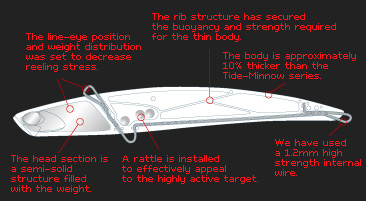
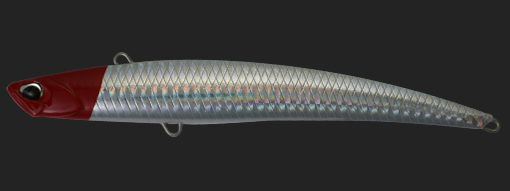
A few more casts with the HALCO Twisty failed to hook up so I decided to try out some of the bigger DUO lures I had brought with me. The first one that had been calling to me from the tackle box, is called the DUO Tide Vib Slim. It is a 32g, 140 mm sinking Vibe lure. Once again, it is a beautifully engineered lure with a very high quality finish. It is comparatively light for its length but has a great action. Although it is very slim it still contains a decent internal rattle. I think this will prove to be big hit with the pelagic species – especially Tuna. I had it in the Qantas colours – red head with a white body. I cast it about fifteen metres off shore and played around until I found what I considered was the ideal retrieve speed – which was fairly slow. I was using the Daiwa Demon Blood rock/ beach rod with a 30lb fluorocarbon leader.

This one fell for the DUO Tide Vib Slim

Tide Vib Slim - weighting system

The Qantas colours often work well - DUO Tide Vib Slim

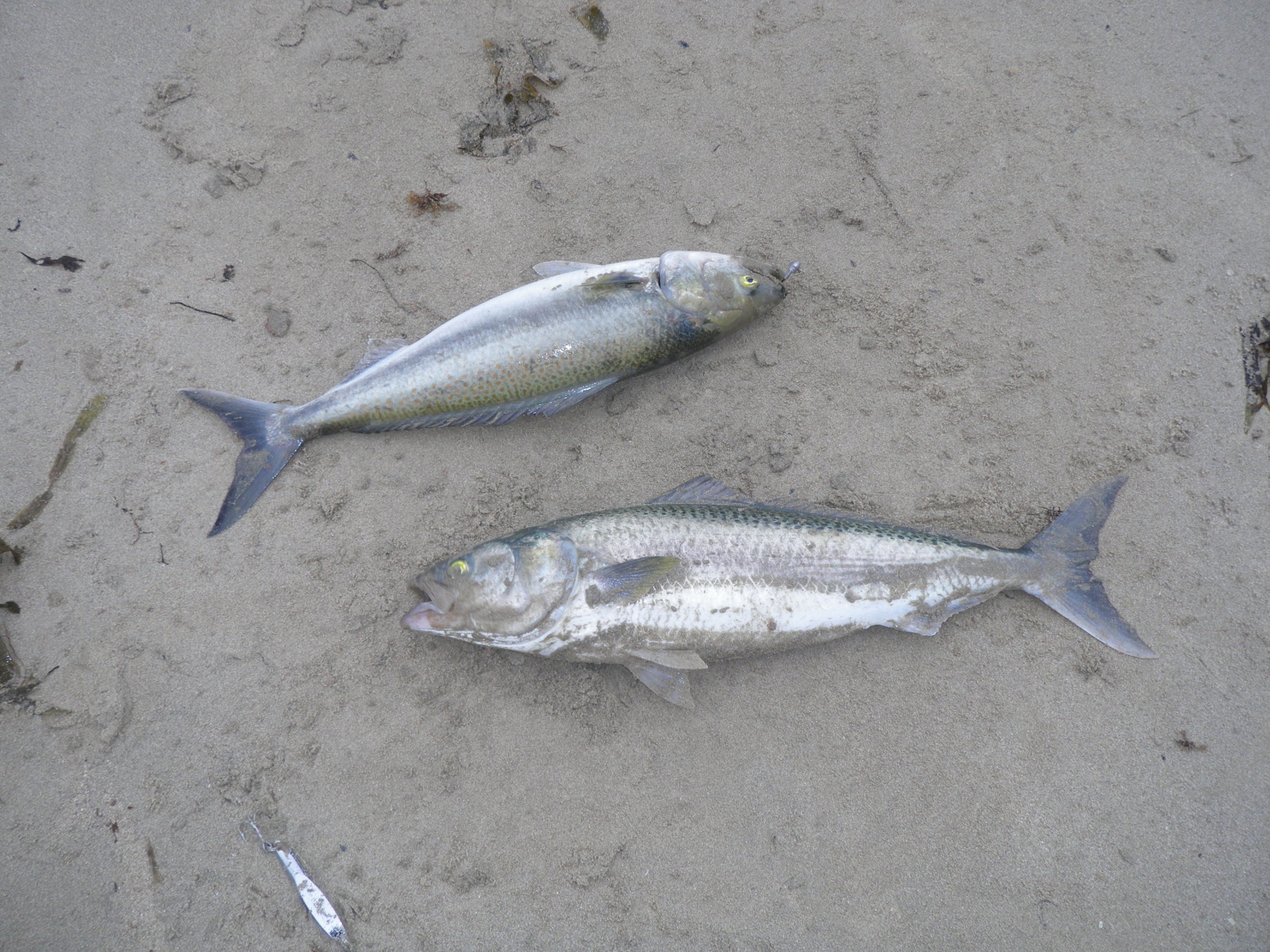
It did not take long to catch a fish – on the fourth cast a Salmon knocked it out of the water and then lunged at it again and was hooked. It took plenty of line on a very determined initial run and then put in a few leaps and rolls but eventually, I had it safely on the beach. It was a bit over 60cm long.

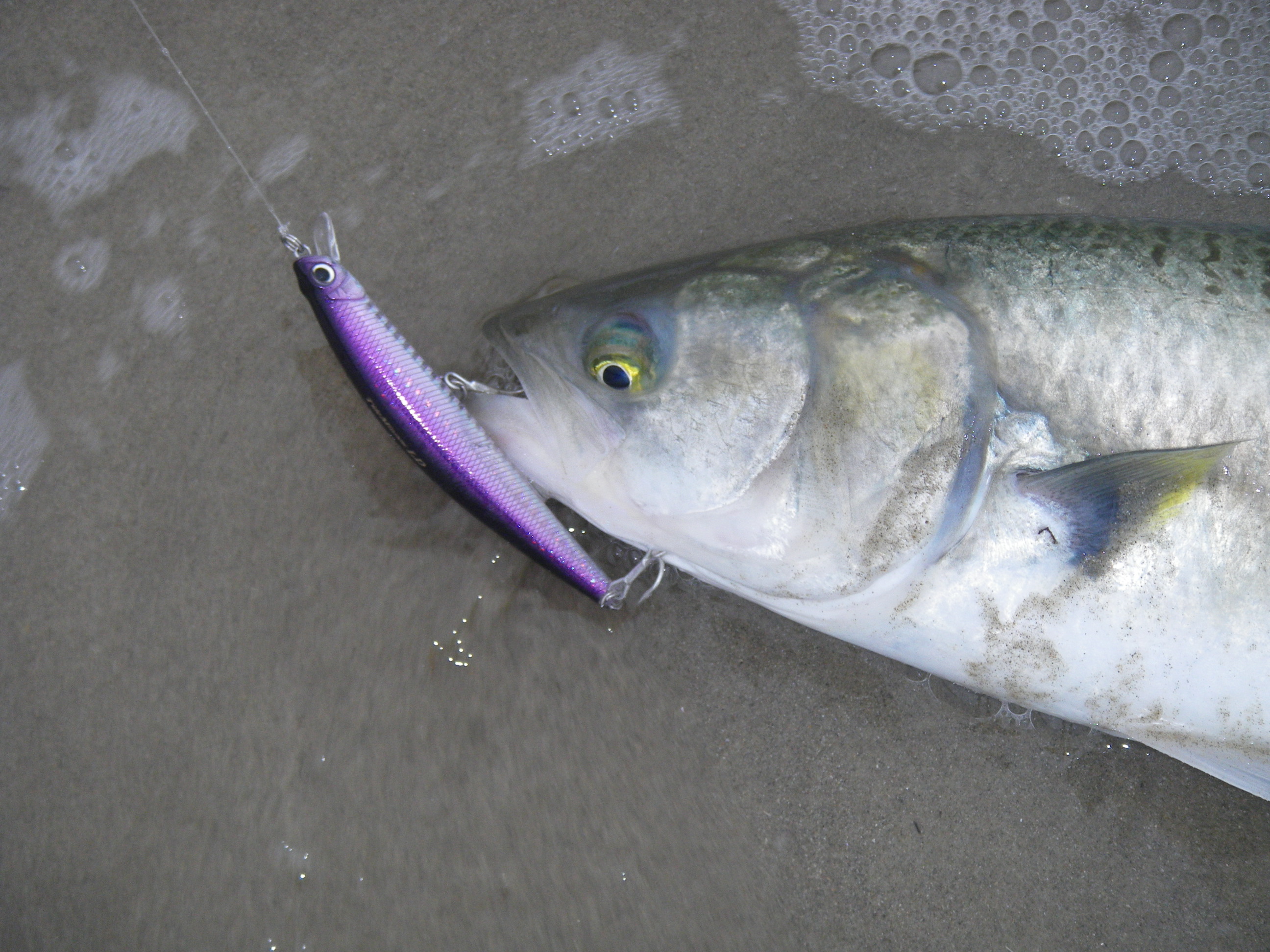
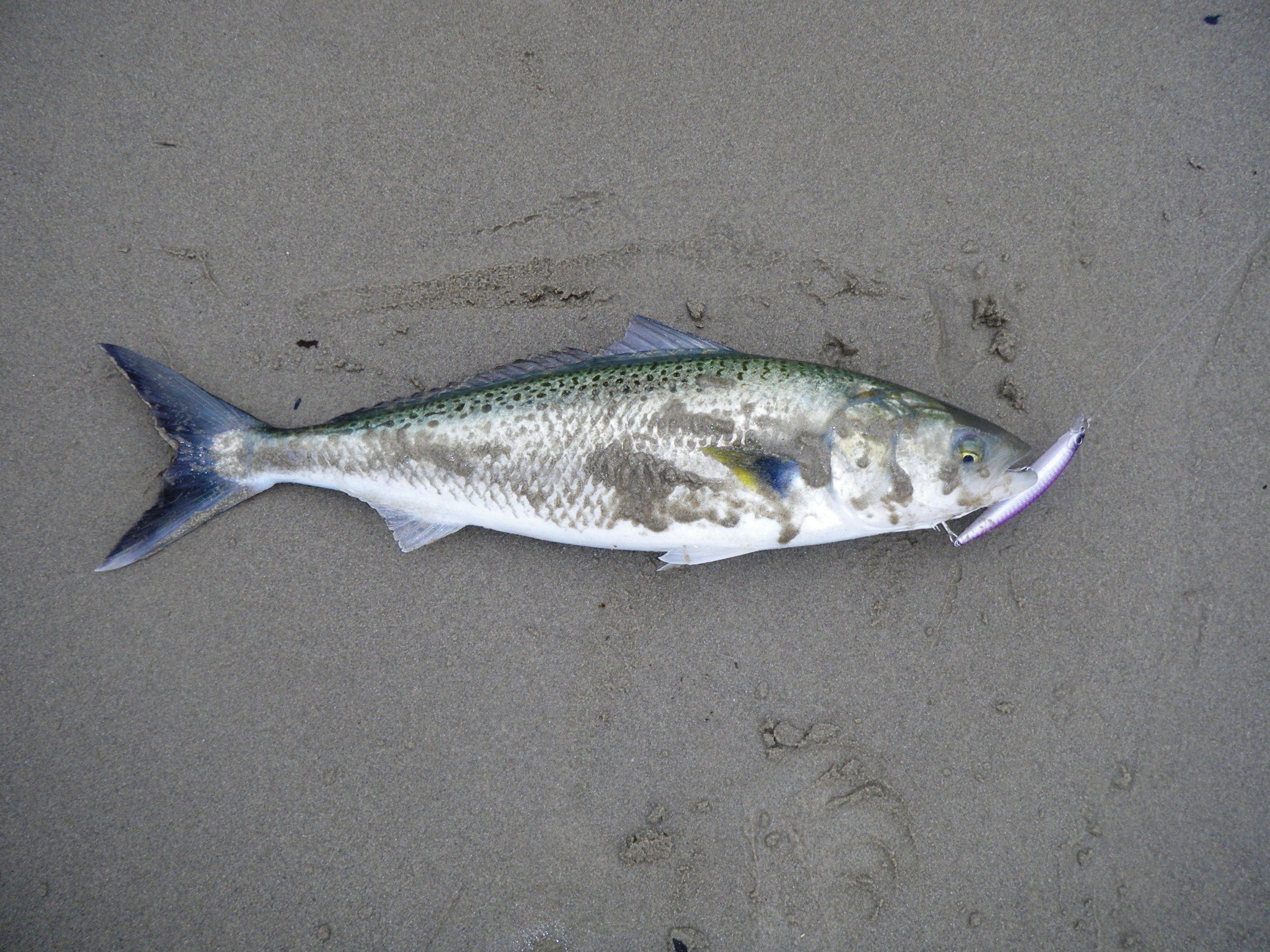
I caught two more with this lure and then things went quiet again. The soft plastics were still catching fish but I decided to try out another DUO hard bodied lure – the Tide Minnow 105LD. The Tide Minnow is one of their long established best sellers in Japan. It is also used extensively in Europe to target Sea Bass. It looks like a fairly standard sinking minnow but its internal ball bearing weighting system means it casts like a rocket. Consistently with the rest of the range, it is finished to a very high standard. I had it in a shiny purple colour with a dark underbody. It finds it rhythm easily in the surf and it has a rolling body with a wiggling tail action. The fish were thick and did not have to wait long. After about five casts another Salmon slammed the lure just a few metres from the shore. I landed it and cast out a few more times and then, bang I was on to another fish. This one was a little larger and took longer to subdue, but eventually I got him up the beach.

I should point out that these DUO lures have been provided to me at no cost to test drive but as with all freebies, I will only write them up positively if they catch fish. So far the DUO range have delivered fish for me and so I am happy to recommend them. If you want to know more about them contact Steve at http://www.swldistributions.com.au

Australian Salmon on DUO Tide Minnow

Australian Salmon on Tide Vibe Minnow

Another Salmon grabs the DUO Tide Minnow


Suddenly, after an hour or so of mayhem, the fish were gone. The birds were still circling and occasionally diving for the odd, wounded Whitebait, but the Salmon had moved on or stopped eating. It had been a great session and over the course of an hour I had witnessed five guys catch about 25 Australian Salmon between them and lose plenty more. They may be awful to eat but they are great fun to catch.

Iluka – Woody Head – Wild weather and Australian Salmon – 6 December 2011

I am just back from a week of land based rock and beach fishing at Woody Head, in the Bundjalong National Park, just north of the town of Iluka, in Northern New South Wales. As is often the case here, the weather made the fishing pretty tough. Heavy rain freshened the mighty Clarence River and big seas, wind and swells conspired to limit access to the best fishing platforms. But there were some good sessions and some good fish.

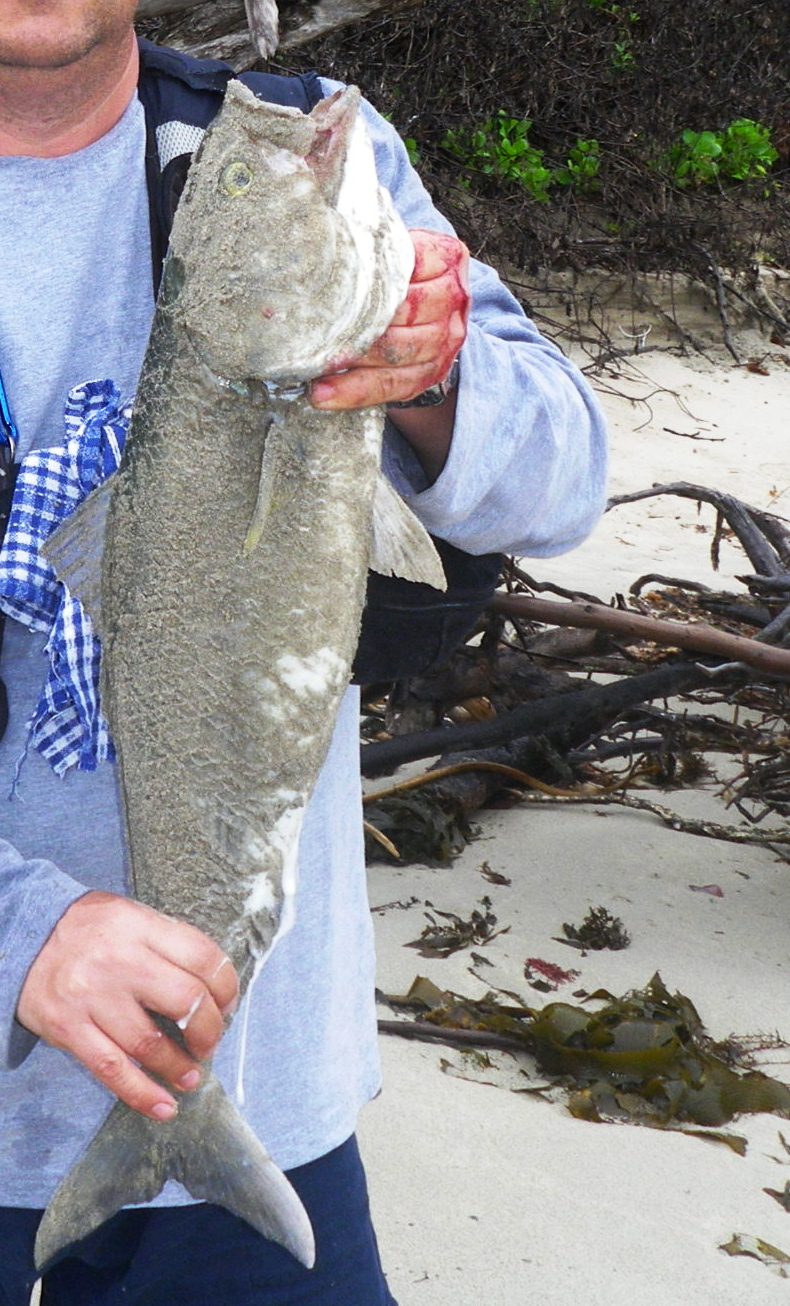
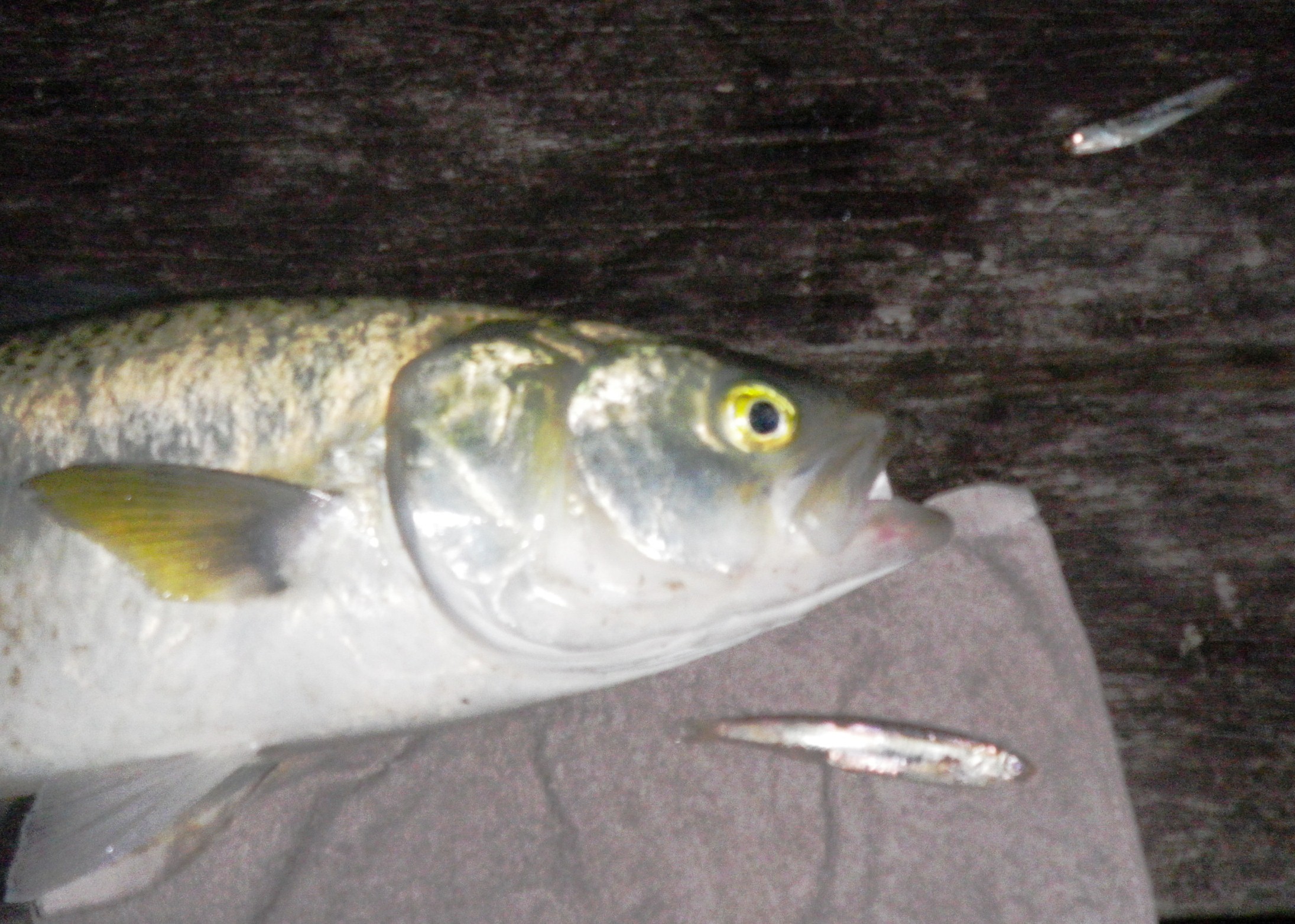
To the north-west of the Woody Head rock platform there is a sheltered bay that remains calm in all but the biggest gales. On the afternoon of our second day, there was a light northerly breeze blowing and the tide was running in. There was a heavy swell crashing on the rocks to the south, but the bay was calm. It had been raining, on and off, all day and the water was murky and the sky, overcast. The birds were working furiously, diving into bait schools close to the shore. Just on dusk, I walked down to the beach with my heavy outfit – Daiwa 9’6’ Demon Blood rod, Shimano Stradic 6000 spinning reel loaded with 30lb braid and 30lb fluorocarbon leader. I tied on a 45g silver HALCO Twisty slug and cast it about 25 metres, towards the diving birds. After a couple of casts – bang – and line starts peeling. It was a solid fish and then it leapt clear of the water – an Australian Salmon. It did a couple of tail walks and even with the heavy rod, it was hard to subdue. I eventually got it to the beach and it immediately started spitting out mouthfuls small whitebait/anchovies (not actually sure which). This was clearly what had attracted the birds.

A 50cm Australian Salmon at Woody Head

It grabbed a 45g Halco Twisty metal slug - and spat up some Whitebait

It was now dark and raining so, after a few pictures, I released the fish and went to dry off. I have never been able to make these fish taste good, so I have given up keeping them for the table. It may not have been dinner but it was a great fish to open the account.

Tweed River – The North wall and upstream – 29 November 2011

Tuesday

I decided on a trip down to the north wall of the Tweed River. This spot is another one that only really seems to fire for me on dawn or dusk, so it was another early start. I walked out along the north wall just after first light at about 4.15 am. It was another warm morning with virtually no breeze and a cloudy sky. Low tide would be at about 4.30am (QLD Time).

I was using the Daiwa Demon Blood rod (2.4m) with a Stradic 800 reel, 30lb braid and a 30lb fluorocarbon leader. I started by casting big soft plastics on 3/8th 3/0 jigheads, all around the end of the rock wall. This produced nothing so I switched to a 110mm Popper – nothing again. I put on a 75g slug – nothing. I tried a few hard bodied shallow running minnows – also nothing. By 6.30 am, the sun was beating down and it felt like lunchtime. I decided to swap locations and techniques; put on the waders and try to find some fish in the Tweed River.

I drove down to the Tweed Heads Rowing Club and parked beside the boat hire place, just by the bridge. I wanted to fish the sand banks and weed beds around the north end of Boyds Island. You can wade out to this area, for a few hours, either side of low tide. The rest of the time the creek mouth gets too deep to cross – so keep an eye on the tide.

Tweed Heads - Rowing Club - Flathead Patch

Even with less than a metre of water in the creek mouth there were plenty of small Flathead hanging around. I was back down to my light spin rod – the Loomis GL2 with a Shimano Stradic 3000 reel, 8lb braid and about 1.5 metres of 10lb fluorocarbon, for a leader. I started with a GULP 4” Minnow soft plastic lure in the Pearl Watermelon colour, on a 1/8th 1/0 jighead. On the first cast I felt a grab but there was no hook up. I slowed it all down and pulled the plastic back past the same spot. This time I felt the bite and paused. A few moments later, as I struck, I saw the white belly of the Flathead roll over under the water but it wasn’t hooked. I moved south west across the mouth of the creek to the weed banks which were now under about 60cm of water.
Over the next hour I caught 11 Flathead from the edges of the weed banks. Unfortunately not one of them was big enough to keep. I move slowly along the shore, casting just over the edge into the main channel and letting the lure pause, in close to the weed.

Another small Flathead snaffles a soft plastic

The Flathead usually find the soft plastic minnow hard to resist

Looking towards Boyds Island

There must be some bigger Flathead close by

I decided to try something different and put on one of the DUO lures – which I have been sent to try out by the manufacturers in Japan. They are beautifully crafted and so far they have proved deadly on the Flathead. I tied on a DUO Tetraworks Yurameki – a small bibless sinking pencil lure that weighs about 7 grams and is just under 5 cm long. I had the Redhead colour. This lure casts like a bullet but also keeps its head down on a long retrieve – this is great when you don’t want to get too close to the area you are fishing.

DUO Tetraworks Yurameki in the Redhead colour

After a couple of casts it was hit, but the angry fish shook the trebles free after a couple of lunges. A few metres further upstream, I caught another and this time it stayed hooked. It was only a small fish but the DUO lure had proved itself again. If you are interested in these lures, they are distributed by http://www.swldistributions.com.au – visit the website for more information. I Caught a few more undersized Flathead on the Yurameki.

Flathead on a DUO Tetraworks Yurameki lure

Only just hooked - the Tetraworks Yurameki lure from DUO

I then decided to try another of my recent favourites – the CULTIVA Miravibe. This lure is made by Owner and is another great sinking bibless vibe. It has a tight action, but does tend to rise up if worked too fast. It also has no action if worked too slow. It can often provoke a strike when the plastics are not working and after about five casts, I was onto a fish. It was the best of the day – after more than 20 fish, I finally had a Flathead over 40cm long. Given how long it had taken to find it, I did not fancy my chances of getting another, so I released it.
There had been no big fish but as long as you are catching something, you can’t complain. I had explored a new spot and I am sure that the bigger Flathead will be lurking round there somewhere. I will definitely be back.

The CULTIVA Miravibe also caught a few fish today

Caloundra – Dirty water, a big tide & elusive fish – 27 November 2011

Saturday

After a rubbish session at Bribie Island on Thursday morning, I decided to go back to Caloundra again on Saturday. It would be the usual wind pattern – virtually no breeze pre-dawn, building to a solid 15 to 20 knot north-easterly by about 11.00 am.

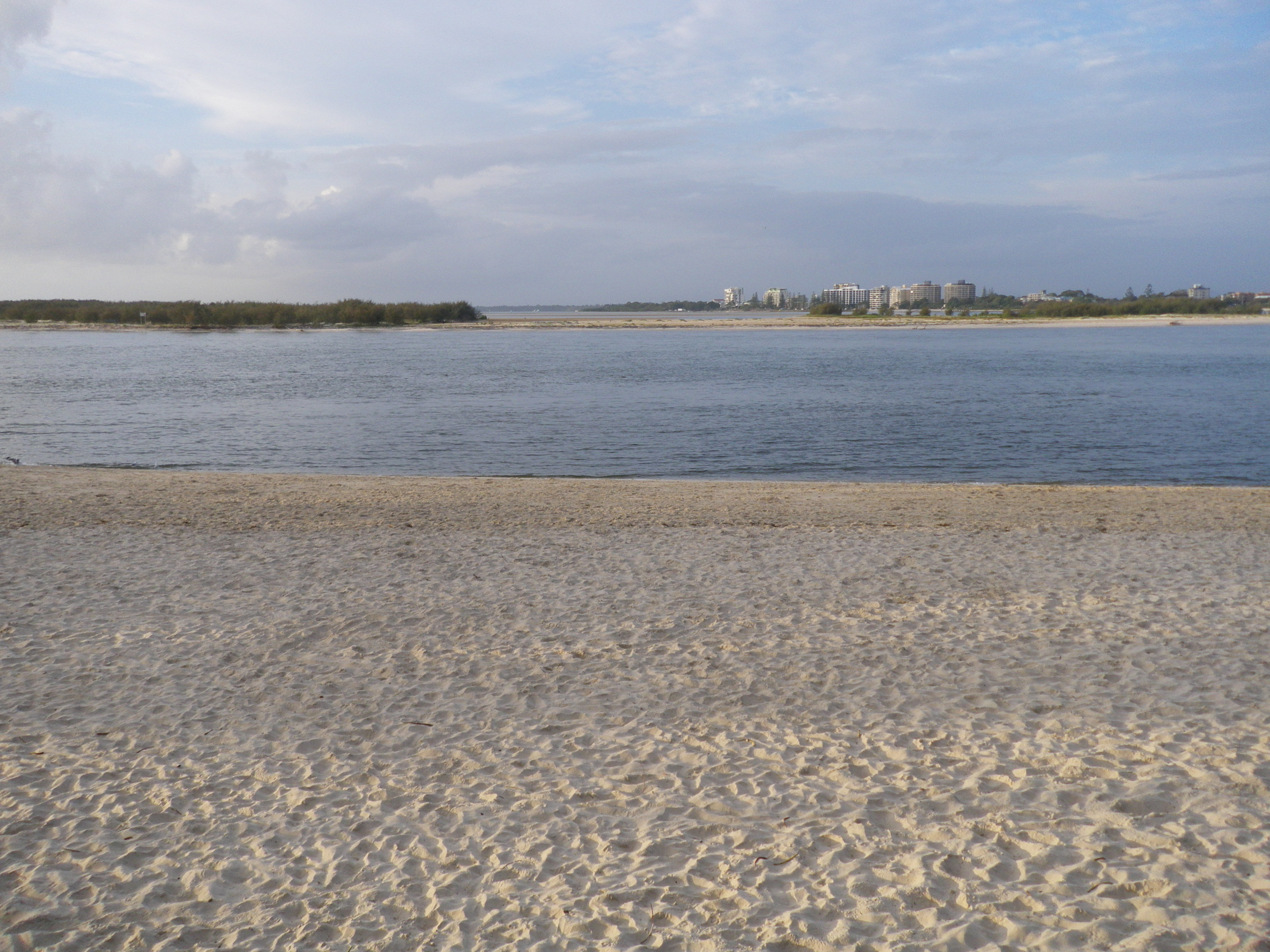
The view from Bulcock Beach - just after dawn


The new moon had risen on Friday, so it would be a big, fast running tide. High was due at 8.40 am and would be 2.1 metres. I arrived at Bulcock Beach at about 4.00 am to find the water just starting the run in, with some force. The blowy weather and rain of the previous few days has stirred the water up and visibility is very poor. There is also a bit of sediment and floating around. I started off fishing with a GULP 4” Minnow in the Pearl Watermelon colour, on a 1/8th 1/0 jighead. I was walking along the shore, under the board walk, casting close in to the shore. Just on first light, I caught a small Flathead – about 35 cm long. I carried on up to the rocks at the mouth of the Passage and caught nothing else.

Bulcock Beach - Small Flathead by the boardwalk


I moved down to the flats and weed beds in front of the Power Boat Club, just south of Golden Beach. The water was flooding over the flats when I arrived. I tried a Strikepro hard bodied, bibless vibe lure for a while, but there was a lot of sea grass floating around and the lure was getting fouled up on every cast, so I switched back to a soft plastic lure. I chose the GULP Crazylegs Jerkshad in the Lime Tiger colour. I hoped the fluttering tail might draw a strike.

I moved further north across the flats in ankle deep water. I cast along the edge of the channel, bouncing the soft plastic along the bottom. The water was still very murky, with the strong tidal flow washing around a lot of debris as it approached high.

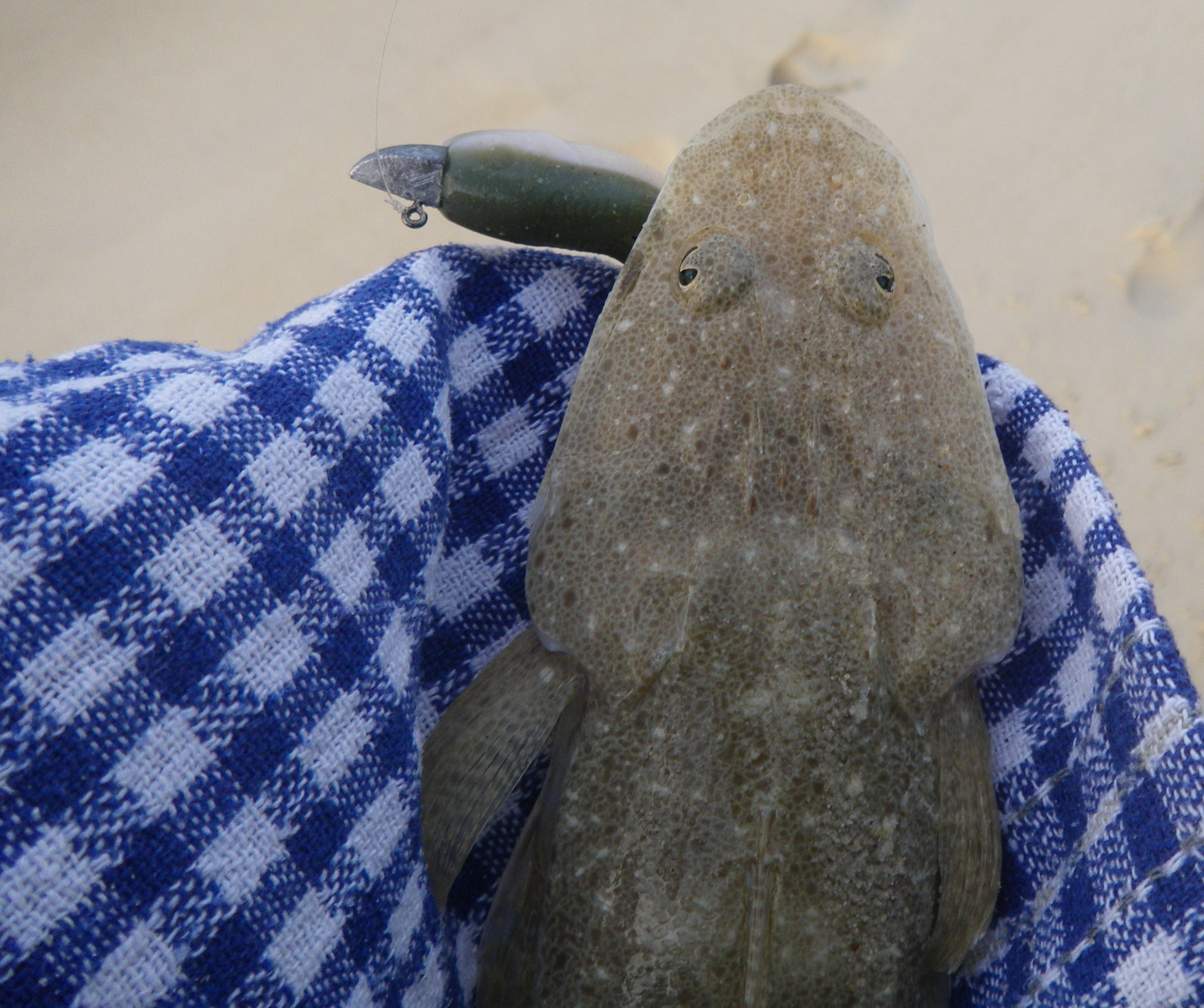
Flathead grabs a Crazylegs soft plastic - Caloundra

After about an hour of fishing this area with the hard bodied lure, I had not found a fish. Three casts with the soft plastic – and I had one. It was no monster – a Flathead, about 45cm long. I released it and spent the next few hours trying, in vain, to find another.

A bit of a frustrating session – but the fish are there.

Bribie Island – North of Pacific Harbour – 24 November 2011

Thursday

Not much to say – drove up to Bribie Island for a late morning fish – caught nothing. I used both small hard-bodied bibless vibes and soft plastic lures. I waded the flats to the north of the entrance to Pacific Harbour, from about 9.30 am through to 1.00pm. The tide was running out the whole time. Despite forecast heavy rain it stayed dry and the wind was from the south-east – turning north-east, part way through the session. The water was very murky.

I guess you have to come home empty handed every now then!

Caloundra – Lots more Flathead but not quite a bagful – 22 November 2011

Tuesday

Caloundra again – an early morning high tide at about 5.00 am. The wind was forecast to be from the north – but starting off light and then building up to 15 knots, by about 10.00 am. It looks like a south-easterly wind change will bring some heavy rain and big seas on Thursday or Friday.

My level of excitement before a fishing day is just like the excitement before Christmas day, when I was a small boy. You get all you gear ready and load the car and then try to force yourself to sleep at 8.00 pm – you can’t sleep because instead of “visions of sugar plums”, etc – you are imagining huge fish or thinking about where to throw that first cast. By the time 2.45 am comes I am usually awake before the alarm goes off. I know, I know – it sounds ridiculous but it’s a powerful addiction.

I arrived just before 4.00am while it was still dark at Bulcock Beach and decided to target the areas under the lights, by the boardwalk. The tide was almost high and the water was close to the sea walls. Sure enough, the bait had come to the lights and the bigger fish had followed. It is fairly snaggy along here, so you have to keep the lure moving. I rigged a GULP 5” Jerkshad in the Cajun Chicken colour – black on top and pink underneath. I was using a 1/8th/1/0 jighead and 10lb fluorocarbon leader tied on to a reel of 8lb braid. I caught a few small Flathead and then eventually one that was big enough to keep.

The GULP Cajun Chicken coloured soft plastic lure works well in the dark

The rocks near the mouth of the Passage were almost covered and there was a bit too much swell washing around them, so just after first light, I decided to move down to the flats at Diamond Head. I waded along to the edge of the channel. I decided to start with a hard bodied bibless lure – the Cultiva MIRAVIBE which looks very like the small leatherjacket and herring that are floating around at the moment. As I waded along the channel, I skipped the hard body along the edge of the weed banks and soon caught a few small Flathead – between 25 and 35cm long. Then right at the point where the sand flats drop into the Diamond Head channel, a better fish grabbed it, just as it came over the bank. This one was around 44cm so I kept it.

A Flathead takes the lure from the sea grass beds at Diamond Head

By about 6.30 am the tide had properly turned and I waded to the shallow drains and weed banks that lie just north of Diamond Head. These were now covered by less than a metre of water in most places. I swapped over to a soft plastic lure as there was too much sea grass floating around to continue with the hard body. I put on the GULP 4” Minnow in the Pearl Watermelon colour on a 1/8th oz, 1/0 jighead. After a couple of casts I found a fish – another small Flathead. I carried on wading north as the tide started to run out. Just short of another weed bed, a Flathead grabbed the plastic and took off. It was only about 30 cm long. I wound it in and released it. I cast back in the same spot and this time caught a bigger one – big enough to keep at about 42cm.
The water was now too shallow to fish so I moved up to the flats and channels at Golden Beach. I swapped back to the hard bodied MIRAVIBE. This lure is effective but suffers from the same problem as many of its competitors in this category – a poor action when retrieved at a low speed. It is ok in very shallow water but becomes a problem in anything more than about 50cm. To get the right action, you need to pull it quite quickly and inevitably; it then rises too high in the water column. It is perfect in about 40cm of water over a sandy bottom and that is where my next Flathead nailed it. This was another fish for the bag at about 45cm.

This one went for the GULP Pearl Watermelon Minnow soft plastic

The Flathead are often in the shallowest water

A few casts later the lure was slammed at the edge of a weed bed by a heftier fish. There was a flash of silver – and then a strange looking fish came into view. I towed it to shore photographed it and carefully released it. The helpful folk on http://www.ausfish.com.au identified it as a Striped or Silver Scat – which has a nasty set of spikes but tastes pretty good, so it was a lucky escape for both of us.

A Silver / Striped Scat

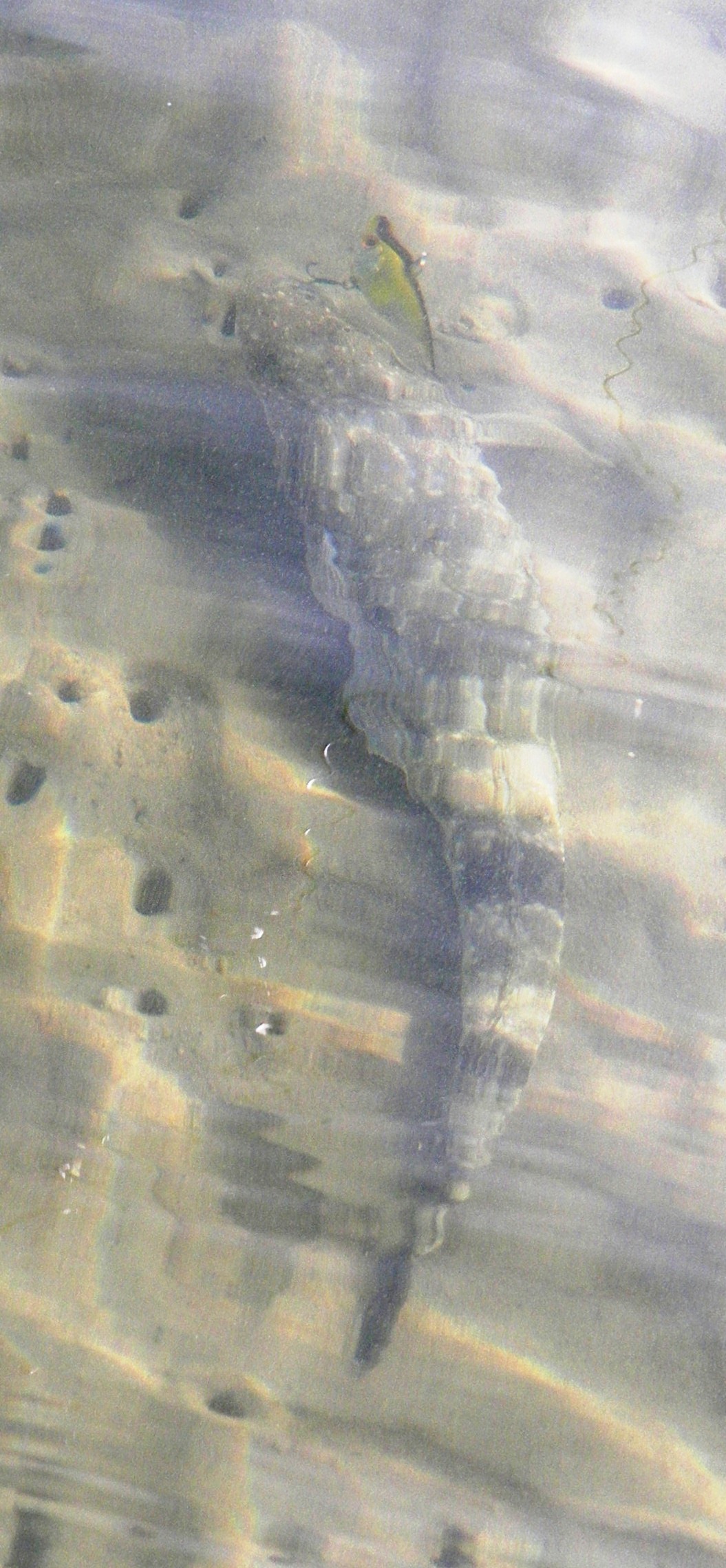
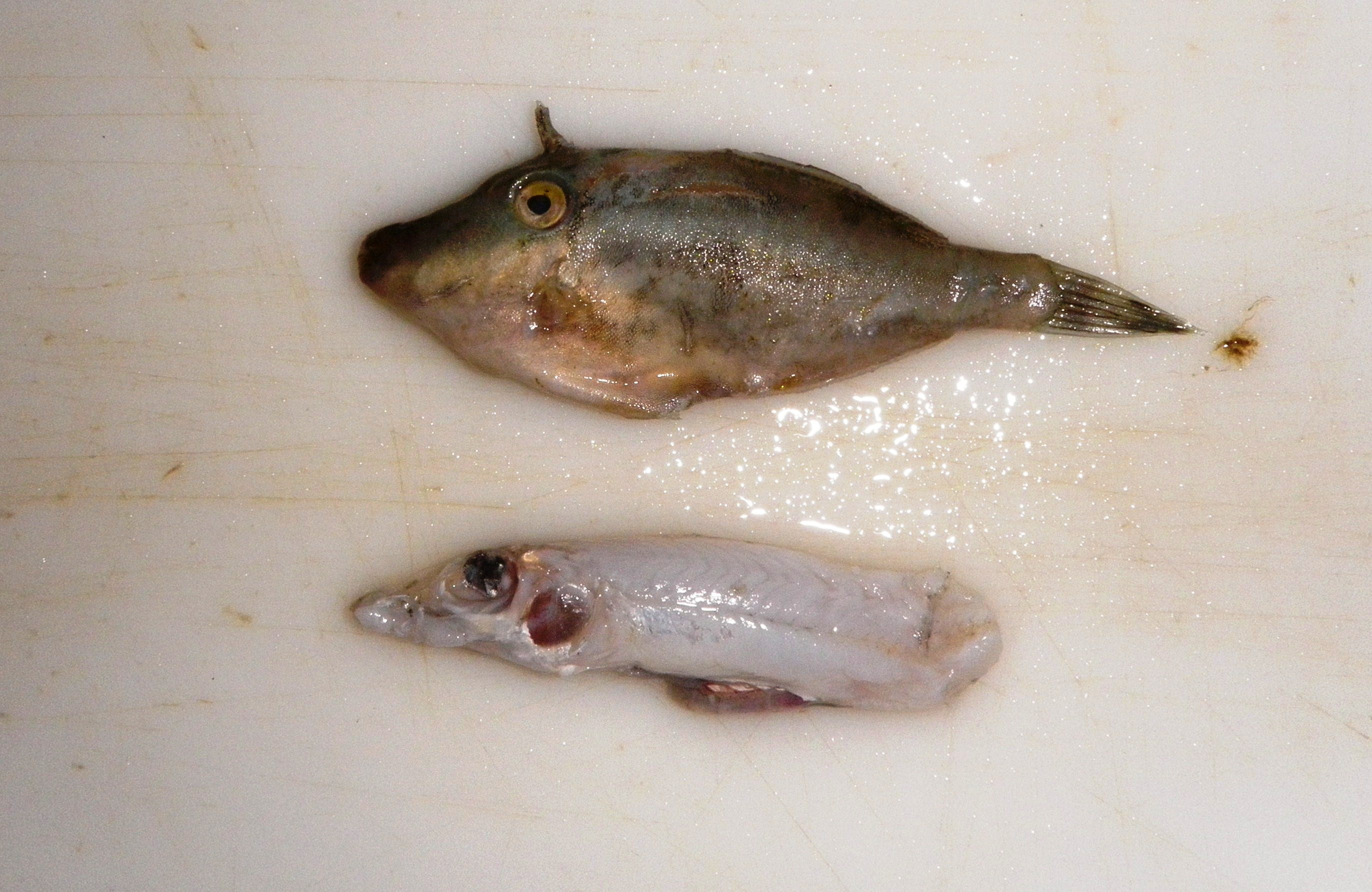
I carried on for a little while longer and caught another couple of undersized Flathead. I ended the day with four keeper fish – two on the hard bodied lure and two on the soft plastic lures. I could not find five legal fish for a full bag – but there were plenty of smaller ones around. The Whiting are everywhere and so are the Garfish. When I filleted the Flathead later, only one had food in its stomach – the remains of Whiting and a recently swallowed Leatherjacket. This was the first fish I have opened in the last few weeks, that has had anything in it.

Contents of a Flathead's stomach - Whiting and Leatherjacket

We will see what a burst of south-easterly breeze brings, later in the week.

Caloundra – Lizards and Lures – 19 November 2011

Saturday

The pattern of wind has been the same now for nearly three weeks – a calm morning followed by a gradually rising north, or north-easterly breeze. We have had no rain or big weather events and there is plenty of bait around. The fish should therefore settle into some regular habits and spots and that seems to be the case. The Flathead are where you would expect them to be, on the edges of sand bars and weed beds, moving up and back with the tides.

Caloundra - the rocks and drains around Bulcock Beach

On Saturday I went back to Caloundra to see if I could find the Trevally again, but with low tide at about 8.00 am, there was a bit to much water for me too cast over, to get to the main channel. The Flathead where still around though, and I caught three in amongst the rocks at Bulcock Beach between first light and just after 6.00 am. I dropped a couple more as I tried to steer them to the beach. I was using the GULP Crazylegs Jerkshad in the Pink Shine and Black Shad colours, on a 1/6th 1/0 jighead. Three of the Flathead were over 40cm and a couple where a bit smaller. It was Saturday morning and the Jetskis, boats, swimmers and boarders were stirring things up a bit, so I decided to move down to Golden Beach.

Bulcock Beach Flathead

It was time to feed my new hard bodied lure addiction. I pulled out the latest try out – the CULTIVA MV 60S-06 Miravibe, 9.5g, 60 mm long – a bibless sinking vibe lure. CULTIVA is and Owner brand, so not surprisingly, the treble hooks are tough, sharp and a bit larger than the lures I have been trying out recently. There is no rattle in this one, but the vibe action is so tight that it almost sounds like there is, as it travels through the water. It looks very like a small Herring and I chose a yellow/bronze colour that seems to work well in the Pumicestone Passage.

CULTIVA Miravibe lure from Owner

I walked out in front of the Gemini Towers apartment complex and found the edge of a small channel. I cast the lure parallel with the bank, hopping it along the bottom in short bursts. The problem with this lure is that you have to move it slightly faster than I would like, to keep up the wobble. As they often say ‘no wobble, no gobble’ – so you have to keep it moving all the time.
I covered a fair bit of ground, travelling south and casting along the edge of the channel. Suddenly I felt a bite and short run but then the fish was off. I stopped and cast back in the same spot, pulling the lure across the bottom in shot sharp jerks – to get the maximum vibration. This worked and the fish (or another fish) grabbed it. It was another Flathead about 45cm long and it had thoroughly inhaled the lure. After a pretty complex extraction I released it. Another lure had passed the test and caught another fish. I suppose they all work in the right circumstances but I found this one a bit difficult to fish with. It seemed to take a while to find its rhythm in the water and I am not sure if bigger trebles help or hinder the hook up. More tests required.

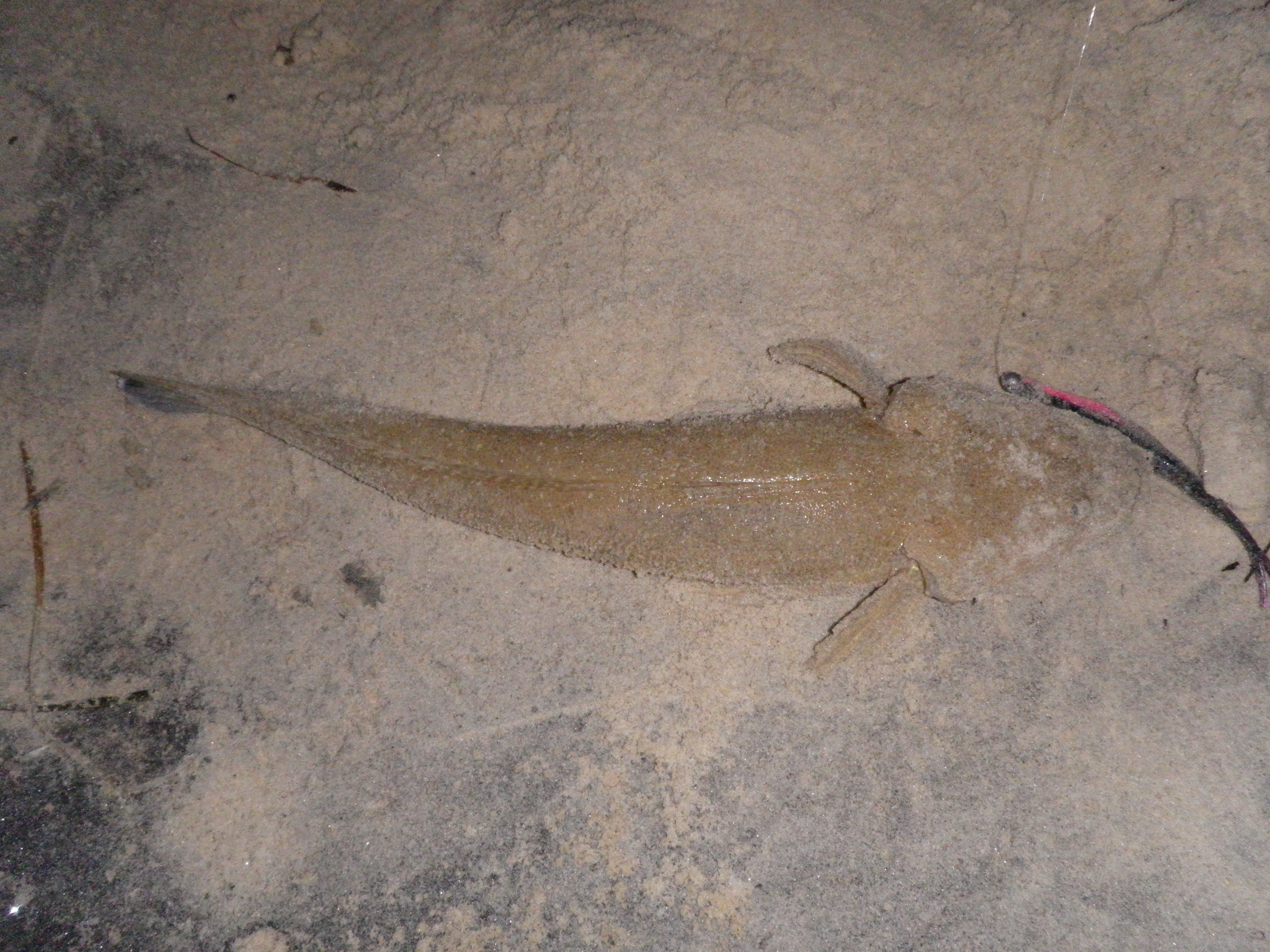
Caloundra Flathead swallows a CULTIVA Miravibe lure

At about 9.30 am I gave up and went for a dip on Kings Beach. A few fish, a swim in the ocean and a fresh cup of coffee overlooking the surf – life’s good!

Caloundra – Trevally, Flathead and a few more old lures – 17 November 2011

Thursday

Back up to Caloundra for another very early start. The same wind pattern, early morning calm followed by a building northerly. The best thing was that the low tide would be after first light, at about 5.45 am.

I walked down onto Bulcock beach at about 4.15 am as the horizon started to glow. After a few casts with a soft plastic – a GULP 5” Jerkshad in the Lime Tiger colour, I had a 40 cm Flathead. It was lying close to the rocks waiting for breakfast to wash by on the outgoing tide. I carried on in the shallow for a while and then turned my attention to the deeper water in the main channel. I swapped to a heavier 1/6th 1/0 jighead – to get a better cast and faster sink rate in the strong current. I had to keep the retrieve fast, so as not to get snagged in the rocks.

I was back to the 7’6” 2-4kg Nitro rod and fishing with a 12lb fluorocarbon leader – so I would have a little bit more power to play a bigger fish, if I found one. I cast out into the main channel with a GULP 5” Jerkshad in the Pink Shine colour. Not long after it hit the water I felt a bump and then a solid bite. It was not a Flathead out there, so I struck after a short pause. Zzzzzzzzzzzzzzzzzzzzzzzzz – I was on to a fish. After catching only Flathead for a week or two, I was blown away by the pace. It was a Trevally and not a particularly big one, but it charged around, all over the place and I had to tighten the drag several times to subdue it. I towed it back to the beach. It was a Big Eye, a bit less than 40cm long but in the current, it had felt much bigger.

I cast back in the same spot and a few seconds later I was on again. I caught about 8 more over the next 30 minutes, all in the same spot and then as the tide turned, they were gone. They were not fussy about colors and had eaten all of the soft plastics that I threw at them – Pumpkinseed, Pearl Watermelon, Camo, Pink Shine, Vader, Satay Chicken.

I decided to head down to Golden Beach to try out some more hard bodied lures. Inspired by the DUO range I have been trying out, I rummaged through my lure boxes to see what else might catch fish. With these northerly winds I think the Flathead are not feeding very aggressively and the vibes and rattles can stir them into a strike, even when they are not really feeding. I found an old, small shallow diving minnow with a good rattle in it and I decided to give it a try. I walked on to the sand banks in front of Gemini Towers and waded out, casting along the edge of the channels and drains, after 5 minutes, I felt a bite but no hook up and after 10 minutes, I was on. It was a small Flathead, just over 40cm but perhaps my theory was right. I released it and a few minutes later I was on to a much bigger one. Unfortunately, I was now about 80 metres from the nearest sand bar and on the walk back it wriggled free. The problem with a lot of hard bodied lures, is the small, puny treble hooks.

I decided to switch to a Strikepro Vibe lure that looked very like the Herring that were floating around the weed beds. It was a 14g, 70mm bibless sinking lure with a decent rattle and good action. Not as refined as the DUO REALIS that I had lost on Tuesday, but pretty close. The first cast travelled 20 metres and sploshed above the weed, on the edge of the channel. A few metres into the retrieve it was rattling along nicely and I could feel the vibrations in the rod tip. Suddenly, it stopped there was splash and I had another Flathead on the line. This was another fish around 40cm long.

It was now around 11 am and as predicted, the northerly was picking up. I decided to give up for the day. I was impressed that both of the ‘noisy’ hard bodies, I had selected had caught fish. The trouble is, I may be about to swap a soft plastic lure addiction for a much more expensive, hard bodied lure addiction!

Caloundra – Bulcock & Golden Beaches – a big Flathead and a runaway – 15 November 2011

Tuesday

Ok – forget about the wind, I told myself. Yes it would be from the north – but the fish must still be there – somewhere, and it was not forecast to pick up until about 9.00 am. Low tide would be at 4.00 am at Caloundra and the top end of the Pumicestone Passage is a little more sheltered than the bottom end, in a Northerly – so that was my destination.

It would have to be an early start – first light would officially be at about 4.15 am , but over the last few weeks, the fish appear to be out hunting for their breakfast as soon as the horizon starts to glow – from about 3.45am. So I set out from Brisbane at 2.45am and reached the rocks on Bulcock Beach at about 3.50 am.

There was no wind and the tide was still running out, but beginning to slow. I started with a GULP 5” Lime Tiger Jerkshad on a 1/6th 2/0 jighead. I cast around the base of the rocks and then waded a fair way out into the shallows. The sand gives way under foot and is constantly moving so you have to watch your step. I was casting just on the edge of the rock bar, which skirts the bank beneath the boardwalk and the car park. I got snagged and re-rigged.

A couple of seconds after the soft plastic hit the water a fish hit it. It must have been slowly sinking down the water column. Unfortunately, after a few days fishing with my heavier spin rod (Nitro 2-4kg) I had swapped back to the light one – the Loomis GL2. It was bent over and the reel was screaming. I had a 12lb leader and the knots would probably hold but I could not exert any pressure on the fish, through the rod. It was running all over the place, out in the middle of the channel. I tightened the drag but it made little difference. It went where it wanted. After about a minute and a half, it changed tactics and headed back in towards the rock bar. As soon as it got next to the rocks, the line went slack and it was gone. I think it had just knocked the jighead and plastic loose on the rocks. Given the powerful runs and its speed, I would think it was a Trevally – who knows?

I cast around hoping there might be a school of them but there were no more takers. I moved into the shallows and decided to try another of the DUO lures I have been sent from Japan. This time I would be using the REALIS VIBRATION 62. It is another beautifully crafted lure. It is a blade shaped vibe lure made of resin with a clever weighting system that means a really consistent swimming action, even when retrieved quickly. The rattle is loud and effective – I think it annoys the hell out of the Flathead – and can stimulate a strike from a fish that would not otherwise be feeding. It weighs 11 grams and is 62mm long, so it can be cast a fair distance and hugs the bottom, even on a fairly fast retrieve.

I carefully worked the REALIS lure over the sandy patches, I could hear the rattle from several metres away. I felt a bite – or was it a snag? I kept it moving pretty fast as I did not want to lose it. The next cast, across the same piece of sand was definitely grabbed and then dropped. Third time lucky – I cast back out and this time the fish made no mistake. There was a splash and head shake as it realized it had eaten something prickly, but it was solidly hooked. I pulled it up on the sand, it was a 52cm Flathead.

I went back to the same area and worked the lure closer and closer to the rocks until, inevitably, it got caught amongst the rocks and that was that. This seems to happen to a lot of my lures!

I took the hint and moved down the Passage to fish amongst the weed beds and sandbanks around Diamond Head. The water had just started to cover the weed along the edge of the channel. I walked across the sand bar to the green channel marker that marks the deeper water in the main channel. There were small flathead lies all over the sand bar, clustered in little groups. I cast around and caught a few small Flathead on a GULP 3” Minnow soft plastic in the Pearl Watermelon colour – between 25 and 35 cm.

After an hour of wading along the edge of the main channel, I decided to drive back up to Golden Beach and try my luck there. The tide was now almost high and the weed banks in front of the Powerboat Club looked like a good target. I waded north from the club, casting along the edge of the sand banks. It was now about 10.30 am and the Northerly wind was starting to pick up, roughening the surface of the water. I waded slowly, changing the soft plastic lure regularly and making sure I moved carefully and quietly. It may be choppy on the surface but it is calm down below. After 45 minutes of this I felt a nice solid bite close in to a clump of weed. I paused, counted to ten, then struck. There was a long slow pull, then a pause, then zzzzzzzzzzzzzzzzzzzzzzzzzzz and zzzzzzzzzzzzzzzzzzzz and zzzzzzzzzzzzzzzzzzzzz. I checked the drag, it was set right with a fair bit of pressure – this was a decent fish. I started to get some line back and moved towards the shore. There were plenty more solid runs but eventually I got a look at a very good Flathead. I kept the rod tip bent and slowly dragged the fish up on to the sandy beach. It was a big female that measured in at just under 75cm. I thought about it, but she was too good-looking to keep for dinner. The lure was now a long way down her throat so I decided to cut the line and leave it to be digested. After a few snaps, she swam away. She had been caught on GULP Lime Tiger coloured 5″ Jerkshad on a 1/8th 1/0 jighead and 12lb fluorocarbon leader.

This slideshow requires JavaScript.

Despite the northerly wind it had been a good session with a cracker of a fish to finish up. I’ll be back!

Bribie Island Bridge & flats around the old Oyster Jetty – 13 November 2011

A long wade - for no fish

Sunday

Northerly winds – I don’t like them. They stir up the water and send most estuary species off the bite. Over the last ten days we have hit that frustrating Queensland summer pattern of an early morning calm, followed by a 15 to 25 knot north-easterly by lunch time. Add in the big tides of the full moon and the Pumicestone Passage is very murky on the bottom of the tide and full of weed, sea grass and other debris on the top of the tide.

Excuses, Excuses – you still have to get out there and try. The Mangrove Jacks don’t mind the northerly and nor do the pelagic species (they just have to keep eating whatever the weather). Therefore, on Sunday morning, I arrived at Bribie, under the bridge on the mainland side, just after first light at 4. 15 am. I waded around, cast soft plastic lures in various colours and sizes, all over the sea grass beds and sand banks for the next three and a half hours, but apart from one persistent Pike, I did not get a bite.
Finally around 9.00 am I gave up – bring on a good south-easterly breeze!