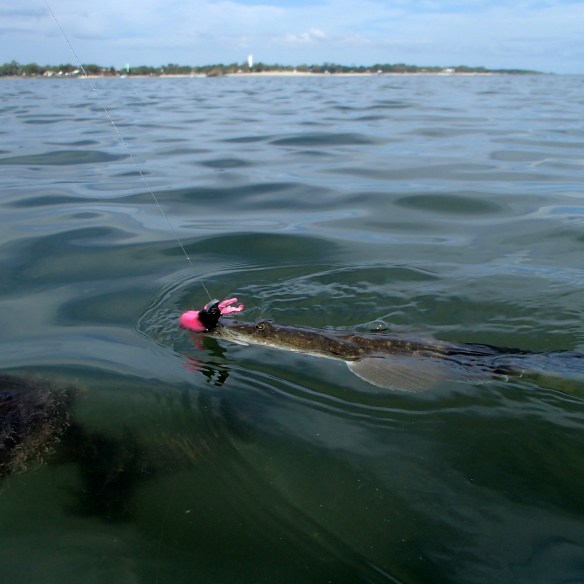
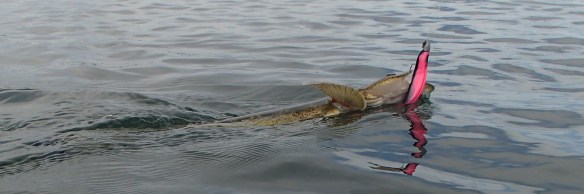
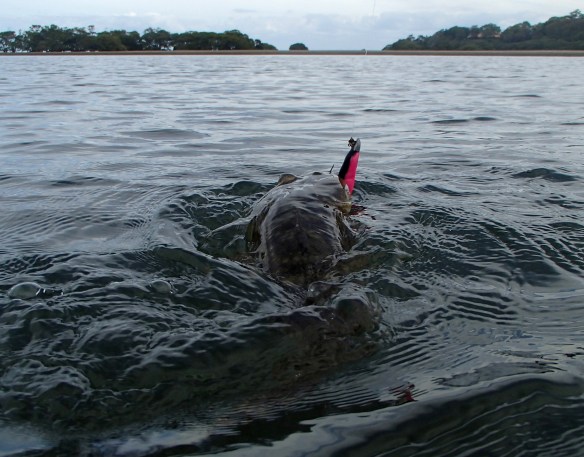
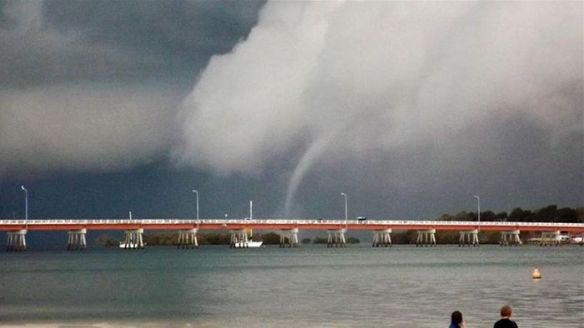
1770 – Wreck Rock – Dart & Slatey Bream – 9 April 2015

By Thursday, the rain had passed over but the wind had picked up considerably. I was up early and decided to try fishing at Wreck Rock. The tide would only be low enough to reach the rocks I wanted to fish from, for about 90 minutes.  The incoming tide would then force me back.

I arrived in the pre-dawn light and walked out to the beach. The sky was gradually turning orange and the wind had dropped right off. It was very light and cool, from the south-west.I walked out on to the rocks on the north edge and picked my way out as far as I could go. The wind had dropped but the swell was up and although the water was warm the cold breeze was nasty.

I knew there would be dart around and predictably, my first cast with a 3” GULP Lime Tiger Minnow soft plastic was just what they wanted. I pulled the first small dart out of the water just after 6.00am.I was sticking with a light 12lb fluorocarbon leader but went with the slightly heavier 1/6th ounce, size 1 hook jighead to counteract the swell.

The dart kept coming but I was hoping for something more significant so I put on the GULP Mantis Shrimp that had caught the slatey bream on Monday. I fished this around for 20 minutes with only a few small hits from the dart. I swapped back to a GULP 2” Shrimp soft plastic in the Banana Prawn colour. This instantly caught the dart again.

I decided to change up to a bigger profile again and tied on a GULP 5” Jerkshad in the Peppered Prawn colour. I cast this one a fair way out towards some a nearby bommie. On its way back to me it was swiped at by a couple of Long Toms, but I did not hook them.

I hit the same area with a few more casts and suddenly there was a quick tug and the reel started screaming. The rod bent over and the fish took plenty of line in a blistering initial run. As soon as it paused I checked the drag tension and realised it was actually quite tight. I tried to get some line back but the fish immediately set off again and snapped the leader. Trevally or maybe a Mackerel, either way a 12lb leader was not going to stop it. I re-rigged with the heaviest leader I had in the bag – 20lb fluorocarbon and cast back out. I peppered the area with casts but whatever it was had moved on.


The wind was now picking up again and the incoming tide was forcing me back along the rocks. I swapped to a GULP Green Camo 4” Minnow and carried on fishing. The dart kept hitting this one and then something slower and heavier grabbed it. It turned with the swell and took a bit of line. It then started swimming away faster, once it realised it was hooked. After a few minutes I pulled it up onto the rocks with the aid of a breaking wave. It was another good sized slatey bream with bright orange markings behind its lips.

I decided to keep this one for supper and so I retreated to the dryer rocks to bleed and clean it. By the time it was gutted the tide had come up further and the wind was really starting to blow so I gave up for the day.

1770 – Baffle Creek – Flat Rock – 22 October 2014

Wednesday

After a windy and stormy night with a fair amount of rain, I woke to grey skies on Wednesday. Agnes Water and 1770 can be a tough place to fish. Half the problem is that everywhere just looks so fishy. The mangrove lined creeks, the rocky headlands and unspoiled beaches. It raises your expectations but as with fishing everywhere, you still need to put in the hard work. That means fishing at dawn and dusk – when the fish eat. It also means trying everything in the tackle box and trying lots of different locations.

Wednesday morning would be wet with rough seas but it was still worth a fish. I was up at 4-15 am and drove down to Flat Rock Beach in Deepwater National Park. I walked out on to the beach and watched the sun come up as I cast a few soft plastics around. The water was murky and it was just too windy, so I retreated and put plan B in to action.

Plan B was to drive further down the sandy track and head for Flat Rock boat ramp on Baffle Creek. It is a fairly wide stretch of Baffle Creek with a few scattered rock bars and mangrove lined edges. The main attraction is a wide rock bar that juts out into the channel and is submerged on high tide. Sadly, despite its fairly remote location, this spot seems to get fished quite a lot and there is a fair amount of boat traffic coming and going from the nearby ramp, especially at weekends and later in the day. When its windy out on the ocean this is the only option.

I arrived at about 11.00 am and only had to share the space with one other land based fisherman – a friendly Kiwi called Chris – who was camping nearby at Wreck Rock. He had had a fair bit of success using flesh baits and pilchards, he had landed a nice mangrove jack, a day previously.  There was sickly sweet smell and I could see it was coming from the nasty green algal bloom covering the mud and the sand, as the tide receded.


I started with my light spinning rig and 10lb fluorocarbon leader. I was fishing with a 1/8th 1/0 jighead and a GULP 2” Shrimp in the Banana Prawn colour. I cast along parallel with the mangroves. The tide was running out. I soon picked up a dusky flathead – 50 cm long. A few casts later the lure was slammed by a fairly significant fish. I hooked up instantly and it took off. On the first leap I could not see what it was. On the second, its black back gave it away as a pretty big (60cm +) Tarpon. It leapt three or four times and kept making blistering runs. With 10lb leader I could not muscle it in so I let it have its head. Unfortunately, as soon as I tried to tighten the drag and put some pressure on, it snapped the leader.


I fished for a little longer with the GULP Shrimp, then swapped to a Jerkshad in the Lime Tiger colour. I had now re-rigged with 15lb leader. After a few casts I had a solid bite and about 3 casts later, another smaller Tarpon hit hard. I set the hook and let it take line and leap around for a few minutes. When it had worn itself out I reeled it in, unhooked it and released it. These are tough fighting fish with small hard mouths, so they can be hard to hook.

I fished on through the falling tide but the wind got stronger and stronger and even made fishing this sheltered spot hard. I had a few bites from smaller fish but at about noon. I gave up for the day.

Bribie – the bridge and the old oyster jetty flats – 12 September 2014

Friday

Another late report – but it may be relevant for anyone planning to fish at Bribie over the school holidays, to get a feel for what is going on. I am planning to get down to Iluka in the next few weeks, so watch this space for a bit more variety.

So I drove back up to Bribie Island to fish my favourite spot on the mainland side of the Pumicestone Passage. I arrived just after first light at about 5.00 am. Low tide would be at 5.25 am. There was a light southerly wind blowing and it was cloudy.

There was a fair amount of bait jumping around under the bridge lights so I decided to start fishing in that area. As I walked out under the bridge I noticed plenty of ‘lies’ showing where the flathead had moved up to feed on the night time high tide.

I started with a small 3” GULP Minnow soft plastic in the Smelt (Grey & white) colour. This plastic looks like just about any small profile bait fish and has a nice soft texture. I cast it towards the edge of the reef, just to the south of the fifth bridge pylon. I waited for it to sink to the bottom and as I lifted, a fish attacked. There was no hesitation and this one hooked itself, as soon as it bit down. It can be a challenge to keep your fish in this area. There are lots of big clumps of weed and rocky outcrops. This fish was a good size and it wrapped itself around a few large weed clumps. Fortunately, the water was shallow enough and I was able to walk up close and free it. After a few minutes of back and forth, I pulled it safely to shore. A solid 57cm flathead, on my first cast – it was a great start.


I tried in the same area for another, but I think my wading around had spooked any remaining fish. It was now low tide and the water was not really moving. I waded to the south. I moved past the old oyster jetty and swapped to the paddle tailed Mad Scientist 6” Optishad soft plastic. I was fishing with a 1/8th ounce, size 1/0 hook jighead and 10lb fluorocarbon leader. At about 6.30 am, I found another flathead, about 40cm long. Then about ten minutes later another smaller fish.

As the tide started to run in, I made my way slowly down to the channel marker, casting into the current and found four more fish – all on the Mad Scientist soft plastic. Only two were about 45cm so I added these to the first one for a family supper. At about 9.00 am I stopped for the day.


Bribie Island – The old oyster jetty flats – 11 August 2014

Monday

After a disappointing outing on Friday I was up earlier on Monday.  It was full moon. In fact, it was a super moon. That is probably why I could not sleep. I did not have much time, so I drove up to Bribie Island for a quick morning session.

The fish are always out there somewhere, so when they are elusive, it is not a bad idea to go back to basics. I decided to drop the leader down to 8lb fluorocarbon, use the fine wire Bream Pro 1/8th ounce, #1 hook jigheads and start with 2” and 3” GULP soft plastics in natural colours – Peppered Prawn, Banana Prawn, Smelt, Pearl Watermelon, etc. This set up should at least attract a few pike and bream.

I started under the bridge lights, on the mainland side of the Bribie Bridge. There was a very light south-westerly wind blowing and the moon was amazing. It was so bright that the fish would certainly have been confused by it. It was just after 5.00 am and low tide had passed at 3.53 am. It had been one of the years lowest at 0.2 metres. The tide was running in fast but there was no sign of any bait under the bridge lights. I cast around with a GULP 2” Shrimp in the Banana Prawn colour. I felt a couple of grabs and half hooked a couple of pike, but they both wriggled off. I had one solid bite, that might have been a small flathead, but it let go before I could find out.

At about 5.30 am, I decided to swap back to the mainland side of the bridge. I drove back over and waded out into the shallows. I stayed about 10 metres north of the bridge and cast towards it. I soon found the pike hiding in amongst the weed clumps and rocks.

I gradually moved south, under the bridge. The mad moon was creating a fantastic bright orange sky, as dawn was breaking. I think the sunrises on the east coast of Australia are the best in the world and this one was as good as they get. My camera does not do it justice – but I am sure if you are as mad about fishing as I am, you will have seen a few of these.

The tide was moving in quickly and the water coming in from the bay was very cold.  I made my way south to the fast disappearing sand bank and fished around this area. It is tough to fish here when the sun is low in the sky, as you cannot see where the sandy patches and weed beds are. You just have to slowly and methodically cover the ground.

I swapped up to slightly bigger GULP Jerkshad in the Cajun Chicken colour. After just a few casts this produced results with a definite hit. I paused but there was no fish there. It was just about 7.00 am. I did not have much more time in this spot as the tide was running in very quickly. I slowed everything down and tried to put the next cast back in exactly the same spot. I left the lure on the bottom for a good ten seconds. I hopped it slowly back towards me – nothing. I cast about a metre to the left and repeated the process. This time after my second pause on the bottom, whack, another solid flathead bite. This time I dropped the rod tip and counted (fairly quickly) to ten. When I lifted the rod the fish was hooked. It felt much bigger than it was (about 45cm) but it was a relief to finally get one.

As the morning progressed the wind picked up a little. The scenery was fantastic and the weather very good but I just could not find the fish. I swapped from small plastics to big plastics, jerkshads to paddletails to grubtails. I tried my DUO hard bodies but nothing worked.

At about 9.00 am I had to give up. It looks like I am going to have to put in a lot of practice to find my form again!

Bribie Island – The oyster jetty flats and Pacific Harbour flats – 8 August 2014

Friday

After more than a month away from the water, I was in a hurry to get out and do some fishing. I finally had a morning off on Friday and jumped in to the car and drove up to Bribie. I arrived at about 5.30 am, just as the sky was beginning to brighten. I pulled on my waders and realised I had forgotten my camera  (which turned out to not really be a problem). I admired the new picnic tables the council has installed on the mainland side of the bridge. I presume they realised I needed a proper area to eat my lunch and drink my coffee.

Bribie Island - just before dawb

Bribie Island – just before dawn


High tide would be at 6.59 am and full moon was due on Monday. There was virtually no wind – perhaps a slight cold south-westerly. I cast around under the bridge lights and caught a Pike on a small minnow soft plastic. I had a few more bites but did not hook any more. The sun came up and I moved to the south. I fished around the sandy patches, drains and weed banks, hoping to locate a flathead, but it seems the fishing gods were punishing me.

I fished for hours  and watched the tide run out until I could reach all my favorite spots, but I could not raise a bite. At 10.30 am I drove over the bridge to the sandy flats, just north of the entrance to Pacific Harbour. The tide was now more than half way out and I fished all along the coffee rock drop off, that runs along this stretch of shore. I tried everything in my tackle pouch – big and small soft plastics and hard bodies but again, I did not feel a bite.

After seven hours without success I finally gave up at 12-30 pm. No fish – I may have lost my mojo!

Bribie Island – the old oyster jetty flats – 20 June 2014

Friday

Sorry readers but I need to post one more very old report for the sake of the historical record. In a thousand years, when the new inhabitants of our planet decipher this blog from a fossilized hard drive, they will be truly perplexed. Imagine the discussion: ‘Yes it appears they wandered around in shark infested waters in long rubber trousers and then used brightly coloured plastic fish to try to catch more fish…….. and when they did finally catch them, they usually let them go!’

So cast you mind back to late June and a cold snap. The flathead fishing had been good but was gradually slowing. The temperature had been down to 9 Celsius overnight and the water was very cold. A light, cold, south westerly wind was forecast. The moon was 50% full and waning. There had been some very light showers overnight and after sun up, the sky was grey and cloudy.

I waded out under the Bribie Bridge at about 6.00 am. Low tide would be at about 9.00 am, so there was still plenty of water covering my favourite target areas. The first taker was a 40 cm flathead, lurking under the lights to the north of the bridge. It swallowed a GULP Pearl Watermelon Jerkshad at about 6.20 am. I was fishing with a 1/8th ounce, 1/0 jighead and using 10 lb fluorocarbon leader. I let the fish go and moved on.

The sky looked ominous. I moved south towards the old oyster jetty. It took about an hour to find the next fish. 45 cm long, it was sitting on a sandy patch of bottom, in the middle of the weed beds, just east of the big sand bank and south of the jetty. I then caught three more fish from the same patch of sandy bottom, in quick succession. They were all just over 40 cm long.

I carried on wading south. After no luck for a while I swapped to a Zman Minnowz paddletail soft plastic, in the Opera colour. This one stirred up another flathead, after a few casts. It was probably about 35 cm long. I carried on with this plastic for another 20 minutes and kept moving. Then I swapped again, this time to a GULP 3” Minnow in the Sardine colour. Once more the change of offering produced a fish – but again it was under the 40cm legal size limit.

As low tide approached I had to give up for the day. Despite the cold water and wind, there were still a few fish around.

Bribie – the old osyter jetty flats – 7 June 2014

On Saturday it would be a morning high tide at 3.52 am on Bribie Island. So on past performance the fishing would start to get really good around 7.00 am, which sounded great. I arrived at my usual spot, beside the old oyster jetty, at about 5.45 am. The air was still but it was very cold.  The moon was just into its second quarter, so it would not be a very powerful or big tide.

The water was up to the mangrove roots, so I moved slowly south. I cast a GULP Crazylegs Jerkshad soft plastic, in the Curried Chicken colour, ahead of me, into the shallows, parallel with the shoreline.  There a few sandy patches in this area and they had been covered in flathead lies, the last time I was here, so I peppered the area with casts.

At about 6.30 am just before the sun came over the horizon, I felt a definite bite but did not hook up. I threw the lure back in exactly the same place and slowed things down. After a long pause on the bottom, I slowly lifted the rod and then flicked the tip. I wound in a little line and then repeated the pause. When I lifted the rod, the fish had already grabbed the plastic and it was hooked, instantly. It was a good flathead around 45 cm long. I released it and tried again and was instantly rewarded with another, slightly bigger one.

As the sun rose, I could see lots of small squid and I noticed the pelicans where swimming around picking them off. This might be what has brought the flathead in. I fished around the mouth of the drain that runs off the flats, from the direction of Pebble Beach. I did not get much interest here so I waded out on to the long sand bank, which runs to the south.  I swapped over to a GULP 4” Minnow in the new Green Camo colour. The sand bank was still was covered in water. From here, I cast at a sandy patch that sits about 30 metres directly south of the jetty. As soon as the lure hit the water it was snaffled. After a brief fight, I had another 45 cm flathead swimming beside me.

I released this one and cast straight back into the same spot. This area is always fishy because it is where the water running off the flats meets the water running down the main channel of the Pumicestone Passage. The current flow forms a bit of a depression with a sandy bottom. After a couple more casts I felt a fast solid hit. The rod tip bent over but this fish was faster than a flathead. It took a bit of line in a few quick runs then I saw the flash of silver and realised it was a good sized bream. It had seriously munched the 4” Minnow soft plastic. It was about 33cm long, I tried for another but could not find any. It was now just after 7.00 am.

As the tide ran out I gradually moved closer to the edge of the weed beds. I caught a couple more 35cm flathead on the GULP 4” Minnow and then decided to try something bigger. I loaded my 1/8th 1/0 jighead with a GULP 7” Jerkshad in the Peppered Prawn colour. This is a very big plastic for a flathead so I flicked it slowly along the bottom with plenty of pauses. I felt a definite bite but struck too soon and probably pulled the plastic out of the fish’s mouth. On the next retrieve I slowed it down even more. In exactly the same spot, I felt the bite and this time I dropped the rod tip and counted to ten. When I lifted it the fish was on. Amazingly, it was a just legal sized 40 cm flathead. I carried on with this soft plastic for a while but I could not catch anymore.

I swapped down the spectrum to a GULP 2” Shrimp in the Banana Prawn colour and fished around the same area. I caught a few more flathead that were just undersize. There were clearly plenty around but I had only caught 4 that would have been big enough to keep.

As I pondered what to try next an old timber bibbed minnow floated past. The front eyelet ring had pulled out. It was nice to get one back. I will have to try and fix it up. It was now getting close to low tide and I had to stop for the day.

In summary, the flathead are back in large numbers but they are mostly under 45cm. Size/ type of lure did not make much difference today. Perhaps they have followed the plentiful squid into the shallows.

Bribie – the bridge, the Seaside Museum creek, the old oyster jetty – 22 May 2014

Thursday

The wind was up again, making it hard to know where to fish. It can be unpredictable, as we move firmly into winter, but as the direction becomes more consistently from the south east, I find the fishing usually improves.

For some reason I could not sleep, so I got up at about 3.30 am and arrived at Bribie at about 4.30 am. The weather was not good. The wind seemed to be building and it was swapping between drizzle and real rain. There had been plenty of activity on the island side, under the bridge, early on Monday morning, so I started there.

The wind had blown the floating sea grass over to this side of the Passage and now it floated by in huge clumps. I loaded up a GULP 3” Minnow soft plastic in the Banana Prawn colour and threw this around for a while. I fished here for about an hour and the contrast with my pre-dawn session on Monday was stark. Despite changing through a few soft plastics, I did not feel a single bite. There was no surface activity and the water seemed completely devoid of fish. At about 5-15 am, I swapped to the DUO Realis Shad 59 MR – my current favourite suspending, hard bodied lure. After a few casts, I caught a small (35cm) flathead. I released it, tried a few more casts and then decided to move on.

At 5-30 am, I moved down to the ledge and the creek drain, in front of the Seaside Museum. The rain had stopped but it was so cloudy that it looked like there would be no real sunrise. Low tide would be at 10.03 am. I waded down to the point where I caught the decent bream on Monday and started casting, with a GULP 2” Shrimp soft plastic. The wind was up and making things tricky. I could see the ledge and I cast at the area both on top of it and beyond it, but did not have any luck. I waded south, following the tide out. I swapped through small and large soft plastics but nothing produced a result.

Then the excavator started up and dug a trench to release the tidal pool that had gathered overnight. I did not think this would do much for the fishing, so I switched locations again. I crossed back over the bridge to my old stomping ground – beside the old oyster jetty.

I swapped to a Powerbait Jerkshad soft plastic lure, in a grey/ silver/ neutral colour. I had also dropped my leader down to 10lb fluorocarbon. The tide was still running out, hard. The water was clear and the sun was trying to come out. It did not take long to find the fish here. I caught the first flathead sitting just behind a submerged weedy sand hill, about 30 metres south of the jetty. It was about 45cm long. I caught three more, about the same size, in quick succession. Then things went quiet.

I was pretty sure there were more fish in the area, so I swapped to a Mad Scientist 4” Optishad soft plastic in the Motor Oil colour. This is a great plastic with a whopping great shad tail that pounds along the sandy bottom. I could not find any more fish in the same spot, so I moved about 10 metres further south. The Optishad worked its magic and caught two more flathead in successive casts. They were almost exactly the same size as the others.


Over the next hour, I caught about 10 more flathead. Most were about the 40 cm size. Only two looked like they were over 50 cm. I swapped through a few more lures, to see if this would affect the size of the fish, but it did not seem to. I put on the new DUO Realis Shad 62DR – a slightly longer, deeper running version of the Shad 59MR. This also proved a hit and accounted for a few more fish.

Eventually I tied on a large timber Detonator 100 from Lethal Lures  – http://www.lethallures.com.au/ , that I bought at Barra Jacks (in Rockhampton) and gave that a go. It was awkward to fish on my light rod and picked up plenty of weed but, after about 10 casts, it caught another 45cm flathead.

At about 11.30am, with the tide running in, I gave up for the day. There were plenty of fish around on one side of the Passage, today, and none on the other. That’s why you have to keep moving.

Bribie Island – WARNING – the old oyster jetty flats – 16 May 2014

Friday

I only had time for a quick fishing session on Friday, so I raced up to my usual spot at Bribie Island, just before dawn. I was going to fish the flats around the old oyster jetty, on the mainland side of the bridge, again.

A word of warning – this area can be dangerous. The sand banks and weed beds constantly shift and there are patches of muddy bottom, where you can easily get stuck. Once you start sinking, it can be very difficult to free yourself and the waders can make things worse, especially if they fill with water.  You should survey the area at low tide and only fish where you are sure of your footing.  A small self-inflating PFD, is a good accessory to have.  I have heard reports lately of a number of people getting stuck in the mud.  No fish is worth having a heart attack or drowning for – so please take care. A special thank you to local fisherman, Richard –  who safely extracted someone from the mud last week.

I arrived at about 5.45 am and it was the day after full moon. There was no breeze at this stage, but as the sky started to change colour a light, cold wind picked up from the south-west. As the sun came up, I realised I had forgotten my camera. Sometimes it’s more fun just to enjoy the show!

After dawn, the wind turned into a stronger south-easterly. The tide was running in. It had been low at about 4.30 am. This meant I could only fish my favourite zones until about 7.30 am, at the latest – after that, they would be out of reach.

At about 6.20 am, I caught my first fish of the day – it was a 48cm flathead and I got it on a GULP Jerkshad in the Lime Tiger colour. I stuck with this plastic for about an hour but I could not find any more fish.

I moved further south and decided to try out a new GULP colour – Green Camo. I had it in the 4 “ minnow pattern; one of my favourite profiles. This soon did the trick and I found another flathead that was just over 45 cm long at about 6.45 am. I fished on until about 8.30 am and caught three more flathead, which were all too small to keep.

At about 9.00 am, with a now belting south-easterly wind blowing, I gave up for the day.

Bribie – the old oyster jetty to the channel marker – 21 April 2014

Monday

I am disappointed to report that once more the curse of paid employment has slowed down my posting and fishing. If the current government has its way, I shall be doing more work, for a lot longer than I had planned. I understand that when the pension was first introduced around 1910, the qualifying age was 65 and life expectancy was 58. So it was the ultimate healthy lifestyle bonus. Rarely did the government have to pay out for more than a few years. Now, most of us will get to our mid 80’s (especially if we eat plenty of fish). So we nearly all qualify for some portion of state funding for 15 years or more. Someone has to pay for it and the woeful performance of most people’s superannuation fund managers, means they will not be making much of a contribution. It’s a mess and it can only mean one thing – the current Australian age pension is probably as good as it will ever be.  So next time you see someone with more grey hair than you, whingeing about the cost of bait, remember you will be working long after they put their feet up, so ask them to shout you a beer. Of course, I can’t imagine who will employ me when I am 65 but that’s a whole another can of worms.

That’s enough social commentary. I was keen to see if the flathead glory days of early March would return. I drove up to Bribie on Monday, to fish the run out tide, which would be low at 8.00 am. It was still school holidays and during my last few visits, there has been plenty boat traffic. The wind has been changing between a light south-easterly and a northerly, with the occasionally cool westerly appearing, in the early morning. On Monday, it was light and cool from the south west. The overnight westerlies will start to bring the water temperature down quite quickly, if they persist. We were about half way between the full and the new moon.

I started in the dark and decided to head straight to the area to the south of the old oyster jetty, on the mainland side of the Pumicestone Passage. My last few sessions through the Easter Holidays had produced some quality fish, but the numbers were thinning out.  I decided to fish with neutral/ natural coloured soft plastics, just in case the fish were getting picky. I started with a GULP 2” Shrimp in the Peppered Prawn colour. I loaded it on to a 1/8th ounce, 1/0 jighead.  It was 5.30 am and the sky was just beginning to turn orange along the horizon. I cast the plastic a long  way out and after two hops, I felt a good bite. Then the line went slack. I wound up the slack and suddenly, I was in contact with a fish again. It was swimming towards me but now it turned away. As it pulled away, the hook struck home and it took off with a blistering first run. I gradually subdued it, but it was powerful and angry and this area has a big patch of rocky bottom, close to the shore, so I took it slowly. After a few minutes, I pulled the fish on to the sandy beach. It was a big female, just under 70 cm. After a few pictures, I let her go.

The sun came up and I waded further south, following the falling tide. It was pretty quiet and it was not until 6.25 am, that I got another bite. I had swapped to the GULP 2” Shrimp in the Banana Prawn colour and hooked another slurping, grunting, spiny puffer fish. I pushed it off the hook and continued fishing. I then caught a couple of undersized flathead in quick succession. Then things went quiet again. I swapped to a longer GULP Jerkshad in the Peppered Prawn colour and this soon attracted a few bites. About 10 minutes after the change, I caught a big (35cm) pike. I was now about half way to the green channel marker.

The water slowed and I turned back towards the jetty. At about 7.20 am I caught an almost legal size flathead, which I released. It was getting frustrating. By low tide at 8.15 am, I found myself back beside the old oyster jetty. I had swapped back to the Shrimp in the Banana Prawn colour. I put in a few last casts and then bang, a big fish grabbed the Shrimp soft plastic, just as it landed. The fish was lying in no more than 20 cm of water. It was big and powerful and as it was so near the surface, it immediately started shaking its head. It ran hard but after about four good runs, it was spent. I waded through the soft muddy weed and pulled it ashore. It was another 70 cm model, or perhaps it was the one I caught earlier. It looked a very different colour in full daylight, but you never know.

I had caught some good fish but I had released them all. It may be time to fish somewhere else for a while.

Bribie – the old oyster jetty flats – 16 April 2014

Wednesday

On Wednesday I drove up to Bribie and arrived just before first light at about 5.30 am. On Tuesday night we had a lunar eclipse and the full moon was huge and bright in the west. There was a surprisingly cool south-westerly wind blowing. Low tide had passed just after 4.00 am so by the time I waded out on to the flats, the tide was really running in.

Just before dawn there was some surface action under the bridge lights so I cast a GULP 3” Minnow in the Smelt colour around the pylons. This soon produced a couple of small Pike. I witnessed another beautiful sunrise and then continued wading south.

The big moon and meant a fairly big tide. The big tide had lifted all the storm debris from the previous week and it was soon clear that this would be the major obstacle to fishing the incoming tide. Seagrass, weed clumps, bait bags, floats and plastic bottles all started to passed by.

The only advantage of all the floating debris was that it allowed me to examine the water currents in the area. There is obviously a slightly sheltered area just to the south of the old oyster jetty and this is often where you find fish. It is protected by a couple of patches of rocky reef to the east and the tree line, on shore, to the west. At certain points in the tide cycle the water in this area slows right down and the debris gathers in a big clump.

I cast around the edges of this slow moving water looking for fish but I got virtually no bites. Just before 8.00 am it was getting too hard to fish into the strike zone, so I started back for the car. I was casting a GULP Jerkshad soft plastic in the Cajun Chicken colour on a 1/8th ounce , size 1/0 hook jighead. Suddenly the line went tight and the rod tip started to wriggle. I set the hook but the fish took a while to register – this often means it’s a big one. It swam towards me for a few seconds and then realised something was amiss. It took off with a long, blistering run towards the jetty. I let it take line and then gradually started to get some back. There were a couple more long runs but after a few more minutes I caught site of a very decent flathead. I steered her up to the beach and took a few photos.  She was just under 70 cm but I let her go. They really can be a bit tough to eat at this size and if I want to still be catching plenty of fish in future seasons, it makes sense to let these big breeding females go.

This final fish rescued what would have been a pretty dismal session. They seem to be far easier to find on the run out tide in this area. The sudden cool south westerly wind may also have put them off their food.

Bribie – the oyster jetty to the channel marker – 10 April 2014

Thursday

I only had time to fish the afternoon run-in tide on Thursday. I arrived at the mainland side of the Bribie Island Bridge at about 12.30 pm. It was a hot, humid day.  It had rained again, in the morning and there was a light northerly wind. Low tide had passed at 12.20 pm. It was a hot still afternoon.


Clumps of weed everywhere

I waded south past the oyster jetty. The water was hardly moving but it was very dirty. As the tide started to run in, it became difficult to fish as the jighead caught on clumps of black, rotting weed. I swapped through a few different soft plastic lures and decided to stick with the GULP Jerkshad in the Cajun Chicken (black & pink) colour.

Just one keeper

It was hard work and I waded further south. As the tide picked up pace, I caught a 45 cm flathead, about 50 metres to the south of the jetty. It was now about 1.30 pm. I carried on towards the green channel marker and caught another 30 cm flathead at about 2.00 pm.

OLYMPUS DIGITAL CAMERA

I swapped to the Mad Scientist Optishad paddletail soft plastic and I got a few bites on this but could not stay connected with anything. Just to the north of the big exposed sand bar I felt a bite. I hooked the fish but it was a slurping, spitting spiny puffer fish. This reminded me why I wear waders. I carefully retrieved my lure with the aid of my pliers.

Porcupine puffer

By about 2.30 pm the incoming tide was pushing me off the edge of the weed beds so I gave up and waded back to the car. It had been a tough session in the middle of the day.

Bribie – the old oyster jetty flats – 8 April 2014

Tuesday

Stormy weather

Stormy weather

A massive storm hit Bribie Island on Sunday – dumping significant rain and really stirring things up. So I left it until Tuesday to go fishing again. It was now about half way between the new moon and the full moon. The wind was forecast to be a light south-westerly. It felt noticeably cooler as I got out of the car, by the bridge at about 5.30 am. The water was definitely cooler, as I waded out on to the flats beside the old oyster jetty. Low tide would be at about 10.30 am.

Just to the south of the jetty I concentrated on a patch of weed that has produced a few flathead in the past. I was fishing with a Gulp 4” Minnow in the Smelt colour. I had it rigged on a 1/8th ounce, size 1/0 hook jighead. As it is now possible that there are a few Tailor around, I am consistently fishing with a 12lb fluorocarbon leader. This won’t stop big fish but it might give me a chance with some good sized choppers.

At about 6.00 am, I felt a few very aggressive bites but did not hook up. I persisted in the same spot and after about 10 minutes, I felt a solid yank and line started peeling. I had hooked a big Long Tom and it promptly leapt out of the water for the camera. I let it get rid of some energy then released it, recovered my jighead and chewed soft plastic. The leader was completely lacerated. So I cut off the last 10 cm and tied my jighead back on. I straightened the soft plastic and carried on casting.

The fishing was very tough. I tried a couple of small hard bodies and jerkshads with no success. By about 7.15am I had dropped down to a GULP 2” Shrimp soft plastic in the Banana Prawn colour. I managed to catch a couple of very small flathead on this plastic.

I waded all the way down to the big sand bar beside the green channel marker, but the fish were elusive.  I swapped to a GULP 3” Minnow in the Smelt colour and this enticed another 30 cm flathead, but it was a long time between bites.

As the tide continued to run out I waded back closer to the oyster jetty and decided to swap to a Z Man Minnowz soft plastic in the Red Bone colour. As I have mentioned before I am no longer a fan of the Headlockz Jigheads. They hold the lure in place but I think they are a bit clunky for this type of estuary fishing. I therefore chose to put the plastic on a Nitro Bream Pro 1/8th ounce, size 1/0 jighead. I hoped the vibration of the paddletail might be more obvious to the fish. It took a while, but after about 30 minutes I did finally catch a 45cm flathead. I swapped to a Minnowz in the Opening Night colour and after about another 30 minutes I caught another, about the same size.

By 10.00 am I had had enough and the wind had picked up. As I waded back towards the bridge a came across plenty of flathead lies – so the fish are around, somewhere. It had been another tough session.

Bribie – the old oyster jetty flats – 4 April 2014

Friday

There had been a few showers and more were forecast. There was also a cyclone forming, up north. The new moon, four days earlier had not really made any difference to the fishing but it had coincided with some heavy rain, which may have limited its effect.

I set off back to Bribie Island. For the last two months I have fished here, exclusively. I apologise to readers who would like a change. But it has been good to fish through a few moon cycles and big weather changes and notice how they the effect what I catch.

Since the first week in March, I have been catching a lot of flathead from the sand flats, on the mainland size of the Pumicestone Passage, to the south of the Bribie Island Bridge. The fish were probably most numerous and at their most aggressive, in the run up to the full moon on the 16th March. The size of the fish and the numbers then gradually dropped off, after the full moon.  We then had some heavy rain which may have pushed them out to saltier water.

Looking back over my archive of fishing reports, I see I have had a number of excellent flathead sessions at this time of the year, in this particular spot.  The large numbers, the aggressive feeding and the fact that a good proportion of the legal size fish I have kept are full of roe, suggests they had gathered to spawn. It seems unlikely that the flathead only schooled up in this one location and I have seen many reports of good flathead catches, through early March, in the fishing press.

According to the sparse research that has been undertaken on flathead (principally in New South Wales – see ‘Reproduction and growth of dusky flathead (Platycephalus fuscus) in NSW estuaries’ – July 2008. NSW Department of Primary Industries – Fisheries Final Report Series No.101 ), they spawn between – September and March.

This would put this particular spawning session right at the end of the window. This is interesting because most fishing pundits will suggest the end of the cooler months – September / November is when you more reliably catch large numbers of spawning flathead. Hopefully I will have time to fish then, as well and I will compare the results.

Back to Friday – low tide would be at 6.28 am and it would be a fairly high low tide, at 0.7 m. I arrived just before first light, at about 5.15 am. It was still warm and I had driven through a couple of showers on the way up from Brisbane. The wind, if there was any, was form the south east.

I waded out into the shallows beside the bridge and cast around with a GULP 4” Minnow soft plastic in the Smelt colour. It was still dark and a few fish were feeding under the bridge lights. On my second or third cast I felt a solid bite, paused and hooked a good fish. I steered it out of the rocks, which dot the area and dragged it to the shore. It was a solid 50 cm flathead.

The next fish came about twenty minutes later, just to the north of the oyster jetty. I was then treated to a really fantastic sunrise which lit up a rain squall that was coming my way. It was now about 6.00 am. I caught a few more flathead in this spot, but they were all under 40 cm.

I moved to the south of the jetty and pulled out another new favourite of mine. The Lucky Craft 4” Mad Scientist Optishad soft plastic lure, in the Pearl Vairon colour. This is the ultimate shape for a flathead soft plastic. It is a Jerkshad with a huge paddle tail. The slim body accentuates the paddle tail and you can really feel the lure moving as you hop it along the bottom. Thanks to the guys at Jones Tackle for introducing me to these – http://jonestackle.com.au/.  It did not take long to find the fish. Between 6.30 am and 8.15 am, I caught 8 more flathead on this soft plastic. However, only two of these fish were over 40 cm.

At about 8.30 am I was soaked by a rain squall and decided to give up.  There are still plenty of fish out there, but the bigger ones are getting harder to find.

Bribie -still at the oyster jetty flats – 13/14 March 2014

Thursday – Friday

I accept that these reports are getting predictable but it is very hard to stay away when the fish are so prolific. So on both Thursday and Friday, I returned to Bribie to fish the last few hours of the run out tide.

The tides would be low at 1.50 pm on Thursday and 2.36 pm on Friday.  The tides were getting bigger, as we headed for the full moon on Saturday. The water was therefore running in and out faster. It was the same wind pattern – east-south-easterly, building through the day. A northerly change was forecast to raise temperatures and blow up on Sunday.

On Thursday, I started at about 10.15 am. There was plenty of water at the base of the mangrove roots, so I started off by casting in to the shallows, just north of the bridge. There is a nice weed bed here and a few sand banks. I started with the GULP 2” Shrimp in the Peppered Prawn colour. I was fishing with 12lb leader and my light spin rod. After a couple of casts, I found my first flathead at about 10.20 am. It was just about 40cm long. I released it and five minutes later I had a much more aggressive bite. I reeled in a tiny moses perch, which had been hovering close to the first bridge pylon.

I moved south past the old oyster jetty and at about 10.45 am, I caught a bigger flathead – about 50 cm long,  on a Gulp 3” Minnow in the Peppered Prawn colour. It was about three hours from low tide and the band of sandy hollows and weed beds, where I have been catching most of the fish in recent sessions, was now within casting range.

I caught a few more fish on the Gulp 4” Minnow and Jerkshad soft plastics and at about 11.30 am, I decided to give the DUO Tetraworks Toto a work out. This is a 2.8 gram, 42mm sinking minnow. It has a tight rolling action. You just cast it – count to five to let it sink, then start a slow and steady retrieve, hop it along the bottom in short bursts like a soft plastic.

This slideshow requires JavaScript.

My first cast with the Toto connected with a fish. This lure caught 5 more flathead over the next 30 minutes. The largest was just over 60 cm. At about noon, I swapped to the DUO Realis Shad 59 MR – a slightly larger, suspending minnow. This really is a great flathead lure and will also catch bream, if they are around. It has a good rattle and the buoyancy balance is perfect. It will suspend in the water column for about 5 seconds, before slowly floating upwards – giving a bottom dwelling predator plenty of time to strike.

First cast with the Realis Shad also produced a fish and over the next hour it produced a fish every 3 or four minutes. On average the hard bodies seemed to attract slightly bigger fish than the soft plastics had done.

Just before 1.00 pm, I was playing a decent flathead that had locked on to the DUO Realis Shad. It was a big fish – well over 60cm, so I decided to pull it in to the shoreline to unhook and photograph. I was a bit impatient and had the drag set a little too tight. When it saw that we were heading for the mangroves, it turned, shook its head and snapped the leader. When you are catching plenty of fish the leader gets worn very quickly, so it pays to keep checking it. At this point I gave up for the day.

On Friday it was a similar story. The fish were a little less plentiful, but the wind was far stronger, which may have made them a little harder to catch. I focused my efforts on an area further to the south of the oyster jetty and again found that the hard bodies – particularly the Rio Prawn lure, found the bigger flathead of the day.

I must go and explore if the fish are everywhere or just clustered over on this side of the Passage. Maybe next time.

Bribie – the oyster jetty flats – again – 12 March 2014

Wednesday 12th

I paused, reluctantly, to dry out the fishing bag and finish filleting and skinning a few flathead, on Tuesday. By Wednesday I had spotted an opening for another fishing session. I was working around the low tide on the flats at Bribie.

I drove up to arrive at about 10.00am – very civilised. We had the same wind pattern as we have now had for about ten days – a 10 to 15 knot east-south easterly wind. It was a bright, sunny day and the wind was building. The water was clear and running out and the full moon would be on Saturday. Low tide would be at 1.10 pm.

I started to fish the small patch of reef just south of the Bribie Island Bridge, on the mainland side. The rocks were just visible above the receding tide. I started the day with a soft plastic. As you will have noticed I prefer to prospect with a soft plastic lure – once I find the fish I will then start to experiment. Today I chose the GULP Jerkshad in the Cajun Chicken colour. I was fishing with 12lb fluorocarbon leader and using a 1/8th ounce, size 1/0 hook, jighead.

I soon found a fish, just to the south of the bridge. This flathead was just below 40cm long. I would release everything I caught today – there is plenty of fish in the fridge. I cast back in the same area and found another, smaller fish.  I moved closer to the jetty and caught 3 more, before wading under the jetty.

As with the previous sessions, the fish kept coming. I swapped from soft plastics to hard bodies and these were even more successful. I caught a 60cm flathead on the MARIA 90 mm MJ Twitch suspending minnow and a 66 cm fish on a RIO Prawn lure, in the 13 g size. The DUO range chipped in with some good flathead on the DUO Tetraworks Toto and, my current favourite – the suspending DUO Realis Shad 59 MR. This one really is a flathead slayer – the action and rattle seems to drive them wild.

I fished from 10.30 am to about 1.30 pm and I rarely went 5 minutes without a fish. I finished the session with some good sized flathead on the Powerbait 5” Rippleshad paddle tail soft plastic, in the black and gold colour (which I usually reserve for chasing Jewfish).

For the fish to be here in such numbers I can only conclude that they are feeding up to spawn. A few of the fish I kept last week were full of roe. It is early but apparently flathead can choose to spawn at any time and do not do it on mass, like bream.

Whatever the reason, I hope they stay for a while –  it’s a great time to be out there fishing.

Bribie Island – Whitepatch – 13 February 2014

Thursday

I am afraid this post relates to a fishing session which is now almost three weeks old. My apologies but for the sake of keeping my fishing diary up to date, I will summarize what happened.


I decided to fish at Whitepatch on Bribie Island, low tide had passed at about 2.45 am and it would be a fairly big run in tide. There was a very light south-easterly wind blowing when I arrived, just after 5.30 am.  I parked by the stairs and waded out towards the drop off. I stopped to pepper the area of weed beds just in front of the ledge. I started with a GULP Jerkshad in the Orange Tiger colour. The first few retrieves were grabbed at by something….moses perch, pike, maybe.

I persisted and after about fifteen minutes I found a small flathead. I released it and carried on fishing. Fish kept hitting the big plastic but I was not hooking them. The tide was getting higher and it was now difficult to cast over the edge of the drop off. I swapped down to a smaller GULP 3” Minnow in the Peppered Prawn colour. This did the trick and I soon caught a few small yellowfin pike.

As the tide came up I waded further south. I kept casting and soon started to catch a few small moses perch. They gradually got bigger but none were bigger than the legal size of 25cm. I swapped through a few different small soft plastics and caught more moses perch and a few tiny whiting.

I put on a GULP jerkshad again, in the Satay Chicken colour and turned to wade back to the car. It was now about 8.30 am and heading for high tide. As I waded to the north I cast in front of me. After a few attempts this method produced the best fish of the day – a 46cm flathead.

After this I gave up. I had caught plenty of fish but only one would have been big enough to keep. Despite the lack of dinner it had been an interesting fishing session.

Bribie – the oyster jetty flats – 3 February 2014

Monday

By Monday the weather looked more promising for a fish at Bribie. A few showers but the wind would drop to about a 10 knot south-easterly, early in the morning. Low tide would be just after 5.30 am, with first light at about 5.00 am.

I decided to fish on the flats around the old oyster jetty on the mainland side of the Pumicestone Passage. If the flathead are around, this is usually where they are easiest to find. It rained for almost the whole journey up from Brisbane but it was not very heavy. I waded out into the shallows, under the bridge at about 5.00 am. The tide was still running out but slowing down quickly. I left the area under the bridge alone as I wanted to reach the jetty while the water was still running out.

I was fishing my light rig – G.Loomis TSR series light spin rod, Shimano Stella 2500, 15lb Super PE braid and the new Gamma 10lb fluorocarbon leader. I started with a soft plastic lure – the GULP Jerkshad in the Watermelon Pearl colour.  The wind was negligible so I dropped down to a 1/8th ounce, 1/0 jighead. This would hop over the weed on the shallows, if moved fairly quickly.

It was light enough to see but the sun was not yet up. I was covering the area just south of the jetty with casts. After a few minutes I caught the first flathead, lying in wait, behind a clump of weed. It was a little over 45cm. It destroyed the Jerkshad and I did not have another, so I put on a smaller, 3 inch minnow in the same colour. I cast at the same spot and instantly hooked up again. The smaller plastic had produced a bigger fish – this one was about 55cm long.

I carried on prospecting around the rocky bits of reef and weed clumps that dot this area. I connected with something that turned out to be some abandoned braid. I decided to wind it up. It was probably 50 lb breaking strain and there was plenty of it. I waded up and down, pulling it off the rocks and as it loosened, I could feel something moving in the end of the line. I eventually reached the leader that was also pretty substantial – perhaps 60 lb+ breaking strain. Then I saw the source of movement; two mud crabs – one large, one small, were completely tangled up, but both wriggling.  I took a few pics and gradually untangled them. One looked big enough for dinner but I am not an experienced crabber – so I could not tell if it was male or female. I was also fairly unsure as to how I would grab it! I cut the last bit of line off and they both slipped away. I wound up the remaining leader and found a very substantial – size 8/0 hook on the end of it.

The sun came over the horizon and the run out tide fizzled out. I moved further south. I kept swapping colours and sizes of soft plastic and caught flathead on the GULP Minnow, Shrimp and Jerkshad shapes. The Watermelon Pearl, New Penny, Lime Tiger, Satay and Cajun Chicken colours all worked. I caught six more fish along the stretch of weed beds that run from the end of the jetty to the green channel marker. They were all between about 35cm and 45cm long.

As the tide turned in I waded back towards the bridge and swapped to my favourite DUO Realis Shad 59MR – suspending hard bodied lure. The loose weed now lifted by the run in tide made fishing with the hard body a bit frustrating. I had a few grabs and snatches which I suspect were Bream or Pike, but I did not catch anything.

At about 8.45 am I could no longer reach the area I wanted to castat and the wind had built up to 20 knots, so I gave up for the day. It looks like a few days of solid south-easterly winds have brought the fish back on the bite.

Bribie – the old oyster jetty flats – 21 December 2013

Saturday

Saturday morning was clear, but hot and humid. I set off for the Bribie sand flats at about 3.30am and was wading out in the pre-dawn light, just after 4.30 am. Low tide was due at 4.58 am. Then it would be another big run in tide – getting up to 2.3 metres.

Pre-dawn there was virtually no breeze but the wind had been a fairly persistent northerly the day before and was forecast to pick up again later. On the still water, at the bottom of the tide there were clumps of seagrass everywhere. The big tides have been lifting it up and spreading it all around. This always makes the fishing tricky. As soon as your lure lands it starts collecting seagrass.

At 4.45 am, I caught my first flathead of the day on a Gulp Orange Tiger 5” Jerkshad soft plastic. Just to the north of the old oyster jetty on the mainland side of the Pumicestone Passage. It must have been lurking in a sandy depression. I could not find any more in this location, so I waded further south, while I waited for the tide to start running in.

The weed got worse as the tidal flow picked up. I was restricted to casting into patches of weed free water, which meant I could not really put my lures where I wanted them to be.

After an hour of frustrating fishing I thought I was attached to another clump of weed, but suddenly it started wriggling. It was another flathead about 50cm long. It had felt much bigger.  I swapped to a smaller GULP 2” Shrimp soft plastic and after another 30 mins I caught another slightly smaller flathead.

I continued to battle the weed but decided to wade back to the bridge. The tide was running in fast and I disturbed a few small flathead in the shallows. The northerly winds had brought the usual herd of blue jellyfish the stingrays were everywhere.

At about 8.00 am I reached the bridge. I fought the weed for a few more casts and then gave up for the day.

Bribie – the old oyster jetty flats – 20 December 2013

Friday

I was beginning to get fed up with the Christmas madness. Every time I have dropped into the supermarket in the last fortnight, there have been people stuffing trolleys with food that will surely end up in the bin in ten days – bags of assorted nuts in their shells, icing sugar dusted Stollen logs, massive hams & huge frozen turkeys, those huge square Italian sponge cakes that taste like cardboard and enough mangoes and cherries to sink a battleship.

Big W / Target / Kmart and the rest have crammed aisle upon aisle with cheap, useless crap that nobody wants or needs. Buckets of Margarita mix (without the alcohol), Brut deodorant combined with bonus Brut aftershave in a gift pack (not sure it really is a bonus). There are enough bath salts, crystals, foams, creams, milks, lotions, serums and bombs to make Wivenhoe Dam fizz. In almost every case, the packaging probably cost several times as much as the rubbish inside it. I am half expecting to see the old ‘soap on a rope’ make a comeback.

Only fishing could lift my spirits. I decided to set the alarm and fish the morning low tide at Bribie. The bottom of the tide was 4.24 am, just after first light and just before dawn. There was a slight northerly wind forecast. It was three days after the full moon. I chose the flats on the mainland side of the bridge, as these have been fishing well.

I arrived about 4.15 am and then waded out to the area south of the old oyster jetty, where the flathead have been hiding. I started with the GULP 5” Jerkshad in the Watermelon Pearl colour on a 1/8th ounce, 1/0 jighead and was using my usual 10lb fluorocarbon leader and G.Loomis TSR light spinning rod. The water was still and the sky was cloudy. I was about level with the end of the jetty, where there are a number of sandy hollows, amongst the thick weed.

At about 4.40am, I caught my first flathead. It was just under 40 cm. I released it and then I cast into the same hollow and caught another. This one was bigger – perhaps 45cm. I couple of casts later; I caught another, about the same size. I had another fish on my line from this spot, but it spat my jighead on the surface.

I moved on to the next hollow and decided to change colours. I chose the orange and yellow GULP Orange Tiger Jerkshad. At about 5.30 am this did the trick and I had another flathead. It was also about 45cm.  It had chewed through the plastic, so I replaced it with a GULP Crazylegs Jerkshad in the New Penny colour.

I kept moving towards the south. The tide was starting to run in now. At 5.40am, I caught another small flathead – approximately 35cm long. The sky had turned grey not long after sunrise and now I could see the rain clouds coming towards me. It started spitting and then really raining but it was only a short shower.

I fished along the edge of the weed beds for another hour without a bite. At about 8.00 am another shower was threatening so I gave up. The best action has definitely been around dawn in the last few sessions – not good news if you like sleep!