Fingal Head predator – 21 November 2012

Wednesday

A couple of big storms over the weekend and this week, the wind was back to blowing from the south east. The tailor have been pretty solid at Fingal Head and despite the long drive and the early start, that looked like the best option on Wednesday. The wind was forecast to gradually drop through the morning, from about 15 knots down to 10 knots. Low tide would be just before 8.00 am.

I arrived about 4.15 am (QLD time) and it was already past first light. There was a small shower of drizzle as I walked out to the rocks. It was cloudy and overcast but the south easterly was blowing a good deal harder than 15 knots.

I rigged the heavy rod – I am still using the 20lb Fireline and a 30lb fluorocarbon leader, for the first casts of the day. I tied on the RAPALA SXR 14 hard bodied minnow. After only a few rock fishing sessions it is looking a bit battered, but I always think you should try the biggest, most daring lure in the bag for your first cast, as it might just tempt something which has been lurking around all night.

It hit the water and bait sprayed in all directions which was a great sign. They were tiny smelt coloured anchovies about 3cm long. They certainly did not look much like a red headed RAPALA SXR 14 but on the next cast – tug, tug – zzzzzzzzzzzzzzzz. That’s how the tailor seem to play. Sometimes I think a couple of fish hit the lure at about the same time and that’s why there is a slight delay before they start running. It’s only when the faster/ more aggressive fish wins and clamps down on the lure that the fun starts. This one tried to head south but with the heavy gear I turned its head and soon had it round on the north side and safely landed. It was another very handsome Tailor – just over 50cm long. It was spitting up plenty of the 3cm bait fish.

It had given the RAPALA SXR 14 a good work over. As I have mentioned, I like these lures – great action, good colours, consistent swimming depth and tough trebles and rings but the paint job and their lack of overall durability lets them down. This one had now lost more than 50% of its paint, it was missing a chunk off its rear end and the wire frame was bent sideways. It had caught three or four fish and was only in its third session. This not a cheap lure at approximately A$20, so it should be tougher than it is. I straightened out the wire frame and peppered the areas with casts again. But I did not get another hit.

After about 10 minutes, I swapped to a smaller RAPALA Clackin Rap CNM11 hard bodied minnow. This lure is 110mm long and weighs 20 grams. I had it in the Grey Ghost colour. RAPALA describe it as ‘slow sinking’ which really means it suspends in a big swell. The ‘clack’ is caused by a big ball bearing that rattles on a cylinder across the body of the lure. It has a lighter set of trebles and, on the back treble, one of the hooks is slightly elongated. It has a fairly standard slashbait /minnow action. The smaller profile or the louder rattle obviously did the trick because I hooked up on the first cast. It was a smaller tailor – about 35cm long.

By 6.30 am things had gone quiet, so I decided to try a soft plastic lure. I tied on a 3/8th ounce, 2/0 hook, jighead and loaded it with a GULP 4” minnow in the pearl water melon colour. I still had the heavy rod but I had dropped down to 20lb fluorocarbon leader. I dropped the lure down close to rocks on the eastern side of the rock platform. I could see a thick school of bait sitting there. I let it sink to the bottom and immediately got snagged. I broke off the line and re-rigged. This time I cast out a bit further and let the plastic waft in, close to the rocks, as I retrieved it.

Just before I lifted it from the water there was a big bait spray and a Jewfish engulfed it. The fish turned and took off. I had got a clear look and it looked like a 10kg fish. At first it started heading north but it soon turned south, in the direction of a load of rocky snags. Even with the big rod and a fairly tight drag, it was taking plenty of line. After a few minutes of sustained pressure I brought it to the surface, close to the rocks. Landing it would be very tricky, but the problem was solved before I had to think about it. With a shake of its head, it spat the bent hook out and was gone.

I swapped the bent jighead and mangled soft plastic for a tougher one and cast out again. After a few casts and a couple more jigheads lost to the bottom, I hooked up again. I did not get a look at it this time. It swam straight around the corner to the south and broke the leader on the rocks. This was getting frustrating.

Con – another local rock fisherman was spinning with a ’waxwing’ lure on the north side of the rocks. He gave me a shout and I went over. He had hooked a small tailor and something had decided to eat half of it on the way in – ouch. I tried a few casts in the area with a soft plastic but could only manage to catch a dart and then a long tom, neither of which seemed like likely suspects for the tailor robbery. Something bigger was prowling around but despite trying every lure in the bag, neither of us could tempt it.

At about 8.30 am I gave up for the day and drove back up to Brisbane. Still plenty of bait and plenty of fish around.

Bribie Island – More Flathead from Bongaree – 25 October 2012

Thursday

I was stuck with my usual problem at Bribie Island. High tide would be an hour or so after dawn at about 6.00 am. I never know where to fish on the first few hours of the run out tide. Once the water comes flooding over the ledge (that runs almost the entire edge of the Pumicestone Passage) it quickly floods on to the sand flats. It brings plenty of hungry fish with it and I have caught big Flathead and other species in this shallow water, but it can sometimes be difficult to know where to start the search. It feels like there is just too much ground to cover.
The low tide was also getting higher and the tidal flow was slowing, as we moved away from the new moon. The wind was swapping around between northerly and south-easterly but it had been a fairly strong south easterly on most early mornings through the week.

By Thursday the wind was forecast to ease off a little around dawn so I started on the flats in front of the creek drain, which comes out under the bridge, by the Seaside Museum. At high tide all of the rocky structure is submerged and the Flathead move right up to the creek mouth to feed on what is being washed out. They like to tuck themselves in in the grooves in the rocks or bury themselves in the sand just beside them.

The wind was a strong south easterly and there where soon a few white caps on the surface. It was a stark contrast to the still waters of the week before. I fished around the rocky ground but did not get any hits so I waded south, to the new opening at the south end of the tidal lagoon. I cast around, but it was very windy. The bait was certainly not so thick and the big schools of Mullet had moved on.

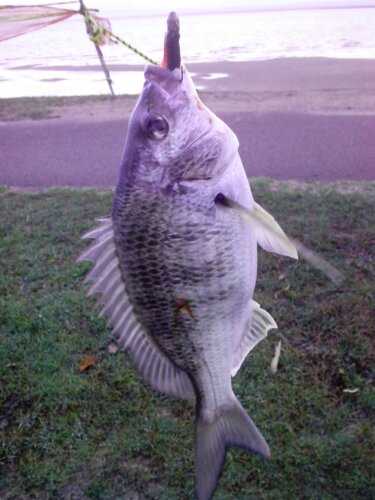
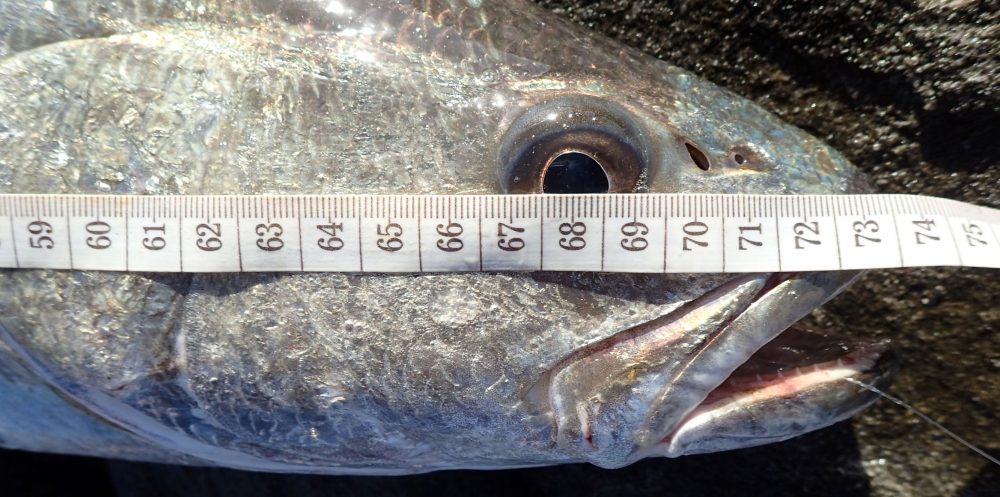
I moved back to the south. Just passed the museum I felt a tug at my soft plastic – a GULP Jerkshad in the Cajun Chicken colour. I paused but there was no fish there when I struck. Two casts later, in the same spot, the fish grabbed it again. I paused again and this time, when I lifted the rod tip, the fish was hooked. It was a good Flathead and it used the run out tide to make some good runs, but after a short fight it was on the beach. You have to be patient and wear them out when you are fishing with 10lb leader. The last drag up on to the sand can often be the point when the leader snaps. Everything held and this was a handsome fish, measuring just over 64cm. It was just after 8.30am.

This slideshow requires JavaScript.

As the tide ran out, I continued south and found another three Flathead – between 45cm and 50 cm. I caught three on the Cajun Chicken Jerkshad and the last on a bigger Crazylegs Jerkshad in the Pumpkinseed colour. All the fish were caught on a 1/8th 1/0 jighead. I did not get a bite from the Pike or small Tailor so the bait really does seem to have thinned out.

Brooms Head – The Razorback – 24 September 2012

Monday

Sunday had been pretty breezy so I spent the day with the family – after all, that is what family holidays are about – I suppose. By Monday I had had enough of them and the wind had eased off in the early morning, so I decided to try fishing the rocks on the southern side of the headland.

I started out on a prominent rock that juts out into the water, just north of Back Beach. I fished with the Catana Coastline rig again, using a 10lb leader and various soft plastics. I did not raise any bites but first the dolphins came through and then a magnificent black back appeared out of the water. It was a big humpback and the dolphins played around it for a while.

I watched the show and then decided to head back to the rocks, known locally as the ‘Razorback’ on the southern edge of the headland. This is a very dangerous spot to fish but, if the sea is flattened by a north westerly, as it was this morning, and there is not much swell – it can be approached, safely. Every now and then a big wave comes over the top of these rocks and I have witnessed several people get washed down the barnacles and leave plenty of skin on them. If you see/hear a big wave coming over, it is best to hunker down and hang on, rather than trying to out run it. Your clothes will dry out quicker than the grazes will heal!

I had watched the swell from my other fishing spot for about an hour before I deemed it safe to go out onto these rocks. I had rock boots and a small automatic inflating life vest on. I stuck with the 10lb leader and a 1/8th 1/0 jighead. I chose a brightly coloured GULP 4” Minnow in the Lime Tiger colour, for my first cast. The wind was now negligible but there was a slight ruffle on the surface of the clear water. I watched the lure sink and counted to five. As I lifted the rod tip I felt a solid hit and run. The fish took some line but the Catana and drag absorbed the lunges and soon I had a healthy 34cm Bream at my feet.

I lost the jighead on the next cast – snagged tight, as the current wafted it into the rocks. I re-rigged with the same weight jighead and leader but swapped to a GULP 2” Shrimp in the Molting colour. I cast this one along the inside of the ‘Razorback’ and it was slammed in close to an opening in the rocks. It was another solid Bream and it was easier to subdue and land on this side. When I got it to my feet I realized it was a monster – pushing 40cm.

I carried on for another 30 minutes and the Bream kept coming. They took all types of small soft plastic – the GULP, 3” Minnow in Smelt, Emerald Shine, Rainbow, Lime Tiger and Pearl Watermelon and the GULP 2” Shrimp in the Banana Prawn and Molting colours. I caught about twelve fish and kept the best four. They were all between 32cm and 40cm. These fish were not fussy.

At about 8.30 am I stopped and cleaned my catch in the rock pools. As I looked down, I could see why the Whales were around. The water was full of tiny see through Krill. There were small shrimp like shapes fluttering around everywhere. I thought this was what the Bream could have been eating, but when I opened their stomachs, I found them all empty. I still could not see any bait in the water but at least now I had found a fishy spot.

Bribie Island – The Seaside Museum drain – 24 August 2012

Friday

The wind is starting its undecided phase with a big northerly blow predicted for Friday afternoon. Friday morning looked ok, so I decided to revisit my favorite Bream location – Bongaree, on Bribie Island.

In years gone by, the Bream have shown up along the coffee rock ledge that runs along the edge of the Pumicestone Passage. They have often schooled up to spawn in the areas around the mouth of the tidal lagoon, in front of Buckley’s Hole. Typically, the best time to chase them has been either side of the new moons in July and August. Sometimes they are also around in June and September, depending on the water temperature.

The GULP 3” Minnow or 2” Shrimp have always been my favorite soft plastic lures for Bream. I prefer the more natural colours. When I am fishing the rocky headlands, I have caught plenty of big Bream on Jerkshads and other big soft plastics, but in the estuaries these fish can be fussy.

I started just after first light at about 5.45am. I was in front of the Seaside Museum again. The tide was running out and would be low at 7.45 am. This is the perfect time to fish this spot. I stopped about three metres from the drop off and cast over it, to the north. I was fishing with my light spin rig, with 10lb fluorocarbon leader and 1/8th, 1/0 jighead. I thought there might be some Flathead around so I had chosen a compromise soft plastic – the GULP 4“ Minnow in the Smelt colour. Big Bream should still be interested in it and if I passed over any Flathead, they would also go for it.

I counted to ten and let the lure sink. I am not sure how deep it is here but I would guess no more than 2.5 to 4 metres, in most places. The first couple of casts produced nothing and then the dolphins swam buy. It is always a pleasant sight but I presume the fish head for cover. About twenty minutes later there were some surface bust ups and just as I pulled the lure over the top of the ledge, there was a fast snatch and I was on. Playing fish here is tricky. It’s best to get close to the edge and play them out in the open water. If you have to hall them over, you risk sawing off your leader when they lunge back down, close to the edge.

This was a good Bream – 32cm and I pulled it safely onto the sand. I waded back out and cast over the edge again. The lure was hit on the drop but the mad head shakes meant it was not a Bream or Flathead. A few moments later I pulled a 35cm Chopper Tailor onto the sand. I fished for another 30 minutes with a few bites but no hook ups.

The wind, a north westerly, was now picking up. I moved to the south of the lagoon mouth and tried a few different soft plastics. I swapped back to the Smelt Minnow and started casting again in the same spot where I had caught the first Bream. At about 7.30 am, I cast out and let the lure sit on the bottom for a while. When I lifted it, I had a fish on. It was another good Bream just over 30cm long. I landed it and decided to pack up.

I had a coffee then decided to try fishing at Whitepatch, further up the Island. I stuck with the same soft plastic and jighead and walked along the drop off casting and retrieving. There was quite a bit of bait in the water and the birds kept turning up for a dive, but I could not find the fish. I did however, pull up a Stonefish – seriously ugly.

It had been a tough session but I had caught two quality fish and had dinner organized – so no complaints.

Bribie Island – The Oyster Jetty and White Patch – 21 August 2012

Tuesday

Monday’s session had not been very promising – there had been a distinct lack of Flathead in the usual locations at Bribie. Perhaps they were all in 1770.

So, on Tuesday I decided to fish the mainland side of the Passage, by the old oyster jetty. Low tide was around 5.30 am and at 0.3m it was a reasonably low, low tide. It is always good to see the areas you fish on a low tide as all of the fish holding structures, such as; banks, drains, gutters and holes, are revealed. The difficulty is remembering where they are once the tide comes in.

It was a cold morning with an overcast sky, the wind was in the process of switching from a south westerly to a northerly and was forecast to drop to nothing midway through the morning. Conditions were calm and I waded through the mud and exposed weed beds until I reached the water’s edge.

I was using my light rod and reel – G.Loomis GL2 4-8lb Fast Action 6’6” Spin Rod and a Shimano Stella 2500FE reel, 6lb braid, 10lb fluorocarbon leader. This set up has almost become an extension of my arm and I reckon it is difficult to beat as a combination for light fishing. Still, if you are reading this Mr. Loomis, I would be happy to give any of you models a try – just pop them in the post.

It was hard work. The tide had passed low but the water was not really moving yet. There was a fair amount of algae weed floating around that kept clogging the jighead. I started with a big GULP Lime Tiger Jerkshad on a 1/8th 1/0 jighead bit after no hits for 45 minutes I decided to try something different.

As you know I am a sucker for anything new in the Tackle Store and the GULP Swimmow caught my eye the other day. This is a welcome addition to the arsenal and GULP has been missing this profile. It is basically a Fry or Worm shape with a small thumping paddle tail. It is four inches long but unlike the various other shads on offer it is still fairly small and light. I picked up the Pumpkinseed, Peppered Prawn and Emerald Shine colours. I decided to try the Emerald Shine first. I watched the lure in the clear water and it has an excellent action. The paddle tail thumps furiously on the drop and whenever you jerk the lure through the water.

I moved further along the edge of the weed beds towards the green channel marker. About 10 cast after the lure change I felt the unmistakable thump of a Flathead bite just a few metres from my feet. I paused and then struck – I was on. After a few runs I had a dark, speckled, weed dwelling Flathead on the mud flats. Quite a colour contrast to those I had been catching the week before. It was 48cm long. A few casts later I caught another – just under 40 cm. I made it to the channel marker then turned back. The tide was coming in and it soon forced me back from the edge of the weed beds. I felt a few rapid bites and almost hooked something – Bream , Pike – not sure.

I had one good fish but needed at least one more to feed my mob. I decided to try White Patch and drove up there. The water was up to the tree line when I arrived, so I decided to concentrate on a few of the rocky/ sandy drain areas about 10 metres out. I could not cast over the edge of the drop off as it was now too far out. I was still fishing with the GULP Swimmow and the Pike were the first takers – I caught three in quick succession.

I moved along in the shallows, walking south and casting in front of me. It was now just after 11.00am. After about 30 minutes, a fish hit the plastic on the drop and took off. It was hooked straight away and after a few solid runs, I had it in the keeper bag. It was another Flathead, just under 50cm. I spread casts over the whole area and after another ten minutes I had another good bite and though the fish was hooked, but it got off.

Just after noon, with six hours of fishing under my belt, but only two fish in the bag – I gave up.

Bribie Island – Seaside Museum – 20 August 2012

I was back in Brisbane and decided on a quick fish at Bribie. Low tide was about an hour before dawn. I decided to try the drop off in front of the Seaside Museum.

I arrived about 5.30 am and rigged up in the dark. It is just after the new moon and I was hoping to find a few Bream. I started with a small 3 ” Minnow soft plastic in the Rainbow colour. I saw a few surface bust ups close to the drop off.  I decided to swap to a bigger plastic, a Gulp Jerkshad in the Cajun Chicken colour.

This worked and the lure was hit on the drop, on the first cast. I thought I had hooked the fish but after a couple of short runs,  it was gone. After a few more casts, I had another fish on. This time it stayed hooked. It was Bream, just under 30cm long. The next cast produced another, slightly smaller Bream.

Then as the sun came up, properly, the fish just shut down. I fiddled with different lures but could not get a bite.

Soon the tide forced me away from the drop off and the cold water and wind persuaded me to call it quits.

My apologies for the photos. I forgot the camera and had to use the phone.

image

Bribie Bream

1770 – Getaway Beach – Flathead, Dart, Perch – 12 August 2012

Sunday

The wind was persistent and it was another noisy night with debris everywhere in the morning. It was my last day at 1770 so I had to venture out. I chose to walk out of the 1770 Getaway Resort down to the local beach.

The wind was blowing from the south west but this beach has a few rocky coves where I found some sheltered spots. I had my first success of the week with a small hard bodied DUO Tetraworks Bivi sinking vibe lure. I had struggled to fish with this lure, in the wind, all week – it is too light for these conditions. It was hit, close into the rocks by a small Stripey Perch. I caught two more in the same spot and then moved on.

I worked around the rocky coves and after a while I switched back to soft plastics. I was using the light rod and reel again and I had dropped down to a 10lb leader, to see if this improved my catch rate. I had chosen a 1/6th 1/0 jighead and started by fishing around the rocks with a GULP 3” Minnow in the Rainbow colour. After about an hour of casting and moving, casting and moving I was on a north facing rocky outcrop. I dropped the soft plastic about 15 metres out and let it sink for ten seconds. I retrieved it slowly along the bottom. About a metre off the rocks I lifted the plastic and clearly saw a small Flathead shoot up and grab the lure. It ran with the minnow and then spat it out before I could set the hook.

I put in another 5 casts all around the same area. On number 6, I felt a solid thud, on the drop. I set the hook and the fish took off. This was a bigger Flathead. I played it out and brought it in close to a sloping rock. After several attempts I used the swell to get it up the rocks. It was the best fish of the week at just over 65cm. I put it in a pool and looked for more, but could not find any. I caught a few tiny Dart and then decided to pack up. I cleaned the fish and carried it up the hill.

Fishing in this area is not always simple but when you are not catching anything, there is nearly always somewhere else to try, just a few minutes away. You can head for the creeks or try the other side of the headland, if the wind is too strong. It’s a great spot with fantastic scenery and you rarely have to share your beach with anyone. I hope to be back here again, very soon.

Bribie Island – The Seaside Museum Drain – 30 June 2012

Saturday

On Saturday morning everything had calmed down and the weather looked perfect again. The fish were singing to me in my sleep and I woke up at about 4.00am. It was a cool morning but not as cold as forecast. There was a slight breeze from the west.

I decided on Bribie Island again and started under the bridge on the island side at about 5.30 am. I could not find anything here so just before first light I moved down to Bongaree, in front of the old seaside museum. It was just about on the 1.9m high tide and I waded out along the sand bank beside the mouth of the drain. The water here was still slowly running in.

I started with the GULP 4” Minnow in the Smelt colour, on a 1/8th oz 1/0 jighead and 12lb fluorocarbon leader. I cast all around but I could not yet reach over the edge of the drop off that runs along here. The water slowed down. There were a few bust ups at the edge of the main channel and there was a large flock of birds following a school of something around. I could not find anything. I tried a few other plastics then reverted to the Smelt Minnow again.

It was now about 7.30 am and the tide was really running out, I cast nearer to the edge of the drop off and felt a bite. I paused then struck. It was a Flathead about 35cm long. It was nothing spectacular but it was good to get started. I released it and cast back in the same spot. After a few more casts I was on to another fish. This time it was about 40cm long. I let it go and then things wnet quiet. There was still too much water to fish where I wanted too so I went and bought a cup of coffee. I came back to the water and sat on the sloping rockwall, just in front of where I had been fishing. The water was clear and as I sipped my coffee, I looked down to see a couple of big swirls right at my feet. The water was less than a metre deep and cruising slowly along the bottom of the wall was a large (80cm plus) Jewfish. I was stunned and by the time I got the rod, it was long gone.

Recharged, I grabbed my rod and waded across to the sand bar, to the south. I stuck with the GULP Smelt Minnow and after a few casts and slow retrieves to the north, I felt a solid bite. I paused and set the hook. This time it was a bigger Flathead at about 45cm. I waded back out and on the next cast, in the same spot, the lure was hit on the drop. It was another Flathead, 50cm long. Things were now going in the right direction.

I tried for more but could not find any, so at about 10.00 am I moved across to the mainland side, to fish the sand/ mud flats, by the Oyster Jetty. I decided to try out another of the DUO hard bodied lures I have in the tackle bag. It is another beautifully crafted fish tempter called the DUO Tetraworks Toto 42. It is a 42mm long, 2.8 g sinking, bibbed lure with a tight rolling action. As with all of the DUO range it has a great action and finds its rhythm as soon as it hits the water. It comes in a range of hues but I was using a bronze backed, orange bellied TS03 colour. It is a very light lure and therefore it suspends in the water column quite effectively.

I cast along the edge of the weed beds and predictably, as we approached the bottom of the tide, the water turned murky. I kept picking up weed, but you need to be close to the weed to find the fish. After about 30 minutes of wading and casting, and a few Pike, I found my target. I felt a whack on the lure and then an angry head came shaking out of the water as the trebles bit. It was another good Flathead – just over 50 cm long. DUO strikes again!

It had been another perfect fishing day – plenty of fish and fantastic weather – get out and catch them while you can!

Bribie Island – the Seaside Museum Drain – 22 June 2012

Friday

Bugger the tax return – back up to Bribie. I arrived at about 8.30 am. High tide would be at about 11.00 am, so I was fishing the run in tide. There was not enough water over the flats around Sandstone Point, so I decided to try fishing on the Bribie Island side of the Pumicestone Passage at Bongaree.

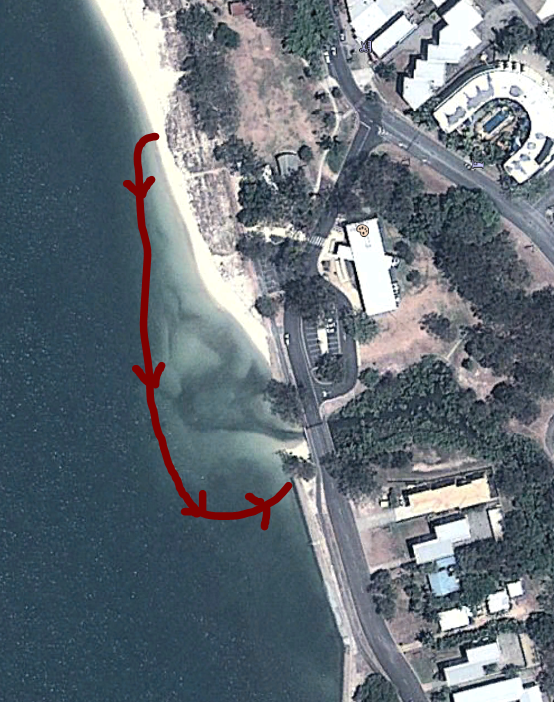
I started in front of the Seaside Museum. I waded along the sand bank at the mouth of the drain and cast over the edge of the drop off that runs along here. There was plenty of bait around and every now and then it would scatter, as a predator came up from below. These bust ups would happen at the edge of the drop off. Probably the passing schools of chopper Tailor or the resident Pike.

The tide was not ideal. There was too much water and I could not really make out where the drop off started. I got snagged plenty of times on the edge. I moved further north, towards the jetty but could not find anything here. I tried big and small soft plastics, hard bodies and even a tiny popper – but I could not find a fish.

Friday's wading route

Friday’s wading route

I drove down to Woorim and round to Skirmish Point for a reconnaissance. There should be some Tailor hanging around here by now. And I have also heard about a few Tuna captures. I walked out to the beach and wandered up and down, prospecting with a big soft plastic and spooked plenty of bait. I will have to come back just before dawn one day.

After a good run, I could not find the fish today. Tide? Location?, Wind? Lures? – too many variables in fishing – that’s what keeps it interesting!