Unknown's avatar

About Landangler

I am a mad keen fisherman - but I am also a seasick one. So I fish the estuaries, beaches, rocks, bays and rivers of the Queensland and NSW coast - from the shore. I like to fish with soft plastics lures, but I will resort to anything to catch dinner!

Fingal Head – More Jewfish – 30 November 2012

Friday

A northerly wind to flatten the seas, a full moon and plenty of bait around the rocks – what more could a fisherman want? A few more hours of sleep, perhaps. Low tide would be at 3.20 am at Fingal Head and that is where I decided to go.

I arrived just before 4.00 am and walked out onto the rocks to find a few good size piles of scales – jewfish scales. The moon was still very bright in the sky. I started with soft plastic lures. I was sure the jewfish would still be around and I am convinced that their favourite food is big Jerkshads. So I started with a big GULP Crazylegs Jerkshad in the Blackshad colour – black and white, with a split curly tail. I was using my heavy rig and cast it out on a ¼ oz, 2/0 jighead hook. I had 30lb leader on.

After a couple of casts I hooked a fish in the half light – a small Tailor about 35cm long. By the time I released the fish, there was only about an inch of the plastic left, I put on a new one and carried on fishing. It was only 4.25 am and the sun had not yet crossed the horizon. I was concentrating on the area at the south end of the rock platform. There has been a big school of small baitfish sitting here for a few weeks and the jewfish have never been far away.

Con arrived and confirmed that he had found some good jewfish the day before – around the 85cm mark. He had caught one on a soft plastic, but had been surprised when one took his Shimano Waxwing hard bodied lure, the previous afternoon. Steve, another local arrived and finally decided to give the plastics a go. His was a cheapy from Kmart which included the jighead. As we were talking fishy rubbish he cast it out a few times, to the south of the rock platform. On about his third attempt a fish grabbed the plastic and took off. After a quick run around it tried to wedge itself under the rocks but Steve played it patiently and let it swim out. He lifted it clear and was delighted with his first jewfish. It looked about 60 to 70cm long and was in great condition.

Now Steve found his rhythm and over the next hour he land two more good jewfish. I was getting just a little jealous and beginning to wish I had never mentioned soft plastics. I had been fishing all through and had had a few bites but could not seem to hook up. I put on a GULP 5” Jerkshad in the Smelt colour and just dropped it straight down beside the rocks and counted to 10. My lure would either be snagged or get a fish and luckily for me, it was the latter. It fought hard initially but I had the heavy rod and it soon tired. With the sea fairly flat I climbed down the stepped rocks to the water and lifted the fish clear. It was another jewfish, just on 65cm.

I continued fishing around that same ledge. I lost a few jigheads and plastics to the rocks and swapped down to a lighter, 20lb fluorocarbon leader. I was now using my old favorite GULP 4” Minnow in the Pearl Watermelon colour. At about 5.50 am there was a tug and then another and then line started peeling. This one wanted to swim out to sea initially and then turned north. I went with it and followed it round to the eastern edge of the platform. It was about the same size as the first and I soon had it up they rocks.

I swapped to a RAPALA SXR 12 for a bit and felt a few knocks from small Tailor but by 6.30am, the jewfish had gone off the bite. I fished on until eight, trying lighter gear but then, with the sun beating down, I cleaned the fish and went in search of a cold drink.

Tailor & Mulloway/ Jewfish – Fingal Head – 26 November 2012

Monday

I had fished on Sunday morning at Bribie and managed not to catch anything at all. I had tried a range of soft plastics and small hard bodies and nothing raised a bite. The water was warm and still and the breeze was from the north. It is a while since I have scored a duck and I did not like the feeling. So on Monday I decided I needed to get back down to Fingal Head where I have been finding fish.

I arrived at 4.00 am and walked out to the rocks with a faint glow beginning to show on the horizon. Northerly, northerly, northerly wind was the forecast – not too strong but consistently from the north. I started with the battered RAPALA SXR 14 hard bodied minnow. When it is still fairly dark you have to be careful at the end of the retrieve not to get snagged on the rocks. I worked the lure around in a semi-circle on the northern side of the rock platform. It did not take long to get a hit – about 5 casts. It turned out to be the biggest Tailor of the day, as the first fish often is. It was about 50cm long. It was 4.50 am. A few casts later I caught another, smaller fish. This one was pinned in the mouth and back and was slightly smaller. Then things slowed down.

The sun was now over the horizon and I could see the large schools of tiny bait fish in close, hugging the rocks. Interestingly, most of the birds were missing from the beach or rocks. I decided to swap over to a soft plastic lure. I stuck with my Daiwa Demonblood heavy rod and tied on a 30lb fluorocarbon leader and 3/8th oz, 2/0 jighead. I chose a GULP 4” Minnow in the Pearl Watermelon colour. I walked over to the south side of the platform. With not much swell and the sea flattened, by the northerlies I had a good chance of landing anything I hooked up with.

Once again it did not take very long. After about three casts the line tightened and the rod bent over. It was a Jewfish, sitting close to the edge of the rocks. I played it round to the front of the rocks and hauled it up. It was just under 50cm long. I tried again in the same area for a while but I could not locate another. It was now about 6.00 am. I got snagged a few times and then decided to move round to the east side of the platform. This area has a lot of bommies and rocks but I think there is an overhang under which the jewfish school. This spot did not produce but I was sure the fish were down there somewhere.

I swapped back to a slightly smaller RAPALA SXR12 – hard bodied minnow, in the red headed ‘clown’ colour. I cast out and slowed down my retrieve, so that I could only just feel the vibration as the lure slashed from side to side. After about six casts a fish hit the lure next to some submerged rocks. I subdued it and pulled it in. It was a smaller Tailor, which I threw back.

By 7.00 am I was back on the east side of the platform fishing with a GULP 5” Jerkshad soft plastic in the Smelt colour. I had dropped down to a 20lb leader but was still using my heavy rig. I managed to put in about 5 casts and retrieves without getting snagged. I was just lobbing the plastic out about a metre and letting it waft around next to the rocks. I let it sink for 5 – 10 seconds then jigged it up from the bottom. On one of these retrieves the bait went flying and the fish grabbed the soft plastic centimetres from the rocks.

This one was a little bigger than the last but I was in a good position. I played it out and then hauled it on to a flat rock. I waited for a gap in the wave sets and jumped down and picked it up. It was another jewfish in beautiful condition.

That was it for the day as I had to get back to Brisbane. I am sure there were more fish around and I will be back soon to have another go at them.

Bribie Island – Dawn & Dusk – 22 November 2012

Thursday evening and Friday morning

I decided to look for some Flathead at Bribie Island. I was able to fish through dusk on Thursday and dawn on Friday.

Only one fish south of the Oyster jetty at dusk

Only one fish south of the Oyster jetty at dusk

On Thursday I drove up from Brisbane at about 4.30pm with a huge storm cloud blackening the sky to the west. I waded around the area just to the south of the old oyster jetty, on the top of the tide. I fished with a GULP 4“ minnow and various other shapes, but it was tough to find the fish. I hooked and then lost a fish at about 5.00pm, which felt like a small flathead. A little later, and a bit further to the south, I tangled with a Long Tom and saw it thrashing around but it bit through my 10 lb leader.

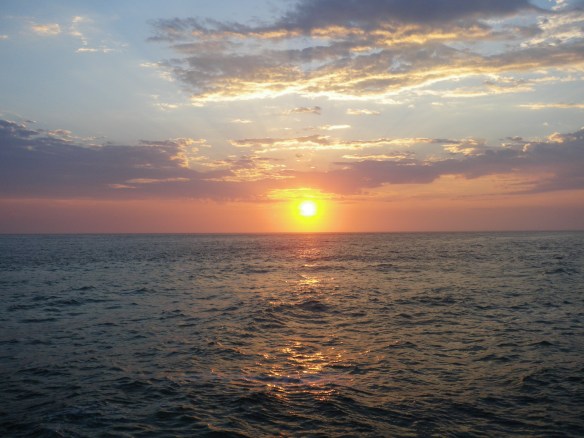
But a really spectacular sunset

But a really spectacular sunset

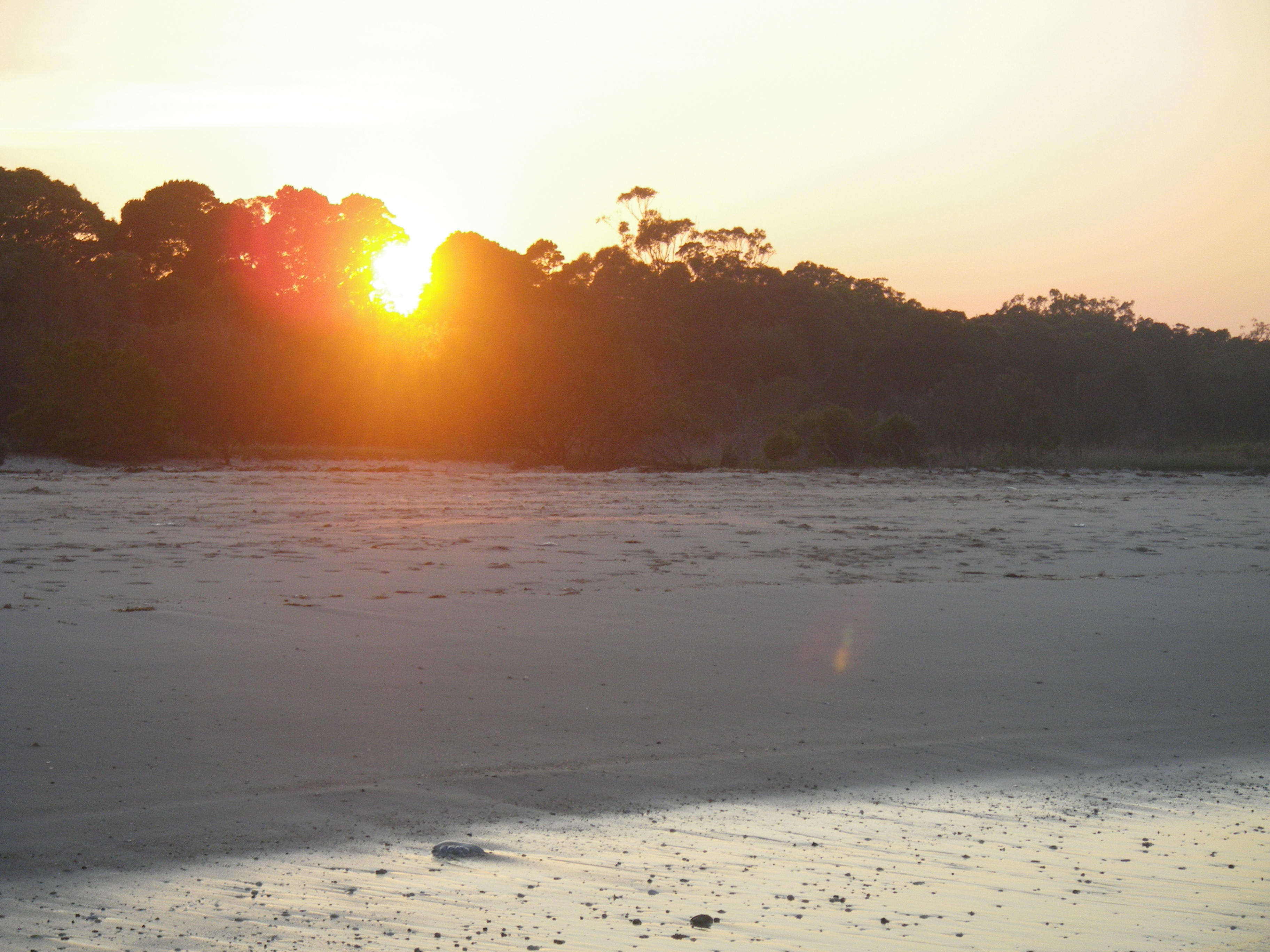
At about 5.30pm I finally hooked up with a 30cm flathead on a GULP 4” minnow in the Lime Tiger colour. That was it for the fishing but I did witness a fantastic sunset behind the oyster shed as I waded back to the car.
The next morning I tried the sand flats at Bongaree, on the island side of the Pumicestone Passage. As usual I was a bit stuck for ideas as I would be fishing the top of the tide. I know the flathead move up very quickly with the rising tide but I find it much easier to predict where they might be, on a falling tide. When the tide is high there is just too much ground to cover.

I started at about 4.40 am, just south of the jetty, with a GULP 3” Minnow in the Lime Tiger colour. The water was clear and still and high tide would be at 5.40 am. My plan was to move south from the jetty casting soft plastic lures over the exposed rocks and sand between it and the creek mouth that drains in front of the Seaside Museum.

I could not find anything under, or around the jetty. I hooked my first fish just after 5.00 am, little to the south of it. It was a flathead. I carried on casting all around the same spot but could not find another one.

I moved a little further south and swapped plastics to a GULP 4” minnow in the pearl watermelon colour. I was using a 1/8th 1/0 jighead and 10lb fluorocarbon leader. The water was still and it was hard works. I moved slowly south casting all around the creek/ drain mouth. Eventually, just after 7.00 am I caught another Flathead – about 40cm long.

I persevered and found just one more flathead at about 8.30am. This one was smaller, at about 35cm. At this point I gave up. I had found a few fish, but it had been another tough high tide fishing session. I had not seen much bait in the water and wind had been solid from the north for a few days. The moon was about half way to full. I think we may have reached the point in the year where the flathead get harder to find!

Fingal Head predator – 21 November 2012

Wednesday

A couple of big storms over the weekend and this week, the wind was back to blowing from the south east. The tailor have been pretty solid at Fingal Head and despite the long drive and the early start, that looked like the best option on Wednesday. The wind was forecast to gradually drop through the morning, from about 15 knots down to 10 knots. Low tide would be just before 8.00 am.

I arrived about 4.15 am (QLD time) and it was already past first light. There was a small shower of drizzle as I walked out to the rocks. It was cloudy and overcast but the south easterly was blowing a good deal harder than 15 knots.

I rigged the heavy rod – I am still using the 20lb Fireline and a 30lb fluorocarbon leader, for the first casts of the day. I tied on the RAPALA SXR 14 hard bodied minnow. After only a few rock fishing sessions it is looking a bit battered, but I always think you should try the biggest, most daring lure in the bag for your first cast, as it might just tempt something which has been lurking around all night.

It hit the water and bait sprayed in all directions which was a great sign. They were tiny smelt coloured anchovies about 3cm long. They certainly did not look much like a red headed RAPALA SXR 14 but on the next cast – tug, tug – zzzzzzzzzzzzzzzz. That’s how the tailor seem to play. Sometimes I think a couple of fish hit the lure at about the same time and that’s why there is a slight delay before they start running. It’s only when the faster/ more aggressive fish wins and clamps down on the lure that the fun starts. This one tried to head south but with the heavy gear I turned its head and soon had it round on the north side and safely landed. It was another very handsome Tailor – just over 50cm long. It was spitting up plenty of the 3cm bait fish.

It had given the RAPALA SXR 14 a good work over. As I have mentioned, I like these lures – great action, good colours, consistent swimming depth and tough trebles and rings but the paint job and their lack of overall durability lets them down. This one had now lost more than 50% of its paint, it was missing a chunk off its rear end and the wire frame was bent sideways. It had caught three or four fish and was only in its third session. This not a cheap lure at approximately A$20, so it should be tougher than it is. I straightened out the wire frame and peppered the areas with casts again. But I did not get another hit.

After about 10 minutes, I swapped to a smaller RAPALA Clackin Rap CNM11 hard bodied minnow. This lure is 110mm long and weighs 20 grams. I had it in the Grey Ghost colour. RAPALA describe it as ‘slow sinking’ which really means it suspends in a big swell. The ‘clack’ is caused by a big ball bearing that rattles on a cylinder across the body of the lure. It has a lighter set of trebles and, on the back treble, one of the hooks is slightly elongated. It has a fairly standard slashbait /minnow action. The smaller profile or the louder rattle obviously did the trick because I hooked up on the first cast. It was a smaller tailor – about 35cm long.

By 6.30 am things had gone quiet, so I decided to try a soft plastic lure. I tied on a 3/8th ounce, 2/0 hook, jighead and loaded it with a GULP 4” minnow in the pearl water melon colour. I still had the heavy rod but I had dropped down to 20lb fluorocarbon leader. I dropped the lure down close to rocks on the eastern side of the rock platform. I could see a thick school of bait sitting there. I let it sink to the bottom and immediately got snagged. I broke off the line and re-rigged. This time I cast out a bit further and let the plastic waft in, close to the rocks, as I retrieved it.

Just before I lifted it from the water there was a big bait spray and a Jewfish engulfed it. The fish turned and took off. I had got a clear look and it looked like a 10kg fish. At first it started heading north but it soon turned south, in the direction of a load of rocky snags. Even with the big rod and a fairly tight drag, it was taking plenty of line. After a few minutes of sustained pressure I brought it to the surface, close to the rocks. Landing it would be very tricky, but the problem was solved before I had to think about it. With a shake of its head, it spat the bent hook out and was gone.

I swapped the bent jighead and mangled soft plastic for a tougher one and cast out again. After a few casts and a couple more jigheads lost to the bottom, I hooked up again. I did not get a look at it this time. It swam straight around the corner to the south and broke the leader on the rocks. This was getting frustrating.

Con – another local rock fisherman was spinning with a ’waxwing’ lure on the north side of the rocks. He gave me a shout and I went over. He had hooked a small tailor and something had decided to eat half of it on the way in – ouch. I tried a few casts in the area with a soft plastic but could only manage to catch a dart and then a long tom, neither of which seemed like likely suspects for the tailor robbery. Something bigger was prowling around but despite trying every lure in the bag, neither of us could tempt it.

At about 8.30 am I gave up for the day and drove back up to Brisbane. Still plenty of bait and plenty of fish around.

Fingal Head – Trevally, Tailor, Dart and Bream – 16 November 2012

Friday

The weather was going from one extreme to the other. On Monday the strong south-easterly had lifted the seas and made things tough. By Friday a howling north easterly was forecast. I managed to find a space for a quick fish but with the wind forecast to be blowing at 30 knots, I wasn’t sure if it would be worth it.

I wanted to have another try with the RAPALA lures I had been sent so I woke at 2.45 am and went outside to see what the wind was doing. In Brisbane there was no breeze at all so I decided to go for it. By the time I reached the rocks at Fingal Head, an hour and a half later, the wind was well and truly up.

I tried to walk over the headland to the rock platform and nearly got blown over. There was no point trying to fish off the rock platform so I had a look to the south for a more sheltered spot. The northerly had completely flattened the swell. I climbed down on to a ledge just to the south of the main platform.

I tied on the RAPALA SXR 14 – a 140mm hard bodied minnow. They describe it as a ‘slashbait’. This just means that it will move more violently from side to side than a normal minnow, but you need to work it, quite aggressively, to achieve this type of action. I had it in the ‘Clown’ colour – red head and yellowish body. I picked the size 14 as it looked like it would be the only one heavy enough to cast against the wind. It weighs 43 grams but with the wind blowing this hard from the north, my attempts to cast against it were fruitless.

The sun was just coming over the horizon and now all I could do was cast to the south and retrieve against the wind. The tide was just past low and would be high at 11.00 am so I was not fishing in much water.

After a couple of casts I felt a really powerful hit and then line started peeling. The drag was set pretty tight but the fish had no trouble stripping line. Initially it went south, with the current and wind, but then it turned north which helped me. I got back some line and climbed down as close to the base of the rocks as I could. It was not a tailor – it was too calm and powerful. I played it for few minutes but still could not get a look at it. Each time I got it towards the foot of the rocks it took off again. Eventually it came into view – a good looking trevally. It was pretty tired now so I used a wave to lift it onto a safe looking ledge and then hopped down and picked it up. It was a very handsome grunting fish, just about 70cm long. After a few pictures, I pulled out the treble and let the fish swim away.

I carried on fishing the SXR 14 and a few casts later it hooked a small tailor. Then all went quiet – except for the wind which just got stronger and stronger. I decided to switch locations and move round to the more sheltered southern side of the headland. There is not much sea bed structure here but there are a couple of large rock pools that are constantly filling and draining. I cast around these with the SXR 14 and then tried an 85g Raider. Neither produced a fish so I decided to swap down to the light rod.

I swapped over to the DUO Tetraworks Yurameki lure. This is a small bibless sinking lure. It has a tight action. It weighs 6.3 grams and is 48mm long. Normally it sinks fairly fast but with the wind blowing a big bow in the line, it dropped very slowly. I could see the Bream come up to look at it but they did not strike. I cast around and got a few hits further out. I persisted in the same area, leaving the lure for a long time, to make sure it had reached the bottom before I started the retrieve. After a long wait I lifted the lure for its first hop and a fish hit it. It pulled hard on the light rod and as it came to the surface I saw it was a swallowtail dart. It was a good size and another species notched up on the DUO Tetraworks Yurameki. I threw it back and carried on battling the wind.

I eventually swapped over to a GULP 4” Minnow soft plastic lure, on a 1/6th ounce, 1/0 jighead and this got the bream going. I kept feeling them hit the plastic but could not hook up. Eventually I caught one and then another, and another but they were only just legal size, at about 28cm. The wind was now too difficult to deal with so, at about 10.00 am, I gave up and headed home.

More Tailor from the rocks – Fingal Head – 12 November 2012

Monday

A big south easterly blow had stirred things up over the weekend and it was still forecast to be blowing at 15-20 knots on Monday morning. It looked like I only had one day to fish this week, so I had to go for it. The recent rain would make the estuaries dirty, so I decided to drive back down to Fingal Head and fish the rocks.

I arrived at about 4.15 am and although the wind had calmed a little, there was at least a 2 metre swell. The horizon was grey with a hint of orange, as the sun started to appear. The swell would make it hard to fish but the Tailor love the white water and there was plenty available. I had to carefully time my hop across the causeway, between the big swells.

I rigged up the heavy rod. The reel is a Shimano Stradic 8000 FJ and I have generally used the pink Bionic 20 or 30lb braid on it. This is great line that lasts well but it has started to fray and so I have replaced it with a spool of 20lb Fireline, in the luminous green colour. I find this colour stands out better than all the others, especially in low light. Fireline has advantages and disadvantages. When its new it can be a little stiff but as it is a fused line, it does not take in much water and it slides through the rod guides very easily. Unfortunately, just as it becomes supple enough to be perfect for fishing and knot tying, it starts to fray. It is certainly much tougher than its advertised breaking strain.

For the first cast of the day I usually start with 30lb fluorocarbon leader. I am out of DUO Minnow lures at present but fortunately RAPALA have sent me a box XRS 12s. I love most of the RAPALA lure range, especially their smaller hard bodies for Trout and Bream. But I am not sure they have the build quality of the DUOs, especially in the larger suspending and floating minnows. When you are fishing from the rocks, the lures get knocked around so they need to have a durable paint job. The X-Rap is nicely shaped and has a good action but after half an hour and a few knocks, the paint starts peeling, the loose flakes catch in the water and this changes the lures action. To get it to swim right you then start peeling off the rest of the paint – which is not ideal.

I tied on an XR12 in the Silver colour and cast out. I have tried different speed retrieves but I generally prefer to go fairly quickly, jerking the rod to the side in long sweeps until I can feel the vibration coming back up the line. On the second cast a fish hit the lure and I hooked up. It was a good Tailor about 50cm long. I took a few pictures and threw it back. Shortly afterwards I lost the lure to the rocks. I tied on another in a different colour but after 30 minutes this had not produced anything. I tried a smaller YOZURI Crystal Minnow but the swell was too much for it and I could not get it to run right. I put on a 65g Raider metal slug and fished it for a while, but it did not find a fish. Then I tied on a cheap, bottom of the tackle box, sinking vibe lure. I cast it out about ten times until it was grabbed at the base of the rocks by another 45cm Tailor.

The swell was pounding over the rock platform, so I could not stand on the eastern edge and cast at the area where the fish have been holding. I decided to give a heavier, 85g Raider metal slug a try. I would be able to cast this further and pull it over the area where I though the fish were. After a few casts I had another fish on. I pulled it round the rocks to the north and landed it. It was another 45cm Tailor. On the next two casts I hooked and then lost fish. A few minutes I hooked yet another.

I got it to the base of the rocks and then it shook itself free. When I pulled up the slug I could see the fish had broken off one of the hooks on the treble and the split ring was looking severely stretched. When the Tailor attack they really get stuck in.

By 9.00am the sun had come up but the swell was still crashing over the front of the rock platform. Even if I hooked more fish it would be very tough/dangerous landing them, so I gave up for the day.

The temperatures are up and it is mid-November but there are still plenty of Tailor about. I wonder how much longer they will hang around?

Fingal Head – more Tailor & more Jewfish – 7 November 2012

Wednesday

Monday’s rock fishing session had me all fired up. There was plenty of bait around and the Tailor and Jewfish would probably stick around as long as it was there. I set the alarm for 2.45 am and arrived at Fingal Head just after 4.00 am (QLD time).

There was not much swell or wind, but the light breeze was from the north east. I walked out to the rocks and rigged up the heavy rod. I was fishing with 20lb braid and 30lb fluorocarbon leader. I tied on a DUO Roughtrail. This is a 130mm sinking, hard bodied, minnow lure. It is designed for tough swell conditions and has a fairly thick bib that keeps the rolling action on track,even in choppy water. It is also a bit tougher than the standard range.

The sun was not yet over the horizon, and it was about 4.50 am when I finished rigging up. The first cast flew away nicely and the lure quickly found its rhythm. On the second, there was an obvious bump, as the lure passed over a submerged bommy. On the third, the line pulled tight and I hooked up. I pulled the fish round the rocks to the north of the platform and landed it – another 50cm Tailor. I took some pictures and bled it. This fish had a treble through its gills so I had to keep it. I quite enjoy eating Tailor when its fresh, but one fish per session is usually enough for me.

I cast out again and a few metres in to the retrieve, the DUO Roughtrail was slammed and line was peeling, this was a bigger fish and it took me straight down into the rocks and released itself. Disastrously, it left the Roughtrail behind – snagged firmly below the water line. I snapped the line and reviewed my tackle options. I was pretty much out of hard bodied minnow lures. I tried a couple of slugs, a 65g and 85g raider, but these did not get any interest. I also tried a big popper, without success.

By 7.00 am I decided to try the light rod and fish with some soft plastic lures. I put on a 16lb leader and a 1/6th ounce, size 1/0 jighead. I chose a GULP 4” Minnow in the Smelt colour. I let the plastic sink, in close to rocks and after a couple of casts I caught a Bream.

I released it and tried casting the plastic so it would float down beside a submerged bommy, about 6 metres out. Just as I was pulling the plastic over the top of the bommy, a fish grabbed it and the rod bent over. The fish was slow and powerful and immediately headed south. I had the light rod, so I had to go with it. I started to exert some pressure but it was still setting the agenda. I assumed it was a Jewfish but I still had not seen it. It swam round into the mouth of the channel, between the rock platform and the mainland and then I caught sight of a 70-80cm Jewfish.

This slideshow requires JavaScript.

The fish was nicely hooked but had plenty of kick left in it. Con, the other fisherman on the rocks, came over to assist but with no gaff and a long way down to a point where we could grab the fish, our options were limited. I tried to ease the fish on to some flat rocks that I could get down to, between wave sets. The swell had built up through the morning and was now easily strong enough to knock me in, if I timed it wrong. I pulled the fish clear of the water and it lay, obligingly on a rock about a metre below. Just then a big wave came through and I had to retreat. As I tried to keep the fish on the rocks the leader snapped, but miraculously the fish just lay there for what seemed like ages (probably 30 seconds) until the next set came through and washed it back into the water.

It seemed like fishing light had done the trick but how would I land them? I swapped up to 20lb leader to give myself more of a chance, but I stuck with the light rod and jighead. About 15 minutes later I was on again. This time the fish had struck right at the base of the rocks, on the eastern side of the rock platform. There was a big swell by now, crashing into the rocks every few minutes and the fish took off to the south again. The last one had shown me that south was not a good option. I tightened the drag and pulled hard, hoping to pull the fish round to the north. I made a bit of headway, but then the line went slack and the fish was gone.

I swapped to the heavy rod with 30lb leader and carried on fishing for another hour. I cast all around the platform and tried a few more different soft plastics, but I did not get another bite. At about 9.30am, I cleaned up the Tailor and gave up for the day.

Fingal Head – Plenty of Tailor – 5 November 2012

Monday

The weather looked OK for some rock fishing on Monday. It was forecast as a slight south easterly breeze and swell. It has been a while since we have had the wind from this direction, at dawn. It means that the swell can be difficult but I think the dawn bite is more aggressive when the wind is blowing this way.

I decided on Fingal Head again. I have been catching fish there and it is a beautiful spot even when you are not. I arrived just after 4.30 am to find 3 fishermen out on the rocks already and I could see one was half way through a battle with a decent fish. He had a very light rig and had tempted the fish with a metal slug. He landed it safely and it was a good sized Tailor around 55cm. By now one of the others had hooked up. He was fishing with a shallow diving 110mm Minnow and a wire trace. He landed his fish and several others over the next 30 minutes.

I wasted no time rigging up but in my excitement lost a DUO Beachwalker MD 120 minnow to the rocks, on my first cast. I put on another and moved round to the front of the platform. The wind was stronger than forecast and this made getting down low on the rocks to get the most action out of the shallow diving minnow, difficult. The fish seemed pretty aggressive so I switched to a RAPALA ‘walk the dog’ lure. I got the fish to follow this one and even saw a couple of aborted strikes, but I could not hook up.

In the meantime the other three now had about 6 good fish in the bleeding pond. I swapped again, this time to a the DUO Bay Ruf Manic sub surface stick bait. I had toughened this one up a bit with stronger single hooks and split rings. A fish knocked it out of the water and then there was a good swirl beside it, but I still could not hook up. This was a good bite but the shallow diving minnow was definitely out fishing everything else. I looked for something similar in the tackle box. I found an 18 gram, 90mm, sinking YOZURI Crystal Minnow in a silvery colour and tied this on with 30lb fluorocarbon leader.

This slideshow requires JavaScript.

Things had slowed a little and the others had stopped to clean their fish – they had about 10 between them – all between 50 and 60cm. This gave me access to a bit more waterfront. The swell was slapping against the rocks and making it tricky to finish the retrieve without getting the lure snagged. I cast out at 45 degress to the north east of the rock platform and let the lure drop down in the water column. I retrieved it fairly slowly with plenty of pauses. Three casts in and bang – a fish grabbed it. The line slackened momentarily, as it pushed the lure towards me and then it took off. It was a decent Tailor and it put in a few jumps trying to head south. The only place to land them safely when the swell is up, is on the north side of the platform, but the current is usually pulling them round to the south and so you have too subdue them fairly quickly.

I took the sting out of this one and got it round to the north, where the trebles pulled free, just as it came up on to the rocks. Fortunately the fish fell between two rocks and I reached down and grabbed it behind the gills. It was a good Tailor just short of 50cm. I bled the fish and cast out the lure again. I felt another hit in the same spot but on the next retrieve I connected with a rock and lost the lure. I was reminded once again why I should buy shares in lure manufacturers.

I looked through the tackle box and was disappointed to discover that I did not have another shallow diving minnow with me. I tried an 85g and 65g Raider metal slug, but these did not raise a bite. By about 8.30 am I had switched to soft plastic lures and I was fishing on the lighter Shimano Catana rod. I was using a GULP 4” Minnow soft plastic in the Smelt colour and because of the swell I had put it on a ¼ ounce 1/0 jighead. As I was finishing a retrieve, a fish hit the plastic right at the base of the rocks. I set the hook and it took off. It broke the surface a few metres out and it looked like a small Tailor. Then it managed to bite through or rub off the 10lb leader I had dropped down to.

At about 9.00am with the swell building so I decided to give up. The hour either side of dawn remains the most consistent fishing time at the moment. I will be back again soon.

Bribie Island – the oyster jetty flats – 4 November 2012

Sunday

Sunday was a grey and rainy morning. The early starts and drives south had worn me out so I had a lie I, until 4.15 am and then decided on a quick wading session at Bribie.

I drove through a few showers on the way up and decided to stay on the mainland and fish the weed banks and mud/ sand flats, south of the old oyster jetty. The jetty is now out of bounds pending re-development but it has been repaired and made safe. The complete removal of the tree cover in the area has made the light quite different and I have been wondering if it will affect the weed growth and therefore the fishing. The terrain has flattened out a quite considerably but I think that has more to do with the change of wind and current, as we settle into a more obvious summer weather pattern.

I arrived just after 5.00 am and the sun was up, but buried behind the grey clouds. I waded past the jetty and had a look around. It was just about slack water on low tide. There was no surface action and the water was pretty murky. I tied on a 1/8th 1/0 jighead and loaded it with a GULP 5” Jerkshad in the Curry Chicken colour – red and yellow. Unfortunately the bright dry sunny days have encouraged the growth of the ‘snot weed’ or algae. This takes particular hold in the areas where there is not much current flow. It means you get a jighead full of slime if you hit the bottom.

Once you reach the edge of the weed beds you can cast parallel with them and avoid it. But don’t go past the sandy patches between the weed as these often harbour a few fish and this was where the first Flathead came from today. It slammed the plastic as soon as it hit the water and I hooked up without really trying, as it tried to swim off with it. It was just under 50cm.

I let the fish go and swapped to a another small hard body from DUO that I have been wanting to try out – the DUO Realis Shad 59 MR. This is a small suspending lure designed for bass but suitable for plenty of other species. It is finished to the usual superb standard and I chose one in the olive colour to try out. I had upgraded the trebles and split rings for saltwater work – the Flathead don’t take prisoners!

I was pretty sure there was more than one Flathead in the sandy patch in front of me and my first cast with the Realis Shad confirmed it. After two quick hops of the lure, a fish knocked it out of the water and then swiped again with a splash. But I did not hook up, so I wound the lure back in and cast out again. This time I let it sit for about 10 seconds – and then gave it a short pull. A fish attacked again and this time it was hooked. But the fish was only about 30 cm long.

I let it go and tried again. After about three more casts, the line pulled tight and a really angry fish surfaced. I pulled this one over to some exposed reef and landed it. This time good Flathead about the same size as the first of the day. I sent it on its way and moved south.

The tide was now flowing in strongly. I waded along casting over the weed beds. I caught two more Flathead – both about 45cm long, on the Realis Shad. The incoming tide had now lifted lots of strap weed and this was starting to clog the hard bodied lure. I swapped back the GULP curry chicken Jerkshad and this tempted two more 45cm fish before I gave up at about 8.30 am.

As I waded back along the shoreline there were Flathead ’lies’ everywhere. Many were very close to the Mangrove roots, showing that the fish will move up into very shallow water on the higher overnight tides.

You have a very good chance of catching dinner at the moment, especially if you get up early!

Fingal Head – Jew & Tailor – 1 November 2012

Thursday

I was up early again – full moon had passed on Wednesday. Low tide would be just before 4.00 am. It would still be a pretty big tidal flow. A northerly blow was forecast but it would be calm around dawn. I decided to drive back down to Fingal Head.

I arrived in between dawn and first light – just a little late. It was cloudy but as the northerly picked up it turned into a beautiful morning. I started with DUO Beachwalker MD 120 hard-bodied minnow in the orange colour. I had swapped back to treble hooks. There were bumps and splashes on each of my first three casts. On the fourth cast I hooked something. It pulled pretty hard and I thought I had connected with a good fish and then I realised it was a small Tailor – hooked through the back. I let it go and carried on casting but could not hook anything else.

I swapped over to a 65g Raider metal slug and moved round to the north edge of the rock platform and cast as far as I could. After about 20 casts I felt a knock at the base of the rocks. Then, on the next cast, a fish hit the lure right at the base of the rocks. It was a small Tailor – around 40cm long. I let that one go. I decided to try some soft plastics on the lighter rod and reel combo – the Shimano Catana Coastline light rod, 2500 reel, 6lb braided main line and 10lb leader.

A local fisho, Bill arrived with his Alvey and big rod and threw out a fresh prawn. His first cast produced an excellent Tarwhine, which looked to be about the 1kg mark. There were definitely fish around.

The strong northerly was making it easier to fish on the southern side of the rock platform now. I cast out a GULP 4” Minnow in the Smelt colour, on a 1/6th 1 jighead and let it slowly sink. I cast in all directions and did not get any interest for about an hour. The water was very clear and just in the mouth of the channel that separates the causeway from the mainland; there was a school of small baitfish, hugging the rocks. There is a slight overhang here and some deeper water close to the rocks. I dropped the plastic into the middle of the channel and thought I felt the faintest of bites. I flicked the bail arm over and released a metre or two of line. As I slowly retrieved it, it flicked tight and the rod bent over. Line started peeling and I started thinking – how and where will I land this?

I decided from the slow and powerful runs it was not a Tailor. I would try to coax it round the rocky outcrop, to the front of the rock platform. The northerly had flattened the sea and it was safe to jump down a few steps to the wash area, to grab a fish between waves, if I could get it that far. It did not want to come round the rocks and with the light rod and 10lb leader I could not apply much pressure. I left the drag quite light and just kept winding. Eventually I dragged the fish round the rocks and saw it was a small Jew. I used the surge to get it onto a flat rock at the water line and then hopped down and picked it up, between waves. It was a good looking 55cm fish. I slit its throat and put it in the keeper pool.

The plastic and leader was a bit gnarled but OK, so I threw it back out. Two or three casts later and I was on again. This time it was a much bigger fish and initially I really was not making much of an impression. But Jewfish tire quickly and after a while the fish was beaten but the swell was still making things tricky. I aborted a couple of attempts to pull the fish round the rocks but eventually it swam in the right direction. I got it on to the same ledge as the previous one, jumped down and grabbed it under the gills. This was a much bigger fish at about 75cm. I decided to keep this one as well. It was 8.15 am.

I swapped the soft plastic for bigger one – a GULP Crazylegs Jerkshad in the Black Shad colour. I stuck with the 10lb leader and the 1/6th 1 jighead. After about 10 more minutes of casting and retrieving, close to the overhang – bang, I was on to a fish. This one was bigger again and after a long tussle I got it to the same spot. But this one was too much for the 10lb leader and as I pulled the fish onto the rock ledge, it snapped.

I decided to upgrade to the bigger rod and use 20lb leader. I stuck with the 1/6th 1 jighead and the same soft plastic. I carried on or another hour but did not get another bite. Was it the heavier leader or had I spooked them? I am not sure. All the fish were caught in no more than 2m of water – the Jewfish certainly don’t mind feeding in the shallows.

At about 10.00am I left the platform to Bill, cleaned up the Jewfish and went in search of ice.

Fingal Head – Tailor – 30 October 2012

Tuesday

I never get bored of catching fish but I have enough Flathead in the fridge so it was time for a change of scene. I decided to drive down to Fingal Head on Tuesday morning, to fish the rocks around the lighthouse and the causeway.

My view is there are some things you can be late for – work, submitting your tax return, your wedding, the births of your children, etc – and then there are some things you must never be late for – fishing. I am ashamed to admit that I was late on Tuesday morning. I was up at 3.45 am and on the road south, a few minutes later, but the sun was well over the horizon as I pulled into the car park, at Fingal Head l. It was just before 5.00 am (QLD time). I quickly pulled my rock boots on and hiked out to the causeway and promontory, below the lighthouse. The skies were grey and rain was on the way. The wind was from the south east, initially.

There were a couple of guys fishing and plenty of fresh blood in the rock pools. This just emphasised for me, the need to arrive just before dawn (rather than just after). One of the fisherman confirmed they had landed a good Tailor just after first light.

I rigged up one of my DUO hard bodied favorites – the Beachwalker Mid120. This is a fairly shallow diving minnow. I have swapped a few of my lures over to single hooks to see how this affects my hook up and capture rates. I think trebles may connect with more fish but bigger, single hooks give you a better chance of landing the fish, from the rocks, once it is hooked. I was using a bright orange coloured DUO Beachwalker and after a few casts I saw the small Tailor following it in. There were some splashes behind the lure and a couple of knocks but I did not hook up.

I swapped to a soft plastic GULP Crazylegs Jerkshad in the Black shad colour on a 3/8th oz, 3/0 jighead and threw that out. I was fishing with my Daiwa Demonblood, 9’6” rod, 30lb braid and 20lb fluorocarbon leader. The soft plastic did not seem to interest the fish. In fact, I did not even lose the tail to the smaller fish, which is what usually happens here.

I swapped through a few more plastics and hard bodies but could not connect with anything. At about 8.15am I swapped down to my lighter Shimano Catana Coastline rod and 2500 size reel 8lb Fireline Exceed and 16lb fluorocarbon leader. I tried fishing a few smaller soft plastics on light jigheads but they did not attract any fish.

I swapped over to another of my DUO lures – the Bay Ruf Manic 115. This is an 18 gram stick bait that is cleverly weighted to cast long distances and sink slowly. At only 18 grams it is a little light to cast with my big rig but it is perfect with the Catana. I had left the original trebles on this one. It does not look like it has much action but on closer inspection, it has a very tight sub-surface wobble which leaves a pulsing wake.

This slideshow requires JavaScript.

I cast it out and let it sink for a few seconds. On the first retrieve I saw a fish come up behind it then turn away. On the next cast a fish grabbed it right at the base of the rocks and took off. It was at this moment that I remembered the rod is called the Shimano Catana Coastline LIGHT. It bends over nicely and is a great shock absorbed but it cannot apply much pressure to decent sized Tailor. After a few frenetic runs, I started to get a bit of line back. The fish jumped and I saw it was going to be a headache to land – it was a good Tailor well over 50cm.

I steered it round the rocks and tried to pull it in close to a ledge where I might be able to grab the leader and pull it up. I increased the pressure and tightened the drag but then the lure pulled free of the mouth and the fish was gone. I pulled up the lure which had scale on it and a slightly bent rear treble. Things went quiet again and I had a chat with another angler – Steve. We were distracted from our chat by a few swooping birds who started dive bombing the swell, a few metres out in front of us.

We both chucked a lure at the boil – I had the Bay Ruf Manic and Steve had a 45g metal slug. We both hooked up straight away. After a brief fight I had a 50cm Tailor at my feet and Steve had landed a slightly smaller model. The Bay Ruf Manic had lost its tail-end treble – half of which I later found lodged in the roof of its mouth. DUO lures had produced for me again.

By this point my shoulders and back were killing me, so I decided one fish would do. I walked back to the car – covered it in ice and drove back to Brisbane.

Bribie Island – the Seaside Museum drain – Big Flathead – 26 October 2012

Friday

Back to Bribie Island on Friday morning, but I decided I would miss dawn and arrive closer to the bottom half of the run out tide. It was a perfect morning with a light northerly wind and a clear blue sky. High tide had passed at 7.00 am and I arrived at about 8.30 am.

I waded out just south of the main Jetty and cast around in the sand flats. As I drew level with the Seaside Museum a solid fish grabbed my soft plastic lure. I was fishing with a GULP 4” Minnow in the Smelt colour, on a 1/8th 1/0 jighead with about 1.5m of 10lb fluorocarbon leader. The fish made a couple of runs but was soon safe on the sand. It was a good size – just under 60cm. I released it and cast out again and, after a few hops I felt another solid fish bite. I brought it in and even got a look at it, but when it realised it was headed for the shore it shook itself free.

I carried on casting in the same area and after about 15 minutes, I felt a good hit and I had another Flathead. This one was a little smaller, about 48cm. I photographed it and released it. Things went quiet for a while so I waded to the south. I caught two more undersized Flathead and one keeper (about 45cm), as I waded along, casting over the ledge. Each time, the fish were sitting on the sand above the ledge.

After about an hour and a half, I had walked down to the south end of the tidal lagoon and back up to where I had started catching fish in the morning, by the museum. It was now about 11.30 am and the tide was much lower. This made it easier to see the ledge and cast the plastic just over it and hop it back in. I was now using a GULP Crazylegs Jerkshad soft plastic in the Pumpkinseed colour.

I was about to give up for the day when I felt a tug, paused and then struck. There was plenty of weight and at first I thought I was snagged on the edge. The rod tip started wiggling and there was a slow steady run. I tightened the drag a little and tried to pull it over the ledge. At this point the fish woke up and put in three blistering runs out towards the middle of the Passage. I slowly got my line back and then tightened the drag some more to make sure I could get the fish over the ledge. I pulled it over and got my first look at a very big Flathead.

By now the fish was pretty tired but it still tried to change direction several times before I grabbed the leader and pulled it gently up onto the sand. It was a Monster. I have a 40, 50, 60 and 70 cm marked on my rod and it was much bigger than these – somewhere between 70 and 80 cm. It was also an unlucky fish because it had my jighead through the left side of its mouth and recent hook wound from what must have been a much bigger hook, on the right side of its mouth. I took a few photos and then released it. It paused in the shallows for a while and then took off at a healthy speed, when I waded closer.

That was it for the day. It has been a while since I have tangled with a really big Flathead and it had been another very successful fishing session. If you want to catch a Flathead on soft plastics, now is the time!

Bribie Island – More Flathead from Bongaree – 25 October 2012

Thursday

I was stuck with my usual problem at Bribie Island. High tide would be an hour or so after dawn at about 6.00 am. I never know where to fish on the first few hours of the run out tide. Once the water comes flooding over the ledge (that runs almost the entire edge of the Pumicestone Passage) it quickly floods on to the sand flats. It brings plenty of hungry fish with it and I have caught big Flathead and other species in this shallow water, but it can sometimes be difficult to know where to start the search. It feels like there is just too much ground to cover.
The low tide was also getting higher and the tidal flow was slowing, as we moved away from the new moon. The wind was swapping around between northerly and south-easterly but it had been a fairly strong south easterly on most early mornings through the week.

By Thursday the wind was forecast to ease off a little around dawn so I started on the flats in front of the creek drain, which comes out under the bridge, by the Seaside Museum. At high tide all of the rocky structure is submerged and the Flathead move right up to the creek mouth to feed on what is being washed out. They like to tuck themselves in in the grooves in the rocks or bury themselves in the sand just beside them.

The wind was a strong south easterly and there where soon a few white caps on the surface. It was a stark contrast to the still waters of the week before. I fished around the rocky ground but did not get any hits so I waded south, to the new opening at the south end of the tidal lagoon. I cast around, but it was very windy. The bait was certainly not so thick and the big schools of Mullet had moved on.

I moved back to the south. Just passed the museum I felt a tug at my soft plastic – a GULP Jerkshad in the Cajun Chicken colour. I paused but there was no fish there when I struck. Two casts later, in the same spot, the fish grabbed it again. I paused again and this time, when I lifted the rod tip, the fish was hooked. It was a good Flathead and it used the run out tide to make some good runs, but after a short fight it was on the beach. You have to be patient and wear them out when you are fishing with 10lb leader. The last drag up on to the sand can often be the point when the leader snaps. Everything held and this was a handsome fish, measuring just over 64cm. It was just after 8.30am.

This slideshow requires JavaScript.

As the tide ran out, I continued south and found another three Flathead – between 45cm and 50 cm. I caught three on the Cajun Chicken Jerkshad and the last on a bigger Crazylegs Jerkshad in the Pumpkinseed colour. All the fish were caught on a 1/8th 1/0 jighead. I did not get a bite from the Pike or small Tailor so the bait really does seem to have thinned out.

Bribie Island – Bongaree Flats – 21 October 2012

Sunday

Sunday saw me back at Bongaree on Bribie Island, again. It was another morning low tide at about 7.00 am. I arrived at about 4.45 am and started fishing on the flats in front of Buckley’s Hole. The water was almost completely still and the midges were everywhere. The sun came up behind me and lit up the school of Mullet, that were finning around on the flats.

The first fish came just after the sun rose

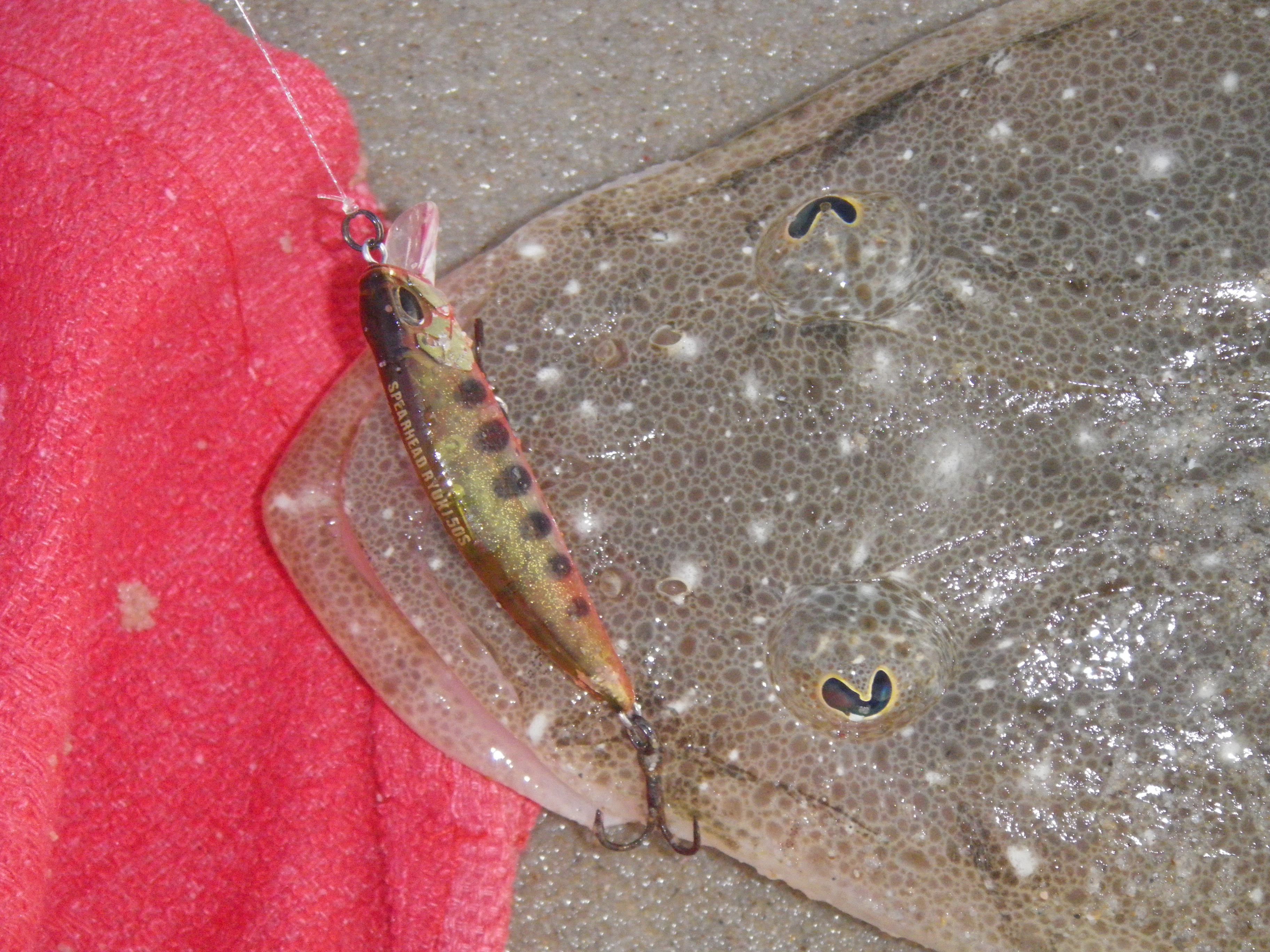
I put on another small DUO hard bodied lure – the Spearhead Ryuki 50s. This is designed as a freshwater trout lure but it will catch just about anything. It is a 50mm long, sinking minnow and weighs 4.5 grams. It has a great wiggling action and is perfect when there is no weed floating around. I cast it towards the drop off and hopped it back along the sandy bottom. After about three casts I connected with a fish. The start of the fight is often very lively with the hard bodied lure – I think the trebles are more painful when they first get lodged and the fish reacts accordingly. It settled down and after a few runs, I had it on the beach. It was a 55cm Flathead. It was just before 6.00 am.

A 55cm Flathead on the DUO Spearhead Ryuki

Kenny arrived and explained that the Jewfish had been breaking the surface to lunge into the Mullet on Saturday morning. The fish were clearly listening because about ten minutes later there was a huge surge about a metre in front of us and loud boof, as a big Jew tried to engulf a Mullet or Pike. It must have missed, as it chased the bait over the ledge and up towards the beach before turning away.

DUO Spearhead Ryuki 50S – annoys the Flathead into striking

Kenny caught some Pike on a bait jig and put one out. We saw the Jewfish repeat its bait attack about 30 metres further north. I decided to wade north and fish around the drain in front of the Seaside Museum. I picked up another small Flathead – just under 40cm. A couple of guys had landed three good ones, a little further north. There were bust ups every 15 minutes or so at various points along the ledge. The bait was everywhere and the bigger fish were making the most it.

Plenty of rods in the water by 9.30 am

By 9.00 am there were rods everywhere and boats, kayaks and jet skis humming up and down. I decided to give up for the day.

Bribie Island – Buckleys Hole Flats Jewfish – 19 October 2012

Friday

Friday was a very fishy day. I drove up to Bribie and headed straight for Bongaree and the sand flats in front of Buckley’s Hole. The large amount of bait that had been hovering over the flats on Monday and Wednesday had convinced me this was the place to fish.

I arrived just before 4.40 am and it was already light enough. The tide would be a very low one again, at about 5.40am. There was no wind, although it was forecast to pick up from the north, later.

I started at the drain in front of the museum. The water was completely still and the midges were thick. I started the day with another of my favorite DUO finesse lures. A small brightly colored hard bodied bibless lure – the Tetraworks Yurameki. It weighs about 7 grams which makes it about 1/5th of an ounce and DUO describes it as a ‘sinking pencil’. I like to retrieve it with a series of hops just above the bottom, with lots of pauses.

On such a low tide the surface of the ledge was covered by only 30cm of water. At the mouth of the drain this water was very muddy, where the run out from the creek was lifting the sediment. It was in this shallow water that I got the first fish of the day on the Yurameki lure. It was a Flathead – it was just about legal size but I threw it back in hope of a bigger one.

I fished this area for a while. There were several surface bust ups and each time herring or mullet would go flying in all directions. I swapped to a GULP Jerkshad in the Cajun Chicken color on a 1/8th 1/0 jighead and started to move south along the edge. I caught a few Pike in front of the car park, by the tidal lagoon but things went pretty quiet, as the tide slowed and turned in.

By about 7.00am I had reached the new opening at the southern end of the tidal lagoon. I was sure there would be Flathead around the drop off here. The water was clearer so I decided to swap to a 2” GULP Shrimp in the Banana Prawn color. I caught a good size Pike and offered it to a fisherman soaking a Pilchard nearby named Kenny. He put it out on three good sized hooks and we swapped a few fishing yarns.

I cast along the top of the ledge, into the run in tide and hopped the lure across the bottom, back towards me. On the third cast the line came up tight on a Flathead. It was just too small to keep – a little under 40 cm, so I let it go. A few minutes later I caught another in the same spot – this one was about 43cm, so it went in the bag. I swapped to a bigger GULP Jerkshad in the Cajun Chicken colour and caught three more Flathead about the same size, from the same location.

I swapped to a brighter coloured Satay Chicken Jerkshad and immediately lost the tail to what I think was a small Tailor. I cast out another and this time I landed a keeper size Tailor. Kenny had just pulled in the Pike. It had a chunk out of its tail and had been sucked clean of scales, like a lollipop. We decided the small Tailor would make a good replacement. Hooked through the nose, back and tail, out went the Tailor.

I carried on fishing with the Jerkshad and caught three more Flathead. I added the first to the keeper bag and released the others. A big mullet school was finning around, sometimes just on top of the ledge and sometimes out over the deeper water. Every now and then there would be a swirl and thrash, as something attacked from below.

The Tailor was still kicking then Kenny pointed to his rod tip which was slowly bending over. There were a couple of slow lunges as the fish mouthed the bait. Kenny waited patiently for a few moments. The fish started to pull and he let it have a bit of line, then he struck. The initial run was slow. Perhaps the fish had not realised it was hooked. Then, as it noticed there was a problem with its latest meal, it powered up and started a serious run. This was a big fish but Kenny’s gear was a match for it – good hooks, good knots, a big spool of solid braid and a 50lb leader. He tightened the drag slightly and settled in. Every time he applied pressure the fish did the same and initially it looked like stalemate. Then he started to get back some line and slowly, moved further north, where the drop off is smoother and sandier.

All this had happened in the space of about 4 minutes but it felt much, much longer. Now Kenny was making steady progress but as soon as the fish saw the ledge it put in another blistering run. We still had no idea what it was. It had been so slow initially that I had thought it might be a ray or shark but its subsequent runs had convinced me otherwise.

Kenny stayed calm and got the fish back to the ledge but it was not interested in coming over the top. On the third attempt we saw a great flash of silver and realised it was a big Jewfish. Kenny kept the pressure on. He got it over the ledge and walked slowly backwards towards the beach. The fish still had plenty of kick in it and there was some serious thrashing as it was pulled through the shallows to the sand. The whole process had taken about 8 minutes from start to finish.

It was a beautiful Jewfish that later weighed in at 13kg but looked a good deal fatter than that, lying on the beach. Kenny was stoked and I was delighted to have witnessed the capture. Hands shaking and hearts racing we took photos and then he set out to show the beast off. There is nothing better than converting small fish into big ones.

I had my bag of five Flathead but I carried on fishing for a while. I found a couple more small Flathead. As I was wading back north to the car I saw Pike flying everywhere then clearly saw a good sized green backed Mackerel chasing them up into the shallows. Before I could cast at it, it was gone. It made several more passes causing chaos amongst the bait schools, but it was moving too fast to target.

At about 9.00 am I decided to get the Flathead to the esky. It had been a very fishy day!

Bribie Island – Buckley’s Hole Flats – Whitepatch – 17 October 2012

Wednesday

Whilst fishing definitely delivers the joy in my life, unfortunately, it can’t seem to deliver the cash. Paid work has many evil consequences – less fishing and no time for a midday hammock session, to name a couple. But perhaps the most evil is the exquisite torture devised by the ATO – the tax return.

I have been fortunate to live in a few countries over the years and unfortunate enough to pay tax in most of them. Nowhere is the process more excruciating than Oz. I admit I have not tried North Korea – which is about the only place where I think they could make it more painful. I like the idea of the Greek tax system where 95% of doctors reported an annual income of less than A$ 9,000, last year – but then again, their economy has ended up a few chickpeas short of a bowl of Hummus. When I was in Indonesia we had to pay our income tax, in person, every year, with a sack load of cash. It seemed the tax collectors did not trust the banks to honor cheques, but it did not seem a particularly good idea from a corruption prevention point of view. In Hong Kong – I thought I had earned a fortune one year and was dreading the bill. I filled in the two page return (yes – just two pages) and got a letter back about three days later explaining that my paltry income did not exceed the tax free threshold and there was no need to submit further annual returns, until it did. You could almost sense their pity!

My other problem was that I took so long to do last year’s tax return that, in the blink of an eye, I received a ‘friendly’ e-mail reminder that this year’s is due. No wonder the unemployment rate is rising – much easier to pop down to the community bank – known as Centrelink and collect your ‘pay’. They will even do the tax return for you.

Spleen vented – on to fishing. I decided on Bribie Island on Wednesday morning. New moon had been on Tuesday and it would be a very low tide (0.1m) at about 4.00 am. These really low tides are great as they enable you to see the terrain you have been fishing, when there is more water around.

I started at the mouth of the drain, in front of the sea side museum at Bongaree. It was just after first light at about 5.00 am. Having seen the marauding Tuna on Monday I decided to start with a big DUO Beachwalker hard bodied lure on my heavy rod. I soon got worn out by that process and there was no sign of marauders, so I swapped back to my Loomis light spin combination.

I put a GULP 2” Minnow in the Smelt colour on a 1/8th, 1/0 jighead. I was fishing with about 1.5m of 10lb fluorocarbon leader. There was a school of mullet finning around on the surface, right by the edge of the drop off. I cast in to it and it was so thick that I jagged one through the eye. I threw it back and continued to walk south along the edge, casting parallel with the shore into the tide, that was now racing in.

It walked and then waded for an hour and caught a couple of Pike. By now I had reached the flats at the south end of the tidal lagoon in front of Buckley’s Hole. I was now fishing with a GULP 3” Minnow in the Lime Tiger colour. The incoming tide had pushed me away from the drop off. As I was about to lift the plastic for another cast something grabbed it. I struck a bit too hard and pulled the fish quickly up to the surface, where it shook its head maniacally and spat the lure out. It was a keeper size Flathead.

I swapped to a bigger soft plastic – a GULP Jerkshad in the Cajun Chicken colour – black and pink. There is now a new opening in the sand bank at this end of the lagoon – which means there is a new drain as the tide runs out. I was right in front of this opening, standing in about 30cm of water, when I felt another solid thud. This time I was more gentle – but the fish was smaller – another Flathead just on 40cm. I took it to the sand, photographed and released it.

There was now too much water over the ledge so I decided to drive up to Whitepatch and fish the high tide. I drove down to the north end of the beach and waded back, to the south, casting in to the last of the incoming current. I caught a few more Pike.

As I reached the point where the black coffee rock is visible along the shore line I paused and concentrated a few casts in close to edge. On high tides the Flathead will sometimes move up close to these rocks. I was now fishing with the GULP Jerkshad in the Satay Chicken colour – yellow and pumpkinseed. After a few casts I found a fish – another Flathead that was just over 40cm. I took a few snaps and flicked it off the hook.

It was now 11.00 am and time to give up. I had only caught two keeper fish but I had surveyed a lot of ground. There is still plenty of bait around so prospects look pretty good for the next week or so.

Bribie Island – The Oyster Jetty flats – 15 October 2012

Monday

A week away from fishing is far too long. I had time for a quick fish on Monday morning, so I drove up to Bribie at about 4.00 am and arrived just after first light at about 4.50 am. The tide was coming in. It would be a 2.3m high at about 9.00 am. The wind was forecast to be a southerly but it seemed to be a cool south-westerly.

A quick look at the flats on the mainland side of the bridge showed that I would be able to fish along the edge of the weed banks, to the south of the (newly repaired) Oyster Jetty, for an hour or so, as the tide came in. It is nearly new moon so it would be coming in fast.

The tide would run in fast


I was fishing with my Loomis GL2 light spin rod again. Unfortunately there was plenty of snot weed around, especially close to the jetty. I started with a 1/8th 1/0 jighead and a GULP 5” Jerkshad in the Curry Chicken colour (red and yellow). I had a 12lb leader on, in case I came across any Tailor. The water was warm but the wind was cold.

The grey cloud masked the sunrise


The Loomis lets you feel everything the jighead touches and it took some time to get used to it. After a while, I could tell that the difference between a nibble and a jighead stuck in the weed again. Then, about 50 metres south of the jetty, just before 6.00 am, I had a solid bite and the line pulled tight. I was too eager and wrenched up the rod tip, pulling the jighead out of the fish’s mouth. Patience, patience – sometimes you have to go back to the beginning and slow everything down. If it was a Flathead, it was probably still there, or one of its friends was. I cast back in the same spot and after two hops I felt the faintest of bites. I dropped the rod tip and counted slowly to 10, then lifted it sharply. I had it this time. It was a small Dusky Flathead – just about 40 cm long. I let it go, hoping the fishing Gods would reward me with a better fish.

Back amongst the Flathead


Suddenly, there was a big surge about 10 metres away to the north and the baitfish went flying everywhere. Then there was another, about 5 metres further away. I wound in furiously and hurled the plastic in the direction of the splashes. It went quiet for a few minutes and then the same thing happened to the south of me. This time I saw the broad shoulders of a good size Tuna as it smashed into some Herring. I cast where I thought they were travelling but again I could not tempt them – they were moving too fast.

Swallowed that

I carried on casting around for Flathead, walking gradually further south. At about 7.30 am I was considering giving up when there was a swirl a few meters in front of me and another bait spray. Then I saw a good size Tuna coming right for me. I thought it would hit me but it swerved at the last minute and the small school flashed by, on either side of me. I was wading in just over a metre of water.

I have hooked Tuna from the rocks and beach but I have never landed one – so this got me really fired up. I have to get back out again soon with some heavy gear and bigger lures! Watch this space

Brooms Head Tailor – 29 September 2012

Thursday / Friday / Saturday

On Thursday I was still at Brooms Head and the northerly wind was forecast to blow hard. This had the advantage of flattening out the sea and, on the southern tip of the headland, you could still fish in the morning.

I started at about 5.15 am, just after first light. I had a look at the Bream spot. The water was not washing over it but with high tide just after dawn it was a bit too dangerous – a rogue wave could easily turn up and leave me soaked, if not worse. I cast a few soft plastics on the inside of the razor back but and lost a few tails but did not hook up with a fish.

The difference however, was the bait. Everytime the lure hit the water, in close to the rocks, bait would go flying everywhere. I thought there might be some Tailor around and another guy confirmed it by catching a 40cm Tailor, on a 65g Raider, on his first cast of the day.

I quickly swapped over to a DUO Tide Minnow in the purple colour, which has caught plenty of fish for me. After a few casts, I came up tight on a small Tailor – around 40 cm. I brought it into the rocks, but I was too keen, with the Catana light rod and I pulled the treble out of its mouth, just as I was about to lift it up.

I carried on casting and the bait kept scattering. A couple of times I even speared a baitfish with the DUO Tide Minnow. I carried on until about 8.30 am when I lost my beloved purple Tide Minnow to a rock. I gave up and vowed to come back the next day.

The northerly had been blowing powerfully all night on Thursday and it was still going on Friday morning but the south side of the Brooms Head platform remained sheltered and if anything, the swell had eased a little. I put on a GULP 4” Minnow soft plastic in the Smelt colour and cast out next to the ‘razorback’. There was still plenty of push around the rocks so I swapped from a 1/8th 1/0 jighead to a 1/6th 1/0 jighead and cast out again. This did the trick and I soon had another good 32cm+ Bream at my feet. The tide was coming in so I decided to retreat and try casting a few slugs around. I had heard that someone had caught a couple of Kingfish the day before so I was keen to try for one.

I cast a few forty gram slugs and hard bodies and felt a few hits but I could not hook up. The bait was still there, but it was more patchy, hanging around close to the bommies. I think a forty gram slug is about the limit of the Catana’s casting capability and I doubt it would be able to subdue a Tailor or Salmon over about 45cm.

Saturday was my last morning and I was hopeful that the bait would bring in some bigger predators. I decided to try bigger slugs and use the heavy rig, 9’6” the Daiwa Demon Blood with the Shimano Stradic 8000. I found the Tailor but unfortunately they were all about 25cm long. I caught fish after fish on a whole range of slugs but they never got any bigger. Finally I threw out a GULP Jerkshad on a 1/6th 1/0 jighead and it was monstered close to the rocks. The fish took off on a solid run but then suddenly it was gone – it had spat the hook. That was it for the day.

I feel I am gradually getting to know this spot. Who knows, in 20 years I may have mastered it.

Brooms Head – 25/26 September 2012

Tuesday/Wednesday

At Brooms Head on Tuesday morning the wind was up from the south east and so was the swell. I could not reach my Bream spot without risking my neck and I was not prepared to do that – especially when there was plenty of fish in the fridge.

Because of the wind and swell I had to switch to a ¼ oz 1/0 jighead. I put on a GULP 4” Minnow in the Smelt colour. I managed to put a few casts out from the top of the ‘Razorback’ towards the Bream spot and after losing a few jigheads, I did hook up with a nice 30cm+ Bream, but the wind and swell made it really difficult to fish and at about 8.00 am I was forced to give up.

The Bream were still there but hard to reach

On Tuesday night we had a thunderstorm and the swell and wind was still up on Wednesday morning. It was a solid south easterly wind. I walked down to the ‘Razorback’ but there was no point fishing. The waves were crashing over the top of the rocks and the whole area was covered in white water. I watched the surf for a while and then decided to head home for a hot cup of tea.

On Wednesday it was just too hard

Brooms Head – The Razorback – 24 September 2012

Monday

Sunday had been pretty breezy so I spent the day with the family – after all, that is what family holidays are about – I suppose. By Monday I had had enough of them and the wind had eased off in the early morning, so I decided to try fishing the rocks on the southern side of the headland.

I started out on a prominent rock that juts out into the water, just north of Back Beach. I fished with the Catana Coastline rig again, using a 10lb leader and various soft plastics. I did not raise any bites but first the dolphins came through and then a magnificent black back appeared out of the water. It was a big humpback and the dolphins played around it for a while.

I watched the show and then decided to head back to the rocks, known locally as the ‘Razorback’ on the southern edge of the headland. This is a very dangerous spot to fish but, if the sea is flattened by a north westerly, as it was this morning, and there is not much swell – it can be approached, safely. Every now and then a big wave comes over the top of these rocks and I have witnessed several people get washed down the barnacles and leave plenty of skin on them. If you see/hear a big wave coming over, it is best to hunker down and hang on, rather than trying to out run it. Your clothes will dry out quicker than the grazes will heal!

I had watched the swell from my other fishing spot for about an hour before I deemed it safe to go out onto these rocks. I had rock boots and a small automatic inflating life vest on. I stuck with the 10lb leader and a 1/8th 1/0 jighead. I chose a brightly coloured GULP 4” Minnow in the Lime Tiger colour, for my first cast. The wind was now negligible but there was a slight ruffle on the surface of the clear water. I watched the lure sink and counted to five. As I lifted the rod tip I felt a solid hit and run. The fish took some line but the Catana and drag absorbed the lunges and soon I had a healthy 34cm Bream at my feet.

I lost the jighead on the next cast – snagged tight, as the current wafted it into the rocks. I re-rigged with the same weight jighead and leader but swapped to a GULP 2” Shrimp in the Molting colour. I cast this one along the inside of the ‘Razorback’ and it was slammed in close to an opening in the rocks. It was another solid Bream and it was easier to subdue and land on this side. When I got it to my feet I realized it was a monster – pushing 40cm.

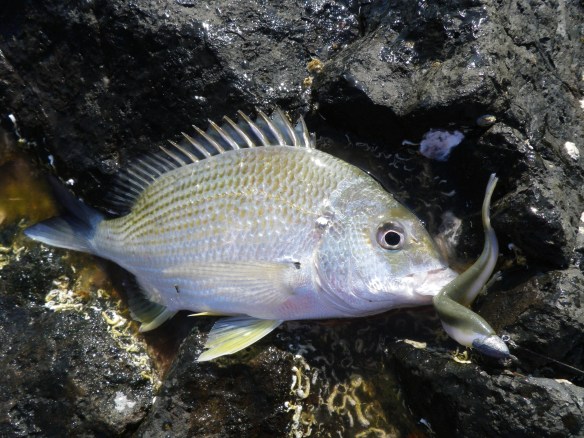
I carried on for another 30 minutes and the Bream kept coming. They took all types of small soft plastic – the GULP, 3” Minnow in Smelt, Emerald Shine, Rainbow, Lime Tiger and Pearl Watermelon and the GULP 2” Shrimp in the Banana Prawn and Molting colours. I caught about twelve fish and kept the best four. They were all between 32cm and 40cm. These fish were not fussy.

At about 8.30 am I stopped and cleaned my catch in the rock pools. As I looked down, I could see why the Whales were around. The water was full of tiny see through Krill. There were small shrimp like shapes fluttering around everywhere. I thought this was what the Bream could have been eating, but when I opened their stomachs, I found them all empty. I still could not see any bait in the water but at least now I had found a fishy spot.