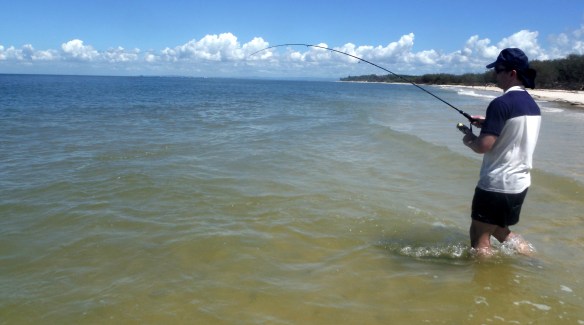
Bribie – the old oyster jetty flats – 26 May 2015

Tuesday 26 05-2015


There is not really enough time for fishing at the moment but you have to keep your hand in. I told everybody I had a conference call and bought myself a few hours on Tuesday morning.

It was a cold and I had a little trouble waking up. I did not arrive at Bribie until about 6.45 am.  Low tide would be at 9.45 am and there was a light south-westerly breeze. It was a clear day and the water was cooler again. I waded out under the bridge on the mainland side of the bridge. I started with the GULP Swimmow soft plastic in the Emerald Shine colour on a 1/8th ounce, size  1/0  hook jighead. By the time I reached the jetty I had caught one flathead, but it was too small to keep.

I waded under the jetty and noticed that the tables have been put out in front of the new Sandstone Point Hotel. The old oyster shed is being done up and I have heard it will be a coffee shop – so I will soon have a direct audience, when I am fishing here.

I swapped to a GULP 4” Minnow in the Green Camo colour. I stuck with the 10lb fluorocarbon leader and the 1/8th ounce, size 1/0 hook jighead. I caught another small flathead that was just over 40 cm. The tide was almost all the way out so I walked down to the green channel marker and started to make my way back towards the old oyster jetty. I found the edge of the weed beds and caught three more flathead, only one of which was just over 40 cm.

As I got closer to the jetty I dropped back down to a GULP 3” Minnow in the Sardine colour. This smaller profile soft plastic attracted a few Pike. At about 10.30 am I caught another just legal sized flathead before giving up for the day.

Persistence and changing you bait/ lure offering regularly is the only real strategy when the fish are spread out like this. There are a few fish to be caught but they do not seem to be grouped together for spawning just yet.

Bribie – A few flathead from the oyster jetty flats – 12 May 2015

Tuesday

Up to Bribie Island again to find some more flathead. The cooler months – from March through to September – are traditionally a very good time to fish on south east Queensland. The pike, bream and flathead all fire up and occasionally the mulloway also arrive.

On Tuesday morning I was up early and wading out under the bridge at about 5.30 am. It was before first light so I decided to have a cast around under the bridge lights on the mainland side. There is always plenty of bait in this location and this morning was no exception. The water was cool and the Pike were surging around having a snap at the smaller fish.

The tide had been high at about 3.45 am and was running out. I cast at the areas of dark water just on the edge of the halo from the lights. I was working the area just north of the bridge around eth mangrove roots. I was fishing with the new Loomis light sin rig and a10lb fluorocarbon leader. I had loaded it with a GULP 3” Minnow in the Pearl Watermelon colour on a 1/8th ounce, size 1 hook, jighead. The first taker was a small flathead, about 35cm long, who was sitting in the shallows. I released it and a few minutes later connected with a series of hungry pike.

As the sky turned red I moved south. The sun came over the horizon at about 6.20 am and soon afterwards I found another flathead. This one was big enough to keep at about 43 cm long. I released it and moved under the jetty.

I could see something moving in the water a little beyond the end of the jetty and heard a blow a little like the sound the turtles sometimes make when they surface. About a minute later I heard it again and turned to see a swirl in the same spot. I realised it was a dugong sitting in the 2.5m deep channel that runs through the rocky/reefy area in front of the jetty. I stopped and watched it surface and sink for about 10 minutes. I have never seen one moving along these sea grass beds but I am sure they come and go fairly regularly.

I moved south and left the dugong to its business. There were lots of swirls on the surface and I realised there was a big school of mullet swimming around over the weed. I waded round the corner towards Sandstone Point and watched as the resident long toms harassed my soft plastic lure. There were mullet schools everywhere here but I could not find anything lurking beneath them. I waded around following them for the next ninety minutes with no luck.

I moved back towards the big sandbank and started casting along its edge. I had now swapped to a GULP 5” Jerkshad soft plastic in the Lime Tiger colour.  At about 8.20 am I felt a grab but did not hook up. I cast back in the same spot and this time I hooked another just legal flathead. I released it and peppered the area with casts but there were no more takers in the area.

I moved down to the edge of the major weed banks that line the main channel, in the direction of the green channel marker. At about 8.40 am I found another flathead, also about 45cm long. Once more, I could not find any others in close proximity. I turned back towards the jetty and waded along the edge of the sandbanks, casting as I went. At 9.00 am I caught my final flathead of the session just short of the jetty.

I waded back to the car. I had caught a few fish but it had been fairly hard work and they had been very spread out. The amount of bait in the water was very encouraging but I could not find the flathead bunched up anywhere – maybe next time.

Bribie – the old oyster jetty – a bagful of flathead – 10 May 2015

Sunday

In to May and time to get back on to the flathead at Bribie. Big wind and rain were forecast for later in the week so I decided I had to get out on Sunday morning. It was going to be bright and cool with light south westerly winds.

I waded out under the bridge at Bribie Island just before dawn and despite the cooler nights the water remains surprisingly warm. I cast around in the shallows under the bridge but there was not much going on so I moved slowly to the south.

I was fishing with a GULP 4“Minnow soft plastic in the Lime Tiger colour, initially. This did not seem to stir any interest so I swapped to a similair sized Minnow in the Pearl Watermelon colour. I was fishing with my new light rod – a G.Loomis SJR6400. This is a very short, very fast action, light spinning rod. It is only 5’ 4” long which should make it easier to use in the smaller creeks that I hope to fish later in the year, up north. Loomis describe it as a ‘magnum ultralight’ rod which sounds more like a diet ice cream to me.  It is designed to have slightly more strength than their ultra-light series, while retaining its sensitivity. I was using it with my Shimano Stella 2500 loaded with 12lb braid and about a metre of 10lb fluorocarbon. The tide was slowly running out so I was using a 1/8th ounce, 1/0 jighead and aiming it at any spot where the sand met the weed.

It was hard work. I disturbed a few sting rays and eventually hooked one, which dragged me around for a while before breaking the light leader. I had now been fishing for 2 hours without connecting with a flathead. The water was getting dirtier as we approached low tide, which would be just after 8.00 am.

I move along towards the green channel marker. It was now right on low tide. I had been joined by a few more keen fishermen on the edge of the sand bank. Just as I was beginning to think the new rod was cursed, I felt the tell-tale thud of the flathead bite. I was now using the GULP 2” Shrimp in the Peppered Prawn colour. I paused then struck. It is always a little tricky catching your first fish on a new rod. You have to calibrate the drag setting to the rod bend and this can take a while. The fish hardly managed to take any line, which meant I had it too tight. It was a flathead about 42cm long and I soon had it in the keeper bag. I loosened the drag a little and carried on casting. A few minutes later I caught a small Pike then things went quiet for about 20 minutes.

The water was still and dirty. I moved slightly north, back towards the old oyster jetty. I felt a bite but did not hook up. This happened twice and each time the fish was a little nearer to me. I moved back a few paces and tried again with a short cast and a long pause. When I lifted the rod the fish was on the soft plastic. It was another flathead about the same size as the first. Over the next 30 minutes I caught two more – one more over 40cm and one just under.

I carried on moving south. The tide was starting to turn and flow in. I kept casting at the edge of the weed beds and was rewarded with another flathead. This time it was a bigger one at about 55 cm. I now had a family dinner in the keeper bag.

I kept casting as I waded back towards the car and I was rewarded with another flathead, just before I passed the jetty. After a slow start it had turned into a great morning. The new rod had proved itself and I had my bag limit for the day.

Bribie Island – the oyster jetty flats – 27 April 2015

Monday

Another big gap between fishing sessions but by the end of April I was back in Brisbane for a few days and the weather was calm, cool and bright. As soon as I had time, I drove up to Bribie Island to see if the flathead where around. March and April always seem to produce plenty of good flathead from the flats around the island.

I hit my favourite spot – the muddy, weedy, sand flats to the south of the old oyster jetty, in front of the Sandstone Point Hotel, which is currently under development. This will be a huge pub when it is finished. I think it is great to see a development that seems to fit in with the natural landscape. My only disappointment was the wholesale removal of the native gum trees behind the mangrove line, to make way for the project. These used to provide a good break when the cold south-westerly winds blow.

I started a little after first light and a bit before dawn at about 6.00 am. I think this short window between getting light and the sun coming over the horizon is an excellent time to fish. The change in light triggers the feeding response and the low intensity means they are bold enough to chase lures and baits into the shallows.

A 2.0m high tide had passed at 4.09 am, so I was fishing the run out tide. The moon was about half full which meant that the tidal flow would not be that significant. There was about 50cm of water at the base of the mangroves, as I waded towards the old oyster jetty.

I was fishing with my very light spin rod – NS Blackhole 6’ SGII 602L Trout rod I picked up in Tumut last year. It is rated for 2 to 8lb line and 2 to 10 gram lures. My beloved Loomis GL2 had a fatal accident in 1770 and the gang at Jones Tackle are seeking out a replacement for me. In the meantime this light, fast action rod is great for flathead, bream and other estuary targets.

It was now about 6.45 am, I had rigged a GULP 4” Minnow soft plastic in the Pearl Watermelon colour on a 1/8th ounce, size 1 jighead and I was using just over a metre of 10lb breaking strain fluorocarbon leader.  I was casting ahead of me in to the shallows. The water was clear but a little cooler than it had been fishing at 1770, a few weeks before. I had just passed the cable crossing warning sign when I felt a faint grab at the soft plastic. I dropped the rod tip and paused but did not entice a strike. I cast back at the same spot and felt the same slight grab. I cast to the right – nothing. I cast to the left – nothing. Then I cast back along the original trajectory and paused with the soft plastic on the bottom, for a good ten seconds. When I lifted it the fish struck. It was a flathead – a little over 50cm. It was good to know persistence pays off.

I waded under the jetty and slowly fished my way to the point where the shoreline turns the corner towards Sandstone Point. I paused here and threw a few casts along the drain that channels the run out tide round the corner and over the flats. I felt a couple mad grabs and swipes and realised that the Long Toms must be snapping at the soft plastic. I could not find a flathead in the drain so I moved on.

I waded along the gradually emerging sand bank until I was almost at the green channel marker. I stuck with the same soft plastic all the way. I then turned back to walk along the edge of the weed beds, in the direction of the jetty.

About half way back to the jetty, I felt a solid hit and paused. When I lifted it, the fish was hooked. It was another, slightly smaller 45cm flathead. I now had two in the bag, but would need at least one more to feed my mob.

I slowly moved north, casting and casting. After another 1 hour I still only had two fish. I was back at the jetty and the water was clear and almost still. It was now about 9.30 am and nearly low tide. I out in a few casts alongside the jetty. On about the third cast a very angry flathead slammed my soft plastic.  I subdued it and carefully pulled it ashore.

That was enough for me. Three fish, four nice fillets from each, that’s twelve good pieces of fish – which makes a very decent family meal. It took 3 hours to catch and about 12 minutes to eat. Good to be back on my home turf.

Bribie – the old oyster jetty flats – 75cm flathead – March 29, 2015

Sunday March 29, 2015

I had the bit between my teeth now, so I woke up early on Sunday and drove up to fish the run out tide, on the flats beside the old oyster jetty on the mainland side of the Pumicestone Passage, beside the Bribie Island Bridge.

Last year, March had been a fantastic month for flathead in this location, so I was hopeful. I had planned to arrive in the dark and fish the high water under the bridge but I woke up too late. When I waded out under the bridge, it was already getting light at about 5.30 am. There was virtually no wind and there had been some rain overnight. High tide had passed at 5.05 am.

Local fisherman Colin had beaten me to it and already had a 55cm flathead in his bag. He explained the recent heavy rain (following the cyclones) has slowed things down a bit and the fishing around Bribie is very patchy.

I put a GULP Jerkshad in the Peppered Prawn colour on a 1/8th ounce, 1/0 jighead and started casting around. There were plenty of prawns skipping on the surface so I dropped down to GULP 2” Prawn in the Banana Prawn colour. Neither of these interested the fish by the bridge so I waded south.

The tide was now slowly running out. I moved along the edge of the mangroves, casting my soft plastic in to a few feet of water and slowly bouncing it along the bottom.  A couple of long toms soon found it and kept snapping at it. They seem to like cruising the shallows in this area.

I was now at the drain that runs round the corner from Sandstone Point, in to the Passage. The terrain has flattened out considerably here and the drain is much less pronounced than it was last year, but there is still a nice sandy hollow in the middle of it.  I was fishing with a new favourite – the GULP 4” Minnow in the Green Camo colour. I had dropped down to a 10lb fluorocarbon leader. The long toms where still attacking the lure every so often. I briefly hooked one and it started leaping around before it unhooked itself.

I cast at the centre of the drain and let the plastic sink. Something grabbed it as I lifted it off the bottom, but I struck a little too quickly and missed it. I dropped the rod tip back down and left the plastic on the bottom for about 15 seconds. When I lifted it again the fish slammed it and hooked itself. It slowly took some line, not realising its meal was not all it seemed. As soon as it felt the hook it took off on a long initial run. It paused and then took off again. It was a solid fish and I only had a 10lb leader so I would need to take my time.

This spot is tricky as there are plenty of oyster covered boulders and as the water level drops the tide seems to run faster over them. The fish slowed but the fast running current was helping it. I slowly waded back toward a gap in the mangroves and after a few minutes pulled a big female flathead up on to a pile of washed up seagrass.

I put the tape to her and she was somewhere between 72cm and 76cm (she was not much interested in sitting still). I removed the jighead and soft plastic with my long nosed pliers and then sent her on her way. She paused and then took off.

I snipped off the end of the leader, which was quite frayed and then re-rigged with the same jighead and soft plastic and waded back to the same area to continue casting.

I soon found another 30 cm flathead, hiding on the edge of the weed. I released and carried on wading to the south. I slowed things down and methodically started to cast around in a semicircle. On about my fifth cast a fish hit hard and took off. It soon slowed and turned towards me. It was a 50cm flathead and I safely manoeuvred it into the keeper bag.

I carried on towards the green channel marker. It was now about 7.45 am. I passed by a few cunningly hidden stingrays and a couple of blue bottle jellyfish (this is why I sweat it out in waders). I dropped down to a GULP 3” Minnow in the Pearl Watermelon colour on a 1/8th ounce, size 2 hook jighead. This instantly produced results and I found a patch of hungry bream. I caught three fish in the next ten minutes. One had had a very hard life and appeared to have half his back missing. All the bream were legal sized but I had flathead for dinner, so I released them.

As the water ran out, it gradually deteriorated in quality and by about 9.00 am it was very murky. I did not get any bites on my way back to the car and at about 9.30 am, I gave up for the day.

Bribie Island – Jan to March 2015 – Catch Up – 24 March 2015

I am ashamed to admit that January to March 2015 has been a fishing black hole as far as the Landangler Blog is concerned. I apologise to those of you who check back here regularly for a fishing fix.

Once more the irrational requirements of modern society – funding for food, clothing and shelter – have diverted me from the most noble of pursuits. I have fished a few sessions at Bribie since returning from 1770 in December, but I have largely been overseas working.

As usual, when you increase the time between fishing sessions it gets much harder. You lose track of which tides work best and where and when the fish are feeding.  You lose your touch with the rod and start to forget what a snag feels like and what a fish feels like. Fishing is often a process of elimination. If you fish in one general location for three or four sessions in a row, in a short time frame, you get a far more accurate idea of what works and what does not. So the moral of this story is fish as often as you can!

In late December 2014 I had a couple of session on the flats beside the old oyster jetty at Bribie and caught a few flathead on each occasion. There were always flathead lies under the bridge after the big night time high tides and because there had not been much rain, up to that point, the water was fairly clear. The GULP 4” Minnow in the New Penny colour proved successful as did the 4” Minnow in the Pearl Watermelon colour. I rigged both on 1/8th ounce, 1/0 jigheads with a 10lb fluorocarbon leader and I was using my light spinning rod and reel combination.

My next session was a beautiful morning in early February. Conditions were good with an early morning run out tide and a light south easterly wind, but I fished the same area for dismal results. There was no evidence of bait around and no lies under the bridge lights. I fished from pre-dawn to low tide with all sorts of soft plastics and hard bodies. The only thing I caught was a tiny foul hooked whiting. At low tide it was very clear that the consistent summer wind pattern of early morning south easterly followed by afternoon northerly had flattened out the terrain quite considerably. This could also be a result of the cleared area where the new resort is being built creating a wind tunnel.

My next session was early March on Red Beach at Skirmish Point, on the southern tip of Bribie Island. I fished the last of the low tide on a beautiful hot morning. I did not start until after 9.00 am and stuck with a light leader and 1/8th ounce, size 1 jighead. I was using the ‘dart slayer’ soft plastic – the GULP 3” Minnow in the Lime Tiger colour. This plastic seems to really work well off the beach. After a few casts I hooked, then dropped, a small flathead. I found the point where the current flows from either side of the island meet and started casting in to it. I could see plenty of small garfish schools and every now and then something would send the schools of smaller bait flying in all directions. The soft plastic lure was getting bumped and snapped at and I soon caught a small dart and then a bigger dart. The next taker was a tiny chopper tailor. They continued to nibble but I did not get any more and left when the tide turned.

In late March I returned to the same spot at about the same time of day with almost identical results. My cousin was visiting from the UK and I was keen to put him onto a fish or two. A great gutter had formed along the beach at Skirmish Point. At its mouth there was constant activity with garfish and other small bait schooling up. There was virtually no breeze, but the tide was coming in this time. I caught a small dart and half an hour later I was delighted to see cousin Joe land a feisty bigger dart. That was it for the day.

Cousin Dangler

Hooked up on a Skirmish Point dart


That’s a quick round up of the story so far this year. I hope to be posting more regularly now – sharks permitting.

Bribie – the old oyster jetty flats – 18 November 2014

Tuesday

Back home to Brisbane for some work. I have done a fair bit of fishing recently but once again paid work has interfered with writing up my sessions, so these reports are far from fresh.

On Tuesday I had a window to fish in the morning, so I grabbed it. The tide would be running out to low at Bribie and it would be low just after noon.

It had rained overnight and there had been a big downpour a few days earlier. I could not get away for dawn, but I arrived and pulled on my waders at about 8.00 am. That is about four hours after first light, at this time of year. It was not a big tide. It was very humid and overcast and the wind was from the north east.

I started just south of the old oyster jetty on the mainland side of the Pumicestone Passage, close to the mangroves roots, in the shallows. I was fishing with a GULP 4” Minnow in the Pearl Watermelon colour – the perfect small mullet/pilchard imitation. I was using my light spin rod and a 1/8th ounce, size 1/0 hook jighead and 10lb fluorocarbon leader. At about 8.30am I caught a small (about 40 cm flathead). I took a picture and released it. It was sitting only a few feet away from the shore in about 35 cm of water. This is typical flathead behavior. They move up to the mangrove roots on the overnight high tide and just stay put until there is almost no water over the top of them.

I moved further south, following the run out tide as it gradually revealed the sand banks and weed beds. I had enjoyed fishing with the small surface poppers at 1770, so I decided to try one on the flats. I cast the small Rebel as far as I could in front of me and retrieved it slowly with quite a few long pauses. It took a while but as I took up the slack after a pause a fish smashed the popper and took off. It some tired and I could see it was a bream – about 30 cm long. I released and peppered the area with more casts. A few casts later, I caught another much smaller bream.

I carried on towards the green channel marker and swapped back to the soft plastic minnow. I found three more flathead, two of which would have been keepers. It was now just before noon and the run out tide had slowed. I turned and walked north, back towards the car. I caught one smaller flathead on the way and by 12.15 pm, I was back at the bridge.

It had taken a while and there were some long gaps between them, but I had found a few fish. The Christmas holiday fishing should be pretty good.

Bribie – The old oyster jetty flats – 31 October 2014

Friday

On Friday I was back on home turf and had a few hours clear in the morning. I set the alarm for 4.00 am and drove up to Bribie to see what I could find. I passed through a few showers on the way up from Brisbane, but by the time I waded out under the bridge, at about 5.00 am, the rain had stopped.  The tide would be running out and would be low at 8.20 am. There was not much of a sunrise but the sky was getting lighter, as I waded south towards the old oyster jetty. I was fishing with my light spin rig – Loomis TSR rod, Shimano Stella 2500 reel, 10lb braid and 10lb fluorocarbon leader.

I started by fishing with a GULP 4” Minnow in the Pearl Watermelon colour. This is always what I start with when I am not sure what to start with. It’s a consistent performer and looks just like a small pilchard or mullet.  I was using a 1/8th ounce, size 1/0  hook jighead. At about 6.15 am, I was 30 metres to the south of the jetty, I felt the tug of a flathead, dropped the rod tip and paused. I lifted and hooked it. It was a decent fish just over 50cm, I photographed and released it.

The clouds thickened and I got a light soaking. I waded further south. The bites were few and far between. I swapped to a GULP Jerkshad in the Cajun Chicken colour and this produced a bite on the first cast. I threw it back in the same direction and paused for a little longer. This time I hooked it. It was a small flounder. I have never really found one big enough to eat here, but I live in hope.

By about 7.00 am I had reached a point about half way to the green channel marker. I was hopping the jerkshad along the bottom towards me. Just as it reached me a flathead popped up and engulfed it. It turned as it tried to swallow and hooked itself. It was a very solid fish, so I let it take some line and started slowly wading back to the sand bank, behind me. It pulled hard but after a few determined runs it gave up and came with me. It was a great flathead probably just under 70 cm. I took a few pictures and released it.

I returned to about the same spot and swapped to a GULP Jerkshad in the Orange Tiger colour. After a few more cast, this lure caught another 45cm flathead and, a few casts later, a slightly smaller one. It was now about 7.30 am so I waded back towards the bridge. I caught two more very small flathead on the way.

By 8.00 am  with more rain threatening and a slowing tide, I gave up.

Bribie Island – the old oyster jetty flats – 14 September 2014

Sunday

After a pretty good session on Friday, I decided to go back up to Bribie and try again on Sunday morning. Low tide would be a couple of hours later at 6.39 am. The moon was in the waning gibbous stage – about half full. The wind was light from the south west and there were a few clouds around.

I was fishing the flats by the old oyster jetty, as usual and as I waded out under the bridge, there were plenty of flathead lies on the sandy bottom. I was pretty confident but my first fish was a tiny whiting, just north of the jetty.

I put on a larger Mad Scientist Optishad soft plastic and started flicking it around, to the south of the jetty. This is a paddle tailed soft plastic which the flathead seem to love. The water was very shallow and clear. After a few casts, I felt a good bite. I paused and set the hook. It was a flathead just under 40 cm. I released it and moved on.

Then things went very quiet for about an hour. I waded all the way down to the green channel marker, gradually changing through a few soft plastic lures. As the tide started to run in, I was fishing with a GULP 2” Shrimp in the peppered prawn colour. First I caught a couple of small Pike. Then, a few casts later. I found a 30cm flathead.

I turned back and started wading back towards the bridge. I felt a couple of hits on the shrimp soft plastic and then a double tap and the rod tip bent over. It was a solid 32cm bream. I released it and carried on back towards the jetty.


On the way out I had felt a couple of bumps as I moved my soft plastic over a sandy hole in the weed beds. I stopped to give it another try. On the first cast I felt another light tap, then nothing. I was sure a fish was lying there. I put in about 20 more casts with no response. I was about to give up, when I decided try a different soft plastic. I swapped to a 3” GULP Minnow in the Sardine colour. On my first cast, with the new plastic – bang – a massive hit and an instant hook up. This was a solid flathead and it angrily came to the surface straight away, shaking its head and trying to spit the lure. It stayed hooked and I slowly turned towards the shore. It made a couple of determined runs but it was nicely hooked. I pulled it into the shallows and paused to admire it. It was a big female, well over 75 cm. I unhooked her and she paused momentarily before swimming away (see video).

That was it for the day. I waded back to the bridge with nothing for supper, but it had been a great session.

Bribie – the bridge and the old oyster jetty flats – 12 September 2014

Friday

Another late report – but it may be relevant for anyone planning to fish at Bribie over the school holidays, to get a feel for what is going on. I am planning to get down to Iluka in the next few weeks, so watch this space for a bit more variety.

So I drove back up to Bribie Island to fish my favourite spot on the mainland side of the Pumicestone Passage. I arrived just after first light at about 5.00 am. Low tide would be at 5.25 am. There was a light southerly wind blowing and it was cloudy.

There was a fair amount of bait jumping around under the bridge lights so I decided to start fishing in that area. As I walked out under the bridge I noticed plenty of ‘lies’ showing where the flathead had moved up to feed on the night time high tide.

I started with a small 3” GULP Minnow soft plastic in the Smelt (Grey & white) colour. This plastic looks like just about any small profile bait fish and has a nice soft texture. I cast it towards the edge of the reef, just to the south of the fifth bridge pylon. I waited for it to sink to the bottom and as I lifted, a fish attacked. There was no hesitation and this one hooked itself, as soon as it bit down. It can be a challenge to keep your fish in this area. There are lots of big clumps of weed and rocky outcrops. This fish was a good size and it wrapped itself around a few large weed clumps. Fortunately, the water was shallow enough and I was able to walk up close and free it. After a few minutes of back and forth, I pulled it safely to shore. A solid 57cm flathead, on my first cast – it was a great start.


I tried in the same area for another, but I think my wading around had spooked any remaining fish. It was now low tide and the water was not really moving. I waded to the south. I moved past the old oyster jetty and swapped to the paddle tailed Mad Scientist 6” Optishad soft plastic. I was fishing with a 1/8th ounce, size 1/0 hook jighead and 10lb fluorocarbon leader. At about 6.30 am, I found another flathead, about 40cm long. Then about ten minutes later another smaller fish.

As the tide started to run in, I made my way slowly down to the channel marker, casting into the current and found four more fish – all on the Mad Scientist soft plastic. Only two were about 45cm so I added these to the first one for a family supper. At about 9.00 am I stopped for the day.


Bribie Island – The old oyster jetty flats – 4 September 2014

Thursday

By Thursday I had time for a morning fishing session. I have been hoping to get down to Fingal Head or Iluka to chase some bream, tailor and mulloway. But I just cannot seem to carve out the time at present, so it was back up to Bribie.

It was another mid-morning low tide at 10.20 am. The moon was about 60% full. Strong southerlies had been blowing for a few days but these were forecast to drop off by lunchtime. It was a bright, sunny morning, when I arrived at about 8.00 am.

I did not really have time for exploring so I waded straight out under the bridge on the mainland side. The tide was already a fair way out and I could see plenty of fresh flathead lies in the sandy area, under the bridge lights. They were not big fish but there were plenty of them. There were also plenty of track marks from cast nets. There must be some prawns or squid around.

The water was very cool but clear. I headed straight for the sandy depressions just north of the old oyster jetty. This area is not as peaceful as it used to be. The new hotel is going up fast just behind the jetty and cement trucks are constantly coming and going.

I decided to start with a small hard body for a change. I selected the DUO Realis Shad MR62. A small diving minnow. After a few casts, something grabbed it, but after a few violent headshakes, it was off. On the next cast I found another fish and this time it stayed connected. It was about 45cm so it went in the keeper bag.

I was feeling confident. I stuck with the hard bodied lure for about another 15 minutes but I could not find any more. I changed to a GULP Jerkshad and then a GULP Shrimp soft plastic, but neither of these got a bite. It was turning into another fairly tough session.

After about an hour, I was using the GULP 3“ Minnow in the Smelt colour on a 1/8th ounce, size 1 hook jighead. I was fishing with about a metre of 10lb fluorocarbon leader tied on to a 10lb braid. I was now about halfway between the old oyster jetty and the green channel marker. I found a few sandy patches amongst the weed and hooked another flathead. This one was a more significant fish at about 55cm – another one for dinner. It was a confidence boost but I had to wait another 30 minutes to find another fish and this time it was just undersize, at about 38 cm.

At about 11.30 am the dolphins came in close and chased a bit of bait around. I had also seen some quite significant squid through the morning. It’s good to see a plentiful food source in the area.But the tide had turned and not much was happening so I made my way back to the bridge.

Just after noon I reached the bridge and stopped to cast around the pylons. This paid off and I caught another small flathead on the 3” Smelt Minnow. It was just under 40cm so I released it. That was it for the day.

Bribie – the old oyster jetty flats – 20 August 2014

Wednesday

Apologies for another long gap between reports – no excuse is adequate for neglecting ones passions, so I wont offer one.

On Wednesday the rain would take a break and it looked like the south westerlies would drop off a little, in the morning. I have not had much time to fish lately, so this small window was good enough for me. Low tide would be at 0.7 m at 11.00 am, so I did not need to rush out too early.

I arrived at the west end of the Bribie bridge just before 9.00 am. I pulled on my waders. The wind was up but the sky was an amazing blue. The sun was out and this took the edge off the cold westerly wind.

It was about a week after full moon. It had been raining fairy constantly over the last week but it had not been very heavy. The water still looked clear. I was expecting the fishing to be pretty tough so I started with an 8lb fluorocarbon leader and a GULP 2” Shrimp soft plastic lure in the Peppered Prawn colour. I waded towards Moreton Bay, casting my soft plastic back towards the bridge.

I felt a few grabs and swipes from what I assume where pike or small Moses perch, but I could not find any flathead to the north of the old oyster jetty. By 9.30 am, I was about 50 metres to the south of the jetty and I felt a bite from a sandy patch in the shallows. I did not hook up so I put the soft plastic back in the same place. On about the 5th cast in the same area, I connected and this time I successfully set the hook. It was a 35cm flathead which I released, after a couple of photos.

After 20 minutes more in this area I decided to move further south and swapped to a 5 inch, GULP Jerkshad in the Cajun Chicken colour. At about 10.10 am, I caught the first keeper size fish of the day. It was lying close to the edge of the large sand bank, which is gradually exposed in this area, on the run out tide. It was about 45cm long and went in the bag for dinner.

I hoped I had now found the fish but it was not to be. In fact, it took almost hour to find another flathead that was big enough to keep. Just after 11.00 am, I had almost reached the green channel marker. The tide had slowed right down and was about to turn. I cast out towards a patch of sandy bottom beyond the weed and let the plastic sink. Just as I hopped it over the edge of the weed, a flathead shot up and grabbed it. After a good initial strike and long run, I was very conscious of the 8lb leader, but I soon had the fish subdued and slid it into the keeper bag. Having caught so few fish of late, it felt much bigger than it was – it measured just 46cm.

That was it for the day I kept casting on the way back to the car, but caught nothing more.

Bribie Island – The old oyster jetty flats – 11 August 2014

Monday

After a disappointing outing on Friday I was up earlier on Monday.  It was full moon. In fact, it was a super moon. That is probably why I could not sleep. I did not have much time, so I drove up to Bribie Island for a quick morning session.

The fish are always out there somewhere, so when they are elusive, it is not a bad idea to go back to basics. I decided to drop the leader down to 8lb fluorocarbon, use the fine wire Bream Pro 1/8th ounce, #1 hook jigheads and start with 2” and 3” GULP soft plastics in natural colours – Peppered Prawn, Banana Prawn, Smelt, Pearl Watermelon, etc. This set up should at least attract a few pike and bream.

I started under the bridge lights, on the mainland side of the Bribie Bridge. There was a very light south-westerly wind blowing and the moon was amazing. It was so bright that the fish would certainly have been confused by it. It was just after 5.00 am and low tide had passed at 3.53 am. It had been one of the years lowest at 0.2 metres. The tide was running in fast but there was no sign of any bait under the bridge lights. I cast around with a GULP 2” Shrimp in the Banana Prawn colour. I felt a couple of grabs and half hooked a couple of pike, but they both wriggled off. I had one solid bite, that might have been a small flathead, but it let go before I could find out.

At about 5.30 am, I decided to swap back to the mainland side of the bridge. I drove back over and waded out into the shallows. I stayed about 10 metres north of the bridge and cast towards it. I soon found the pike hiding in amongst the weed clumps and rocks.

I gradually moved south, under the bridge. The mad moon was creating a fantastic bright orange sky, as dawn was breaking. I think the sunrises on the east coast of Australia are the best in the world and this one was as good as they get. My camera does not do it justice – but I am sure if you are as mad about fishing as I am, you will have seen a few of these.

The tide was moving in quickly and the water coming in from the bay was very cold.  I made my way south to the fast disappearing sand bank and fished around this area. It is tough to fish here when the sun is low in the sky, as you cannot see where the sandy patches and weed beds are. You just have to slowly and methodically cover the ground.

I swapped up to slightly bigger GULP Jerkshad in the Cajun Chicken colour. After just a few casts this produced results with a definite hit. I paused but there was no fish there. It was just about 7.00 am. I did not have much more time in this spot as the tide was running in very quickly. I slowed everything down and tried to put the next cast back in exactly the same spot. I left the lure on the bottom for a good ten seconds. I hopped it slowly back towards me – nothing. I cast about a metre to the left and repeated the process. This time after my second pause on the bottom, whack, another solid flathead bite. This time I dropped the rod tip and counted (fairly quickly) to ten. When I lifted the rod the fish was hooked. It felt much bigger than it was (about 45cm) but it was a relief to finally get one.

As the morning progressed the wind picked up a little. The scenery was fantastic and the weather very good but I just could not find the fish. I swapped from small plastics to big plastics, jerkshads to paddletails to grubtails. I tried my DUO hard bodies but nothing worked.

At about 9.00 am I had to give up. It looks like I am going to have to put in a lot of practice to find my form again!

Bribie Island – The oyster jetty flats and Pacific Harbour flats – 8 August 2014

Friday

After more than a month away from the water, I was in a hurry to get out and do some fishing. I finally had a morning off on Friday and jumped in to the car and drove up to Bribie. I arrived at about 5.30 am, just as the sky was beginning to brighten. I pulled on my waders and realised I had forgotten my camera  (which turned out to not really be a problem). I admired the new picnic tables the council has installed on the mainland side of the bridge. I presume they realised I needed a proper area to eat my lunch and drink my coffee.

Bribie Island - just before dawb

Bribie Island – just before dawn


High tide would be at 6.59 am and full moon was due on Monday. There was virtually no wind – perhaps a slight cold south-westerly. I cast around under the bridge lights and caught a Pike on a small minnow soft plastic. I had a few more bites but did not hook any more. The sun came up and I moved to the south. I fished around the sandy patches, drains and weed banks, hoping to locate a flathead, but it seems the fishing gods were punishing me.

I fished for hours  and watched the tide run out until I could reach all my favorite spots, but I could not raise a bite. At 10.30 am I drove over the bridge to the sandy flats, just north of the entrance to Pacific Harbour. The tide was now more than half way out and I fished all along the coffee rock drop off, that runs along this stretch of shore. I tried everything in my tackle pouch – big and small soft plastics and hard bodies but again, I did not feel a bite.

After seven hours without success I finally gave up at 12-30 pm. No fish – I may have lost my mojo!

Bribie Island – the old oyster jetty flats – 20 June 2014

Friday

Sorry readers but I need to post one more very old report for the sake of the historical record. In a thousand years, when the new inhabitants of our planet decipher this blog from a fossilized hard drive, they will be truly perplexed. Imagine the discussion: ‘Yes it appears they wandered around in shark infested waters in long rubber trousers and then used brightly coloured plastic fish to try to catch more fish…….. and when they did finally catch them, they usually let them go!’

So cast you mind back to late June and a cold snap. The flathead fishing had been good but was gradually slowing. The temperature had been down to 9 Celsius overnight and the water was very cold. A light, cold, south westerly wind was forecast. The moon was 50% full and waning. There had been some very light showers overnight and after sun up, the sky was grey and cloudy.

I waded out under the Bribie Bridge at about 6.00 am. Low tide would be at about 9.00 am, so there was still plenty of water covering my favourite target areas. The first taker was a 40 cm flathead, lurking under the lights to the north of the bridge. It swallowed a GULP Pearl Watermelon Jerkshad at about 6.20 am. I was fishing with a 1/8th ounce, 1/0 jighead and using 10 lb fluorocarbon leader. I let the fish go and moved on.

The sky looked ominous. I moved south towards the old oyster jetty. It took about an hour to find the next fish. 45 cm long, it was sitting on a sandy patch of bottom, in the middle of the weed beds, just east of the big sand bank and south of the jetty. I then caught three more fish from the same patch of sandy bottom, in quick succession. They were all just over 40 cm long.

I carried on wading south. After no luck for a while I swapped to a Zman Minnowz paddletail soft plastic, in the Opera colour. This one stirred up another flathead, after a few casts. It was probably about 35 cm long. I carried on with this plastic for another 20 minutes and kept moving. Then I swapped again, this time to a GULP 3” Minnow in the Sardine colour. Once more the change of offering produced a fish – but again it was under the 40cm legal size limit.

As low tide approached I had to give up for the day. Despite the cold water and wind, there were still a few fish around.

Bribie – the old oyster jetty flats – 15 June 2014

Sunday

I love my trips away – up and down the Queensland and New South Wales coasts, but this year I have not had much time for them. This has given me the chance to fish my home turf, at Bribie Island, more often. People ask if I get bored fishing the same spots and the answer is always, a resounding no. The main reason is that every day and every tide change brings you a different set of variables. You may be very familiar with the geography of the area but as the water runs in or out, faster or slower, depending on the moon phase and as the weed grows or dies off, with shifting water temperatures, everything is constantly changing. Then you add the wind direction, weather and shifting sand banks and there is always plenty to consider.

So as you may have guessed on Sunday, I decided to fish the old oyster jetty flats at dawn. Low tide would be at 5.15 am, so I would be fishing the first part of the run in tide. It was a couple of days after the full moon and the forecast was for a 12 knot south-westerly. I arrived at 5.45 am just after low tide and waded out under the bridge. The water was calm and the wind was hardly blowing, but it was cold. More importantly the water was really cold. A few days of very cold nights had really brought the temperature down.

I started with a GULP Crazylegs Jerkshad in the Curried Chicken colour. I find this is good to fish before the sun comes up. It has plenty of action and the high contrast often attracts a bite. Just north of the jetty I found my first fish of the day. It was just after 6.00 am and it was a 45cm flathead. I cast around the same area and then moved in, closer to the jetty, where I picked up another, slightly smaller flathead, about 20 minutes later.

OLYMPUS DIGITAL CAMERA OLYMPUS DIGITAL CAMERA OLYMPUS DIGITAL CAMERA OLYMPUS DIGITAL CAMERA OLYMPUS DIGITAL CAMERA


The sun took a long time to come over the thick band of cloud that was sitting along the horizon. I kept moving south, as the run in tide picked up pace. I swapped to the GULP 4” Minnow in the Watermelon Pearl colour. I was fishing with 10lb fluorocarbon leader and a 1/8th ounce, size 1/0 hook, jighead. At about 6.45 am, I caught another flathead, just over 40 cm.

I swapped soft plastics again. This time I chose a GULP  2” Shrimp in the Banana Prawn colour. It took a while, but after another 30 mins I caught my final fish of the day – another 45 cm flathead. It had been a good but tough fishing session with some long gaps between fish. Perhaps it was the cold weather/ water or maybe I just had trouble locating them today.

Bribie – the old osyter jetty flats – 7 June 2014

On Saturday it would be a morning high tide at 3.52 am on Bribie Island. So on past performance the fishing would start to get really good around 7.00 am, which sounded great. I arrived at my usual spot, beside the old oyster jetty, at about 5.45 am. The air was still but it was very cold.  The moon was just into its second quarter, so it would not be a very powerful or big tide.

The water was up to the mangrove roots, so I moved slowly south. I cast a GULP Crazylegs Jerkshad soft plastic, in the Curried Chicken colour, ahead of me, into the shallows, parallel with the shoreline.  There a few sandy patches in this area and they had been covered in flathead lies, the last time I was here, so I peppered the area with casts.

At about 6.30 am just before the sun came over the horizon, I felt a definite bite but did not hook up. I threw the lure back in exactly the same place and slowed things down. After a long pause on the bottom, I slowly lifted the rod and then flicked the tip. I wound in a little line and then repeated the pause. When I lifted the rod, the fish had already grabbed the plastic and it was hooked, instantly. It was a good flathead around 45 cm long. I released it and tried again and was instantly rewarded with another, slightly bigger one.

As the sun rose, I could see lots of small squid and I noticed the pelicans where swimming around picking them off. This might be what has brought the flathead in. I fished around the mouth of the drain that runs off the flats, from the direction of Pebble Beach. I did not get much interest here so I waded out on to the long sand bank, which runs to the south.  I swapped over to a GULP 4” Minnow in the new Green Camo colour. The sand bank was still was covered in water. From here, I cast at a sandy patch that sits about 30 metres directly south of the jetty. As soon as the lure hit the water it was snaffled. After a brief fight, I had another 45 cm flathead swimming beside me.

I released this one and cast straight back into the same spot. This area is always fishy because it is where the water running off the flats meets the water running down the main channel of the Pumicestone Passage. The current flow forms a bit of a depression with a sandy bottom. After a couple more casts I felt a fast solid hit. The rod tip bent over but this fish was faster than a flathead. It took a bit of line in a few quick runs then I saw the flash of silver and realised it was a good sized bream. It had seriously munched the 4” Minnow soft plastic. It was about 33cm long, I tried for another but could not find any. It was now just after 7.00 am.

As the tide ran out I gradually moved closer to the edge of the weed beds. I caught a couple more 35cm flathead on the GULP 4” Minnow and then decided to try something bigger. I loaded my 1/8th 1/0 jighead with a GULP 7” Jerkshad in the Peppered Prawn colour. This is a very big plastic for a flathead so I flicked it slowly along the bottom with plenty of pauses. I felt a definite bite but struck too soon and probably pulled the plastic out of the fish’s mouth. On the next retrieve I slowed it down even more. In exactly the same spot, I felt the bite and this time I dropped the rod tip and counted to ten. When I lifted it the fish was on. Amazingly, it was a just legal sized 40 cm flathead. I carried on with this soft plastic for a while but I could not catch anymore.

I swapped down the spectrum to a GULP 2” Shrimp in the Banana Prawn colour and fished around the same area. I caught a few more flathead that were just undersize. There were clearly plenty around but I had only caught 4 that would have been big enough to keep.

As I pondered what to try next an old timber bibbed minnow floated past. The front eyelet ring had pulled out. It was nice to get one back. I will have to try and fix it up. It was now getting close to low tide and I had to stop for the day.

In summary, the flathead are back in large numbers but they are mostly under 45cm. Size/ type of lure did not make much difference today. Perhaps they have followed the plentiful squid into the shallows.

Bribie – the old oyster jetty flats – 4 June 2014

Wednesday

After a pleasant but not very successful session at Whitepatch Beach on Bribie Island, it was time to head back to my favourite spot, on the mainland side of the Pumicestone Passage, beside the old oyster jetty, just south of the Bribie Bridge.

Low tide would be at 7.37 am and the fishing has consistently been good in the last few hours of the run out tide, in this area. First light is at about 6.00 am, at the moment and I drove up to Bribie so that I would be in position at about 5.30 am. We were about a week into a new moon.

I put my waders on. I have seen a few people trying to brave this area without them, lately. I would not recommend wading around this area without a pair of waders. The crabs often try to nip your heels as you walk past and I have kicked plenty of stonefish. I have stepped on rays and been stalked by a few big wobbegongs and the whole area is littered with oyster covered clumps of rock and debris. To round things off, the water is now cold, so you will get fed up pretty quickly if you are soaked.

It was still dark so I started fishing under the bridge lights with a GULP Crazylegs Jerkshad soft plastic, in the Curried Chicken colour.  I had a couple of tugs and follows from the pike, that where circling under the lights and then a grab from a flathead. It suddenly appeared, almost on the surface behind the soft plastic. It snapped at the lure, but perhaps it felt some resistance or saw me standing a few feet away, either way, it turned and disappeared with a tail splash.

I moved towards the jetty following the line where the seagrass gives way to sandy bottom. The sky had turned bright red and it would be a fantastic sunrise. I felt a solid bite and dropped the rod tip for a few moments. Then I lifted it and felt a wriggle and a head shake and knew I had another flathead. It was about 45cm and the first keeper of the day. I caught another fish, a couple of casts later, in about the same place. I noticed a few small squid in the shallows but not much other bait.

I moved to the south of jetty and swapped to the small, hard bodied DUO Realis Shad 62. It was light now and the water was fairly clear. From about the third cast, this little hard body started catching fish. From 6.45 am through to about 8.00 am, it caught a steady stream, probably about 10 to 12 flathead in total, of which more than half would have been big enough to keep.


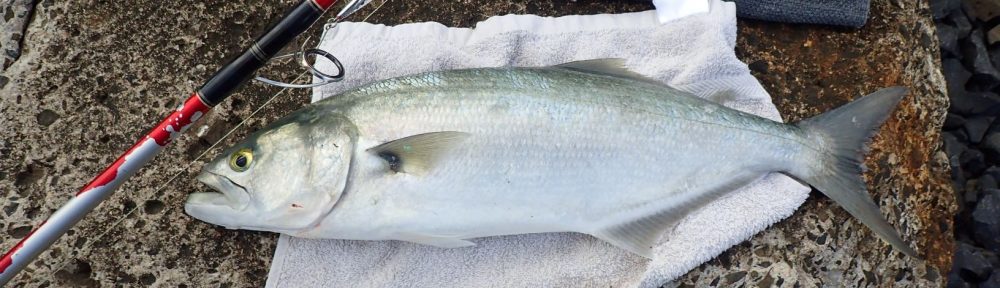
At around 8.00 am, the water was calm and shallow all around and it was a very bright and clear morning. The trebles on the Realis Shad were now all bent out of shape so I took it out of service and tied on a MARIA MJ Twitch 90 mm suspending hard bodied bibbed minnow and cast it out.  This is a big lure to throw at flathead but when they are around they seem happy to go after it. I varied the retrieve until I felt I was slowly moving the lure along, just above the bottom, with plenty of pauses. I felt a few aborted strikes and then there was a solid whack. The line started slowly peeling as the fish swam away with the lure, then it took off, as the treble hooks set. The first run was long and powerful, but fairly slow. I thought it might be a ray. Then it started shaking its head and I realised it was a flathead. There are only a few rocks in this area but there is small group that have sprouted tall seaweed clumps.  I soon realised the fish had the line wrapped around one of these. Fortunately the tide was still a low and I waded out to it and freed the line. I gradually tired the fish out and pulled it up into the shallows.

Unfortunately, in the prolonged fight, or perhaps in its initial hard strike, it had got the big hard bodied lure stuck a long way down its throat. I later measured it at 68cm – normally I would release a fish of this size but with the lure lodged where it was, I did not think it would survive the process of removal, so I decided to keep it. I would rather eat it, than let a shark have it!

I decided to give up at about 8.30 am and as I wandered back to the car, there where flathead lies everywhere. It seems the fish are back, in large numbers.
Bribie – the bridge and White Patch – 2 June 2014

Monday

No time for anywhere but Bribie at the moment, but I decided to try a few different areas. These bright winter dawns are the best of the year and although the cooler weather makes it a bit tougher to get out of bed in the dark, it’s dark for much longer.

I started on the Bribie Island side at about 5.45 am, just north of the bridge. I would be fishing the low tide and the start of the run in. The water was still and the tide had slowed down. I started with a GULP 2” Shrimp soft plastic in the Banana Prawn colour and I have now swapped back down to fishing with a 10lb fluorocarbon leader. This definitely produces more hits than fishing with 12 lb leader or heavier. It is also a good strategy to try and catch a few bream.

There was not much going on under the lights below the bridge. A few prawns skittered around, which was why I chose the Shrimp patterned soft plastic. At about 6.00 am, I caught a couple of small Pike. I moved a bit further to the south and a few minutes later, I caught two 35cm flathead, which had been lying in the shadows on the edge of the weed beds.

The sun started to light things up and nothing much was happening, so I drove up to White Patch Beach, further north on Bribie Island. The drop off that lines the edge of the Pumicestone Passage, also runs along the shoreline here. I parked at the set of steps down to the beach and wandered down. The fishing can be tough here but the scenery is fantastic, so it’s worth a regular visit.


There are nearly always lots of pike here and whilst you do catch the odd snapper, queenfish, mulloway and trevally, it is the core estuary species of cod, bream, flathead and tailor that dominate. Predictably, I found a patch of pike straight away. It was now about 7.30 am. I swapped to a GULP 3” Minnow soft plastic in the Lime Tiger colour and the pike liked this as well.

I moved slowly to the south and swapped to the DUO Realis Shad 59 MR a suspending hard body that has caught a few bream for me. I put in some long casts further to the south and I slowly twitched the lure back along the edge of the drop off. I felt a few grabs and then, as I slowed things down a little I connected with a fish. It was a small bream – about 28cm long. A few casts later, I connected with another, but I had the drag set a little tight and I pulled the trebles out.

It was now 8.30 am, well after low tide but the water still appeared to be running in, on the surface. The water was quite, murky and stirred up, so I decided to swap to a big bright coloured soft plastic lure. I chose the GULP Crazylegs Jerkshad in the Curried Chicken colour. I was now close to Wrights Creek, casting ahead of me into the shallows.

I was now close to Wrights Creek, casting ahead of me into the shallows. I got plenty of grabs and small bites, as I worked the soft plastic along the edge of the drop off, but I had to wait another hour to find the next fish. It was another small flathead about 35cm.

At about 9.45 am I had to pack up. I had found a few small fish, which usually means the bigger ones are nearby, but there was nothing for dinner.

Bribie – the old oyster jetty flats – 28 May 2014

Wednesday

Wednesday afternoon was my next free spot for a quick session and I drove up to Bribie to fish the run out tide. I wanted to fish today to see if the New Moon made any difference. It would be a 0.4m low tide, at about 3.00 pm. A 10 knot northerly was forecast but when I arrived, at about 1.15 pm, it was more like a 15 knot south-easterly.

I waded out to the south, under the bridge towards the old oyster jetty. The water was stirred up from the wind and the big tide, but there was not too much floating dead weed and sea grass around. I started with a DUO Realis Shad 62 DR, a small floating hard bodied bibbed minnow lure.

At this point I thought I would clarify that Landangler is not sponsored by anyone and does not own shares in BERKLEY GULP, DUO, RIO, MARIA, LUCKY CRAFT or any other lure manufacturer (although I probably should). From time to time (very rarely) manufacturers send me a few lures to try. If they look like they might work for the type of fishing I do, I will give them a try and see if they catch fish. If I do try them, then I will write about the results – good or bad.  But I will always let you know if I did not have to pay for them. This approach is not always welcomed and I often receive a package only once!

I read a great blog post by Adam Royter, a few weeks ago – it is worth a look, if you have time – http://www.maddogroyter.com/1/post/2014/04/the-truth-be-told.html . I was impressed that he was willing to bite the hand that feeds him by pointing out how disappointingly predictable reviews in Australian fishing magazines have become. I appreciate that the fishing industry is small here and that the ‘pay for advertising in return for a positive review’ model has become normal practice – but that don’t make it right.

Landanglers prediction is that only good quality, current, unbiased content will get read in the future and most of it will not get read in the paper format. Like it or not, the younger generation consider web content as free, so if you want to get paid in some way to be a fishing journalist, your product will need be exceptional and that is how it should be.

Right, it’s time to get off the soap box and get back to the fishing. I tied on the DUO Realis Shad 62DR (purchased with hard earned cash from Tacklewarehouse at Camp Hill – http://www.tacklewarehouse.com.au/). The tide was running out quickly and I was now standing about 30 metres to the south of the old oyster jetty. After about three casts, using a fairly fast, constant retrieve an angry flathead surfaced with the lure lodged in its mouth. It was a good sized fish – about 55cm long. A few casts later, the same lure caught a slightly smaller one.


Then things slowed a bit. As the tide got lower, more and more weed started to clog the lure so I swapped back to a soft plastic – the GULP 4” Minnow in the Smelt colour. This found the fish pretty quickly and I caught another 3 small flathead over the next 30 minutes.  I waded a long way towards the green channel marker and caught one more 45cm flathead before turning back.

Just before 4.00 pm I made my way back towards the bridge and stopped to cast a few shots in the area just to the north of the jetty. I had now swapped to the GULP Crazylegs Jerkshad in the Curried Chicken colour. This produced another couple of small fish.

It had been another good session with plenty of fish around. They were all released today, so go and catch them again.