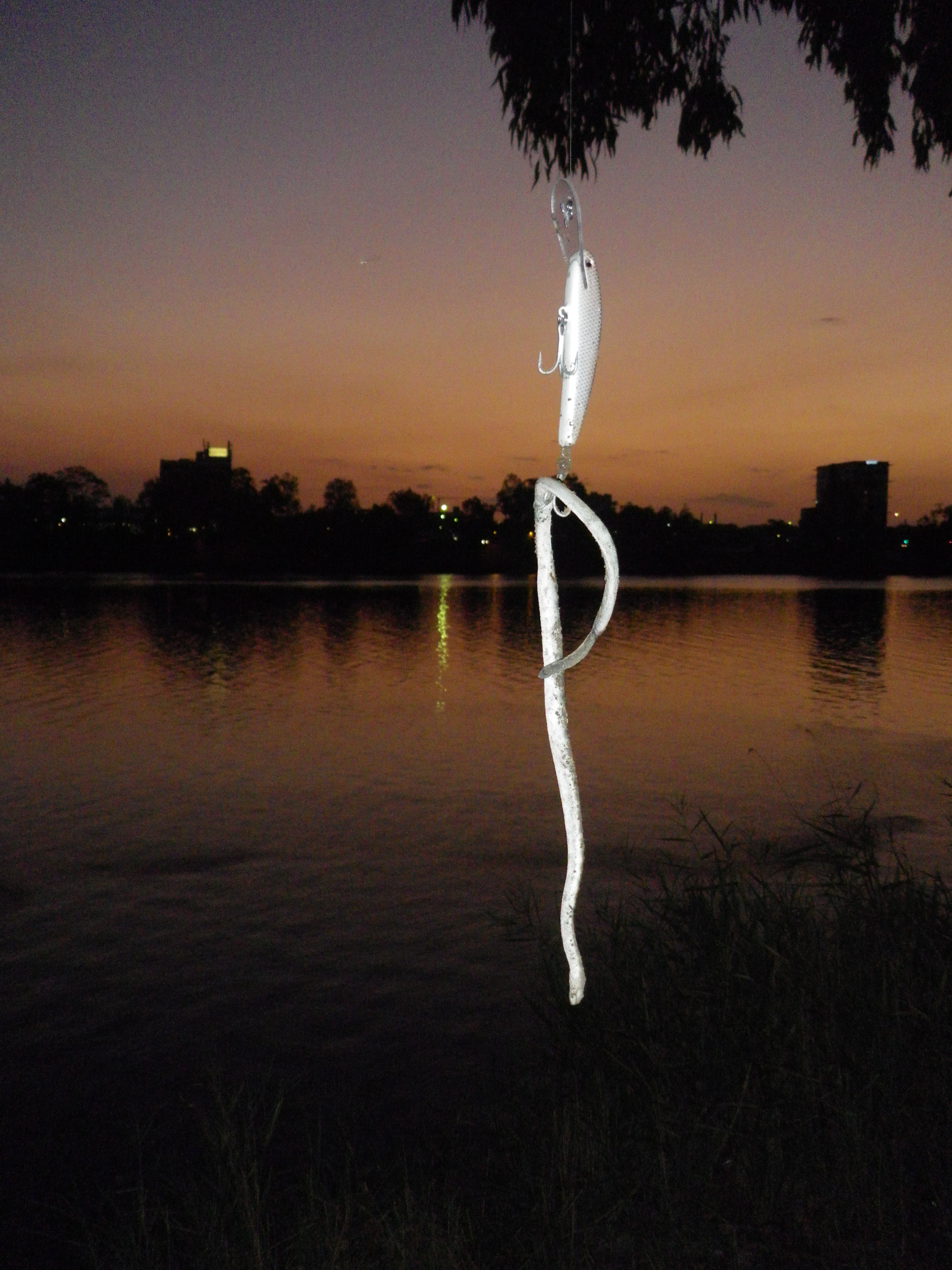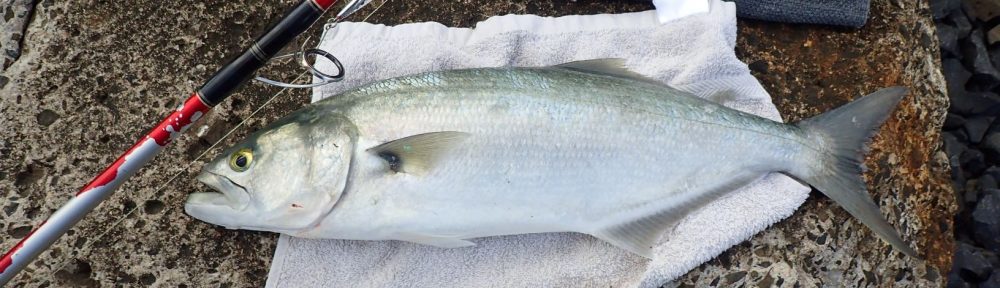
Rockhampton – Fitzroy River – 22/3 November 2013

Friday

Friday saw me back in Rockhampton. I am enjoying fishing up here, whenever I can, but I am also missing the Bribie Island flathead fishing. I have completely missed the busy months of September and October. I hope to get this job finished and be back out there soon.

Rocky is warming up and by 3.00 pm, its usually over 35 degrees and extremely humid. There have been a few more storms and the Fitzroy River is looking murkier and murkier. I arrived in town just after lunch. I had a few meetings, dumped my kit in the motel and headed across the bridge to the north side of the river.

I wanted to see if I could find any more giant herring, grunter or tarpon. The locals insist the last few hours of the run out tide are the best time to fish here, especially when they coincide with dawn or dusk. Full moon had passed on Thursday, so their would be plenty of tidal flow. The sun was dropping, as was the tide and it was hot and sticky. I arrived at about 5.30pm and wandered out under the railway bridge, to the edge of the rocks. Low tide would be at about 9.00pm. It had rained the night before and there were rumbling grey clouds on the horizon with a few, far away lightning flashes. I could smell the rain but it was not falling yet.

There were a few prawns jumping, so I started with a GULP 4″ Shrimp in the Banana Prawn colour. I had rigged it on a 1/8th ounce, size 1 hook jighead and I was using 12lb fluorocarbon leader. I was using my new 6′ Shimano Catana rod and the 2500 size Shimano Stradic reel.I was casting along the edge of the rocks, so I did not need a long rod – the fish are usually close to the shore, lurking around the rock bars and overhangs.

As the sun dropped the surface activity picked up and there were small jelly prawns scattering, each time I pulled the soft plastic up close to the rocks. After about 15 minutes, I decided to let it drop down right next to the rocks. Once I was sure it was on the bottom, I paused for a good ten seconds. I then jigged the soft plastic shrimp up and down few times and paused again. It was third time lucky and something fairly powerful grabbed the plastic and headed off. It quickly surfaced – a barramundi, about 45 to 50 cm long. It tail walked on the surface a couple of times, trying to spit the lure. After a short fight, I lifted it out of the water. Although I was delighted to catch a decent Fitzroy barramundi, it is currently the closed season for barramundi, so after a quick picture, I released the fish unharmed and decided to moved round to the next set of rocks. You are not supposed to target these fish at this time of year and whilst you cannot decide which fish is going to eat your lure, it was a fair bet that there would be more than one barramundi lurking at the base of those rocks, so I moved on.

The jelly prawns were all over the place but there was nothing much feeding, close in. I lobbed the soft plastic a little further out, and let it sink again. As I lifted it off the bottom, I felt a tentative bite but did not hook up. I kept casting and put in some long pauses, close to the base of the rocks. The sun had set and the rain and thunder was close. At about 6.15 pm, something slammed my shrimp at the base of the rocks. I knew it was another barramundi straight away. It soon surfaced and made a couple of leaps. I let it settle and pulled it gently out of the water. It was a little bigger than the first. I photographed and released it.

I moved to another location, about 10 metres further south for a few more casts. It was now about 6.30 pm and pretty much dark. The rain was imminent and the wind was gusting in all directions. I continued with the soft plastic lure that was catching fish – GULP 4″ Shrimp. In a carbon copy of the two previous captures, a third barramundi grabbed the lure at the base of the rocks. It was also about 45cm long. I released just as the rain started spitting and decided it was time to go. By the time I reached the car I was soaked to the skin.

The session confirmed all the local advice I had been given – fish during a big falling tide, at dawn and dusk. I think the humidity and pending storm also helped. The next morning, I swapped sides to avoid the barramundi and found a few small fish, some of which I have never caught before. The rain seemed to have fired up the small grunter and tarpon and I caught a few of each, in the hour around dawn.

That was it for Rocky for a while – hopefully I will get back around March, when those barramundi will have grown big enough to keep.
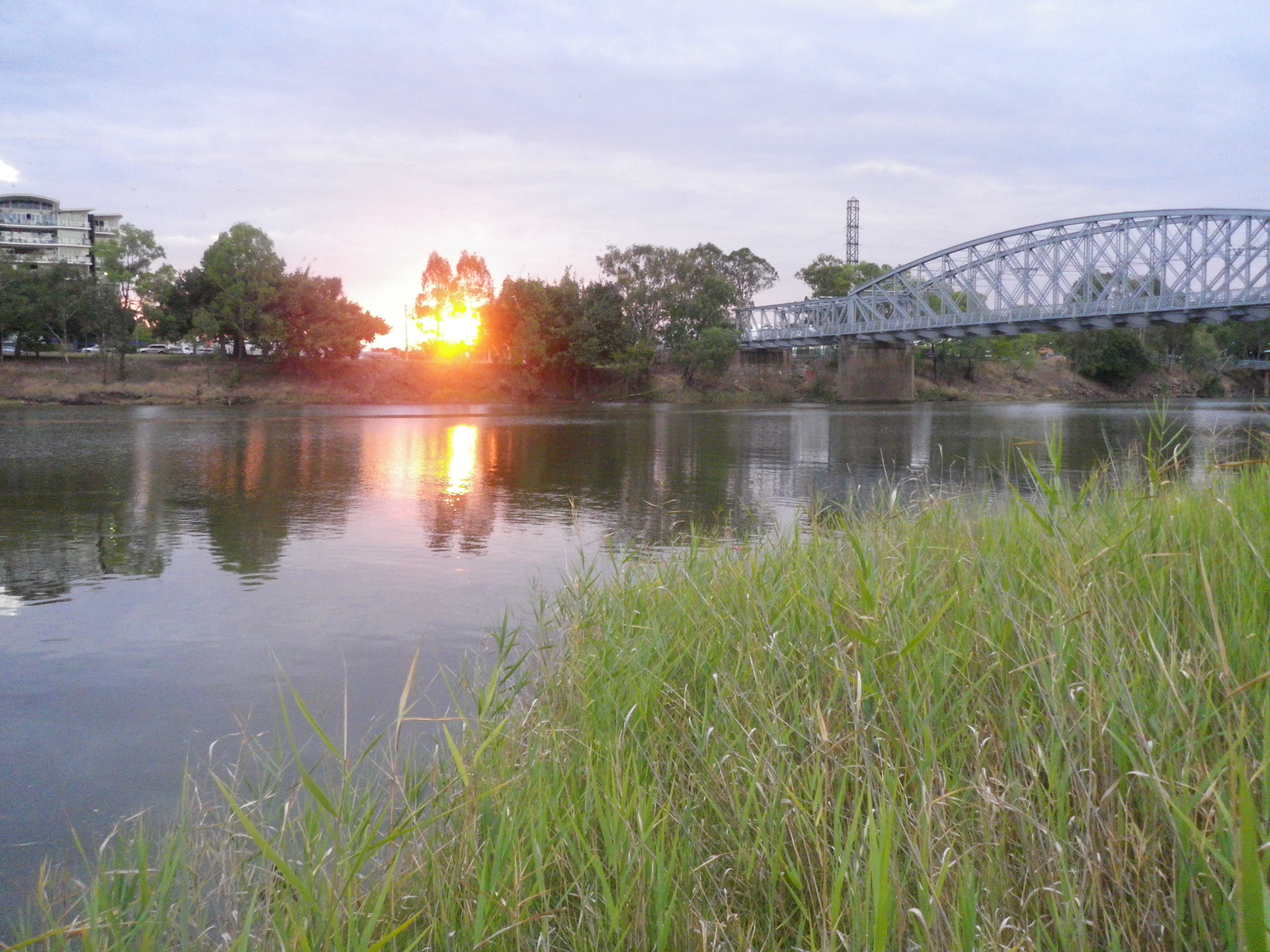
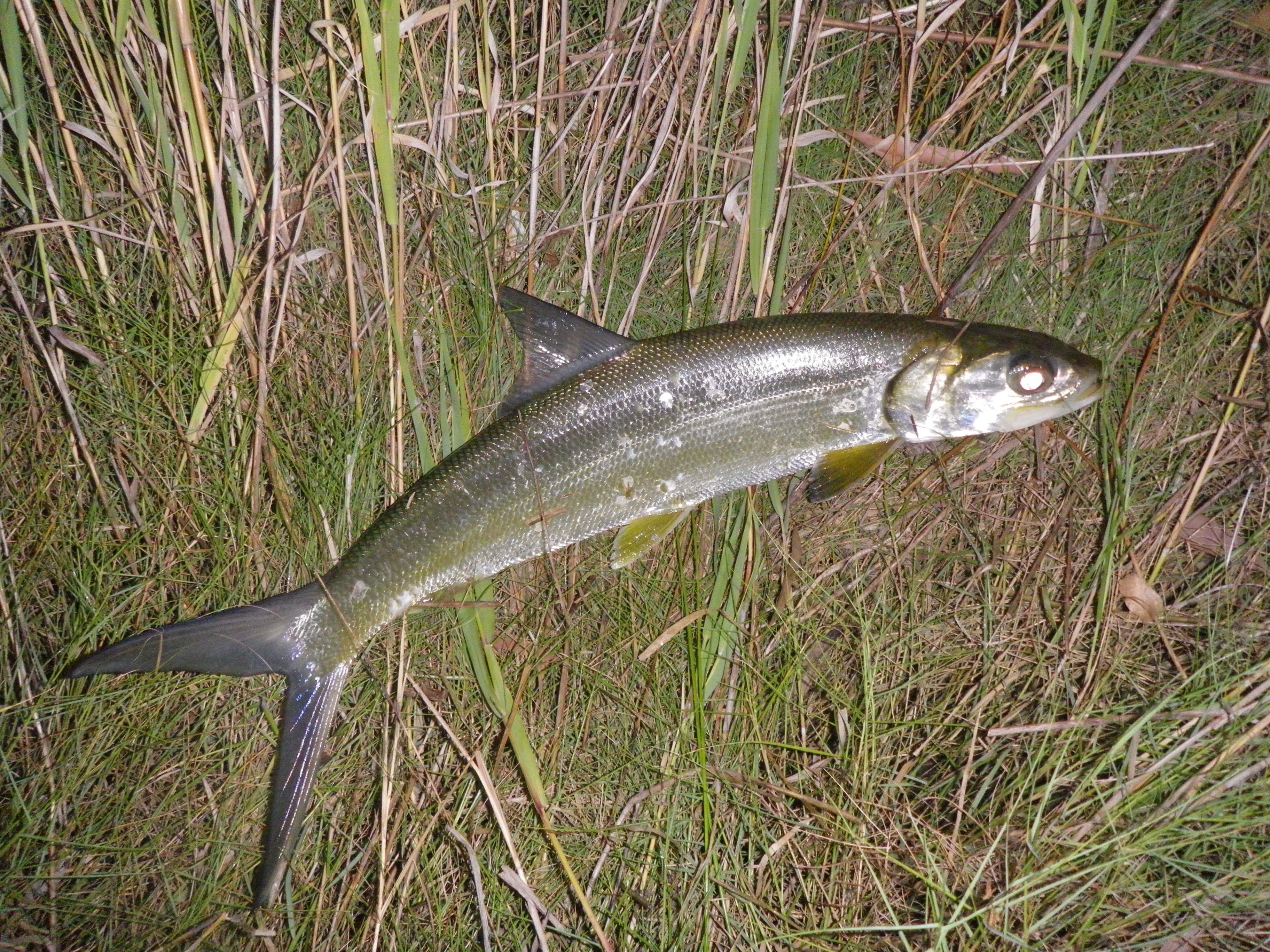
Yeppoon – Fishing Creek – 14 November 2013

Thursday

It would be my last chance to fish in Yeppoon, for a while. The wind had been blowing hard, so I decided to give Fishing Creek a look.I arrived at about 8.30 am but I had misjudged the tide. It was a big high and it would be a while before it ran out enough for me to proceed down the creek. I fished around the top end and saw a fair amount of bait moving around, but did not catch anything. The combination of a strong north-easterly wind and the big tide had stirred the water up, so I could not see much.

By about 9.30 am the water level was dropping fast and I could walk down the creek towards Corio Bay. I was using my new G.Loomis TSR Ultralight 6′ 7″ rod. It needed to catch a fish, to settle its nerves and I thought it would be fairly easy to find a flathead for it, in this creek. I waded down the creek for an hour, stopping at a every bend and sand bar, but I could not find a fish.

I liked the feel of the rod and its very sensitive tip. I gradually got used to the feel of the 1/8th ounce jighead hopping along the sand corrugations, on the bottom. I lost plenty of jigheads to the trees and snags, as I got used to casting with the slightly longer rod. At about 11.00 am I reached a bend in the creek where a big drain rounds a sand island and empties out into the main channel. The fast flowing water has carved some deepish holes and exposed the mangrove roots.

I thought there must be a fish here. I put on a GULP 5″ Jerkshad soft plastic, in the natural, Peppered Prawn colour and loaded it onto a 1/8th ounce, size 2/0 hook jighead. I cast around the mouth of the drain, still looking for a flathead, without any luck. I turned my attention to the eddies, at the foot of the mangroves on the other side of the channel. After about three casts at these roots, the line pulled tight about halfway back across the channel and a fish took off with the soft plastic. The rod bent right over and absorbed the initial smash, then line started peeling. I could feel the tail beats of something fast.

It kept making for the mangrove roots but I gradually subdued it. When I caught sight of it, it was a trevally – about 40cm long. It is amazing how powerful these fish can be when they have a strong current to run with. It took a while but I pulled it up on to the sand and took a few pictures.

The rod was off the mark but I could not find any more fish. With the north-easterly now almost gale force, I gave up just before noon.

This slideshow requires JavaScript.

Rockhampton – Fitzroy River – 11-13 November

Monday to Wednesday

I would be in Rockhampton for most of the week. I wanted to put in a few sessions fishing the town reaches of the Fitzroy River. It’s now closed season for barramundi, but I am told there are all sorts of other things to catch on lures and soft plastics. Monday evening was hot, still and humid – perfect fishing conditions. It looked like it was about to rain and the mosquitoes and midges were buzzing in my ears, as soon as I got out of the car.

I had chosen to fish on the north side of the river, close to the base of the railway bridge. The grass is head high here, but there are a few tracks through it. I think its best not to think too hard about what might be lurking in the long grass at dusk. I always wear boots and long sleeves and trousers in this kind of terrain.

By the time I reached the waters edge I was soaked in sweat. The water was fairly murky but the locals I spoke with said this was about as clean as the salty part of the river ever gets. Once the rain started it would get much murkier.

It was about 5.30 pm and the sun was dropping fast. There was plenty of bait around and every now and then, a predator would send tiny fish flying in all directions. High tide would be just before 6.00 pm and the water was not moving very fast.

I was fishing with the Berkley IM6 Dropshot GEN IV 6’6″ Light spin rod. I had it rigged with 14lb fluorocarbon leader and had put on a 1/8th ounce, 1/0 jighead and a GULP 2″ Shrimp in the Banana Prawn colour. I felt a few nudges and as it got dark the plastic was grabbed by a fish which took for a short powerful run, then dropped it.

Fishing the Fitzroy River at dusk

Fishing the Fitzroy River at dusk

A couple of casts later it must have come back around and this time it did not hesitate. It took off with the soft plastic heading for mid-stream. Almost immediately the fish jumped clear of the water and initially I thought it was a large Tarpon. On the second jump I got a better look and realised it was not a Tarpon. On the third jump I got a really good look at it because it jumped out of the water and up on the bank next to me. It was a giant herring. It thrashed around while I took a few photos and then with one final jump spat the lure and landed back in the water – a very tidy catch and release.

Fitzroy River giant herring

Fitzroy River giant herring

It was now 6.30 pm and very dark, so I decided it was time to get out of the long grass and head for a cool shower. Over the next few nights, I swapped sides of the river and fished through dusk, under the bridges through the high tide. I caught a few grunter and a few tarpon. I connected with another giant herring but failed to land it. I also had a couple of bite offs which could have been anything. I found the natural coloured peppered prawn and banana prawn plastics worked best.

Grunter bream on a GULP Peppered Prawn Jerkshad

Grunter bream on a GULP Peppered Prawn Jerkshad

Yeppoon – Emu Park 10/11 November 2013

Sunday/ Monday

I was back in Yeppoon on Sunday and decided to see if the fingermark were still around at Emu Park. It would be low tide just after dawn and the winds would be light from the north-east. The temperature was a bit lower than it had been when I was last here and the water was not as clear.

I had repaired the tip on my slightly heavier rod, which is ideal for this kind of fishing – the NS Blackhole Cabin 2 S862L, rated 8-14lb, 2.59m long. I match this with a Shimano Sustain 4000, loaded with 15lb Super PE braid and I started with 14lb fluorocarbon leader and a 1/8th, 1/0 jighead. This rod is great for fishing with soft plastic lures and small hard bodied lures and slugs. It has the power to land a decent fish but is still quite sensitive.

As is often the case the first 30 minutes of the session produced the most action. I rigged up a GULP 3” Minnow in the Watermelon Pearl colour and cast it out towards a semi-submerged bommy. As soon as I pulled in the slack there was a fish attached and it took off. A few moments later I landed a decent sized fingermark – about 45cm long.

After a few more touches, I decided to put on a larger soft plastic and chose a 5” Peppered Prawn Jerkshad. After a few casts, I felt a very solid bite but when I struck the fish was not there. I cast back in the same spot and let the soft plastic sink and sit on the bottom for 10 seconds. When I lifted it, it was slammed and line started peeling. A few moments later a very big fingermark – well over 70cm leapt clear of the water. I was still attached but even my bigger rod was no match for this fish. It kept running and soon had itself wrapped around some rocks. There was a bit of see-sawing and the fish was gone.

I re-rigged with a GULP Crazylegs Jerkshad in the New Penny colour. As soon as I cast this out it was slammed, as it sank. It was another big fish and it took plenty of line. I did not get a look at it, as it also buried itself in the rocks and the leader snapped. I continued fishing with the bigger soft plastics but everything seemed to have shut down and I did not get another bite.

The next morning I was back, at sunrise. There was more water over the rocks as low tide would be about an hour later. I beefed up my leader to 20lb fluorocarbon, as I wanted to try and hang on to any big fish that I could hook. I was pretty confident but nothing much happened with the big soft plastics. After about 40 minutes something grabbed the a GULP Crazylegs Jerkshad in the New Penny colour. It was too slow for a fingermark but it was still crafty and tried to lodge itself under the overhanging rocks. After a minute or two, I pulled up a decent sized cod.

I dropped back down to a smaller soft plastic – the GULP Swimmow in the Peppered Prawn colour. This soft plastic has a small paddle-tail and creates a tight vibration in the water, as you retrieve it. After a couple of casts with this I felt a very light bite, I paused and struck, but there was no fish there. Next cast – same thing. Next cast, I left the soft plastic on the bottom for about 10 seconds and as soon as I lifted it … the fish was running with it. After a short fight, I saw a flash of silver. A few moments later, I landed a 40cm grunter.

By about 7.30 am everything seemed to shut down. I walked around the whole headland casting, but all I could collect were more small cod. At about 9.00am it was hot and I was tired, so I gave up.

Lake Monduran – 9 November, 2013

Saturday

After a bit of work and a bit of time at home, I found myself on the road back up to Central Queensland, on Saturday. I often drive past the various arms of Lake Monduran, around Kolonga, but rarely have time to stop. But today I did have time and even though the sun was blazing and it was 10.30 am, I had to give this area a go.

Unsurprisingly, once back in Brisbane, I had been doing some tackle spending. I had replaced my G.Loomis GL2 with a G.Loomis Ultralight TSR Series , Fast Action, 2 to 6 lb, 6’7”rod. This is a beautifully crafted, incredibly light trout rod and even though it is a little longer than my preference, I think it will be a great Bribie Island flat’s rod. But I had also decided I wanted a fairly heavy shorter rod that would be easy to cast in the cramped, freshwater environments I have been exploring. It still needed to have enough power to subdue a big barramundi, if I came across one. Steve at Jones Tackle seems to now understand my light gear obsession and knows that I consider anything rated over 2-4kg to be really only suited to offshore big game fishing. After my recent bruising barramundi encounters, I recognised I was going to have to sacrifice ‘feel’ for strength but everything I tried seemed very stiff. In the end I compromised with a cheap 6’ Shimano Catana, rated 2 – 4kg. There is nothing very sophisticated about this rod but at $70 it was cheap enough to experiment with.

I parked in a shady spot pulled on some lightweight long trousers and my ankle boots and wandered off along the bank. The water was brown and still, almost every branch had a lizard on it and I could see tiny baitfish hovering around the fallen timber. I was not sure what would be in here. I was confident there would be fish of some kind. I tied on a GULP 4” Swimming Mullet in the Banana Prawn colour, on a 1/12th ounce, size 2 hook jighead. I was using 12lb fluorocarbon leader.

On my first cast I found a familiar species – the catfish. I moved along the banks casting at lots of snags and caught a catfish on almost everyone. I tried various plastics and it was the grub tails that were most attractive to the catfish. Whenever I let them sink and remain still on the bottom, for anything more than about 20 seconds, they would be hoovered up.

I walked towards an area where the lake opened up a bit and came across an enormous flock of birds escorted by a pretty big group of pelicans. This area looked really fishy with lots of fallen timber and presumably, some deeper holes.

There were lots more fish but they were all catfish – there were some really big brutes among them so the new Shimano Catana was christened with a good workout. After a couple of hours I gave up. It’s always good to explore and maybe a dawn or dusk session here might haven been more successful.

Yeppoon – Fishing Creek – 31 October 2013

Thursday

Time for one last session at Fishing Creek before heading back to work. It would be a late morning low tide with not much wind to start with. There was no need for very early start as the creek would be too full of water to wade along, until about 7.30 am.

I was back to fishing light. I was using my recently acquired Berkley IM6 Dropshot GEN IV 6’6″ Light Spin two piece rod, rated 2-4 kg. I paired it with the Shimano Stella 2500 loaded with 8lb Fireline and a 12lb fluorocarbon leader. I had a few of my favorite GULP soft plastics and small DUO hard bodied lures, in my chest pack.

I started with the trusty GULP 3″ Minnow in the Watermelon Pearl colour on a 1/8th ounce, size 2 hook jighead. This soon found a few small flathead. Wherever I found flathead lies in the sand I cast around until I found the fish and it usually worked.

I swapped to a 3″ Minnow soft plastic in the newly available Red Green Sparkle colour. GULP have recently released a few new colours in Australia and this is my favorite amongst the newcomers. The new colours fill in a few gaps in the range. I will not try to describe the colour but have a look at the photos attached to this post. The new colour did not seem to have much trouble and after a few casts, I christened it with a small flathead.

As the tide ran out I followed it about 3.5 kms down the creek. My constant companion was an eagle looking for a free lunch. I kept catching small flathead but there were not many keeper size ones around. I swapped back to the more natural coloured Watermelon Pearl Minnow and this produced a decent estuary cod.

At about 11.30 am, as the wind picked up and I was about to give up for the day, I found a reasonable sized grunter bream. I released it and made the long trek back to the car. Not many big ones, but plenty of fish – which I think makes for a good session.

Rockhampton – Hedlow Creek – 29/30 October 2013

Tuesday / Wednesday – Hedlow Creek

More time stuck in Rockhampton – which is not necessarily a bad thing. I decided to go looking for a freshwater barramundi. It was just a few days before the barramundi closed season came into effect.

I had chosen to stay at Henderson Park Station – http://www.hendersonpark.com.au/, in one of their cabins. Henderson Park is a working cattle property which has a lodge and a couple of cabins which are situated right on Hedlow Creek. Hedlow Creek is a fairly narrow freshwater creek about 10 km long, just north of Rockhampton. It has been regularly stocked with barramundi fingerlings and also has sleepy cod and a few other species of native fish. The creek is spring fed from either end, so never runs dry. The Henderson Park cabins are located on the west bank for the creek, within casting distance of the water.

You need to start early

You need to start early

The scenery is spectacular and I think this is about the prettiest place in Queensland to chase a fresh water barramundi. The creek is accessible from the public dirt road on the east side, but if you stay at Henderson Park, you can access the water all along the west side, as well.

The owners said there were some big barramundi in the creek and that casting soft plastics at dusk or dawn, around the fallen timber, had been the most successful way to connect with them. I have to confess that I have been here before and only caught catfish but I have seen pictures of some great captures, so I was determined to have another try.

The fantastic thing about this waterway is the amount of structure. There are fallen trees and overhanging branches all along it and there are some nice deep holes. There are only a few places where the creek gets wider than about 20 metres, so for much of its length you can comfortably cast from one bank to the other.

There were a few pricky footballs in the undergrowth

There were a few pricky footballs in the undergrowth

On my last visit I had fished a couple of dusk sessions and only one morning. I had used lightly weighted soft plastics – GULP Shrimps, Minnow and Minnow Grubs and caught perhaps 10 small catfish. The main challenge was losing jigheads to the numerous sunken logs and other snags. All this structure would have made using hard bodies a pretty expensive business.

This time I decided to focus on the early morning sessions. That meant being awake at about 4.00 am and walking out along the banks of the creek, as the horizon started to glow at about 4.30 am. Instinctively, I felt the grub tail soft plastics might attract a strike. Loaded on a 1/12th or 1/8th ounce jighead, their fluttering tails sinking down next to a snag, might be tempting.

In hindsight, I realise I was fishing far too light. I had 8lb Fireline as mainline and 16lb fluorocarbon leader on the light Berkley Dropshot spin rod. I started with the GULP 3” jigging grub on a 1/8th 1/0 jighead, in the neutral looking “Smoke” colour. I moved along the bank to the north of Hedlow Lodge, stopping to cast at any likely looking snag or log. At about 5.45 am I stopped beside a fallen trunk that stretched out to a point well over half way across the creek. I cast my soft plastic just north of the trunk and let it slowly sink. I paused and retrieved the soft plastic in a slow and steady motion, along the line of where I thought the sunken tree must lie.

I have watched endless fishing shows and been told you have to be persistent with barramundi. They will ignore 20 casts and finally lose their temper on the 21st and strike. Well, I received a very personal lesson – and it all happened in the blink of an eye.

I had put in perhaps 25 casts using various retrieves – slow vs fast, regular hops vs a steady wind. I lobbed out another cast and let it sink around where I thought the end of the sunken log might be. I let the lure sink and paused for perhaps 10 seconds. When I lifted the rod tip the soft plastic stopped dead and then after less than two seconds the reel was literally spinning and a huge wake was moving towards the bank on the far side. The fish then broke the surface, close to the other bank and I could see it was a very big barramundi. This had all happened in about 5 seconds and it was only now that I realised that the fish had taken the lure under the fallen log. I could feel the line rubbing as it lunged and pulled. After about 15 seconds there was a great tail slap and the line went slack.

The contrast of the incredibly violent and powerful attack with the peaceful dawn scene of a few moments before, was total. My hands were still trembling and my heart pumping, as I slowly wound the line back on to the reel. Miraculously the mainline had held as had the knot attaching it to the leader. The bite off or break, had been a long way down the leader close to the jighead. The line from “Jaws” sprang to mind: “We are gonna need a bigger boat” (substitute rod, line, leader, jighead for ’boat’).

I waited for my hands to stop shaking and re-rigged with 25lb leader (the toughest in my chest pack). I moved gradually north along the bank and caught a couple more catfish but by about 10.00 am, I had not had any more interactions with the barramundi, and the wind had picked up, so I gave up for the day.

Next morning, it was more or less the same drill, up at 4.00 am and fishing by 4.30 am. This time I swapped up to a bigger 4” Jigging Grub in the Peppered Prawn colour, on a tougher 1/8th ounce, 3/0 jighead and the 25lb fluorocarbon leader. I moved much further north along the creek, to a large bend where the west bank is lined with a couple of fallen trees. I cast around them, losing a couple of jigheads to the sunken branches.

It was a case of methodically covering the area with casts and again, persistence paid off. I was casting at the far bank and slowly hopping the lure back along the sides of submerged tree branches, which were on my side of the creek. About ten casts into the process a huge, green shouldered, silver scaled shape, launched itself up, from under a tree branch and dived down over the soft plastic, as it was suspended, about 30cm from the bank.

This looked like a smaller fish than the one from the day before, but I would estimate it was still over 80 cm long. It took off for the far bank with amazing speed and power. It was heading for some timber on the other side and by virtually locking up my drag, I pulled it clear. Then it came back towards me and torpedoed across the surface, shaking its wide open mouth trying to spit out the jighead. I really had no more stopping power in the rod and reel, so I was at its mercy. It paused briefly and I thought I might have a chance and then it took off again and there was the sickening feeling of the line rubbing against timber. I loosened the drag a little to see if it would swim free but it just kept tearing around until the line snapped at the main line to leader knot.

Fantastic spot to have a look for some barramundi - Hedlow Creek

Fantastic spot to have a look for some barramundi – Hedlow Creek

I carried on fishing around that area and tempted a couple more catfish, but no more barramundi. It looked like I would not be getting a big freshwater model until next season. I had only had a couple of encounters but it was enough to bring me back – and next time I will be properly equipped.

Yeppoon – Emu Park – 29 October 2013

Monday

Up early and back out to Emu Park to see if I could find more fingermark. I had the replacement Berkley Dropshot and the Shimano Stella 2500 was pretty well suited to it. I upped my leader to 14lb fluorocarbon, mainline was original fused Fireline, rated 8lb.

I have probably said this before, but I love the original fused Fireline in the fluoro/yellow colour. It casts well, I can see it in low light and it is extremely tough. The only downside is that I need a new spool of it after every 5/6 sessions, when its starts to fray and breakdown. I have tried Berkley Exceed and Nanofil but these are not an improvement on the original. Just make the original more durable please Berkley.

I arrived just after 5.00 am and there was a bit more water over the rocks and the wind was up. It was an easterly, blowing about 10 knots. There were a few clouds around, but rain was unlikely. The moon was a waning crescent with the new moon not due for about a week. The tide was running out and would be low just before 10.30 am.

The first fish was a tiny striped perch who grabbed the soft plastic, in close to the rocks. Next came the obligatory small cod. I fished for 30 minutes and caught a few more small cod. Perhaps the Fingermark had moved on.

Just after 6.00 am I found them again – maybe they were having a lie in. The first one made a tentative nudge at the soft plastic lure as it sank (a GULP 4” Minnow in the Watermelon Pearl colour), then it (or one of its companions) followed it in to the shore and thumped it right at the edge of the rocks. It took off and the added strength of the Berkley Dropshot was immediately apparent. It was a good size fish so I actually loosened the drag a little to avoid straightening the hook or pulling it out, and let the fish wear itself out. A minute or two later I had it at my feet. It was another very nice fingermark, well over 50cm long.

I released it, tidied up the soft plastic lure, re-positioned it on the jighead and cast it out again. Two lifts of the rod tip and bang, I was on again. It was another slightly smaller fingermark. The fish were definitely eating now. I released it and cast out again. This time the soft plastic did not reach the bottom. A fish walloped it and took off for New Zealand. A couple of times I felt that I might be slowing it down, but it was probably just pausing for a rest. I gradually tightened the drag but it did not make much difference. This fish was big and I could not really apply any pressure. Eventually the line went slack and I pulled in a bent jighead.

The jighead was a TT Headlockz series; 1/8th ounce , size 2/0 hook. These carry a GULP Minnow 4” soft plastic very nicely. I have however, straightened a few of them. I think the heavier gauge hook necessary for the Headlockz system gives the impression they are heavier duty than they actually are. In my experience the original fine gauge Tournament Series TT/ Gamakatsu jigheads (in the orange backed packet) are actually tougher than the Headlockz. Having said that, I would probably not have landed this fish with a 6/0 heavy duty jighead – it was just too powerful.

I re-rigged, this time with a bigger GULP 5” Jerkshad but after 10 minutes, this produced nothing. I swapped back to the smaller GULP 3” Minnow first in Peppered Prawn and then in Watermelon Pearl colour. I caught three smaller fingermark on each, over the next 30 minutes. It seems lure size was important to these fish.

At about 7.30 am I caught a small estuary cod and that was it – everything suddenly went quiet. I tried a few different soft plastics and moved to a few other spots around the headland, but it seems the fish had shut down again.

Another great session and a good way to warm up a new rod.

Rockhampton – Fitzroy River – 27 October 2013

Sunday PM

First stop was the tackle shop in Rockhampton, to find an emergency replacement for my broken light spin rod. The G.Loomis GL2 range has moved on since I bought mine. I found all the available G.Loomis ‘fast’ action rods a little too stiff for my liking. I think this is because the new, higher quality graphite has less give. I decided to look at something cheaper with a little more give. I settled on a 6’6″ Berkley Dropshot, rated 2-4 kg, two piece. It would do, until I could look into a more refined replacement.

With the Barramundi closed season fast approaching I felt I should try another session, land-based fishing in the Fitzroy River, at dusk. The boats were thick and there where plenty of land-based anglers wandering the banks. Everyone was keen to tempt a Barramundi. The tide was running out and had been high at about 4.00 pm. The wind was north-easterly but its was dropping off.

The folks in Barra Jacks (http://www.barrajacks.com.au) had loaded me up with traditional hard bodied suspending minnows and 45 lb leader but the reports from the Barra Bounty competition (a few weeks earlier) had suggested many anglers had been successful using small soft plastics. Obviously, I had a few packets of these as well.

Fitzroy Flathead

Fitzroy Flathead

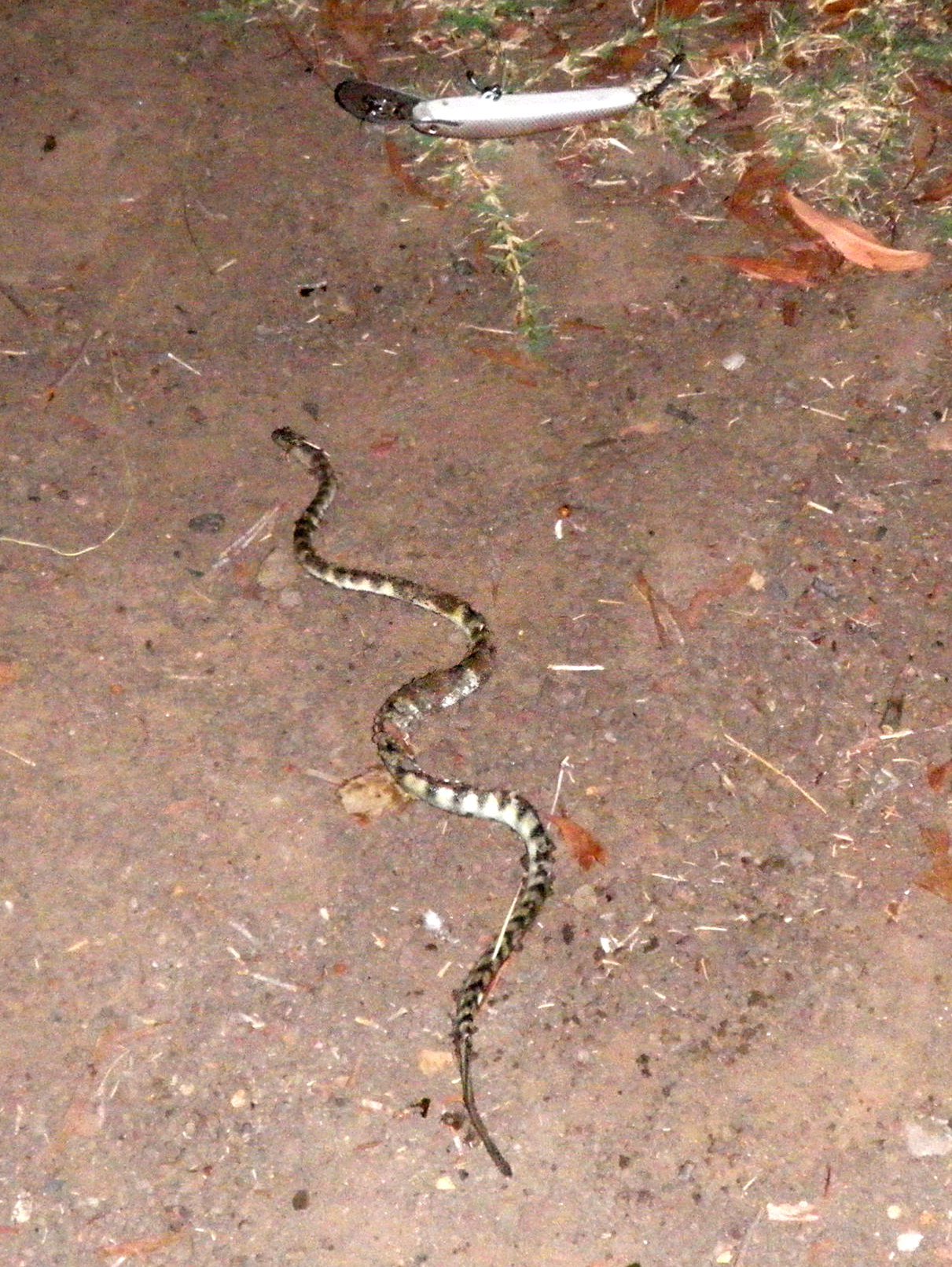
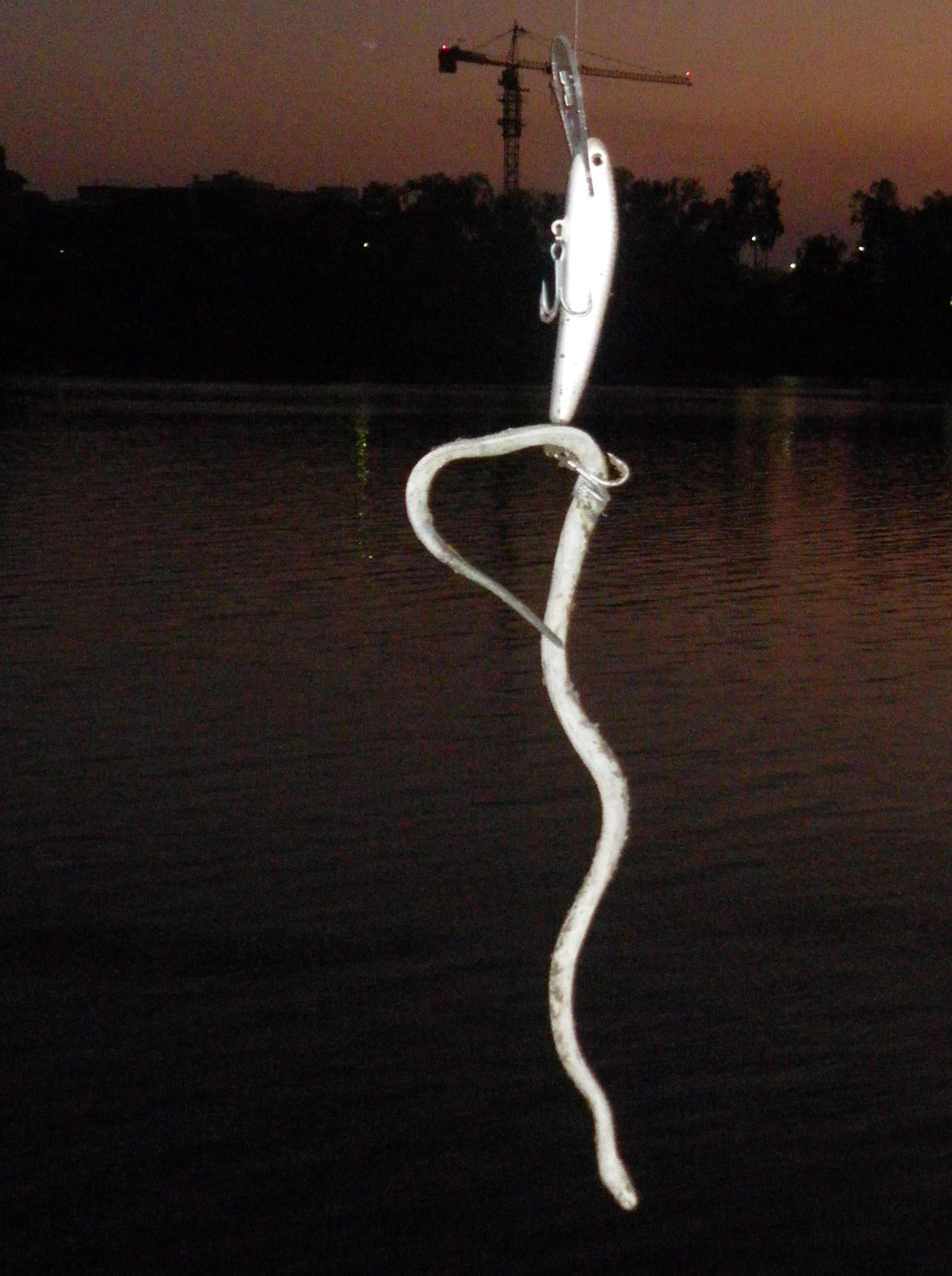
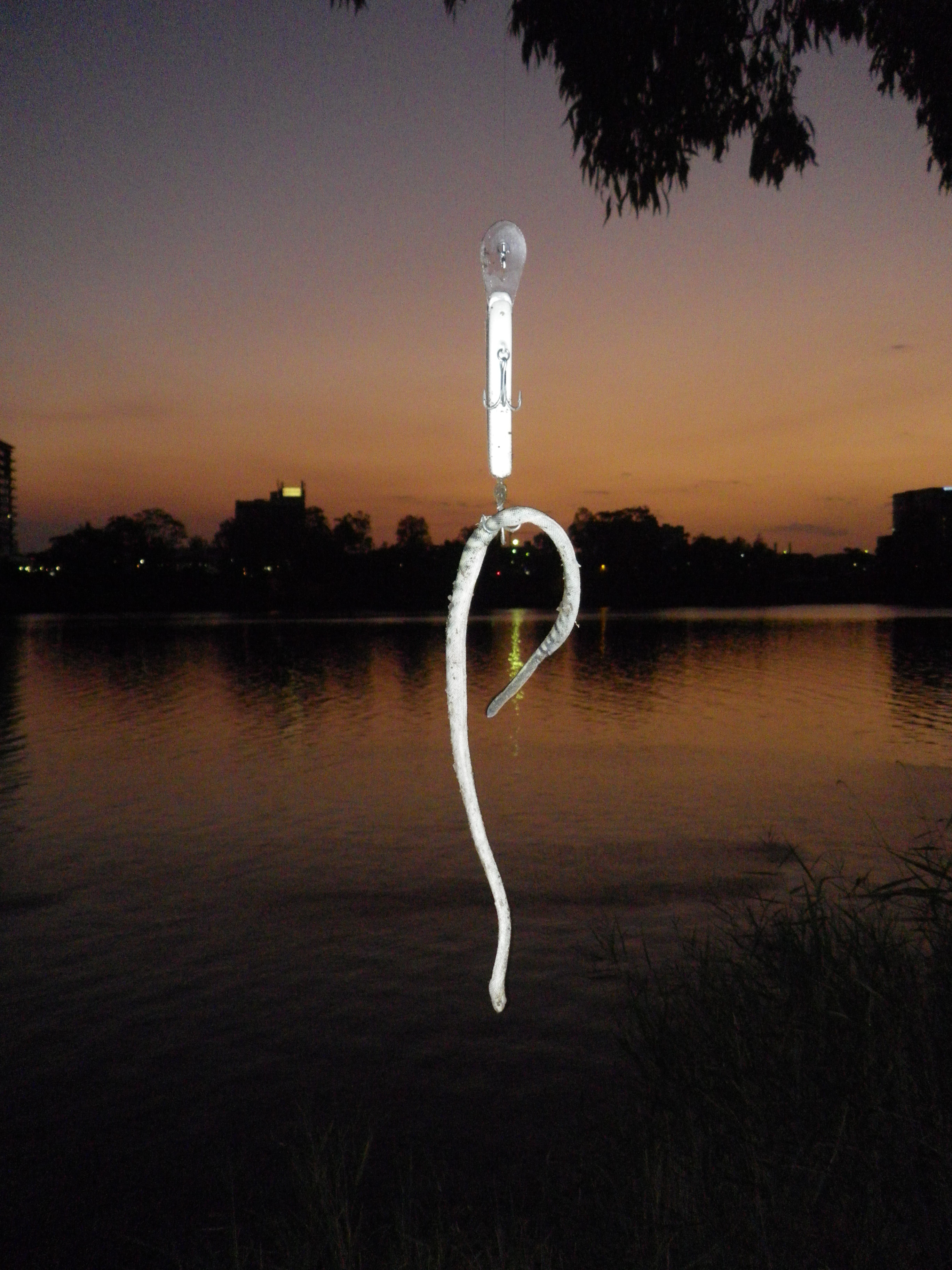
Rocky seasnake

Fitzroy River seasnake

Fitzroy River seasnake

Lures will catch anything

Lures will catch anything

Nasty

Nasty


I started fishing at about 5.30 pm behind the bowls club on the north side of the river, with a locally made, timber hard bodied suspending minnow lure in a silver colour. There were a few surface slurps and I could see decent bait schools swimming around. As the sun dropped on the horizon I felt some resistance and wound in. I had something but I could not see what. As I pulled it clear of the water I realised it was a sea snake. Is there no end to the predator list up here!

I managed to shake it loose from the line and it slithered off, back to the water. I decided to swap to soft plastic and put on a GULP 3″ Minnow in the Peppered Prawn colour, on a 1/8th ounce, size 1 hook jighead. It was now almost completely dark. I walked along the bank casting wherever there was an opening in the tall grasses.

Just before seven I felt a fish grab the plastic and I was hopeful. After a couple of small runs I realised it was a flathead. It came to the surface angrily shaking its head. It was about 45cm long. I released it and gave up for the day.

Yeppoon – Emu Park – 27 October 2013

Sunday

Finally a morning with virtually no wind forecast. I decided to head for Emu Park to fish the rocks. Low tide would be around 9.30 am and the moon was in its last quarter. I started at one of the headlands towards Zilzie and climbed out on to the rocks just after first light, at about 5.00 am.

There was virtually no wind and the sea was still. The water was not particularly clear and there was the bad smell of a recent algal bloom on the rocks. I was fishing light – actually I did not have a choice – as I had noticed, the night before, the tip on my heavier rod had snapped off during my recent travels.

I rigged up with 12lb fluorocarbon leader and a 1/8th ounce, size 1/0 hook jighead with a GULP 4” Minnow in the Watermelon Pearl colour. I was using my trusty Loomis GL2 light spin rod and Shimano Stella 2500. I have fished here a few times in the cooler months and found some good Bream. This morning the first taker was a tiny greedy estuary cod. I caught a few of these and swapped through a few colours and styles of soft plastics.

After about 45 minutes the cod where the only thing biting, so I moved round to the rocky outcrop in front of the ‘Singing Ship’ at Emu Park. It was now about 6.15 am and already getting warm. I stuck with the same light rod but swapped to a lighter, 1/12th ounce, size 1 hook, jighead. I put on a 3” GULP Minnow in the Peppered Prawn colour. I positioned myself right on the end of the outcrop and cast to the north of a large bommy that sits a few metres offshore. If you are fishing land-based, you can only reach this spot for a few hours either side of low tide.

After a couple of casts in various directions, I felt a very solid and obvious thud as the lure sunk. I paused and then lifted the rod tip fairly quickly. I had hooked the fish and now it took off for the submerged rocks and caves, which are all over the seafloor in this area. I could not really muscle it in with my light rod, so I let it take line when necessary and very slowly tightened the drag. I gradually started to move it towards me. It managed to get behind the rocks a couple of times but, on both occasions I let it swim out and then successfully took up the slack.

It was soon in the wash at my feet and I could see it was a good sized Fingermark with the tell-tale black dot on its side. I grabbed the leader and pulled the fish clear of the water. I recovered the soft plastic with the aid of my pliers. It was a long way down its throat. The fish was about 50 cm long and it looked like the perfect size for dinner, so I put it in a nearby rock pool that was big enough to act as a live well.

I re-loaded the soft plastic on the jighead and cast into the same area. Just a few retrieves later, I was on to another fish. This one was bigger and put up a more spirited fight. My 2 to 4 lb Loomis rod was working pretty hard. I saw a big tail flap over and thought I had it, but as I increased the pressure the jighead came free.

I re-rigged – same small 1/12th ounce jighead, same small soft plastic. 12lb leader was all I had with me, so that had to do. Things went quiet for 30 minutes and I mover around the rocks in either direction looking for more good spots. I had another solid bit but did not hook the fish.

Just after 7.00 am I was back where I had caught the first fish. I lobbed out a long cast and again, as I lifted the plastic off the bottom I felt that very solid whack! This was another good fish. It did not do much initially but as soon as it realised something was wrong, it went mad and leapt clean out of the water. It remained on the line but tried to bury itself under a weedy ledge. After a few minutes I pulled it clear with a great lump of weed on its nose. It was about 55cm – so I added it to the live well. I decided to stay in this spot and was soon rewarded with another smaller Fingermark – about 40cm. I let this one go and carried on fishing.

It was now about 7.30 am. I lobbed a cast up close to the edge of the bommy and let it sink. I paused and gave it a couple of slow lifts and then paused again. Next time, I felt a very light tap as I lifted the rod tip and then a solid whack! The fish took the lure and turned for open water. It stripped perhaps 25 metres of line in two long, straight runs and I began to think it might be some kind of pelagic. I held on, tightened the drag as much as I dared and held the spool to slow it ever so slightly, each time it to tried run again. I gradually tired it out and fortunately it had stayed clear of the worst structure. After a few minutes it was close to the sloping rock where I had pulled the other fish ashore. Bit this would be tricky. Its tail flapped over and I could see it was a big Fingermark. I waited for a surge in the light swell and heaved the fish up. Crack! My beloved G.Loomis GL2 light spin rod made the ultimate sacrifice in the line of duty. It snapped just above the join but the leader was intact and still attached to the fish. I grabbed the line and pulled the fish up the rocks and it just reached safety before the leader also snapped.

I sat clutching the fish with one hand and broken rod in the other, with my heart still pounding from the fight. It had been a fantastic capture and it was a marvellous fish. We do not get to sample much reef fish in my house, so I decided to keep the three in the live well. The big one measured in at 63cm and it probably weighed in somewhere between 3 and 4 kg – maybe more.
Needless to say that was the end of the session – but what a session it had been!

Rockhampton – Fitzroy River – 25 October 2013

Friday

I arrived in Rockhampton late in the afternoon and decided to go fishing on the banks of the Fitzroy River, right in town. I drove over to the Bowls Club and worked my way down to the shoreline just as the sun was dropping, at about 5.00pm. Low tide would be a few hours later. This area, below the ‘new’ bridge, across the river, has lots of rocky channels and drains with muddy/sandy bottom in between.

I could see the fish rising to slurp up bait or perhaps small prawns. The locals prefer to fish this area with large hard bodied minnows. I had no idea what the pattern of the rocks beneath the water, so I started with soft plastics. I decided to initially fish with a 3” Gulp Minnow in the Peppered Prawn colour with a 1/8th ounce, 1/0 jighead.

I had a few touches and as the tide receded and the sun fell, I got a better view of the terrain. This far up the river is obvious fish territory. About 800 metres further upriver, the salt water is stopped when it meets the Fitzroy River Barrage. Presumably the fish follow their natural impulse to swim upriver to spawn and then get stuck in this area (unless they work out how to climb a fish ladder – which seems unlikely!). I concentrated on casting next to the rock bars and into the channels and lost a bit of tackle in the process.

Dusk on the Fitzroy River at Rockhampton

Dusk on the Fitzroy River at Rockhampton

Caught just after sunset on a run out tide

Caught just after sunset on a run out tide

A baby - but still a barra

A baby – but still a barra

At about 6.30 pm, when it was almost too dark to fish, I felt something grab the soft plastic and drop it. I had now swapped to a 2” GULP Shrimp in the Banana Prawn colour on the same light , 1/8th ounce, 1/0 jighead. I carried on peppering the area with casts and a few minutes later I connected again. It was a very small saltwater barramundi, I photographed and released it.

It was now too dark to fish and so I retraced my steps back to the car. Only a baby – but I had found a Fitzroy River barramundi.

Walilly Creek nr Lake Monduran – 25 October 2013

Friday

After a week at home with no time to fish it was time to get back to work. Apologies to my regular Bribie Island readers, but I have not had a chance to fish on my home territory for a while. Whilst I am missing the best time for flathead fishing in the Pumicestone Passage, I am sure there are plenty of people out there catching good fish.

I was headed from Brisbane to Rockhampton again on Friday and decided to break the journey at a suitable looking creek to have a quick fish. I chose Walilly Creek just to the west of Lake Monduran. The Bruce Highway crosses the creek via a small bridge. I parked up to stretch my legs after a few hours driving and decided the sunken timber on the western side of the bridge looked promising. It was overcast but hot and it was about 11.00am.

I rigged up the light spin outfit and loaded it with an 1/8th ounce, size 1 hook, jighead on a 2.5 inch GULP Crabbie in the Peppered Prawn colour. I was fishing with 10lb fluorocarbon leader and 8lb original fused Fireline.

I cast the soft plastic at some fallen trees and immediately got snagged. People often ask why I used the softer, light wire TT jighead series (they come in the green backed packet). I like them because, as in this case, they give and bend when you apply pressure. This has a downside if you hook a monster fish but it means that you can often bend the hook slightly and pull it out of a snag, then bend it back into shape. This means you lose a few fish but you lose a lot less gear, while you are working out what is going on under the water. The problem with fishing soft plastics in the freshwater is that the fish are always buried deep in the structure, so you have to put your casts right into the middle of it.

I straightened the hook on the jighead, pulled it free and then reshaped it with my pliers. Don’t do it with your teeth – I learned the consequence of putting a hook in your mouth fairly early on – not good! I straightened the soft plastic lure so that it was sitting right and cast a few feet to the left of the fallen tree. As soon as I lifted my rod something took the plastic into the timber. I felt the leader pulling against the branches so I loosened the drag and waited for perhaps twenty seconds. I retightened and pulled the fish free. I saw the slime covered leader and realised it was a catfish. I think I can safely say I now know how to catch catfish.

I moved further away from the bridge and caught a catfish. I moved closer to the bridge and caught two more catfish. In fact, I caught about 8 in the next 30 minutes. I change soft plastics and tried some small hard bodies. The different soft plastics caught more catfish and the hard bodies did not get a hit.
I looked at my watch. It was time to get going. I had found another creek full of fish; the only problem was they were catfish. Still it was better than sitting at the service station with a bad cup of coffee!

Bedford Weir – Blackwater – The Mackenzie River – 17 October 2013

Thursday

Back to Blackwater – theoretically to do some work but, of course, my true purpose was to have a go at those fussy saratoga, swimming around down-stream of Bedford Weir. I arrived on Wednesday and got the paid work out of the way. On Thursday I had some time in the afternoon.

It was full moon. I had fished the full moon last time I was here and I had found a few good fish. This time I drove down the four wheel drive track, which runs to the east, alongside the Mackenzie River downstream of the weir wall. I followed it almost to the end – about 6 kms in total. The track is reached by turning to the east, off the Blackwater Cooroorah Road (right – if you are coming from Blackwater) just before you reach the weir.

Take care on this track. It is fine while the ground is dry and solid but it would be fairly tricky once it has rained. Also be aware there is a very high fire danger at this time of year, with tall dry grass lining the river banks and tracks.

At this point the banks of the river are quite steep and there is wide pool that has formed as the river runs against a rock bar, which slows it to a trickle, beyond this point. It looks like the fish cannot comfortably travel beyond this pool so it should be a good fishing spot.

Sure enough, as I approached the bank I could see several large saratoga lurking under the overhanging branches. The only thing that had worked on them before was a GULP soft plastic with arms and legs flailing everywhere – the 3 inch Ghost Shrimp. The hard bodies had just spooked them. I was out of suitable plastics so I started with a ¼ ounce spinner bait in a yellow and white colour. The fish were very well protected by the overhanging branches and it was pretty difficult to approach them without spooking them. I managed to get the spinner bait quite close to them a couple of times, before they dived down out of sight. These are very cautious fish.

I moved a little further along the bank and loaded a 1/11th ounce/size 2 hook jighead with a 2” GULP Shrimp in the Banana Prawn colour. I hopped this along the bottom around the snags and soon connected with a small catfish. I caught three of these.

I moved a bit further along and switched to the same soft plastic in the Peppered Prawn colour. I cast this at some sunken branches, which were close to the bank and felt a slightly more urgent tap, as I retrieved the lure. I cast back in the same spot and this time I hooked up. It pulled hard and fast, faster than the catfish. But it was not big enough to be a saratoga. I kept the rod tip up and pulled it clear of the snaggy timber. It was a respectable golden perch/ yellow belly.

I looked for a few more and may have had one on, that I did not land. After a while I could see the saratoga out in the middle of the stream, again. I swapped back the spinner bait and even though I pulled a few directly past their noses, I could not entice them to strike. They would turn towards the lure as it hit the water and sometimes swim towards it – but then lose interest. Its pretty tough fishing in the fresh water but I learn a little more on each session.

At about 5.30 pm, having caught a couple more catfish – I gave up for the day.

Yeppoon – Fishing Creek – 14 October 2013

Monday

Last morning in Yeppoon for a while and yes, of course I was heading for Fishing Creek. I had wanted to fish some of the headlands on this trip but the wind was up to 15 knots everyday by 10.00 am, so it had been out of the question. In hindsight, I was glad I had been forced to explore. I was enjoying fishing in this estuary system.

It was the same basic plan as Monday – walk down the creek from the top end, following the receding tide, casting into the pools and channels. I started at the shallow end with the GULP 3” Minnow in the Peppered Prawn colour. I was using my light spin rig, 2.8kg Fireline, 12lb fluorocarbon leader and 1/8th ounce, size 2 hook, jighead. This is the perfect size jighead for this size soft plastic. The weather was overcast but there had been no rain. There was a light north-easterly wind blowing but it was gradually picking up. I started just before the sun came over the horizon.

It took a while to find some fish, first some small flathead, then one that was big enough to keep, then a couple of small cod. Then I caught a magnificent spotted ray. I was tempted to let him keep my soft plastic but managed to safely remove it.

I swapped up to a GULP 5 inch Jerkshad in the Peppered Prawn colour. After a few casts, this got slammed and I thought I might have another barramundi. Then I realised this fish was too frantic to be a barramundi. After some spirited runs I saw a flash of silver and realised it was a small Trevally – these fish always pull surprisingly hard. I released it and moved on.

I reached the spot where I had caught the barramundi, the day before and decided to try one of my DUO hard bodies. I pulled out a Spearhead Ryuki 70S in a pink silver and black colour. This is really a trout lure but I have found it works well in a shallow estuary situation. The bream like it and so do the flathead. It weighs 9 grams and is effectively a sinking minnow. It is designed to maintain its action in fast flowing water and that is why it was ideal in this situation. I put in a few casts and immediately felt a few bumps. After fifteen minutes of casting, up and down current, I connected with a fish, but it spat the lure out. I cast back in the same spot and this time there was no hesitation – as soon as I took up the slack, the fish was attached.

It pulled pretty hard and the current helped it. After a minute or two it settled down and I pulled it ashore. It was a chunky grunter bream. I released it and continued casting the DUO Spearhead Ryuki 70S. I had a few more touch ups from interested fish before the inevitable happened – I lost the lure to the mangrove roots. Yet another lure to add to the very long shopping list I am collating.

It was now about 11.00 am and the wind had started howling, so I made the long walk/ wade back to the car – keeps you fit this fishing lark!

Yeppoon – Fishing Creek Barramundi – 13 October 2013

Sunday

The wind was forecast to be a north-easterly that would build through the day and we were 6 days off the full moon. I could not stay away from Fishing Creek – the sandflies were driving me nuts but the good catches of the day before, drew me back to the same spot, just after dawn. The tide was another hour further in, as I waded through the shallows. I stopped at all the usual pools and channels and continued to fish with lightly weighted GULP soft plastics, in the natural Banana Prawn, Peppered Prawn and Watermelon Pearl colors. I caught a couple of small flathead and tried out a new MARIA suspending minnow hard bodied lure, that I have been sent. Sure enough it got the small flathead going and accounted for another two, before I lost it to a mangrove root. I could not find any big mothers but there were some enormous ‘lies’ in the sand, so they were around.

The MARIA lures that I have used so far have been very good. Despite this, they are slightly cheaper than many of the more established, mass produced lures on sale in Australia. Like my favorite DUO lures, they have superb colours and always have a very refined and specific action. I would love to see them in more tackle shops.

I wanted to fish the area where I had found a Trevally the day before. It is a mangrove lined curve in the bank with several fallen trees along it. The water powers round the curve, when the tide is running and the fallen timber offers a good ambush spot for bigger, predator fish.

My hunch proved right. I was now fishing with a 3″ GULP Minnow on a 1/8th ounce, 1/0 jighead. First taker was a 45cm estuary cod. It tried to lodge itself in the mangrove roots but I let it swim out and then pulled it ashore.

Something was smashing bait close to the mangrove roots and I thought it was probably another cod. I lobbed a long cast and it landed inches from the roots in exactly the right spot. I let it sink and thought – it will either be snagged or it will catch a fish. I twitched the rod tip up but there was no resistance. I let it sink again, paused and repeated the process. I did this about four times until the lure must have been on the bottom, in about mid-stream.

I twitched the lure up , off the bottom and it stopped dead, on something solid. Before I could register line was screaming off the reel. The fish was heading up current but in the direction of the mangrove roots. I instinctively started walking backwards and winding against the screaming drag. This had little impact at first but then it turned back towards me.

I tightened the drag a little and the fish seemed to pause in the current, for a few moments. It then lunged off again. It kept making long powerful runs but they gradually got shorter. After what seemed like a lifetime, I caught a glimpse of large silver scales and a big tail slapped the surface – it was a barramundi. I was as patient as I could be and I let it run when it needed to. I was fishing with 12lb fluorocarbon leader, so brute force was not going to land this fish. Fortunately I was on a gently sloping sandy bank so when I was sure it was played out, I gradually eased it out of the water.

It was a beautiful 57cm saltwater barramundi. As it lay on the sand, the jighead just dropped out of its chin. I took a few pics and measured it and after a minute or two, decided it was just too handsome to eat. I took it back to the water and it swam off. It was about 9.15 am.

Now I was excited, but cast as I might, I could not find another barramundi. I swapped to a MARIA MJ Twitch hardbodied, suspending minnow and cast this out. This got whacked on its second try, but it only pulled up an angry estuary cod.

I moved on to larger GULP Jerkshad in the Cajun Chicken colour. After a few casts, something walloped the plastic and took off. It went berserk and started leaping and splashing. I took it for a Tarpon and after a very violent fight, I landed it.

I fished on until about 10.30 am and then decided I had had enough. It had been an excellent mornings fishing in a beautiful location.

Yeppoon – Fishing Creek – 12 October 2013

Saturday

On Saturday I drove back out to Fishing Creek so that I could be fishing as the sun came up. There would be a few hours more water in the creek than the day before and I was sure that would mean some better fish.

I used the same tactics as the day before – light spin rod and reel, light leader, light jigheads and small, natural coloured soft plastic lures. The earlier start paid off and on my first two casts, I caught two small flathead.

As I moved down the creek there were plenty of bait schools moving up and down. I paused at a point where the main channel ran over a sandy drop off. I was now fishing with a GULP 2” Shrimp in the Banana Prawn colour, on a 1/8th ounce, size 1 jighead. I crossed the channel as quietly as I could and cast back up into the tide, which was running out. I caught two small flathead (about 30cm long) and then another one that was just over 40 cm. They were all sitting along this bank. I was convinced there were some bigger ones somewhere here, so I carried on casting.

It was now about 7.20 am and I think it was still a couple of hours off low tide, at this point in the creek. I had now switched to the GULP 4” Minnow soft plastic in the Pearl Watermelon colour. There was good current flow but a 1/8th ounce jighead gave me just the right sink rate. I kept casting as close as I could to the mangrove roots and the deeper water along the edge of the channel. I let the lure get washed along the bottom for about ten seconds on each cast. On one of these casts, I lifted the lure and felt some resistance. I set the hook with a jerk of the rod tip and there was a long, powerful run back up the creek against the current. I had found a decent fish.

Fortunately this one did not seem to want to go back into the roots but it did start to cause problems when it turned and started swimming with the current flow. I just let it run – with a 10lb fluorocarbon leader, I did not have much choice.

It kept its head down but I gradually tired it out. As I brought it into the shallows it created some big swirls and I saw it was a nice flathead. I grabbed the leader and gently pulled it up the sand. It measured about 77cm on my tape and after a few pictures, I let it swim off.

I moved onto the next likely patch of darker water and loaded a new soft plastic in the same pattern. After a couple of casts something ate it. I could feel the fish trying to wedge itself against the terrain on the bottom and knew it was an estuary cod. Eventually a 40cm cod popped up on the surface.

I was now about 3km from the mouth of Fishing Creek and it was just after 9.45 am. I was still using the 4” Minnow soft plastic and something grabbed it and took off. After a tough fight I pulled up a 30cm Trevally which had completely swallowed the lure.

I turned around and headed back to the car. I looked at my legs and realised I had been monstered by sandflies – I would be itching like hell in a few days’ time. On the way back I caught a few more cod and tiny flathead. The fishing had definitely been better than the day before, but I had probably just timed my session better. I’ll be back!

Yeppoon – Fishing Creek – 11 October 2013

Friday

On Thursday, I found myself with time off for a few days. I was in Central Queensland and decided to drive out to Byfield National Park, just north of Yeppoon. I stayed at the Rainforest Ranch Cabins in Byfield (which are very comfortable, but more focused on providing a romantic getaway than fish filleting facilities) and intended to drive over the sand hills, to fish in Corio Bay, as I have done before.

I was up early and reached the foot of the big sand hill that leads over to Nine Mile Beach, at about 6.15 am. I lowered my tyre pressures to about 22 PSI and put the FJ Cruiser into low range. Last time it had floated up this hill – but that was after months of rain. This time it was like wading through treacle. The sand was soft and dry and the track had no doubt been torn up by previous drivers, who had found it as tough as I had. I tried three times and stopped when I started to sink and rolled back down to try again. After three attempts I gave up. I was on my own and I was concerned I would get stuck and not be able to simply roll back down. I need a bit more practice at this sort of thing.

I turned around and looked at my options. It was now just about low tide. I decided to drive back through Byfield and towards Yeppoon. I would go to the end of Fishing Creek and walk down it, towards Corio Bay, fishing in the pools and mangrove lined channels. This spot had produced a few fish for me in the past but it looked like it had potential for far better things.

By the time I got going it was about 8.30 am. Low tide was about 7.30 am in Yeppoon, so I assumed it would be about 1.5 hours later, this far up Fishing Creek. The moon was a somewhere between new and full and it was not a particularly big tide. It was hot – already about 28 degrees. It was still but a northerly wind was forecast to pick up later in the morning.

I was fishing light – 2.8 kg Fireline and a 10lb fluorocarbon leader, Loomis GL2 Fast Action spin rod and Shimano Stella 2500 reel. I started with small soft plastics in natural colours on a 1/8th ounce, size 1 hook jighead. The locals had recommended the GULP 2” Shrimp and 3” Minnow, in the Banana Prawn colour, for flathead and grunter bream.

I waded through the shallows and paused to cast wherever there looked like there was a bit of a hole or drain. There were plenty of schools of small mullet (or perhaps blue salmon) cruising the shallows. I was hoping the bigger predators had followed them up the creek.

I passed plenty of flathead lies on the exposed sand banks, but most looked like the fish would have been under the legal size. My first fish of the day was a tiny flathead that was sitting a metre from the bank, in about 15 cm of water. It was now just after 9.00 am and I expect we were nearly at low tide, as the water was slowing.

I found a slightly deeper channel, on a mangrove lined bend and concentrated on putting my casts in close to the mangrove roots. I lost plenty of jigheads to the trees and roots – but that’s where the fish live so if you are not pretty close, you will not catch them. I had some solid bites and caught another small flathead. At about 9.30 am something grabbed the GULP 2” Shrimp soft plastic and dragged it down into the roots. I could not pull it out so I let the drag off and eventually it swam out and I pulled it up on to the sandbank. It was an estuary cod, but only a small one. I let it go but as it swam away another predator – an eagle, swooped down and grabbed it. It did not have a good grip and dropped it on the sand. It soon swooped for another attempt and this time it was successful. It disappeared into the mangroves to eat its breakfast.

I continued along the creek and caught several more cod, the largest of which would have been just over 40 cm long. At about 11.00 am the tide turned in and I decided I had better head back to the car. I was delighted to be catching fish, even if they were small. I decided to try and get back here a little closer the high tide next time.

Between Gayndah and Biloela – 1 October 2013

I have been stopping at as many creeks as I can during my recent travels. I keep the light rod rigged with a 10lb leader and light jighead, ready to go, in the back of the car. The other day, somewhere between Gayndah and Biloela, I crossed this puddle just after dawn. I could not resist a quick cast.

The pool was just about a metre deep and hardly any water was running through. I put on my new freshwater favorite soft plastic; the GULP 2 inch Crabbie in the Emerald Shine colour. On my first cast I felt a few taps. On the second I pulled out a tiny pretty spotted fish – I assume it is a spangled perch. Great start to the day!

Bedford Weir – Blackwater – Saratoga – 23 September 2013

Over the next 7 days I had four more afternoon fishing sessions at Bedford Weir. I decided I should explore the skinny water of the Mackenzie River, below the weir and I had heard tales of saratoga lurking in the pools downstream. There is a fairly rough track that runs alongside the river, as it runs away from the weir wall.

There are a few turn offs along the main track that lead down to the water. There are steep banks with lots of fallen timber and neck high grasses. The fallen timber makes it almost impossible to walk continuously along the bank for any distance so you have to keep scrambling up and down. Its a good workout and needless to say you have watch out for snakes! Judging by the dug up banks and flattened tunnels in the grasses, there are plenty of wild pigs around as well.

On my first session I concentrated on a wide pool, about a kilometre from the weir wall. There was a steep bank and then a small gravel beach area, next to an enormous fallen tree. At one end of this stretch the deeper water was close to the bank I was on and at the other, it was across from me. The water was fairly clear. It was hot again – well over 30 degrees. The sun was behind me and I started fishing at about 4.45 pm. I started with a GULP 2″ Shrimp in the Banana Prawn colour on a 1/12th ounce, size 1 hook, jighead and 8lb fluorocarbon leader.

The first taker was a small catfish. Then a much larger one took the lure under a log and I could not pull it out. As I was tying on a new leader, a long thin narrow shape slowly swam up the middle of the river, a few centimetres below the surface – it was a southern saratoga. It was followed a few moments later, by another one. I scrabbled around and tied on the new leader and jighead as quickly as I could, but they were long gone by the time I hurled a cast in their direction. After a few more catfish I gave up at about 6.00pm.

The next session was few days later. I arrived earlier, at about 3.00 pm. It was super hot – about 36 degrees. I approached the river bank as quietly as possible and my stealth approach paid off. Two saratoga were cruising mid-stream whilst another was lurking under a fallen tree branch, near the far bank. I thought about my options. I would need an accurate cast, as I might only get one chance. I would be trying to emulate an insect or bug, dropping from an overhanging branch. I decided on a lightly weighted soft plastic lure.The GULP Crabbie shape had legs and arms flailing and could work as a bug but I had run out. It had worked well but I also wanted something bright in the clear water. I had a 3 inch Ghost Shrimp in the Red belly colour,so I chose this.

My heart was pumping as I crept forward to the bank. I checked the knots and got myself as close as I dared. I lofted the cast over towards the fish in the shadows and it plopped into the water, inches from the bank and inches from the fish’s nose. Then time stood still, for about 2 seconds. I paused and slowly let the lure sink, then bang, it all happened so fast!

The saratoga from the shadows grabbed the plastic and instantly swam forward with it. As it did so, it pulled the leader under a partially submerged log. The leader caught on it and set the hook and the fish then went crazy. It leapt backwards over the log completing a nice loop over it. It pulled back and forth and fought and after about a minute, settled down. I let the drag off to see if it could, by some miracle, free itself but it just swam off with the leader sliding up and down on the log. It was only 8lb fluorocarbon and after a few rubs, it broke.

The commotion had scared the others off so I moved downstream and tied on GULP Ghost Prawn soft plastic in the same colour. I cast it at a likely looking snag and let it sink. When I lifted it off the bottom there was a tension and the rod tip started wriggling. There were a few pulls then a long, blistering run right across the river to a submerged log on the other side. It was obviously a very big catfish. I tightened the drag and heaved but I could not pull it out. I loosened the drag and tightened it again and the line pulled free from the fish. When I retrieved it, I could see it had been a catfish – the leader and lure were completely slimed.

I put it back in and over the next hour, caught a few more smaller catfish but the saratoga had gone into hiding.

Over the next few days I found the saratoga at various points up and down this stretch of the Mackenzie. I often saw two or three fish cruising mid stream. I tried casting everything at them. Surface lures, shallow and deep divers (including my favorite DUO hard bodies) and every soft plastic lure I had with me. Occasionally one would strike, but only because the lure landed right on its nose. I had more success with the fish I found sitting under tree banks in the dappled shade. These would follow a shallow diver or popper out into the stream, if I could land the cast close enough. A few made a real strike, but I could not hook up.

Frustrated – I looked for help on the web and, coincidentally saw a brilliant post on “Micks Gone Fishing” on ‘spybaiting’ for saratoga. Mick’s blog is brilliant and often makes me consider selling everything and moving north! He achieved what I wanted too – maybe his saratoga were just angrier or hungrier http://micksgonefishing.com/spybaiting-aussie-style/.

Bedford Weir and the saratoga, yellowbelly and catfish encounters had been a fascinating freshwater interlude – but it was time to get back to the briny.

Bedford Weir – Blackwater – 19 September 2013

Thursday

Flushed with freshwater success, I could not resist another session at Bedford Weir, on Thursday. I arrived below the weir wall at about 4.30 pm. It was the day after full moon and it was stinking hot, again – about 36 C with no breeze.

I was not going to change the winning formula of the day before. I dropped down to a slightly lighter jighead – 1/16th oz, size 1 jighead. I wanted the plastic to flutter down through the water column a little less quickly and with no wind, I could still cast fairly accurately. I stuck with the GULP 2.0 inch Crabbie soft plastic in the peppered prawn colour.

The session played out pretty much as it had the day before. At about 5.00pm I felt a few hits, as the sun dropped behind the weir wall. Over the next hour, I dropped four fish, but I ended the session with two nice golden perch/ yellow belly and several catfish.

I finally felt like I was getting the hang of the freshwater thing.