Wreck Rock and Middle Creek – 8 October 2011

Saturday

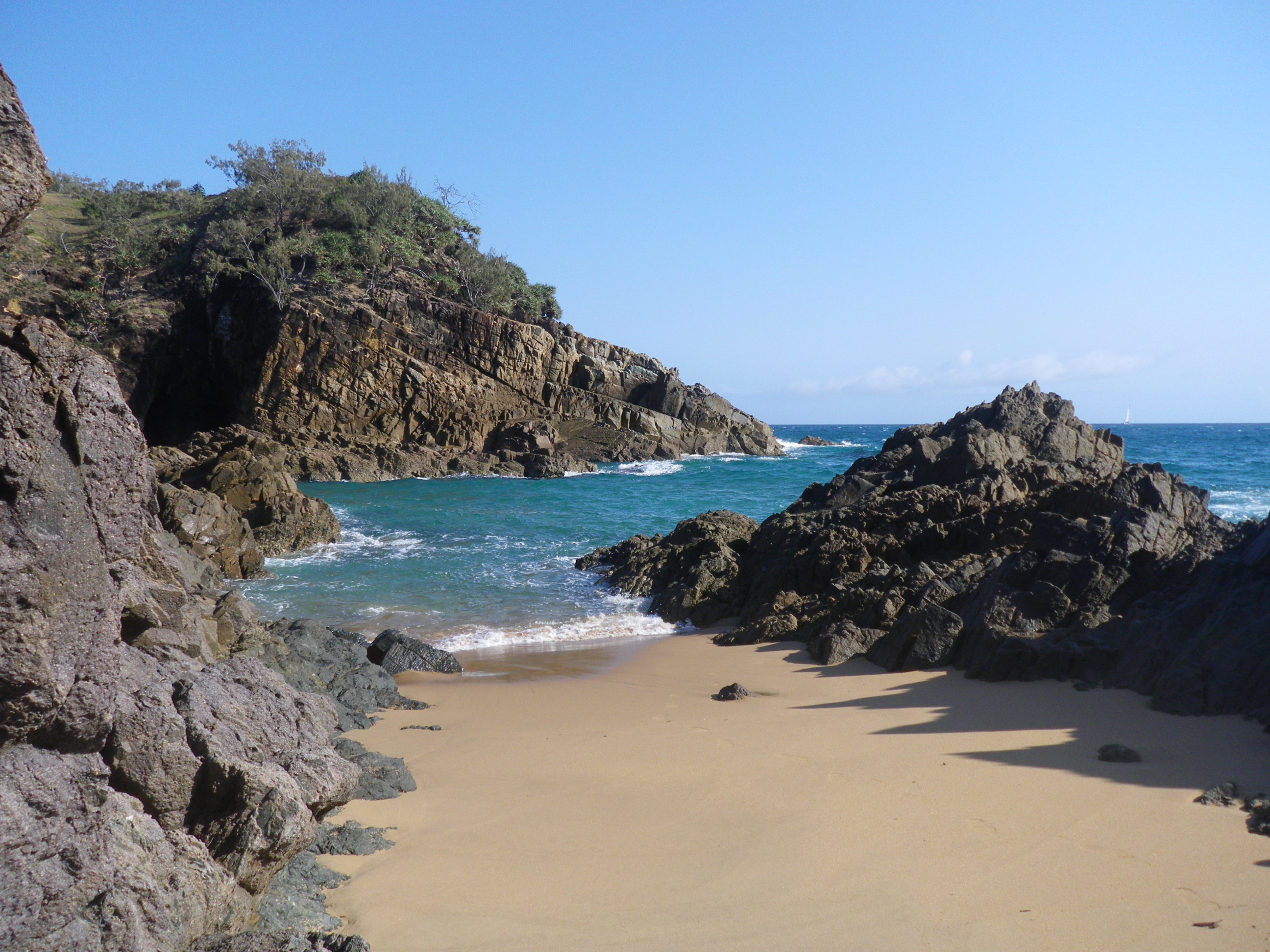
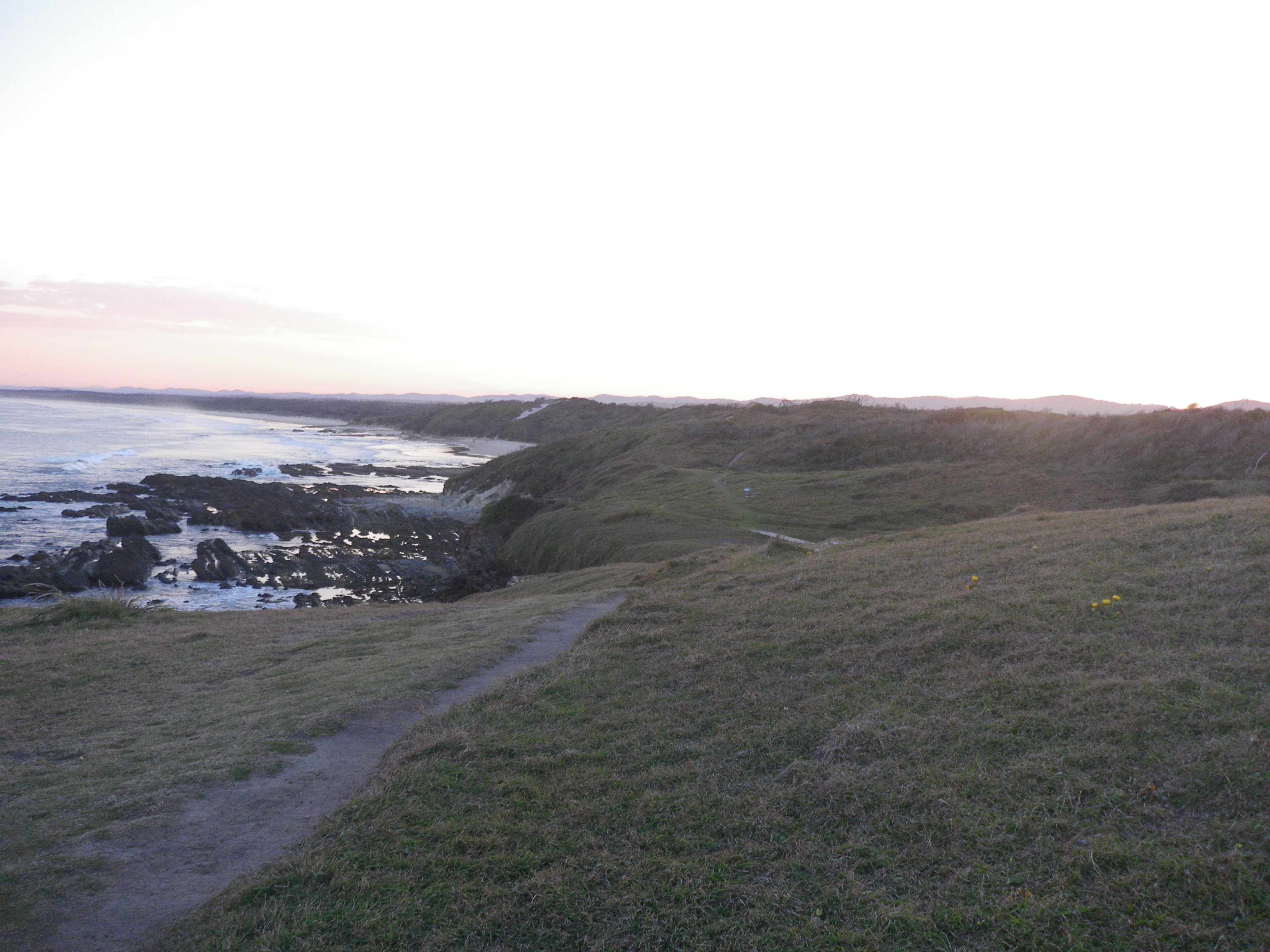
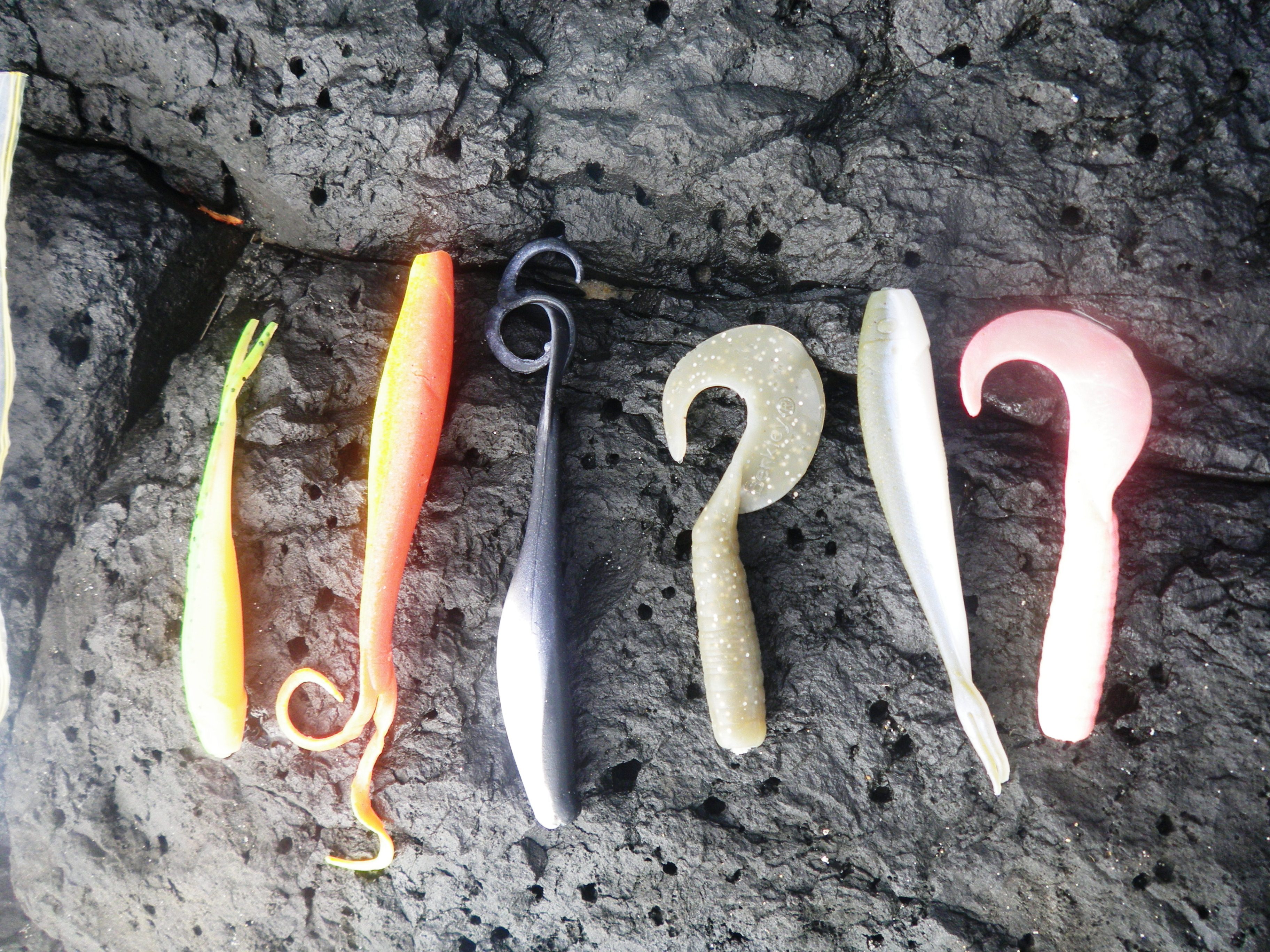
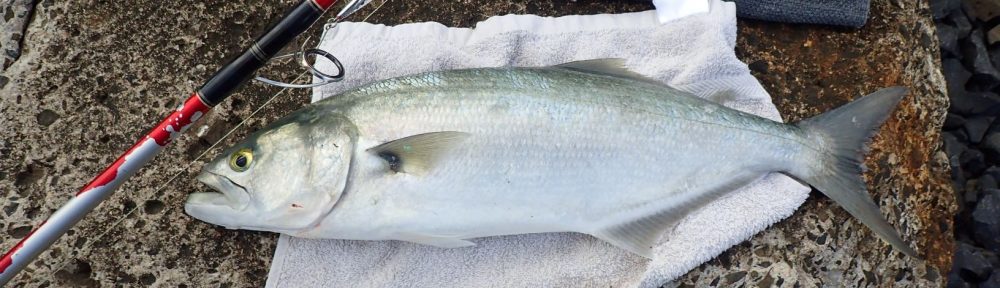
I was still camped at Wreck Rock in Deepwater National Park. The best fishing is around the low tide on the local beaches. But I had morning highs for a few days so I started right out the front of the camp site at Wreck Rock, standing on the southern corner of the bay cast into the wash from the rocks. There was a very light swell and a light north-easterly breeze. As the first glow lit the horizon things looked very promising. I started with a 5” Jerkshad soft plastic in the Pumpkinseed colour, rigged on a 1/8th 1/0 jighead. After a few casts and no hits I swapped down to a smaller 3” Minnow in the Pearl Watermelon colour.

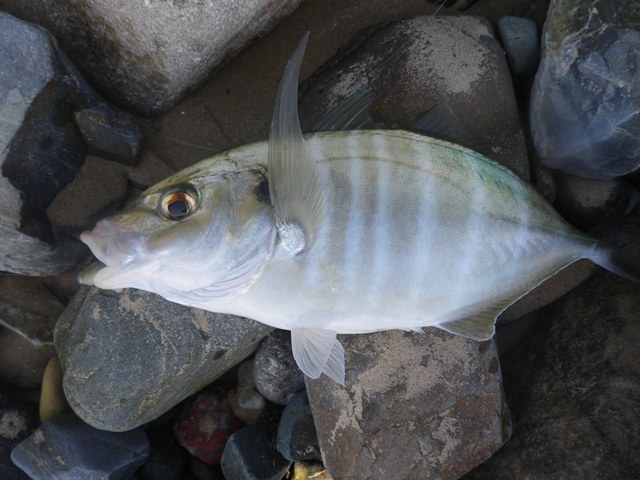
The sun had now crossed the horizon and unfortunately the wind was picking up. Right at the base of the rocks I felt a solid hit and realized I had a fish on. I reeled it clear of the water – it was a Dusky Flathead – around 35cm long. I released it and carried on fishing. Some other campers had pulled two 50cm + Flathead from these rocks the day before so I was hopeful I might find a bigger one. I swapped the plastic for a brighter coloured Nuclear Chicken version and then, for 2” Shrimp pattern in the Pepper Prawn colour – none of these tempted the fish. Finally, I switched to a 5” turtle back worm in the Pepper Prawn colour and I caught a few small Dart.

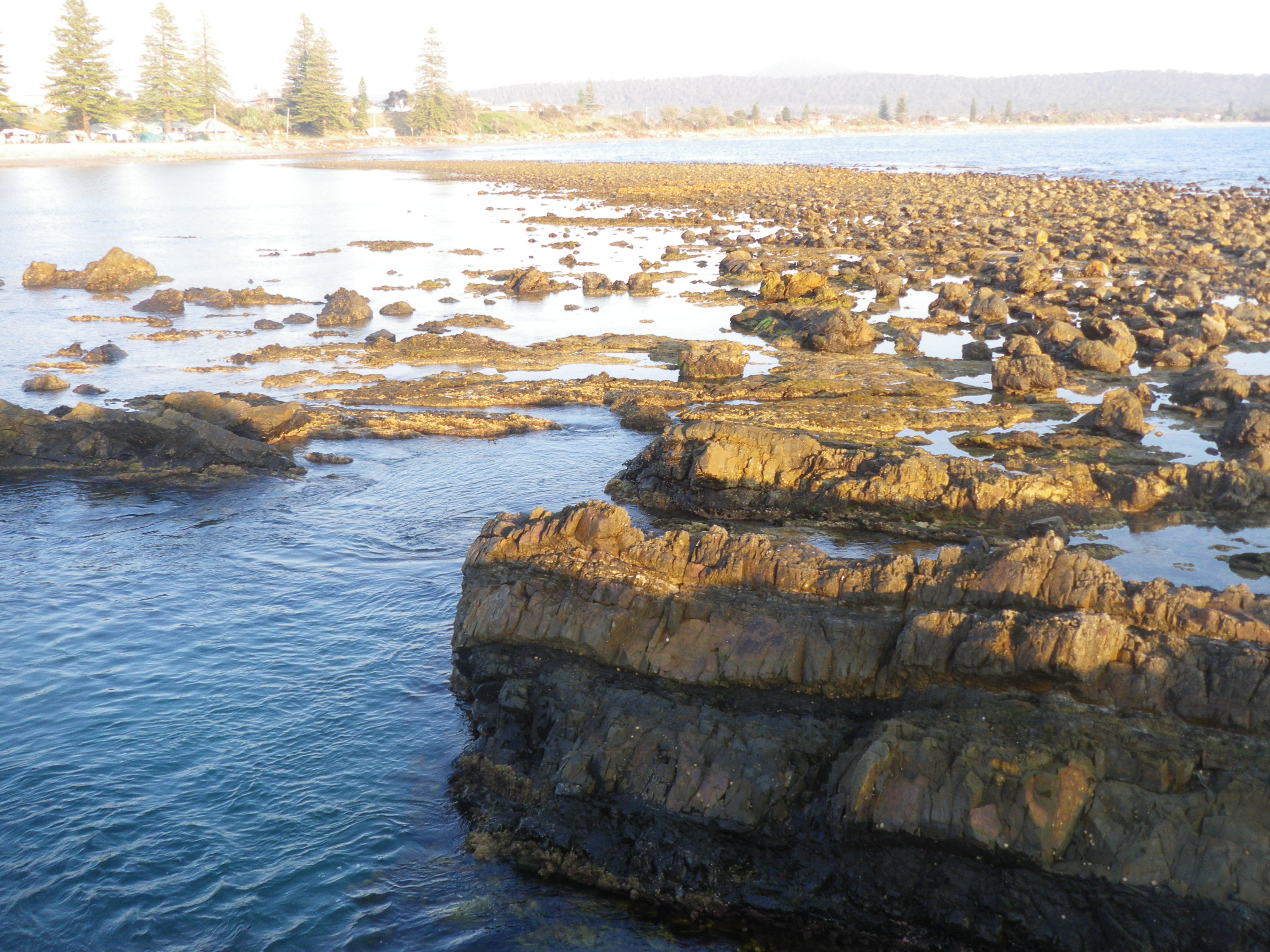
The wind had been very changeable over the last few days. It was swirling round from the south to the north and back again. Finally it settled into a very solid northerly – 25 knots and forced me off this spot. I needed to find some sheltered water to fish and decided to drive up to Middle Creek, to fish the main channel on the bottom of the tide – which would be around 1.00 pm. Middle Creek is reached along another four-wheel drive track off the road into Agnes Waters. The creek has a wide tidal estuary that forms a fairly narrow channel at its mouth, at low tide. You can walk or wade along the south side of the channel for about a kilometer. The track in is currently very easy but can be a challenge after heavy rain. This whole area is effectively a tidal swamp and parts of the road quickly get submerged in a big storm.

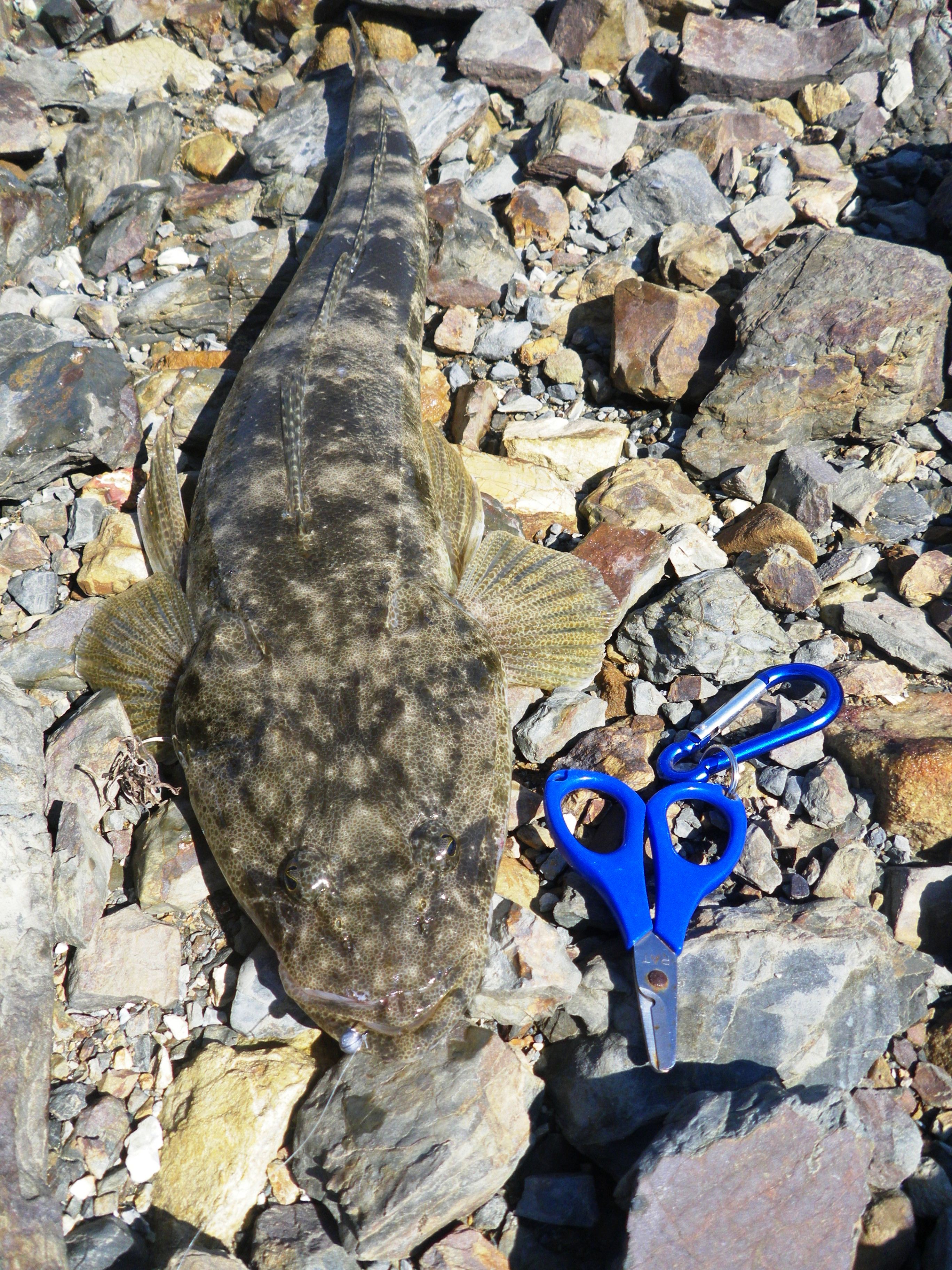
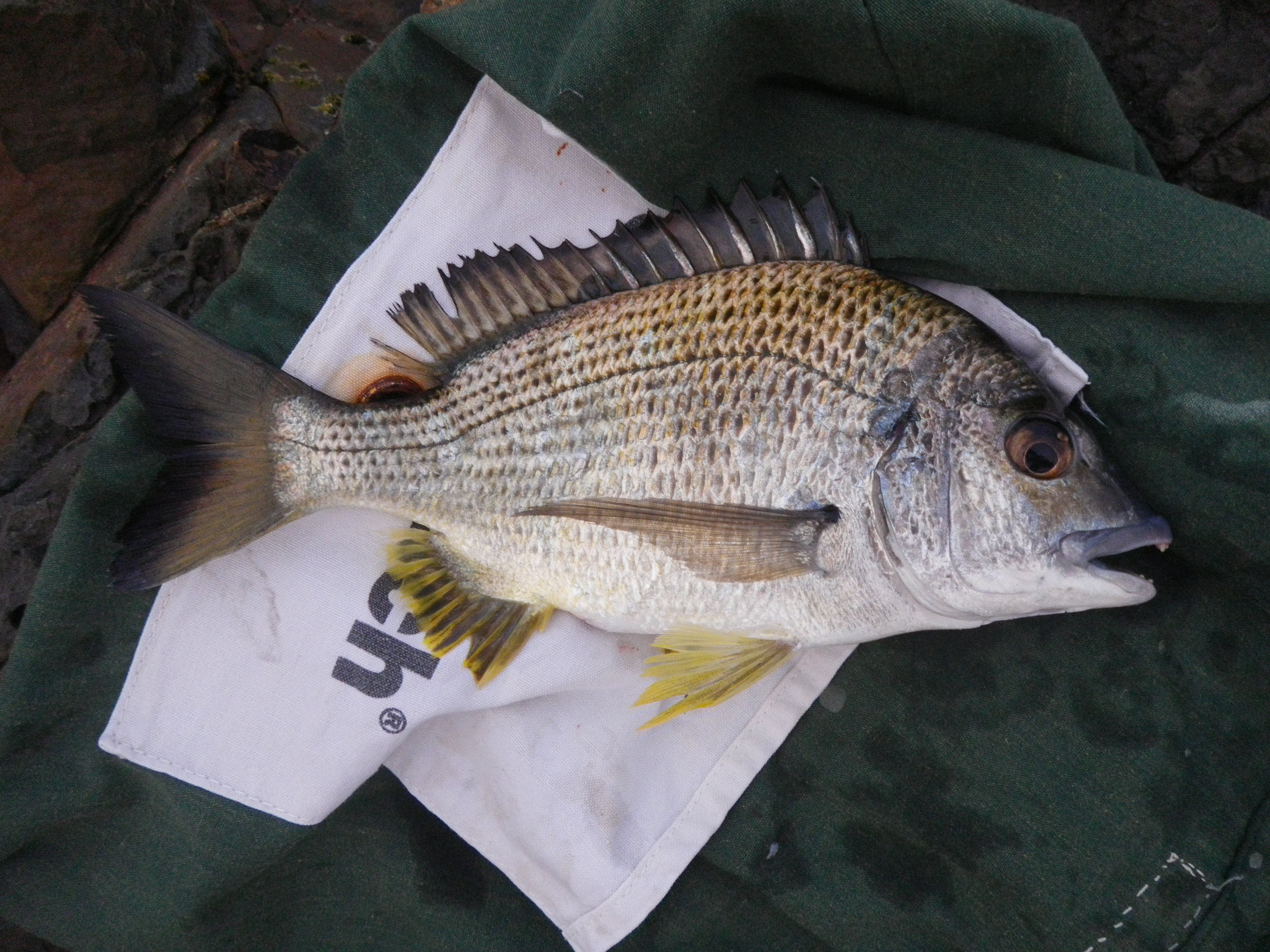
By the time I got out to fish the wind was howling, blowing the sand off the tops of the banks like a scene from Lawrence of Arabia. I walked out towards the mouth and started casting, as I waded across a lagoon of shallow water – less than 30 cms deep , I saw a couple of decent Flathead scatter. They are always in less water than you think! I decided to start with a 4” Minnow in the Pearl Watermelon colour – this is my all time favorite Flathead soft plastic. I rigged it on a 1/6th 1/0 jighead as I needed to keep in touch with the bottom. I cast and cast and cast but to no avail. I swapped down to a 2” Shrimp in the Pepper Prawn colour and almost immediately pulled up a tiny 25cm Bar-tailed Flathead. I walked further out, towards the mouth and after another 30 minutes caught another Flathead – this time it was a Dusky, approximately 30 cm long. Then I caught a few Whiting and saw a few Bream in the clear water, but I could not tempt them.

The sky had turned a scary shade of grey so I walked back to the car. As I got in the heavens opened and a major deluge started. I drove carefully back along the track which was already underwater in a number of places. The ground had not really softened and the going was pretty solid but I could see how easily this track could become impassable. It had been another morning with no really decent fish. The weather had not helped and, in my experience, a northerly wind often turns the fish off. I spent a wet and windy night in my tent which, thankfully kept the rain out and I prayed to wake up to some sunshine and a light south-easterly breeze.

1770 – Ocean Drive Bay – 6 October 2011

Thursday

I have just returned from a week of fishing at 1770 and its surrounds. I camped at Wreck Rock, about 15kms south of the town of 1770. Wreck Rock is located in Deepwater National Park and can be reached by driving south, out of Agnes Waters, on a sandy four-wheel drive track. There are about a dozen campsites dotted through the trees behind the beach, a composting toilet and cold, outdoor shower, fed by bore water. There is also a large rainwater tank for drinking water. It is a very quiet spot and is an ideal base to fish the surrounding headlands and beaches.

I did a little research on Google Earth prior to this trip and located a few spots that I would try to fish. I was looking for spots with a bit of deep water and structure, in close to the shore. My trips to this area, over the last couple of years, have usually produced similar results – I can usually catch a respectable tally of Trevally, Bream, Dart, Whiting, Spanish Flags (Stripey Perch) and the odd Flathead that provide my daily sustenance. But the bigger fish can be harder to locate. There are very fishy looking spots at the end of almost all the beaches and bays, but they do not all hold fish. One problem is that the big fish in this area, the pelagic species – move fast and they keep moving, chasing the bait schools up and down the beaches. If you are land based, you cannot really follow them. You just have to pick a likely spot and hope they will come by. Invariably, by the time they arrive you have downgraded to your light gear, to try to catch the smaller fish and so when the rod bends over and the reel starts screaming, you don’t have the power you need to subdue the fish.

I started by fishing the marked areas in this aerial photo

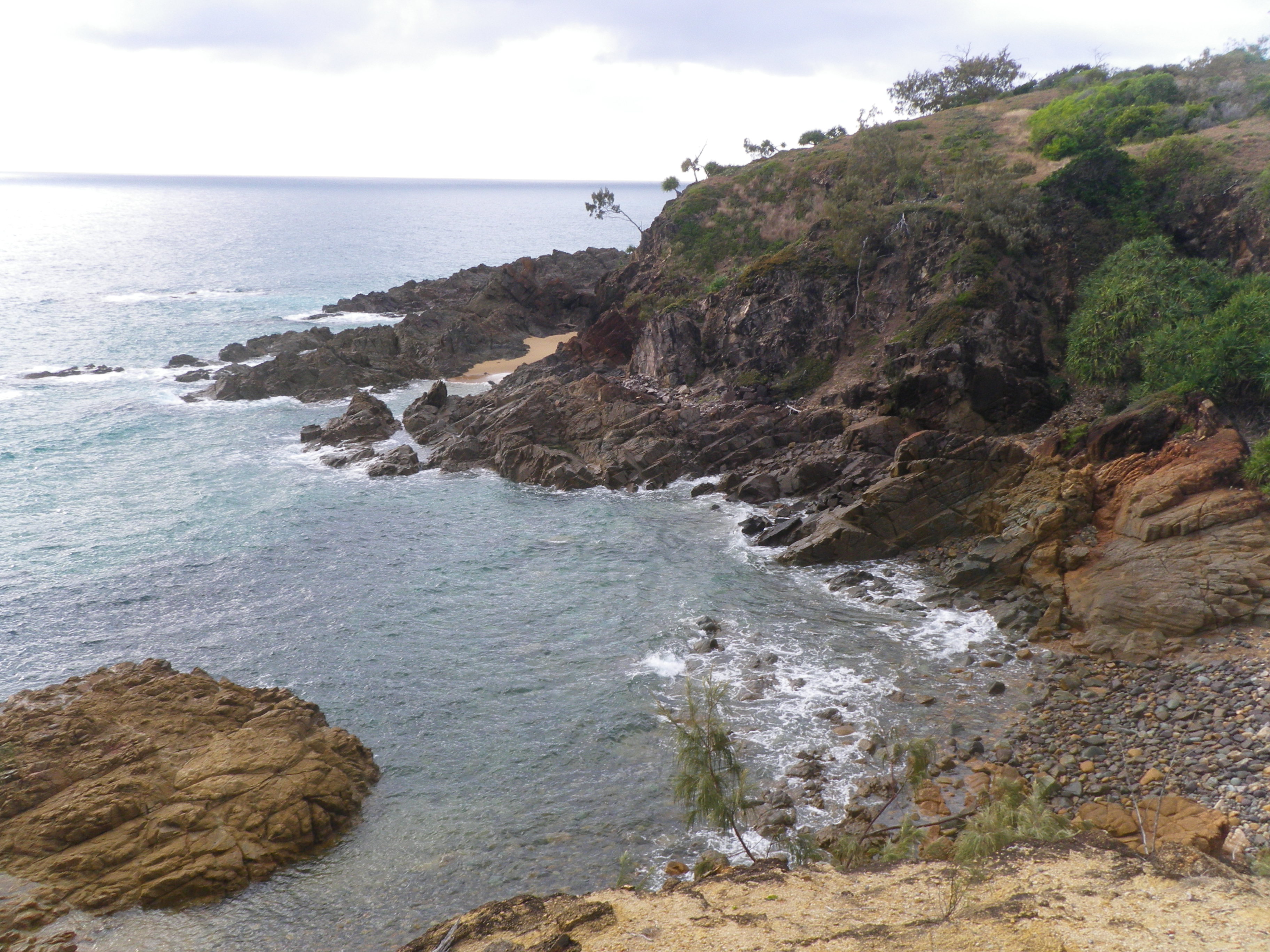
On Thursday morning I focused on the headlands just south of the main look out at 1770 (see aerial photo). The bay I was fishing was just below Ocean Drive. It is a sheltered cove with plenty of bommies and a beach covered on boulders. I started on the north side, fishing from atop a large rock that sticks out into the bay. I was using a new rod – the Shimano Catana Coastline Light. It is a light weight 10’ 6” rod that is rated 3-6 kg. It is ideal for casting soft plastics on 1/8th oz to 3/8th oz jigheads for Dart, Bream and Whiting but it will also land bigger Tailor, Trevally and even school Jewfish, if carefully handled. The longer length means it casts well in the surf. I was using a Shimano Stradic 3000 spin reel – which is probably a bit small for the rod. I had the reel loaded with 12kg breaking strain braid and a couple of metres of 12lb fluorocarbon leader.

It was about half an hour after dawn when I started fishing. The first cast produced a fish – a 25cm Stripey or Spanish Flag. These fish are everywhere around the rocks. They are part of the Mangrove Jack family and taste fantastic. Unfortunately they rarely get much bigger than 35 to 40cm and when you catch them around the rocks they are usually under 30 cm. The legal size is 25cm but they are not really worth keeping until they reach about 30 cm. At this size they have a couple of decent fillets that will make a meal. I let the first one go and caught a few more on the next few casts. I was using a GULP 3” Minnow soft plastic in the Pearl Watermelon colour on a 1/8th 1 hook jighead.

A 25cm Stripey or Spanish Flag


I moved around to the other side of the bay and cast out into the middle. I felt plenty of hits from small fish and eventually hooked a Whiting – also just about 25cm long. A few more followed and I decided to switch to a 1/4 oz blade lure. This immediately attracted the attention of the Dart and I caught several small ones. They did not get any bigger so I swapped back to the soft plastic Pearl Watermelon minnow and moved further round the bay to the next headland. Here, I cast out into the wash behind a half-submerged bommie. I felt a few more hits and hooked up with more small Stripeys. The wind was getting stronger from the north so I decided to give up for the day. I had not really caught anything decent but I had explored another new spot and caught a few fish.

Brooms Head – Plover Island & Bonito – OOPS! Slimey Mackerel – 23 September 2011

Friday

Crystal clear water at Plover Island


It was to be my last fishing day for a while. I decided to try fishing the rocks at the front of Plover Island, at the mouth of the Sandon River, about 10kms south of Brooms Head in Northern New South Wales. At low tide you can walk across to the sand spit to the Island. The northern side has a number of rocky platforms to fish from. I arrived at about 9.30 am, just before low tide and climbed across a rocky causeway to some really fishy looking water on the northern side.

Plover Island causeway


I started with a GULP 2” Shrimp in the Pepper Prawn colour on a 1/8th 1 jighead. I got a couple of hits on the first cast and on the second, I caught a small Butter Bream. I caught a few more of these and then pulled up a 25cm Tarwhine. I fish this spot again at either dawn or dusk. I moved around to another rocky outcrop and caught a few good sized Pike. I made a mental note to come back and fish this spot again at either dawn or dusk, one day.
For the afternoon session I was back at the Brooms Head lagoon. It would be high tide at about 5.00 pm and decided to clamber along the rock ridge at the eastern end of the Brooms Head lagoon.

Plover Island Tarwhine

I rigged up with the favorite soft plastic of the week –the GULP 3” Pearl Watermelon Minnow. It was fairly choppy – with a strong south easterly blowing. Was using a 1/8thoz, 1/0 jighead, my light 7’6” spinning rod and a 16lb fluorocarbon leader. The bottom in this area is covered in rocks and kelp, with a few sandy holes in between. If you fish with heavy sinkers/ jigheads – you are doomed.

I pulled up a couple small speckled, green coloured fish that are common in amongst the rocks – not sure what they are – but they seem to like the soft plastics. Then I caught a strange red finned Wrasse of some kind. Then I found a few Pike – they always seem to hit the lure really close into the rocks, just as you are about to pull it clear of the water.

Big toothed green fish

Then I noticed a big shimmering area on the surface of the water about 50 metres away that was moving towards me – I waited for it to get in range and then cast the soft plastic straight into the middle of it. I got a couple of bumps but no hook ups. I cast out again and retrieved the lure quickly, so that it was swimming just below the surface. I could now see it was a good sized school of Bonito. I cast out again and this time I raced the lure back through the school and hooked up. I land a small Bonito and released it. For the next half an hour I had a great time catching and releasing Bonito, every time the school came in range. It was a decent size school and it circled the area for about 45 minutes before being chased further out by the Dolphins.

Slimey Mackerel school enters the lagoon

Slimey Mackerel on the surface

Slimey Mackerel

And that was my last session at Brooms Head. The variety of fish had been fantastic, even if there had been no real trophy fish. We had managed to catch dinner most days and I was quite happy with the diet of fresh Flathead and sea Bream. The weather gods had been very kind and I plan to be back again at the same time next year.

Brooms Head – Red Cliff – 22 Sept 2011

Thursday

This slideshow requires JavaScript.


Perfect conditions again, a big contrast to the wild weather of this time last year. I decided to take advantage of the calm waters and have a fish off the rocks at Red Cliff, a few km north of Brooms Head. As its name suggests, it is a large red cliff with a rock platform beneath. The platform offers some excellent fishing spots on the lower half of the tide.

I arrived at about 9.15 am and the tide had been low at 8.50 am. The water was absolutely crystal clear and was able to hop from rock to rock until I reached an outcrop that looked over a couple of holes that were probably about 3 or 4 metres deep. With my polarized sunglasses I could clearly see the Bream sheltering at the base of the rocks in the calmer water. There was virtually now wind.

I decided to cast out towards a spot where the waves were breaking over a rocky promontory. I was fishing with a 1/8th 1 jighead loaded with a GULP 2” Shrimp in the Pepper Prawn colour. This is always a good one to start with and I notice it’s a favorite with a lot of the ABT pros. Hungry Bream can’t resist it. As I hopped it along the sandy bottom towards the rocks, I felt a couple of bites and then a solid grab. I landed a small Bream around 25cm, followed by a couple of slightly bigger ones and then a really solid, 34 cm fish. They had all come from the same spot and perhaps they wised up, because things then went quiet.

I moved round to the other side of the rocks and cast in to some calmer water. I could see the lure float down to the bottom in between a couple of submerged bommies. As soon as I lifted it off the bottom, a small Bream darted out and grabbed it. I wound him in and cast out again, this time they didn’t wait and I was on to a better fish before the lure touched the sand. I landed it and decided to keep it – it was 33 cm long. As I wound it in, it had a couple of other Bream following. After a couple more casts I caught a smaller Bream and then this spot went quiet.

I moved round onto another rocky outcrop and caught a couple more small Bream before calling it quits. It had been a good session and a great opportunity to clearly observe the way the Bream break cover to attack the soft plastic lures. I stopped fishing around 11.30 am.

Brooms Head Lagoon Drain – 21 Sept 2011

Wednesday

It was to be another land based fishing session at Brooms Head just south of Yamba, in Northern New South Wales. At dawn the wind was already gusting strongly from the south-east. It was forecast to blow up to about thirty knots during the morning but the area on the west side of the lagoon was sheltered by the Brooms Head Bluff. I decided it was worth an early morning wade.

Low tide was at 7.30 am and I was wading across the mouth of the lagoon, at the western end, at about 5.45 am. I had broken my lightest rod the day before so I was using my Nitro 7’6” distance spin rod and because of the breeze I had moved up to a heavier 1/8th oz, 1/0 hook jighead and 12lb fluorocarbon leader.

I soon found the fish. They were lurking just on the border of the rocky northern wall of the lagoon, where the weed covered rocks met the sand. I started with a Pike and then 30cm Tarwhine and then three of the striped Trevally. I released them all and with nicely chilled nuts, I waded back for a hot shower and breakfast.

Brooms Head / Sandon River – 20 Sept 2011

Tuesday

I was up early on Tuesday and decided to try the other side of the Brooms Head lagoon. Low tide would be at 6.20 am and I set off just after first light, at about 5.30 am. The wind was blowing at 15 knots, west south westerly, but the main bluff gives this area a bit of cover and so it felt like less.

I waded out through the bottom of the tide and scrambled over the rocks on the northern edge of the lagoon until I reached the series of ridges that form the eastern wall. It gets a bit tricky here -there are deep pools between the ridges so you have to get over them. There are points where you can cross but you need good, non-slip rock boots to avoid ending up in the drink.

This area can be reached and fished only either side of low tide

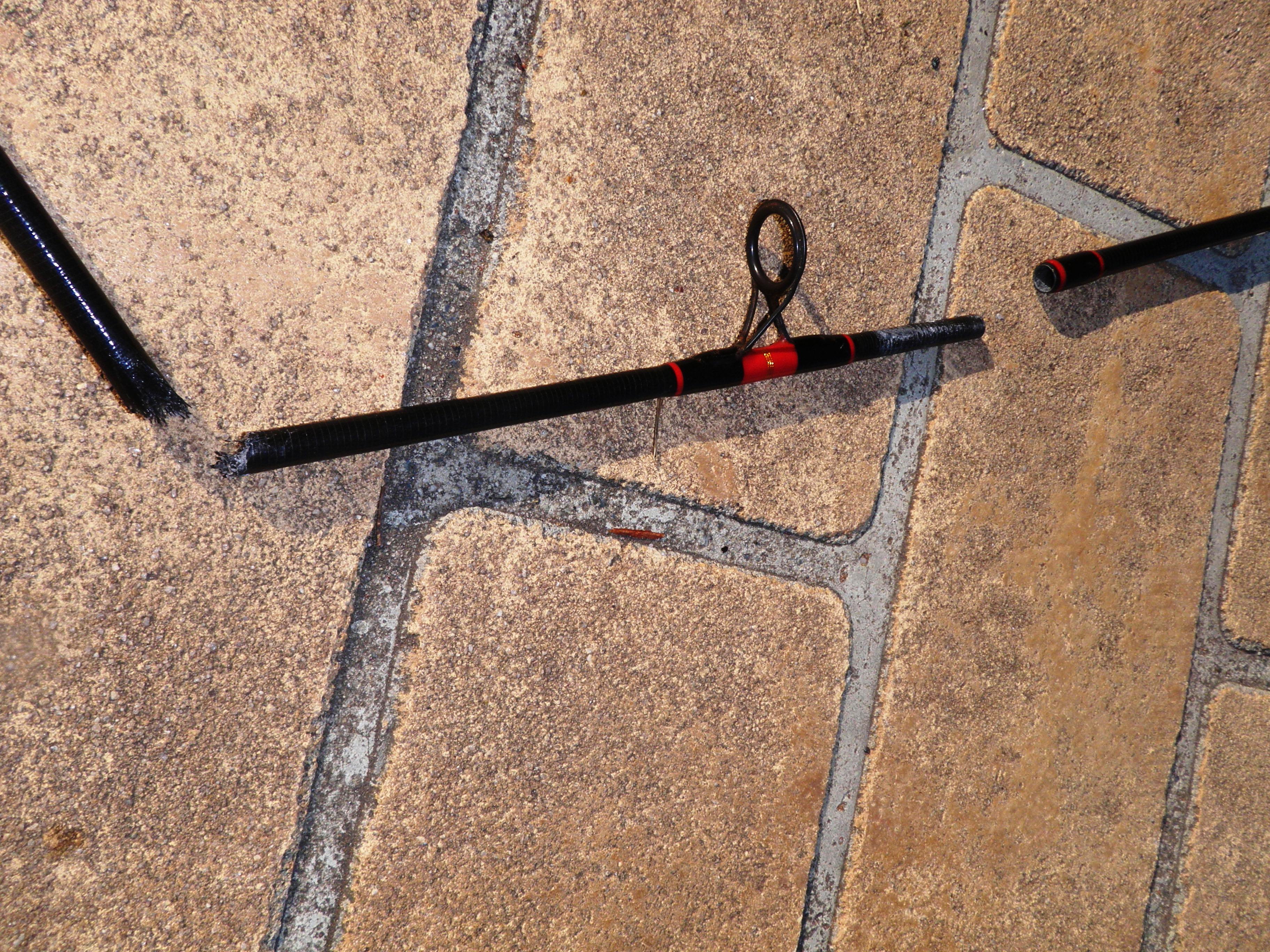
Eventually I was facing east, on the front rock ridge and casting into very fishy looking water. I had the light set up again but had upgraded to 16lb leader as I was hoping for some bigger fish. I used the GULP 3” Pearl Watermelon Minnow soft plastic but rigged it on a 1/6th 1/0 jighead as there was now a bit of swell building up. A few casts produced a few small Pike and a very small Bream and then bang! Something came and grabbed the lure just as I was about to lift it from the water. I had the drag set reasonably tight because of the proximity of the rocks and the whippy Gary Howard Estuary 9’ bent over and line started peeling. The fish took a couple of metres of line then stopped. Then there was another violent surge as it took off again. The rod jerked bent over and I heard the sickening crunch as it snapped just below the join. I attempted to play the fish with the broken rod but it made short work of the leader and soon bit me off. This session was over.

The north east rock ridge in the Brooms Head Lagoon

I trudged back for a shower and breakfast imagining an enormous Snapper. I needed more, but now the wind was howling so I considered the options and decided to drive down to the Sandon River, which is only about 10 kms away. The Sandon River is a small, pristine, shallow river system that holds plenty of Flathead, Bream, Whiting and Luderick. There are lots of points along its banks where you can fish – many, right next to the road. I stopped close to an informal boat launching area that is near an old oyster lease. The remains of the oyster beds have been covered by weed and form good fish holding structure. I stuck with the same soft plastic that had been working well and decided to rig it on a very light 1/16th oz, 1 hook, jighead. I dropped down to a 10lb fluorocarbon leader and I was now fishing with my Nitro 7’6” 2-4kg Distance Spin rod.

The pristine Sandon River


A 50cm Sandon River Flathead


Another Sandon River Flathead


I walked along the bank casting into the run-in tide and bringing the soft plastic back with the current. The tide was running in fast and I just let the soft plastic sink and bump along the bottom with a few jerks and jumps. After working about ten metres of river bank, a fish swallowed the lure. It took a bit of line and then settled into the current. It was a good Flathead just over 50cm long. I put it in the keeper bag and carried on along the river side. I soon found another, this time just over 40 cm. I peppered the same area with casts and found another, smaller Flathead a few casts later. After an hour of fishing, I had dinner and so I gave up and headed home – it was around 11.00 am

Brooms Head – Lagoon Drain – 19 Sept 2011

Monday

The weather was good again. There was a light breeze from the south west. It was sunny and clear and the wind still had some chill in it. The last few sessions, fishing at Brooms Head in Northern New South Wales had suggested light tackle was probably the best option. I decided to fish the drain at the western side of the Brooms Head lagoon. The lagoon sits just north west of the main Bluff and is deepest by the rock ridge at its mouth, to the east. As the tide rises and falls, the water enters and exits close to the beach via a big sandy drain. The drain never fills to more than about waist deep. If you walk across it your reach rocky/ weedy covered bottom that forms the north wall of the lagoon. Further north, where this wall drops off to a sandy bottom is a great fish holding area. They sit here waiting for food to be washed in and out of the lagoon on the rising and falling tides. The area is highlighted in the aerial photo.

Fishing area just north of the Brooms Head lagoon


I was using the Gary Howard 9’ Estuary rod again. I had loaded a very light 1/16th oz 1 hook jighead. I wanted to avoid getting snagged on the rocky weedy bottom. I used about 1.5 m of 10lb breaking strain fluorocarbon leader. I used the soft plastic lure that had been successful the day before – the GULP 3” Minnow in the Pearl Watermelon colour. I waded out into the water, which was surprisingly warm. I put in long casts out over the rocks to the sandy areas to the north. Every time I lifted the lure over the edge of the rocks there would be a small bite or nudge from a fish. The tide was running in and had been low at about 5.30 am. The incoming tide had also produced the fish the day before.

Looking back from the mouth of the lagoon at low tide - Brooms Head


After a bit of wading around up and down the rocky bottom I was onto a fish. It was a good Bream around 30 cm long. I cast back out in the same spot, and the plastic was slammed as soon as it hit the water. The fish pulled hard and took a bit of line. It felt much stronger than the Bream. It kept turning to run as I waded back into the beach, to land it. I saw the stripes in the water and realized it was a small Trevally. It really had pulled hard on the light rod. I released it and headed back out. It was about 8.30 am and the tide was running in strongly.

Lagoon Bream


Lagoon Trevally

Over the next hour I caught two more small Bream, a Tarwhine, three more Trevally and a couple of Pike. The cold southerly breeze eventually made me too cold to carry on but I was delighted to find a few fish. At around 9.45 am I went back to our cabin for a hot shower. Fishing with lighter gear had paid off.

Brooms Head – Back Beach – 18 September

Sunday

I have my 9 year old daughter with me this week so 4.30 am starts are out of the question. She likes to fish, but not that much! At around 8.00 am I persuaded her to walk from Brooms Head south, past the Brooms Head Bluff to Back Beach. It was already warm and fairly still with a very light northerly wind. Low tide had passed at about 5.00 am.

Brooms Head Sunrise


After a disappointing session with the heavier fishing rod and reel the day before, I swapped down to my favorite light beach rod, a Gary Howard Estuary, 9ft. It is excellent for Whiting, Dart and Bream – very whippy with loads for spring and great at hooking fussy fish. It works best with a 1/8th or 1/6th jighead and although it is really designed for an Alvey, I use a Shimano Seido 2500 spinning reel. I have never really mastered the Alvey. I use 10lb Fireline or Braid and usually a 10 or 12lb fluorocarbon leader.

As the fish had been reluctant to bite the day before and because we were outside ideal fish feeding hours (dawn and dusk) I decided to start with a 6lb leader. I waded out to about waist deep and cast in to the northern corner of the bay, just where the rocks meet the sand. I had loaded up with a 2” GULP Shrimp soft plastic in the Banana Prawn colour. I could feel the 1/8th 1 jighead bumping on the rocks and it soon got snagged. I swapped down to a 1/16th 1 hook jighead and put on a 3” GULP Pearl Watermelon Minnow soft plastic. It is not usually possible to cast such a light weight into the surf, but today conditions were calm enough to do it.
After a little while I started to cast over the top of the rocks as the tide was moving up quite quickly. The jighead was now light enough to bump over the top rather than get snagged. Just as the lure reached the edge of the rocks it was grabbed. The rod tip bent over and I had a fish on. It took some line but then swam into the rocks and made short work of the 6lb leader.

I re-rigged with a 10lb leader and cast back out with the same weight jighead and soft plastic lure. After a few casts, I felt a couple of bumps and knocks and then bang, I had a fish. This time the leader held and I steered the fish back up the beach. It was a Bream around 30 cm. I put it in the bag and carried on fishing. About ten minutes later the same thing happened, this time it was a Tarwhine, about the same size, but with much more fight in it.

A Bream from Back Beach at Brooms Head


Now I had dinner so it was time to quit and go for a swim. Conditions were perfect and the water was crystal clear. Even without a mask you could see plenty of Bream swimming around and good schools of bait fish in close to the shore.

Brooms Head – 17 September 2011

Saturday

This slideshow requires JavaScript.


We arrived at Brooms Head at about 3.00pm on Saturday. I grabbed the rod and headed straight for the rocks, out the front. There was no wind and it was a hot, still afternoon. There was no swell and the tide would be low at about 5.00 pm. This meant it was quite safe to cross out onto the rocks in front of the main headland and fish over, into the deeper water beyond. I loaded up the 9’ Daiwa Demon Blood with a 3/8th oz 2/0 jighead and a 5” GULP Crazylegs Jerkshad in the Black Shad colour. I had high expectations – this area looks very fishy, but I have rarely been able to get close enough to it, to fish. The first cast got snagged and so did the second, so I switched to a ¼ oz jighead. I felt a few small hits and lost the tail on the soft plastic lure.

I gradually changed down through the soft plastics to a 3” GULP Minnow, in the Pearl Watermelon which caught a couple of Butter Bream and eventually a just legal, Bream. Just before dark, I gave up, disappointed and with nothing for supper.

Fingal Head and the Tweed South Rockwall – Jewfish/ Dart – 13 September 2011

Tuesday

Tuesday morning looked windy again and the swell would be up. Ideal Jew conditions – if I could find a safe spot to fish. I started on the south rock wall at the Tweed River mouth, just before dawn. The tide was coming in and there was a cold westerly blowing. It would be high at about 8.30 am. I cast all around the end of the wall with soft plastics, slugs and a big hard bodied minnow lure, but did not find any fish.

I decided to move down to Fingal Head. The swell was building up and when I arrived I was in two minds about crossing over on to the causeway, to fish. I watched for half an hour and then finally got across and stashed my gear on some dry rocks. The swell was now crashing in and there was white water all around. I rigged up a 5” GULP Black Shad Crazylegs Jerkshad on a 1/2 oz, 2/0 jighead. I was fishing with my 9’ Daiwa Demon Blood and Shimano Stradic 6000, loaded with 30lb Bionic braid and a rod length of 30lb Fluorocarbon Rock – leader. I had to stay at the back of the promontory as the front was getting a bashing. I cast out and felt a few tugs on the retrieve. On the next cast I had a fish, it was a Dart – just about big enough for the table.

The got the hang of the waves and concentrated on fishing during the calmer period, in between the big sets. There were birds everywhere and I presume there were some Tailor somewhere nearby. After a few more casts, I felt a solid hit as the lure sank. I lifted the rod but did not hook up. I dropped it again and paused. When I lifted it again the rod tip bent over and line started peeling off the reel. This wasn’t a Dart. Fortunately the swell was working for me and pushing the fish in. After a couple of strong runs I saw Jewfish. I pulled it up the rocks, with the aid of a surging wave and got my hand in, under its gills. It was a good fish at around 80cm, in excellent condition. There was nothing in its stomach. It was just after 8.00 am.

This slideshow requires JavaScript.


I cast back out in all directions, but I could not find another so, at about 9.00 am I gave up, cleaned the fish and crossed back over the causeway. After too many disappointing sessions recently it was great to be carrying a decent fish back to the esky.

Bribie Island – Whiting & Flathead – 11 Sept 2011

Sunday

The weather was going to be a challenge again. I wanted to fish at Bribie but the tides would be far from perfect. I like to fish my favorite Bribie Island haunts in the 6 hours around low tide. This is because the best land-based fishing spots are most accessible during this period. There are still usually plenty of fish around at high tide but, by then, I cannot reach the structures that form their permanent cover.

On Sunday, low tide would be just after 3.00am and this meant that by first light at about 5.15am, I would probably only have about an hour before I would be forced out of reach of the best areas, by the incoming tide. It also looked like the wind would blow up again soon after dawn.

I decided to fish the area around the old oyster jetty on the mainland side. I soon realized I had made a mistake. The fierce westerly winds from Saturday had obviously stirred up all the weed and sediment and as the water flooded in over the flats it lifted it all up. It was a mucky swamp of weed and mud and I could not cast without catching a large clump of debris.

I went back to the car and drove back across to the mouth of the tidal lagoon, at Bongaree, in front of Buckley’s Hole. The wind was now howling. The tide had moved up and I could only fish above the drop off, on the sand flats. After a couple of hits in the same spot, I pulled up a very ambitious Whiting – which had attacked my GULP 4” Pearl Watermelon Minnow. I moved further along the sand banks to the south. I was fishing with a 1/6th 1/0 jighead and 12lb fluorocarbon leader. Finally, I caught a 44cm Flathead on a GULP 3” Pumpkinseed Jigging Grub. With the wind now up around 20 knots I decided to give up and head for home.

Fingal Head – Dart & Tailor – 4 September 2011

Sunday

The wind played up at Bribie on Saturday and my fishing results were not that impressive. On Sunday, I decided to go back down to Fingal Head to fish off the rocks. September should be Tailor time but the last few sessions here have been a bit disappointing.

Low tide was around 6.30 am and so it was easy enough to skip across to the causeway, between waves. I arrived about 5.30 am but I was not the first there. As ever, I was hopeful that the one hour either side of dawn, would produce a few fish.

All I caught with the soft plastics was this Dart

Well it did, but not for me. Just on dawn a chap to the left of me pulled out a 40cm Tailor on a hard bodied minnow lure and a few casts later, he got another. Then the chap to my right got one on a small slug. I fished on with a soft plastic minnow and was eventually rewarded with a decent Dart, but no Tailor. The chap to the right caught another Tailor, also on a hard bodied Rapala minnow.

Lee with his good Tailor

The wind picked up just after dawn and carried on rising until it was probably a 20-25 knot south-easterly. The water looked very fishy but there was not much bait around. At about 7.00 am, Lee, the Scotsman to my right, who already had a couple of Tailor, hooked into a solid fish. He held on tight and copped a soaking from a big wave but managed to land it. It was a great Tailor – I would guess around 2.5kg.

The Tailor were going for hard bodied minnows

I carried on fishing, using every colour of soft plastic in the box, but I could not tempt them. In fact, no one could and at around 9.30 am I climbed back up to the lighthouse and headed for the car. It was good to see few people catching Tailor. According to all the reports they are certainly around, in numbers, in the Tweed River. They must start feeding around the headlands soon.

I tried a fair range of colours and shapes

Bribie Island – Oyster Jetty Flats – 3 Sept 2011

Saturday

I have been catching fish but not catching dinner. A few trips to unfamiliar fishing locations and my inability to land anything decent , closer to home, has left the fridge empty. I decided to head up to Bribie Island for a land based fishing session on Saturday.

Unfortunately the weather was not kind. I arrived around first light to be greeted by a 20 knot southerly wind which showed no signs of easing off. I tried to fish the mouth of the lagoon in front of Buckley’s Hole but the wind made it too hard.

I crossed back over to the mainland to fish on the flats around the old oyster jetty. You get a bit of shelter from the southerly wind here. Low tide was around 6.30 am and the water was slowing, as I waded along the exposed flats. The sea grass beds are just beginning to grow up through the ‘snot ‘weed. Hopefully in a few weeks it should start to disappear.

I waded south casting along the edge of the weed banks. I fished for an hour or so, with only a couple of bites, which I think were Pike. I stopped for a chat with a fellow fisherman, who was also not having much luck casting soft plastics. Around 8.00 am, just as the tide started to run in properly I felt a good bite and dropped the rod tip. A few seconds later I lifted it and had a fish hooked. It was a small Flathead that was just about legal size. I decided to let it go.

I was fishing with the GULP 4” minnow soft plastic in the pearl watermelon colour. This lure is about as close as you can get to a replica of a small mullet or pilchard and often seems to produce a fish when nothing else can. I was fishing with a 1/6th 1/0 jighead and 10lb fluorocarbon leader. I fished on for another hour but I could not find anymore. The fridge remains empty of fish!

Fingal Head – a lone Tailor – 28-08-2011

Sunday

The only Tailor caught - but not by me


Back to Brisbane and off down to look for some Tailor at Fingal Head. It was a beautiful morning but the fishing was poor. I arrived just before dawn, hopped across the causeway and rigged up a Jerkshad soft plastic on a 9g 3/0 jighead on a 30lb leader. I was soon joined by another fisherman who was casting a slug. Half an hour later there were about seven of us standing on the rocks.

This stretch always looks so 'fishy'


I lost the tails of a few plastics and had a couple of solid bites, but no hook ups. The chap with the slug, dropped a small Tailor at the base of the rocks. This all happened around 6-30 am. Then it all went quiet. I swapped plastics and tried a few different weights of jighead. Just before 9.00 am one of the other fisherman caught a decent 45cm Tailor. We all cast out in the same direction for another hour and I tried all up down the headland, but could not find a fish. It’s now been a while since I have taken a fish home. I will have to see what is going on at Bribie, next weekend.

Magnetic Island – Townsville – 27 August 2011

Saturday AM

I was up early for a quick morning fish at Bremner Point on Magnetic Island. The climb out, over the boulders to reach the fishing zone was pretty tough. My knees are not that effective as shock absorbers anymore, but I managed to arrive just before dawn, at around 5.30 am.
The first cast produced a small pike and the next a small Stripy Perch. I carried on casting, gradually moving north around the front of the headland. I caught a few more Perch and a few more cod. They were all very small but pulled hard on the light rod.

After a slightly more solid fish bit me off I put a GULP 4” Minnow in the Peppered Prawn colour on a 1/8th oz, 1/0 jighead and cast it out. I was now standing on a flat rock above a ‘V’ shaped inlet. Things had slowed down a bit and I was letting the plastic slowly waft around in close to the shore. As I wound in the plastic and was about to lift it out of the water, a great silver shape came shooting up from beneath and in one clean movement, turned over on top of the plastic, swallowed it and took off. It was a good size Giant Trevally and line started peeling. The tiny rod was never going to stop it so reluctantly I gradually tightened the drag. The fish slowed for a bit and then as it took off again the line went slack. I wound it in to find a jighead with a thoroughly straightened hook.

I carried on fishing around the headland until I reached Alma Bay at about 11.00 am – where I stopped for a quick swim. Outgunned by the fish again.

This slideshow requires JavaScript.

Saturday PM

This was to be my last session on Magnetic Island and I decided to try the north rockwall, in front of the main harbor at Nellie Bay. I tried a number of different soft plastics but nothing really happened until the sun dropped behind the hills. Then the familiar routine started up again. Just as the plastic reached the edge of the rocks, a fish would dart out, grab it and drag it back down. I think these fish were better sized cod and I did not manage to win my fight with any of them. Just as it was really getting dark I pulled one clear of the water, only to find the orange/ brown eye of a small barramundi staring back at me – it was no more than 25cm long and had grabbed the GULP 3” Pearl Watermelon Minnow on a 1/8th oz 1/0 jighead. Its skin was almost black and that was why I had mistaken it for a cod.

The session ended abruptly as the tip of the Pflueger rod snapped on the next cast. I had put it through its paces over the last few days but it should be made of sterner stuff – so I will be taking it back to BCF. It had been a great introduction to land based fishing on Magnetic Island. I will be back again soon,but next time I will go properly prepared!

Magnetic Island – Townsville – 26 August 2011

Friday PM

The benefit of working from time to time is that you sometimes end up on Friday in a good fishing spot. That was the case yesterday. I was in Townsville and decided to take the ferry across to Magnetic Island in search of some good land-based fishing.

I only had my recently purchased Pflueger Travel Spin Combo – 6’6″, 5 Piece light rod, so I knew I would be in trouble if I came across anything big. I started off looking at the map of where I could fish. Many of the bays are green zones, but fortunately you can fish off almost all the rocky headlands. So after a knee trembling boulder scramble, I arrived at the tip of Bremner Point – the headland at the northern end of Geoffrey Bay. It was around 5.15 pm and I put on a GULP 4” Jigging Grub in the Pumpkinseed colour. The first cast produced a nice solid bite, but no hook up. The next cast had the rod bent over. Whatever it was – it headed straight for the rocks and that was the last I saw of it. A couple of tugs and the 20lb leader snapped. I re-rigged and tightened the drag. The same thing happened but this time I heaved the fish straight up, out of the rocks and up to my feet. I think it was a small Fingermark (see photo).

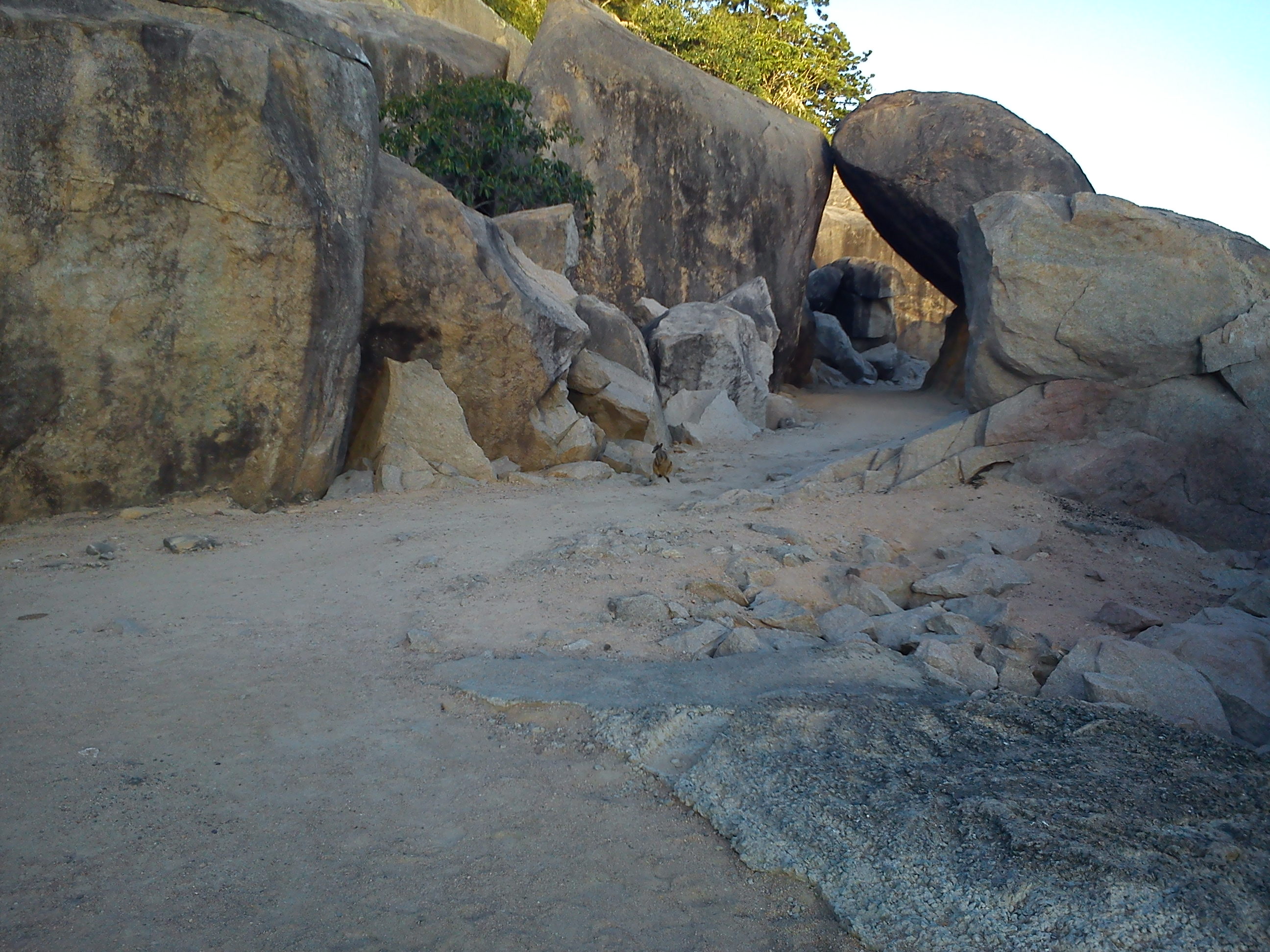
Bremner Point is reached by scrambling over the boulders beyond this archway

I scrambled over a few more boulders to another promising looking spot and cast out. I was now fishing with a 1/8th oz, 1/0 jighead and using a GULP 4” Minnow in the Pearl Watermelon colour. After a few casts I was onto another fish but again it went straight down into the rocks and unhooked itself. I could see I was going to lose plenty of fishing gear. I re-rigged and a few casts later I caught a glimpse of a large black and white reef fish heading down into the rocks with my soft plastic. Once again I could not pull it out. I moved again and found a couple of small Stripy Perch and a tiny cod with a big appetite. The sun was now dropping behind the hills and I decided to climb back over the boulders while I could still see. I walked back to my hotel thinking about what might have been if I had brought the proper rod!

Bowen – 19 August 2011

Friday

This slideshow requires JavaScript.


Weather and work can be the keen anglers’ two worst enemies. Work slowed me down a bit last week but also gave me the opportunity to get out for a quick fish at Bowen, on the Whitsunday coast. I was lucky enough to be spending the night there, on my way home from work. I grabbed a cheap rod and real combo, a couple of packets of jigheads and plastics on Thursday night and drove out to fish the rocks, around Horseshoe Bay, just as the sun was setting.

I was fishing a reel pre-loaded with 12lb monofilament line and tied on a 1/6th 1/0 jighead. I loaded it with a GULP 4” Jigging Grub. There is a series of bays along this section of coast, all divided by rocky out crops. They are covered in smooth boulders and are very easy to access. The locals tell me there are all sorts of reef species hiding down at the base of the rocks. They pull out plenty of Coral Trout and cod. The Mackerel and Trevally are also cruising up and down, at this time of year.

My expectations were high but I doubt I could have landed any significant fish on the light rig I had. I walked along the boulders, casting out about 3-5 metres and trying to pause the plastic just at the base of the rocks. After a few casts and a few snags, I caught a small Stripy Perch and then another. As usual with fishing, it took a while to figure out where the fish would be and unfortunately darkness beat me to it.

The next morning I went back to another rocky outcrop, a bit further south, to fish through the sunrise. I used the same technique and tried a few different coloured, paddle tailed GULP soft plastics. The first fish was a Stripy Perch again, next was some kind of tiny spotted Cod and then a more familiar Pike. They were all tiny. Then something kept biting and releasing the plastic. As the sun came up I could see it was a group of squid floating over the rocky bottom. I tried but I could not hook one.

I had a plane to catch so, after an hour I gave up. The sunrise over Gloucester Island was spectacular, even if the fishing was not. As is often the case, this quick session has just confirmed that I need to get back up here for a real fishing trip!

Bribie Island – Tailor, Tailor, Tailor – 14 August 2011

Sunday

I drove up to Bribie Island for a quick early morning fishing session. Rain was threatening as I arrived, at around 5.30.am. The tide was running in and I decided to start under the bridge in the shallows, on the island side.

I started with a GULP 5” Crazylegs Jerkshad in the Curry Chicken colour. After a few casts and solid bites, a fish bit the tail off. I re-rigged with a GULP 4” Minnow in the Pearl Watermelon colour. I was fishing with a 1/6th 1/0 jighead and my light spin rod. After a couple of casts I caught a small Tailor – just around the 30cm mark. I let it go and cast out again, under the bridge lights. Bang – the fish grabbed the lure as soon as it hit the water – it was just before dawn. It was another small Tailor. I let it go and re-rigged with a brighter coloured soft plastic – the GULP Jigging Grub in the Pink Shine colour. After a couple of casts this also brought up another Tailor.

As the sun came up I decided to move down to the mouth of the tidal lagoon in front of Buckley’s Hole, at Bongaree. I waded out into the tide, which was now running in strongly. I cast out the Pink Shine soft plastic and as it sank I felt the line go tight. There were lots of head shakes and a few moments later I had the biggest Tailor of the morning at around 35cm. I fished on for around 30 minutes and finally gave up at about 7.30am.

There are clearly plenty of Tailor around at the moment and the surf beaches and rocky headlands should produce some good fish over the next few weeks.

Fingal Head – Salmon, Tailor, Bream – 11 August 2011

Thursday

Tuesday was a fishing disaster but somehow I just could not believe that the Tweed Rockwalls could ‘shut down’. So on Thursday, I found myself driving back down across the New South Wales border for another session. When I arrived at the north rock wall there was no swell and a slight breeze from the south-west. I started about 5.30 am. It was cloudy and very overcast and it looked like it would rain.

I started fishing with a GULP 5” Jerkshad in the Lime Tiger colour, rigged on a ½ oz 2/0 jighead. The heavy skies seemed to have completely flattened the water. The cloud blocked out the sunrise. As I cast all around the front of the rock wall the south-westerly breeze started to lift and it was very cold.

By 7.00 am I had not had a bite so I decided I had to switch locations. I drove down to Fingal Head. I walked out across the small causeway on to the rocky promontory. I decided to make the first cast count. It is so often the first cast in a new location that produces a fish. I checked and double checked my knots and decided on a GULP 7” Jerkshad in the Lime Tiger colour, rigged on ½ oz 5/0 jighead. The south-westerly wind was picking up and the tide was running out. I cast straight out in front of the promontory and let the lure sink. Before it hit the bottom I felt a solid bite. I dropped the rod head and then struck hard. I was on to a good fish – it was not frenetic, like a Tailor but felt a bit too lively to be a Jewfish. It took plenty of line but I gradually tightened the drag until I had it at the foot of the rocks. It was only as I lifted it clear of the water, on a helpful surge, that I saw it was an Australian Salmon. It was a good size fish – just under 70cm long. I photographed it and then released it. I will eat almost any fish but I have never been able to make one of these taste good.

I thought there would be more, so I re-rigged the same soft plastic and cast back in to the same area. Nothing – I tried up and down the rock ledge and after a while switched to a smaller 5” Jerkshad in the Peppered Prawn colour. I covered the whole area with casts but they had moved on.

This slideshow requires JavaScript.


I moved round to the north side of the ledge and cast out into the corner of the Fingal Head beach. The water is crystal clear but I could not see much bait around. After another 30 minutes, I hooked a small Tailor – around 30cm which I quickly released. I then switched to a Gulp Jigging Grub in the Pink Shine colour and swapped down to a 9 gram 2/0 jighead. After a couple of casts, I caught a small Bream , very close to the base of the rocks.

It was now around 10.00 am. I had caught a few fish and it had been a better session than Tuesday but I still had nothing for dinner. Maybe it is time to get back up to Bribie Island and see if the Flathead are biting again.

Tweed River – South Rockwall – Nothing – 9 August 2011

Tuesday

On Tuesday I drove back down to the south rockwall at the Tweed River mouth. I was hoping for more Tailor, Jew, Trevally or Snapper. I had recently encountered all of these species down there and I had pretty high expectations.

It was high tide around 4-15 am and the wind had changed around to a light westerly. Just on dawn a few Tailor turned over in the water, behind my soft plastic. I got a look at them but could not hook one. It was all downhill from then on. I fished from about 5.30 am through to 9.00 am without a bite.

A fisherman along the rocks caught plenty of Bream, using mullet gut for bait. He kept the five biggest which were all around the 30 to 35cm mark. Where had the Tailor , Jew, Trevally gone – who knows? The main change had been the wind – perhaps that was it. Another duck for the Landangler!