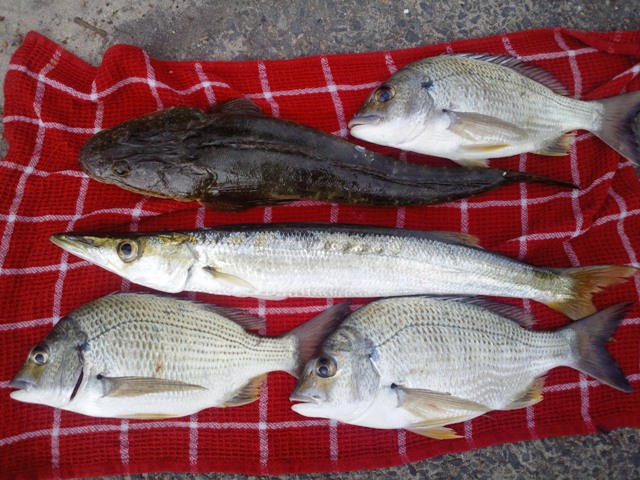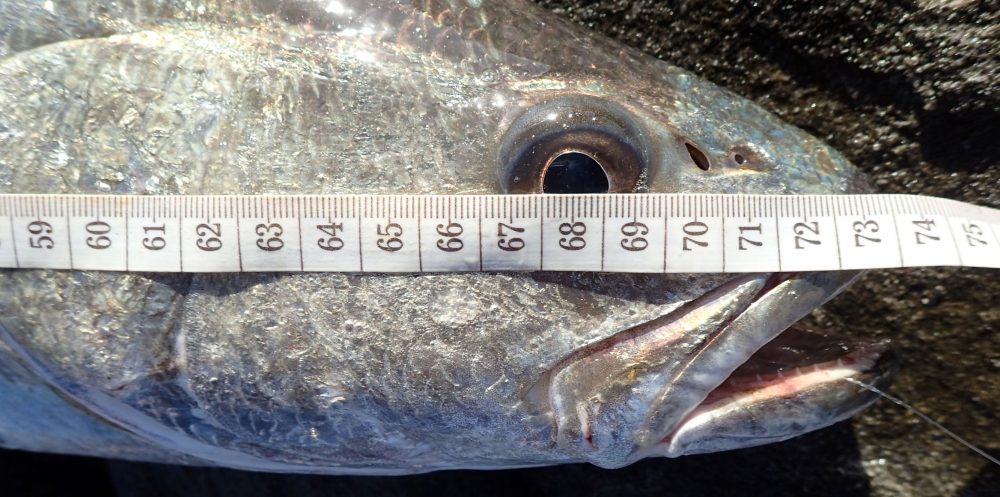
Iluka – Shark Bay in the rain – 3 Dec 2010

This slideshow requires JavaScript.


Friday
It wasn’t raining at 4.00am Friday – so I walked out on to the rocks in front of Woody Head. I was disappointed to still see a big sea. I tried casting from a few safer spots but after losing four jigheads to the rocks, I decided I needed another plan. I walked along the beach to Shark Bay. It is probably one or two km but at this time of the morning, it was a beautiful stroll. There were big black clouds everywhere but initially, at least, it stayed dry and there was not much wind.
I had swapped my heavy rod for a lighter set up and I was fishing with a 7’6” Nitro 2-4 kg Distance Spin Rod matched with a Shimano Stradic 3000 reel. I had loaded the reel with 3.8 kg Fireline in the yellow colour and tied on about 1.5 metres of 12lb breaking strain fluorocarbon leader. I had decided to fish lighter as I wanted to see if there were any good Bream around. This rig is also quite capable of land the odd small jewfish or Tailor should they show up.
I walked out onto the rock platform at the southern corner of Shark Bay and moved out to the north east corner. I had a few hours in this spot before the incoming tide would force me off. Just as I put in the first cast a shower came over and I was soaked in a few minutes. At least it wasn’t cold.
I started by fishing the GULP 4” Pearl Watermelon minnow soft plastic. This is a great imitation of a pilchard and has proved to be excellent bait in this location. But today I could not raise a bite. Maybe it was the murky water. I switched to one of my new favourites the GULP Crazy Legs Jerkshad in the New Penny colour. I also switched down in weight from a ¼ oz to a 1/6th oz jighead both with 1/0 hooks. This gives me a little less distance when casting but increases the sink time and gives the fish more time to strike. After a few casts with the new rig, a fish slammed the lure at the edge of the kelp covered ledge. I struck hard and then let it have some line. On the next surge I pulled it up through the kelp. It was a nice 36cm Bream. I cast out again and over the next few casts pulled in three smaller fish around the 30cm mark all on the same plastic.
With another rain squall on the horizon and the tide moving up rapidly I decided to head back to the campsite to try to dry out. I would think with all the rain, good Bream would be all around these rocky headlands. The only problem would be finding a safe place to fish for them.

Iluka – The Rockwall – 2 Dec 2010

This slideshow requires JavaScript.

Thursday

I went to bed in a heavy rain shower and woke up to yet another one at about 4.00 am. After a while it eased off so I pulled on the (now very wet and fairly malodorous) fishing boots and made a cup of tea. The wind was light from the north east but as I walked out from Woody Head in the half light of dawn, I could see the swell was significant and the rocks were going to be too dangerous. I jumped in the car and headed down to the rock wall that runs out from the northern bank of the mouth of the Clarence River, at Iluka.
Fishing the Iluka rock wall is not for the faint hearted. You need good boots and good knees. It is a long walk from where you park to the best fishing spots. The first half of the wall has a nice pathway along the top, but as you reach about half way, the fill underfoot gets bigger and bigger until you a walking across wobbling boulders. Finally in the last 200 metres all the loose fill has been washed away and what is left is a mass of boulders. If you persist and clamber on, there are a few good flat boulders that make excellent fishing platforms on either side, but the most consistent fish holding spot, for me, is the wash around the base of the wall at the very end. Depending on the wind and tide you can either fish the river side or the ocean side
Depending on the wind and tide you can either fish the river side or the ocean side. I recommend giving both a try. I usually put in a few casts whilst walking out and one of these got smashed at the foot of the rocks by a small Tailor. I was using the GULP 5” Pumpkinseed Jerkshad soft plastic lure on a 3/8 2/0 jighead. I landed this fish after a short fight and as it was only just legal size at around 35cm, I threw it back. I had a few more casts here with no further action and so I moved on to the end of the wall.
The swell was calming down a bit, but the rain was still blowing over in 10 minute showers. There was too much swell to fish directly off the end of the wall, so I started off fishing the north side of the wall. The tide was running out and I assumed that the fish would shelter from the current on the ocean side of the wall. I switched to a ½ oz 4/0 jighead and put on a GULP 7” Limetiger Crazylegs Jerkshad. This is a great plastic with a split curly tail that flutters, as it sits or sinks, in the current. I was sure there would be some Jewfish around. I put in about 50 or 60 casts without result, so I switched to the river side. Fortunately, the rain was flattening the sea now. After a few casts out into the mouth of the river, the line came up tight and the rod tip started shaking. This is a tricky spot to land a fish. You are a couple of metres above the water line and you just have to heave the fish up. If you are on your own this is your only option. I find a long handle gaff is too hard without someone to hold the rod. I had a good size Tailor on. Tailor have such soft mouths that the final lift is even more difficult. Sure enough, as I tried to raise it clear of the water, I pulled the hook. I put on a fresh soft plastic and cast out in the same spot. After a few seconds I got a solid hit and I dropped the rod tip. When I lifted it I had another fish on. After a short fight, I successfully landed another Tailor. At about 45cm, I decided to keep this one.
I continued to cast in semicircle in the area but the fish had moved on or they had stopped eating because I could not raise another bite. Finally after another rain squall I packed up.

Iluka – Shark Bay – 1 Dec 2010

This slideshow requires JavaScript.


Wednesday

It rained all night on Tuesday and most of Wednesday morning. I got up early and surveyed a few rock fishing spots around Woody Head and Iluka Bluff, but the swell had got up during the night and there was really nowhere to fish on the morning high tide. The Clarence River was now a tea coloured soup with lots of debris floating around, so that was not really an option.
I grabbed a cuppa and watched the rain pour down from my tent. Thankfully, it was doing a good job of remaining waterproof. Around 11.00 am the rain eased off and so did the wind. I decided to have a fish in Shark Bay which is a little to the north of Woody Head. There is a low rock promontory in the corner of the bay, which you can walk out to at low tide. On the north east side of the promontory there is a pronounced rock ledge that is covered in kelp. About fifty metres further east there is a partially submerged patch of reef that rises just above sea level, at low tide. As the tide runs in and out, it funnels bait into a twenty to thirty metre channel which is a great area to target all kinds of species. There are often birds smashing into the baitfish in this area but there was no action when I arrived around 11.30 am.

I had my new felt-soled Cloudveil fishing boots on. I prefer these to the rubber booties with studded soles, which I have been using. The felt gives you an excellent grip but the tougher boot also gives good ankle support. To cast out over the kelpy rock ledge you really need to stand about knee deep in the water. You can only really get close enough to it for a couple of hours, either side of low tide. The water was certainly cooler than I expected and definitely much cooler than usual for this time of year – maybe it’s all the rain. I started with soft plastic lures on a 3/8 oz 3/0 hook jighead. I tried a number of shapes in the Pumpkinseed and also a few other colours and apart from a tiny Moses Perch, I did not catch anything.

After an hour or so, I decided to put a metal slug on and have a spin for some Tailor. I put on a 60g Mojiko (Anaconda) slug in a pink/purple colour and started casting. I like the colour of these slugs but I suspect the reason Anaconda can’t give them away, is that after about ten casts, all the colour chips off and you are left with a zinc coloured battered piece of metal. This can still catch fish but it doesn’t look too impressive. I was putting in very long casts, trying to land the slug as close as I could to the exposed reef. With all the kelp and rocks it was very difficult to tell whether I was getting hit or just catching on debris on the retrieve. However after about 50 casts I tried to yank the lure free of what I thought was some kelp and the rod tip started shaking and line started peeling. As the fish came towards the ledge it made a good leap and I could see it was a nice Tailor. It tried to get down under the ledge but I tightened the drag and pulled it over the top and up to my feet. My arms were burning from all the spinning so after a couple of follow up casts, I cleaned up the fish and headed back to camp. After a couple of hours on ice, I ate fresh fried Tailor fillets for dinner. Only one fish – but a good one at about 55cm.

Iluka – Frasers Reef – 30 Nov 2010

This slideshow requires JavaScript.

Tuesday
I am just back from a week down at Iluka. There were fish around but the weather did its best to stop me catching any. The consistent northerly winds created a constant swell at most of the rock fishing spots and the rain just kept coming.
I arrived last Tuesday, 30th Dec and, in hindsight, the conditions that day were the best. I started early in the morning, just on dawn, looking for some jewfish from the rocks around Frasers Reef. The swell was just fishable but every now and then I got soaked by a surge that slapped up against the rocks and came straight down on top of me – at least it was warmer than June and September. The tide was about half way in.
Any plastic in the Pumpkinseed colour is a firm favourite with the locals and I rigged a GULP 5” Jerkshad which has worked well for me in this spot. The swell was big and after a few casts with a 3/8 oz jighead, I switched to a heavier ½ oz jighead. Soon after sun up I got a few bites and nudges at the foot of one of the bommies that I like to cast at from the shore. As always, it is very difficult to get a plastic down on the bottom and leave it there for any length of time. If you jerk it off the bottom too quickly the fish don’t find it and if you leave it too long you get snagged. Add in the swell and the murky water and things did not really look promising.
I persisted and got soaked and snagged a few times and then switched to a smaller GULP. I also changed down from 30lb to 20lb fluorocarbon leader. It started to rain. A couple of casts later I had a fish on. I played it for a bit and then noticed a huge wave building, about fifty metres offshore. I tightened the drag and made an effort to get the fish up on the preceding, smaller wave, but I just could not pull it up. I crouched and the wave smashed against the rocks. The plume of water went straight up for 5 metres or so before absolutely soaking me. But as the water receded, I was delighted to hear some tail slapping and just beside me there was a small school jewfish, just about legal in NSW, at a little more than 45cm. I decided to release this fish in the hope of finding a better one. I removed the jighead without too much trouble and speared the fish back into the foam.
About twenty minutes later I had another one on and despite the strong current, it felt a bit bigger. I decided to walk it round to a more sheltered landing spot and got another soaking in the process. I managed to hold on and let the swell lift it onto a ledge. I then grabbed the leader and pulled it up. It was a better fish at around 50cm long, but it was no monster. This one I kept for dinner and after cleaning it up in the rain I decided to give up at around 9.30 am.

Bribie Island – Buckley’s Hole Sand Flats – 5 Oct 2010

This slideshow requires JavaScript.


Tuesday
I could not get to Bribie Island to start fishing until about 9.30 am on Tuesday. I decided to head back to the sandbanks to the south of Buckley’s Hole. This area has consistently been producing fish for me –no monsters but plenty of fish.
The wind had turned around from a northerly to a south easterly and unfortunately, it had brought the weed with it. The tide was running out so I walked down to the bottom of the island then turned around and waded back north. Despite the weed and recent rain, the water was fairly clear and the sun was out. I decided to rig up a GULP 3” Minnow soft plastic on a 1/6th 1 hook jighead. I was told once that in clear water and bright conditions the weirder colours often do well, so I chose the Lime Tiger colour which is an orange and green combination. This theory is counter intuitive but it certainly seems to work – especially on a sandy bottom.
I moved forward slowly, putting out long casts in a semicircle, in front of me and then slowly hopping the soft plastic along the bottom. After half an hour of constantly pulling weed of the jighead, I finally hooked up. It was a Flathead but he was around 35cm long so I released him.
The weed was a pain but I could not really find a solid pocket of fish. On the last few occasions fishing here, I have tended to find the fish in groups of two or three. Over the next hour and a half I caught three more Flathead but they were all too small and they were all caught in separate spots. At noon I had to give up what had been a bit of a frustrating session and head for home.

Bribie Island – Buckley’s Hole – 2 Oct 2010


Saturday
The weather was poor – 10 – 15 Knot wind and showers. But it was still better than Thursday, so I decided to get out fishing for a few hours, around dawn on Saturday.
I set off in a rain storm, at around 4.00 am and arrived at Buckley’s Hole on Bribie Island, at about 4.45 am. The wind was quiet – it had stopped raining and although it was grey and cold, the sand banks looked very fishable.
I would be fishing the last couple of hours of the run out tide. This is usually a great time to fish, especially if it coincides with dawn. In this area the tidal flow is washing all sorts of bait out of the lagoon during this period. It then gradually flows down, south over the sand banks. First the Whiting and Pike feed on the small stuff and then the Flathead lie in wait for the Whiting and Pike.
I walked south, along the shore for a few hundred metres, then waded out to about waist deep. I now turned back and waded parallel with the shore, casting north into the tidal flow. It did not take long to find a few Pike – but they are getting smaller. Then I was surprised as a stonker 34cm Whiting grabbed the Gulp 4” Pearl Watermelon minnow soft plastic, which I was casting around. It sounds like there are plenty of quality Whiting around at the moment. They must be hungry if they are even sampling plastics of this size.
Unfortunately as the tide dropped, the weed started to become a problem and the wind picked up. After about an hour of fishing and peppering the banks with casts, I caught a small flathead, again on the Gulp 4” Pearl Watermelon minnow. I had switched from a 1/8th to a ¼ 1/0 jighead as the wind was making it hard to keep contact with the bottom. On clear sandy bottom I really think the disturbance of the heavier jighead, bashing along the bottom is very attractive to the Flathead. It picks up more weed but that is a necessary evil.
I focused on this area for the next 40 minutes or so. Standing in one place and casting around me in a tight semicircle. After 15 minutes, I switched to the smaller 3” GULP Lime Tiger Minnow. This instantly produced results and I caught a nice, 44cm Flathead. I stayed in the same place but focused my casts into the shallower water. This also worked and in the next 25 minutes I caught five more Flathead of which two, were big enough to keep.
I had now had enough and with the wind and swell getting up, I headed home. Good fishing – despite the weather.

Bribie Island – Wild & Windy – 30 Sept 2010


Friday
With the SSE wind gusting to at least 25 knots this morning; I really should have stayed in bed. However there is something in all diehard fishermen that makes us think it might not really be that bad.
When I arrived at Bribie Island at 4.45 am it really was that bad. In fact, it was probably worse! The wind was howling from the south east, so the only option was to try and fish the mainland side of the Pumicestone Passage. I waded out under the bridge at Bribie, on the island side, just before the first glow of dawn. There was no surface activity under the bridge lights – not a good sign. However things looked up after a couple of casts, as I caught a few Pike. I was using the 4” Gulp Minnow in Pearl Watermelon on a 1/6th 1/0 jighead with a 10lb fluorocarbon leader.
There is some good submerged structure in this area. Between the third and the sixth bridge pylons there are some rocky outcrops. These are just visible at low tide. In amongst them are a few channels with a sandy bottom, dotted with clumps of tall sea weed. This area is just below the bridge lights and at night it is often a hive of activity. There are usually Flathead on the sandy bottom looking for the Pike and other baitfish that are drawn to the lights, on the surface. The dolphins often come surging in here, following the Pike.
This morning I walked round to the south and then cast up, into the run out tide, so that my lure was floating back with the current. I got snagged a few times in the weed and rocks but always managed to pull the jighead free. Just on dawn there was some surface commotion and I flicked the soft plastic straight into a jumping boil of Pike. A fish hit the lure instantly and the mad shaking and running indicated a chopper Tailor. I was right and I wound him in quickly. I did not want him to munch his way up through the leader. As soon as I got him to shore he shook the hook free. He was probably just legal size, but I released him after a couple of pictures. We are all still eating Flathead (see previous posts).
The wind was building as was the swell and after an hour or so, I had really exhausted my fishing options in this area. I headed home, cursing the weather gods all the way.

Bribie Island – Bag of Flathead – 28 Sept 2010


Tuesday
I was back out wading around on Bribie Island this morning. The midges were doing their best to put people off and I swallowed more than a few for breakfast. With the weather warming up and the weed beds exposed at low tide, conditions are perfect for them.
I decided to focus on the sand flats at the bottom tip of the island. There is no defined rock ledge marking the edge of the Pumicestone Passage here. There is a smoother, sandy drop off, peppered with weed beds. With low tide around 5.30 am I was fishing the run in tide for most of the morning. I parked at Buckley’s Hole, waded out to about waist deep and then walked south, casting out in front of me, parallel with the shore.
I decided to start with the larger GULP 4” Minnow in the natural, Pearl Watermelon colour. This soft plastic lure looks remarkably like a pilchard in the water. As it was the bottom of the tide and there was no current flow, I rigged the soft plastic on a 1/8th 1/0 jighead. It was not long before I felt a solid hit on the lure. After a pause, I pulled up hard, then I thought I was snagged as I could hardly move the rod tip and line started to peel from the spool. But it wasn’t a rock it was a fish and initially it swam towards me so I got a little line back. Then I think it realised something was up or got fed up and started really thrashing around. With a couple of massive headshakes, it was off the hook and swam away. It was a big female Flathead. I consoled myself with the thought that it probably would have been too big to keep.
I carried on wading south putting long casts out in front of me and moving as quietly as I could. The bottom was predominantly sandy and fairly featureless now. I switched plastics to a GULP 3” Minnow in the Lime Tiger colour on the same jighead. After another 50 metres or so I had a bite, but no hook up. I cast back along the same trajectory, slowed my retrieve right down and added plenty of 3 second pauses. This time in the same spot I got a solid bite. I dropped the rod tip, paused and then struck. I had caught my first fish of the day, an under-size Flathead. I un-hooked and released it.
Now I had found them and over the next two hours, while wading another 200 metres or so, I caught 14 flathead, 8 or 9 were big enough to keep. So I took my bag limit of 5 and released the rest. I put on bigger soft plastics and smaller soft plastics but regardless of these different offerings, could not find any bigger fish. Everything was between 35cm and 45cm long.
I gave up around 10 am. I love this time of year – if you have been thinking of trying out soft plastics in the estuaries – now is the time.

Broomes Head – Sandon River – 23 Sept 2010

This slideshow requires JavaScript.

Thursday
The weather was improving but the swell was still up, so fishing the rocks out in front of Broomes Head did not look like a good prospect. I decided to go and have a look at the Sandon River, just 15 minutes drive to the south. This is small river system with a tidal estuary that has patches of mangroves, sandbanks and weed beds. There are also various submerged structures left over from the long abandoned oyster leases. It is very shallow so there is hardly any boat traffic.
I arrived just on dawn and put on a small Gulp 3”Minnow soft plastic lure in the Pearl Watermelon colour. It was almost a full moon and the tide was a fairly high one. High tide would be around 8.00 am. The water was running in fast, so I used a 1/6th ounce, size 1 jighead, which sinks fairly quickly. I waded out into about 70cm of water and started to cast around on the sand flats and in between the weed beds. I started at a small bay, by some broken oyster racks, about 1 km from the mouth of the river, on the north shore. The water was crystal clear and schools of good size mullet and whitebait were everywhere. After a few casts I caught an undersized flathead.
I carried on towards the river mouth and as I reached a stretch of Mangrove lined shore, I came upon a large school of Luderick sitting around the Mangrove roots. They weren’t interested in the soft plastic lures, but just beyond them I caught a better size, 44 cm flathead. After a couple of hours, and one more under-size flathead, I gave up. This is a beautiful, pristine river and in calmer conditions, the river mouth would also offer superb rock fishing. I will definitely be back.

Broomes Head Lagoon – Wild & Windy – 21 Sept 2010

This slideshow requires JavaScript.

Tuesday

I am just back from a trip down to Broome’s Head, just south of Yamba, in northern New South Wales. It is typical of the rocky headlands on that stretch of coast. You can fish on either side of the headland depending on the prevailing winds. However last week the weather really made things difficult. On Monday it rained all day while an enormous swell smashed over the rock ledges. I am pretty keen on my fishing but I could not find anywhere I could cast from.

Tuesday was better – well at least the rain had stopped. The seas were still enormous, with a three metre swell. Fortunately the northern side of Broomes Head has a sheltered lagoon. Just on dawn, I waded out into the lagoon and got as close as I could to its mouth. I cast out a 3” GULP Pearl Watermelon minnow soft plastic on a 1/8th 1/0 jighead. I wanted to keep my rig as light as possible to avoid getting snagged on the rocky bottom. I got a couple of touches and saw a few Long Toms following the lure in. After a few more casts, I hooked up with a small Bream – around 25cm. Then a couple of casts later I hooked up to a better fish. When I got him to me, he was a small golden Trevally. I hooked a couple more under-size Bream and a Moses Perch from this position before deciding to try to get closer to the lagoon’s entrance.

At its eastern edge the lagoon is filled through a gap in a long ridge of rocks. Here at the mouth of the lagoon there is some deeper water on either side. The outside of the lagoon entrance was far too rough to fish. But by walking out along the rocky ridge I found a spot from where I could cast into the deeper water just inside the lagoon. I started with the 4” GULP Swimming Mullet soft plastic on a 1/6th 1/0 jighead. I could not really let it settle for more than a few seconds on the retrieve, for fear of losing it to the rocks or kelp beds. I gradually got a feel for where I could stop and start the retrieve and what the sink rate was. After about 30 minutes of peppering the area with casts I caught a very good Bream – just on 35cm. On the next cast I caught another Bream, a bit smaller but also a good fish. Then things went quiet on the fish front and the wind was really howling. I switched to a 3”GULP Minnow soft plastic in the Pearl Watermelon colour and cast it out into the wash at the foot of the rocks. Just as I was about to lift the lure from the water it was grabbed by a big dark shape. The fish took the lure down deep into the kelp at the foot of the rocks and then just sat there. I was only running a 10lb leader so I decided to ease off the pressure and let him swim out of his hiding place. I dropped the rod tip and counted to ten then pulled hard. It worked and I slid a very decent fish up on to the rock ledge at my feet. After giving it the once over, I decided it was a Morwong or Mother-in-law fish of some kind and kept it for the table. I later found out it was a Spotted Hind. It did not taste much good and apparently is quite common down here. I now had plenty of fish for a family supper so I headed off for a hot shower.

Bribie Island – Buckleys Hole – 17 Sept 2010

Friday
I am off to Broomes Head in northern New South Wales next week so I thought I would get a quick fishing trip in before departure.
I headed up to Bribie and straight for the flats to the south of Buckley’s Hole, arriving around 9.30 am. The water was fairly clear and the tide was running in. I put a 3” GULP Lime Tiger Minnow soft plastic on a 1/6th ounce weight, size 1 hook, jighead. I then waded south gradually from Buckley’s Hole, casting up into the run-in tide, just on top of the ledge that runs parallel with the shore.
It was not long before I found the fish. First a couple of Pike attacked the lure and then, a few minutes later I found the flathead. They were in just about 60cm of water sitting in the hollows in the weed beds that are just starting to sprout. In that first spot I caught two undersize flathead, both around the 35cm mark.
I moved on and kept putting in long casts out over the sand flats. Suddenly the lure was slammed, the line started peeling and the rod tip was rattling. I had a chopper Tailor on the lure, about 30 cm long. The water was crystal clear and as I wound him towards me, I could see a monster (70cm plus) Flathead following him. Was he going to eat the Tailor or had been following the plastic? I was hopeful, although not quite sure how to play it. I did not have to wait and see as, at that moment, the Tailor munched his way through the 10lb leader and was off. The Flathead sat there, looking disappointed. Then I cast the lure at the sand a metre or so in front of him, but he just turned and swam slowly away into deeper water.
I carried on towards Red Beach and caught another three flathead in similar terrain. Two were just legal size at around 43-44cm, and one was smaller. After a couple of hours of good fishing I headed back to Brisbane.
I will be posting my Broomes Head reports when I get back on the 27th September.

Bribie Island – I tried everywhere – 11 Sept 2010

Saturday
Well just to show that I am not a ‘good news only’ fishing blogger, Saturday morning was a disaster. It went like this – I had high hopes for a good catch, with a big tide and good weather. I started off under the Bridge on the island side at Bribie. It was just on 4.00 am. I cast soft plastic lures up against the pylons – I tried paddle tails, shrimps and minnows in various colours, with no luck.
Ok, onto Plan B. As the sun came up I drove down the island, through Bongaree to fish the coffee rock ledge in front of the saltwater lagoon, at Buckley’s Hole. This is a great position on low tide, the lagoon empties out and the fish usually congregate just south of its mouth. It was around slack water on dawn, with low tide at 5.20am. I walked up and down, up and down but I could not even raise a bite.
Ok, on to Plan C. I jumped back into the car and drove north, up to Whitepatch. The tide was just starting to run in. I walked down the wooden staircase to the spot I have christened ‘Pike Rocks’ and put on a GULP 3” Minnow soft plastic in the Smelt colour. I cast out as fair as I could and let it sink for 10 seconds or so. I then began a slow and steady retrieve. Well at least the Pike did not let me down. About 4 metres from the shore I got a hit, then another and then a hook up with a fairly small Yellow fin Pike. I started to move south along the sand flats, casting out over the rock ledge and bouncing the plastic along the bottom. About 15 minutes passed and the 2” Shrimp plastic I had switched to was slammed as it came up over the ledge. After a good tussle I was disappointed to find it was only a 20cm Moses Perch. I carried on along this stretch until the run in tide drove me to far from the ledge and my lure kept getting snagged. I turned around and waded back to the car. I was now casting my lure on top of the ledge. By 9.30am I still had nothing for dinner.
Ok, on to plan D. I climbed back into the car and drove down to the old Oyster Jetty on the mainland side of the Pumicestone Passage, to the south of the bridge. By 10.30 am I was wading along the edge of the weed banks just south of the jetty casting a 4” Pearl Watermelon Minnow on a 1/6th 1 jighead. That big tide I had been looking forward to was now, unfortunately stirring everything up, so just to add to my woes, the jighead was constantly getting clogged with weed. I walked round the corner and cast out over a big sand bank. The tide was streaming in and I felt sure the flathead would have moved up to sit in the cover offered by the sandbank. There was a bit of surface activity with bait jumping so I wound in and cast at it. There were a couple hard bites so I dropped the rod tip for a few seconds and then struck. There was a load of splashing and then I saw the unmistakable writhing thin silver body of a Long Tom. I took this as an omen and decided to give up for the day. It was 11.45am. There was plenty of bait around and the water was fairly clear, the tide was good – I just could not find the fish.

Bribie Island – Whitepatch – 29 August 2010

Sunday Morning
The advantage of fishing from the shore is that provided you are prepared to wrap up, you can still fish in a 15 knot wind. Especially if you chose somewhere like the Pumicestone Passage which has a few, fairly sheltered areas. The other advantage of fishing at these times is there is almost zero boat traffic. All the wise boaties are tucked up in bed having lie in or just listening to Nugget’s fishing show and cursing the weather gods. I am not sure that I subscribe to the idea that there are less fish around in the estuaries than there were 20 years ago – but I do believe the massive increase in boat traffic and other noise and disturbance, has a big effect on our ability to find and catch the fish that are there.
On Sunday morning there was plenty of wind forecast but when I arrived at Whitepatch on Bribie Island, the water was reasonably calm. It was about 5.15 am and the wind had dropped away as the sun was about to come up. This hour around dawn nearly always produces slightly calmer weather. It was just on low tide and I started fishing on the slack water with virtually no tidal flow. I often find this is a slow time. I presume the fish are beginning to reposition themselves and are slightly confused as to where to lie in wait to ambush prey. Sunday was no exception and nothing of note happened until about 45 minutes later when the tide really started running in.
I was fishing a 3” GULP Minnow soft plastic lure in the Banana Prawn colour on a 1/6th 1 jighead. This is another great lure for bream but will tempt almost anything. There is a sizeable drop off all along the shoreline at Whitepatch – it is perfect to fish for about two hours either side of low tide. I had parked at the last car park before the entrance to the Bribie National Park and I was wading south, along the shore, casting up into the run in tide. I caught a few Pike and then a tiny Moses Perch and then I got a touch, a pause, another touch and then bang – the blistering run and head shakes that had to be a Snapper. Over the course of each year, in this spot, I catch perhaps two or three legal size snapper and many more just undersize. Unfortunately this one was in the latter category. He measured up at 28cm and I threw him back, after a quick mug shot. What is uncanny is the consistent way I get these fish when the start of the run in tide coincides with dawn.
I switched to a 2” GULP Shrimp plastic, also in the Banana Prawn colour. I was fishing with about a metre and a half of 10lb fluorocarbon leader, tied onto a spool of 1.8kg Fireline. About 40 minutes after catching the Snapper, I found a patch of Bream. I caught three fish in quick succession. The largest was approximately 30 cm long. Shortly afterwards I reached a large drain with weed beds on either side. These were now covered by approximately a metre of water. I cast out, methodically in a semicircle and caught several Pike and then a very small (25cm) Flathead. I moved on and about 30 minutes later reached a similar drain. I used the same tactics and was rewarded with another Flathead that was just on 40cm. Like all the other fish, I released it. By 9.30 am the water was now effectively too high to continue fishing over the edge of the drop off and the wind was steadily building, so gave up for the day.

Bribie Island – The Old Oyster Jetty – 26 Aug 2010

Thursday morning did not look that promising with gusty, cold, westerly winds. I decided to fish at Bribie as you can usually find some reasonably sheltered spots by swapping from one side of the Pumicestone Passage to the other, if necessary.
It was a late start and I waded out in to the water just to the south of the old Oyster Jetty at around 9.30 am. High tide was at around 10.00 am, so the tidal flow had almost stopped. There a couple of good drains in this location that often produce a few Flathead. However to maximise my chances I knew I really had to wait for the tide to start running out. The water was probably the coldest I have felt all year. I flicked various shrimp and minnow soft plastics around on a 1/6th 1/0 jighead. I didn’t get a touch for more than hour. I was so cold I retreated to the car for more clothes. I went out again this time to the north of the old oyster jetty. I was wading back towards the bridge, about 4 metres from the edge of the mangroves. I put on a fresh GULP 3” minnow in the Pearl Watermelon colour and cast it out towards the bridge at a 45 degree angle to the shore. I jerked it a couple of times and then felt the plastic stick. There are a few rocks on the bottom in this area and I thought I had snagged the line on one. As I lifted the rod to try and jerk the jighead free, it slowly started to come towards me. Then suddenly the line started peeling in a long, slow, deliberate rhythm. I knew it was a good size lizard. I started to wind and apply some pressure with no result. I thought the drag might have been set to light so I checked it, but it was good. I gradually tightened it and got a bit of line back, but the fish took off again. We went back and forth for a while like this – perhaps for 5 minutes or so. Big flathead can’t be rushed but they will eventually just saw through you leader, so you have decide on a plan pretty fast. I had a 12lb leader on but I was using my very light 6’6 Loomis GL2 spin rod so there was no way to force the pace. I just had to wear the fish out and keep her away from the mangroves and rocks. I gradually steered her towards a small gap in the mangroves and shortened the line down to about 3 metres. I then walked backwards, towards the gap, tightened the drag some more and in one long sweep, heaved her up onto the sand. The leader broke as I did that but fortunately, not until the fish was metre clear of the water.
It was a beautiful fish that measured in at 78cm. I took a few pictures and then sent her on her way. I cast around for a bit longer in the same area without a touch. I ended up fishing for 4 hours and apart from the monster flathead, I got no bites at all. The Pike, Bream and everything else just failed to show up. May it was the wind – maybe the water temperature – who knows?

Iluka – Frazers Reef Tailor – 13 August 2010

Friday brought a slightly warmer morning so I headed back to Frazer’s Reef at Iluka to see if there were anymore Jewfish to be had. I was fishing with a mate who is yet to land one and expectations were high. The conditions were still very good but the wind had turned around to a light northerly. We started just in the pre-dawn light and predictably lost a few jigheads to the bommies. Just on dawn my mate’s rod goes off and he is on to a very solid fish. It had better be a Jewie – me thinks – but it looked a bit too lively and it was taking plenty of line. Then it jumped and we realised it was an Australian Salmon. The fun of the capture made up for it not being a Jew – well that’s what I told him anyway. He pulled it up via a few rock ledges and weighed it at 3kg. He was using the GULP 5” Crazy Legs in the Lime Tiger colour on a 3/8 3/0 jighead on 20lb leader. These fish taste awful but everyone takes the first one home just to see for themselves and this one was no exception – yes, it went home and yes, it tasted like rubber. However we made sure the kids were starving before dinner – so they scoffed most of it.
Back to work and we were still hopeful that the Jewfish would come back on the bite. I was now fishing with the GULP 5” Jerkshad in the Peppered Prawn colour. When things get slow I often find switching back to the more natural colours can tempt a reluctant fish. Sure enough on about the 5th cast with this lure, I scored a solid hook up. The rapid head shakes and frenetic runs suggested it was a Tailor and with the aid of a big wave I had it up on the ledges before it could chew its way up the plastic to bight through the 25lb leader. It measured up at just over 50cm.
We fished on but the Jewfish did not put in an appearance. It was interesting to note that all the fish we gutted during the course of the week had virtually nothing in their stomachs. There was plenty of bait around so one can only assume they were not really feeding.
I decided to walk right around Frazer’s Reef putting in casts wherever I could. After half an hour, this strategy paid off and I caught another similar sized Tailor. I hooked him quite a long way out and through the very clear water, I watched his mates take several snaps at the plastic that was hanging from his mouth. They followed him right to the base of the rocks.
We retreated to stop ourselves from being caught by the tide and although we did not find the Jewies we had seen some good action.

Iluka – Frazers Reef – Jewies – 12 August 2010

On Thursday morning conditions were as near perfect as you can get on the rocky headlands around Iluka. There was a light (but cold) westerly wind which had flattened the swell and despite the rain earlier in the week, the water was fairly clean. I decided to fish the rock ledges around Frazer’s Reef, a rocky outcrop, located just to the south of Woody Head at Iluka. This is another spot you can only get to 3 hrs or so, either side of low tide. As the tide rises, it swamps the rocky causeway of boulders that you cross to get to the fishing spots.
At dawn on Thursday, the only other sign of life on the walk along the beach were the tracks in the sand made by the kangaroos. It was seriously cold. I was hoping for something more than a Tailor or Trevally. So again I rigged up a plastic on a 3/8 3/0 jighead but this time I went for a 5” GULP Lime Tiger Crazy Legs Jerkshad. This is a Jerkshad shaped plastic with twin curly tails and has a fantastic action both on the drop and when sitting in the current on the bottom. I not convinced about the colour, but I love the action.
I started fishing in the red glow before the sun came up and had a few bumps and nudges and lost the tails on the first plastic. As the great orange ball broke the horizon just on 6.00 am, I hooked a fish. It put in a solid run but it was difficult to follow as the Stradic’s (my expensive reel !!) drag ratchet chose this moment to give up on me. The drag was still working but I could not hear the clicking as the fish took line. It is a very strange sensation fighting a fish without the ‘zzzzzzzzzzzzz’ every now and then. I had subdued the fish but now had to get him up the rocks. I moved him to a corner where there are a few stepped ledges and used the swell to lift him on to the lower one. Then I jumped down one step, wrapped the leader round the glove and lifted the fish clear. It was a beautiful school Jewfish. It was in great condition and measured just on 80cm.
I bled the Jew and put him in a keeper rockpool (one without a wobbegong!). I then got straight back into it. This time I got snagged on a bommy. Next cast produced another, smaller (65cm) school jewfish which I again landed with the aid of the swell. Now I knew they were obviously right on the bottom just behind the bommy. This kind of fishing requires deep pockets – I must have lost 10 more jigheads to that bommy over the next hour. I had a couple of runs with decent fish which I judged from the headshakes were Tailor, but I failed to hook up with either of them. Finally, as the tide was going to force me off my spot I was on to a fish again. This time I had swapped to a GULP 5” Jerkshad in the Pumpkinseed colour. This fish felt big but when I got him up the rocks he was actually the smallest of the day at around 60cm – another school jewfish.
I now had to wade, waist deep, through the water to get back across the causeway to the beach, but I reckon getting my nuts chilled was a reasonable sacrifice for some great fishing.

Iluka – Woody Head – 11 August 2010

Tuesday was a washout with 24 hours of almost solid rain. Fortunately the tent kept me dry throughout. By the lunchtime low tide on Wednesday, the sky was still overcast but things where brightening up. The ‘Barnacles’ at Woody Head, where I had been fishing the day before, were out of bounds due to the swell. I decided to try fishing the northern side of the Woody Head rock shelf which was a bit more sheltered. I started with the same terminal tackle as the day before – 3/8 3/0 jighead, 25lb fluorocarbon leader and a 4” Pearl Watermelon Minnow. Fishing these spots is always difficult. You need the plastic down in the water column, but leave it too long or weight it too heavily and you will just get snagged. On the first three casts I lost three jigheads to the rocks. This was the price of getting a feel for the swell and terrain. After a few more successful casts I felt a distinct hit but no hook up. Two more casts and just as I was about to jerk the jighead out of the water, at the end of the retrieve – bang! I had a solid fish. It tried to dip down and bury itself in the rocks but fortunately the swell was on my side. I tightened the drag and towed him straight up to my feet with the rising water. I had a nice trevally, about 45cm. I fished on for an hour or so and lost two similar fish to the barnacle covered rock ledges.
I then decided to clean the Trevally in a rock pool. I gutted the fish and started tidying it up when I noticed a splash a few feet away. A decent sized Wobbegong had turned up hoping for a free meal! I retreated, in case he mistook my foot for a fish and made a mental note to check the content of the next rock pool before I start gutting.

Bribie Island – Sandstone Point and Buckleys Hole – 5 August 2010

BRIBIE - THE MAKINGS OF A FISH PIE

Thursday looked like a great fishing morning – cool, not much wind and a run out tide through dawn. I decided to start off on the sandbanks of Sandstone Point. I put the waders on in the dark and wandered along by the old oyster jetty, on the mainland beside the Bribie Bridge. The sky was beginning to glow red. I have noticed that I don’t seem to catch many flathead in the dark. I get them around the bridge lights at night, but rarely seem to catch them out on the flats until there is a bit of light on the water. This may just be because I spend more time fishing in the daylight!
High tide was around 4.00 am and I started fishing at about 5.30am. I walked as far as I could along the sand banks and then turned back northwards. I was wading in about a metre of water, parallel with the exposed sand bank. I was casting up into the outgoing tide, trying to land my soft plastic lure right on the edge of the weed banks. As usual, it was the Pike that struck first – a few small ones then a monster – I thought initially it was a flathead but soon realised it wasn’t when it started thrashing around. I got it to the shore and measured it at 46cm – the biggest Pike I have ever caught.
Usually in these conditions I would expect to be getting plenty of flathead but things were a bit slow. I hooked then dropped a small on, about 30 metres short of the jetty and then a couple of casts later; I caught a 42cm fish. I was using the 4” GULP Minnow Grub in the Pearl Watermelon colour on a 1/8th 1/0 jighead. I could not raise anymore so I walked back to the car and drove over the bridge to Buckley’s Hole to fish the drop off there.
I arrived there at about 8.00am – with low tide scheduled around 10.00 am. I walked to the south and started wading north and casting a 2” GULP Shrimp in the Banana Prawn colour. I was looking for the Bream that are often to be found here. The tide was running fairly hard so I rigged the soft plastic on a 1/6th 1/0 jighead – this meant that I could get the plastic down deep fairly quickly. I waded up and down the beach casting out over the drop off and letting the plastic float down to the bottom with the current. After about 45 minutes of this, I found a patch of Bream and caught seven in quick succession, all on the soft plastic shrimp. Only three were big enough to keep and all three were about 28cm. The wind was now getting up and it was still cold and overcast so at about 10.00 am I decided to give up and grab a hot cup of coffee.
Next week I am off to Iluka in Northern New South Wales, to fish the rocks and beaches of the Bundjalong National Park. I am hoping to find some Tailor, monster Bream and no doubt, a few surprises. I will post the results as soon as I am back.

Bribie Island – Pike – If you can’t beat them – eat them – 1 August 2010

PIKE - PRETTY GOOD FRIED IN OLIVE OIL

Sunday – Not too much wind and a dry, mild morning – I pulled the waders on and at 6.15 am I wandered down the steps onto the beach at White Patch on Bribie Island. It was about half an hour until low tide and I was hopeful that I could tease out a few flathead. Early in the morning they are often sitting in a few feet of water on top of the rock ledge that forms the edge of the Passage. A few well executed casts into the mouths of likely looking drains produced nothing except weed. I carried on casting around through slack water but still couldn’t find the fish. As the tide started to run in, I caught a couple of very small snapper (25cm) on a GULP 3” minnow in the Lime Tiger colour. I was fishing it on 1/8th 1/0 jighead with 12lb leader. The fish did not get any bigger but then I found the voracious Pike again. After pulling up 6 fish in six casts I decided that I would have to settle for Pike for lunch so I put on a GULP 2” shrimp in Peppered Prawn and started casting that around. The Pike were everywhere and each hooked fish was followed to the bank by two of three friends. I selected the five 35cm+ fish to keep for lunch and gave up at about 9.00 am.

Bribie Island – Buckleys Hole – 29 July 2010

It was early Thursday morning and although it had been raining most of the night, the wind had died down so I decided to pack the waders and waterproofs and head up to Bribie to see what I could find. At about five o’clock. I had a quick cast under the bridge lights on the island side but there was nothing happening. It was slack water; just on low tide and the rain had stopped. The water was very calm, still and fairly clear.
At about 6.00 am I moved down to fish the mouth of the tidal lagoon at Buckley’s Hole. The Bream still appear to be spawning and this is a spot where they traditionally like to school up. It was now a couple of hours into the run in tide and I think this is often the best time to fish this area. I was looking for Bream but the first taker was a 30 cm Tailor. It hit the lure as soon as it dropped on the first cast. I was fishing the GULP 4” Pearl Watermelon Minnow on a 1/6th 2/0 jighead with 12lb leader. As I dragged it back to the beach you could see it munching its way up the plastic. It looked solidly hooked in the jaw but while I was photographing it, it managed to shake the hook and lure out – Tailor just never give up. I sent it on its way.
As dawn broke the Bream started to bite. I caught a 28cm fish then a couple of throw backs and then a good 32cm fish. I switched down to the 3” Minnow in the same colour and also used a 2” Peppered Prawn Shrimp. I caught about 6 more keeper size fish over the next hour or so and plenty of smaller ones. By about 8.00 am there was too much water to fish over the edge of the coffee rock ledge that runs along there, so I retreated. I had kept three better size fish for dinner and released the rest.