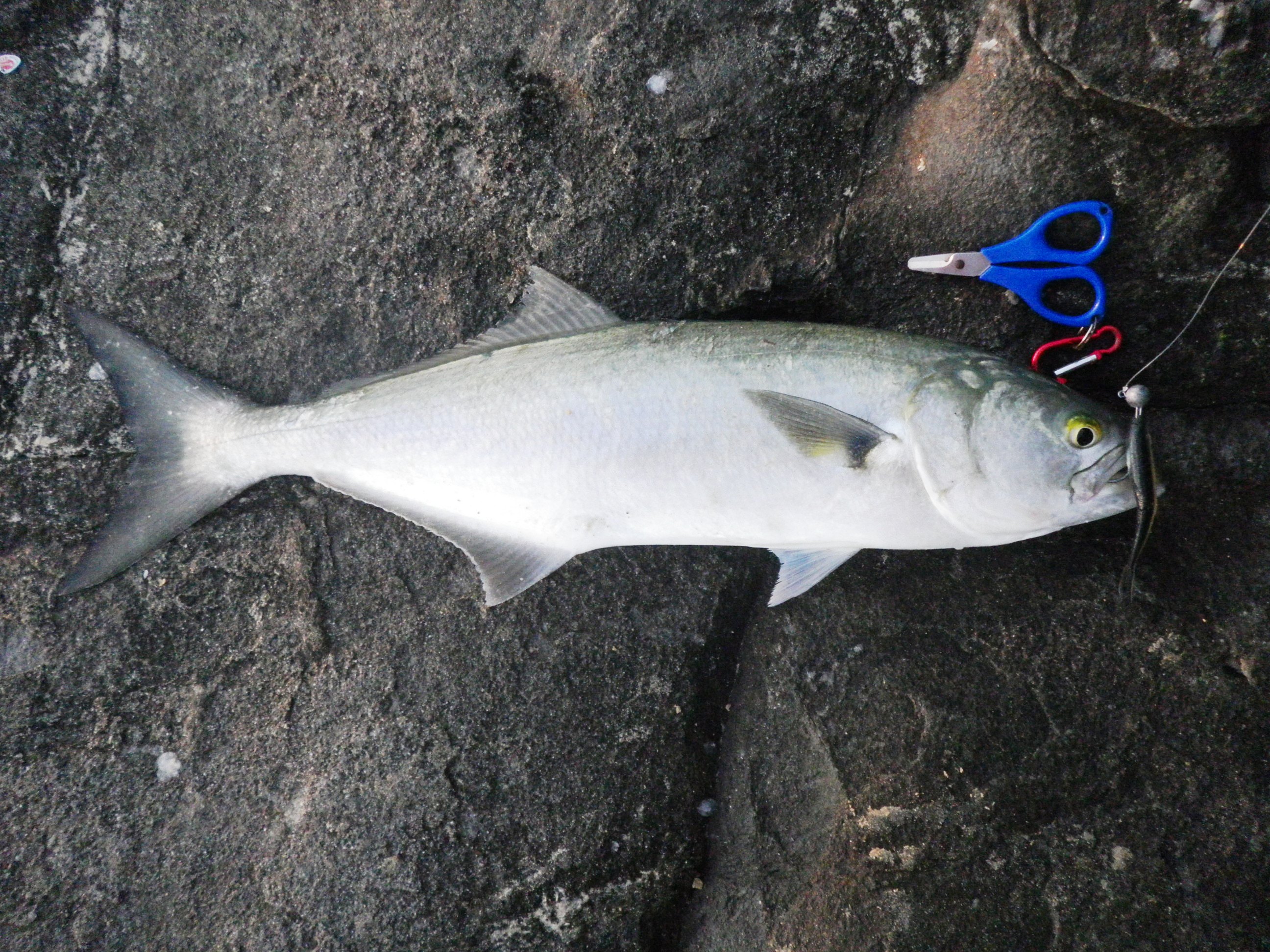
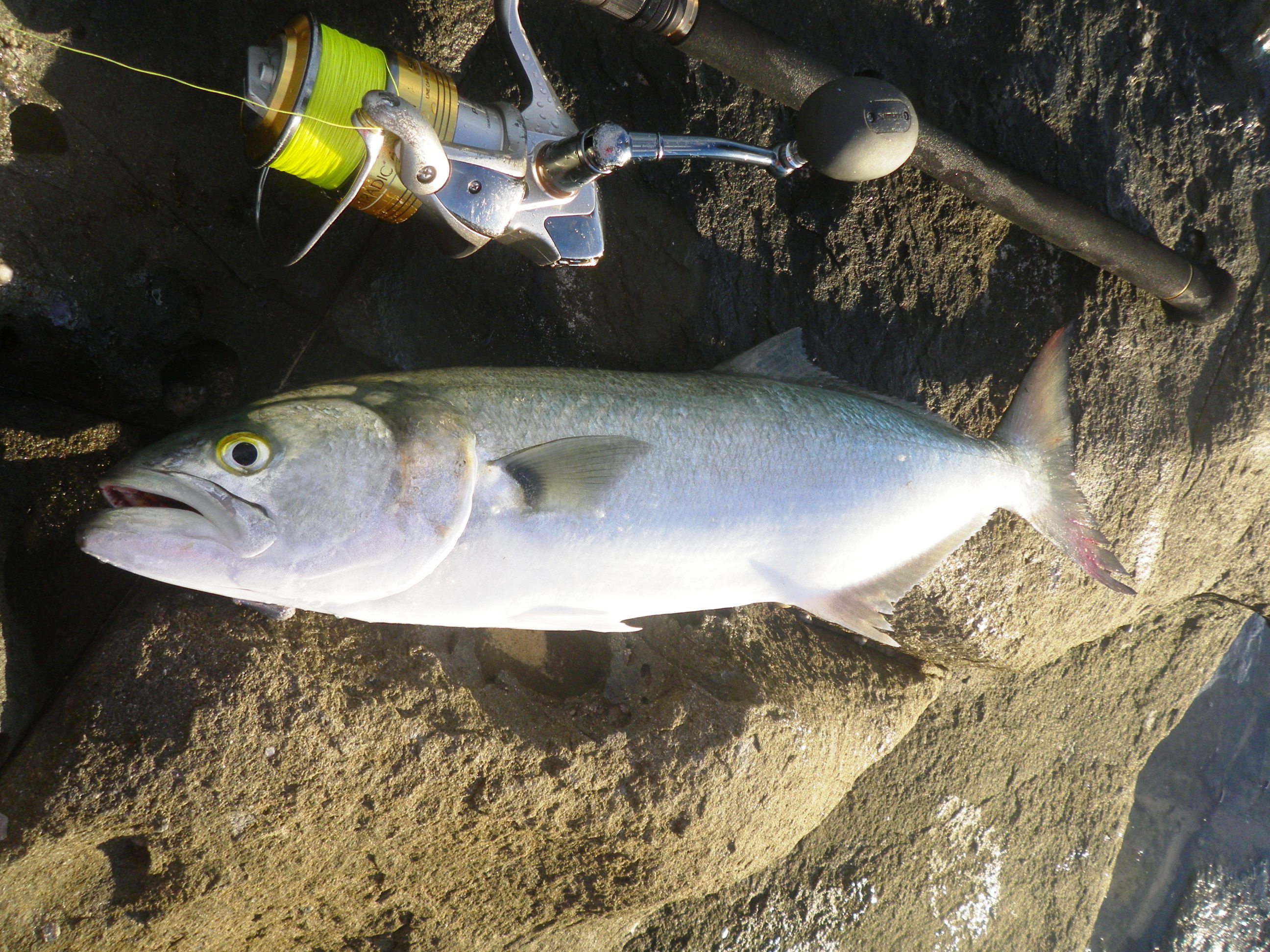
Caloundra – Lots more Flathead but not quite a bagful – 22 November 2011

Tuesday

Caloundra again – an early morning high tide at about 5.00 am. The wind was forecast to be from the north – but starting off light and then building up to 15 knots, by about 10.00 am. It looks like a south-easterly wind change will bring some heavy rain and big seas on Thursday or Friday.

My level of excitement before a fishing day is just like the excitement before Christmas day, when I was a small boy. You get all you gear ready and load the car and then try to force yourself to sleep at 8.00 pm – you can’t sleep because instead of “visions of sugar plums”, etc – you are imagining huge fish or thinking about where to throw that first cast. By the time 2.45 am comes I am usually awake before the alarm goes off. I know, I know – it sounds ridiculous but it’s a powerful addiction.

I arrived just before 4.00am while it was still dark at Bulcock Beach and decided to target the areas under the lights, by the boardwalk. The tide was almost high and the water was close to the sea walls. Sure enough, the bait had come to the lights and the bigger fish had followed. It is fairly snaggy along here, so you have to keep the lure moving. I rigged a GULP 5” Jerkshad in the Cajun Chicken colour – black on top and pink underneath. I was using a 1/8th/1/0 jighead and 10lb fluorocarbon leader tied on to a reel of 8lb braid. I caught a few small Flathead and then eventually one that was big enough to keep.
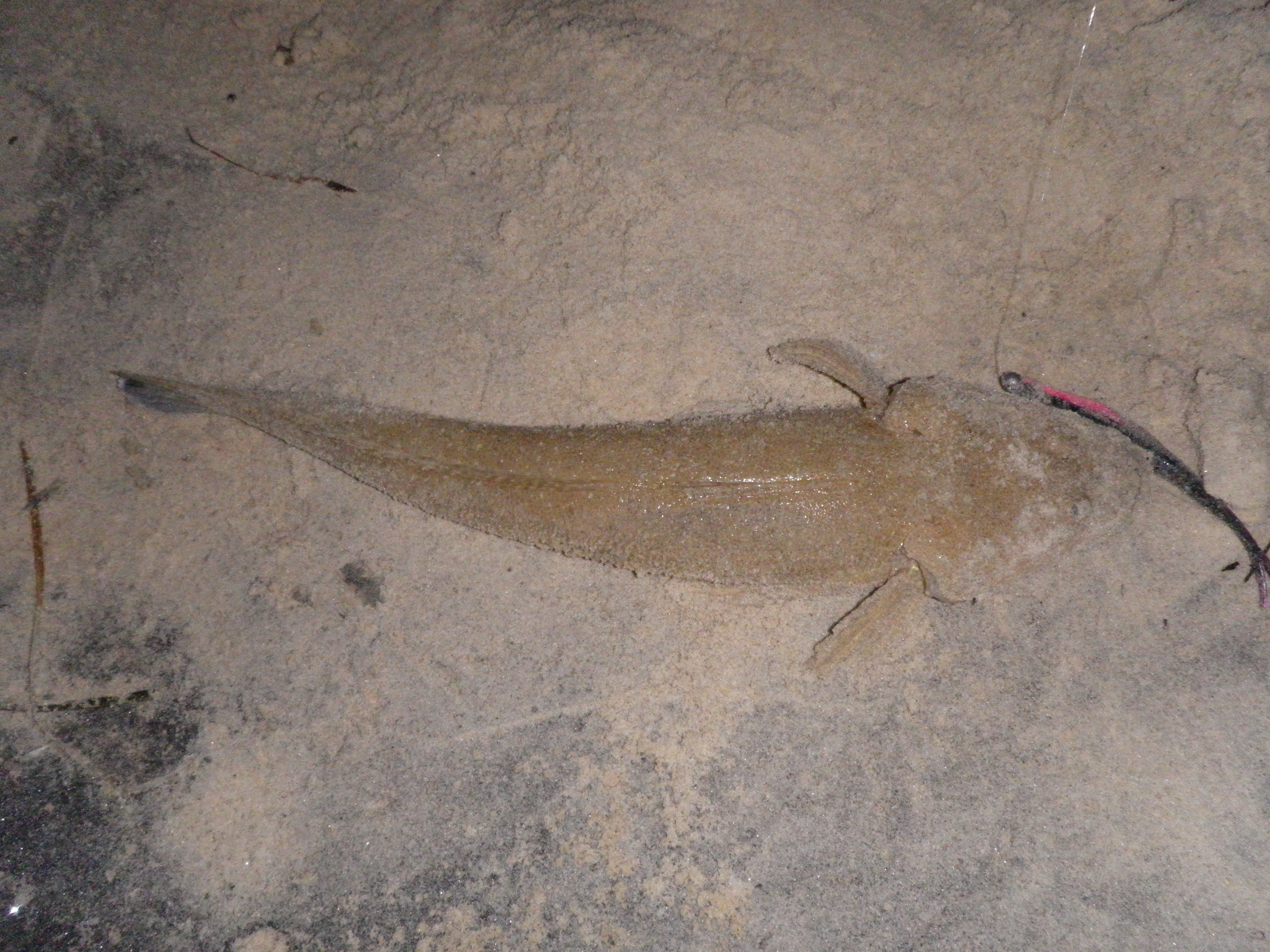
The GULP Cajun Chicken coloured soft plastic lure works well in the dark

The rocks near the mouth of the Passage were almost covered and there was a bit too much swell washing around them, so just after first light, I decided to move down to the flats at Diamond Head. I waded along to the edge of the channel. I decided to start with a hard bodied bibless lure – the Cultiva MIRAVIBE which looks very like the small leatherjacket and herring that are floating around at the moment. As I waded along the channel, I skipped the hard body along the edge of the weed banks and soon caught a few small Flathead – between 25 and 35cm long. Then right at the point where the sand flats drop into the Diamond Head channel, a better fish grabbed it, just as it came over the bank. This one was around 44cm so I kept it.
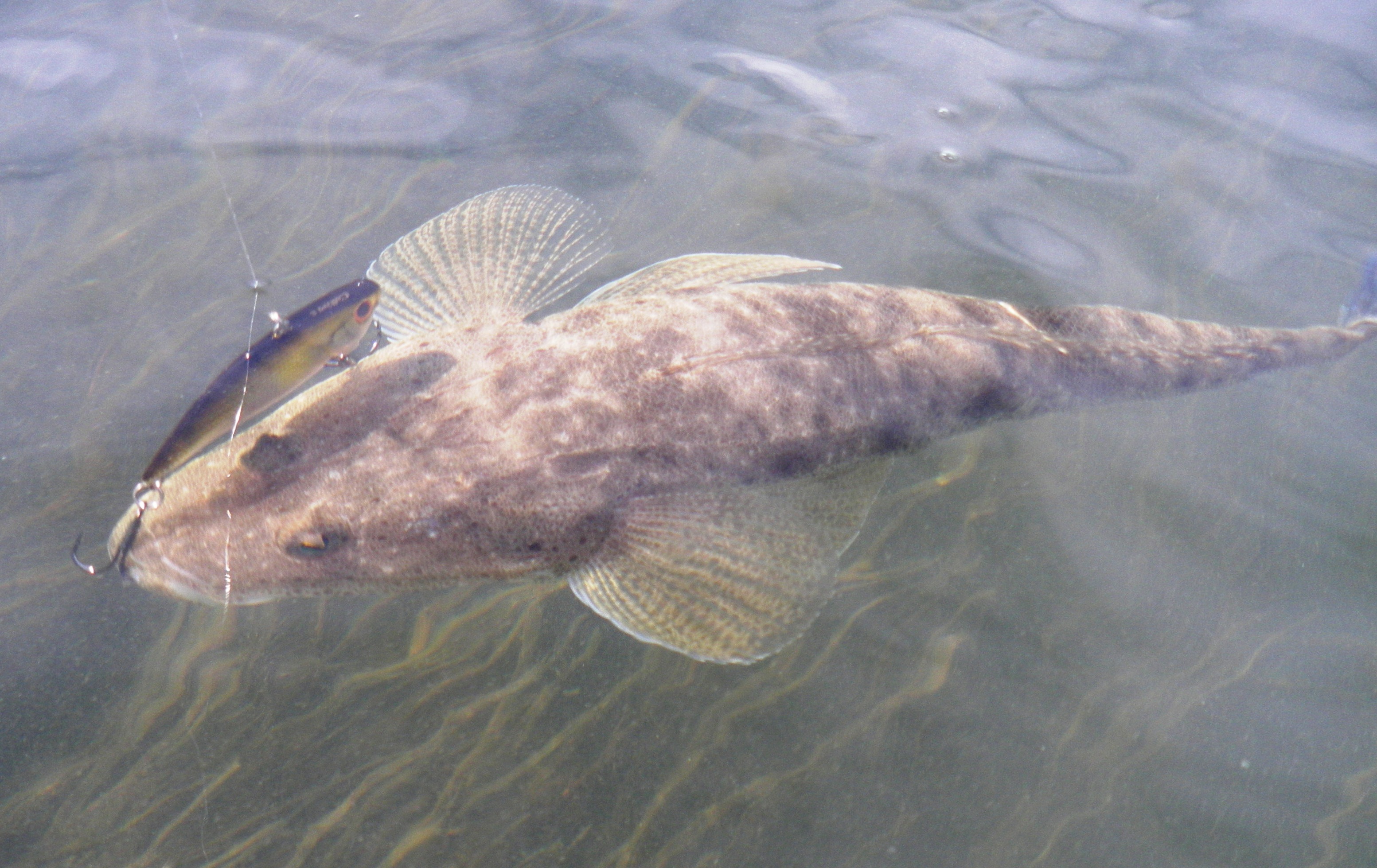
A Flathead takes the lure from the sea grass beds at Diamond Head

By about 6.30 am the tide had properly turned and I waded to the shallow drains and weed banks that lie just north of Diamond Head. These were now covered by less than a metre of water in most places. I swapped over to a soft plastic lure as there was too much sea grass floating around to continue with the hard body. I put on the GULP 4” Minnow in the Pearl Watermelon colour on a 1/8th oz, 1/0 jighead. After a couple of casts I found a fish – another small Flathead. I carried on wading north as the tide started to run out. Just short of another weed bed, a Flathead grabbed the plastic and took off. It was only about 30 cm long. I wound it in and released it. I cast back in the same spot and this time caught a bigger one – big enough to keep at about 42cm.
The water was now too shallow to fish so I moved up to the flats and channels at Golden Beach. I swapped back to the hard bodied MIRAVIBE. This lure is effective but suffers from the same problem as many of its competitors in this category – a poor action when retrieved at a low speed. It is ok in very shallow water but becomes a problem in anything more than about 50cm. To get the right action, you need to pull it quite quickly and inevitably; it then rises too high in the water column. It is perfect in about 40cm of water over a sandy bottom and that is where my next Flathead nailed it. This was another fish for the bag at about 45cm.

This one went for the GULP Pearl Watermelon Minnow soft plastic
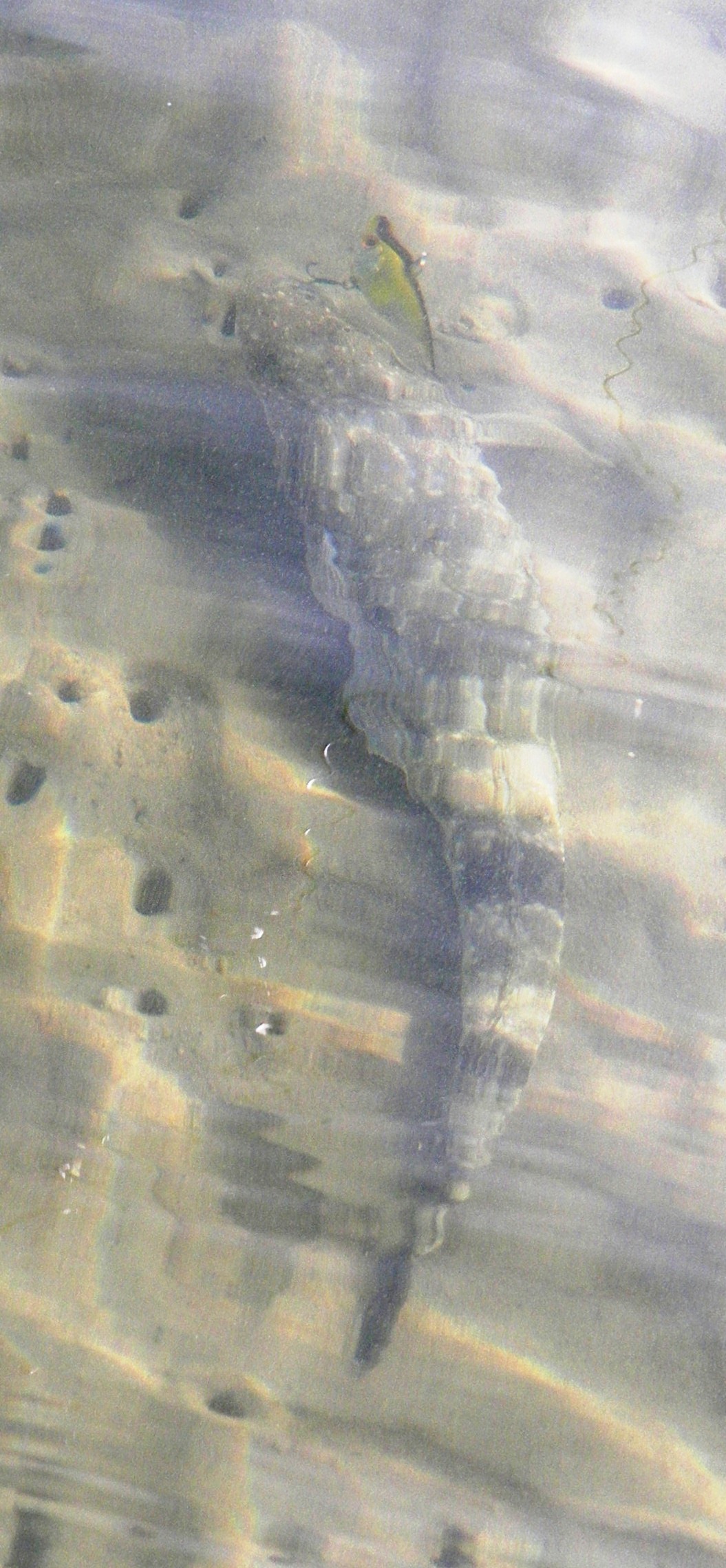
The Flathead are often in the shallowest water

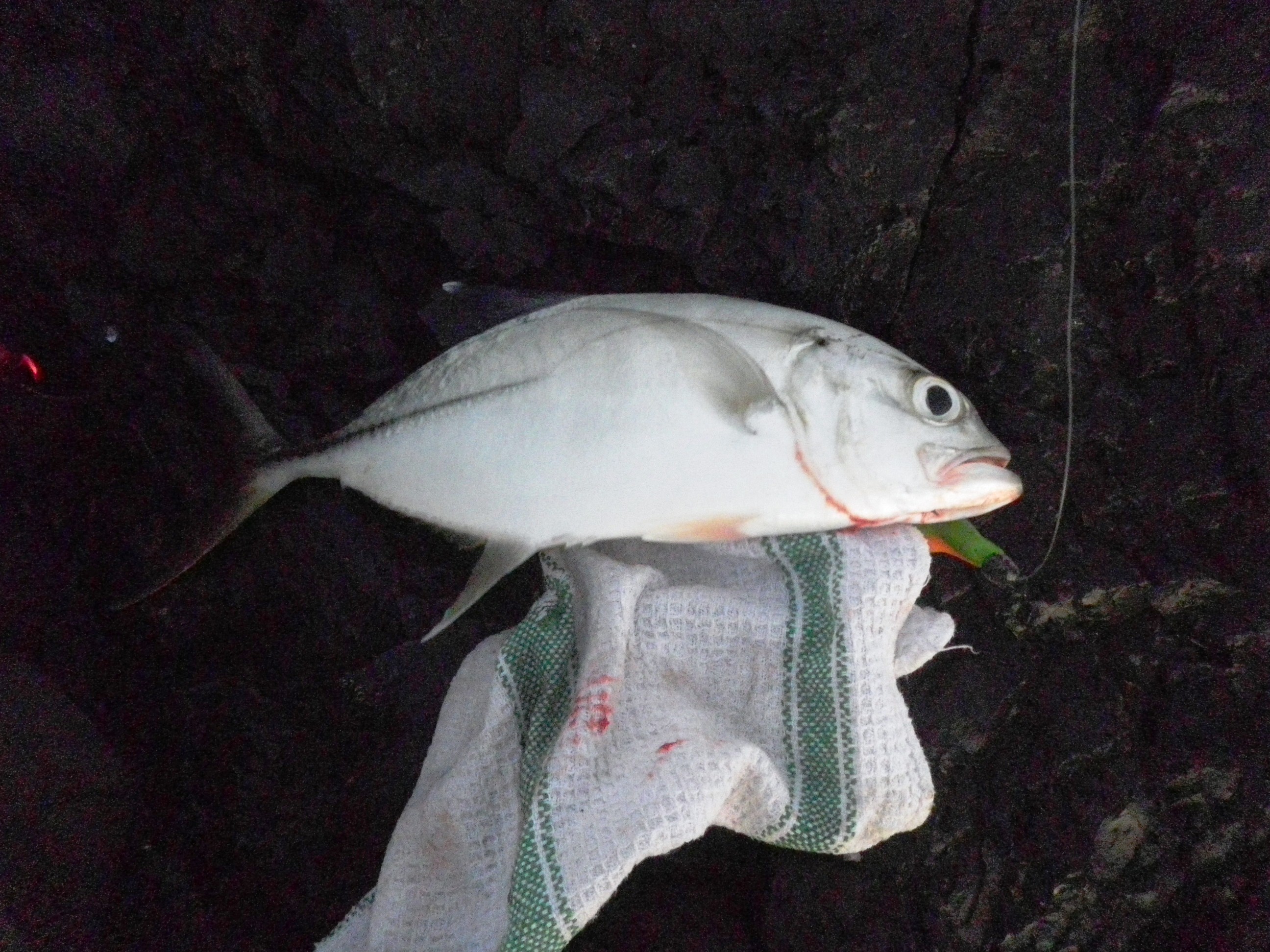
A few casts later the lure was slammed at the edge of a weed bed by a heftier fish. There was a flash of silver – and then a strange looking fish came into view. I towed it to shore photographed it and carefully released it. The helpful folk on http://www.ausfish.com.au identified it as a Striped or Silver Scat – which has a nasty set of spikes but tastes pretty good, so it was a lucky escape for both of us.

A Silver / Striped Scat

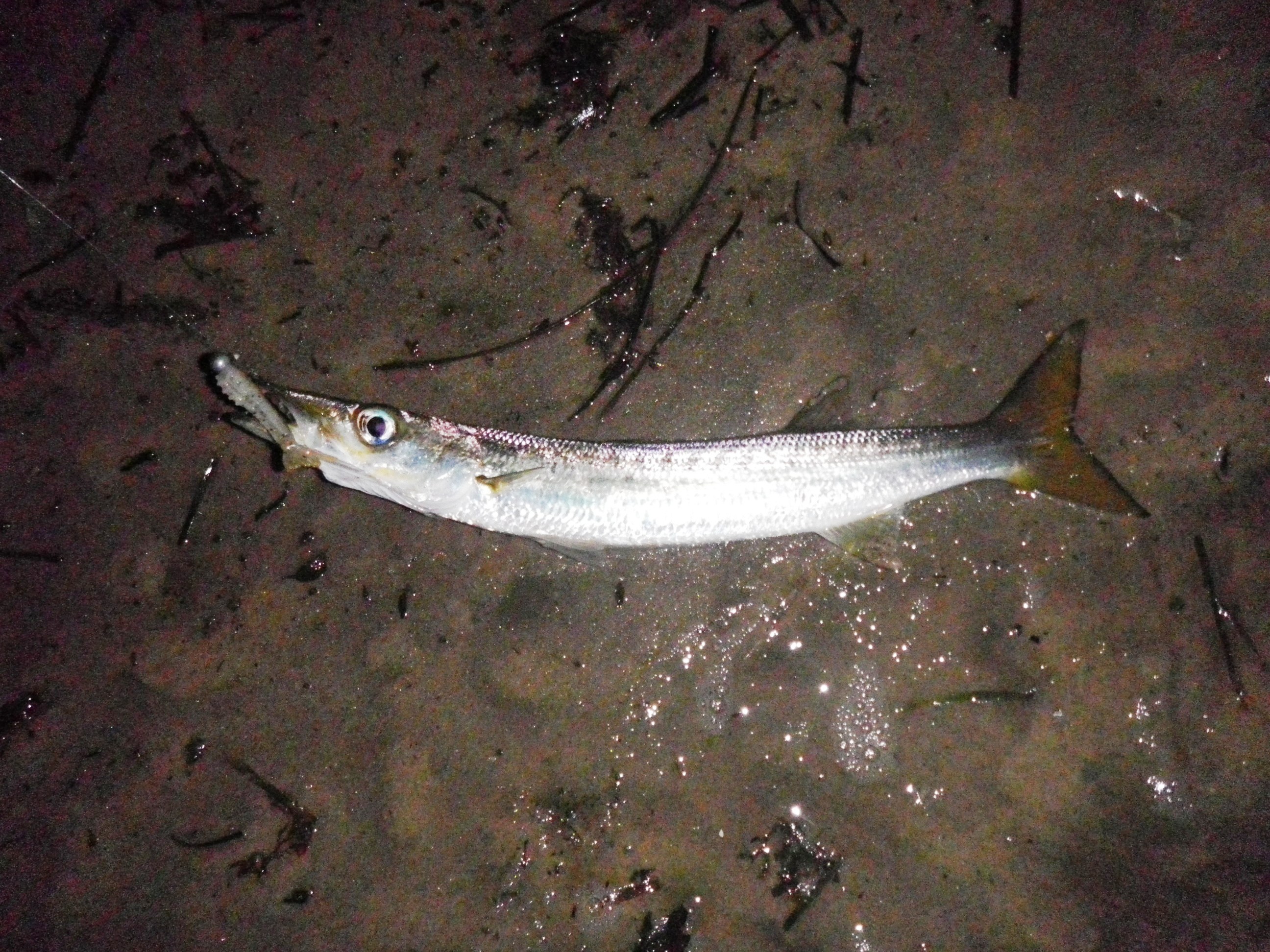
I carried on for a little while longer and caught another couple of undersized Flathead. I ended the day with four keeper fish – two on the hard bodied lure and two on the soft plastic lures. I could not find five legal fish for a full bag – but there were plenty of smaller ones around. The Whiting are everywhere and so are the Garfish. When I filleted the Flathead later, only one had food in its stomach – the remains of Whiting and a recently swallowed Leatherjacket. This was the first fish I have opened in the last few weeks, that has had anything in it.
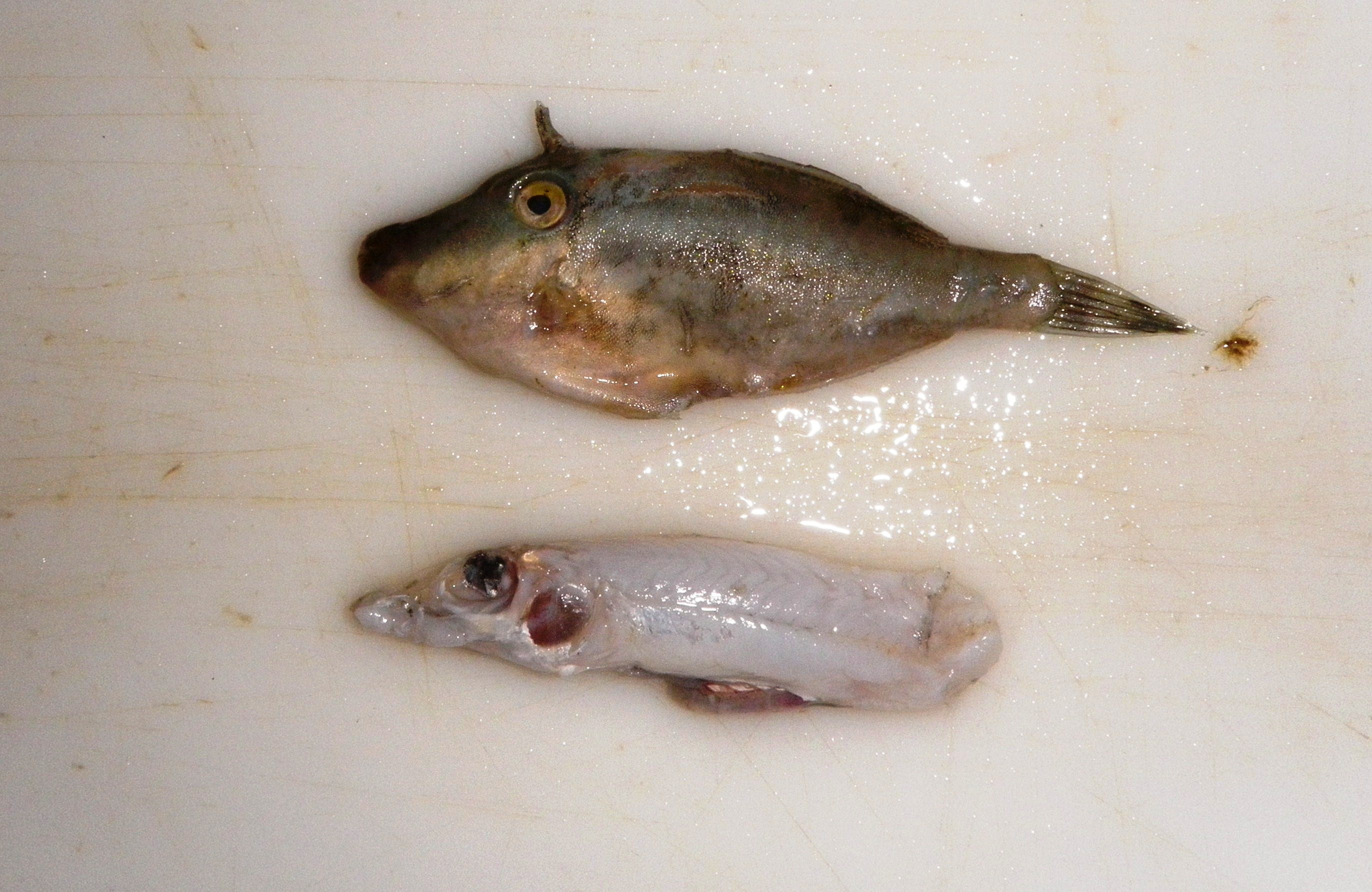
Contents of a Flathead's stomach - Whiting and Leatherjacket

We will see what a burst of south-easterly breeze brings, later in the week.

Caloundra – Bulcock Beach and Golden Beach – 8 November 2011

Tuesday

Strong northerly winds were forecast, but not until around 10.00 am. I decided to fish at my new favorite spot – Caloundra – at the northern end of the Pumicestone Passage, about 1 hour north of Brisbane, on the Sunshine Coast.

High tide would be at 7.40 am and it would be a nearly full moon. There would be plenty of power in the tidal flow and it would come up very high. I arrived at first light, just after 4.00 am. I started fishing at the mouth of the Pumicestone Passage, at the southern end of Bulcock Beach, on the rocks. The wind was blowing and it was already fairly choppy. The tide was rushing in, so I focused on casting my soft plastic lure at the eddies, behind the rocks. After a few casts, I caught a 45cm Flathead on a GULP 3” Minnow lure, in the Lime Tiger colour.

It was too windy to stay in this location so at about 6.00 am, I moved south along the Pumicestone Passage to Golden Beach, to fish the weed banks in front of the Power Boat Club. This is a good spot on high tide as the Flathead move up over the weed beds, looking for something to eat. After half an hour of casting I found one, another 45cm Flathead on the same lure. I was fishing with a 1/8th 1/0 jighead and 1.5m long 12lb fluorocarbon leader. I let the fish go and few casts later I got a better one. This time, on a GULP 5” Jerkshad soft plastic., in the Satay Chicken colour. As soon as I felt the initial bite, I had dropped the rod tip and counted to 10. The waiting nearly killed me but when I jerked the rod tip up, the lure lodged firmly in the fish’s throat. The fish was too big to grab in waist deep water so I had to tow it all the way back to the sand – about 100 metres. Luckily, it stayed on and did not saw its way through the leader.

I fished for a few more hours, wading up and down the weed banks. But, by about 9.00 am, it was just too hot to carry on, so I put the fish on ice and went for a swim.

This slideshow requires JavaScript.

Bribie Island – Buckley’s Hole and the old Oyster Jetty – 20 October 2011

Tuesday and Thursday

Back in Brisbane and time to zip up to Bribie Island for some local land-based fishing. But the wind had other ideas. I arrived at around 4.30 am on Tuesday and it was blowing hard from the south-east. It was only about 15 knots on dawn but it soon picked up to about 25 knots.

I started fishing at the mouth of the Buckley’s Hole tidal lagoon. The water from this ever changing land mark now comes out almost level with the new Bribie Island seaside museum. Low tide was around 6.00 am and I started fishing here just after first light, at around 5.00 am. I was using my Loomis GL2 light spin rod, Shimano Stradic 3000 reel, 10lb braid, 12lb fluorocarbon leader, a 1/6th oz 1/0 jighead loaded with a GULP 5” Jerkshad soft plastic in the Pumpkinseed colour.

I moved along the edge of the drop off casting up, into the falling tide and jerking the plastic slowly along the bottom, back towards me. The jighead kept slowing and as it got lighter, I realized there were large blue jellyfish everywhere. I was casting the plastic on top of the ledge in no more than 30cm of water. Suddenly I felt a tug and then saw a swirl in the water, then I had a fish on. I played it for a while and after a couple of runs, I started to pull it slowly back towards the sand. But the fish had other ideas and with a couple of furious headshakes it dislodged the jighead and swam slowly back towards the deeper water.

As I stood wondering what went wrong, I was surprised to see a couple of good sized Tuna leap clear of the water right at the edge of the drop off. I cast all around but they were gone in seconds. I am not sure how I would have subdued one if I had hooked up! Back to the Flathead – I cast in every direction but as the sun rose, so did the wind and by about 9.00am it was just too hard.

On Thursday I was back in the same spot just after dawn. The wind had dropped considerably and low tide would be around 8.00 am this time. I started with the same soft plastic – the 5” Pumpkinseed Jerkshad. I waded out to the same area where I had lost the fish on Tuesday and after 20 minutes of peppering the terrain with casts, I was onto a fish. It was a Flattie, I played it very carefully back to the sand and where it measured in at around 55cm. I waded back out and caught another 35 cm Flathead about ten minutes later.

I then decided to move south along the beach towards the southern tip of the island. As a walked across the mouth of the big drain, I caught another undersize Flathead, but spooked a much bigger one, that took off across the sand.

I walked down the beach casting as I went. I swapped through a few different soft plastics but did not get a touch. Finally just as I reached Beach Flag No.1, I sent a large Flathead skittering off across the sandy bottom. I was in ankle deep water and there was absolutely no structure around at all. It was right on low tide. I stopped and cast all around. I swapped down to a 3” Minnow in the Pearl Watermelon colour, still nothing. I turned and walked back towards Buckley’s Hole. I cast inland, in to the shallower water. Infuriatingly, I almost stepped on another three Flathead, who went flying off passed me into the depths. I could see them, but I could not seem to catch them.

I found myself back where I had started and decided to dump the subtle approach. The tide had now just started to run in. I put on a GULP 5” Crazylegs Jerkshad in the Curry Chicken colour. After three or four casts it paid off and I had another fish on. I safely steered it back to land – it was a 42 cm Flathead.

This slideshow requires JavaScript.


I decided it was time to try the other side of the Pumicestone Passage. I drove over to the old oyster jetty and waded out onto the muddy flats. The sea grass is now growing quickly and most of the ‘snot’ weed seems to have died off. I stuck with the GULP 5” Crazylegs Jerkshad and after a few casts, just south of the jetty, I saw a decent Flathead roll over onto the lure just after it hit the water. I paused, then struck. I had it on for a bit and then it spat the lure out. I moved south and after wading for about 50 meters, I cast out and hooked up with another. This time I dragged it carefully, all the way back to the sand. It was a 45cm Flathead.

By now the water was getting to high to fish the edge of the weed banks so I decided to call it quits. I had only landed three fish but encountered many more. There are obviously plenty of Flathead around – but I need to get better at catching them!!

Fingal Head – Salmon, Tailor, Bream – 11 August 2011

Thursday

Tuesday was a fishing disaster but somehow I just could not believe that the Tweed Rockwalls could ‘shut down’. So on Thursday, I found myself driving back down across the New South Wales border for another session. When I arrived at the north rock wall there was no swell and a slight breeze from the south-west. I started about 5.30 am. It was cloudy and very overcast and it looked like it would rain.

I started fishing with a GULP 5” Jerkshad in the Lime Tiger colour, rigged on a ½ oz 2/0 jighead. The heavy skies seemed to have completely flattened the water. The cloud blocked out the sunrise. As I cast all around the front of the rock wall the south-westerly breeze started to lift and it was very cold.

By 7.00 am I had not had a bite so I decided I had to switch locations. I drove down to Fingal Head. I walked out across the small causeway on to the rocky promontory. I decided to make the first cast count. It is so often the first cast in a new location that produces a fish. I checked and double checked my knots and decided on a GULP 7” Jerkshad in the Lime Tiger colour, rigged on ½ oz 5/0 jighead. The south-westerly wind was picking up and the tide was running out. I cast straight out in front of the promontory and let the lure sink. Before it hit the bottom I felt a solid bite. I dropped the rod head and then struck hard. I was on to a good fish – it was not frenetic, like a Tailor but felt a bit too lively to be a Jewfish. It took plenty of line but I gradually tightened the drag until I had it at the foot of the rocks. It was only as I lifted it clear of the water, on a helpful surge, that I saw it was an Australian Salmon. It was a good size fish – just under 70cm long. I photographed it and then released it. I will eat almost any fish but I have never been able to make one of these taste good.

I thought there would be more, so I re-rigged the same soft plastic and cast back in to the same area. Nothing – I tried up and down the rock ledge and after a while switched to a smaller 5” Jerkshad in the Peppered Prawn colour. I covered the whole area with casts but they had moved on.

This slideshow requires JavaScript.


I moved round to the north side of the ledge and cast out into the corner of the Fingal Head beach. The water is crystal clear but I could not see much bait around. After another 30 minutes, I hooked a small Tailor – around 30cm which I quickly released. I then switched to a Gulp Jigging Grub in the Pink Shine colour and swapped down to a 9 gram 2/0 jighead. After a couple of casts, I caught a small Bream , very close to the base of the rocks.

It was now around 10.00 am. I had caught a few fish and it had been a better session than Tuesday but I still had nothing for dinner. Maybe it is time to get back up to Bribie Island and see if the Flathead are biting again.

Tweed Rockwall – Trevally and a Snapper encounter – 02 Aug 2011

Tuesday

I was fed up with the weed in the Pumicestone Passage so this morning, I decided to head south from Brisbane and spend the morning fishing the north side of the Tweed River rock wall. Conditions were perfect – a light breeze, low tide just before dawn and very little swell.I arrived about 5.30 am and walked to the very end of the wall in the dark. I used my head lamp to rig up. I was fishing with the big rod – the Daiwa 9’ 6” Demon Blood and the Shimano Stradic 6000 reel. I had it loaded with 40lb braid and a 30lb fluorocarbon leader. I decided to start with a soft plastic and chose a GULP Crazylegs Jerkshad in the Curry Chicken colour. I rigged it on a Squidgy fish-shaped jighead – 9 gram, 2/0 hook.

Tweed Rockwall - Trevally

The first glow of dawn was on the horizon but sunrise was still about 30 minutes away. There was virtually no moon and the sky was pretty clear. I cast out about 15 metres and counted to 10 while I let the lure sink. As I picked it up there was a solid ‘thud’ as something took a swipe at it. Next cast there were a couple of bites and then, as I paused, a hook up. It was a small Trevally , I released it and cast out in the same spot. A few casts later I caught another about the same size. I lost the next one – which was a bit bigger, as I tried to haul it up the rocks. I switched to a Gulp 5”Jerkshad in the Lime Tiger colour. I caught yet another small Trevally.

Another Tweed Trev


I moved round to the river side of the rock wall and cast out into the river. The sun was just over the horizon now. A big fish grabbed the soft plastic as it sunk. It took line for about ten seconds, in a solid run back around towards the ocean side of the rockwall. It soon had my line tight against the rocks and after a couple of seconds the line snapped. I tied on a new 40lb fluorocarbon leader and another of the same jigheads. I decided to try a different plastic – the GULP 5” Crazylegs Jerkshad in the New Penny colour.

I cast out into the same spot and bang – the lure was slammed on the drop. This time I put the pressure on straight away and kept its head out of the rocks. It had plenty of power but it was not fast like a Tailor or Trevally. I thought it might be a Jew but it kept making determined attempts to burrow down into the base of the rockwall. It was too fast for a Jew. After about 10 minutes of play I had the fish coming round to the ocean side of the wall where I thought I might be able to grab the leader. I slid down the rocks on my backside to the lowest rock that was fairly dry. I tightened the drag a little and heaved – suddenly a big pink tail slapped the surface of the water – it was a Snapper. It was a good size with a big knobby forehead, perhaps 60 or 70 cm long. It was exhausted but still had plenty of kick. It lolled over on its side and I grabbed the leader just as a surge washed it over the rocks at my feet and pushed it down into a gap in the rocks, behind me. It was now temporarily stuck but out of reach. I had no gaff and therefore no choice but to try to pull the fish out by the leader. As I tried to pull it up, another surge washed over and it wriggled off the hook. With the next set of waves it wriggled free – and slowly swam off! I rarely get Snapper from the rocks and to lose a great fish like this was heart-breaking. Still he is there for someone else to catch now.

Close but no Snapper


I sat trembling for 10 minutes or so and then re-rigged and put in a few more casts. By now my heart was not really in it. Just out of casting distance the birds were working over a bait school that was being smashed from beneath. I put on a slug but I could not reach them. Around 8.30 am I headed home – but I’ll be back!

Bribie Island – Buckley’s Hole to Red Beach and back – 7 June 2011

Tuesday

With the wind forecast to kick up to a 15 knot south-westerly around 7.00 am on Tuesday, I had no real choice but to fish in the Pumicestone Passage again. When I arrived at Bribie at around 5.00 am the wind was nowhere near that level, so I decided to fish on the island side of the Passage.

Bribie Island Bridge - Chopper

Low tide would be at about 7.30 am. I started under the bridge with a GULP 4” Turtleback worm in the BBQ Chicken colour on a 1/6th 2/0 jighead. As I waded, quietly in the shadows, there was no surface action and everything was very quiet. I realised why, when two dolphins popped up less than 5 metres away. They usually do a good job of eating or scaring the fish. They were wallowing around in less than a metre of water, they must have known I was there but it did not seem to put them off. A third one joined them and they headed over to the other side of the bridge. I moved to the south and caught a few Pike. After about twenty minutes I moved back north of the bridge and caught a few small Tailor. Then the dolphins came back again so I decided to move on.

The Flounder seem to love the GULP Minnow soft plastic lures

It was now just after first light – about 6.15 am. I drove down to the car park beside the saltwater lagoon that sits just in front of Buckley’s Hole. This lagoon and the drain at its mouth, has been completely transformed by the wild weather of the last year or so. The mouth has gradually moved further north, towards the main Bribie Island Jetty. The drop off into the main channel of the Passage is only a few metres from the shore at low tide. I walked out of the car park and on to the sand.

I started by casting just over the drop off and walking along it, heading south. As the current slowed there was weed everywhere, this made things difficult. I was hoping for a few Bream, as they like to school up by this drop off, when they are spawning. Initially, all I caught were a few Pike.

I waded all the way down to the corner of Red Beach. On the way I landed a couple of Flounder and I kept the biggest of them. By now I was fishing with a GULP 4” Minnow in the Pearl Watermelon colour. I waded and cast for about 3 hours without much success. I walked back towards the car park and carried on north towards the Bribie Island main jetty.
I had now switched to a GULP 3” Minnow in the Peppered Prawn colour. I had also swapped to a lighter jighead – a 1/8th 1 hook. I was using 10lb leader. About 100 metres short of the jetty I caught a small bream – around 27cm.

Then I found the Flathead. The tide was running in, solidly and the weed had cleared up. Just after 10.00 am, I caught the first one – around 30cm long. It was quickly followed by a couple of 40cm + fish. I switched to a Gulp Crazylegs Jerkshad in the Curry Chicken colour. I caught a couple more undersize fish and then two good ones – at 48cm and 54cm. All the fish were caught on the same 30 metre stretch of sand and by 11.30 am, I had a full bag limit of five.

A full bag of Bribie Flathead from 41cm to 54cm

It had been a cold and blustery morning and I had put in a lot of hours before I found the good fish, but eventually I located them. It may have been the tide change that encouraged them to feed. Once I had my five I decided to head for home and thaw out.

Wreck Rock & Middle Rock – Tuna & Trevally – Deepwater National Park – 14 May 2011

Saturday

On Friday evening the keen fisherman camped nearby told me he had hooked up to a freight train Tuna, off the beach, in the early afternoon and unfortunately pulled the treble out. He had spent the rest of the day running up and down the beach trying to get his metal slug back in front of the fish but they just never came close enough. I decided to try the slugs in the morning down at Flat Rock where I had also seen the Tuna working. As the sun came up I cast and cast and cast in the direction of the feeding Tuna – but they just never quite came close enough.

Flat Rock beach - with the rock just covered - just after dawn

After a couple of hours I gave up and went back to camp for breakfast. I was greeted by my neighbour whose persistence had paid off and finally he had a good size Mac Tuna. He had eventually caught up with a school that came into less than 3 metres of water, only about 25 metres from the shore, about 1km south of Wreck Rock, along the beach. He had followed the birds and dead Whitebait that littered the beach until he saw a boil of feeding fish on the surface close in to the beach. He hooked up on his second cast and hung on. I was delighted for him, but he looked almost as tired as the fish. Who said angling is a sedentary sport?

Mac Tuna caught off Wreck Rock Beach on a chrome slug - May 2011

Mac Tuna off the beach - does not happen very often - full marks to this fisho for putting in the hard work

Now I was really fired up but I needed to have a look at some other spots, so that afternoon with a high tide due for about 6.00 pm, I jumped in the car and drove along the track to Middle Rock. Middle Rock, predictably sits between Flat Rock and Wreck Rock. It is a set of three rocky promontories that are almost completely submerged on the bigger high tides. It was approaching high tide when I started fishing there just after 5.00pm.

I was using the light spin rod and was casting out a 1/6th 2/0 jighead loaded with a GULP Jerkshad in the Pumpkinseed colour. I was hopping the plastic over the submerged rocks pretty quickly so that it would not get snagged. Suddenly a fish smashed the soft plastic lure ran with it for a few metres, then dropped it. A few casts later and I was in contact with a fish again. It took off and took plenty of line. The light rod has no real strength so I had to wear this one out with the drag and use the waves to bring it in. It put up a good fight but it was solidly hooked and I soon had a 50cm Trevally at my feet. I think it was a Big Eye – but I am never quite sure as some of the species can look pretty similar. The sun had gone down by now and the south-westerly wind was chilling so I gave up for the day.

This slideshow requires JavaScript.

Bribie Island – Buckley’s Hole – Stonefish Encounter – 5 May 2011

Thursday

The weather forecast looked windy but not until about 8.00 am, so I set out early to fish on Bribie Island. I crossed over the bridge around 4.30 am and decided to fish around the base of pylons on the island side. I met another keen fisherman there, flicking soft plastics. It’s always nice to know that there is someone just as mad as me out there!

The bridge lights had attracted the prawns, and they had attracted the Pike and a few small chopper Tailor. We cast either side of the bridge for about 45 minutes. I hooked up with a few Pike, but could not find anything bigger. The other fisherman had found a couple of Flathead earlier and then been busted off.

The Pike are back with the cooler weather

At first light I moved down to fish the drop off in front of Buckley’s Hole. The wind was starting to pick up and it had stirred up the water. The tide was running in. I waded south, in about waist deep water and cast around in the area just before the coffee rock forms a ledge at the main channel. I was using the GULP 3” Crazy Legs Grub on a 1/6th 1/0 hook. After ten minutes or so I hooked up with a Flathead that was just under 50cm. I released it and cast back in the same area. I hooked another fish immediately, but then somehow it wriggled off the lure.

50cm Flathead

I moved further south, parallel with the shore. Then disaster struck. I felt a sharp needle under my wader boot and instinctively hopped away. Something had pierced the gumboot sole and gone into the sole of my foot. I thought things through and concluded it was probably a Stonefish. It did not hurt initially but after about ten minutes all that changed and it really went off! I limped back to the car and fortunately for me, the ambulance station was only a few hundred yards away. It was around 6.30 am, so I rang on the bell. A paramedic sat me down and had a look at the puncture mark. She then put my foot in a bowl of hot water. The relief was pretty much instant. Apparently the heat neutralises the toxin. After 15 minutes the pain was far more manageable and I hobbled off to the car and drove home. A few hours later the pain was just a tingle.

I was lucky. I was wearing my Horne waders which have a very thick soled, Blundstone boot. This meant that only one spike actually got to my foot. I was also able to find a qualified paramedic only a few hundred yards away. The paramedic explained that without the boots on it would have been very messy! If you are ever fishing in that area, I would certainly advise protecting your feet with some form of shoe and being very careful where you tread. I will certainly be a little more cautious in future.

Bribie Island – Large Easter Sunday Flathead – 24 April 2011

Easter Sunday

I had a big Easter BBQ planned for Monday. Four Good Friday Flathead was a good start but I would need a bit more fish to make sure my guests didn’t go hungry. That was my excuse for getting out on Easter Sunday!

I arrived at the Bribie Island Bridge at 5.00am and parked on the bank, on the mainland side. I put on my waders and had a few casts around the rocks under the bridge. I caught a small Moses Perch and released it.

Just as it started to get light I moved off to the south. There was lots of surface feeding going on and the tide was running out strongly. Low tide was at around 8.00am. I waded past the oyster jetty with no more bites and then started to fish the drain that runs round from Sandstone Point. I fished all along it without a touch. I moved out to a point where the water was waist deep and started to move north, back towards the bridge.

I was fishing with a new favourite, the GULP 3” Smelt Crazylegs Grub soft plastic. It is a short version of the Crazylegs Jerkshad that has proved so useful. I had it rigged on a 1/6thoz 1/0 jighead. I was using my light spin rod and a 12lb fluorocarbon leader.

I got a couple of solid bites but could not keep the fish on. Then as I moved towards the oyster jetty a fish grabbed the plastic about a metre away from me. I struck with rod and stepped back. It was a good fish but it did not do much, initially. I decided to walk it back to the shore. I loosened the drag a little, as I did not want a bust off. I started to tow it towards the bank and about half way there it really woke up and made a few powerful runs. As I dragged it up onto the muddy shore the leader snapped, but it was clear of the water.

It was a healthy female Flathead, just under 70cm long. I fished around this area for another hour and caught and released several Flathead that were around the legal size limit of 40cm. At about 8.30 I gave up. It had been great morning land-based fishing in the Pumicestone Passage.

70cm Flathead

Iluka – Middle Bluff – Tailor – 11 April 2011

Monday – am

I have just got back from a week fishing the rocks at Iluka in Northern New South Wales. The weather was fantastic with only a couple of showers and very little swell, the whole week. For the beginning of the week we had early morning low tides, which also made it possible to fish some usually inaccessible spots. The week produced some great fish, as you will see.

I started on Monday morning at Middle Bluff in the Bundjalong National Park, just north of Iluka Bluff and Frasers Reef. I arrived around 5.00 am and faced a mild swell and a very light northerly wind. Low tide would be at about 7.00 am. I watched a few big waves slap over the rocks and decided to wait for better light to start fishing. At about 5.30 am I could see my feet and had got a feel for the wave pattern, so I started casting.

Dawn at Middle Bluff - Iluka

I bought a new rod for this trip – the Daiwa Demon Blood 9ft 6. The Rovex Bario 12ft and Aureus 9ft have served me well, off the rocks, but I needed a rod with a faster action and more sensitivity when casting lighter weighted jigheads. I also broke the 9ft Aureus while landing a decent Jewfish a few months back and although Rovex backed the rod with a replacement straight away, I have lost a bit of confidence in it. The Daiwa is a much pricier rod but it is really light and should also be able to lift big fish – we will see.

I started with a GULP Crazylegs Jerkshad in the Satay Chicken colour rigged on a 3/8/ 3/0 jighead. I was using my Shimano Stradic 8000, loaded with 20lb Fireline and about 2m of fluorocarbon leader. I join the mainline to the leader with a uni to uni knot. The first half an hour produced nothing. I used a few other large plastics in fairly bright colours but nothing got a bite. It had been raining on and off, for about three weeks before we arrived and the Clarence River was pumping out a solid stream of sediment. As a result the water was very murky and got dirtier as we approached low tide.

At about 6.00 am I decided to put on a GULP 4” Minnow in the Vader colour – this has a black back and crème coloured underside. On my second cast it was grabbed close to the rocks. There were plenty of head shakes and then a decent Tailor leapt clean out of the water as it tried to shake the jighead from its jaw. The swell helped wash him up the ledges and after a short fight, I had him safe at my feet. It was a great way to christen the new rod – a 55 cm Tailor.

55cm Middle Bluff Tailor

I bled the Tailor, dropped it in a rock pool and cast out the rather mashed Vader Minnow again. Before I had lifted the rod tip – bang – a fish grabbed the lure and took off. It was a good size and peeled line for 10 seconds or so before – ping – it snapped the leader on a rock. I was out of Vader Minnows so I switched to a 4” Minnow in the Rainbow colour. This soft plastic is very similar to the Vader pattern but with a slight silvery sparkle on its underside. Second cast and I was on again this fish gave me plenty to think about by lodging itself down low in the rocks. I loosened the drag and as the line wafted free of the rocks I thought I had lost the fish. I started to wind in and bang – it was off again. This time it did not have much strength and with the next big wave I had it up on the rocks – another good Tailor at about 60cm.

60cm Middle Bluff Tailor

I fished on for another hour or so through the tide change without another touch. I gave up around 8.00 am and headed home. A great start to the week.

Bribie Island – Bridge, White Patch & Oyster Jetty – 8 March 2011

Tuesday

Up early and back to Bribie Island. I arrived at the mainland side of the bridge at around 4.00 am and started by casting soft plastics in amongst the pylons. The tide was in the last hour of running out and the rain showers overnight had again stirred things up. There is also a storm water drain under the bridge that empties out from time to time, further clouding the water.

I had rigged up a GULP 5” Jerkshad soft plastic in the Satay Chicken colour on a 1/8th 1/0 jighead. I was fishing with 10lb braid and a 12lb fluorocarbon leader, on my light spin combo – a Loomis GL2 rod with a Shimano Stradic 3000 reel.

I started just to the north of the bridge and got no bites for a while. I moved quietly, round to the north and cast into the area where the light and bridge shadows meet. Thud – a solid hit, I dropped the rod tip, paused and then struck. The fish took some line then settled into the current. I gradually eased it up on to the sandy area at the foot of the rocks. It was a nice, 46cm Flathead. I let it go, straightened the plastic on the jighead and peppered the area with more casts. It was about 4.20 am. A few retrieves later there was a smaller bite, in about the same spot and I caught another Flathead. This time it was just on 40 cm. I released it and moved all around the bridge area and down to the street light beside the boat hire outlet, but I could not find any more.

This slideshow requires JavaScript.

As dawn broke, I drove up to White Patch to look for some more fish. I walked down on to the beach and out towards the drop off, that runs all the way along the edge of the Pumicestone Passage. It was just after low tide and I waded along casting in all directions, out over the drop off and on top of it, in the shallow water. I did not get a bite on the soft plastic lures. I swapped to a 1/6thoz weight, Berkley Big Eye vibration blade, but this did not find any fish either. After an hour of wading up and down, I decided to change locations again.

I drove across the bridge to the Oyster Jetty and waded out beside it, on the south side. The tide was now running in solidly and the water was much cleaner than it had been up at White Patch. However, the wind was really getting up and there were some very nasty clouds on the horizon. I hooked a decent fish but was disappointed when it leapt out of the water – a huge Long Tom. I got rid of it and waded south for about 60 metres, casting in front of me, into the run in tide. I swapped to a GULP 4” Pearl Watermelon Minnow soft plastic and rigged it on a 1/8th 1 jighead. After a few casts in this area, the line came up taught and I had another fish. There was a bit of weight to it, so I decided to wade back the shoreline. It was a good size Flathead at 49cm.

I carried on for another 45 minutes but then a couple of monster rain squalls gave me a good soaking and the cooler southerly wind was really getting up. At about 9.45 am I headed home.

Bribie Island – Sandstone Point Drain – 26 Feb 2011

Saturday

After a good session on Thursday, I headed back up to Bribie Island early on Saturday morning. I was wading out under the bridge, on the mainland side, just after high tide, at about 4.30 am. I decided to try some big GULP Crazy Legs Jerkshads, to see if I could find some bigger fish, under the bridge lights. I rigged a pink shine version on a 1/8th 2/0 jig head and cast out to the north side of the bridge. After a few casts, nothing was happening so I moved to the south side. The first cast came up taught as soon as I flicked the reel bail arm over. The fish held on until it was only a couple of metres away and then let the lure go. The same thing happened, a couple of casts later. I could not see what was biting, but I think they were probably Pike or Moses Perch.

As the sun came up I moved south, past the old oyster jetty to the big drain that empties round the corner from the direction of Sandstone Point. The tide was really running out now and I decided to try a 1/5th of an ounce Berkley Big Eye Blade lure. I cast it out let it sink briefly, and jerked it back towards me fairly quickly. To get the right action you really need to keep these lures moving fast. After a few cast, I had a fish. The small, soft hooks on these blades mean I often lose the fish before I can get it back to shore. There was no problem this time. I had a nice Flathead around 48cm.

This slideshow requires JavaScript.

After a 15 minutes more fishing with the blade lure, it got snagged and I lost it. I switched to a GULP 3” Minnow Grub soft plastic in the pepper prawn colour and rigged it on a 1/8th 1/0 jighead. I was now fishing along the edge of the big sand bank that channels the water down through the drain. After a couple of hits I cast back in the same spot about 6 times before I finally connected with the fish. It was another, bigger Flathead at 52cm. I wandered around this area for another hour or so. I hooked up with a couple more fish but dropped them or they spat out the lure. Finally I connected with a good size Long Tom who jumped clean out of the water when it realised it was hooked. These really are ugly fish.

Another great morning fishing and as we have plenty of fish in the fridge, they were all released today, some unintentionally!

Tweed River – The Rockwall – Tailor & Queenfish – 23 Dec 2010

On Wednesday morning – the rain looked like it would stop for a bit and as the wind was forecast to come from the south for a while, I decided to go for one more Tweed rockwall session before Christmas. The couple of hours either side of dawn has always been the most productive for me in this spot, so I was up at 3.00 am again. I drove down from Brisbane and was at the end of the rockwall, watching the red glow on the horizon at about 4.15 am.
There was a light south westerly blowing and it was quite cool. There was a little more swell as a result. I started with a River 2 Sea 110mm Dumbell Popper in the Pilchard colour. I was blooping it back slowly across the front of the rockwall. Suddenly there was a boil on the surface so I cast out, in that direction. The popper was knocked out of the water by a marauding fish but there was no hook up. After several more casts and hits – but no connections. I quickly tied on a GULP 5” Jerkshad in the lime tiger colour. I used a ½ oz 4/0 jighead. As soon as it hit the water is was snaffled by a solid fish. I had the drag fairly tight and got the fish round to the left (north) side of the rockwall, fairly quickly. Its head was shaking and then there were a few leaps and I could see it was a Tailor. I got it up the rocks and it measured up at just over 60cm.
Then everything went quiet. I switched from popper to metal slug, to plastic, several times but I could not raise a bite. I could not find any Kingfish but after another hour or so, I had another hook up on a GULP 4” Minnow soft plastic in the pearl watermelon colour. This time it was a tiny Queenfish. The range of species in this spot is amazing. After a quick snap I returned it to the water. I carried on for another ½ hour without success and finally headed home around 7.30 am.
Happy Christmas to all and I wish you the best of luck for your holiday trips. Get out there (in your rain gear) and find some good fish. Even if it is raining, the fish still have to eat!