Tweed River – The Rockwall – Tailor / Trevally – 14 Jan 2011

This slideshow requires JavaScript.

Friday

Living on the north side of Brisbane – meant that I was thankfully completely unaffected by the floods. With the Gateway motorway now open and easy to access, I decided to make a trip down to the Tweed River mouth again.
I arrived to meet a fairly strong east south east wind and a good two metres of swell. I walked out to the end of the north rock wall at about 4.00 am. It was a beautiful dawn sky and as the tide was still running in – the water was not too discoloured.
I started with a GULP 5” Jerkshad in the lime tiger colour and rigged it on a ¾ oz 4/0 jighead. I am now using a ROVEX Aureus 9 Ft rod (the Aureus is just the new name for the old Bario) with the SHIMANO Stradic 6000 reel. I have loaded this with 20lb Fireline and a 40lb fluorocarbon leader.
The wind made it hard to cast but after a couple of attempts, I had the plastic just about where I wanted it – right at the base of the rockwall. As I was about to lift the plastic clear of the water it was slammed and I was onto my first fish of the day. I had no chance with this one. It put its head down and went straight for the rocks and a big wave washed the leader onto the sharp edges and ‘ping’, it was gone.
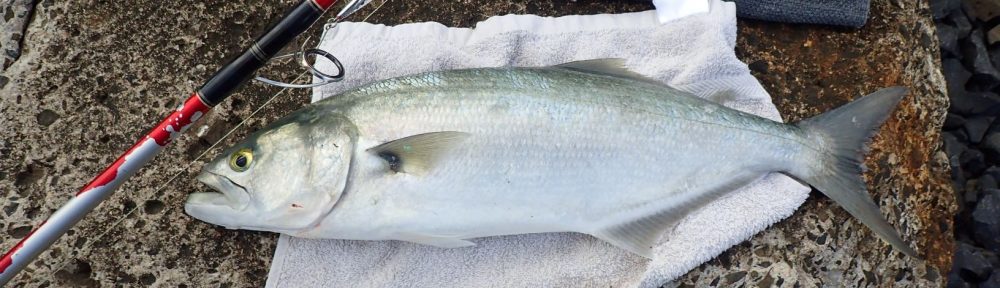
Another local rock fisherman had a couple of Taylor by now – on a slug – so I switched to a 90g slug for a few casts but then lost it to the rocks. Back to the soft plastic lures. This time I tried the same pattern in a more natural colour – sardine. This did not seem to tempt them, so I switched to the brighter lime tiger again. First cast I got a couple of hits and the tail was bitten off. I threw it out in to the surf again and as soon as it hit the water (minus the tail) it was grabbed. Landing the fish is always a challenge here and it is even worse when the swell is up. With a bit of luck and a fairly tight drag setting, I got the fish safely up the rocks. It was a Tailor just on 50cm.
I put a new soft plastic on and cast it straight back out in the same spot. There were plenty of bites and I thought I had a fish on at one point, but then it either let go or wriggled off. I pulled up the jighead with only ½ a inch of soft plastic left on it. I lost another two or three plastics in this way, over the next 20 minutes.
By now it was about 6.30 am. The tide was running out strongly and the brown slick of the Tweed River was gradually spreading out from the mouth. I put another plastic on, this time on a 1 oz jighead. I cast right out in front of the rock wall and again felt a series of knocks and nudges on the retrieve. I kept pausing but I could net connect with a fish. About fifteen minutes later the line finally came up taught and I had another fish on. I played it round to the ocean side of the rock wall and used a surge to get it safely up to my feet. It was a 40cm Big Eye Trevally. The swell gave me a couple of soakings and I lost a few more plastics, so at around 7.00 am I packed my bags and headed back to Brisbane.
With a cyclone passing out to sea, big swells are forecast for the next few days – the weather is not giving us many breaks this year!

Broomes Head Lagoon – Wild & Windy – 21 Sept 2010

This slideshow requires JavaScript.

Tuesday

I am just back from a trip down to Broome’s Head, just south of Yamba, in northern New South Wales. It is typical of the rocky headlands on that stretch of coast. You can fish on either side of the headland depending on the prevailing winds. However last week the weather really made things difficult. On Monday it rained all day while an enormous swell smashed over the rock ledges. I am pretty keen on my fishing but I could not find anywhere I could cast from.

Tuesday was better – well at least the rain had stopped. The seas were still enormous, with a three metre swell. Fortunately the northern side of Broomes Head has a sheltered lagoon. Just on dawn, I waded out into the lagoon and got as close as I could to its mouth. I cast out a 3” GULP Pearl Watermelon minnow soft plastic on a 1/8th 1/0 jighead. I wanted to keep my rig as light as possible to avoid getting snagged on the rocky bottom. I got a couple of touches and saw a few Long Toms following the lure in. After a few more casts, I hooked up with a small Bream – around 25cm. Then a couple of casts later I hooked up to a better fish. When I got him to me, he was a small golden Trevally. I hooked a couple more under-size Bream and a Moses Perch from this position before deciding to try to get closer to the lagoon’s entrance.

At its eastern edge the lagoon is filled through a gap in a long ridge of rocks. Here at the mouth of the lagoon there is some deeper water on either side. The outside of the lagoon entrance was far too rough to fish. But by walking out along the rocky ridge I found a spot from where I could cast into the deeper water just inside the lagoon. I started with the 4” GULP Swimming Mullet soft plastic on a 1/6th 1/0 jighead. I could not really let it settle for more than a few seconds on the retrieve, for fear of losing it to the rocks or kelp beds. I gradually got a feel for where I could stop and start the retrieve and what the sink rate was. After about 30 minutes of peppering the area with casts I caught a very good Bream – just on 35cm. On the next cast I caught another Bream, a bit smaller but also a good fish. Then things went quiet on the fish front and the wind was really howling. I switched to a 3”GULP Minnow soft plastic in the Pearl Watermelon colour and cast it out into the wash at the foot of the rocks. Just as I was about to lift the lure from the water it was grabbed by a big dark shape. The fish took the lure down deep into the kelp at the foot of the rocks and then just sat there. I was only running a 10lb leader so I decided to ease off the pressure and let him swim out of his hiding place. I dropped the rod tip and counted to ten then pulled hard. It worked and I slid a very decent fish up on to the rock ledge at my feet. After giving it the once over, I decided it was a Morwong or Mother-in-law fish of some kind and kept it for the table. I later found out it was a Spotted Hind. It did not taste much good and apparently is quite common down here. I now had plenty of fish for a family supper so I headed off for a hot shower.

Iluka – Woody Head – 11 August 2010

Tuesday was a washout with 24 hours of almost solid rain. Fortunately the tent kept me dry throughout. By the lunchtime low tide on Wednesday, the sky was still overcast but things where brightening up. The ‘Barnacles’ at Woody Head, where I had been fishing the day before, were out of bounds due to the swell. I decided to try fishing the northern side of the Woody Head rock shelf which was a bit more sheltered. I started with the same terminal tackle as the day before – 3/8 3/0 jighead, 25lb fluorocarbon leader and a 4” Pearl Watermelon Minnow. Fishing these spots is always difficult. You need the plastic down in the water column, but leave it too long or weight it too heavily and you will just get snagged. On the first three casts I lost three jigheads to the rocks. This was the price of getting a feel for the swell and terrain. After a few more successful casts I felt a distinct hit but no hook up. Two more casts and just as I was about to jerk the jighead out of the water, at the end of the retrieve – bang! I had a solid fish. It tried to dip down and bury itself in the rocks but fortunately the swell was on my side. I tightened the drag and towed him straight up to my feet with the rising water. I had a nice trevally, about 45cm. I fished on for an hour or so and lost two similar fish to the barnacle covered rock ledges.
I then decided to clean the Trevally in a rock pool. I gutted the fish and started tidying it up when I noticed a splash a few feet away. A decent sized Wobbegong had turned up hoping for a free meal! I retreated, in case he mistook my foot for a fish and made a mental note to check the content of the next rock pool before I start gutting.

Landangler’s Tailor on Soft Plastics

I am sure you have all heard it said a million times – if you want to catch some Tailor you can’t go past a lightly weighted, West Australian Pilchard floating down off the back of the boat or a well place chrome slug cast from the rocks. Don’t get me wrong – it’s sound advice and it definitely will get you some fish, but I thought I would offer my experience of catching Tailor on soft plastic lures.
As you may have worked out, I love to fish with soft plastics and I almost only fish from the shore. So my experience of catching Tailor is based on those parameters. Firstly, most of the time when I get a good (keeper size – 35cm + QLD or 30cm + NSW) ‘chopper’, it is an accident. I am usually not targeting them; they just wallop whatever I am fishing with. I am usually prospecting on some sand flats, beside a bridge or rock wall and suddenly the line starts peeling and the rod starts shaking and I realise that I either have a Flathead on steroids or it’s a Tailor. This usually results in a bite off as I fish pretty light (10 to 12lb leader), but occasionally, if the fish is nicely hooked, I will get it safely to the bank. The plastic is usually pretty smashed up but if I cast it straight back out, I often get another. Then they are gone.
So this year, as the weather cooled, I decided I would actually try to catch some tailor with plastics. The first thing I did was switch to heavier tackle. I decided on a 6000 size spinning reel, loaded with 12lb Fireline down to a 20lb fluorocarbon leader. I also made sure I had the toughest jigheads that I could find, from 1/6th to ½ ounce. Then I thought about my rod. The problem, when choosing a rod for plastics in these circumstances, is the immediate compromise between strength and sensitivity. A ‘medium’ weight estuary spinning rod (something like a 7’6 3-6kg Berkeley Dropshot) gives you a good, sensitive connection to the soft plastic and so you can fish fairly light weight jigheads (1/8 to ¼ ounce) and still cast them out effectively. However if you hook up to a decent fish (in my book that is anything over 2kg) you are really going to struggle, especially if you need to pull it up a rock wall or onto a ledge. The alternative is to go heavier but then, inevitably, you lose a bit of the sensitivity. My ‘heavy’ plastics rod is the 11 Ft 6-15kg Rovex BARIO. This rod still has some feel in the tip but it is strong enough to heave some decent fish up the rocks. The downside is that it is very difficult to fish with much less than a 3/8 ounce jighead, as the rod is really too stiff to feel anything lighter. I have landed plenty of 2 to 5 kg fish with this rod – if you hook up with anything much heavier then you really need a mate with long handled gaff.
Once I had decided on the set up I looked for likely locations. This was tricky as I have caught Tailor from Yamba in Northern NSW right up to 1770 in Queensland, but I have usually caught the bigger ones when chasing jewfish from the rocks.
So my first experimental Tailor plastics session was fishing the end of the rock wall at the mouth of the Tweed River, about a month ago (in mid June). I find that the north side of the north rock wall is a good fishing spot, so I arrived an hour before dawn and found a large flat boulder near the end of the wall. I rigged up the ‘heavy’ rod. So which plastic to choose? Working on the principle that Tailor love Pilchards – I chose the GULP 4” Minnow in Pearl Watermelon – as it looks quite like one. It is basically a dark green on top with silver coloured under body and v shaped tail. It is an excellent all rounder that I often start with it. I rigged it on a 3/8 2/0 jighead. The first few casts – in the dark – produced nothing. Fishing from the rocks in the dark is pretty hit and miss, not to mention dangerous, so I usually wait for the pre-dawn light to see what I am doing. Yes – I have a headlamp but it is pretty easy to spook the fish by shining a few high powered LEDs down at them. Sure enough just as the horizon started to glow I got a couple of solid hits and then a good fish took the plastic right at the foot of the wall, on a fairly quick retrieve. A bit too big for a Bream and a bit too frenetic for a trevally, sure enough it was a good ‘chopper’, probably around 40cm. Once I turned it around, it broke the surface, in the foam, by the rocks, but as soon as I lifted it clear of the water, it started wriggling and wriggled off the jighead. In the space of half an hour, I had four more fish of a similair size. I landed two and lost two in a similair manner to the first. They have very soft mouths and once they are out of the water it is very difficult to stop yourself pulling the hook out. Then all went quiet for about forty minutes and they were back again. They were obviously chasing the bait schools up and down the rock wall. This time round (using the same plastic) I dropped the first fish and was bitten off by the second. By the time I had re-rigged they were gone. I stayed the rest of the morning and caught a few bream but the Tailor did not come back. The plastics had certainly taken a beating – I had to put a new one on after every successful hook up – but it seemed like a reasonable trade off.
The next trip was down to Iluka Bluff in Northern New South Wales. I had a couple of days there but due to the weather I could only manage two fishing sessions – the morning and evening of the first day. Conditions on that morning were perfect with only a light swell and virtually no wind. The Bluff is a large flat ledge at the end of a headland and there are tailor here all year round although they improve in size and numbers in the cooler months. Again I arrived in position pre-dawn on the southern side of the Bluff. I started with the same rig except I ran a 40lb leader and switched to the same shaped plastic in the Pumpkinseed colour. About 30 mins after dawn I was bitten off, then after re-rigging, I landed a nice 50cm Tailor and dropped two more in quick succession. Things slowed for an hour or so and then I down sized to a twenty pound leader. Third cast with the lighter leader and I was onto a decent fish which rubbed me off, but after a quick re-rig I got another 45cm fish which I landed. Downsizing the leader as the sun gets higher in the sky often works for me in this way, as does matching the size of the plastic, as closely as possible, to the bait that’s already in the water.
That evening the wind was up and so was the swell. Again the fish appeared to come on and off every 20 to 30 minutes. It certainly seemed like they were cruising up and down in front of the headland, chasing the bait. Each time they came by I would get a couple of knocks and nudges and sometimes a hook up. I like to use a pretty standard retrieve – it is always a tricky balance between getting the fairly heavy jigheads (3/8 ounce) down low in the water column and not getting snagged on the bottom. I usually cast out and count slowly to ten. On ten, I jerk the rod tip up, and pause while the plastic sinks again. Then I wind in some line and repeat the process. Finally, just on dusk I got the best fish of the trip – a 65cm Tailor and fortunately the rising swell more or less landed it for me, by washing it up over a ledge right at my feet. This time I had switched to the 5” Jerkshad plastic also in the pumpkinseed colour.
Although two trips hardly make a definitive study, I have had many rock fishing sessions which have produced Tailor on soft plastic lures and I think I can draw the following key conclusions.
There are a few disadvantages to using plastics. Firstly, they are expensive – the Tailor destroy them and you will rarely get two fish out of one plastic, often they will get munched before you even get a fish to the shore. Secondly, you certainly cannot cast them as far as a heavily weighted bait or slug. Thirdly, jigheads often do not hook up as solidly as a treble right in the mouth – so slugs can make it easy to lift the fish to safety without pulling the hook.
However, the single biggest advantage of using soft plastics for Tailor is the ability to fish a moving lure through the lower part of the water column, more consistently, than you could a bait or a slug. You simply cannot move bait along the bottom with the action of a plastic and a slug is almost always on an upward trajectory once it gets up to speed. So if the fish are travelling along, or close to the bottom, I think you will get more hooks ups with a soft plastic, than with a slug or bait. Of course, if they are feeding on the surface they will still take the plastic on the drop, but maybe they will be more interested in a surface popper, fast moving slug or lightly weighted pilchard.
Of course, none of the above applies in the weeks that lead up to spawning off Fraser Island. If you can locate the fish at that time – they are usually so thick and so competitive that you can catch them with almost any type of bait, lure or even an old sock!
I hope you found this useful and, as always I would welcome any comments – questions or experiences that you may wish to share.
Bribie Island – Buckleys Hole – 15 July 2010

Thursday morning – I got up at 4.15 am and drove from Brisbane up to Bribie looking forward to a good fishing session. Low tide would be around 6.40 am and although the forecast was for moderate West to Southwest wind, it was pretty flat when I arrived.

I decided to start off under the Bridge lights on the island side. I find the bridge lights attract the bait and there is often something waiting to pounce on your lure/ bait from the dark water around the pylons. I loaded a 1/6th ounce, 1/0 jighead with Gulp 3” minnow soft plastic in the pearl watermelon colour and sure enough, first cast I pulled up a Pike and next cast 15cm Tailor. I moved up and down the weed banks, along the edge of the Passage, on either side of the bridge. After about half an hour I picked up a 45cm Flathead about 15 metres north of the bridge., right on the edge of the weed.

The first glow of dawn was showing so I decided to move down to the mouth of the tidal lagoon in front of Buckley’s Hole. This is an excellent Bream spot especially when they are schooling up to spawn. Using the same plastic and weight I cast up into the last of the run out tide and let it sink down along the coffee rock ledge – jigging every 5 seconds or so. After a few casts I caught an undersized Bream, followed by a few Pike and gradually I started to catch a few keeper Bream. Every third fish or so, was legal and after an hour I had 5 keepers between 25cm and 30cm.

At about 8.30am I called it quits and went to find a hot drink.

PASSAGE BREAM ARE BEGINNING TO FIRE
BREAM FROM BUCKLEY’S HOLE – BRIBIE ISLAND

Bribie Island – White Patch – 9 July 2010

It was hard to get out of bed at 4.15 am yesterday but I managed it – just. The outside temp was not too bad but as I put on my waders and wandered out under the Bribie Bridge but I noticed how much the water temp has dropped in the last couple of weeks. I usually find this is good news for estuary fishos like me.  Just before dawn I cast around under the bridge, on either side, but only manage a few pike on the Gulp Shrimp (2 inch Banana Prawn). There was plenty of evidence of school holidays with an abandoned cast net, plenty of terminal tackle with 50kg + breaking strain line, sinkers and enormous hooks stuck in the weed and shallow snags. Maybe they were trying for a Dugong!!

I sat out a rain shower and then moved up to White Patch. My first cast produced a tiny Flathead followed by more Pike. I walked up and down the flats flicking various plastics around. I generally target the sandy patches in between the weed. As the plastic comes over the edge of the weed that is when you get the dull thud of the Flathead attack – I then try to count to five (to let the fish get a good mouthful) then strike. The tide was running out and floating weed made things a bit tricky but after covering a bit of ground I got two keepers around 45cm.

As the tide got low enough I fished out over the coffee rock ledge and got a couple more Pike and then a solid hit and run that turned out to be a Trevally – I was using a 10lb leader,  1/6th 2/0 jighead and a 3” Gulp Minnow in Pearl Watermelon. I moved up and down the ledge and after a quiet period the tide started to run out  a bit faster and I caught a couple of undersize Snapper on the same rig. I am yet to find a keeper Snapper from the shore this season – but it will happen.

Miserable weather but reasonable fishing and I caught enough to feed the family!!

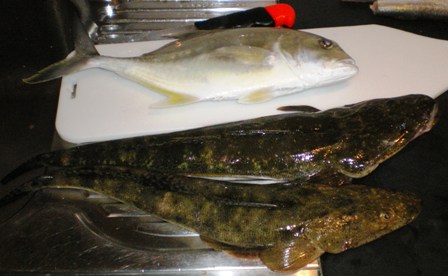
FLATHEAD & TREVALLY

BRIBIE FLATHEAD & TREVALLY

Fishing From the Shore in Queensland and New South Wales

Hello – I am Landangler AKA the Mullet Musketeer – so named because my early attempts at casting were closer to fencing than fishing. I love to fish the estuaries, rocks, beaches and bays of the beautiful Queensland and New South Wales coasts. This is my blog where I will post fishing reports  from time to time. Hopefully my experiences will enable you to learn about great fishing spots and techniques and also quench your thirst for fishy tales when it feels like a long time until the next trip.