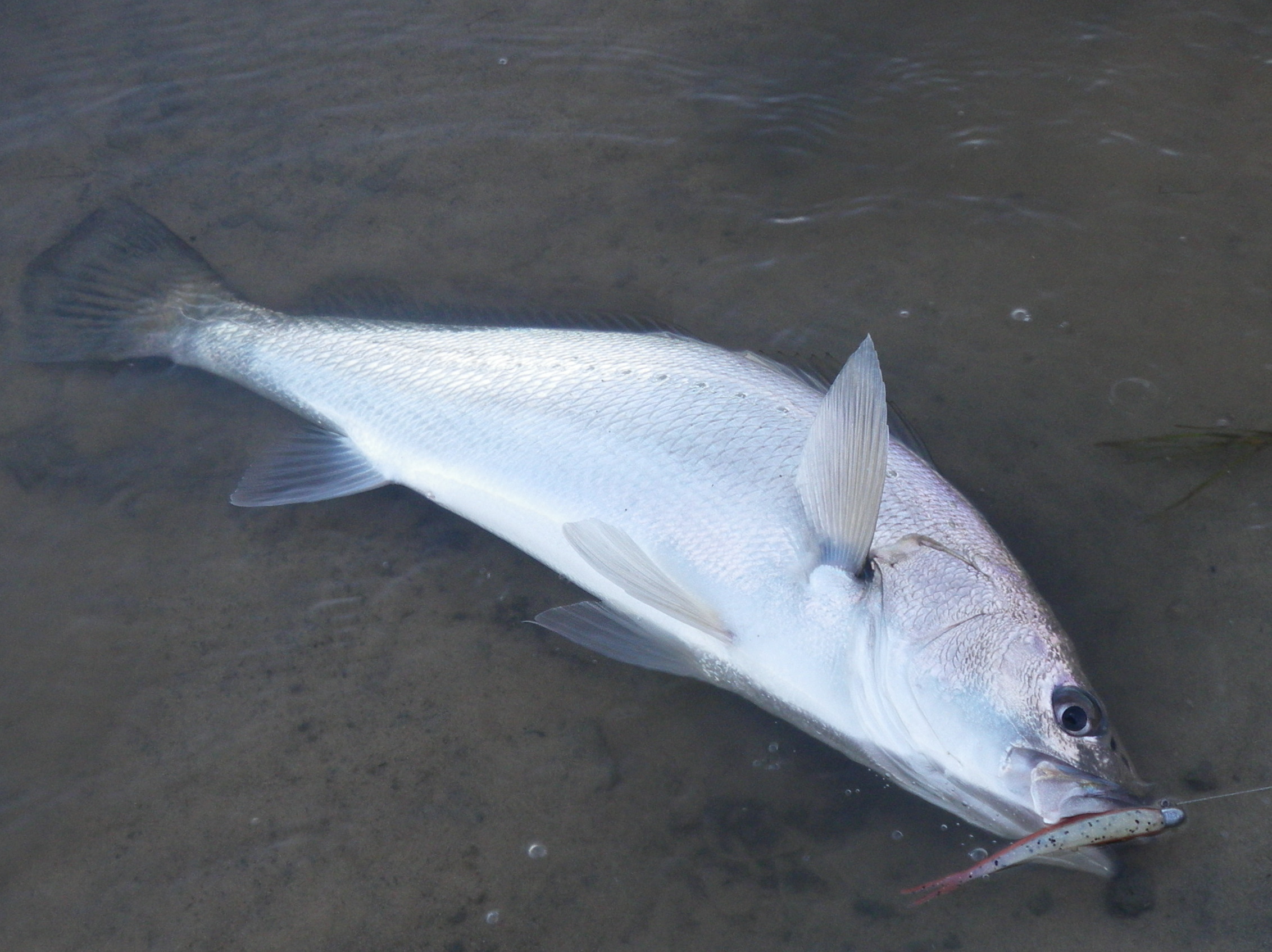
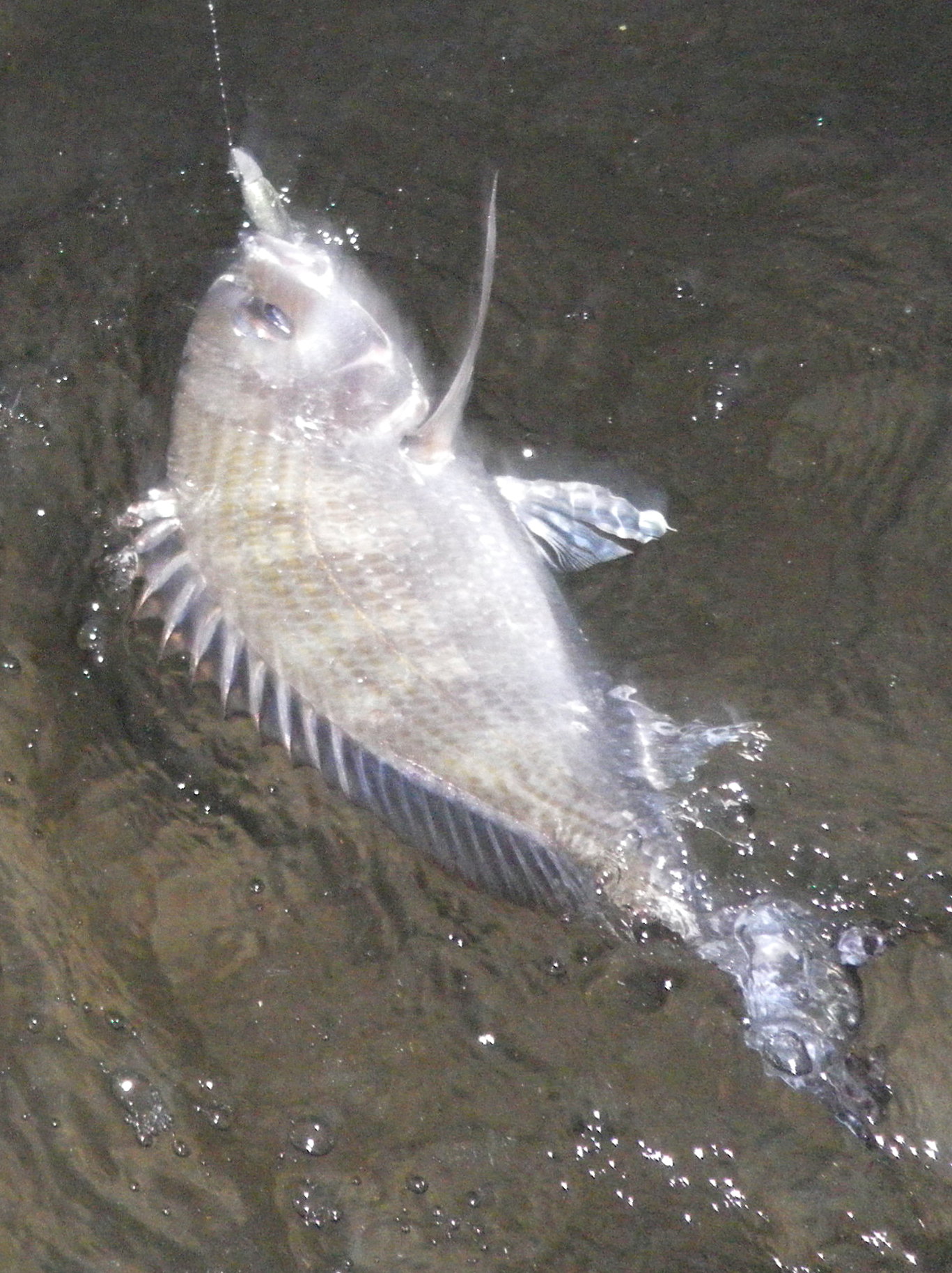
Bribie – the oyster jetty flats – 10 March 2013

Monday

I managed to stay away for Sunday, but by Monday the fish were calling again. It’s very hard to resist going back when you have had some great sessions. Fish don’t generally school up in one spot forever, so having found the Flathead, on the flats opposite Bribie Island – I wanted to make the most of it.

The productive spots I have been fishing can only be reached during the lower half of the tide.  This meant I had the luxury of starting fishing a bit later than usual. The wind was going to be a solid 10-15 knot south-easterly, and low tide would 0.9 m at 11.21 am, at Bongaree. I arrived on the mainland side of the Bribie Island Bridge at about 9.15 am.

I waded out to the old oyster jetty. The wind was blowing hard and it was quite cloudy. The area just to the south of the jetty is sheltered from the full thrust of the wind so this was where I started. To locate the fish, I decided to prospect with a GULP Jerkshad in the Cajun Chicken colour. I upped my leader to about a 1.5m length of 12lb fluorocarbon.  The 10lb leader is usually adequate, but I had had such a good catch rate in recent sessions that It was getting worn too quickly.

Once again I soon found the fish. I caught the first flathead at 9.24 am – it was about 50 cm and then another, about the same size, a few minutes later. The wind was creating quite a chop now and it was still a little too deep to reach the ideal target area – along the edge of the weed beds. I waded a little further south to the mouth of the drain that runs off the flats, in front of Sandstone Point.

When I first started fishing about 12 years ago, I went out with a guide on the Noosa River. This was the first time I had used lures.  One of the lures we used was the RIO Prawn. This lure is a very lifelike resin imitation of the typical Noosa river system prawn. It is Australian made, near Noosa. The guide positioned us over some likely looking hollows and weed beds and cast the lure out, into one of the sandy bottomed areas. He let it sink, raised it up in a long fluid movement then let it sink back down, to the sand. He counted to ten then repeated the process. He did this perhaps three times before the lure pulled up a flathead. I then had a go and managed to catch one, as well. I, like the fish was hooked!

I have caught plenty of fish on RIO lures since, but I rarely use them at Bribie – because of the weedy and rocky bottom. Today I decided I would give them an outing. I chose the 13 gram size RIO Prawn in the red colour. The water was clear and I could see the sandy patches. I repeated the process that I had been taught all those years ago and after a few tries, I was on to a fish. The first was a small Flathead about 45cm. On the next cast I caught another and on the third, I hooked up to another. The RIO Prawn caught about five more flathead over the next 30 minutes. Then I lost it to a 60cm + fish. The leader must have been damaged in some of the previous fights and it snapped just as I was walking the fish to shore.

Next I went down in size to the small DUO Tetraworks Bivi – a sinking bibless vibe lure, in a black /rainbow colour. This small vibe is always good for Flathead. It casts a long way and quickly falls into a tight action. The only problem with these smaller vibes is stopping the fish from swallowing them. This one also produced on its first cast. The fish were clearly not fussy today. I swapped again, this time to the DUO Koikakko tiny squid imitation. Once again this tiny lure caught the biggest fish of the day – a 63 cm flathead.

As we reached the bottom of the tide I pulled out another Charles Talmans soft plastics, which I called a ‘prong’. It is a split tail in a clear/ white colour. It is quite a chunky plastic so I put it on a 1/8th ounce 2/0 jighead and cast it out. After a few casts the fish found it and it pulled in another three or four fish to end the session. If you want to know more about Charles’ plastics drop him an email on ctalman@hotmail.com.

With the wind howling at noon, I walked back to the car. Another great session fishing the flats at Bribie.

Bribie – the old oyster jetty flats – 8 March 2014

Saturday

After an extraordinary session on Friday, I had to get back up to Bribie again to fish the low tide. Fortunately, I could squeeze in a session on Saturday morning. The wind was forecast to be pretty lively again, with a couple of tropical cyclones hovering off the coast, up north. Low tide would be at 8.40 am. The moon was a week away from full.

I arrived just after first light at about 5.30 am. I ran into Matt, another keen fisho who had had the same idea. We walked out towards the old oyster jetty and swapped a few fishing stories. He headed south along the sandbank towards the channel marker and I settled on a spot just to the south of the jetty.

It took a while to find the fish. The sun came over the horizon and the wind started to pick up. The tide was running out quickly. I started by fishing with a GULP Jerkshad in the Satay Chicken on a 1/8th 2/0 jighead. I was using my G.Loomis TJR fast action, light spin rod and a 15lb Super PE braid and 10lb fluorocarbon leader. At about 6.20 am I dropped a small flathead, but on the next cast, I felt the bite and paused. When I lifted, the fish was attached.

Now I had found the fish and I caught a fish on almost every cast for the next 30 minutes.  A hot bite is a great time to experiment. A gent named Charles Talman from Mount Gambier in South Australia makes his own soft plastics and recently was kind enough to send me some to try out. There were plenty of prawns jumping so I decided to start by rigging up one of his 4” Shrimp soft plastics. These plastics do not quite have the finesse of the major brands, but as you will see from the pictures, they are cleverly designed and have good actions and texture – both essential characteristics. I rigged the first one on a 1/8th ounce, 2/0 jighead and cast it out. I knew the fish were here but I wasn’t sure they would go for it. There was no need to worry – half way into the retrieve a fish hit it. I dropped the rod tip and paused. About five seconds later, I struck and I pulled up a flathead, about 45cm long. A few casts later, I caught another. Over the next hour, they kept coming. I cycled through a couple more of Charles’ lures and then put in a GULP 4” Shrimp in the Natural colour. There was no difference in the catch rate between the two types of shrimp soft plastic.

I now decided to try the DUO Tetraworks Koikakko tiny hard bodied squid imitations. These are made with the usual DUO care and attention to detail. They can be used in deep water as a jig or hopped across the bottom like a traditional sinking hard body. They are only 34mm long and weigh 4.6g. They are ideal to cast across the flats in crystal clear water, on light leaders and will tempt almost any species.  I knew there had been a lot of small squid around this area so I thought they would be perfect. My only concern was that perhaps they would be too small for the flathead to notice. I checked my knots and decided to slow everything down and increase the pauses on the bottom.

Success was not immediate, but after about 15 minutes I saw a flathead come up behind the lure and then turn away at the last minute. I cast back in the same spot and left the lure on the bottom for about 20 seconds. On the second hop, I felt the violent thud of a flathead mouth crunch down on my lure. The fish took the lure and slowly swam away with it. It took a while for it to register that this was not an ordinary squid and when I lifted the rod tip to ensure the tiny treble was lodged, it took off.

It was obviously bigger than the small flathead that had swiped at the lure on the previous retrieve and it made couple of blistering runs out towards open water. You cannot muscle a fish with the fast and flexible G.Loomis TJR rod. It absorbs the lunges beautifully but you have to be patient and let the reel’s drag do the rest. I have traded up the single tiny treble hook on the DUO Tetraworks Koikakko for a slightly tougher Gamakatsu version. I waded back to the shoreline with the fish. It was tired now, but as we reached the shallows, it continued to try and turn and then shake its head. I pulled it across the weed in the shallows and on to the sandbank. It was the biggest fish of the day – a 68cm flathead. I released this one and carried on fishing.

The Koikakko lure caught plenty more flathead and its tiny size did not seem to have much bearing on the size of fish it attracted.  By low tide I had five good fish in the keeper bag – all between 50 cm. and 60cm.

By 9.00 am, the wind was howling and making it pretty hard to fish. I decided to finish the session with a couple more of Mr Talman’s soft plastics. I particularly like his small, three legged monster – not sure what it is but the flathead love it. I lost the green version to a fish that wrapped itself around an abandoned crab pot.  Fortunately, there was also a fluorescent gold/creamy coloured one, so I re-rigged with this. The flathead could not resist and I caught about 5 more, all good sized fish, on this soft plastic lure. I finished up with a 5” worm in a green colour. This also delivered and after a few casts it connected with a 50cm flathead.


I am not really sure why the fish have suddenly appeared but I hope they hang around for a while. I’ll be back.

Bribie – The old oyster jetty flats – 7 March 2014

Friday

On Friday the wind situation was not promising with a 10-15 knot easterly forecast for mid – morning.  But it has been a long time since I wet a line so I had to go for it and I was very glad that I did.

I have been struggling to wake up recently and I managed to sleep through the 4.00 am alarm. I woke at about 4.45 am and rushed up to Bribie, arriving just after 5.30 am.  It was very cloudy and I passed through a few showers on my way up from Brisbane.  They had cleared by the time I reached the Bribie Bridge. I pulled on my waders and walked out under the bridge towards the old oyster jetty. There was plenty of light but the sun had not yet come over the horizon. The wind was much lighter than forecast – as it often is, for the hour either side of first light.

Low tide would be a fairly high low at 0.8 m, at 7.40 am. The moon was about half way to full. I waded out to the south of the old oyster jetty and loaded up the light spin rod with a GULP Jerkshad on a 1/8th ounce, 1/0 jighead. I was using a 10lb fluorocarbon leader. It was now just before 6.00 am.

On the first cast, I felt the lure drag a little and I thought it was stuck in the weed. I yanked the rod tip up to free it and a small angry flathead (about 35cm long) came flying out of the water towards me. It managed to catapult itself off the jighead so I did not have to release it. The next cast produced another bite but no hook up. On the third cast, I paused and connected with a fish, as soon as I lifted the plastic off the bottom. This was a decent sized flathead so I decided to wade with the fish, back to the beach. It turned out to be about 55cm.

At this point I realised I did not have my camera. This was a shame because it turned into an extraordinary session. I was joined by Lee – another keen plastics fisherman. We had a chat and as we were talking and casting, we realised this was going to be one of those fantastic fishing sessions. Almost every cast produced a fish and the majority of those fish were between 45cm and 55cm long.

As the sun rose and the wind picked up the fish carried on biting and even the tide change did not seem to slow them down. I swapped through various Gulp soft plastics – Minnows, Jerkshads and Shrimps, which all caught fish. I put on a Z Man Minnowz with a paddle tail and this caught a few.  Lee was fishing with a Gulp minnow grub in the Banana Prawn colour that was catching a fish on almost every cast.

I decided to experiment with some hard bodies. I started with the DUO Realis Shad 59 MR suspending minnow. This caught a couple of nice flathead but their violent head shakes soon reduced the small trebles to one remaining hook. I took it off and decided to test just how hungry these fish were. I tied on a MARIA MJ Twitch 90mm Suspending hard body. This is a great lure but I would generally consider it a bit of a mouthful for flathead. It has a great action but usually gets clogged in the weed before a fish gets to it. Not today – I cast it into the strike zone and after a couple of twitches, a flathead smashed it. It was a decent fish and the trebles struck home. I waded back to the shore with it and pulled out the trebles. It was about 65cm and one of the best fish of the day.

It was now low tide and the weed was everywhere so I swapped back to soft plastics. Every size and colour caught fish. Lee was equally successful. In three hours, between us we must have caught upwards of 60 flathead. We kept five each and released the rest.

It is difficult to know what fired them up or how long they have been there. There were lots of small squid and prawns around, but no massive bait schools. The terrain of sandy hollows and weed beds is ideal flathead country but I don’t ever remember a session were the fish were so easy to catch. Something must have drawn the fish to this area but it is not immediately obvious what.

At about 9.00 am I decided to take my catch home and Lee also gave up. We are in for some wild weather over the weekend. Let’s hope it does not blow the fish away.

Bribie Island – Whitepatch – 13 February 2014

Thursday

I am afraid this post relates to a fishing session which is now almost three weeks old. My apologies but for the sake of keeping my fishing diary up to date, I will summarize what happened.


I decided to fish at Whitepatch on Bribie Island, low tide had passed at about 2.45 am and it would be a fairly big run in tide. There was a very light south-easterly wind blowing when I arrived, just after 5.30 am.  I parked by the stairs and waded out towards the drop off. I stopped to pepper the area of weed beds just in front of the ledge. I started with a GULP Jerkshad in the Orange Tiger colour. The first few retrieves were grabbed at by something….moses perch, pike, maybe.

I persisted and after about fifteen minutes I found a small flathead. I released it and carried on fishing. Fish kept hitting the big plastic but I was not hooking them. The tide was getting higher and it was now difficult to cast over the edge of the drop off. I swapped down to a smaller GULP 3” Minnow in the Peppered Prawn colour. This did the trick and I soon caught a few small yellowfin pike.

As the tide came up I waded further south. I kept casting and soon started to catch a few small moses perch. They gradually got bigger but none were bigger than the legal size of 25cm. I swapped through a few different small soft plastics and caught more moses perch and a few tiny whiting.

I put on a GULP jerkshad again, in the Satay Chicken colour and turned to wade back to the car. It was now about 8.30 am and heading for high tide. As I waded to the north I cast in front of me. After a few attempts this method produced the best fish of the day – a 46cm flathead.

After this I gave up. I had caught plenty of fish but only one would have been big enough to keep. Despite the lack of dinner it had been an interesting fishing session.

Bribie Island – the oyster jetty flats and White Patch – 10 February 2014

Monday

The wind was dropping gradually so I decided to try Bribie Island again, on Monday. As regular readers will have spotted, I find fishing the incoming and high tides much harder around Bribie. On Monday high tide was at 6.36 am. The wind was forecast to get up to about a 10 knot south-easterly by mid-morning.

I was stuck for inspiration on where to fish, so I opted for the flats either side of the old oyster jetty, to start off with. I arrived just after 5.00 am and the wind had dropped off. I started to the south of the bridge and almost immediately caught a tiny (25cm) flathead on a GULP 3” Minnow soft plastic, in the Watermelon Pearl colour. I released it and was treated to a magnificent sunrise. I waded along the edge of the mangroves until I reached the jetty, casting in all directions. Just passed the jetty, I saw a flathead take off from the shallows just in front of me. I stopped and started casting around in a broad arc, starting parallel with the mangrove roots and gradually turning out into deeper water.

There are a lot of rocks on the bottom in this area, so I kept the soft plastic moving fairly quickly. At about 6.10 am, I caught a small flathead that was just about legal size. I let it go feeling confident that I would find something bigger. However, despite trying numerous spots and lots of different plastics, I fished right up to the high tide and through it, without any luck.

As the water slackened off I went for coffee and thought about where to try next. I drove up to White Patch to have a look around. It was now about 8.30 am and the tide was slowly picking up pace on the run out. I drove all the way to the northern most beach access and walked out between the mangroves. This access leads out on to a large area of shallow featureless sand, which is only really deep enough to fish on the bigger high tides.

There are a few weed clumps and depressions and I cast all around these in search of fish. I saw a flathead follow the plastic and then dart away, when it saw me. I moved further south until I reached the area where the weed clumps are thicker and the floor slopes away in to the main channel. I decided to swap up to a bigger, brighter soft plastic as I had not had much luck with the natural coloured minnow that I was using. I loaded a GULP Crazylegs Jerkshad in the Lime Tiger colour on to the jighead and started putting in some long casts, right out to the edge of the channel.

At about 9.30 am I felt a very solid hit and then line started peeling. The fish must have been sitting just beyond the drop off and had struck as the soft plastic swam over it. I felt the leader pulling on the edge of something, so I loosened the drag a little and let the fish take line. It made a couple of big runs and then started to swim back towards me. I took up the slack and kept winding. It was now clear of the drop off and coming into the shallows. It was a big flathead – between about 65 and 75cm long. I never got to measure it. I took my camera out to get a few shots and as I did so it wriggled off the hook and slowly swam away.

That was it, after a few more casts I called time on a fairly frustrating morning of fishing.  I looked back at the blog when I got home and realised I have lost a lot of big fish in this area. I will definitely be back.

Bribie – the oyster jetty flats – 3 February 2014

Monday

By Monday the weather looked more promising for a fish at Bribie. A few showers but the wind would drop to about a 10 knot south-easterly, early in the morning. Low tide would be just after 5.30 am, with first light at about 5.00 am.

I decided to fish on the flats around the old oyster jetty on the mainland side of the Pumicestone Passage. If the flathead are around, this is usually where they are easiest to find. It rained for almost the whole journey up from Brisbane but it was not very heavy. I waded out into the shallows, under the bridge at about 5.00 am. The tide was still running out but slowing down quickly. I left the area under the bridge alone as I wanted to reach the jetty while the water was still running out.

I was fishing my light rig – G.Loomis TSR series light spin rod, Shimano Stella 2500, 15lb Super PE braid and the new Gamma 10lb fluorocarbon leader. I started with a soft plastic lure – the GULP Jerkshad in the Watermelon Pearl colour.  The wind was negligible so I dropped down to a 1/8th ounce, 1/0 jighead. This would hop over the weed on the shallows, if moved fairly quickly.

It was light enough to see but the sun was not yet up. I was covering the area just south of the jetty with casts. After a few minutes I caught the first flathead, lying in wait, behind a clump of weed. It was a little over 45cm. It destroyed the Jerkshad and I did not have another, so I put on a smaller, 3 inch minnow in the same colour. I cast at the same spot and instantly hooked up again. The smaller plastic had produced a bigger fish – this one was about 55cm long.

I carried on prospecting around the rocky bits of reef and weed clumps that dot this area. I connected with something that turned out to be some abandoned braid. I decided to wind it up. It was probably 50 lb breaking strain and there was plenty of it. I waded up and down, pulling it off the rocks and as it loosened, I could feel something moving in the end of the line. I eventually reached the leader that was also pretty substantial – perhaps 60 lb+ breaking strain. Then I saw the source of movement; two mud crabs – one large, one small, were completely tangled up, but both wriggling.  I took a few pics and gradually untangled them. One looked big enough for dinner but I am not an experienced crabber – so I could not tell if it was male or female. I was also fairly unsure as to how I would grab it! I cut the last bit of line off and they both slipped away. I wound up the remaining leader and found a very substantial – size 8/0 hook on the end of it.

The sun came over the horizon and the run out tide fizzled out. I moved further south. I kept swapping colours and sizes of soft plastic and caught flathead on the GULP Minnow, Shrimp and Jerkshad shapes. The Watermelon Pearl, New Penny, Lime Tiger, Satay and Cajun Chicken colours all worked. I caught six more fish along the stretch of weed beds that run from the end of the jetty to the green channel marker. They were all between about 35cm and 45cm long.

As the tide turned in I waded back towards the bridge and swapped to my favourite DUO Realis Shad 59MR – suspending hard bodied lure. The loose weed now lifted by the run in tide made fishing with the hard body a bit frustrating. I had a few grabs and snatches which I suspect were Bream or Pike, but I did not catch anything.

At about 8.45 am I could no longer reach the area I wanted to castat and the wind had built up to 20 knots, so I gave up for the day. It looks like a few days of solid south-easterly winds have brought the fish back on the bite.

Bribie Island – Bongaree & the oyster jetty flats – 31 January 2014

Friday

I have been away for most of January. I was on a holiday that did not include any fishing – a complete waste of time and money, in my opinion. But the family seemed to enjoy it.

I was therefore dead keen to get back amongst the fish. Unfortunately my return coincided with the weather turning pretty wild. There was the tropical cyclone crossing the coast further north and the wind had been blowing fairly solidly from the east or south east, all week. The change from persistent northerlies also meant the temperature had dropped a bit.

Conditions at Bribie Island did not look great on Friday. There would be a 10 to 15 knot easterly wind and there would be a very low 0.2m tide at 3.17 am. First light would be at about 4.55 am, but it was new moon. The tide would be running in fast, at dawn, but I would be able to reach my favourite spots for about an hour.

I set off from Brisbane at 4.00 am and arrived at Bongaree, outside the Seaside Museum, just before 5.00 am. The place is currently a building site. The council has finally decided to properly rebuild the seawall on either side of the museum drain. They have completed the work on the north side and are currently working on the south side. The stepped sea wall will probably change the way the currents and sandbanks form, at the mouth of the drain. This should give us some new and interesting fishing opportunities.

At 5.00 am all was quiet. The tide had turned in and I arrived during the first of many light showers that continued through the morning. I started fishing with a GULP 5” Jerkshad soft plastic in the Watermelon Pearl colour on a 1/8thounce, 1/0 jighead. I tied it on to some new Gamma 10lb fluorocarbon leader. I popped in to see Nigel from http://www.gatewaybaitandtackle.com.au  a few weeks ago and he suggested I give it a try. It seems like a great leader and almost as important it comes in a great little dispenser. It feels like it is probably tougher than the rated 10lb – I was hoping to give it a good work out and find out.

It was gloomy and I edged my way towards the drop off that runs along this section of beach. The sand banks are always moving around in this location, so I usually poke the ground in front of me with my rod. I have seen more than one keen angler wade boldly over the edge and filled my own waders, a few times.

I found the edge and cast over it. I got a couple of hits on the first cast. A few casts later, I caught a tiny moses perch and then another. I caught about 6 of these on various plastics and also found a ‘Happy Moment’. I moved up and down the ledge for about an hour.

I tried swapping to a small MARIA MS 1 D45 SP hard bodied lure. This is a 3.4g, 45mm, suspending deep diving minnow. It is very light but will get down to about 1 metre, very quickly. As with many of the lures still made in Japan, it is beautifully crafted. I was using an olive green colour. The moses perch and whiting kept attacking it but I did not hook any. I covered the same ground that I had with the soft plastics but did not catch anything.

The incoming tide had pushed me a long way back from the edge and another, heavier shower had started up so I decided to swap locations. I crossed back over the bridge and waded out to the south, under the bridge. The water was already up around the mangrove roots along the shore and coming in fast. It was now just before 7.30 a.m. I waded along the edge of the mangroves, past the old oyster jetty to the drain, which runs around the corner from Sandstone Point. The easterly wind was now picking up and the water was getting choppy.

I was back using the soft plastic lures and had tried a GULP 2” Shrimp in the New Penny colour with no luck. I swapped up to a heavier, 1/6th ounce, 1/0 jighead as the wind, swell and current made it too difficult to fish a 1/8th ounce. I also swapped over to a GULP 4” Minnow in the grey/ black and white Smelt colour.


The tide was getting higher and so was the wind and there were not really many places to cast from. I was about to give up when I felt a touch on a slow retrieve. I cast back in approximately the same location and let the lure sink, until I was sure it was on the bottom. I waited about 15 seconds then hopped it off the floor and I felt a solid bite. I dropped the rod tip again and then paused. Then I struck. The rod tip bent over and a little line peeled away and then the tip started wriggling. I finally had a fish.

The current helped the fish and it took a bit of line. I looked for a gap in the mangroves, behind me. The tide had come up and there were not many options. I let the fish play itself out in the open water and then slowly pulled it towards the shore. The big tide and wind had created a floating carpet of loose weed, about a metre deep at the foot of the mangroves. I managed to skid the fish over the top of it and find some firm ground.

It was a fine example of the dusky flathead species, about 50 cm long. It had been hard won and would make a perfect lunch. It was good to be back in business.

Bribie – the old oyster jetty shark adventure – 02 January 2014

Thursday

After a short break from fishing over Christmas and far too many mince pies and hangovers, I was anxious to clear my head and wet a line.

Some big blows were forecast but the best weather looked like Thursday morning. I did not have much time, so I decided I would carry on at Bribie, on the flats around the old oyster jetty, on the mainland side of the Pumicestone Passage.

The new moon had arrived on Wednesday. As a result we are in the middle of some very big daytime high tides which provide advantages and disadvantages. On the positive side, my experience suggests the fish feed more confidently when there is good tidal flow. Also, as a land-based fisherman you get to examine more of the terrain you regularly fish, as more of it is exposed on the really low tides that follow/ precede the big highs. On the negative side, the water and the fish move very quickly, so you often can only fish safely in one spot, for about 30 minutes. The big flows also lift a lot of sediment, weed and other debris – which can make the water very cloudy.

I walked out to the water’s edge, under the Bribie Bridge, in the dark, at about 4.15 am. Low tide had passed at about 3.30 am and there water was fairly still. There was not much weed floating around so I decided to fish with the DUO Realis Shad 59 MR. As I have mentioned, I have tried a few alternative,  small hard-bodied lures but I keep coming back to this one. It is a shallow running, suspending bibbed minnow, I was using the bronze colour and even on the first cast, the small moses perch attacked it. I was standing ankle deep in the water, casting into the shadows around the bridge pylons. On the next couple of cast the nudges and bumps from small fish continued. I think the rattle in this lure really gets them fired up.

After about 10 more casts I waded out a bit further, to about waist deep and put in a long one to the north of the bridge. As the lure hit the water I gave it a couple of pulls to get it running below the surface. Then there was a slight feeling of tension and it was gone. I wound in to find the leader cut cleanly by something.

I was fishing with only 10lb fluorocarbon leader, so I upped it to 14lb, the heaviest I had, and tied on a GULP soft plastic jerkshad on a 1/8th ounce, 1/0 jighead in the Lime Tiger colour. I lobbed this out to approximately the same spot and on my second cast, the same thing happened. I re-rigged and it happened again. There was something toothy out there so I backed up a little.

The sun was now peeping over the horizon and the tide was running in, fast. I decided to move quickly to the south of the old oyster jetty and look for some fish. Just after first light I caught a 40cm flathead on the GULP Lime Tiger jerkshad soft plastic. At this point, I realised I had my camera but I had forgotten to put the battery back in.

I moved further south, casting in to the incoming tide. There was now a lot of weed around and it was hot and still. The water was very murky. As the birds flew over the shallows they spooked some big bait schools. For an hour I swapped soft plastics and fished along the edge of the sand banks, but I could not get a bite. At about 5.30 am, I noticed a bit of movement in the water about 30 metres to the south, in the shallows. I thought I saw a few fins but assumed they were just the tips of rays’ wings which you often see in this area.

By 6.00 am I still had not had a bite. The tide was now running in quickly and I was standing about 3 metres from the edge of the long weed bank that runs along this part of the flats. At the edge of the weed there is a sloped sandy drop off. The water beyond the drop off is only a couple of metres deep but this is where the bait tends to school up.

As I stopped to swap plastics again, a fin broke the surface just a few metres in front of me. At first I thought it was a dolphin, but then I saw the tail fin and realised it was a decent sized bull shark, moving very slowly along the edge of the bank. I immediately started slowly wading backwards from the edge. It was followed by another shark, a couple of metres behind that was also swimming with its fins above the surface.

After covering a few metres I looked back and to my disappointment I realised that the tide had been coming in so fast that I now had a good 30 metres of waist deep water to walk through, before I could reach the safety of the sand bank. I waded as fast as I dared and as you can imagine, I covered the ground pretty quickly.

From the safety of the sand bank, I counted at least 8 fins – so perhaps four sharks – in the group. I expect there were a few more.  On reflection it is difficult to work out how big, but they were certainly all over 2 metres and the first one that I saw quite clearly would have been 2.5 + metres long. I knew there was plenty of bait around but they did not seem to be hunting. They just cruised slowly up and down the edge of the banks and the fins would only break the surface when the water got too shallow. They stayed over the sandy areas and did not seem to venture up over the weed beds. I watched them for 30 mins and decided I would leave that area to them.

I waded back to towards the bridge and stopped under it to have a few casts in the shallows. I was now fishing with a GULP 2” Shrimp soft plastic on the Banana Prawn colour, on a 1/8th ounce, size 1 hook jighead. I was back down to 10lb fluorocarbon leader. I was about ankle deep in the water (I was reluctant to go any further – for obvious reasons). I was standing to the north of the bridge and I cast close to the pylons and hopped the shrimp back to me, across the rubble on the bottom. As the lure hopped over a sandy patch, no more than 20 cm deep, there was a big surge and something grabbed it and turned away.


The tide was running fast across these shallows and the fish drifted with it for a few metres. I then lifted my rod tip and set the hook. It carried on drifting for a few moments and then it took off towards Caloundra. The rod tip bent over and the reel started screaming.  There was rubble on one side, mangroves on the other and the barnacle covered bridge pylons in the middle (and probably a selection of sharks, further out). I walked north with the fish, away from the bridge and let it take line. It was very heavy and slow and initially I thought it might be a ray. The two initial runs were long and powerful but the rod kept soaking up the lunges and eventually it calmed down. After about 5 minutes of steering I had it close enough to the shore to grab the leader. As soon as the leader took the full weight of the fish it snapped but I was able to push it onto the shore with my boot.

I was now under the bridge, so I raced to the car that was now only a few metres away and grabbed the phone and tape measure. I measured her at about 77 cm, and after a couple of pictures, she swam away, unharmed. It had been quite an eventful session. Wherever you are fishing take care!

Bribie – the old oyster jetty flats – 21 December 2013

Saturday

Saturday morning was clear, but hot and humid. I set off for the Bribie sand flats at about 3.30am and was wading out in the pre-dawn light, just after 4.30 am. Low tide was due at 4.58 am. Then it would be another big run in tide – getting up to 2.3 metres.

Pre-dawn there was virtually no breeze but the wind had been a fairly persistent northerly the day before and was forecast to pick up again later. On the still water, at the bottom of the tide there were clumps of seagrass everywhere. The big tides have been lifting it up and spreading it all around. This always makes the fishing tricky. As soon as your lure lands it starts collecting seagrass.

At 4.45 am, I caught my first flathead of the day on a Gulp Orange Tiger 5” Jerkshad soft plastic. Just to the north of the old oyster jetty on the mainland side of the Pumicestone Passage. It must have been lurking in a sandy depression. I could not find any more in this location, so I waded further south, while I waited for the tide to start running in.

The weed got worse as the tidal flow picked up. I was restricted to casting into patches of weed free water, which meant I could not really put my lures where I wanted them to be.

After an hour of frustrating fishing I thought I was attached to another clump of weed, but suddenly it started wriggling. It was another flathead about 50cm long. It had felt much bigger.  I swapped to a smaller GULP 2” Shrimp soft plastic and after another 30 mins I caught another slightly smaller flathead.

I continued to battle the weed but decided to wade back to the bridge. The tide was running in fast and I disturbed a few small flathead in the shallows. The northerly winds had brought the usual herd of blue jellyfish the stingrays were everywhere.

At about 8.00 am I reached the bridge. I fought the weed for a few more casts and then gave up for the day.

Bribie – the old oyster jetty flats – 20 December 2013

Friday

I was beginning to get fed up with the Christmas madness. Every time I have dropped into the supermarket in the last fortnight, there have been people stuffing trolleys with food that will surely end up in the bin in ten days – bags of assorted nuts in their shells, icing sugar dusted Stollen logs, massive hams & huge frozen turkeys, those huge square Italian sponge cakes that taste like cardboard and enough mangoes and cherries to sink a battleship.

Big W / Target / Kmart and the rest have crammed aisle upon aisle with cheap, useless crap that nobody wants or needs. Buckets of Margarita mix (without the alcohol), Brut deodorant combined with bonus Brut aftershave in a gift pack (not sure it really is a bonus). There are enough bath salts, crystals, foams, creams, milks, lotions, serums and bombs to make Wivenhoe Dam fizz. In almost every case, the packaging probably cost several times as much as the rubbish inside it. I am half expecting to see the old ‘soap on a rope’ make a comeback.

Only fishing could lift my spirits. I decided to set the alarm and fish the morning low tide at Bribie. The bottom of the tide was 4.24 am, just after first light and just before dawn. There was a slight northerly wind forecast. It was three days after the full moon. I chose the flats on the mainland side of the bridge, as these have been fishing well.

I arrived about 4.15 am and then waded out to the area south of the old oyster jetty, where the flathead have been hiding. I started with the GULP 5” Jerkshad in the Watermelon Pearl colour on a 1/8th ounce, 1/0 jighead and was using my usual 10lb fluorocarbon leader and G.Loomis TSR light spinning rod. The water was still and the sky was cloudy. I was about level with the end of the jetty, where there are a number of sandy hollows, amongst the thick weed.

At about 4.40am, I caught my first flathead. It was just under 40 cm. I released it and then I cast into the same hollow and caught another. This one was bigger – perhaps 45cm. I couple of casts later; I caught another, about the same size. I had another fish on my line from this spot, but it spat my jighead on the surface.

I moved on to the next hollow and decided to change colours. I chose the orange and yellow GULP Orange Tiger Jerkshad. At about 5.30 am this did the trick and I had another flathead. It was also about 45cm.  It had chewed through the plastic, so I replaced it with a GULP Crazylegs Jerkshad in the New Penny colour.

I kept moving towards the south. The tide was starting to run in now. At 5.40am, I caught another small flathead – approximately 35cm long. The sky had turned grey not long after sunrise and now I could see the rain clouds coming towards me. It started spitting and then really raining but it was only a short shower.

I fished along the edge of the weed beds for another hour without a bite. At about 8.00 am another shower was threatening so I gave up. The best action has definitely been around dawn in the last few sessions – not good news if you like sleep!

Bribie – the old oyster jetty flats – 16 December 2013

Monday

Back up to Bribie to play with the flathead again. Usually the flathead fishing goes off a bit after November, during the hotter summer months. But my last two sessions had showed there were still plenty of lurking lizards hanging around on the sand flats.

The sunrise is gradually working its way towards a more reasonable hour, but it has a long way to go. First light was due at about 4.15 am and I like to ready to fish by then. Low tide had been at about 2.00 am, so I would not be able to fish my favourite spots for long. Over the years I have caught good fish at all stages of the tide, but the last few hours of a big run out tide are probably my favourite time to fish around the Pumicestone Passage.

It was the day before full moon, so the tide would be running in fast. I headed a favourite spot, just south of the old oyster jetty, on the mainland side of the Pumicestone Passage. There was a light south–easterly wind blowing which was forecast to pick up significantly.

Just before the sun came over the horizon I had my first bite, but no hook up. I was fishing with a GULP 4” Minnow in the Smelt colour on a 1/8th ounce, size 1/0 hook jighead. I was using 10lb fluorocarbon leader. The same thing happened on the next cast.

I swapped to the bigger GULP 5” Jerkshad in the Watermelon Pearl colour. A few casts later a flathead struck. In fact, it cleared the surface to make sure it hit the plastic. I subdued it and could see it was about 45cm long. I was not keeping today so I loosened the tension on the line, grabbed the leader and the fish and released it.

I caught two more in the next ten minutes, in the same spot just after the sun had come up. Both were about the same size. I waded south trying to fish in the gaps between the weed beds but with a low bright sun, it was difficult to see where the fish might be.

After a fruitless hour, the weed was everywhere and the tide was coming up fast, so I turned back towards the shoreline and started casting at the large exposed sand bank. There was now about 20cm of water on the sand patch between the bank and the weed beds. I cast at this patch. It was about 5.40am, almost four hours after low tide. This patch of sand had been covered with water for only about 20 to 30 minutes.

After working my way along about ten metres of the sand bank, my lure was slammed as it hit the water. I thought I had picked up a big clump of weed but then the rod tip started wiggling and realised it was a fish. It was a good flathead, about 55cm long. I released it and marvelled at just how quickly these fish will move up, into the shallows, on a rising tide.

I tried for more but the big tide had lifted so much weed that I eventually got fed up and gave up at about 7.00 am. The fish are still around!

Bribie – the old oyster jetty flats – 10 December 2013

Tuesday

I arrived on the mainland side of the Bribie Bridge at 4.30 am, just after first light. I waded straight out to the area just south of the old oyster jetty, where I had done well on the flathead, during my last session.

The tide was on its way out. It had been a 1.8m high, at about 3.30 am. There was not much flow as the moon was in its first quarter. It was a building northerly blowing with a stronger, south-easterly forecast to take over, later in the day.

There was not much weed moving around, so I decided to give one of my DUO hard-bodied lures an outing. My latest favourite is the Realis Shad 59 MR. This is a shallow diving, suspending, 59mm minnow, with a great rattle and the usual superb DUO finish. It is perfect for fishing over the weed beds and I was keen to try it with the new G.Loomis TSR series light spinning rod that I am now using. I picked out a gold/ bronze coloured one and tied it on.

The sun broke over the horizon just before 5.00am. There were a few mullet jumping around and as a few cormorants flew over, they spooked a large school of whiting/ mullet in the shallows. I started casting the Realis Shad 59 MR all around in a semi-circle in front of me.

I felt a few nudges and a couple of real bites. After about ten minutes a fish attacked hard and swam away with it. It too a bit of line but soon settled. It was a nice Bream – about 30cm long that had been cruising above the weed. About 10 minutes later, there were a few more knocks on successive casts and I hooked another smaller one.

I had made my way south, towards the green channel marker. It was just about 6.00 am and I could now cast over the edge of the major weed bank that runs along here. I felt an angry bite and then another. I pulled the trebles home and saw a Pike leap out of the water. I pulled it up close and shook it off the hooks.

The tide was now lifting a lot of sea grass so I decided to switch lures to a soft plastic. I chose the GULP 5” Jerkshad in the Watermelon Pearl colour. I loaded it on to a 1/8th ounce, 2/0 jighead and started fishing it along the edge of the weed.

I waded back towards the bridge but did not get a bite for more than hour. About 60 metres from the end of the old oyster jetty, I felt a grab, but I did not hook up. I cast back in the same spot six more times – slowing my retrieve down to a crawl. On number seven…. thud. I dropped the rod tip and slowly counted to ten. When I lifted it, I felt the hook slide home and I had a flathead on the line. This one was a keeper, about 45cm, but I was releasing everything today. It was just before 8.30 am.

Five minutes later and ten metres closer to the jetty, I found another slightly bigger one. Just before 9.00 am, I cast into the shallows – between me and the mangrove lined shore and the line went tight, immediately. It was the best fish of the day, about 60cm long. It was diminishing returns from then on. I caught two more fish, but both were around 35cm long.

By 10.00 am, the wind was blowing hard and I had Christmas shopping to get on with, so that was it for the day.

Bribie Island – the oyster jetty flats – 6 December 2013

I was delighted to be back on home turf but shocked at just how early sunrise is. With first light just after four you have to be up at three. Low tide at Bongaree, on Bribie Island would be at 5.10 am. At first light, I would just catch the last of the run out tide – which is usually a very good time to fish.

As I pulled into the car park beside the bridge, on the mainland side, I saw Colin’s car already parked up. Colin is the local flathead specialist -great minds think alike! I pulled on my waders and wandered out for a chat. He was chucking a few hard bodied lures around under the bridge and soon found a small flathead. He gave me an update on what has happening in the Passage and, as always it was a comprehensive briefng.

It was now about 4.45 am, so I set off to fish the weed beds, to the south of the old oyster jetty. It was a big tide so I had a good view of how the drains and channels had changed in the the 3 months that I have not fished here. The weed beds are thick and healthy but the drain that used to run out round the corner from Sandstone Point, is now much less well defined. The persistent northerly winds may have flattened the sand banks, a little.

The breeze was light but quite cool, from the south-west. I started fishing at about 4.45am and the tide was still running out. I was fishing with my new G.Loomis Trout Series (TSR) spinning rod. I was using a 10lb fluorocarbon leader tied on to 10lb Super PE braid. This rod is excellent but I am still getting used to its sensitivity. Pulling a soft plastic through the weedy bottom was confusing at first, I thought I was getting bites but was not sure. Then I saw a few skid dart past and I realised they had been biting the plastic.

I kept moving south. The sun came up behind the clouds. I started fishing with a GULP 4″ Minnow in the Smelt colour. This caught a couple of small flathead just after 5.00 am. Then there was a pause, as the tide turned. I swapped over to a GULP 5″ Jerkshad in the Watermelon Pearl colour.

Flathead

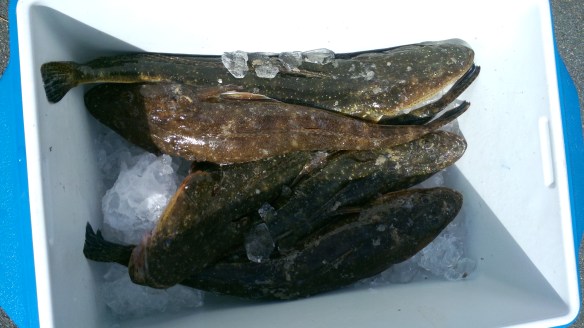
An esky full of Bribie flathead

At about 5.45 am the incoming tide picked up pace and I found a patch of keeper size fish. Over the next hour, I caught 12 fish along a 50 metre stretch of the weed beds. I kept five but forgot my camera. So all I have is the full esky to show you. The smallest fish was 44cm and the largest 59cm. I caught most of the keepers on the 5″ GULP Jerkshad but also found a few with the Zman Minnowz in the Redbone colour.

It was great to have such a successful first session back on home turf.

Bribie – the old oyster jetty flats – 25 August 2013

Sunday

I had caught a few good fish around Bribie Island through the week. There was plenty of variety – Estuary Cod, Mulloway, Bream, Flathead, Whiting, and Pike all put in an appearance. Despite some good catches, the fishing had actually been quite tough with a long time between bites.

On Sunday I decided to stay on the mainland, opposite Bribie and fish the old oyster jetty flats. Low tide had been would be at 6.02 am and I arrived just before first light at about 5.30am. There was no wind to speak of. I waded out to a point about half way between the green channel marker and the oyster jetty and started casting with a GULP 4” Minnow in the New Penny colour, on a 1/8th ounce, #1/0 hook, jighead. I was sticking with the light 8lb fluorocarbon leader as fishing light had worked well, earlier in the week.

I tried everything; big plastics, small plastics, different retrieve. At one point I thought I had found some fish but the rabbit like bite marks showed they were probably those revolting spiny toad/ puffer fish, which sometimes float around here.

The tide eventually started to run in but this did not stir things up. There is a big trawler moored in this area at the moment and for some reason it was running its engines – perhaps this noise did not help.

The weather has been so good that that by 9.00 am, when I gave up, there were boats and kayaks everywhere. It had been a tough morning but it is always better to have tried and failed than to not have tried at all!

Bribie Island – White Patch – Unexpected Jewfish – 23 August 2013

Friday

Another cold fine morning and I decided to try Whit Patch on Bribie Island again. As you will see from recent reports fishing can be hit and miss here. The coffee rock ledge structure that appears at various points all along either side of the Pumicestone Passage creates several holes and submerged mini rock bars along this stretch of shore.

I started early in the cold at White Patch

I started early in the cold at White Patch

There is a lot more sediment around after two years of floods, followed by a very wet period at the beginning of winter. This means that water clarity is not very good at the bottom of the tide. It also means that the weed/ sea grass beds that clump on the sand above the ledge, are taking longer than usual to spring up. But there must be something to eat in the area, as the first thing I saw, as I walked out in the pre-dawn light at the north end of White Patch beach, was the bristly snout of a Dugong. It was cruising along the ledge surfacing every now and then, to blow.

Great minds think alike and Bribie Island local – Colin was already out flicking some soft plastics further up the beach. I saw him pull up a legal Flathead, so I was enthused. I rigged up with a GULP 2” Shrimp in the Banana Prawn colour, on a 1/8th ounce, #1 hook jighead. I was sticking with the 8lb fluorocarbon leader.

An ambitious pike was my first customer

An ambitious pike was my first customer

Low tide was at about 5.30 am – just on first light. There was no wind to speak off and I was starting fishing in the slack water just on low – which is not ideal. The first half an hour was uneventful – apart from the Dugong sighting. At about 6.15 am an ambitious pike grabbed the soft plastic but it was only about 15cm long. I wandered up and down casting diligently, but I had to wait another hour for a decent bite. I connected with the fish, which felt like a Flathead, but after a few moments it was gone.

At about 7.15 am, I caught a Flathead that was not much bigger than the pike and was sitting in only about 10 cm of water. I always forget just how quickly these fish will move up the beach with the tide. I decided to swap to the Zman range and put on a Minnowz paddle tail shape soft plastic, in the Houdini colour. I cast in all directions but this did not produce anything.

This one was only 20cm long

This one was only 20cm long

At about 7.30 am I swapped to a GULP 4” Minnow in the flecked New Penny colour. I cast it over the ledge and let it sink. I paused until I was sure it was on the bottom then hopped it up and paused again. On the second lift the rod bent over and then line started peeling – something decent had eaten the soft plastic. It mad a solid and long initial run. My drag was not very tight and I need to re-spool this reel, so I quickly found myself down to the backing line. Patience is the key at moments like this. I left the drag alone and wound every time the fish paused. I kept the rod tip up and maintained the fairly light pressure. I gradually covered the backing line with braid and felt more comfortable.

The fish did not have very much power left after that first initial long run and so I had an inkling it was a jewfish/ mulloway. Now I tightened the drag just a little so that I could pull the fish cleanly over the ledge. As I did so I saw the silvery blue spots along its lateral line and confirmed it was a Jewie. A gentle stroll backwards and I had it up on the sand.

I measured it – 68cm – still not legal in Queensland, but a cracking fish nonetheless. I took a few photos in the shallows then sent it on its way. I fished on for a while but I could not find anymore. I looked back through my archives and realise this is the farthest up the Pumicestone Passage that I have caught a Jewfish/ Mulloway – it’s a very encouraging sign and more evidence of a healthy fishery.

68cm - still not a legal Jewfish - it is taking a while to find one at Bribie this year

68cm – still not a legal Jewfish – it is taking a while to find one at Bribie this year


I had not expected to find a Jewfish at White Patch

I had not expected to find a Jewfish at White Patch

I stopped for a coffee at Scoopys and ran into an old friend – local Brisbane children’s author – Julie Fison. Her Hazard River series of adventure stories are a great tool for engaging both reluctant and accomplished young readers. She has also just launched a series for teenage girls. I should warn my readership to check their pacemakers before they delve into these! Its book week in Queensland, so she was spreading the word about the wonder of reading, at the Bribie library. I would think there are some sections of our community where children don’t know what a book looks like! So full marks to Julie for taking this on. For more about the books visit http://www.hazardriver.com/. or Julie Fison visit http://juliefison.wordpress.com/. She also has an amazing and painful tale related to a Garfish encounter – but that is for another time.

Bribie Island – Bongaree and White Patch – 22 August 2013

Thursday

Clear skies and 10 knot south-westerly winds – it would be cold but quite reasonable fishing weather. Low tide would be 4.17 am, about an hour before first light and the moon had been full the day before.

I decided I would start on Bribie Island at the Seaside Museum drain at Bongaree, again. I waded out into the shallows at about 5.30 am and the big moon was still high and bright. There was a cold breeze and a bit of chop on the water.

There were some cormorants swimming around and there were a few surface bust ups, as the sky gradually lightened. I started with a big soft plastic – a GULP 5” Jerkshad in the Lime Tiger colour. The water was already running fast – it would be a powerful tide, so close to the full moon. I was back to 8lb fluorocarbon leader, as I genuinely believe fishing light can make a difference when chasing bream – which were the main target.

It did not take long. At 6.15 am I had a solid bite and the fish ran with the lure for about a metre, but then I lost it. A few casts later I hooked another. It must have been sitting just below the edge. It grabbed the lure and ran off to the north, with the current. After a few runs, I got it over the ledge and walked it back to the sand. It was a good bream – over 30 cm. I have not caught large numbers of bream in this spot, this year, but almost all the fish I have caught have been over 30 cm.

The tide was getting too high to fish over the ledge so I opted to switch locations. I grabbed a hot cup of coffee at Scoopys and drove up to White Patch. This time I went up to the north end to fish around the weed beds.

The water was clear and it was well past dawn so I opted for a natural coloured, 2” GULP Minnow in the Banana Prawn colour. I chose a fine wire 1/8th ounce, #1/0 hook jighead and stuck with the 8lb leader. It was now about 8.15 am. I was casting into the incoming tide and hopping the lure back towards me. I would put in about three or four casts from one location, then move a few metres south and repeat the process.

At about 9.00 am I connected with a flathead and got a look at it, but it wriggled off before I could land it. I stayed in the same spot and methodically covered the area with casts. At about 9.15 am I hooked another fish and this time I set the jighead firmly. I pulled it up to the shoreline – it was a keeper flathead at 45 cm. Using the same plastic, same technique, in the same area, I caught another bigger flathead, about 50cm long, ten minutes later.

Five minutes later, I thought I had another small flathead but it was pulling very hard. It put up a tremendous fight and as it came into view I was surprised to see it was a whiting. It was probably the fattest whiting I have ever caught and measured 36cm.

At this point I had the makings of a good fish pie in my bag, so I gave up and went off to clean my catch.

Bribie Island – the Seaside Museum flats – 12 August 2013

Monday

Sunday had been a disappointment I had fished for three hours and caught nothing. Had my fishing mojo deserted me? There was only one way to find out – get straight back out there. So, on Monday, I was up early, to beat the forecast building south-westerly winds.
I decided to head for Bongaree on Bribie. I would go back to a familiar spot where I felt confident that I would catch something. I was heading for the freshwater drain in front of the seaside museum.

It would be low tide at 6.28 am and at this stage there was no wind. I arrived at about 5.45 am. I put on my waders and walked out in front of the drain down to within a couple of metres of the drop off into the main channel. After a disappointing day on Sunday, I decided to fish very light with 8lb fluorocarbon leader. I chose to stick with natural coloured small soft plastic lures. These were most likely to tempt the bream.

I started with the 2” GULP Shrimp in the Banana Prawn colour. After a few casts, in the pre-dawn light, I felt a tug and then the pressure was gone and so was the jighead. Something sharp toothed had swallowed the lot. I re-rigged, and upgraded to 12lb fluorocarbon leader. I was out of shrimps so I tied on a 3” GULP Minnow in the Banana Prawn colour.

I cast into the running tide and hopped the lure along the bottom back towards me. At about 6.20 am I broke my duck with a decent bream, about 30cm long. About 15 minutes later, I caught another – a little smaller. Then things went quiet.

The cormorants and the dolphins like to fish in this area which suggests there are plenty of bait fish around but I could not see them in the water. I swapped through a few soft plastics and tried a small hard body vibe lure for a while.

By about 7.00 am I was back with the 3” GULP Minnow in the banana prawn colour. In an effort to get something going I was leaving the lure on the bottom for as long as possible between rod lifts. This can sometimes entice bored fish to strike. It did the trick and the rod bent over and something powerful took 3 metres of line and disappeared under the ledge.

I presumed it was a cod by the tactics. Brute force was not going to pull it out, I only had my light rod and 12lb leader. I tried a few angles but there was no movement. I decided my only option was to loosen the drag and see if it swam out. This requires the patience of a saint. You cannot put the tension back on until you are sure the fish is clear of the overhang. I waited about two minutes and then the line very slowly started to float out and away on the current. I waded along with it for about another 20 seconds then tightened the drag and pulled the fish over the ledge and slowly back to the beach.

It was a nice estuary cod – it measured up at 49cm and proved how good these fish are at ambush attacks. I decided it had earned its freedom and released it after a few pictures. The wind was up and although it had not been an easy session I had caught fish – so I went home happy.

Bribie Island – White Patch – 11 August 2013

Sunday

On Sunday I decided to try fishing at White Patch on Bribie Island. There have been a few Snapper around – just watch a few of Nigel Newman’s great video fishing reports on https://www.facebook.com/gatewaybaitandtackle. He, and others have caught some nice keepers lately. They seem to come a fair way up the Passage at this time of year and, in my experience, they often come on the bite just as the tide turns in.

This slideshow requires JavaScript.

I arrived at about 5.30 am and parked by the first set of steps that lead down to the shore, at White Patch. My favourite soft plastic for tempting a snapper is the GULP Turtlebackworm in the Pumpkinseed colour. So I started with this one, on a 1/8th ounce, 1/0 hook jighead. Low tide was at 6.20 am and the moon was a waxing crescent. There was no wind to speak of, but the water was quite dirty. As the tide turned, it lifted the weed and this made it difficult to keep the lure swimming.

As the tide really began to run in I was hoping the action would start. The weed floated off up the Passage and I kept casting. After 3 hours, I could no longer reach over the ledge without getting snagged on every other cast, so I gave up.
A morning with no fish, what is the world coming to?

Caloundra – Bulcock Beach and the Power Boat Club flats – 5 August 2013

Monday

As we were approaching the new moon I wanted to have a fish, pre- dawn. I was hoping to find some bream, which should, by now be schooling up to spawn, around the estuary mouths. I have not found many at Bribie, so I decided to try Caloundra.

I like to fish the rocky area, right at the mouth of the northern end of the Pumicestone Passage, off Bulcock Beach. There is always good tidal flow here and lots of structure. At night, the street lights bring the bait in and the predators follow.

I started about 5.30 am, in my waders on Bulcock Beach. I rigged up with the GULP 2” Shrimp in the Banana Prawn colour – which is gold with a black fleck. I put it on a 1/8th ounce, size 1 jighead. I was fishing with my 6’6” Loomis GL2 light spin rod. I opted for 8lb fluorocarbon leader as the water was very clear. High tide would be at 7.02 am, there was no real wind at this stage. It was forecast to pick up from the south west later in the morning. There would be a new moon in a couple of days’ time.

It was very dark and there were a few prawns skipping around on the surface. I cast the soft plastic into the fast moving water in the middle of the channel and let it sink. After about ten seconds, it was on the bottom, so I started hopping it back towards me. I paused for few seconds close to the shore line and when I picked up the rod tip I had a fish. My first customer of the day was a small pike.

I continued fishing, slowly moving towards the sea and soon picked up a bream about 28cm. I was hopeful I had found a patch of them, as my next few casts were all hit on the drop. I could not hook whatever was biting the soft plastic and so I moved on towards the mouth of the Passage.

Now the sun was up and the tide was running in. I decided to swap locations and drove down to the Caloundra Power Boat Club to fish the flats and weed beds. I generally find flathead in this area, so I rigged up a larger GULP 5 “ Jerkshad in the Satay Chicken colour – which is a mix of pumpkinseed and yellow. I found the edge of the weed beds that line the edge of the main channel and focused on leaving the soft plastic on the bottom, just where the sandy slope drops away to deeper water.

I took a while but at about 7.45am, I felt a solid bite and after a pause, I lifted the rod tip and set the hook. After a brief tussle I subdued a just legal 40cm flathead. I took some pictures and let it go, hoping I would find a better one. I covered the same area in casts but I could not find another one, so waded further along the edge of the channel.

I had no luck for about an hour and the wind was really picking up and making casting difficult. At about 8.45 am I felt another solid bite. Again the fish was less than a meter from the edge of the weed and was waiting to ambush anything that came its way. It was another flathead, about the same size as the previous one, so I released it.

I had not secured a fish supper but I had connected with a few fish and enjoyed a beautiful morning.

Bribie Island – The Seaside Museum flats – 26 July 2013

My apologies for taking so long to post this report but standing waist deep in cold water finally took its toll last week and I caught a miserable man cold. At least 50% or more of my readers will be aware that this is, typically, far more serious than the milder colds that women contract. Frankly, I was surprised at my own courage and resilience. I battled my way out of bed to the sofa each morning and kept operating the remote control with no fuss at all. After about four days I had run out of fishing videos to watch and I realised I was better.

Cold and grey again

The weather has been very poor through to the end of July but the fish have been around if you can brave the elements. Hopefully things will settle down soon.

On the Friday in question, I decided to see if there were anymore bream or jewfish lurking around the mouth of the freshwater creek drain, at Bongaree, on Bribie Island. I arrived just before dawn. Unfortunately, there was another fairly strong cold south-westerly breeze blowing. Once more, nothing happened until the horizon started to glow behind me.

I was looking for bream so I started with a GULP 3″ Minnow in the pearl watermelon colour on a 1/8th ounce, 1/0 jighead. I was fishing with my Loomis GL2 light spin rod and using 12lb fluorocarbon leader, in case the jewfish were around.

As the sun came up I felt couple of hits but could not hook a fish. At about 6.30 am, a fish grabbed the lure, as I pulled it over the edge of the drop off that runs parallel with the shoreline. It was a good one – over 30 cm long. I released it and went looking for more.

Found the first Bream at about 6.30 am

Found the first Bream at about 6.30 am

Should be plenty of bream around at the moment

Should be plenty of bream around at the moment

The wind was bitterly cold from the south west and it was building up. Low tide had passed at 6.03 am and the tide was running in slowly. I fished for another 2 hours, but all I managed was one more small flathead and at about 9.00 am I gave up.

Too cold and windy!

A small flathead could not resist the GULP Shrimp A small flathead could not resist the GULP Shrimp[/caption