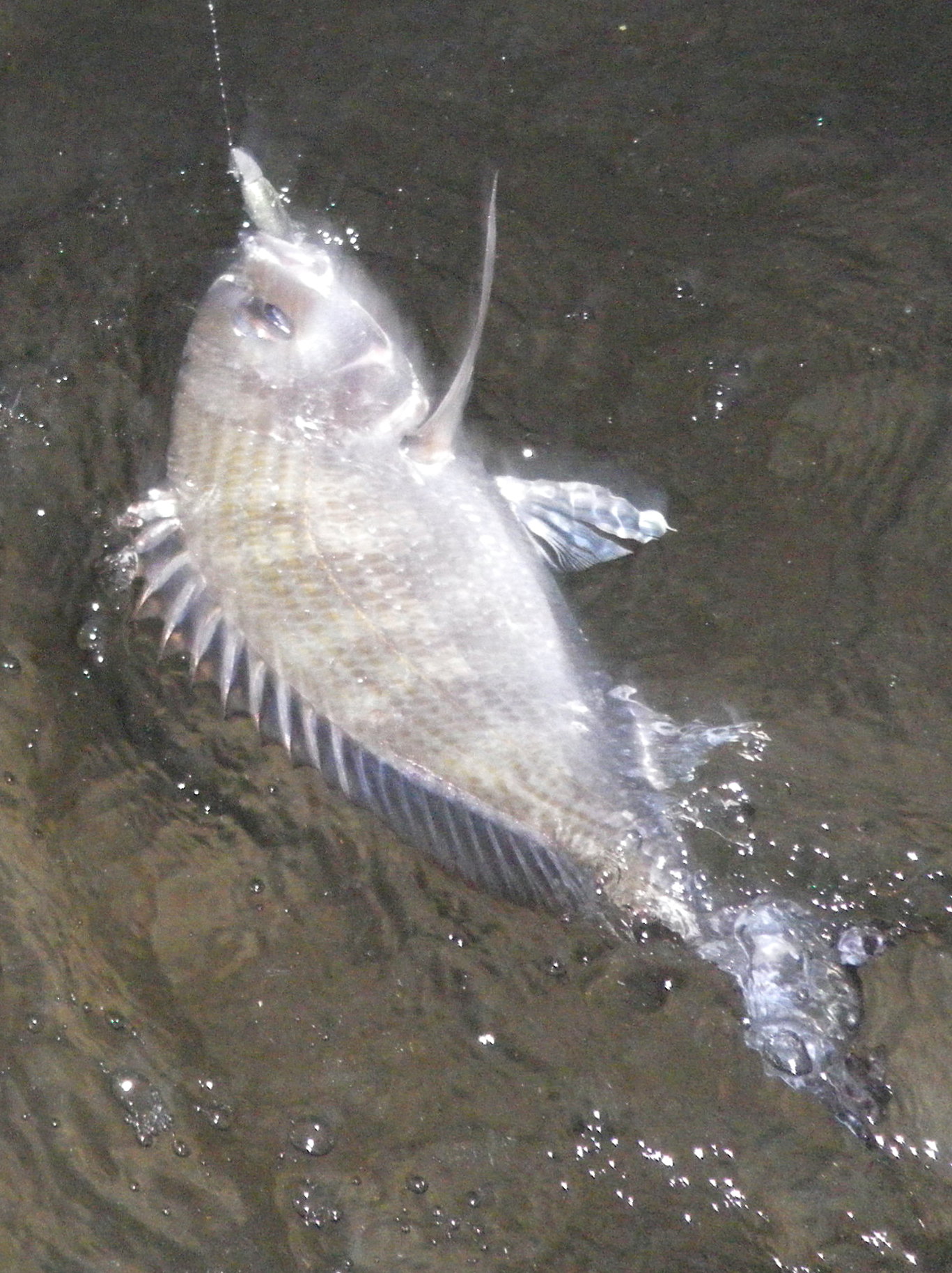
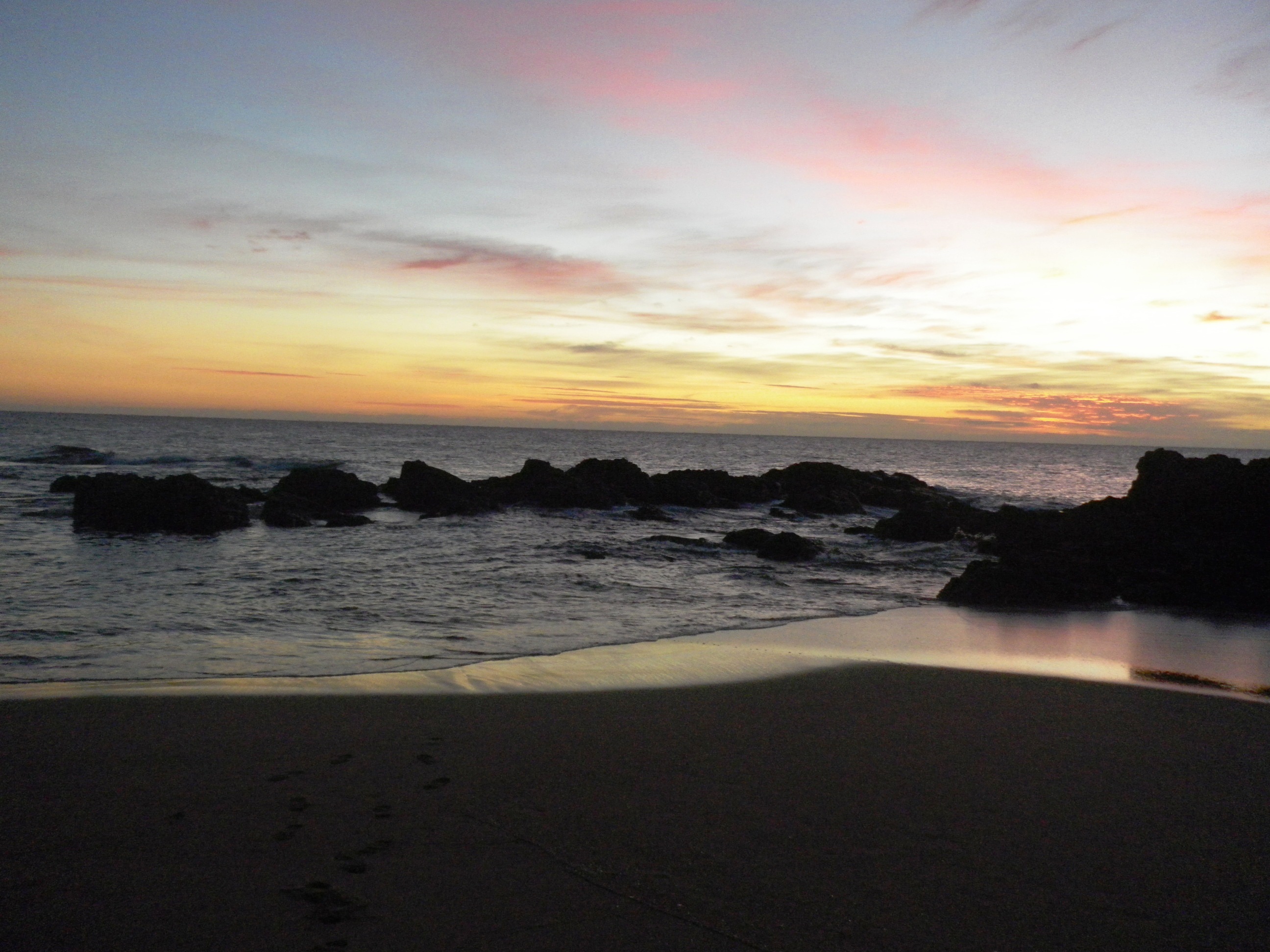
Iluka – Shark Bay – Tailor – 18 March 2016

Friday.

It was Friday and although the wind and swell was forecast to drop off slightly in the morning – it would soon pick up again. I stuck with Shark Bay and arrived at about 5.45am. The skies were the clearest they had been all week and I was treated to a magnificent sunrise.

I fished in the bays on each side of the rocks while I waited for the tide to recede. I started with a small no name popper and attracted plenty of long tom interest but nothing else. At about 7.00 am I waded through the tide and out on to the north side of the rock platform.

At this stage of the run out tide I had to stick with a surface lure so that I could cast out over the kelp covered ledge. I chose the Fluoro Pink Roosta Popper again.  This hooked up to a good tailor straight away but it wriggled off. I kept casting and the long toms kept swiping. After about 30 casts, I found another smaller tailor but it also wriggled off in the shallows. I swapped to the Spanyid Maniac 45g wide metal spoon. I soon caught a 25cm Tailor and then a few casts later, a 50cm model.

I swapped lures again. This time to a 55g HALCO Twisty in the gold colour – this was the most successful lure of the morning. But the fish were not feeding furiously. They seemed to come and go. I caught 5 more fish over the next 90 minutes. But none of them were over 35cm long.

As low tide approached I decided to switch locations and walked back to the car and drove round to Woody Head. I wandered out to the area known as ‘the Barnacles’. The sun was finally out and the swell had dropped off a little.

I tied on a ¼ ounce, size 1/0 hook jighead and cast out a GULP Crazylegs Jerkshad in the Curry Chicken colours. As is so often the case in this spot, a fish grabbed the lure on the first cast, as I started to retrieve it. I landed it with the aid of an incoming wave. It was a 35cm bream. As a warning, the next wave came up and soaked me so I decided it was time to retire. No monsters and interestingly, no jewfish but plenty of action.

I was soaked but the sun was out and the water was warm so I took a dip in one of the many rock pools (which were even warmer). I can just see the advert – Woody Head Day Spa with sea minerals and slimy kelp rub – what would they pay for one of those in Sydney?

Bribie Island – White Patch – 11 December 2015

Friday

The flats in front of the old oyster jetty at the Sandstone Point Hotel had not produced much action during my last fishing session. So on Friday I decided to fish somewhere else on Bribie. Wild weather was forecast and it was very hot – 33 C. There was a strong northerly wind blowing and there was plenty of cloud around. A storm seemed likely in the late afternoon.  I decided to give White Patch a try. This is a stretch of shore on the inside of Bribie Island where the 2 to 3 metre coffee rock drop off into the Pumicestone Passage, is quite pronounced. I have caught just about everything here over the years – snapper, trevally, queenfish, flathead, bream, whiting, estuary cod, moses perch, pike, long toms, tailor and jewfish. Flathead, whiting, bream and pike are by far my most common catches.

I wanted to fish the falling/ low tide. As regular readers will be aware, I much prefer fishing a run out tide at Bribie. That is not to say fish do not bite on the run in. I am just more confident of where to find them when the tide is running out. Fish, (especially flathead) move back in surprisingly fast with the run in tide. Both flathead and whiting love to eat soldier and other small crabs. As the tide runs into the shallows, they have a very good chance of finding them. If you are fishing with children over the holidays, soldier crabs are a great bait. They are plentiful, fun to collect and if you slide two or three on to a #4/#6 hook, at the end of a lightly weighted 6 to 10 lb line, you should find a few fish in the shallows.

Low tide would be at about 4 pm. I arrived at about 2.30 pm and wandered down the steps to the beach. The shoreline has a mixture of weed, sand and flat rocky areas. The edge of the main channel is only exposed on the very lowest of tides. I like to fish on top of the ledge, in the shallows before later casting over it, as the tide recedes.

This is a beautiful spot but this afternoon the fishing was very tough. I walked up and down casting everything I had in the tackle bag without much luck. At about 3.00 pm I caught a very grumpy bream who slammed my GULP 3” Lime Tiger coloured soft plastic minnow. I had dropped right down to 8lb fluorocarbon leader in the clear water.

I waded a long way along the shore almost to the south end. At this point there was plenty of bait in the shallows and each time I cast, it would scatter as the lure passed overhead. It was now about 4.30 pm and the tide was starting to slowly run in. There was a big surge about 5 metres in front of me and the bait scattered in all directions. I was now fishing with a bigger GULP Jerkshad in the Cajun Chicken colour. I cast in the direction of the surge. After about five casts something grabbed the soft plastic and took off at a tremendous pace. Fortunately the drag was not set too tight so it could easily take line. It stripped off about 20 metres of line in a solid fast run. Then after just a few seconds, it was gone. It looked like it had just dropped the soft plastic. I suspect it was a trevally, which I have caught in this area before.

I carried on casting but it did not come back. The sky got blacker and blacker, so at about 5.00 pm I decided to retire. Fishing in our estuaries is tough in the summer months but persistence is the key.

Hat Head – Korogoro Creek – 28 September 2015

Monday

On Monday I did not have time for the walk out to the headland so I decided to see what the monster, full moon morning high tide would push up Korogoro Creek. On the low tide the day before the water had looked like gravy, as the tannin stained water drained off the surrounding swamps. As I walked along the edge of the creek the contrast was stunning. I was about an hour off high tide but the water was crystal clear and the current was pushing up the creek.

I had my waders on. The sun had come out but the water was still pretty fresh. I was fishing with my current light estuary fishing rig – a very light NS Blackhole trout rod. I was using 10lb fluorocarbon leader, a 1/8th of an ounce, size 1/0 jighead and I stared with a GULP 2” Shrimp soft plastic in the Banana Prawn colour. It was very early but people were popping up all along to bank to fish or launch kayaks or stand up paddle boards or even have a swim.

I walked and waded along the northern bank, stopping at each gap in the vegetation to throw a few casts. I could see schools of small bream and Blackfish cruising the now submerged tree roots and some big whiting out nearer the centre of the main channel. Even on a big tide the creek is rarely more than 1.5m deep. I moved slowly northwards and stopped at a small bay about 100 m east of the road bridge. The water was so clear I could see the bream inspecting the shrimp soft plastic, each time it hit the water. But I could not entice them to strike. A whiting followed the lure all the way to my feet, but also would not bite.

I swapped soft plastic to the GULP 3’ Minnow in the Pearl Watermelon colour and started to pepper the far bank with casts. The tide was slowing but the water was still crystal clear. After a few casts I felt the solid thud of a flathead bite. I dropped the rod tip and paused for about 8 seconds then struck. The fish was hooked. I reeled it in and took a few snaps before releasing it. It was a flathead about 40cm long.

It was only 7.00 am but the creek was getting busy with the kayaks, canoes, swimmers, and other fishermen. I decided to retire for breakfast. The creek would definitely fish well on the big tides when there is a little less traffic around.

Iluka – Middle Bluff – Shark Bay – Iluka Bluff – Tailor – 16 June 2015

Tuesday

Tuesday morning was dry but the big swell was still hanging around. I decided to try fishing for some more Tailor at Middle Bluff and set off before dawn. The walk from the Frasers Reef carpark along the beach to Middle Bluff in the pre-dawn light is always great. The sky is usually beginning to glow and I am conjuring visions of huge jewfish, tailor and tuna in my mind.

The wind was light from the east and not particularly cold. It was the day of the new moon so it would be a big tide. High tide would be at 7.45 am so I had to watch the rising water levels and surges carefully.

I started fishing at about 6.20 am with the River to Sea 110mm Dumbbell Popper. I cast this around until my shoulders were sore and did not get any hits. I swapped over to the 50g DUO Pressbait Saira jig/ slug and started to put in some long casts, off the north end of the headland. This soon paid off and at about 7.00 am, just before the sun came over the horizon, I hooked up and then dropped two tailor before finally holding on to a chunky 50 cm model.

I carried on spinning the Pressbait until the inevitable happened and I lost it to the rocks. I decided to try a soft plastic and rigged up a GULP Crazylegs Jerkshad in the New Penny colour on a ¼ ounce, size 3.0 hook jighead. I was using my heavier Daiwa Demonblood rod with a 30lb fluorocarbon leader. You really need to tie on at least a ¼ ounce jighead to make this combination work. Anything lighter and you cannot feel the jighead or cast it past the rocks close that line the shore. By way of proof, even with the ¼ ounce weight, I lost the first rig to the rocks on the first cast. I re-rigged and cast out again.

The sun was up but it was still cloudy and it was just after 7.30 am. After a few casts I felt a solid thump and then another and another. I let the plastic go for a few seconds then pulled the rod up hard and I had a fish on. It managed to keep it on and pull it, wriggling hard, over the rocks with the help of the swell and landed it safely. It was another bigger Tailor about 55 cm long.

I noticed the tailor had a good sized bite mark on its back (probably from another fish in the same school). I photographed and released it and re-rigged with a fresh Crazylegs Jerkshad. I fished around for another hour, but the rising tide made things very difficult so at about 8.30 am I gave up.

I went for breakfast and then thought I would try the Shark Bay jewfish spot again. The sky had clouded over again but with a new moon and big swell I thought I had a pretty good chance of catching another jewfish/ mulloway. I arrived just after 1.00 pm and fished around with the heavy rod and leader and some big jerkshads, without much luck. I swapped down to the light rod and 12lb leader. This did the trick and I caught another stonker 38 cm bream on a GULP Crazylegs Jerkshad. The rain arrived again and forced another break.

At about 4.00 pm it had eased off so I decided to try fishing at Iluka Bluff. A keen Korean fisherman from the Gold Coast had been there all afternoon and had caught a few good sized silver trevally and some small giant trevally and also been bitten off a couple of times. The swell was tricky and the tide was running, I was tired and had only brought my light surf rig with me form the car. I rigged up a GULP Jerkshad in the Orange Tiger colour. As I pulled it close to the rocks on the retrieve it was slammed and the fish took off. I had no chance and after a few seconds I was bitten off.

I re-rigged with 20lb leader and cast out the same colour soft plastic. After a few casts I was hit again and this time I held on to the fish. It was a 45cm silver trevally. The other fisherman was regularly broadcasting berley and had been doing so all afternoon which may well have brought the fish in.

I decided to try a small 18g MARIA Duplex hard bodied sinking minnow. This lure is only about 60mm long and has a tight action. It casts like a bullet. I threw it around for about ten minute. On about the sixth cast something absolutely slammed it and took off.  I immediately regretted having only brought the light rod. It bent over and the line continued to peel. The fish was moving straight and fast out to sea and I was very quickly into the backing line. I held the spool and tried to slow it and then turned the drag slightly tighter. None of this made any difference and the fish was still running. I tightened the drag and pop, the line went slack. It was faster than a jewfish but I have no idea what it actually was. It was certainly the biggest fish I had interacted with all week but I did not have the right gear to face it. The leader was still attached when I wound in but there was no sign of the lure.

It was getting dark and I did not have another lure so I gave up for the day.

Bribie – the old oyster jetty – a bagful of flathead – 10 May 2015

Sunday

In to May and time to get back on to the flathead at Bribie. Big wind and rain were forecast for later in the week so I decided I had to get out on Sunday morning. It was going to be bright and cool with light south westerly winds.

I waded out under the bridge at Bribie Island just before dawn and despite the cooler nights the water remains surprisingly warm. I cast around in the shallows under the bridge but there was not much going on so I moved slowly to the south.

I was fishing with a GULP 4“Minnow soft plastic in the Lime Tiger colour, initially. This did not seem to stir any interest so I swapped to a similair sized Minnow in the Pearl Watermelon colour. I was fishing with my new light rod – a G.Loomis SJR6400. This is a very short, very fast action, light spinning rod. It is only 5’ 4” long which should make it easier to use in the smaller creeks that I hope to fish later in the year, up north. Loomis describe it as a ‘magnum ultralight’ rod which sounds more like a diet ice cream to me.  It is designed to have slightly more strength than their ultra-light series, while retaining its sensitivity. I was using it with my Shimano Stella 2500 loaded with 12lb braid and about a metre of 10lb fluorocarbon. The tide was slowly running out so I was using a 1/8th ounce, 1/0 jighead and aiming it at any spot where the sand met the weed.

It was hard work. I disturbed a few sting rays and eventually hooked one, which dragged me around for a while before breaking the light leader. I had now been fishing for 2 hours without connecting with a flathead. The water was getting dirtier as we approached low tide, which would be just after 8.00 am.

I move along towards the green channel marker. It was now right on low tide. I had been joined by a few more keen fishermen on the edge of the sand bank. Just as I was beginning to think the new rod was cursed, I felt the tell-tale thud of the flathead bite. I was now using the GULP 2” Shrimp in the Peppered Prawn colour. I paused then struck. It is always a little tricky catching your first fish on a new rod. You have to calibrate the drag setting to the rod bend and this can take a while. The fish hardly managed to take any line, which meant I had it too tight. It was a flathead about 42cm long and I soon had it in the keeper bag. I loosened the drag a little and carried on casting. A few minutes later I caught a small Pike then things went quiet for about 20 minutes.

The water was still and dirty. I moved slightly north, back towards the old oyster jetty. I felt a bite but did not hook up. This happened twice and each time the fish was a little nearer to me. I moved back a few paces and tried again with a short cast and a long pause. When I lifted the rod the fish was on the soft plastic. It was another flathead about the same size as the first. Over the next 30 minutes I caught two more – one more over 40cm and one just under.

I carried on moving south. The tide was starting to turn and flow in. I kept casting at the edge of the weed beds and was rewarded with another flathead. This time it was a bigger one at about 55 cm. I now had a family dinner in the keeper bag.

I kept casting as I waded back towards the car and I was rewarded with another flathead, just before I passed the jetty. After a slow start it had turned into a great morning. The new rod had proved itself and I had my bag limit for the day.

Bribie – the old oyster jetty flats – 75cm flathead – March 29, 2015

Sunday March 29, 2015

I had the bit between my teeth now, so I woke up early on Sunday and drove up to fish the run out tide, on the flats beside the old oyster jetty on the mainland side of the Pumicestone Passage, beside the Bribie Island Bridge.

Last year, March had been a fantastic month for flathead in this location, so I was hopeful. I had planned to arrive in the dark and fish the high water under the bridge but I woke up too late. When I waded out under the bridge, it was already getting light at about 5.30 am. There was virtually no wind and there had been some rain overnight. High tide had passed at 5.05 am.

Local fisherman Colin had beaten me to it and already had a 55cm flathead in his bag. He explained the recent heavy rain (following the cyclones) has slowed things down a bit and the fishing around Bribie is very patchy.

I put a GULP Jerkshad in the Peppered Prawn colour on a 1/8th ounce, 1/0 jighead and started casting around. There were plenty of prawns skipping on the surface so I dropped down to GULP 2” Prawn in the Banana Prawn colour. Neither of these interested the fish by the bridge so I waded south.

The tide was now slowly running out. I moved along the edge of the mangroves, casting my soft plastic in to a few feet of water and slowly bouncing it along the bottom.  A couple of long toms soon found it and kept snapping at it. They seem to like cruising the shallows in this area.

I was now at the drain that runs round the corner from Sandstone Point, in to the Passage. The terrain has flattened out considerably here and the drain is much less pronounced than it was last year, but there is still a nice sandy hollow in the middle of it.  I was fishing with a new favourite – the GULP 4” Minnow in the Green Camo colour. I had dropped down to a 10lb fluorocarbon leader. The long toms where still attacking the lure every so often. I briefly hooked one and it started leaping around before it unhooked itself.

I cast at the centre of the drain and let the plastic sink. Something grabbed it as I lifted it off the bottom, but I struck a little too quickly and missed it. I dropped the rod tip back down and left the plastic on the bottom for about 15 seconds. When I lifted it again the fish slammed it and hooked itself. It slowly took some line, not realising its meal was not all it seemed. As soon as it felt the hook it took off on a long initial run. It paused and then took off again. It was a solid fish and I only had a 10lb leader so I would need to take my time.

This spot is tricky as there are plenty of oyster covered boulders and as the water level drops the tide seems to run faster over them. The fish slowed but the fast running current was helping it. I slowly waded back toward a gap in the mangroves and after a few minutes pulled a big female flathead up on to a pile of washed up seagrass.

I put the tape to her and she was somewhere between 72cm and 76cm (she was not much interested in sitting still). I removed the jighead and soft plastic with my long nosed pliers and then sent her on her way. She paused and then took off.

I snipped off the end of the leader, which was quite frayed and then re-rigged with the same jighead and soft plastic and waded back to the same area to continue casting.

I soon found another 30 cm flathead, hiding on the edge of the weed. I released and carried on wading to the south. I slowed things down and methodically started to cast around in a semicircle. On about my fifth cast a fish hit hard and took off. It soon slowed and turned towards me. It was a 50cm flathead and I safely manoeuvred it into the keeper bag.

I carried on towards the green channel marker. It was now about 7.45 am. I passed by a few cunningly hidden stingrays and a couple of blue bottle jellyfish (this is why I sweat it out in waders). I dropped down to a GULP 3” Minnow in the Pearl Watermelon colour on a 1/8th ounce, size 2 hook jighead. This instantly produced results and I found a patch of hungry bream. I caught three fish in the next ten minutes. One had had a very hard life and appeared to have half his back missing. All the bream were legal sized but I had flathead for dinner, so I released them.

As the water ran out, it gradually deteriorated in quality and by about 9.00 am it was very murky. I did not get any bites on my way back to the car and at about 9.30 am, I gave up for the day.

1770 – Wreck Rock – 2 December 2014

Tuesday

Once again I apologize for not writing up my fishing reports sooner but Christmas got in the way.  This one and the few that I will publish over the next few days, are from early December 2014 – better late than never.

I managed to get a few days off in Gladstone in early December. That enabled me to shoot back down to Agnes Water and 1770. Once again Gavin and Kim found me a great deal at Loka Santi – through http://www.1770beachaccommodation.com.au/. These apartments could easily become my home away from home.

I started at Wreck Rock on Tuesday morning. Low tide would be mid-morning and there was a light north-easterly wind blowing. It was a bright sunny day and the water was fairly clear. I was using my NS Blackhole light surf/ rock fishing rig and started with 12lb fluorocarbon leader and 1/6th ounce, size 1/0 hook jighead. I was fishing on the northern set of rocks.

I started at about 9.20 am but did not get a bite until around 10.00 am. I was using a GULP 3” Minnow in the Sardine colour. I was right at the north end of the line of rocks that are exposed as the tide runs out. Over my last few trips there have always been fish at the end of this set of rocks. Last time, it was mostly dart and stripey perch but in the cooler months it is often tailor, trevally and bream. You regularly see the tuna further out but they very rarely come close enough to cast at.

Today the first fish was a small trevally. It was followed by two more, in quick succession. None of them were more than about 35 cm long. Then things went quiet so I walked over to the rocks at the south end of the bay. I fished all round these and even dropped right down to 10lb fluorocarbon leader, but I did not get a bite.

By noon the easterly wind was making things tough so I gave up for the day.

Iluka – Woody Head – 27 November 2014

Thursday

It was another grey and humid start on Thursday morning in Iluka. There had been several showers overnight and the rain seem to have stifled the wind and swell. I had been doing well at Woody Head so I drove back out there, before dawn.  It would be an early morning low tide – which is pretty much perfect for fishing the rock ledges.

The recent bite offs suggested there was something big and toothy around so I tried again with a big shallow running hard bodied lure – the DUO Jerkbait 120 SP. I cast it around all through dawn but could not stir anything up.

I moved south along the rocks and swapped to a GULP 3 “ Minnow in the Lime Tiger colour on a 1/6th ounce, size 1/0 jighead. I was now on my lighter rock fishing NS Blackhole rod. I was using 14 lb fluorocarbon leader. I caught a small bream at about 5 am, from the spot which I believe the locals call the ‘Jew Hole’. It is a large inlet with a deeper channel in the middle, to the south of the area known as the ‘Barnacles’, where I usually start my fishing.

The sun came over the horizon and there was a brief glow of red before it got lost again, in the thick cloud. At about 5.30 am I hooked a fish and it took off. It was moving fast and I caught a flash of silver and realized it was a solid dart. I soon subdued it.  I caught another on the next cast and about 4 more, smaller ones over the next 20 minutes.  Then, I swapped to a GULP 3“ Minnow in the Green Camo colour and caught another, bigger dart. I bled the two bigger dart and left them in a rock pool that had a ledge overhanging it. Hopefully the various freeloaders – kites, pelicans, crows, crabs and wobbegongs, etc, would not find them.

Things slowed down a little so I moved further south to an area known as ‘Mossies’. This is a large, flat set of rocks covered in ankle deep green weed, at the southern end of the Woody Head platform. It is really only safe to fish here in gentle conditions, around low tide.  It was now about 6.00 am and low tide had been at 5.51 am. The first fish to grab the plastic was another solid 30 cm + bream. Another bream followed, on the next cast.

I was now almost as far south as I could go on the Woody Head rocks. I cast out the Green Camo minnow and let it waft down beside the ledge. Before it hit the bottom something smashed it. It took off to the south with a blistering run then turned back and torpedoed into the base of the rocks and snap went the leader.

I looked for tougher leader but I had used it all, so it was 14lb or 10lb. I tied a strong knot with the 14lb and put the same soft plastic minnow on a 1/8th ounce, size 1/0 hook jighead. I cast back in the same spot and after a couple of tries, I was on to a fish again. I had the drag set tighter this time and I pulled pretty hard from the minute I hooked up. It was a tough fish but this time I kept it out of the rocks. After a few minutes it was tired and I landed it with the aid of the swell. It was a small king fish (or possibly an Amberjack – not sure) about 55cm long. I took some pictures and threw it back. A few casts later I was on to another one. This one was slightly smaller but put up just as tough a fight.

Next taker was a golden trevally which was longer than the king fish but not quite as mad. It was still a tough fight on the lighter rod and great fun. It was not even 6.30 am and I had caught four species. That is the beauty of Iluka.

I fished for another hour until the sun was really out and the cloud had burned away. Things slowed down a little but the bream and dart kept coming. I ended up keeping a few of the bigger dart, the trevally and a couple of bream, to make a mixed fish fried rice. I find using different flavoured and textured fish is great for this kind of dish. I fillet the fish and fry it, then add it to the cooked rice with some fried spring onions, crushed garlic, fresh coriander, Thai fish sauce and fresh lime juice.

By 8.00 am I was back at the car after a great mornings fishing.

1770 – Flat Rock at Baffle Creek and Wreck Rock – 23 October 2014

Thursday

On Thursday the seas were still up and low tide would not be until about 2.30 pm. The wind would hopefully have dropped by then and I could try fishing the beaches and rocks again. In the morning I decided to drive back out to Flat Rock on Baffle Creek and see if I could have some more fun with the Tarpon.

It takes about an hour to drive south from 1770, down the four wheel drive sand track, past Flat Rock, Middle Rock and Wreck Rock beaches, across Deepwater Creek and on to Flat Rock boat ramp on Baffle Creek.

By the time I arrived, the sun was already up and the insects were humming in my ears. You need plenty of insect repellent in these parts! The wind had dropped away and the tide was coming in. It would be high at about 9.00 am.  There were a few surface strikes and the bait was jumping around. I worked through a few different soft plastics on the light rod. The usual minnows, jerkshads and shrimps did not work, so I swapped to a Watermelon coloured GULP Minnow grub. I slowed the retrieve and let it flutter around in the current. After a few casts, there was a solid bite and I hooked up. The fish headed for the rocks and immediately tried to get under them. I was still fishing with 14lb leader so I tightened the drag and pulled it out. It was an estuary cod – about 45cm long. I released it and after another hour with no luck, I went off to the Baffle Creek Township, to find some breakfast.

The wind had dropped off so I decided to make my way to Wreck Rock to fish the last few hours of the run out tide. It would not be possible to get out to the spots I like to fish there, until two to three hours before low tide, from about 10.30 am onwards. So I drove back up the sand track and stopped for a nap in a shady spot. I woke to some rustling and found a mother emu and three chicks walking past. This really is a very unspoilt spot!

I drove on to Wreck Rock and walked out on to the beach. The sun was out and there was no one else around. The wind was now a 10 to 15 knot north-easterly and the swell was dropping. I decided to stay with the light spinning rod and 10lb leader. It was the middle of the day and I thought the fish would be fairly picky.

I started fishing on the calmer side of the rocky peninsula that sticks out to the north of the little bay. I put on a 1/8th ounce, size 1 hook jighead with a 2” GULP Shrimp soft plastic, in the Banana Prawn colour. After a few casts, the first taker was a small stripey perch, this was followed by an equally small bream. Both these fish where sitting at the base of the rocks in a few feet of water. About 20 minutes later, I dropped a bigger bream, as I tried to land it.

It was pretty warm so I decided to risk getting wet and wandered a bit further out along the rocks. I wanted something chunkier to throw out into the breaking waves, in front of the rocks and I chose a GULP Jerkshad in the Waremelon Pearl colour. I also upped my jighead to a slightly bigger 1/6th ounce with a 1/0 hook. I cast this out in to the gaps between the rocks and let it sink for as long as I could before hopping it back towards me. I lost a couple of rigs to the rocks and gradually moved further out as the tide dropped. At about noon I was almost at the end of the rocky peninsula. I cast clear of the rocks and let the jerkshad sink. On the drop, it was slammed and line started peeling. The swell was still significant and this fish new how to use it. As soon as I applied some pressure, it took off. There were rocks everywhere and I had a 10lb fluorocarbon leader on the end of a very light, fast action trout spinning rod. Patience – Patience – Patience would be necessary. I got a little line back and tightened the drag, very slightly. I watched the swell and used the waves to steer the fish towards me. I took several tries but eventually I had it out of the water and at my feet. It was a trevally, about 50cm long.  I love to eat fresh trevally, so I killed and bled it and put it in a keeper pond, about 10 metres back from the shoreline.

A climbed back out along the rocky peninsula and put on another Jerkshad soft plastic. This time it was in the green and orange Lime Tiger colour. I cast around for another trevally but could not find any out the front. I started casting into the foamy water right at the end of the line of rocks. Small dart kept attacking the soft plastic just as it reached the rocks and on a few occasions they almost beached themselves trying to eat it. On the next cast there was a solid hit and then a clean bite off. I re-rigged with 14lb fluorocarbon leader and put the same soft plastic/ jighead combination on again.

I cast out wide again and let the jighead sink but then I added some urgency to the retrieve, a few quicker, more violent jerks. This did the trick and just before I got the soft plastic back to the rocks, a fish grabbed it, dropped it, and then grabbed it again. I felt the hook set in the jaw and then the fish went ballistic. I knew it was a Tailor before I could see it and I suspect this was what had bitten me off, before.


I pulled up a wriggling 40 cm tailor – I photographed it and released it. I shortened the mashed soft plastic then cast it out again. After a few jerks of the rod tip I had caught another slightly bigger one. Over the next 20 minutes I caught 4 more and dropped a few. The biggest was about 45cm. I am not sure how long they would stay in this area, but I suspect they are nearly always around until the water really warms up.

By 1.30 pm I was soaked and the fish seemed to slow a bit, as the wind and swell picked up again. I waded back towards the keeper pool, where I had left my trevally but I could not find it. Then I saw a big brahminy kite circling the shallows, about 50 metres away towards the beach. I watched as it swooped and plucked up the trevally – which it or another bird must have dropped halfway back to its nest. It struggled to get airborne again but eventually it got its full wingspan deployed and made it to the tree line. That was the end of my fish supper.

I decided to give up for the day and drove back up to 1770.
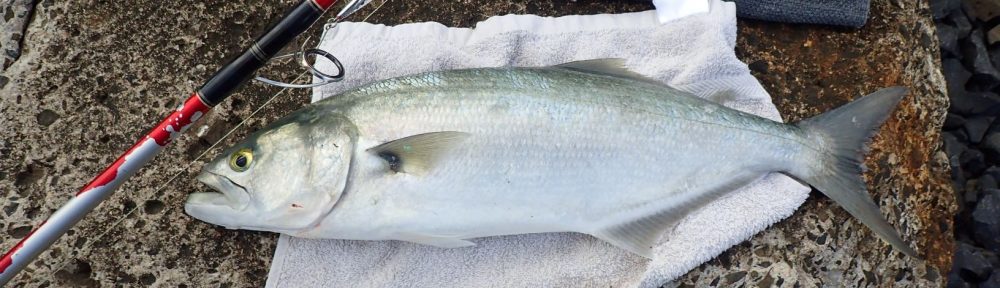
Bribie – the Sandstone Point flats – 27 April 2014

Sunday

I am so far behind with my fishing reports that I will make this one short and sweet.

Early Sunday morning I headed for Bribie Island and arrived at about 5.15 am. I waded out under the bridge, fishing in the shallows, on the mainland side of the Bribie Island Bridge. High tide would be at about 8.00 am. There was a cool south-westerly breeze blowing.

I started with a GULP Peppered Prawn Jerkshad soft plastic lure on a 1/8th ounce, 1/0 jighead and I was fishing with 10lb fluorocarbon leader. A 5.25 am I caught a 45cm flathead, that was feeding under the bridge lights.

It was a big high tide at 2.3 m, so I decided to head past the old oyster jetty and round the corner towards Sandstone Point. This area is great to fish on big tides. The water was very clear so I decided to swap to a Gulp 3” Minnow in the Lime Tiger colour. At about 7.30am my plastic was knocked around a few times by a Long Tom. Then, about 10 minutes later, I caught a 30 cm Bream. It was followed, a few casts later by another, smaller bream.

I swapped to a DUO Realis Shad 59MR suspending, hard bodied lure. This lure will catch just about anything, but the bream love it. After a few casts it connected with another bream. As I waded back towards the bridge, it caught two more bream – both about 25cm long.

I finished my session at about 8.30 am. It is good to see the bream are back in business.

Bribie Island – The Seaside Museum flats – 26 July 2013

My apologies for taking so long to post this report but standing waist deep in cold water finally took its toll last week and I caught a miserable man cold. At least 50% or more of my readers will be aware that this is, typically, far more serious than the milder colds that women contract. Frankly, I was surprised at my own courage and resilience. I battled my way out of bed to the sofa each morning and kept operating the remote control with no fuss at all. After about four days I had run out of fishing videos to watch and I realised I was better.

Cold and grey again

The weather has been very poor through to the end of July but the fish have been around if you can brave the elements. Hopefully things will settle down soon.

On the Friday in question, I decided to see if there were anymore bream or jewfish lurking around the mouth of the freshwater creek drain, at Bongaree, on Bribie Island. I arrived just before dawn. Unfortunately, there was another fairly strong cold south-westerly breeze blowing. Once more, nothing happened until the horizon started to glow behind me.

I was looking for bream so I started with a GULP 3″ Minnow in the pearl watermelon colour on a 1/8th ounce, 1/0 jighead. I was fishing with my Loomis GL2 light spin rod and using 12lb fluorocarbon leader, in case the jewfish were around.

As the sun came up I felt couple of hits but could not hook a fish. At about 6.30 am, a fish grabbed the lure, as I pulled it over the edge of the drop off that runs parallel with the shoreline. It was a good one – over 30 cm long. I released it and went looking for more.

Found the first Bream at about 6.30 am

Found the first Bream at about 6.30 am

Should be plenty of bream around at the moment

Should be plenty of bream around at the moment

The wind was bitterly cold from the south west and it was building up. Low tide had passed at 6.03 am and the tide was running in slowly. I fished for another 2 hours, but all I managed was one more small flathead and at about 9.00 am I gave up.

Too cold and windy!

A small flathead could not resist the GULP Shrimp A small flathead could not resist the GULP Shrimp[/caption

Bribie – Under the bridge – 5 March 2013

Tuesday

The rain is easing but it is just being replaced by howling south-easterly winds. The only real option would be to fish the couple of hours either side of dawn, in a fairly sheltered location. So it was off to Bribie again, to fish the area under the bridge, on the mainland side of the Pumicestone Passage, as the tide fell.

I arrived at about 4-45 am to find I was not the only mad angler wetting a line. A couple of fishos were on the bridge casting to the north – a few pylons out. A couple of good jewfish have been landed from the middle of the bridge, at night, recently. The favoured technique is to fish with very heavy gear then drop a grappling hook down once the fish is worn out. This strikes me as a pretty tough proposition – but it does work.

I rigged up and waded along the edge of the mangroves, to the south of the bridge. The wind was from the south east and was blowing around 15 knots. The water was dirty and running out, against the wind. High tide had been at about 3.00 am.

I started by fishing with a GULP Jerkshad in the Orange Tiger colour, on a 1/8th oz, 2/0 jighead. There was a bit of surface action on the edge of the pools of light, cast by the bridge lights. Every so often, I could trace the path of a cruising predator by the scattering bait fish. There were some pretty big surges and splashes which made me reluctant to wade out further.

I had no luck with the brightly coloured Jerkshad, so I made a counter-intuitive switch to a 3” GULP Shrimp soft plastic in the Banana Prawn colour. This is a gold colour that would not really stand out at all in the sediment rich, murky water. After about ten minutes of casting without result, I switched my attention to the deeper water, just out of reach of the bridge lights. I carried on peppering the area and was about to swap soft plastics again when I felt a solid bite and a few moments later, I set the hook on a good fish. As I pulled it in between the mangroves, bait went flying everywhere. There is plenty of food around. It was a good flathead, about 55cm long and I kept it for dinner. It was 5.10 am and its possible that the sun was trying brighten the sky but the clouds were too thick.

The heavens opened and I retired under the bridge. The fishos on the bridge had disappeared – probably washed away by the relentless rain. I started casting to the north and gradually moved along between the pylons. It was now a little lighter and the rain had stopped. The water was getting dirtier as the tide ran out. As I cast out, around the base of the third bridge pylon, I felt a good bite, but did not connect. I cast back in exactly the same spot and got hit again, still no hook up. I cast another ten times in the same spot gradually slowing the retrieve right down and increasing the length of my pauses. On the eleventh cast I felt the solid bite of a committed fish. I dropped the rod tip and slowly counted to ten. After what seemed like an eternity, I lifted it and felt the lure lodge in the mouth of the fish. The rod bent over, I felt the resistance and the tip started wobbling. I waded back to the shoreline and safely landed my second flathead. It was a little smaller than the first, just under 50 cm. It was 5.23 am. I also kept this one for dinner.

I swapped to a 4” GULP Minnow soft plastic in the Smelt colour. I concentrated in the same area, around the third pylon. At 5.34 am I caught another flathead, almost exactly the same size. Three fish is about right to feed my mob for dinner.

It was now light but the sun could not break out above the clouds and the rain showers just kept coming. I persisted in the same area but things seemed to go a bit quiet, as the traffic on the bridge built up and the water receded. I swapped down to 3” GULP Minnow in the Smelt colour and moved a bit further out, to the south of the bridge. I felt a couple of taps and then hooked a small Bream. It was now just after 6.00 am. A few casts later the same plastic produced flathead number four. The smallest of the morning, but it was still a healthy fish, at 47cm.

I waded south, past the oyster jetty and on to the windy flats. The sun almost emerged above the clouds but the now howling south-easterly immediately blew some more rain clouds in, to block it out. One of these gave me a thorough soaking and despite casting around for more than an hour, I did not get a bite out here.

Just before 8.00 am another nasty black cloud opened above me and I decided to call it quits. It had been a successful morning but the wild weather had made it a challenge.

Bribie Island – The Seaside Museum drain – 24 August 2012

Friday

The wind is starting its undecided phase with a big northerly blow predicted for Friday afternoon. Friday morning looked ok, so I decided to revisit my favorite Bream location – Bongaree, on Bribie Island.

In years gone by, the Bream have shown up along the coffee rock ledge that runs along the edge of the Pumicestone Passage. They have often schooled up to spawn in the areas around the mouth of the tidal lagoon, in front of Buckley’s Hole. Typically, the best time to chase them has been either side of the new moons in July and August. Sometimes they are also around in June and September, depending on the water temperature.

The GULP 3” Minnow or 2” Shrimp have always been my favorite soft plastic lures for Bream. I prefer the more natural colours. When I am fishing the rocky headlands, I have caught plenty of big Bream on Jerkshads and other big soft plastics, but in the estuaries these fish can be fussy.

I started just after first light at about 5.45am. I was in front of the Seaside Museum again. The tide was running out and would be low at 7.45 am. This is the perfect time to fish this spot. I stopped about three metres from the drop off and cast over it, to the north. I was fishing with my light spin rig, with 10lb fluorocarbon leader and 1/8th, 1/0 jighead. I thought there might be some Flathead around so I had chosen a compromise soft plastic – the GULP 4“ Minnow in the Smelt colour. Big Bream should still be interested in it and if I passed over any Flathead, they would also go for it.

I counted to ten and let the lure sink. I am not sure how deep it is here but I would guess no more than 2.5 to 4 metres, in most places. The first couple of casts produced nothing and then the dolphins swam buy. It is always a pleasant sight but I presume the fish head for cover. About twenty minutes later there were some surface bust ups and just as I pulled the lure over the top of the ledge, there was a fast snatch and I was on. Playing fish here is tricky. It’s best to get close to the edge and play them out in the open water. If you have to hall them over, you risk sawing off your leader when they lunge back down, close to the edge.

This was a good Bream – 32cm and I pulled it safely onto the sand. I waded back out and cast over the edge again. The lure was hit on the drop but the mad head shakes meant it was not a Bream or Flathead. A few moments later I pulled a 35cm Chopper Tailor onto the sand. I fished for another 30 minutes with a few bites but no hook ups.

The wind, a north westerly, was now picking up. I moved to the south of the lagoon mouth and tried a few different soft plastics. I swapped back to the Smelt Minnow and started casting again in the same spot where I had caught the first Bream. At about 7.30 am, I cast out and let the lure sit on the bottom for a while. When I lifted it, I had a fish on. It was another good Bream just over 30cm long. I landed it and decided to pack up.

I had a coffee then decided to try fishing at Whitepatch, further up the Island. I stuck with the same soft plastic and jighead and walked along the drop off casting and retrieving. There was quite a bit of bait in the water and the birds kept turning up for a dive, but I could not find the fish. I did however, pull up a Stonefish – seriously ugly.

It had been a tough session but I had caught two quality fish and had dinner organized – so no complaints.

1770 – Deepwater National Park – Flat Rock – 10 August 2012

Friday

After a couple of weeks of mostly perfect fishing weather, two high pressure fronts were heading up the Queensland coast. Cold south westerly winds to 25 knots were forecast for Friday and I woke to the sound of palm fronds crashing down and a very cool breeze.

I stepped out just on dawn but it was too windy, so I drove down to 1770 for breakfast. I sorted out my gear, re-loaded the fishing vest and added a few drops of oil to the Stella. By lunchtime the wind had dropped a little, so I decided to drive down to Flat Rock beach, in Deepwater National Park, to the south of Agnes Water.

When there is a westerly blow the steep beach provides some shelter from the wind. The tide was about half way in and it was just washing over the long flat rock that gives the beach its name. The westerly wind had flattened the sea but once my legs were wet, the wind chill was nasty. Fortunately it was a bright sunny day.

I started at about noon at the south end of the rock and walked along casting off the seaward edge. As the waves rose over the rock you could see plenty of baitfish hugging the edge. The water was crystal clear. I was fishing with the light rod, a 1/6th 1/0 jighead, 8lb fluorocarbon leader and a 2” GULP Shrimp in the Natural colour. I felt plenty of touches and after about 10 minutes caught a tiny Stripey Perch. I caught a few more, all hiding in close to the edge. None of them were big enough to keep. I moved further along and the lure was hit by a better fish – this time it was a Bream, about 30cm long. I released and carried on.

The waves were now breaking over the rock and I was soaked and pretty cold. I let the soft plastic lie on the bottom for a while and when I lifted it I had another fish on – a flounder – plenty of species along here.There was now too much water washing over the rock and I was too cold so I gave up and went to thaw out in the sun.

I went back to my cabin and after a few hours off, I went down the track to the beach. I walked up on to a slightly sheltered rock and cast a small 3″ Gulp Minnow in the Sardine colour. The wind carried the 1/6th 1/0 jig head a long way and I slowly retrieved it. At the base of the rocks in the foam, a fish took it and made for cover. It took some line then felt like a brick – typical Cod behavior – they turn sideways and try to wedge themselves under an over hang or rock. I only had the 8lb leader in place so I let it swim down and hide and loosened the drag. After a couple of minutes it swam out and I landed it. No monster but a reasonably fat little cod. A few more casts produced nothing and the wind was just too strong to feel anything, so I gave up for the second time.

Middle Rock and Flat Rock – 1770 – 9 October 2011

Sunday

The storm passed and I woke around 4.00 am thinking the sun was coming up. In fact it was the moon – high above, in a very clear sky. It was a few days off full and so bright, that I did not need a torch to get the billy on and brew up some tea. After a few nights of instant noodles, I needed some protein, so it was time to stop looking for trophy fish and go and catch something to eat.

I started at dawn at Middle Rock. High tide would be at about 7.00 am and first light was about 5.00 am. It is just a few km north of my campsite at Wreck Rock, in Deepwater National Park. There are three main rocky outcrops with rubble, coral bommies and sandy patches in between. As the sky brightened only the tops of a few of the bommies and the big rocks were visible. I have had a few good Trevally from this spot on high water.

I was using the Shimano Catana Light rod again but put on a 16lb leader – just in case something big appeared. I loaded up with the GULP 3” Minnow in the Pearl Watermelon colour on a 1/8th 1 jighead. I cast out, as close as I could to the edge of the half-submerged bommy. I started a quick retrieve – there are too many rocks to let the soft plastic hang around in one spot. I had only jerked the rod tip a couple of times and then I had a fish. It was a nice Bream about 30cm long. A few more casts produced another. Then I caught a couple of tiny Moses Perch and finally a couple of smaller Bream.

The water was calm and glassy and crystal clear, despite the storm. At about 9.00 am I drove up to Flat Rock and waded out onto the partially submerged rock, to fish the rest of the run out tide. Flat Rock is great to fish on once you can stand safely on the rock itself. There are a couple of breaks in the rock that runs the length of the beach and these are good fish congregating areas.

I started at the south end where the front of the rock has an almost vertical edge, in some places. These are usually a good Bream spots as there is plenty of wash. Sure enough, as I wandered along the rock casting into no more than 1.5m of water, I caught about five more Bream, a handful of small Whiting, a tiny Bar Tailed Flathead, Butter Bream and lots of small Stripey Perch and Dart. All of the Bream were just about 30cm – so I kept the biggest three. I was impressed with the range of fish but disappointed by the size.

This slideshow requires JavaScript.

I moved down to the southern end where the rock breaks down into a surf beach dotted with submerged bommies, but by about 11.00 am the northerly wind had come up again and the fish seemed to stop biting. I cleaned up the Bream in the rock pools and headed back to camp for some hammock time.

Fingal Head – Salmon, Tailor, Bream – 11 August 2011

Thursday

Tuesday was a fishing disaster but somehow I just could not believe that the Tweed Rockwalls could ‘shut down’. So on Thursday, I found myself driving back down across the New South Wales border for another session. When I arrived at the north rock wall there was no swell and a slight breeze from the south-west. I started about 5.30 am. It was cloudy and very overcast and it looked like it would rain.

I started fishing with a GULP 5” Jerkshad in the Lime Tiger colour, rigged on a ½ oz 2/0 jighead. The heavy skies seemed to have completely flattened the water. The cloud blocked out the sunrise. As I cast all around the front of the rock wall the south-westerly breeze started to lift and it was very cold.

By 7.00 am I had not had a bite so I decided I had to switch locations. I drove down to Fingal Head. I walked out across the small causeway on to the rocky promontory. I decided to make the first cast count. It is so often the first cast in a new location that produces a fish. I checked and double checked my knots and decided on a GULP 7” Jerkshad in the Lime Tiger colour, rigged on ½ oz 5/0 jighead. The south-westerly wind was picking up and the tide was running out. I cast straight out in front of the promontory and let the lure sink. Before it hit the bottom I felt a solid bite. I dropped the rod head and then struck hard. I was on to a good fish – it was not frenetic, like a Tailor but felt a bit too lively to be a Jewfish. It took plenty of line but I gradually tightened the drag until I had it at the foot of the rocks. It was only as I lifted it clear of the water, on a helpful surge, that I saw it was an Australian Salmon. It was a good size fish – just under 70cm long. I photographed it and then released it. I will eat almost any fish but I have never been able to make one of these taste good.

I thought there would be more, so I re-rigged the same soft plastic and cast back in to the same area. Nothing – I tried up and down the rock ledge and after a while switched to a smaller 5” Jerkshad in the Peppered Prawn colour. I covered the whole area with casts but they had moved on.

This slideshow requires JavaScript.


I moved round to the north side of the ledge and cast out into the corner of the Fingal Head beach. The water is crystal clear but I could not see much bait around. After another 30 minutes, I hooked a small Tailor – around 30cm which I quickly released. I then switched to a Gulp Jigging Grub in the Pink Shine colour and swapped down to a 9 gram 2/0 jighead. After a couple of casts, I caught a small Bream , very close to the base of the rocks.

It was now around 10.00 am. I had caught a few fish and it had been a better session than Tuesday but I still had nothing for dinner. Maybe it is time to get back up to Bribie Island and see if the Flathead are biting again.

Woody Head – “The Barnacles’ – Bream – 27 June 2011

Monday

Monday morning was my last session, land-based fishing at Woody Head. The weather had improved and we had clear skies and no swell. I started fishing around 9.30 am at ‘the Barnacles’ area, again. Low tide would be around 11.30 am.

The first cast produced a small Trevally, who fell for the GULP 4” Minnow soft plastic in the Lime Tiger colour. I then caught a few snags and then a small Bream. Over the next hour or so I caught six or seven more Bream – all between 25 and 35cm.

I moved all along the front of the rock platform, casting at any fishy looking water. There were plenty of people around – taking advantage of the excellent conditions. One guy had caught a nice looking 50cm Tailor on a slug. It was the only Tailor I had seen caught in the whole weekend. Further along I saw another fisherman with a 50cm school jewfish, which he caught on some fresh mullet strips.

This slideshow requires JavaScript.

I caught more Bream as I walked along the rocks, down to the area at the southern end of the platform, known as ‘Mossies’. I caught more fish on the smaller 3” GULP minnows on light jigheads – 1/6th and 1/8th oz. Another fisherman was catching plenty of Bream on unweighted squid pieces.

By about 12.30pm it was time to go. It had been another great few days of land-based fishing, from the rocks in Northern New South Wales. The big Jewfish had been the highlight but there were plenty of Trevally and Bream, as well. I had not been fishing at dawn, but I was a little surprised by the lack of Tailor – maybe next time.

Bribie Island – Buckleys Hole lagoon and south of the oyster jetty – 16 June 2011

Thursday

I could not resist another Flathead session – so I set off for Bribie Island bright and early around 4.45 am. I had checked the lunar phase and saw that the moon was full on Wednesday. When I walked out to the car it looked like a half-moon in the sky. As I drove up to Bribie, I switched on the radio and heard that we were in the midst of a lunar eclipse. By the time I arrived at the car park by Buckley’s Hole, the moon was almost completely in shadow, with just a faint red glow marking its outline. It was now about 5.45 am and the tide was a couple of hours into the run-in phase.

At first light I waded around the mouth of the lagoon, casting out, over the drop off into the Pumicestone Passage. Small bait fish schools kept breaking the surface – running away from something. I was fishing with the GULP 2” Shrimp in the Peppered Prawn colour on a 1/6th 1/0 jighead, with a 10lb fluorocarbon leader. Every time there was a surface break, I cast at it and just on dawn, I caught a small Bream. I carried on for another hour and got a couple more good bites from Bream or Tailor but then the marauding Dolphins arrived and had a good rummage around in my fishing spot.

There was now too much water to fish over the drop off so I decided to move over to the other side of the Passage where I could also get out of the wind, which was building up from the west. So I parked beside the bridge on the mainland side and waded along south past the old oyster jetty. Things were very quiet through to high water at around 10.00am. I didn’t register a bite for about four hours. I waded all around the area trying different soft plastic lures and experimenting with different jighead weights.

Finally as the tide turned and really started running out I caught a few Pike and then at noon I caught a decent Flathead on a GULP Crazylegs Jerkshad soft plastic in the Curry Chicken colour, rigged on a 1/8th 1/0 jighead. It was around 54cm – Flathead number one. I carried on wading south along the big sandbank to the south of the jetty. Ten minutes later, I caught a smaller, just legal Flathead on the same lure – Flathead number two. I was casting along the edge of the weed beds into the clear sand and jogging the lure back along the bottom.

I switched to a GULP 5” Jerkshad on the Orange Tiger colour. After a couple of casts there was a good solid bite and a fish slowly swam off with the lure. I counted to ten and then set the hook and at that point – it took off with around ten or twelve metres of line. I slowly walked back towards the sandbank, maintaining the bend in the rod and getting line back as it swam towards me. It was a really solid fish and it made about four more big runs. Eventually it started to tire and I tightened the drag a little, to pull it up on to the sand bank. The leader snapped as I pulled it clear of the water but it was safely on the sand. It was a good size female at around 68cm – Flathead number three.

I waded back out to the same area and after a few more casts I was on to another fish. Again it did not initially realise it was hooked. It made a few small runs and then really went crazy with head shakes and tail slaps and solid long runs. It was safely hooked through the jaw and after another long slow walk back to the sand bank; I pulled it up on to the shore. This was another quality fish at about 73cm long – Flathead number four.

This slideshow requires JavaScript.

As the tide ran out further I moved even further south, over the weed beds. I was still using the Orange Tiger Jerkshad. It did not take long, less than ten minutes, in fact, before I had another good fish. This time it was another very respectable Flathead at 62cm – Flathead number 5.

It had ended as a fantastic session but from 5.30 am through to noon all I had caught were a ‘just legal’ Bream and a couple of Pike. I am not sure if the fish were only biting on the run out tide or whether it just took a long time to find them. It was a good feeling to head back to the car with a heavy keeper bag. I was completely knackered but as always, it was worth it!

1770 – Middle Rock – Flat Rock – Deepwater National Park – 15 May 2011

Sunday

On Sunday morning the weather was beginning to change. The breeze was moving round from the south west to the south east. It was much warmer and conditions were good as the south easterly was still light. I had worked out that low tide presented the better fishing opportunities at Flat Rock and Wreck Rock and so, with high tide a few hours after dawn, I headed back to Middle Rock and more specifically the set of rocks in the middle of Middle Rock.

Middle Rock - an hour before high tide pre-dawn

Jupiter and Venus had been bright and visible in the eastern sky just before dawn, all week. Since about Thursday, Mercury was also clearly visible. Venus was so bright that it cast a clear light across the water. It had been similarly bright when I was fishing down at Iluka, in NSW, last month and I wonder if it has an effect on the fish.

I was fishing with the heavy rod – the Daiwa 9’ 6” Demon Blood, matched with a Shimano Stradic 6000 reel, loaded with 20lb braid and a 30lb fluorocarbon leader. I was hoping to encounter some bigger fish at dawn and thought that the cold snap would have got the Tailor going. My camping neighbour had caught a few off the beach to the south of Wreck Rock, the evening before. They had taken cut up Pike baits about an hour after sunset.

I rigged up with a GULP 5” Pumpkinseed Jerkshad soft plastic lure on a 3/8 oz 2/0 jighead. I cast all round the rocks in the pre-dawn light. I could not raise a bite so I dropped down to a ¼ oz 1/0 jighead and 16lb Fluorocarbon leader and cast around again. Third cast, in very shallow water, only a couple of metres from the beach, I had a fish. It was a Bream about 30cm long. I released it and cast back in the same spot. I hooked up straight away – it was another Bream – slightly bigger at around 34cm. I carried on but all I could not find anything bigger so at 8.00 am I went back to camp for breakfast.

Middle Rock Bream

Whilst there were fish around it was becoming clear that this week was right in the middle of the changeover between the dominance of the warm weather species –Tuna, Mackerel, Dart, Whiting and the emergence of the cold weather species – Tailor, Bream, Flathead. The air temperature had been bitterly cold but the water was still very warm. It was hard work trying to figure out what to try next!

After breakfast I decided I would fish the run out tide at Flat Rock. The moon was almost full so the tide would be very low. I arrived just after 10.00 am and the long rock was already exposed. I waded out and climbed up onto it. I was back to the light spin rod, using a 1/6th 1 jig head, 12lb leader and 2” and 3” GULP Shrimp and Minnow soft plastics. For the next few hours I walked all the way along the rock to the northern end of the beach, casting out over the edge. There was no shortage of fish but the problem was size. Everything seemed to be under 30 cm long. I caught Whiting, Flathead, Bream, Stripy Perch, Dart and Long Toms, but nothing was worth keeping. By 2.00 pm the wind was getting up and the tide was running in so I gave up.

Bribie Island – Sandstone Point Flats – 1 May 2011

Sunday

After a week of wind I was keen for some fishing this morning. I decided on Bribie Island, as the forecast wind and swell were not great and it offers a few sheltered spots. I drove up from Brisbane and arrived at about 5.00 am. I would be fishing the last few hours of the run in tide and the first few hours of the run out. With all the recent wind and rain, the water was predictably dirty and as high tide approached, there was plenty of weed floating around.

I started in the dark, next to the old oyster farm jetty on the mainland side of the Bribie Bridge. The area under the bridge was being flogged by the cast netters who had a few crab pots out on long ropes. There were already a couple of boats anchored in by the bridge pylons so I decided to wade south towards Sandstone Point.

I have been experimenting with which plastics to fish in the dark and pre-dawn. My latest theory is that the high contrast plastics with a solid silhouette seem to work better than the lighter/ white glow colours. I decided to put it to the test this morning. I started about 5.30am by fishing with a GULP 2” Shrimp soft plastic lure in the Midnight Tiger colour. This is a predominantly black colour with a flash of orange on its underside. It has been a great Bream lure for me at night. I rigged it on a 1/8th 1 hook jighead, as the tide was not running very fast. I was fishing with a 10lb fluorocarbon leader and my light spin rod.

This slideshow requires JavaScript.

Just before six, it was still pretty dark and I was wading south, parallel with the shoreline, about 10 metres out. I cast into a spot about 3 metres out from the Mangrove roots, where the water was around 30cm deep. As the lure hit the water, there was a great splash and line started peeling. The water was shallow and the fish started shaking its head immediately and splashing about. I let get into some deeper water and calm down and then gradually walked it back to a gap in the mangroves and pulled it up onto the beach. It was a good size Flathead at 58cm. I released it and moved back to the same spot to try for more. I could not get another bite so I moved on.

I worked the flats around the corner, towards Sandstone Point. At the top of the tide the water was very dirty close into the Mangroves and the cleaner water was just out of reach of my wading capability. I waded along the edge of the shoreline casting out onto the flats and slowly retrieving my soft plastic. As the tide started to run out at about 8.30 am I got a couple of hits from some Pike and then a few casts later, a solid hook up. I pulled the fish back to the shore and it was another good size Flathead at 54cm. I released it, as well and headed back to the car.

The fish were not thick and there was not much bait around so I was happy with two good fish from my session. Conditions look like they will improve as the week goes on.