Bribie Island – Bridge and Sandstone Point – 1 March 2011

This slideshow requires JavaScript.

Tuesday

Up at 3.45 am and back up to the Pumicestone Passage in search of more Flathead. I decided to start by fishing the Bribie Island side of the bridge, this morning. There is always plenty of surface action in this area with Jew, Pike, Moses Perch, Bream, Tailor, Flathead and even juvenile Snapper, all drawn in to feed on the jelly prawns and small baitfish that gather under the bridge lights.

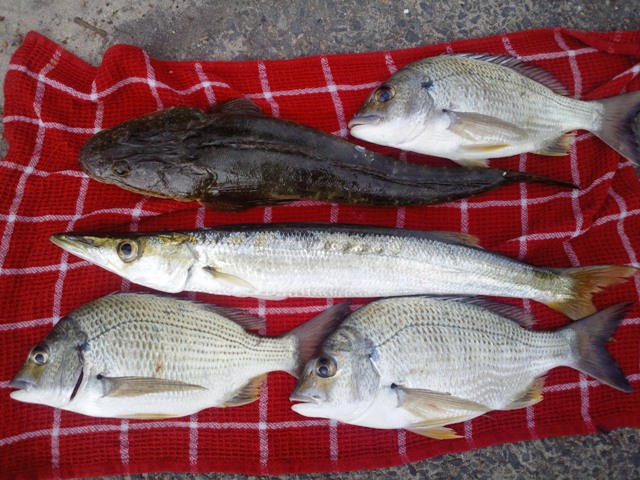
In recent sessions, I have noticed the small jelly prawns are everywhere and the Flathead that I have caught and gutted, generally have a belly full of them. I therefore grabbed a bag of the GULP 2” Shrimp in the Jelly Prawn colour and decided to try these out. The tide was running in so I decided to start by casting my soft plastic at the base of the first bridge pylon, on the north side of the bridge and jigging my plastic along the bottom , all the way back to the edge of the rock wall. On the first cast, just as it reached the base of the wall, in about 30cm of water, the lure was grabbed. I was using a 1/8th 1/0 jig head and a 12lb fluorocarbon leader. The fish took a bit of line but I soon subdued it and swung it up, over the rocks. At 42cm it was the first keeper Flathead of the day. It went in the bag and I cast back out. A couple of casts later, I had another – this one was just on 40 cm so I let it go. I moved to the south side of the bridge and carried on. I had a couple of bites from Pike and dropped a better fish, which was probably a Flathead and then I decided to move over to the mainland side of the bridge.

I put on a GULP Crazy Legs Jerkshad soft plastic in the Lime Tiger colour, waded out and cast to the south of the bridge. The tide was now rushing in and a few Pike grabbed the bigger plastic but usually released it just before they reached me. There were some big surface bust ups erupting, in close to the Mangroves, so I cast straight into one and the line came up taught. I brought the fish in – the headshakes were too rapid for a Flathead and as it came close there was a flash of silver. It was either a Bream or a juvenile Snapper, but it spat out the lure so I will never know.

With the dawn I decided to change positions again and I drove round to Pebble Beach. I walked out onto the beach and turned left. I walked to the end of the beach and along the rocky area that fronts the Mangroves. I was casting in to the sandy areas amongst the rocks and although I lost a fair amount of jigheads, the strategy paid off. Over the next couple of hours, I caught nine more Flathead in this area – between about 25cm and 48cm. I experimented with different colour and size plastics and they did not appear to be fussy. I caught fish on the GULP Crazy Legs Jerkshad in Lime Tiger and Pink Neon, the 2” Shrimp in Jelly Prawn and Banana Prawn, the 3” and 4” Minnow in Pearl Watermelon and the 4” Minnow in Vader. The Long Toms were a constant menace – slashing through the soft plastics and often wrecking the last few cms of the leader.

I kept the first four fish over 40cm, to add to the one I had kept at the bridge, so I had another bag full. It was another good session and as there was a Northerly wind blowing the whole time, it did not really support my idea that the fish don’t like it!

Bribie Island – Old Oyster Jetty – Flathead & Cod – 20 Feb 2011

This slideshow requires JavaScript.

Sunday

Back in Brisbane and it was time to go looking for some fish in the Pumicestone Passage at Bribie Island. Conditions looked pretty good for Sunday morning so I was wading out in the pre-dawn light, by the old oyster jetty, on the mainland side of the Bribie Bridge at around 4.45 am.

It was just after low tide and there was no real current flow. The water was very murky with plenty of sediment stirred up by the big tides of the full moon (which was the night before). I started with a 1/8th 1 hook jighead and a GULP 3” minnow soft plastic in the lime tiger colour.

There is plenty of debate about the use of bright coloured soft plastics for murky water. I am yet to be convinced that they work better than natural colours, in these conditions. I think darker, natural colours, which create a clear silhouette in the water, probably work better. I am also a convert to using bright colours in extremely clear water, although this is somewhat counter intuitive and has taken a while for me to accept. Today the lime tiger had produced nothing in the first twenty minutes and as this was the bite window around dawn, I switched to a more natural coloured pearl watermelon minnow in the 4” size.
I waded slowly south, parallel with the shoreline casting in between the patches of rocky reef that are exposed on a low, low tide in this area. I got a couple of bites from what felt like Bream, or perhaps Long Toms, but no hook ups. At about 6.00 am the tide started to flow in with a bit more power and the water began to clear slightly.

At a point about 50 metres to the south of the old oyster jetty, I felt a light thud as I jerked the soft plastic off the bottom. I waited and then struck, but there was no fish. I cast back in the same direction and in the same spot, another thud. I dropped the rod tip slowly and then struck and I got the fish. It was a very small Flathead, around 20cm long, but at least I was off the mark.

The tide was really moving now and it was covering the weed beds very quickly. I found a patch of weed in about one metre of water. I cast up current and let the plastic hop across the bottom. As it reached the weed patch – thud. I set the hook and realized this time I had a better sized fish. I walked it back to the shoreline – it was another Flathead – just over 40cm long. With plenty of fish in the fridge I decided to let this one go.

I waded back out to the same area and over the next hour or so caught three more similar sized Flathead and a 40cm Estuary Cod – all on the same 4” pearl water melon coloured soft plastic. The water had been quite clear for a while at the beginning of the run in tide but now it was full of stirred up sediment again. By 8.45 am it was already around 30 ° C so I stopped fishing and headed for the air con.

Bream & Flathead from the Clarence River – Browns Rocks – 12 Feb 2011

This slideshow requires JavaScript.

Saturday pm

I decided to have a fish in the Clarence River on Saturday afternoon. I had been concentrating on the rocks and beaches at Iluka, as the river water still looked very dark after the recent floods. I decided to try and fish the north bank of the river just to the east of the Norfolk Island dock, near Browns Rocks. You get to this spot by turning left off the Iluka road at Woombah. There is an area of weed beds and sand flats here. There is also an old oyster farm and a few drop offs into the main river channel.

I arrived about 4.30 pm. The tide was about half way out and it was hot and humid. There was a light northerly breeze and it was fairly cloudy. This area is best approached in a pair of waders. I pulled mine on and rigged up my light spin outfit for soft plastics. It is a 6ft Loomis GL2 spin rod matched with a Shimano Stradic 4000 reel. I had spooled it with 6lb (2.8kg) Fireline and tied on a 1.5m long 10lb fluorocarbon leader. I started fishing with a 1/6th 1/0 jighead, but almost immediately changed down in weight and size to a 1/8th 1 hook jighead when I realized there was not much current flow.

I waded out to the point just short of where the sand flats drop off into the main channel and then turned and waded up river, parallel with the river bank. I was therefore casting up, into the run out tide and bouncing my soft plastic over the bottom, along the edge of the weed banks, right along the drop off.

I was looking for Flathead and that was what I found, in almost plague proportions – I caught twenty in an hour and a half. I was using the GULP 2” Shrimp in the Banana Prawn colour and the 3” Minnow in the Lime Tiger and Pear Watermelon colours. They were all catching fish. The problem was size. The vast majority of Flathead were under 20cm long. There were few around the 30cm mark, but only three over 40cm. The best fish was just over 55cm.

There were also plenty of small Bream cruising above the weed beds. Initially, they definitely preferred to hit the Pearl Watermelon minnow but as it got later and darker, they got less fussy. I caught 9 in the session of which three were over 25cm – but I released them all.

Finally around 7.15pm I gave up and drove back to Iluka. It was a great session and shows that there are still plenty of fish in the Clarence River.

Iluka – Frasers Reef – Jewfish/Bream – 12 Feb 2011

This slideshow requires JavaScript.

Saturday – am

I woke around 4.30 am Saturday to meet a very sweaty dawn. There had been a northerly wind change overnight and it had brought warmer temperatures. Fortunately the wind was light so I decided to head back out to Middle Bluff to see whether the fish would still be biting.

I arrived on the rocks in the dark and carefully rigged up and edged out for my first cast. I was full of anticipation as the first few casts had produced some good results over the preceding few sessions. I was using the GULP 5” Jerkshad soft plastic in the lime tiger colour as I had run out of the ‘crazy legs’ version. It was rigged on a 3/8th oz 4/0 jighead.

The first cast produced nothing, nor did the next. In fact, after an hour of fishing, I had not registered a touch on the lure. I switched to a 70g HALCO Twisty slug to try and spin up a Tailor, but that technique was also unsuccessful. I reverted to the lime tiger soft plastic and at about 6.30am I connected with a fish. It was a small Jewfish/ Mulloway, just under 45cm so I released it.

I decided to move along the rocks to Fraser’s Reef. You can only reach this rocky outcrop about one to two hours either side of low tide. When the water is calm, there are a number of great spots to fish, particularly on the front of the promontory. In a number of places the waves break into narrow cuttings in the rocks which are constantly filling and draining. These provide great cover for the fish.

It was now around 8.30am and I decided to fish a paddle tail plastic. I chose the GULP Jigging Grub in the Nuclear Chicken colour. I put it in a 3/8thoz 4/0 hook jighead and fished it in as close to the rocks as I could. I would put in a few casts every few metres or so. The water was quite murky at the bottom of the tide – probably because of all the sediment that has been washed out of the Clarence River by the floods.

I cast down into a v-shaped channel between the rocks, as I lifted the rod I felt a double tap, I let the plastic sink again and when I lifted it for the second time, I had a fish on. I played it with the swell and eventually lifted it clear of the water. It was a monster Bream – around 39cm long. I continued fishing all around these rocks for another half an hour, but I could not find any more. At 9.30 am I gave up.

Iluka – Shark Bay – 8 Feb 2011

Tuesday

I arrived at Iluka around lunch time and it was raining heavily. I checked into the cabin – too wet for camping – and drifted off to sleep thinking of where to fish that evening. A few hours later I wandered out on to the rocky promontory at the southern corner of Shark Bay. This is a good spot to spin for Tailor in the cooler months, using metal slugs. But at this time of year they can be hard to find. The rain had flattened out the sea and I decided to fish with my light spin rod again – using lighter jig heads and soft plastics lures.

Iluka - Shark Bay - rock promontory

The rain just kept coming and I fished for an hour or so, with little success and plenty of gear lost to the rocks. About 7.00 pm, as it started to get dark, I switched from a 1/4 oz to a 1/6th oz jighead and rigged a GULP 4″ Pearl Watermelon minnow soft plastic. I cast out into the whitewash and bang, a fish grabbed it. There was not much weight to the fish but it used the swell to try to bury its head in the rocks.

Iluka - Shark Bay Bream - 28cm

I pulled it out and wound it in. It was a 28cm Bream but had felt much bigger. I let it go and on the next cast scored another. I caught 3 more over the next half hour, all around the same size and all on the same soft plastic. It was now dark and wet and I was actually feeling cold for the first time in a few months, so I headed home for a hot shower.

Tweed River – The Rockwall – Another Duck

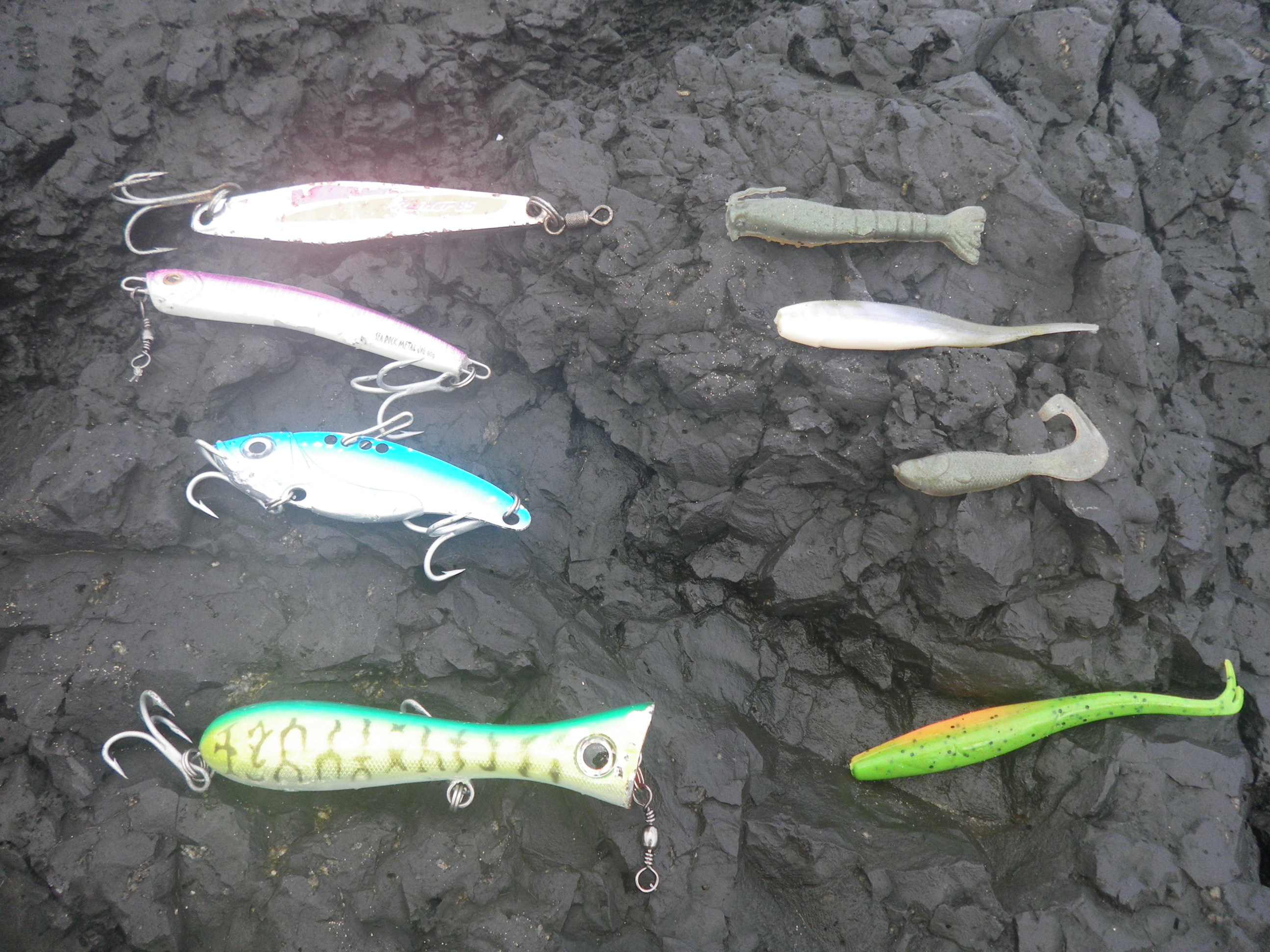
My lure arsenal for the Tweed rockwall

Saturday

Oh dear , oh dear , oh dear – another morning with no fish. As I have said before, this is the worst time of the year for me. The main estuary species – Flathead & Bream – have long finished spawning and as the water temperature climbs and weather patterns get more unpredictable they get harder to find. Add to that – flooded river systems and constant changes in wind patterns and I get stuck focusing on the ocean rock walls and ledges.

In these locations the fish come and go with the bait and the wind. Tailor, Trevally, Kingfish, Queenfish and even good sized Mackerel and Tuna will all come in close to the rocks if the bait is around. The Tailor are particularly voracious in these situations and you can catch them on almost any type of lure or bait. The Trevally are sometimes harder to please, often limiting their feeding period to an hour or so either side of dawn and dusk. The other species require you to be in the right place at the right time and this means putting in the casting hours – and it can be a long time between fish!

This morning I arrived at the north rockwall, at the mouth of the Tweed River at around 4.00 am. The horizon started to glow just as I rigged up and I started by fishing soft plastic lures through the last of the run out tide. I switched to a surface popper for about 30 casts and put in 50 casts with an 85 gram metal slug. Nothing I used produced results. At one point a fellow fisherman caught a 30cm Tarwhine on a fresh beach worm, but that was the only fish I saw caught.

Apparently a few decent Trevally had been caught at dusk, on Friday and everyone was hopeful that this mornings session would produce fish – But it didn’t! I gave up around 7.30 am as another of this summer’s rain showers arrived.

Iluka – Shark Bay in the rain – 3 Dec 2010

This slideshow requires JavaScript.


Friday
It wasn’t raining at 4.00am Friday – so I walked out on to the rocks in front of Woody Head. I was disappointed to still see a big sea. I tried casting from a few safer spots but after losing four jigheads to the rocks, I decided I needed another plan. I walked along the beach to Shark Bay. It is probably one or two km but at this time of the morning, it was a beautiful stroll. There were big black clouds everywhere but initially, at least, it stayed dry and there was not much wind.
I had swapped my heavy rod for a lighter set up and I was fishing with a 7’6” Nitro 2-4 kg Distance Spin Rod matched with a Shimano Stradic 3000 reel. I had loaded the reel with 3.8 kg Fireline in the yellow colour and tied on about 1.5 metres of 12lb breaking strain fluorocarbon leader. I had decided to fish lighter as I wanted to see if there were any good Bream around. This rig is also quite capable of land the odd small jewfish or Tailor should they show up.
I walked out onto the rock platform at the southern corner of Shark Bay and moved out to the north east corner. I had a few hours in this spot before the incoming tide would force me off. Just as I put in the first cast a shower came over and I was soaked in a few minutes. At least it wasn’t cold.
I started by fishing the GULP 4” Pearl Watermelon minnow soft plastic. This is a great imitation of a pilchard and has proved to be excellent bait in this location. But today I could not raise a bite. Maybe it was the murky water. I switched to one of my new favourites the GULP Crazy Legs Jerkshad in the New Penny colour. I also switched down in weight from a ¼ oz to a 1/6th oz jighead both with 1/0 hooks. This gives me a little less distance when casting but increases the sink time and gives the fish more time to strike. After a few casts with the new rig, a fish slammed the lure at the edge of the kelp covered ledge. I struck hard and then let it have some line. On the next surge I pulled it up through the kelp. It was a nice 36cm Bream. I cast out again and over the next few casts pulled in three smaller fish around the 30cm mark all on the same plastic.
With another rain squall on the horizon and the tide moving up rapidly I decided to head back to the campsite to try to dry out. I would think with all the rain, good Bream would be all around these rocky headlands. The only problem would be finding a safe place to fish for them.

Bribie Island – Bag of Flathead – 28 Sept 2010


Tuesday
I was back out wading around on Bribie Island this morning. The midges were doing their best to put people off and I swallowed more than a few for breakfast. With the weather warming up and the weed beds exposed at low tide, conditions are perfect for them.
I decided to focus on the sand flats at the bottom tip of the island. There is no defined rock ledge marking the edge of the Pumicestone Passage here. There is a smoother, sandy drop off, peppered with weed beds. With low tide around 5.30 am I was fishing the run in tide for most of the morning. I parked at Buckley’s Hole, waded out to about waist deep and then walked south, casting out in front of me, parallel with the shore.
I decided to start with the larger GULP 4” Minnow in the natural, Pearl Watermelon colour. This soft plastic lure looks remarkably like a pilchard in the water. As it was the bottom of the tide and there was no current flow, I rigged the soft plastic on a 1/8th 1/0 jighead. It was not long before I felt a solid hit on the lure. After a pause, I pulled up hard, then I thought I was snagged as I could hardly move the rod tip and line started to peel from the spool. But it wasn’t a rock it was a fish and initially it swam towards me so I got a little line back. Then I think it realised something was up or got fed up and started really thrashing around. With a couple of massive headshakes, it was off the hook and swam away. It was a big female Flathead. I consoled myself with the thought that it probably would have been too big to keep.
I carried on wading south putting long casts out in front of me and moving as quietly as I could. The bottom was predominantly sandy and fairly featureless now. I switched plastics to a GULP 3” Minnow in the Lime Tiger colour on the same jighead. After another 50 metres or so I had a bite, but no hook up. I cast back along the same trajectory, slowed my retrieve right down and added plenty of 3 second pauses. This time in the same spot I got a solid bite. I dropped the rod tip, paused and then struck. I had caught my first fish of the day, an under-size Flathead. I un-hooked and released it.
Now I had found them and over the next two hours, while wading another 200 metres or so, I caught 14 flathead, 8 or 9 were big enough to keep. So I took my bag limit of 5 and released the rest. I put on bigger soft plastics and smaller soft plastics but regardless of these different offerings, could not find any bigger fish. Everything was between 35cm and 45cm long.
I gave up around 10 am. I love this time of year – if you have been thinking of trying out soft plastics in the estuaries – now is the time.

Broomes Head Lagoon – Wild & Windy – 21 Sept 2010

This slideshow requires JavaScript.

Tuesday

I am just back from a trip down to Broome’s Head, just south of Yamba, in northern New South Wales. It is typical of the rocky headlands on that stretch of coast. You can fish on either side of the headland depending on the prevailing winds. However last week the weather really made things difficult. On Monday it rained all day while an enormous swell smashed over the rock ledges. I am pretty keen on my fishing but I could not find anywhere I could cast from.

Tuesday was better – well at least the rain had stopped. The seas were still enormous, with a three metre swell. Fortunately the northern side of Broomes Head has a sheltered lagoon. Just on dawn, I waded out into the lagoon and got as close as I could to its mouth. I cast out a 3” GULP Pearl Watermelon minnow soft plastic on a 1/8th 1/0 jighead. I wanted to keep my rig as light as possible to avoid getting snagged on the rocky bottom. I got a couple of touches and saw a few Long Toms following the lure in. After a few more casts, I hooked up with a small Bream – around 25cm. Then a couple of casts later I hooked up to a better fish. When I got him to me, he was a small golden Trevally. I hooked a couple more under-size Bream and a Moses Perch from this position before deciding to try to get closer to the lagoon’s entrance.

At its eastern edge the lagoon is filled through a gap in a long ridge of rocks. Here at the mouth of the lagoon there is some deeper water on either side. The outside of the lagoon entrance was far too rough to fish. But by walking out along the rocky ridge I found a spot from where I could cast into the deeper water just inside the lagoon. I started with the 4” GULP Swimming Mullet soft plastic on a 1/6th 1/0 jighead. I could not really let it settle for more than a few seconds on the retrieve, for fear of losing it to the rocks or kelp beds. I gradually got a feel for where I could stop and start the retrieve and what the sink rate was. After about 30 minutes of peppering the area with casts I caught a very good Bream – just on 35cm. On the next cast I caught another Bream, a bit smaller but also a good fish. Then things went quiet on the fish front and the wind was really howling. I switched to a 3”GULP Minnow soft plastic in the Pearl Watermelon colour and cast it out into the wash at the foot of the rocks. Just as I was about to lift the lure from the water it was grabbed by a big dark shape. The fish took the lure down deep into the kelp at the foot of the rocks and then just sat there. I was only running a 10lb leader so I decided to ease off the pressure and let him swim out of his hiding place. I dropped the rod tip and counted to ten then pulled hard. It worked and I slid a very decent fish up on to the rock ledge at my feet. After giving it the once over, I decided it was a Morwong or Mother-in-law fish of some kind and kept it for the table. I later found out it was a Spotted Hind. It did not taste much good and apparently is quite common down here. I now had plenty of fish for a family supper so I headed off for a hot shower.

Bribie Island – Whitepatch – 29 August 2010

Sunday Morning
The advantage of fishing from the shore is that provided you are prepared to wrap up, you can still fish in a 15 knot wind. Especially if you chose somewhere like the Pumicestone Passage which has a few, fairly sheltered areas. The other advantage of fishing at these times is there is almost zero boat traffic. All the wise boaties are tucked up in bed having lie in or just listening to Nugget’s fishing show and cursing the weather gods. I am not sure that I subscribe to the idea that there are less fish around in the estuaries than there were 20 years ago – but I do believe the massive increase in boat traffic and other noise and disturbance, has a big effect on our ability to find and catch the fish that are there.
On Sunday morning there was plenty of wind forecast but when I arrived at Whitepatch on Bribie Island, the water was reasonably calm. It was about 5.15 am and the wind had dropped away as the sun was about to come up. This hour around dawn nearly always produces slightly calmer weather. It was just on low tide and I started fishing on the slack water with virtually no tidal flow. I often find this is a slow time. I presume the fish are beginning to reposition themselves and are slightly confused as to where to lie in wait to ambush prey. Sunday was no exception and nothing of note happened until about 45 minutes later when the tide really started running in.
I was fishing a 3” GULP Minnow soft plastic lure in the Banana Prawn colour on a 1/6th 1 jighead. This is another great lure for bream but will tempt almost anything. There is a sizeable drop off all along the shoreline at Whitepatch – it is perfect to fish for about two hours either side of low tide. I had parked at the last car park before the entrance to the Bribie National Park and I was wading south, along the shore, casting up into the run in tide. I caught a few Pike and then a tiny Moses Perch and then I got a touch, a pause, another touch and then bang – the blistering run and head shakes that had to be a Snapper. Over the course of each year, in this spot, I catch perhaps two or three legal size snapper and many more just undersize. Unfortunately this one was in the latter category. He measured up at 28cm and I threw him back, after a quick mug shot. What is uncanny is the consistent way I get these fish when the start of the run in tide coincides with dawn.
I switched to a 2” GULP Shrimp plastic, also in the Banana Prawn colour. I was fishing with about a metre and a half of 10lb fluorocarbon leader, tied onto a spool of 1.8kg Fireline. About 40 minutes after catching the Snapper, I found a patch of Bream. I caught three fish in quick succession. The largest was approximately 30 cm long. Shortly afterwards I reached a large drain with weed beds on either side. These were now covered by approximately a metre of water. I cast out, methodically in a semicircle and caught several Pike and then a very small (25cm) Flathead. I moved on and about 30 minutes later reached a similar drain. I used the same tactics and was rewarded with another Flathead that was just on 40cm. Like all the other fish, I released it. By 9.30 am the water was now effectively too high to continue fishing over the edge of the drop off and the wind was steadily building, so gave up for the day.

Brisbane River – Pinkenba Rockwall – 25 Aug 2010

After a great week of fishing down at Iluka I was keen to get back out on my home patch around Brisbane. On Wednesday the weather was not too promising. With limited time and strong westerly winds I decided to try fishing along the Pinkenba rock wall on the north side of the Brisbane River. I usually access this spot by parking next to the QCL Cement Plant and walking around the plant to the river bank. There is a long stretch of rock wall that goes from the plant all the way to the mouth of Boggy Creek. It is fairly shallow all along here so I find it fishes best around high tide. My timing was good as I arrived right on high tide at around 9.45am. All along the rock wall there are areas where it has it has broken down and there is therefore plenty of structure at its base and as you move further out the lower rocks are completely covered in oysters.
My tactics here are to walk along the rock wall casting back up river and letting the soft plastic bump along the bottom with the current, with a few jerks every now and then. I have almost always caught fish right at the foot of this rock wall – I assume this is because the riverbed further out is fairly featureless and the bait stays close in. I walked slowly along the wall towards the river mouth but after an hour of casting, I had nothing to show for my efforts. I had been using my favourite GULP 4” Minnow soft plastic in the Pearl Watermelon colour on a 1/6th 1/0 jighead with a 10lb fluorocarbon leader. I decided to swap it for a ¼ oz blade lure in a silver rainbow colour. Sometimes the blades can be more effective at getting reluctant fish to bite. I think they annoy the fish into an attack. They have a great action and fish will feel their vibration in the water long before they see them.

Buy this time I had reached the spot where the rock wall has water on both sides. The north side is a shallow, tidal inlet next to the refinery tank farm. The bottom is mud and weed beds and as long as there are a couple of feet of water, there are nearly always flathead in here. After a few casts with the blade I finally found my first fish of the morning – a flathead just on 40cm – I took a picture and put him back (we are still finishing the Jewfish from Iluka at home). I carried on in this spot for a while but could not raise anymore. The water was very cloudy after the recent rain. I then put on a smaller, GULP 3” Pearl Watermelon Minnow and decided to walk back along the wall, up river. This is an excellent soft plastic for Bream – especially when lightly weighted. I swapped the jighead down to a 1/8th 1/0. The tide was really running out hard now and I started to get a few touches close into the oyster clad rocks. After another twenty minutes with no hook ups, the lure was slammed by a solid fish. The initial hit was very hard but it was only a 30cm Bream. I put him back assuming there would be more but despite trying a few other weights, plastics and putting the blade back on, I could not find them.

By now it was just past 1.00pm and even though it was warm and sunny, the wind was really blowing and there was less than a foot of water at the base of the rock wall, in places. I decided to stop for the day.

Bribie Island – Sandstone Point and Buckleys Hole – 5 August 2010

BRIBIE - THE MAKINGS OF A FISH PIE

Thursday looked like a great fishing morning – cool, not much wind and a run out tide through dawn. I decided to start off on the sandbanks of Sandstone Point. I put the waders on in the dark and wandered along by the old oyster jetty, on the mainland beside the Bribie Bridge. The sky was beginning to glow red. I have noticed that I don’t seem to catch many flathead in the dark. I get them around the bridge lights at night, but rarely seem to catch them out on the flats until there is a bit of light on the water. This may just be because I spend more time fishing in the daylight!
High tide was around 4.00 am and I started fishing at about 5.30am. I walked as far as I could along the sand banks and then turned back northwards. I was wading in about a metre of water, parallel with the exposed sand bank. I was casting up into the outgoing tide, trying to land my soft plastic lure right on the edge of the weed banks. As usual, it was the Pike that struck first – a few small ones then a monster – I thought initially it was a flathead but soon realised it wasn’t when it started thrashing around. I got it to the shore and measured it at 46cm – the biggest Pike I have ever caught.
Usually in these conditions I would expect to be getting plenty of flathead but things were a bit slow. I hooked then dropped a small on, about 30 metres short of the jetty and then a couple of casts later; I caught a 42cm fish. I was using the 4” GULP Minnow Grub in the Pearl Watermelon colour on a 1/8th 1/0 jighead. I could not raise anymore so I walked back to the car and drove over the bridge to Buckley’s Hole to fish the drop off there.
I arrived there at about 8.00am – with low tide scheduled around 10.00 am. I walked to the south and started wading north and casting a 2” GULP Shrimp in the Banana Prawn colour. I was looking for the Bream that are often to be found here. The tide was running fairly hard so I rigged the soft plastic on a 1/6th 1/0 jighead – this meant that I could get the plastic down deep fairly quickly. I waded up and down the beach casting out over the drop off and letting the plastic float down to the bottom with the current. After about 45 minutes of this, I found a patch of Bream and caught seven in quick succession, all on the soft plastic shrimp. Only three were big enough to keep and all three were about 28cm. The wind was now getting up and it was still cold and overcast so at about 10.00 am I decided to give up and grab a hot cup of coffee.
Next week I am off to Iluka in Northern New South Wales, to fish the rocks and beaches of the Bundjalong National Park. I am hoping to find some Tailor, monster Bream and no doubt, a few surprises. I will post the results as soon as I am back.

Bribie Island – Buckleys Hole – 29 July 2010

It was early Thursday morning and although it had been raining most of the night, the wind had died down so I decided to pack the waders and waterproofs and head up to Bribie to see what I could find. At about five o’clock. I had a quick cast under the bridge lights on the island side but there was nothing happening. It was slack water; just on low tide and the rain had stopped. The water was very calm, still and fairly clear.
At about 6.00 am I moved down to fish the mouth of the tidal lagoon at Buckley’s Hole. The Bream still appear to be spawning and this is a spot where they traditionally like to school up. It was now a couple of hours into the run in tide and I think this is often the best time to fish this area. I was looking for Bream but the first taker was a 30 cm Tailor. It hit the lure as soon as it dropped on the first cast. I was fishing the GULP 4” Pearl Watermelon Minnow on a 1/6th 2/0 jighead with 12lb leader. As I dragged it back to the beach you could see it munching its way up the plastic. It looked solidly hooked in the jaw but while I was photographing it, it managed to shake the hook and lure out – Tailor just never give up. I sent it on its way.
As dawn broke the Bream started to bite. I caught a 28cm fish then a couple of throw backs and then a good 32cm fish. I switched down to the 3” Minnow in the same colour and also used a 2” Peppered Prawn Shrimp. I caught about 6 more keeper size fish over the next hour or so and plenty of smaller ones. By about 8.00 am there was too much water to fish over the edge of the coffee rock ledge that runs along there, so I retreated. I had kept three better size fish for dinner and released the rest.

Landangler’s Tailor on Soft Plastics

I am sure you have all heard it said a million times – if you want to catch some Tailor you can’t go past a lightly weighted, West Australian Pilchard floating down off the back of the boat or a well place chrome slug cast from the rocks. Don’t get me wrong – it’s sound advice and it definitely will get you some fish, but I thought I would offer my experience of catching Tailor on soft plastic lures.
As you may have worked out, I love to fish with soft plastics and I almost only fish from the shore. So my experience of catching Tailor is based on those parameters. Firstly, most of the time when I get a good (keeper size – 35cm + QLD or 30cm + NSW) ‘chopper’, it is an accident. I am usually not targeting them; they just wallop whatever I am fishing with. I am usually prospecting on some sand flats, beside a bridge or rock wall and suddenly the line starts peeling and the rod starts shaking and I realise that I either have a Flathead on steroids or it’s a Tailor. This usually results in a bite off as I fish pretty light (10 to 12lb leader), but occasionally, if the fish is nicely hooked, I will get it safely to the bank. The plastic is usually pretty smashed up but if I cast it straight back out, I often get another. Then they are gone.
So this year, as the weather cooled, I decided I would actually try to catch some tailor with plastics. The first thing I did was switch to heavier tackle. I decided on a 6000 size spinning reel, loaded with 12lb Fireline down to a 20lb fluorocarbon leader. I also made sure I had the toughest jigheads that I could find, from 1/6th to ½ ounce. Then I thought about my rod. The problem, when choosing a rod for plastics in these circumstances, is the immediate compromise between strength and sensitivity. A ‘medium’ weight estuary spinning rod (something like a 7’6 3-6kg Berkeley Dropshot) gives you a good, sensitive connection to the soft plastic and so you can fish fairly light weight jigheads (1/8 to ¼ ounce) and still cast them out effectively. However if you hook up to a decent fish (in my book that is anything over 2kg) you are really going to struggle, especially if you need to pull it up a rock wall or onto a ledge. The alternative is to go heavier but then, inevitably, you lose a bit of the sensitivity. My ‘heavy’ plastics rod is the 11 Ft 6-15kg Rovex BARIO. This rod still has some feel in the tip but it is strong enough to heave some decent fish up the rocks. The downside is that it is very difficult to fish with much less than a 3/8 ounce jighead, as the rod is really too stiff to feel anything lighter. I have landed plenty of 2 to 5 kg fish with this rod – if you hook up with anything much heavier then you really need a mate with long handled gaff.
Once I had decided on the set up I looked for likely locations. This was tricky as I have caught Tailor from Yamba in Northern NSW right up to 1770 in Queensland, but I have usually caught the bigger ones when chasing jewfish from the rocks.
So my first experimental Tailor plastics session was fishing the end of the rock wall at the mouth of the Tweed River, about a month ago (in mid June). I find that the north side of the north rock wall is a good fishing spot, so I arrived an hour before dawn and found a large flat boulder near the end of the wall. I rigged up the ‘heavy’ rod. So which plastic to choose? Working on the principle that Tailor love Pilchards – I chose the GULP 4” Minnow in Pearl Watermelon – as it looks quite like one. It is basically a dark green on top with silver coloured under body and v shaped tail. It is an excellent all rounder that I often start with it. I rigged it on a 3/8 2/0 jighead. The first few casts – in the dark – produced nothing. Fishing from the rocks in the dark is pretty hit and miss, not to mention dangerous, so I usually wait for the pre-dawn light to see what I am doing. Yes – I have a headlamp but it is pretty easy to spook the fish by shining a few high powered LEDs down at them. Sure enough just as the horizon started to glow I got a couple of solid hits and then a good fish took the plastic right at the foot of the wall, on a fairly quick retrieve. A bit too big for a Bream and a bit too frenetic for a trevally, sure enough it was a good ‘chopper’, probably around 40cm. Once I turned it around, it broke the surface, in the foam, by the rocks, but as soon as I lifted it clear of the water, it started wriggling and wriggled off the jighead. In the space of half an hour, I had four more fish of a similair size. I landed two and lost two in a similair manner to the first. They have very soft mouths and once they are out of the water it is very difficult to stop yourself pulling the hook out. Then all went quiet for about forty minutes and they were back again. They were obviously chasing the bait schools up and down the rock wall. This time round (using the same plastic) I dropped the first fish and was bitten off by the second. By the time I had re-rigged they were gone. I stayed the rest of the morning and caught a few bream but the Tailor did not come back. The plastics had certainly taken a beating – I had to put a new one on after every successful hook up – but it seemed like a reasonable trade off.
The next trip was down to Iluka Bluff in Northern New South Wales. I had a couple of days there but due to the weather I could only manage two fishing sessions – the morning and evening of the first day. Conditions on that morning were perfect with only a light swell and virtually no wind. The Bluff is a large flat ledge at the end of a headland and there are tailor here all year round although they improve in size and numbers in the cooler months. Again I arrived in position pre-dawn on the southern side of the Bluff. I started with the same rig except I ran a 40lb leader and switched to the same shaped plastic in the Pumpkinseed colour. About 30 mins after dawn I was bitten off, then after re-rigging, I landed a nice 50cm Tailor and dropped two more in quick succession. Things slowed for an hour or so and then I down sized to a twenty pound leader. Third cast with the lighter leader and I was onto a decent fish which rubbed me off, but after a quick re-rig I got another 45cm fish which I landed. Downsizing the leader as the sun gets higher in the sky often works for me in this way, as does matching the size of the plastic, as closely as possible, to the bait that’s already in the water.
That evening the wind was up and so was the swell. Again the fish appeared to come on and off every 20 to 30 minutes. It certainly seemed like they were cruising up and down in front of the headland, chasing the bait. Each time they came by I would get a couple of knocks and nudges and sometimes a hook up. I like to use a pretty standard retrieve – it is always a tricky balance between getting the fairly heavy jigheads (3/8 ounce) down low in the water column and not getting snagged on the bottom. I usually cast out and count slowly to ten. On ten, I jerk the rod tip up, and pause while the plastic sinks again. Then I wind in some line and repeat the process. Finally, just on dusk I got the best fish of the trip – a 65cm Tailor and fortunately the rising swell more or less landed it for me, by washing it up over a ledge right at my feet. This time I had switched to the 5” Jerkshad plastic also in the pumpkinseed colour.
Although two trips hardly make a definitive study, I have had many rock fishing sessions which have produced Tailor on soft plastic lures and I think I can draw the following key conclusions.
There are a few disadvantages to using plastics. Firstly, they are expensive – the Tailor destroy them and you will rarely get two fish out of one plastic, often they will get munched before you even get a fish to the shore. Secondly, you certainly cannot cast them as far as a heavily weighted bait or slug. Thirdly, jigheads often do not hook up as solidly as a treble right in the mouth – so slugs can make it easy to lift the fish to safety without pulling the hook.
However, the single biggest advantage of using soft plastics for Tailor is the ability to fish a moving lure through the lower part of the water column, more consistently, than you could a bait or a slug. You simply cannot move bait along the bottom with the action of a plastic and a slug is almost always on an upward trajectory once it gets up to speed. So if the fish are travelling along, or close to the bottom, I think you will get more hooks ups with a soft plastic, than with a slug or bait. Of course, if they are feeding on the surface they will still take the plastic on the drop, but maybe they will be more interested in a surface popper, fast moving slug or lightly weighted pilchard.
Of course, none of the above applies in the weeks that lead up to spawning off Fraser Island. If you can locate the fish at that time – they are usually so thick and so competitive that you can catch them with almost any type of bait, lure or even an old sock!
I hope you found this useful and, as always I would welcome any comments – questions or experiences that you may wish to share.

Brisbane River – Boggy Creek – 23 July 2010

If you have children of school age you will know that most officially classified biological weapons are far less toxic than the coughs and colds they bring home. I succumbed this week and I have been feeling like crap. I missed my usual fishing session on Thursday, so I decided to put in a couple of hours this morning, close to home, at Boggy Creek, on the Brisbane River.
For those of you who don’t know it, Boggy Creek is a small arm off the Brisbane River on the north side of the Pinkenba Shell oil terminal. You can fish all along the northern bank, but I usually start by the small pedestrian bridge that leads across to the refinery. You cannot fish on the bridge as it has a security gate and belongs to the refinery.
I find this creek fishes best for a couple of hours on either side of the high tide and it is a great spot pre-dawn. There is a small rock wall on either side of the bridge and the channel narrows significantly at this point. This has cut a fairly deep channel under the bridge. There is always plenty of bait under the lights and once the tide is running there are large swirls, eddies and sections of slack water where the big fish lurk.
I started around 9.00 am – the wind (from the southwest) was getting up and the run out tide was really moving. The water was fairly clear so I started with a 3” GULP Pearl Watermelon Minnow on a 1/6th 1 jighead on 10lb leader. My strategy was to cast out, upstream and let the plastic float with the current down under the bridge. I would jig it every 5 seconds or so to stop it getting snagged. There is plenty of manmade structure under that bridge ranging from tyres to shopping trolleys. After a few prospecting casts I switched to the GULP Pumpkinseed Minnow Grub. I find the paddle tail pattern is good when there is a strong current. The tail moves realistically even when the plastic is at rest on the bottom and it is almost irresistible as it sinks. Sure enough – second cast a hungry Pike wallops the plastic. This scenario played out a few more times and then I cast over towards the far rock wall. On the retrieve there were a few nudges and tickles and then a solid hit and hook up. As I brought the fish in, a great school of Pike scattered before it. It turned out to be a 28cm Bream with a Mohican fin! I released him after a picture or two and then decided to move up the bank towards the Brisbane River.
There are a number of openings all along the bank from which you can fish. I stopped at each one and did a semicircle of casts in each location. When I reached the mouth of a small drain I was a bit more thorough with my coverage and on about the 6th cast I pulled up a 35cm Flathead. I let him go and got another smaller one from exactly the same spot. The water was getting very shallow now and it was blowing a gale so decided to give up for the day.
It was good to get the rod in the water and find a few fish – even if there was nothing for dinner.

Bribie Island – Buckleys Hole – 15 July 2010

Thursday morning – I got up at 4.15 am and drove from Brisbane up to Bribie looking forward to a good fishing session. Low tide would be around 6.40 am and although the forecast was for moderate West to Southwest wind, it was pretty flat when I arrived.

I decided to start off under the Bridge lights on the island side. I find the bridge lights attract the bait and there is often something waiting to pounce on your lure/ bait from the dark water around the pylons. I loaded a 1/6th ounce, 1/0 jighead with Gulp 3” minnow soft plastic in the pearl watermelon colour and sure enough, first cast I pulled up a Pike and next cast 15cm Tailor. I moved up and down the weed banks, along the edge of the Passage, on either side of the bridge. After about half an hour I picked up a 45cm Flathead about 15 metres north of the bridge., right on the edge of the weed.

The first glow of dawn was showing so I decided to move down to the mouth of the tidal lagoon in front of Buckley’s Hole. This is an excellent Bream spot especially when they are schooling up to spawn. Using the same plastic and weight I cast up into the last of the run out tide and let it sink down along the coffee rock ledge – jigging every 5 seconds or so. After a few casts I caught an undersized Bream, followed by a few Pike and gradually I started to catch a few keeper Bream. Every third fish or so, was legal and after an hour I had 5 keepers between 25cm and 30cm.

At about 8.30am I called it quits and went to find a hot drink.

PASSAGE BREAM ARE BEGINNING TO FIRE
BREAM FROM BUCKLEY’S HOLE – BRIBIE ISLAND

Bribie Island – Oyster Jetty & White Patch – 11 July 2010

 Sunday morning and finally a good forecast – 4 knots SE wind and only a chance of a shower. I was out on the Bribie sand flats at 5.15 am wading in the dark. I moved down to the old oyster banks on either side of the jetty, on the mainland side of the Passage. I flicked soft plastics – 2” Gulp  Shrimps in the Peppered Prawn colour  and 4” Gulp Minnows in the Pearl Watermelon colour on a 1/8th 1/0 jighead. As the sun came up I was constantly dragging up the slimy algae. This now seems to be covering the regular sea grass in that area. I caught a pike and the plastics kept getting tugged and bashed by Long Toms. The sky reddened and suddenly I could see what I was doing but then, after 10 minutes, it was grey and overcast as the sun moved up behind the clouds.

I decided to change locations and drove up to White Patch to a spot at the foot of one of the staircases, which I have named Pike Rocks. Sure enough, on the first cast I caught a 40cm Pike and then got a fish a cast for about twenty minutes – all Pike except for a  small Bream and a Moses Perch. I kept the big Pike for the cat and wandered south casting out over the coffee rock ledge that runs the length of the shore. I caught more Pike and then a 25cm Flathead. Finally I got slammed by a 30 cm Tailor which jumped and dived and shook as only Tailor can. I put him back after pulling the mangled GULP 3”  Minnow from his jaw. I cast all around but could not find any more so at 8.45 am – almost the top of the tide – I gave up and headed for a hot shower and breakfast. Only the cat got to eat fish today.

PIKE

Fishing From the Shore in Queensland and New South Wales

Hello – I am Landangler AKA the Mullet Musketeer – so named because my early attempts at casting were closer to fencing than fishing. I love to fish the estuaries, rocks, beaches and bays of the beautiful Queensland and New South Wales coasts. This is my blog where I will post fishing reports  from time to time. Hopefully my experiences will enable you to learn about great fishing spots and techniques and also quench your thirst for fishy tales when it feels like a long time until the next trip.