Tweed River – The Rockwall – 14 Dec 2010


Tuesday

I had seen a few recent reports of anglers catching good fish off the Tweed River mouth rockwall. I have always loved fishing this spot, so on Tuesday I decided to give it a try. The problem with the Queensland summer is that early starts need to be really early. To be at the Tweed for the best fishing, you really need to arrive just before dawn. That means a 3.00 am departure from Brisbane at this time of the year.
The Tweed River (like just about all the rivers in Queensland and New South Wales at the moment) is in flood. It’s brown and murky, like the colour of strongly brewed tea. Theoretically, the most likely time to get fish around the mouth is the end of the run in tide, when the water will be at its clearest and saltiest. However, fish hang around the mouth all the time in these conditions, as the surge of fresh water washes down all sorts of potential food for them. There is often a clear line on the surface were the brown river water mixes with the clearer blue/ green ocean. This is usually my target area.
The rockwall on the north side of the Tweed is easily accessible and has a number of rock ledges that make for great casting platforms. I walked out to the end of the wall at around 4.30 am. Unfortunately I had missed dawn, but I rigged up as quickly as I could and got started. I have caught fish here on soft plastics, metal and hard-bodied lures, but at this time of the year I prefer to use slugs and surface poppers. The surface poppers seem to work best for me, just before dawn, in the half light. I believe it is the combination of slightly lower light and hungry, feeding fish that makes them successful. I have caught plenty of Tailor and Trevally at this time, in this spot.
As I had missed dawn I decided to fish lower in the water column and use a metal slug. I like to use the HALCO Twisties in the 85gm weight or the SPANYID Raiders/ Snipers in the 85/95gm weight, but just about any metal lure will catch fish here. I use my trusty 11Ft ROVEX Bario rod with a SHIMANO Stradic 6000 reel. For line I use 40lb PLATYPUS Bionic braid in the hi-vis pink colour and tie on a two metre, 25lb fluorocarbon leader. The knots need to be good and the reel needs to be carefully spooled. The long rod and relatively heavily weighted lures means you are putting a lot of pressure on the terminal tackle with every cast so, it needs to run smoothly.
I started with an 85gm HALCO Twisty in the chrome colour. I generally cast the slug about 30 to 40 metres, let it sink (count to ten) then wind it in very fast, keeping the rod tip down as close to the water surface as I can. The idea is to keep the lure sub-surface for as long as possible. If I believe the fish are in close, I may stop the retrieve twenty metres from the wall, allow it to sink back down and crank it up again.
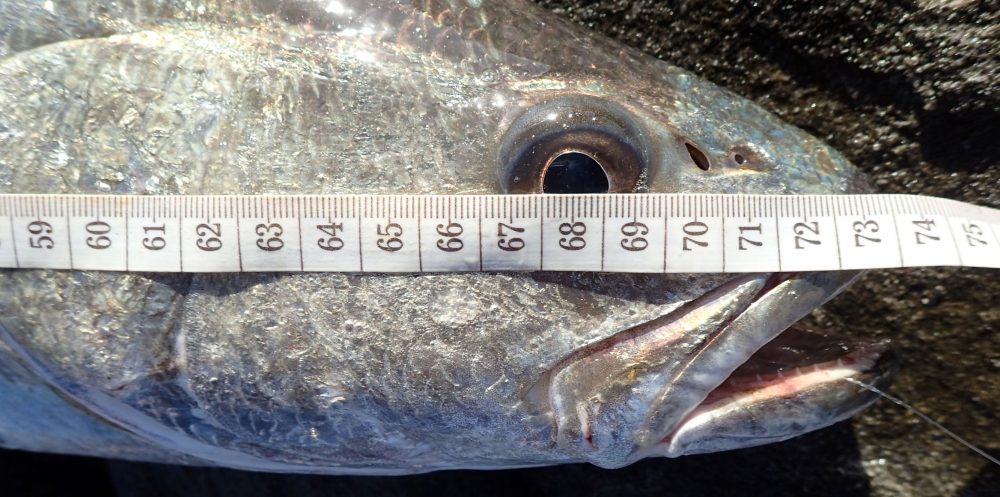
I cast all around the end of the wall with no result. The tide was running out and it was around 8.30 am. I started putting in big casts, along the line were the dark water from the river meets the sea, directly off the end of the rockwall. About 25 metres out, half way through the retrieve – whack! The rod tip bends and line starts peeling. Initially the fish is running out to sea – ok, at least it is not heading for the base of the rocks. I look around for where to try to land it and conclude that I have to get it round to the side of the wall. The front is too rocky and there is still too much swell. I opt for the ocean side as this is a little more accessible. The fish has made a couple of solid runs but a couple of minutes into the fight it decides to head towards the wall. All the work I had done trying to get it round the corner is instantly undone, as it dives down towards the base of the rocks. The first surge of water lodges the leader firmly in the barnacles and on the next one – ping, the fish is gone.
I don’t know what it was. I doubt it was a Tailor as there was no mad shaking – my guess would have been a Trevally or possibly a Kingfish. I will never know. I carried on until my shoulders burned from the casting but I could not find another. At about 10.00 am I was drenched by an incoming shower and so I gave up. The fish definitely won today – perhaps I will try a forty pound leader next time!

Yamba – Jewfish – 3 Dec 2010

Friday
As the rain poured down I headed in to Yamba, mid morning, to visit the local tackle store and replenish my supplies. I stopped for a coffee and the rain eased off. I decided to have a look at the fishing off the rocks, down below the light house in front of Yamba.
It was about 11.30 am and the sea was doing a good impersonation of a washing machine, but the rock walls at the mouth of the Clarence River provide some shelter for this area when there is a north easterly wind. I found a safe ledge on the rocks and watched the swell for a while.
I rigged up the big rod – a Rovex Bario 11”. I put on a 1/2oz jighead and a GULP 4” Pumpkinseed Minnow soft plastic lure. I cast around and lost a few jigheads as I got used to the terrain. After about 50 casts, I hooked up to a very small Soapie (juvenile Jewfish) around 30 cm long. After a quick snap, I released it.
The rain started again and by now even I had reached the end of my weather tether. With no dry clothes I decided it was time to pack up camp and head back to Brisbane.
So overall, the good news is the fish are there. The bad news is the weather may well make them very hard to get at this month.

Iluka – Shark Bay in the rain – 3 Dec 2010

This slideshow requires JavaScript.


Friday
It wasn’t raining at 4.00am Friday – so I walked out on to the rocks in front of Woody Head. I was disappointed to still see a big sea. I tried casting from a few safer spots but after losing four jigheads to the rocks, I decided I needed another plan. I walked along the beach to Shark Bay. It is probably one or two km but at this time of the morning, it was a beautiful stroll. There were big black clouds everywhere but initially, at least, it stayed dry and there was not much wind.
I had swapped my heavy rod for a lighter set up and I was fishing with a 7’6” Nitro 2-4 kg Distance Spin Rod matched with a Shimano Stradic 3000 reel. I had loaded the reel with 3.8 kg Fireline in the yellow colour and tied on about 1.5 metres of 12lb breaking strain fluorocarbon leader. I had decided to fish lighter as I wanted to see if there were any good Bream around. This rig is also quite capable of land the odd small jewfish or Tailor should they show up.
I walked out onto the rock platform at the southern corner of Shark Bay and moved out to the north east corner. I had a few hours in this spot before the incoming tide would force me off. Just as I put in the first cast a shower came over and I was soaked in a few minutes. At least it wasn’t cold.
I started by fishing the GULP 4” Pearl Watermelon minnow soft plastic. This is a great imitation of a pilchard and has proved to be excellent bait in this location. But today I could not raise a bite. Maybe it was the murky water. I switched to one of my new favourites the GULP Crazy Legs Jerkshad in the New Penny colour. I also switched down in weight from a ¼ oz to a 1/6th oz jighead both with 1/0 hooks. This gives me a little less distance when casting but increases the sink time and gives the fish more time to strike. After a few casts with the new rig, a fish slammed the lure at the edge of the kelp covered ledge. I struck hard and then let it have some line. On the next surge I pulled it up through the kelp. It was a nice 36cm Bream. I cast out again and over the next few casts pulled in three smaller fish around the 30cm mark all on the same plastic.
With another rain squall on the horizon and the tide moving up rapidly I decided to head back to the campsite to try to dry out. I would think with all the rain, good Bream would be all around these rocky headlands. The only problem would be finding a safe place to fish for them.

Iluka – The Rockwall – 2 Dec 2010

This slideshow requires JavaScript.

Thursday

I went to bed in a heavy rain shower and woke up to yet another one at about 4.00 am. After a while it eased off so I pulled on the (now very wet and fairly malodorous) fishing boots and made a cup of tea. The wind was light from the north east but as I walked out from Woody Head in the half light of dawn, I could see the swell was significant and the rocks were going to be too dangerous. I jumped in the car and headed down to the rock wall that runs out from the northern bank of the mouth of the Clarence River, at Iluka.
Fishing the Iluka rock wall is not for the faint hearted. You need good boots and good knees. It is a long walk from where you park to the best fishing spots. The first half of the wall has a nice pathway along the top, but as you reach about half way, the fill underfoot gets bigger and bigger until you a walking across wobbling boulders. Finally in the last 200 metres all the loose fill has been washed away and what is left is a mass of boulders. If you persist and clamber on, there are a few good flat boulders that make excellent fishing platforms on either side, but the most consistent fish holding spot, for me, is the wash around the base of the wall at the very end. Depending on the wind and tide you can either fish the river side or the ocean side
Depending on the wind and tide you can either fish the river side or the ocean side. I recommend giving both a try. I usually put in a few casts whilst walking out and one of these got smashed at the foot of the rocks by a small Tailor. I was using the GULP 5” Pumpkinseed Jerkshad soft plastic lure on a 3/8 2/0 jighead. I landed this fish after a short fight and as it was only just legal size at around 35cm, I threw it back. I had a few more casts here with no further action and so I moved on to the end of the wall.
The swell was calming down a bit, but the rain was still blowing over in 10 minute showers. There was too much swell to fish directly off the end of the wall, so I started off fishing the north side of the wall. The tide was running out and I assumed that the fish would shelter from the current on the ocean side of the wall. I switched to a ½ oz 4/0 jighead and put on a GULP 7” Limetiger Crazylegs Jerkshad. This is a great plastic with a split curly tail that flutters, as it sits or sinks, in the current. I was sure there would be some Jewfish around. I put in about 50 or 60 casts without result, so I switched to the river side. Fortunately, the rain was flattening the sea now. After a few casts out into the mouth of the river, the line came up tight and the rod tip started shaking. This is a tricky spot to land a fish. You are a couple of metres above the water line and you just have to heave the fish up. If you are on your own this is your only option. I find a long handle gaff is too hard without someone to hold the rod. I had a good size Tailor on. Tailor have such soft mouths that the final lift is even more difficult. Sure enough, as I tried to raise it clear of the water, I pulled the hook. I put on a fresh soft plastic and cast out in the same spot. After a few seconds I got a solid hit and I dropped the rod tip. When I lifted it I had another fish on. After a short fight, I successfully landed another Tailor. At about 45cm, I decided to keep this one.
I continued to cast in semicircle in the area but the fish had moved on or they had stopped eating because I could not raise another bite. Finally after another rain squall I packed up.

Iluka – Shark Bay – 1 Dec 2010

This slideshow requires JavaScript.


Wednesday

It rained all night on Tuesday and most of Wednesday morning. I got up early and surveyed a few rock fishing spots around Woody Head and Iluka Bluff, but the swell had got up during the night and there was really nowhere to fish on the morning high tide. The Clarence River was now a tea coloured soup with lots of debris floating around, so that was not really an option.
I grabbed a cuppa and watched the rain pour down from my tent. Thankfully, it was doing a good job of remaining waterproof. Around 11.00 am the rain eased off and so did the wind. I decided to have a fish in Shark Bay which is a little to the north of Woody Head. There is a low rock promontory in the corner of the bay, which you can walk out to at low tide. On the north east side of the promontory there is a pronounced rock ledge that is covered in kelp. About fifty metres further east there is a partially submerged patch of reef that rises just above sea level, at low tide. As the tide runs in and out, it funnels bait into a twenty to thirty metre channel which is a great area to target all kinds of species. There are often birds smashing into the baitfish in this area but there was no action when I arrived around 11.30 am.

I had my new felt-soled Cloudveil fishing boots on. I prefer these to the rubber booties with studded soles, which I have been using. The felt gives you an excellent grip but the tougher boot also gives good ankle support. To cast out over the kelpy rock ledge you really need to stand about knee deep in the water. You can only really get close enough to it for a couple of hours, either side of low tide. The water was certainly cooler than I expected and definitely much cooler than usual for this time of year – maybe it’s all the rain. I started with soft plastic lures on a 3/8 oz 3/0 hook jighead. I tried a number of shapes in the Pumpkinseed and also a few other colours and apart from a tiny Moses Perch, I did not catch anything.

After an hour or so, I decided to put a metal slug on and have a spin for some Tailor. I put on a 60g Mojiko (Anaconda) slug in a pink/purple colour and started casting. I like the colour of these slugs but I suspect the reason Anaconda can’t give them away, is that after about ten casts, all the colour chips off and you are left with a zinc coloured battered piece of metal. This can still catch fish but it doesn’t look too impressive. I was putting in very long casts, trying to land the slug as close as I could to the exposed reef. With all the kelp and rocks it was very difficult to tell whether I was getting hit or just catching on debris on the retrieve. However after about 50 casts I tried to yank the lure free of what I thought was some kelp and the rod tip started shaking and line started peeling. As the fish came towards the ledge it made a good leap and I could see it was a nice Tailor. It tried to get down under the ledge but I tightened the drag and pulled it over the top and up to my feet. My arms were burning from all the spinning so after a couple of follow up casts, I cleaned up the fish and headed back to camp. After a couple of hours on ice, I ate fresh fried Tailor fillets for dinner. Only one fish – but a good one at about 55cm.

Iluka – Frasers Reef – 30 Nov 2010

This slideshow requires JavaScript.

Tuesday
I am just back from a week down at Iluka. There were fish around but the weather did its best to stop me catching any. The consistent northerly winds created a constant swell at most of the rock fishing spots and the rain just kept coming.
I arrived last Tuesday, 30th Dec and, in hindsight, the conditions that day were the best. I started early in the morning, just on dawn, looking for some jewfish from the rocks around Frasers Reef. The swell was just fishable but every now and then I got soaked by a surge that slapped up against the rocks and came straight down on top of me – at least it was warmer than June and September. The tide was about half way in.
Any plastic in the Pumpkinseed colour is a firm favourite with the locals and I rigged a GULP 5” Jerkshad which has worked well for me in this spot. The swell was big and after a few casts with a 3/8 oz jighead, I switched to a heavier ½ oz jighead. Soon after sun up I got a few bites and nudges at the foot of one of the bommies that I like to cast at from the shore. As always, it is very difficult to get a plastic down on the bottom and leave it there for any length of time. If you jerk it off the bottom too quickly the fish don’t find it and if you leave it too long you get snagged. Add in the swell and the murky water and things did not really look promising.
I persisted and got soaked and snagged a few times and then switched to a smaller GULP. I also changed down from 30lb to 20lb fluorocarbon leader. It started to rain. A couple of casts later I had a fish on. I played it for a bit and then noticed a huge wave building, about fifty metres offshore. I tightened the drag and made an effort to get the fish up on the preceding, smaller wave, but I just could not pull it up. I crouched and the wave smashed against the rocks. The plume of water went straight up for 5 metres or so before absolutely soaking me. But as the water receded, I was delighted to hear some tail slapping and just beside me there was a small school jewfish, just about legal in NSW, at a little more than 45cm. I decided to release this fish in the hope of finding a better one. I removed the jighead without too much trouble and speared the fish back into the foam.
About twenty minutes later I had another one on and despite the strong current, it felt a bit bigger. I decided to walk it round to a more sheltered landing spot and got another soaking in the process. I managed to hold on and let the swell lift it onto a ledge. I then grabbed the leader and pulled it up. It was a better fish at around 50cm long, but it was no monster. This one I kept for dinner and after cleaning it up in the rain I decided to give up at around 9.30 am.

Bribie Island – One Flathead at a time – 19 Nov 2010

This slideshow requires JavaScript.

Friday

I was glad to see that the wind was forecast to turn around to a Southerly over the weekend, but less excited to see it would be blowing 20+ Knots. I decided to get one more fishing session in before that happened, on Friday.

I could not get out there for dawn, but managed to get up to Bribie Island around 9.00 am. There had been a far bit of rain over night and again, the water was fairly murky close to the shore. I only had a few hours available and I was fishing the back half of the run out tide. I tried Whitepatch for a while but I could not raise anything, so I moved down to the muddy/ weedy flats on either side of the old Oyster Jetty, on the mainland side of the Bribie Island Bridge.

I walked south down to the corner, around which sits Sandstone Point. I then turned and started wading north, about waist deep in water, putting in long casts ahead of me. There were lots of small baitschools around and plenty of small sand crabs. I was fishing my favourite GULP 3″ Minnow in the Pearl Watermelon colour on a 1/6th 1 jighead. In this area there is weed everywhere and you have to pull you lure through it from time to time. Your jighead is constantly snagging on the weedy bottom but when you get a solid single thud – you know you are onto a fish. This happened just to the south of the old Oyster Jetty, after about an hour and half. In fact I was just about to give up. The fish took a bit of line in a good, solid initial run. It felt like a reasonable sized fish but as it was swimming with the current, I was not sure. The beach was 40 metres away, but I opted to walk the fish back there, rather than try to grab it in the water. After a slow tow and few more good runs I had it on the muddy sand. It was a healthy 54cm Flathead. As you can see from the pictures – it was only just hooked.

That completed another single fish session. Hopefully, the wind change may make things easier next week.

Bribie Island – The Old Oyster Jetty – 17 Nov 2010

Wednesday
I started fishing at about 9.15 am – not ideal, but sometimes life gets in the way of my true calling. It was a fantastic Queensland day with bright sunshine and light breeze from the North West. I was at my usual haunt – Bribie Island. I headed up to Whitepatch where I had caught a few fish on Sunday. The tide was about half way out with low tide forecast for around 12.45pm.
I rigged up with a very light 1/32 oz jig head and put on a Gulp Sandworm in the Camo colour. I was trying for a few whiting. There were plenty around – I suspect their favourite food is the soldier crabs that come out on to the flats, in huge numbers, at low tide.
I caught a couple of very small Whiting and then decided to look for something bigger. There was plenty of bait in the water – whiting, garfish etc. I upgraded to a 1/6th 1/0 jighead and put on a GULP 2” Shrimp in the Peppered prawn colour. I walked up and down the ledge that runs all along this section of the Passage and cast alternately; one over the edge and one out in front of me, into the shallow water on top of the ledge. I did this for well over an hour without success. At one point a hungry Pike made a great lunge at the lure just as I lifted it out of the water, but I did not get it.
At this stage I think it is fair to point out that I usually find November, December, January and February by far the toughest months to fish the Queensland estuaries from the shore. If I look back through my diaries there is a dramatic drop off in my catch rate after the Flathead finish spawning and the water warms up. However, summer brings the possibility of rarer, but exciting species such as Mangrove Jack and Sweetlip and even the occasional pelagic, like Tuna or Mackerel. It is a different style of fishing and requires a bit more work. You have to find them and this means lots of long casts and long walks/ wades.
I decided to switch spots and drove over to the mainland side of the Bribie Island Bridge. I waded out onto the muddy weed banks just to the south of the old oyster jetty. By now these were only covered with about 60cm of water. I put on the Gulp 3” Minnow in the Pearl Watermelon colour – I stuck with the 1/6th 1/0 weight jighead. I was aiming at the sandy patches in between the weed and the edge of the rubble piles that dot the area. There was a bit of weed floating around but not enough to make the fishing difficult. About 40 metres to the south of the jetty I cast into a piece of clear sandy bottom and just as the plastic hit the edge of the weed, I felt a dull thud. Finally, after three hours of fishing I was on to a reasonable fish. I gave it plenty of line and gradually towed it back to the shore to unhook. It was too valuable to try to risk grabbing while wading around in the water. When I got it up and away from the water it was a respectable 46cm Flathead. It was now right on low tide and after a few more casts to see if the fish had any friends around, I gave up.
The fishing is getting harder but the harder they are to find, the sweeter they taste!

Bribie Island – Bridge, Buckleys Hole and Whitepatch – 14 Nov 2010

This slideshow requires JavaScript.

Sunday

After a month away from fishing, I was keen to get a line in the water as soon as possible. I decided to head up to Bribie Island and was on the road from Brisbane at 3.30 am. A lot changes in 4 weeks – the water has warmed up, sunrise is a good deal earlier and there has been plenty of rain. As I waded out under the bridge, on the island side, the first thing that struck me was the murky water and the lack of surface activity. Then I gradually realised that the plus side of all the rain and the northerly winds, was distinct lack of weed floating around.
I started by casting my old favourite soft plastic – the GULP 4” Minnow in the Pearl Watermelon colour – in close to the Bribie Island bridge pylons. Not much happened for half an hour or so. I had a few nudges and bumps, but no hook ups. Finally, I put a cast right into the foot of the second pylon and it scraped the barnacles as it went into the water. Next thing the line went taught but with not much weight on it. I wound in the line and had my first fish of the morning a 10cm Moses Perch! As the sky lightened I caught a couple of small Pike. At about 5.30 am I decided to move on.
I drove down to the sand flats at Buckley’s Hole, at the southern tip of Bribie Island. High tide had been at 3.30 am and now the tide was running out strongly. The water here was very cloudy. I think this is due to the hollowing out of the banks at the mouth of the tidal lagoon. You can see where the current has washed the sand away and revealed the mud underneath. During the run out tide this further clouds the water. Despite the discolouration there was plenty of surface activity and there were Whiting everywhere. On many casts my plastic would land in the middle of a school and send them jumping in all directions. There were also plenty of herring and other small bait fish around. Perhaps because there was so much bait in the water, I was still casting around after an hour or so with no fish. There were plenty of jellyfish around, no doubt blown in on the northerly winds. The turtles were also out in force and at about 6.30 am a Dugong swam past.
I changed plastic to a GULP 2” Shrimp in the Peppered Prawn colour which I was fishing on a 1/6th 1/0 hook jighead. I was using a 10lb fluorocarbon leader tied to 2.8kg Fireline. I had my favourite Loomis GL2 Light spin rod with a Stradic 3000 reel. About 300 metres south of the mouth of the tidal lagoon I got a couple of hits that I took for a Pike or Bream. I cast back again into the same spot and almost instantly felt the solid bite of a Flathead. I was so excited I nearly catapulted him out of the water on to the shore. He was just under the legal size limit so I snapped him and put him back. In the attached pictures you can see just how cloudy the water was. I carried on for another 30 mins without success and then decided to change spots.
I drove up to Whitepatch beach, further up on the inside of Bribie Island. It was now almost low tide, so I stayed out of the water, initially. I cast out the same soft plastic shrimp on to the ledge that forms the edge of the Pumicestone Passage, all along this beach. There was only about 50cm of water covering the ledge and again, the water was very murky. On the third or fourth cast, a fish slammed the soft plastic shrimp and took off over the ledge. I let it have some line then moved down to the edge, tightened the drag a little and pulled it up and over. I then dragged it up on to the sand. It was a nice 52cm Flathead and it went straight into the bag for dinner.
As the tide started to run in, I decided to try my Snapper theory for this spot. My experience suggests that they often feed in this area during the first half hour of the run in tide. This seems to be especially true when these are the conditions just after dawn. I prefer a plastic with a curly tail for Snapper but I didn’t have one, so it was back to the trusty GULP 4” Minnow in the Pearl Watermelon colour. The fish are usually in close to the ledge but I cast a fair way out, let the plastic sink then skip it across the bottom fairly slowly, increasing the pause to five seconds or so, as the plastic comes close to the ledge. Right on cue, on the third cast the rod bends over and I am losing line to something that can only be a Snapper. After a quick tussle and a slight tightening of the drag I successfully pulled it up on to the sand. It was just under legal size at around 34cm but this is a good fish for this spot. As I photographed it, I noticed it had lost one of its fins – it’s a tough ocean out there! I let it go and decided to pack up for the day.
It was 9.00 am and I had fed my craving – watch this space – I will be back out there again soon.

Brisbane River – Pinkenba Rockwall – 7 Oct 2010


Thursday
I only had time for a short fishing excursion today. I checked the tide and saw we had a pretty high high-tide at around 9.00 am at the mouth of the Brisbane River. I could not start fishing until about 9.30 am so I decided to walk out, along the Pinkenba rock wall in search of some Flathead.
You can get access to the rock wall down a small track that runs down to the river side, behind the Queensland Cement Plant, which is next to the Pinkenba boat ramp. I have caught Flathead, Bream and Tailor all along this wall. When the high tide is over 2 metres, as it was today, I like to walk along the wall until the water is flowing over the top of the broken down sections. The tide forms small drains and channels as it runs out and usually, this is where the fish are lurking.
I walked for about 35 mins until I could walk no further. I then turned around to walk back along the wall, casting out on either side and working my lure back along the bottom beside the wall. The tide was now running out strongly. Unfortunately the big tide had made the water a bit murky. I have always found the more natural coloured lures work well in the Brisbane River so I started fishing with the GULP 3” Minnow soft plastic on a 1/6th 1 jighead. I lost a few jigheads to the oyster covered rocks on the river side of the wall and watched a few tiny Bream follow it in – but after an hour I had nothing to show for my efforts.
I turned my attention to the lagoon side of the rock wall. The lagoon sits between the wall and the BP Refinery Tank Farm. It is less than two metres deep, even on a high tide but it has plenty of weed beds that attract the Flathead. I found a break in the wall where the water was running into the lagoon. I cast in a semi-circle, into the eddy that had formed a few metres behind the opening. I felt a few small hits then hooked a 10cm Whiting. I carried on and after a few more casts the lure was slammed by a Flathead, just at the base of the rock wall. I landed him – took a picture and sent him on his way. He was just over 40cm but there is more than enough Flathead in the fridge at present. I carried on in the same spot, peppering the area with casts and after about 5 more I had another Flathead around the same size. I also released him.
I gradually moved back along the rock wall casting as I went but despite changing colours and even trying a blade lure, I did not get another touch from the fish. I arrived back at the car at about noon.

Bribie Island – Buckley’s Hole Sand Flats – 5 Oct 2010

This slideshow requires JavaScript.


Tuesday
I could not get to Bribie Island to start fishing until about 9.30 am on Tuesday. I decided to head back to the sandbanks to the south of Buckley’s Hole. This area has consistently been producing fish for me –no monsters but plenty of fish.
The wind had turned around from a northerly to a south easterly and unfortunately, it had brought the weed with it. The tide was running out so I walked down to the bottom of the island then turned around and waded back north. Despite the weed and recent rain, the water was fairly clear and the sun was out. I decided to rig up a GULP 3” Minnow soft plastic on a 1/6th 1 hook jighead. I was told once that in clear water and bright conditions the weirder colours often do well, so I chose the Lime Tiger colour which is an orange and green combination. This theory is counter intuitive but it certainly seems to work – especially on a sandy bottom.
I moved forward slowly, putting out long casts in a semicircle, in front of me and then slowly hopping the soft plastic along the bottom. After half an hour of constantly pulling weed of the jighead, I finally hooked up. It was a Flathead but he was around 35cm long so I released him.
The weed was a pain but I could not really find a solid pocket of fish. On the last few occasions fishing here, I have tended to find the fish in groups of two or three. Over the next hour and a half I caught three more Flathead but they were all too small and they were all caught in separate spots. At noon I had to give up what had been a bit of a frustrating session and head for home.

Bribie Island – Buckley’s Hole – 2 Oct 2010


Saturday
The weather was poor – 10 – 15 Knot wind and showers. But it was still better than Thursday, so I decided to get out fishing for a few hours, around dawn on Saturday.
I set off in a rain storm, at around 4.00 am and arrived at Buckley’s Hole on Bribie Island, at about 4.45 am. The wind was quiet – it had stopped raining and although it was grey and cold, the sand banks looked very fishable.
I would be fishing the last couple of hours of the run out tide. This is usually a great time to fish, especially if it coincides with dawn. In this area the tidal flow is washing all sorts of bait out of the lagoon during this period. It then gradually flows down, south over the sand banks. First the Whiting and Pike feed on the small stuff and then the Flathead lie in wait for the Whiting and Pike.
I walked south, along the shore for a few hundred metres, then waded out to about waist deep. I now turned back and waded parallel with the shore, casting north into the tidal flow. It did not take long to find a few Pike – but they are getting smaller. Then I was surprised as a stonker 34cm Whiting grabbed the Gulp 4” Pearl Watermelon minnow soft plastic, which I was casting around. It sounds like there are plenty of quality Whiting around at the moment. They must be hungry if they are even sampling plastics of this size.
Unfortunately as the tide dropped, the weed started to become a problem and the wind picked up. After about an hour of fishing and peppering the banks with casts, I caught a small flathead, again on the Gulp 4” Pearl Watermelon minnow. I had switched from a 1/8th to a ¼ 1/0 jighead as the wind was making it hard to keep contact with the bottom. On clear sandy bottom I really think the disturbance of the heavier jighead, bashing along the bottom is very attractive to the Flathead. It picks up more weed but that is a necessary evil.
I focused on this area for the next 40 minutes or so. Standing in one place and casting around me in a tight semicircle. After 15 minutes, I switched to the smaller 3” GULP Lime Tiger Minnow. This instantly produced results and I caught a nice, 44cm Flathead. I stayed in the same place but focused my casts into the shallower water. This also worked and in the next 25 minutes I caught five more Flathead of which two, were big enough to keep.
I had now had enough and with the wind and swell getting up, I headed home. Good fishing – despite the weather.

Bribie Island – Wild & Windy – 30 Sept 2010


Friday
With the SSE wind gusting to at least 25 knots this morning; I really should have stayed in bed. However there is something in all diehard fishermen that makes us think it might not really be that bad.
When I arrived at Bribie Island at 4.45 am it really was that bad. In fact, it was probably worse! The wind was howling from the south east, so the only option was to try and fish the mainland side of the Pumicestone Passage. I waded out under the bridge at Bribie, on the island side, just before the first glow of dawn. There was no surface activity under the bridge lights – not a good sign. However things looked up after a couple of casts, as I caught a few Pike. I was using the 4” Gulp Minnow in Pearl Watermelon on a 1/6th 1/0 jighead with a 10lb fluorocarbon leader.
There is some good submerged structure in this area. Between the third and the sixth bridge pylons there are some rocky outcrops. These are just visible at low tide. In amongst them are a few channels with a sandy bottom, dotted with clumps of tall sea weed. This area is just below the bridge lights and at night it is often a hive of activity. There are usually Flathead on the sandy bottom looking for the Pike and other baitfish that are drawn to the lights, on the surface. The dolphins often come surging in here, following the Pike.
This morning I walked round to the south and then cast up, into the run out tide, so that my lure was floating back with the current. I got snagged a few times in the weed and rocks but always managed to pull the jighead free. Just on dawn there was some surface commotion and I flicked the soft plastic straight into a jumping boil of Pike. A fish hit the lure instantly and the mad shaking and running indicated a chopper Tailor. I was right and I wound him in quickly. I did not want him to munch his way up through the leader. As soon as I got him to shore he shook the hook free. He was probably just legal size, but I released him after a couple of pictures. We are all still eating Flathead (see previous posts).
The wind was building as was the swell and after an hour or so, I had really exhausted my fishing options in this area. I headed home, cursing the weather gods all the way.

Bribie Island – Bag of Flathead – 28 Sept 2010


Tuesday
I was back out wading around on Bribie Island this morning. The midges were doing their best to put people off and I swallowed more than a few for breakfast. With the weather warming up and the weed beds exposed at low tide, conditions are perfect for them.
I decided to focus on the sand flats at the bottom tip of the island. There is no defined rock ledge marking the edge of the Pumicestone Passage here. There is a smoother, sandy drop off, peppered with weed beds. With low tide around 5.30 am I was fishing the run in tide for most of the morning. I parked at Buckley’s Hole, waded out to about waist deep and then walked south, casting out in front of me, parallel with the shore.
I decided to start with the larger GULP 4” Minnow in the natural, Pearl Watermelon colour. This soft plastic lure looks remarkably like a pilchard in the water. As it was the bottom of the tide and there was no current flow, I rigged the soft plastic on a 1/8th 1/0 jighead. It was not long before I felt a solid hit on the lure. After a pause, I pulled up hard, then I thought I was snagged as I could hardly move the rod tip and line started to peel from the spool. But it wasn’t a rock it was a fish and initially it swam towards me so I got a little line back. Then I think it realised something was up or got fed up and started really thrashing around. With a couple of massive headshakes, it was off the hook and swam away. It was a big female Flathead. I consoled myself with the thought that it probably would have been too big to keep.
I carried on wading south putting long casts out in front of me and moving as quietly as I could. The bottom was predominantly sandy and fairly featureless now. I switched plastics to a GULP 3” Minnow in the Lime Tiger colour on the same jighead. After another 50 metres or so I had a bite, but no hook up. I cast back along the same trajectory, slowed my retrieve right down and added plenty of 3 second pauses. This time in the same spot I got a solid bite. I dropped the rod tip, paused and then struck. I had caught my first fish of the day, an under-size Flathead. I un-hooked and released it.
Now I had found them and over the next two hours, while wading another 200 metres or so, I caught 14 flathead, 8 or 9 were big enough to keep. So I took my bag limit of 5 and released the rest. I put on bigger soft plastics and smaller soft plastics but regardless of these different offerings, could not find any bigger fish. Everything was between 35cm and 45cm long.
I gave up around 10 am. I love this time of year – if you have been thinking of trying out soft plastics in the estuaries – now is the time.

Broomes Head – Sandon River – 23 Sept 2010

This slideshow requires JavaScript.

Thursday
The weather was improving but the swell was still up, so fishing the rocks out in front of Broomes Head did not look like a good prospect. I decided to go and have a look at the Sandon River, just 15 minutes drive to the south. This is small river system with a tidal estuary that has patches of mangroves, sandbanks and weed beds. There are also various submerged structures left over from the long abandoned oyster leases. It is very shallow so there is hardly any boat traffic.
I arrived just on dawn and put on a small Gulp 3”Minnow soft plastic lure in the Pearl Watermelon colour. It was almost a full moon and the tide was a fairly high one. High tide would be around 8.00 am. The water was running in fast, so I used a 1/6th ounce, size 1 jighead, which sinks fairly quickly. I waded out into about 70cm of water and started to cast around on the sand flats and in between the weed beds. I started at a small bay, by some broken oyster racks, about 1 km from the mouth of the river, on the north shore. The water was crystal clear and schools of good size mullet and whitebait were everywhere. After a few casts I caught an undersized flathead.
I carried on towards the river mouth and as I reached a stretch of Mangrove lined shore, I came upon a large school of Luderick sitting around the Mangrove roots. They weren’t interested in the soft plastic lures, but just beyond them I caught a better size, 44 cm flathead. After a couple of hours, and one more under-size flathead, I gave up. This is a beautiful, pristine river and in calmer conditions, the river mouth would also offer superb rock fishing. I will definitely be back.

Broomes Head Lagoon – Wild & Windy – 21 Sept 2010

This slideshow requires JavaScript.

Tuesday

I am just back from a trip down to Broome’s Head, just south of Yamba, in northern New South Wales. It is typical of the rocky headlands on that stretch of coast. You can fish on either side of the headland depending on the prevailing winds. However last week the weather really made things difficult. On Monday it rained all day while an enormous swell smashed over the rock ledges. I am pretty keen on my fishing but I could not find anywhere I could cast from.

Tuesday was better – well at least the rain had stopped. The seas were still enormous, with a three metre swell. Fortunately the northern side of Broomes Head has a sheltered lagoon. Just on dawn, I waded out into the lagoon and got as close as I could to its mouth. I cast out a 3” GULP Pearl Watermelon minnow soft plastic on a 1/8th 1/0 jighead. I wanted to keep my rig as light as possible to avoid getting snagged on the rocky bottom. I got a couple of touches and saw a few Long Toms following the lure in. After a few more casts, I hooked up with a small Bream – around 25cm. Then a couple of casts later I hooked up to a better fish. When I got him to me, he was a small golden Trevally. I hooked a couple more under-size Bream and a Moses Perch from this position before deciding to try to get closer to the lagoon’s entrance.

At its eastern edge the lagoon is filled through a gap in a long ridge of rocks. Here at the mouth of the lagoon there is some deeper water on either side. The outside of the lagoon entrance was far too rough to fish. But by walking out along the rocky ridge I found a spot from where I could cast into the deeper water just inside the lagoon. I started with the 4” GULP Swimming Mullet soft plastic on a 1/6th 1/0 jighead. I could not really let it settle for more than a few seconds on the retrieve, for fear of losing it to the rocks or kelp beds. I gradually got a feel for where I could stop and start the retrieve and what the sink rate was. After about 30 minutes of peppering the area with casts I caught a very good Bream – just on 35cm. On the next cast I caught another Bream, a bit smaller but also a good fish. Then things went quiet on the fish front and the wind was really howling. I switched to a 3”GULP Minnow soft plastic in the Pearl Watermelon colour and cast it out into the wash at the foot of the rocks. Just as I was about to lift the lure from the water it was grabbed by a big dark shape. The fish took the lure down deep into the kelp at the foot of the rocks and then just sat there. I was only running a 10lb leader so I decided to ease off the pressure and let him swim out of his hiding place. I dropped the rod tip and counted to ten then pulled hard. It worked and I slid a very decent fish up on to the rock ledge at my feet. After giving it the once over, I decided it was a Morwong or Mother-in-law fish of some kind and kept it for the table. I later found out it was a Spotted Hind. It did not taste much good and apparently is quite common down here. I now had plenty of fish for a family supper so I headed off for a hot shower.

Bribie Island – Buckleys Hole – 17 Sept 2010

Friday
I am off to Broomes Head in northern New South Wales next week so I thought I would get a quick fishing trip in before departure.
I headed up to Bribie and straight for the flats to the south of Buckley’s Hole, arriving around 9.30 am. The water was fairly clear and the tide was running in. I put a 3” GULP Lime Tiger Minnow soft plastic on a 1/6th ounce weight, size 1 hook, jighead. I then waded south gradually from Buckley’s Hole, casting up into the run-in tide, just on top of the ledge that runs parallel with the shore.
It was not long before I found the fish. First a couple of Pike attacked the lure and then, a few minutes later I found the flathead. They were in just about 60cm of water sitting in the hollows in the weed beds that are just starting to sprout. In that first spot I caught two undersize flathead, both around the 35cm mark.
I moved on and kept putting in long casts out over the sand flats. Suddenly the lure was slammed, the line started peeling and the rod tip was rattling. I had a chopper Tailor on the lure, about 30 cm long. The water was crystal clear and as I wound him towards me, I could see a monster (70cm plus) Flathead following him. Was he going to eat the Tailor or had been following the plastic? I was hopeful, although not quite sure how to play it. I did not have to wait and see as, at that moment, the Tailor munched his way through the 10lb leader and was off. The Flathead sat there, looking disappointed. Then I cast the lure at the sand a metre or so in front of him, but he just turned and swam slowly away into deeper water.
I carried on towards Red Beach and caught another three flathead in similar terrain. Two were just legal size at around 43-44cm, and one was smaller. After a couple of hours of good fishing I headed back to Brisbane.
I will be posting my Broomes Head reports when I get back on the 27th September.

Bribie Island – Plenty of Flathead – 14 Sept 2010


Tuesday
After a really disappointing land-based fishing session at Bribie Island (see previous post)on Sunday, I was a little concerned on when we were going to eat fish next. Rain was forecast for Tuesday morning but I had to get back out there. So I was up early and fishing under the Bribie Bridge, on the island side at about 4.45am.
I started on the south side of the bridge – a logical spot as the tide was running out and the fish often feed in the eddies, behind the pylons. I put on a 3” GULP Minnow soft plastic in the Peppered Prawn colour. The water was moving fairly slowly so I rigged it on 1/8th 1 jighead. After a few casts up under the bridge, I felt the solid thud of a Flathead. It was only a little one so I photographed it and sent it on its way.
The northerly breeze had blown most of the weed away. This enabled me to try a 1/4oz blade vibration lure in amongst the bridge pylons. The tide was running out and would be low at about 7.00 am. I gradually waded to the north side of the bridge. I was now standing at the foot of the oyster covered rocks in the sand, in about 70cm of water, casting as close as I could to the foot of the third bridge pylon. Just as the sun started to rise behind me, a fish hit the blade. I dropped the rod tip for a few seconds and then I struck. After a few headshakes I had my first Snapper on a blade. At about 25cm he was not going to be dinner and back he went.
It was a good start but after another half an hour and a few Pike, I decided to move. I drove down to Bongaree and waded out onto the sand flats in front of Buckley’s Hole. The Pike were plentiful here as well. Just on low tide another angler, further along the beach, pulled in a nice 70cm flathead on a whole, fresh herring bait.
I decided to move south, along the coffee rock ledge, in the direction of Red Beach. My strategy was to target the Flathead as they moved up over the ledge with the incoming tide. The water was now very clear and the sun was fairly bright. Although it seems counter intuitive, I have often been told that these are the best conditions to use a bright coloured plastic. So I switched to a 2” GULP Shrimp in the green and orange Lime Tiger colour. After about 15 minutes this seemed to pay off as my line came up tight on another small flathead. I carried on and after covering another 10 metres or so, I was on to a much bigger fish. The problem in fighting a fish in this location is that they will immediately try to get themselves back down deep, below the rock ledge. You need to keep their head above the ledge and walk them back towards the beach, the drag needs to be set fairly tight to achieve this and with only a ten pound leader you really have to be careful. Perhaps I was pulling too hard or had not really set the hook properly. Either way, almost as soon as the Flathead came into view (about 3 metres away), it dropped the hook. It just sat there on the sandy bottom for a few moments then turned and made its way back, very slowly, to the ledge. It had two smaller fish following it the whole time. A few metres further on and I caught yet another undersize flathead.
I switched back to the Minnow soft plastic in the Peppered Prawn colour and as the tide was now running in quite strongly, I put it onto a 1/6th oz 1 hook jighead. I felt a knock on the first retrieve and after a few more casts in the same spot, I hooked up with 48cm Flathead. I walked it back to the shore and finally I had something to keep for dinner. Using the same tactics I caught four more undersize fish as I gradually waded south. By now it was around 9.15 am and I was almost at the point where the shore turns left and becomes Red Beach. I decided to give myself a few more casts before turning for home. I clearly saw a decent Flathead just miss my lure as I lifted it up at the end of the retrieve. So I immediately cast it out just a couple of metres away, in the same direction and let it sit on the bottom for 10 seconds. As I lifted it, it was smashed by what I presume was the same fish. After a long walk back to the beach I pulled it safely up onto the sand and it was the best fish of the day – a 60cm Flathead. It was now starting to rain so with two nice fish for dinner; I called time on the session and headed back to Brisbane.

Bribie Island – I tried everywhere – 11 Sept 2010

Saturday
Well just to show that I am not a ‘good news only’ fishing blogger, Saturday morning was a disaster. It went like this – I had high hopes for a good catch, with a big tide and good weather. I started off under the Bridge on the island side at Bribie. It was just on 4.00 am. I cast soft plastic lures up against the pylons – I tried paddle tails, shrimps and minnows in various colours, with no luck.
Ok, onto Plan B. As the sun came up I drove down the island, through Bongaree to fish the coffee rock ledge in front of the saltwater lagoon, at Buckley’s Hole. This is a great position on low tide, the lagoon empties out and the fish usually congregate just south of its mouth. It was around slack water on dawn, with low tide at 5.20am. I walked up and down, up and down but I could not even raise a bite.
Ok, on to Plan C. I jumped back into the car and drove north, up to Whitepatch. The tide was just starting to run in. I walked down the wooden staircase to the spot I have christened ‘Pike Rocks’ and put on a GULP 3” Minnow soft plastic in the Smelt colour. I cast out as fair as I could and let it sink for 10 seconds or so. I then began a slow and steady retrieve. Well at least the Pike did not let me down. About 4 metres from the shore I got a hit, then another and then a hook up with a fairly small Yellow fin Pike. I started to move south along the sand flats, casting out over the rock ledge and bouncing the plastic along the bottom. About 15 minutes passed and the 2” Shrimp plastic I had switched to was slammed as it came up over the ledge. After a good tussle I was disappointed to find it was only a 20cm Moses Perch. I carried on along this stretch until the run in tide drove me to far from the ledge and my lure kept getting snagged. I turned around and waded back to the car. I was now casting my lure on top of the ledge. By 9.30am I still had nothing for dinner.
Ok, on to plan D. I climbed back into the car and drove down to the old Oyster Jetty on the mainland side of the Pumicestone Passage, to the south of the bridge. By 10.30 am I was wading along the edge of the weed banks just south of the jetty casting a 4” Pearl Watermelon Minnow on a 1/6th 1 jighead. That big tide I had been looking forward to was now, unfortunately stirring everything up, so just to add to my woes, the jighead was constantly getting clogged with weed. I walked round the corner and cast out over a big sand bank. The tide was streaming in and I felt sure the flathead would have moved up to sit in the cover offered by the sandbank. There was a bit of surface activity with bait jumping so I wound in and cast at it. There were a couple hard bites so I dropped the rod tip for a few seconds and then struck. There was a load of splashing and then I saw the unmistakable writhing thin silver body of a Long Tom. I took this as an omen and decided to give up for the day. It was 11.45am. There was plenty of bait around and the water was fairly clear, the tide was good – I just could not find the fish.

Bribie Island – Choppers, Snapper & a few Flathead – 7 Sept 2010

Tuesday
I headed north from Brisbane very early on Tuesday. I wanted to get fishing under the Bribie Bridge an hour before first light. I was on the road at 3.45am and in position on the island side right under the bridge lights by about 4.30 am. As usual there was plenty of surface action with Chopper sized Tailor and Pike feeding on the smaller bait that is drawn to the lights. Unfortunately the rain and westerly breeze had washed a huge amount of weed up against the beach but this gradually moved away as the tide started to really get running. Low tide had been at about 3.30 am.
Perhaps predictably the first fish I caught was a Pike. I was using my usual light estuary rod and reel (see previous posts) and fishing a GULP 2” Shrimp soft plastic lure in the Peppered Prawn colour on 1/8th 1/0 jighead. I cast out again and found another one. I moved north along the bank and put in a long cast towards the foot of the third bridge pylon. I let it sink for about ten seconds then jerked the plastic up. Smash – it got hit on the drop and the ferocious jerking and splashing indicated Tailor. Sure enough, a minute or so later, I had a 30cm Tailor on the sand – I took it up to the light and pavement for few snaps and off it went. I decided to move further north to the sand banks that sit beneath the lights of the seaside path. If there is enough water here it is an excellent flathead spot. Unfortunately, today it was covered with a floating mass of weed in the shallows. I waded a bit further out and cast out into the current. The first glow of light was showing over my shoulder. As I retrieved the lure it was slammed just metres from my feet. The fish took off but the self contained, persistent head shakes suggested snapper and so it was. Despite the rod bend and solid fight, when I finally subdued it and got it too the sand, it was just too small – so back it went. The fishing was good but there was nothing for dinner yet.
As dawn broke I jumped in the car and moved up to Whitepatch and fished the sandbanks until the top of the tide. I waded up and down casting out so that the plastic was landing just on top of the coffee rock ledge, at the edge of the main channel. The Pike were consistent all the way along but, after a while I decided to switch to a 1/5th oz blade lure. Predictably, the Pike loved it and I had a hit, but no hook up with something larger. The weed was a problem so I dumped the blade and put the GULP Shrimp plastic back on. As the tide got higher I walked closer to the shore. I was now casting into 70 – 90 cm of water. At the edge of a drain I hooked a just legal flathead at 40 cm. I carried on peppering the area with casts and after about 5 more, I caught another, better fish at 50 cm. It was a two metre high tide which meant that the water was right up to the tree line. As I walked along I caught another three undersize Flathead on the same soft plastic before things seemed to slow down.
As the high tide peaked and the weed started to stand still in the water, I decided to give up for the day. Although I only had a couple of keepers, the fishing had been very varied and entertaining! Once more the Snapper capture had coincided with the start of the run in tide and the first glow of dawn.