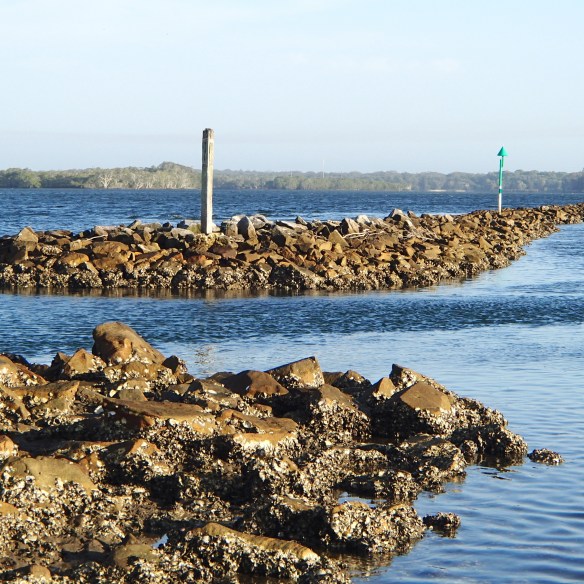
Iluka – the Clarence River and Iluka Bluff – 24 November 2014

I woke up to a rising 25 knot north-easterly wind. So I could not fish the rocky headlands. I would have to find some shelter from the wind. I decided to go back to where I had been fishing the night before.

So just after first light, I walked along the top of the rock wall, to the south of the boat ramp. I started with my light spin rod and a GULP 3 “ Minnow soft plastic in the Peppered Prawn colour. I caught a tiny bream after a couple of casts and then saw a school of fish come through the gap in the rocks. They splashing and gulping on the surface and I realized they were small tailor. I suddenly understood the term ‘choppers’ as this is exactly what they were doing to the surface of the water. I cast into them and got a bite but no hook up. When I retrieved my lure its tails was missing.
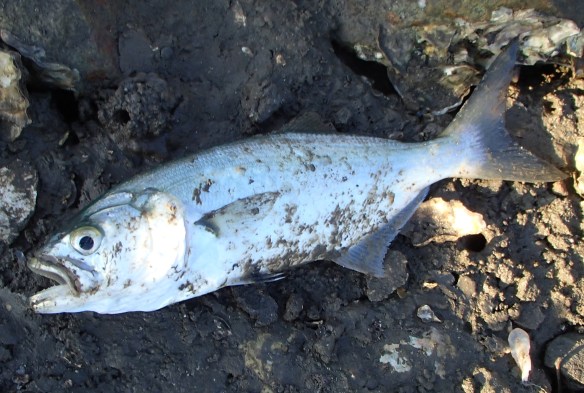
Clarence River tailor The gap in the rockwalls Clarence River

As I re-rigged a trailer boat came through the gap. The owner of the boat left his two-stroke running while he jigged for bait in the gap a few times. He did not get anything and after a few more goes he revved up and took off. Not surprisingly the fishing went quite for about 20 minutes. Then the choppers were back.

This time I cast my soft plastic 3” minnow right into the middle of the school and let it sink. It was whacked about three times as it floated towards the bottom. I jerked the rod tip up and connected with a fish. It was a small (30cm) ‘chopper’ tailor and it was soon jumping around in the mud at my feet.

Another boat came through and repeated the process that the first one had, with similair results. I had not realized this gap in the rocks was such a heavily used thoroughfare. The water must be consistently deep as a couple more boats soon came hurtling through. I decided it was getting a bit too noisy for the fish to hang around so I went back to find a coffee in town.

The wind kept howling all day. At about 3.30 pm I decided to see if the sheltered side of Iluka Bluff was worth fishing. A couple of other keen fisho’s were also braving the wind. They already had a couple of good-sized (45cm+) tailor from the foamy water. I big popper in the Qantas (red and white) colour had been the most successful. I did not have a popper with me so I tried a DUO Jerkbait 120 SP sub surface shallow diving hard bodied minnow. After few casts I lost this to the rocks. I tried a few plastics but the wind just blew them away. After 30 minutes of battling I finally decided that the day was not suitable for fishing and headed for the pub.

Bribie – the old oyster jetty flats – 18 November 2014

Tuesday

Back home to Brisbane for some work. I have done a fair bit of fishing recently but once again paid work has interfered with writing up my sessions, so these reports are far from fresh.

On Tuesday I had a window to fish in the morning, so I grabbed it. The tide would be running out to low at Bribie and it would be low just after noon.

It had rained overnight and there had been a big downpour a few days earlier. I could not get away for dawn, but I arrived and pulled on my waders at about 8.00 am. That is about four hours after first light, at this time of year. It was not a big tide. It was very humid and overcast and the wind was from the north east.

I started just south of the old oyster jetty on the mainland side of the Pumicestone Passage, close to the mangroves roots, in the shallows. I was fishing with a GULP 4” Minnow in the Pearl Watermelon colour – the perfect small mullet/pilchard imitation. I was using my light spin rod and a 1/8th ounce, size 1/0 hook jighead and 10lb fluorocarbon leader. At about 8.30am I caught a small (about 40 cm flathead). I took a picture and released it. It was sitting only a few feet away from the shore in about 35 cm of water. This is typical flathead behavior. They move up to the mangrove roots on the overnight high tide and just stay put until there is almost no water over the top of them.

I moved further south, following the run out tide as it gradually revealed the sand banks and weed beds. I had enjoyed fishing with the small surface poppers at 1770, so I decided to try one on the flats. I cast the small Rebel as far as I could in front of me and retrieved it slowly with quite a few long pauses. It took a while but as I took up the slack after a pause a fish smashed the popper and took off. It some tired and I could see it was a bream – about 30 cm long. I released and peppered the area with more casts. A few casts later, I caught another much smaller bream.

I carried on towards the green channel marker and swapped back to the soft plastic minnow. I found three more flathead, two of which would have been keepers. It was now just before noon and the run out tide had slowed. I turned and walked north, back towards the car. I caught one smaller flathead on the way and by 12.15 pm, I was back at the bridge.

It had taken a while and there were some long gaps between them, but I had found a few fish. The Christmas holiday fishing should be pretty good.

Iluka – Middle Bluff – 28 September 2014

Sunday

On Saturday, I packed up the car and drove 3 hours south, from Brisbane, to Iluka. It is about a year since I was here last and it feels like much longer. At last I had the opportunity to get away and fish for some different species. The weather was forecast to be pretty good for most of the week – with limited swell and wind and plenty of sunshine.

I arrived on Saturday night and ate at the Sedgers Reef Hotel. The food in here continues to go steadily downhill, while the prices go up. Everything is deep-fried (mostly from frozen) and hot chips are really the only thing worth eating. Still, the beer is cold and the location is fantastic. It’s a great place to watch the sunset across the mighty Clarence River.

The Clarence River empties into the ocean between Iluka to the north shore and Yamba to the south. The Clarence is a huge river and there is always activity at its mouth and on the rocky headlands, on either side. I prefer to fish the Iluka side of the river mouth, as it is quieter and has the beautifully unspoiled Bundjalung National Park.

This time I was staying at the Anchorage Holiday Park www.anchorageholidaypark.com.au in one of their deluxe cabins. I love to camp at the Woody Head camp ground, but they were booked out for the school holidays and its nice to have a proper fridge and running water, if you are planning to keep a few fish, to take home. There is also good fishing on the river, right in front of the park.

I went to bed early on Saturday night and as usual I found it hard to sleep. At about 4.00 am I woke before the alarm, had a quick cup of tea and set off for the rocks. I decided to start by fishing just to the north of Frazers Reef, at what is known as Middle Bluff (or sometimes Second Bluff). This is a rocky headland in between Woody Head and Iluka Bluff. I walked along the beach in the pre-dawn light and I was relieved to feel only a very light south easterly wind blowing. As the sky grew lighter I could see there was not much swell, which would make things much easier (and safer). I arrived at the northern end of Middle Bluff at about 5.15 am and started to rig up.

I had two rod and reel combos with me. The first – my heavy rig – is a Daiwa Demonblood 962H rod matched with a Shimano Stradic FJ 8000 reel. This is rigged with 20lb braid and I usually fish it with a 25lb or 30 lb fluorocarbon leader. The second is the much lighter, N.S Black Hole Cabin II – S-862 L Spin Rod. It is 2.59m long (8’6”) and rated 8-14 lb. I match this rod with a Shimano Sustain 3000 reel. This is rigged with 15lb braid and I usually fish it with a 12lb to 16lb fluorocarbon leader.

Around dawn I tend to fish with the heavy rig and try a few hard bodied lures or poppers. This morning I tied on a small but fairly heavy (31g) sinking bibbed minnow from Maria – called the Duplex. It is designed for long casts and high speed retrieves and it is ideal for casting from the rocks. I threw it out about 15 times and felt a few bumps. The sun was just coming over the horizon when I felt my first solid hit. I had the drag set quite tight as I did not want to get dragged down into the rocks. I did not hook up, so I cast out again and cranked up the retrieve. This time the hit was much more solid and the rod bent over, there was a fairly slow initial pull followed by a massive yank and the lure pulled free. When I got it back the rear treble had been completely pulled out – not happy.

I continued to fish with another Maria Duplex for about 15 minutes, but I could not find that fish again. I decided to switch to a soft plastic and chose the trusty GULP 4” Minnow in the Pearl Watermelon colour. I started fishing on a ¼ ounce, 2/0 hook jighead. The swell was light and the ¼ ounce jighead ensured the lure would drift around in the water column, before it reached the bottom. I tried to keep the jighead on the bottom for as long as possible without getting snagged. After about five casts a felt a faint bite, very close to the rocks. I dropped the plastic straight back down, only a meter or so away from the rock ledge. I paused for about 10 seconds as it sank to the bottom. When I lifted the rod, the line pulled tight and the rod tip started wriggling. I had the drag set tight as I was fishing very close to the barnacle covered rocks, but the fish predictably tried to swim under the rock ledge. It was no match for the heavier Daiwa rod and 25lb leader and I muscled it out and up on to the rocks beside me. It was a small Jewfish/ Mulloway – I estimated it at just under 50cm – a long way off the new NSW legal size limit. I let it recover in the rock pool for a bit, so that it might avoid becoming a shark snack. Then I speared it back in to the water. I continued with the same rig for about another half hour and had another faint hit, but did not hook up.

I decided to swap to the lighter fishing rig with a 14lb fluorocarbon leader. I had tried a number of bigger soft plastics but none of these had created any real interest. I now swapped down to a GULP 3” Sardine Minnow which I rigged on a ¼ ounce, size 1/0 hook, Nitro breampro fine wire jighead. I lost a few of these to the rocks but at about 8.30 am I felt a solid bite in very close to the rocks. This was a stronger fish but the swell had dropped off a little, which made things easier. I could not muscle this one in, so I let it play itself out and then landed it with the help of a good wave surge. It was bigger than the last at about 55cm – but still not big enough to keep. I took some photos and threw it back in.

I continued fishing for another 90 minutes without any more success, but the birds were working a few hundred metres away. The dolphins came through a couple of times – so I assume that there was some bait around. At about 10.00 am, I gave up for the morning. There was no fish for supper but it was a great start to the week.

Bribie – the old oyster jetty flats – 23 April 2014

Wednesday

It was a late start for me again on Wednesday – juggling work and fishing is hard.  But then most of my readers are probably well aware of that!

I arrived at the Bribie Bridge at about 9.00 am and waded out towards the flats to the south of the old oyster jetty. The sun was shining and there was a light south westerly wind. It is definitely getting cooler and the wind had some bite in it. The moon was 37% full and waning. It would be a 0.6m low tide at about 10.30 am.

I started fishing with a GULP 2” Shrimp soft plastic in the Peppered Prawn colour and this soon found a fish. It was a Flathead – just over 40 cm. I released it and went looking for more.  The water was clear but there were still a lot of black clumps of ‘snot’ weed floating around. There were sand crabs everywhere. Plenty of them seemed to be in romantic embraces.

As the tide slowed, I moved further south. In one of the sandy hollows, I caught another fish. This flathead had the brightest coloured tail I have ever seen. I released it and carried on wading south. I swapped to a GULP Jerkshad in the Peppered Prawn colour and as the tide started to run in, I caught another 45cm flathead.


I briefly tried fishing with a few small hard bodied lures, but they kept getting clogged with weed. I swapped back to a GULP Jerkshad in the Lime Tiger (orange and green colour) and at about 11.00 am I found a couple more small flathead that were probably just under 40 cm.

This had not been a bad fishing session – especially as the school holidays have just finished and this area has been fished pretty hard. All fish were released today.

Bribie – the oyster jetty flats – again – 12 March 2014

Wednesday 12th

I paused, reluctantly, to dry out the fishing bag and finish filleting and skinning a few flathead, on Tuesday. By Wednesday I had spotted an opening for another fishing session. I was working around the low tide on the flats at Bribie.

I drove up to arrive at about 10.00am – very civilised. We had the same wind pattern as we have now had for about ten days – a 10 to 15 knot east-south easterly wind. It was a bright, sunny day and the wind was building. The water was clear and running out and the full moon would be on Saturday. Low tide would be at 1.10 pm.

I started to fish the small patch of reef just south of the Bribie Island Bridge, on the mainland side. The rocks were just visible above the receding tide. I started the day with a soft plastic. As you will have noticed I prefer to prospect with a soft plastic lure – once I find the fish I will then start to experiment. Today I chose the GULP Jerkshad in the Cajun Chicken colour. I was fishing with 12lb fluorocarbon leader and using a 1/8th ounce, size 1/0 hook, jighead.

I soon found a fish, just to the south of the bridge. This flathead was just below 40cm long. I would release everything I caught today – there is plenty of fish in the fridge. I cast back in the same area and found another, smaller fish.  I moved closer to the jetty and caught 3 more, before wading under the jetty.

As with the previous sessions, the fish kept coming. I swapped from soft plastics to hard bodies and these were even more successful. I caught a 60cm flathead on the MARIA 90 mm MJ Twitch suspending minnow and a 66 cm fish on a RIO Prawn lure, in the 13 g size. The DUO range chipped in with some good flathead on the DUO Tetraworks Toto and, my current favourite – the suspending DUO Realis Shad 59 MR. This one really is a flathead slayer – the action and rattle seems to drive them wild.

I fished from 10.30 am to about 1.30 pm and I rarely went 5 minutes without a fish. I finished the session with some good sized flathead on the Powerbait 5” Rippleshad paddle tail soft plastic, in the black and gold colour (which I usually reserve for chasing Jewfish).

For the fish to be here in such numbers I can only conclude that they are feeding up to spawn. A few of the fish I kept last week were full of roe. It is early but apparently flathead can choose to spawn at any time and do not do it on mass, like bream.

Whatever the reason, I hope they stay for a while –  it’s a great time to be out there fishing.

Bribie Island – Whitepatch – 13 February 2014

Thursday

I am afraid this post relates to a fishing session which is now almost three weeks old. My apologies but for the sake of keeping my fishing diary up to date, I will summarize what happened.


I decided to fish at Whitepatch on Bribie Island, low tide had passed at about 2.45 am and it would be a fairly big run in tide. There was a very light south-easterly wind blowing when I arrived, just after 5.30 am.  I parked by the stairs and waded out towards the drop off. I stopped to pepper the area of weed beds just in front of the ledge. I started with a GULP Jerkshad in the Orange Tiger colour. The first few retrieves were grabbed at by something….moses perch, pike, maybe.

I persisted and after about fifteen minutes I found a small flathead. I released it and carried on fishing. Fish kept hitting the big plastic but I was not hooking them. The tide was getting higher and it was now difficult to cast over the edge of the drop off. I swapped down to a smaller GULP 3” Minnow in the Peppered Prawn colour. This did the trick and I soon caught a few small yellowfin pike.

As the tide came up I waded further south. I kept casting and soon started to catch a few small moses perch. They gradually got bigger but none were bigger than the legal size of 25cm. I swapped through a few different small soft plastics and caught more moses perch and a few tiny whiting.

I put on a GULP jerkshad again, in the Satay Chicken colour and turned to wade back to the car. It was now about 8.30 am and heading for high tide. As I waded to the north I cast in front of me. After a few attempts this method produced the best fish of the day – a 46cm flathead.

After this I gave up. I had caught plenty of fish but only one would have been big enough to keep. Despite the lack of dinner it had been an interesting fishing session.

Bribie – the old oyster jetty flats – 20 December 2013

Friday

I was beginning to get fed up with the Christmas madness. Every time I have dropped into the supermarket in the last fortnight, there have been people stuffing trolleys with food that will surely end up in the bin in ten days – bags of assorted nuts in their shells, icing sugar dusted Stollen logs, massive hams & huge frozen turkeys, those huge square Italian sponge cakes that taste like cardboard and enough mangoes and cherries to sink a battleship.

Big W / Target / Kmart and the rest have crammed aisle upon aisle with cheap, useless crap that nobody wants or needs. Buckets of Margarita mix (without the alcohol), Brut deodorant combined with bonus Brut aftershave in a gift pack (not sure it really is a bonus). There are enough bath salts, crystals, foams, creams, milks, lotions, serums and bombs to make Wivenhoe Dam fizz. In almost every case, the packaging probably cost several times as much as the rubbish inside it. I am half expecting to see the old ‘soap on a rope’ make a comeback.

Only fishing could lift my spirits. I decided to set the alarm and fish the morning low tide at Bribie. The bottom of the tide was 4.24 am, just after first light and just before dawn. There was a slight northerly wind forecast. It was three days after the full moon. I chose the flats on the mainland side of the bridge, as these have been fishing well.

I arrived about 4.15 am and then waded out to the area south of the old oyster jetty, where the flathead have been hiding. I started with the GULP 5” Jerkshad in the Watermelon Pearl colour on a 1/8th ounce, 1/0 jighead and was using my usual 10lb fluorocarbon leader and G.Loomis TSR light spinning rod. The water was still and the sky was cloudy. I was about level with the end of the jetty, where there are a number of sandy hollows, amongst the thick weed.

At about 4.40am, I caught my first flathead. It was just under 40 cm. I released it and then I cast into the same hollow and caught another. This one was bigger – perhaps 45cm. I couple of casts later; I caught another, about the same size. I had another fish on my line from this spot, but it spat my jighead on the surface.

I moved on to the next hollow and decided to change colours. I chose the orange and yellow GULP Orange Tiger Jerkshad. At about 5.30 am this did the trick and I had another flathead. It was also about 45cm.  It had chewed through the plastic, so I replaced it with a GULP Crazylegs Jerkshad in the New Penny colour.

I kept moving towards the south. The tide was starting to run in now. At 5.40am, I caught another small flathead – approximately 35cm long. The sky had turned grey not long after sunrise and now I could see the rain clouds coming towards me. It started spitting and then really raining but it was only a short shower.

I fished along the edge of the weed beds for another hour without a bite. At about 8.00 am another shower was threatening so I gave up. The best action has definitely been around dawn in the last few sessions – not good news if you like sleep!

Bribie Island – the old oyster jetty flats – 21 June 2013

Friday

It’s been a long time between fishing sessions. Work and the dreadful weather – particularly the wind, have limited my fishing opportunities. On Friday the rain and strong south-easterly winds were forecast again but I had no choice, I had to go for it. Fish don’t really care about the wind in an estuary, but if it is really strong, it makes it very hard to feel the bite and cast accurately, not to mention the cold, if it has some west in it.

On Friday morning, on the flats opposite Bribie Island, the wind was switching between a strong south-easterly and south-westerly and bringing plenty of rain with it. The tide had been high at 7.10 am and we were approaching the full moon, due in a couple of days.

I started fishing at about 9.00am. I wanted to fish the second half of the run out tide, through to about midday. I waded out under the bridge in a disposable rain poncho and my waders – I was dry underneath but the wind was very cold. The rain varied between a steady drizzle and heavy squalls.

Despite the wild weather the water was clear and cold. Unfortunately the algae (snot weed) are all over the sea grass and rocks on the bottom, between the bridge and the old oyster jetty. If you let your lure hit the bottom, it just gets clogged up with this stuff, straight away.

The situation improved to the south of the oyster jetty. I think the current is a little stronger here so the algae find it harder to take hold. I was fishing with a GULP 4” minnow in the Lime Tiger colour. After an hour of casting around I connected with a fish, but after a short fight, it slipped free. I persisted in the same spot for another 20 minutes. Eventually, I hooked the fish (or one of its neighbours) again. It was a flathead about 45cm long. Given how tough the fishing had been it seemed I was unlikely to catch the three fish minimum that I would need to feed my mob, so I released it.

I was now about 200 metres to the south of the old oyster jetty and the tide was running out, strongly. It was time to continue the sea trials of the Zman Minnowz. I chose the fairly natural, Houdini colour and put it on a 1/8th ounce, 1/0 jighead. I covered much of the same ground I had covered with the GULP Minnow and after about 20 minutes, I caught another small flathead about 35cm long.

I moved up and down casting at the edge of the weed beds but the after another 40 minutes with no bites I swapped back to a GULP 4” Minnow soft plastic lure, in the Pearl Watermelon colour. This produced a result on the first cast – another small flathead about 30cm long. I continued fishing the same area for another 30 minutes, but could not find anymore.
The wind was really building now, so I turned back and waded towards the bridge. On the way, I slowed my retrieve right down and left it longer on the bottom between hops. This produced one more flathead, just before low tide at about 1.00 pm.

Tough session – but the fish were there – as they nearly always are.

1770 – Eurimbula Creek – 8 May 2013

Wednesday

With the weather showing no signs of improving, I decided it was futile to keep trying on the rocks, so on Wednesday, I drove back out to Eurimbula Creek. I arrived a little after first light and the tide was running in. The water was not quite so dirty here. I went back to basics and started by fishing with small, lightly weighted soft plastics, first a GULP 3” Minnow in the Lime Tiger and then a 2” Shrimp in the Banana Prawn colour. After an hour with no luck I switched to a DUO Tetraworks Bivi, small, hard bodied vibe lure. This did not stir anything up either.

I decided to try a slightly bigger soft plastic and put on a GULP 4” Minnow, in the Pearl Watermelon colour. The tide was running in fast, so I also upped the weight to a 1/6th ounce, 1/0 hook jighead. The water had now come over the sandy edge of the main channel. I dropped the lure over the edge and then retrieved it, pausing for as long as I could, right at the edge. I felt the small bait fish attack the lure on each retrieve and then, after about 10 casts, a bigger fish grabbed it. It was a dusky Flathead – just over 40 cm. After a few pictures it went back.

I moved nearer to the mouth of the creek and put on a GULP 3” Jigging Grub in the Pumpkinseed colour. I lost a few of these to the fast flowing current and the fallen trees. I rigged up for the third time and aimed the soft plastic at eddies around one of the snags. It was hit on the drop and the fish went straight into the tangle of roots. With the Loomis GL2 light spin rod and 10lb fluorocarbon leader, I really did not have the power to fight a determined fish in heavy current – the fish was in charge. I backed off the drag a little and it swam out. I let it move about a metre away from the snag, tightened the drag and then increased the pressure again. It headed straight back in. We repeated this process 3 times until I eventually pulled out a 45 cm estuary cod. It was perfect cod terrain with overhanging mangrove roots and plenty of snags.

The rain showers kept coming. At about 10.00 am, I caught a couple of small grunter bream (javelin fish) – about 30 cm long. I had swapped back to the GULP 2” Shrimp in the Banana Prawn colour. I have caught plenty of these in the creeks around here, especially after heavy rain. I put them back and carried on fishing, up and down the creek bank, as high tide came and went.

By about 11.00 am I had had enough and drove back to Agnes Water.

1770 – Workmans Beach – 7 May 2013

Tuesday

The wild weather continued; strong south-easterly winds and plenty of rain. On Tuesday morning I braved the rocks at the southern end of Workman’s Beach, near Agnes Water. This area is sheltered from a southerly and south-easterly and there is plenty of fishy looking territory.

After a few days of big seas, the water was all stirred up and a milky brown colour. I started with soft plastics and then switched to slugs and hard bodies, but nothing yielded results. The sun came out mid-morning, but not for long. As the day wore on, the wind picked up. It then brought the clouds back in. Just after lunch, there was another downpour, so I gave up. Tuesday had been my first zero fish session for quite some time!

Nothing seemed to work today

Nothing seemed to work today

Bribie – oyster jetty to the channel marker – 28 April 2013

Sunday

When the fish have been biting in a particular spot it is hard to tear yourself away, so it was back to Bribie Island. It is also good to fish the same spot for a few weeks, so that you can see if any patterns appear in fish behaviour.

Sunday looked more promising than Friday had been. The moon was still pretty full but low tide was at 5.21 am. I would not be able to fish much of the run out tide, but I could reach my favourite target area, for a couple of hours, as the tide started to run in. In general, I have had more success on the ‘run out’ rather than ‘run in’ tide, in this area, on the edge of the main channel. The moon is also a factor. As I mentioned in my previous post the big moon means a very big tidal flow and this is not very helpful here.

There are a different current flows that run over and around the sand banks, at different times of the tide. You feel this very obviously in your waders, as you move between cold water – rushing in from Moreton Bay and warmer water, flowing out, off the sand flats and shallows, from the Pumicestone Passage. This can make deciding which direction to cast in, quite confusing. If possible, you should always cast up, in to the current and hop the lure back along the bottom, towards you.

I started early, around 5.30 am and made straight for the green channel marker. It took about 20 minutes to get out there and I started by fishing with GULP Jerkshads in various colours, but these did not find the fish. I swapped down to a GULP 4” Minnow soft plastic in the Watermelon Pearl colour. I was using a 1/8th 1/0 jighead and the usual 10lb fluorocarbon leader. By 6.45 am the tide was running in and I found a small flathead in a sandy patch, about half way between the channel marker and the oyster jetty. I could only find one in this spot so, after 10 minutes of casting, I moved on.

It took more than hour to find the next one – at about 8.00 am. This one was over 40 cm, but I was releasing them all today. I covered the surrounding area with casts but could not find any more.

The incoming tide was now starting to push me out of reach of the main edge of the weed beds. I swapped to the GULP Jerkshad in the Cajun Chicken colour – black and pink colour. At 8.15 am I caught another small flathead – about 35cm long.

At about 9.00 am I was back at the bridge and had not caught any more. The combination of full moon and incoming tide had stirred the sediment in the water up and it was very murky again. I had only caught three fish. It seems that fishing the incoming tide is not working so well for me. We will have to see what happens when I get a chance to fish the ‘run out’ tide, next week.

Bribie – Oyster jetty flats – 24 April 2013

Wednesday

The tide was all wrong but the fish were around, so I decided on Bribie again. We would have a 2.2m high tide at 8.05 am. This would mean the tide would be just over half way in, at first light.

I arrived just before sunrise and wandered south along the shoreline, on the mainland side of the bridge. I passed the oyster jetty, casting soft plastics on the flats on either side. I felt a few tugs in the area just south of the oyster jetty, but I could not hook up with anything. I was fishing with a GULP Jerkshad in the Lime Tiger colour, on a 1/8th 1/0 jighead. I was using 10lb fluorocarbon leader.

I find the last of the run-in tide the hardest to fish, land-based, at Bribie. You can no longer reach the various drop offs on either side of the Pumicestone Passage. The fish move up quickly but suddenly there is no obvious structure for them to hide in; they spread out over the open expanse of flats and it is difficult to know where to concentrate your efforts.

As I thought about where to fish a huge flock of cormorants came into land. I have never seen a group as big as this before. They settled on the water for a few minutes then took off again.

In this area the only obvious structure is the slight drain that runs round the corner from Sandstone Point. Even this seems to be gradually silting up at the moment. This is where I decided to focus my efforts. The water was flowing round the corner from the south. I stood beside the mangroves and cast to the south, in the direction of the long, now submerged, sandbar.

It was now about 7.00 am. After a couple of casts, a fish grabbed the plastic, made a short run then it let it go. This also happened on the next cast and I saw the familiar snout of a long tom, following my lure in. I cast a little more towards the south east and when I took up the slack I had a fish on the line. I set the hook and it took off with the current. I soon had it under control and waded back to a gap in the mangroves. It was a good flathead, about 50cm long. I let it go.

I waded back to the same spot and cast out again. I continued fishing this area as the tide came up. I swapped to GULP Jerkshad in the Curry Chicken colour. After a few casts the line pulled tight again and I had another flathead, about the same size. It was about 7.30 am. In the next twenty minutes I dropped two more fish and caught one smaller one.

Things went quiet around the tide change so I decided to wait out the slack water over breakfast and coffee. I waded back to the car and went off for breakfast. The wind was picking up from the south-east, but it was a beautiful morning.

By 10.00 am I had waded back to almost the same spot that I had been fishing earlier. The water level was much lower but I put in a few casts anyway. After about 10 casts, I caught another 45+ cm flathead, on a GULP Jerkshad, in the Satay Chicken colour.

The tide was now running out strongly and the big sand bar, down by the green channel marker, was clearly in view. With the wind behind me, I could reach the edge of the main channel and the sea grass beds, with some long casts. I started to make my way towards the green channel marker, casting as I went. I hooked a stingray which towed me around for a while and then broke me off. I also connected with an spiky puffer fish which grunted, spat jets of water at me and fluttered round in circles for a while before cut the line and got rid of it.

I re-rigged with a GULP Jerkshad in the Cajun Chicken colour. The water was now really running and lifting more and more sediment as the tide got lower. This did not seem to bother the fish. I averaged one every 15 minutes or so, for about the next three hours. The colour of plastic did not seem to matter. Most were around the 40 to 45 cm size, but there were several more 50+ cm models amongst them.

At about 1.30 pm, I had to tear myself away – always hard to do when you are catching fish. I had caught more than 15 flathead through the morning and it does not get much better than that!

Bribie Island – Sandstone Point – Monster Flathead – 2 May 2011

Monday – Labour Day

10 to 12 knot winds forecast and even though there would be a big swell offshore, the estuaries would be good for fishing. Back up to Bribie, to the Sandstone Point flats where I have been getting some good Flathead.

At about 5.00 am I waded out under the bridge – on the mainland side, to cast around under the lights. The tide was running in, so I was casting from the north side of the bridge, under the bridge, into the shadows and hopping my lure across the bottom, along with the current, back towards me. Theoretically, the Flathead will be lying facing the current flow, waiting for their prey to be washed towards them. After a couple of casts with the GULP 4” Pearl Watermelon soft plastic, I had a fish. This area can be tricky, as there are loads of prominent rocks to trip over and lose the fish on. Unfortunately just as I got a look at a decent 50cm + Flathead, it lunged down behind one, bumped the jighead out of its mouth and slowly swam away.

As the horizon started to glow I walked south and then around the corner onto the Sandstone Point flats. On my way, I caught a small Flathead in the weed beds, about 20 metres from the shore. It was only just 40cm long, so I released it.

I moved past the jetty to the point where the shoreline turns right, casting as I went. I waded over the big sandbar that runs roughly north to south; onto the area I call the Sandstone Point flats. This area is very rocky initially and then softens to sandy weed beds with some central channels and drains. It holds plenty of fish, especially at the top of the tide. The Flathead lie between the rubble and the weed beds waiting to pounce, while the Bream cruise over the top.

I was still fishing with the same soft plastic, but as the water was less than a metre deep, I was only using a 1/8th 1/0 jighead. The tide was still running in and this meant I was casting directly in front of me, as I waded across the flats. Because I had missed a fish on the rocks earlier, I had switched up from a 10lb to a 16lb leader. I was retrieving the lure fairly quickly with very short pauses to avoid getting snagged. I felt a bit of resistance and thought I was snagged. I jerked the jighead up and what felt like a rock, rolled towards me a little and then felt like it was free. I wound in my line and as I was about to lift the plastic from the water, the line went tight again and the ‘rock’, which I now realise was a fish, swam straight past me. Line started peeling at a steady pace and then, as the fish realised it had eaten something sharp, it took off on a powerful initial run, with the current.

My Loomis GL2 6’6 Light spin rod is very sensitive and amazingly flexible but it is not designed for power. If you get a big fish on, patience is the key. I let it run. Then I recovered some line and let it run again. It was obviously nicely hooked, but at the beginning of each run, it would put in a series of angry headshakes. I realised now it was a very big Flathead. I identified a break in the Mangroves and started to steer the fish in that direction. It must have made five or six long, determined runs for freedom and after each one, I had tightened the drag slightly, with little effect. Even 16lb leader will not last forever and the longer the fight goes on, the more likely the fish is to find a conveniently placed rock or snag. I tightened the drag and got the fish into the slacker water close to the shore. There was another short run but it was tired now and had no current to help it. With one long last heave I pulled it up onto the sand. The leader snapped as soon as its weight hit the sand but it was clear of the water.

This slideshow requires JavaScript.

It was a monster female Flathead – well over 75cm. I measured it as best I could with my tape, took a few pictures and released it. I am settling on 75cm for the length, which makes it this year’s ‘personal best ‘Flathead for me.
Ironically, I still had no fish to eat, so I waded on. I caught a few undersize bream cruising over the weed and then in a small sandy depression, I finally picked up a 42cm Flathead. It was a good end to a great mornings fishing.

Bribie Island – Jew and Flathead – Good Friday – 22 April 2011

Good Friday

I am back in Brisbane for Easter and so I decided to drive up to Bribie to fish, wading the flats, early on Good Friday. I arrived by the bridge on the mainland side, at around 4.45am and low tide would be at about 7.00 am, so there was not much water under the bridge lights.

I cast around in that area using the GULP 4” Pearl Watermelon Minnow on a 1/6th 1/0 jighead. There was plenty of surface action with Long Toms and a few Pike cruising around. After wading around for a while I felt a light tug and paused. When I raised the rod tip and set the hook – I had a fish. I assumed it was a Flathead but as I saw a flash of silver I realised it was a Jewfish/ Mulloway at 40cm. I took a picture and released it. These are the one species that really love dirty water and after all the recent rain, conditions are currently perfect for them. I could not find any more and so as first light started to glow above the horizon, I waded south.

I passed under the Oyster Jetty and fished the weed beds, rocky bumps and dips, just to the south. I stuck with the same soft plastic and soon found a few Flathead. I caught 6 in this area in the next couple of hours, of which four were between 42 and 56cm. I kept these for the Easter BBQ and the rest went back. Things seemed to slow down with the turning of the tide and just after 8.00 am, I went home.

Bribie Island – Bridge, White Patch & Oyster Jetty – 8 March 2011

Tuesday

Up early and back to Bribie Island. I arrived at the mainland side of the bridge at around 4.00 am and started by casting soft plastics in amongst the pylons. The tide was in the last hour of running out and the rain showers overnight had again stirred things up. There is also a storm water drain under the bridge that empties out from time to time, further clouding the water.

I had rigged up a GULP 5” Jerkshad soft plastic in the Satay Chicken colour on a 1/8th 1/0 jighead. I was fishing with 10lb braid and a 12lb fluorocarbon leader, on my light spin combo – a Loomis GL2 rod with a Shimano Stradic 3000 reel.

I started just to the north of the bridge and got no bites for a while. I moved quietly, round to the north and cast into the area where the light and bridge shadows meet. Thud – a solid hit, I dropped the rod tip, paused and then struck. The fish took some line then settled into the current. I gradually eased it up on to the sandy area at the foot of the rocks. It was a nice, 46cm Flathead. I let it go, straightened the plastic on the jighead and peppered the area with more casts. It was about 4.20 am. A few retrieves later there was a smaller bite, in about the same spot and I caught another Flathead. This time it was just on 40 cm. I released it and moved all around the bridge area and down to the street light beside the boat hire outlet, but I could not find any more.

This slideshow requires JavaScript.

As dawn broke, I drove up to White Patch to look for some more fish. I walked down on to the beach and out towards the drop off, that runs all the way along the edge of the Pumicestone Passage. It was just after low tide and I waded along casting in all directions, out over the drop off and on top of it, in the shallow water. I did not get a bite on the soft plastic lures. I swapped to a 1/6thoz weight, Berkley Big Eye vibration blade, but this did not find any fish either. After an hour of wading up and down, I decided to change locations again.

I drove across the bridge to the Oyster Jetty and waded out beside it, on the south side. The tide was now running in solidly and the water was much cleaner than it had been up at White Patch. However, the wind was really getting up and there were some very nasty clouds on the horizon. I hooked a decent fish but was disappointed when it leapt out of the water – a huge Long Tom. I got rid of it and waded south for about 60 metres, casting in front of me, into the run in tide. I swapped to a GULP 4” Pearl Watermelon Minnow soft plastic and rigged it on a 1/8th 1 jighead. After a few casts in this area, the line came up taught and I had another fish. There was a bit of weight to it, so I decided to wade back the shoreline. It was a good size Flathead at 49cm.

I carried on for another 45 minutes but then a couple of monster rain squalls gave me a good soaking and the cooler southerly wind was really getting up. At about 9.45 am I headed home.

Bribie Island – Bridge and Sandstone Point – 1 March 2011

This slideshow requires JavaScript.

Tuesday

Up at 3.45 am and back up to the Pumicestone Passage in search of more Flathead. I decided to start by fishing the Bribie Island side of the bridge, this morning. There is always plenty of surface action in this area with Jew, Pike, Moses Perch, Bream, Tailor, Flathead and even juvenile Snapper, all drawn in to feed on the jelly prawns and small baitfish that gather under the bridge lights.

In recent sessions, I have noticed the small jelly prawns are everywhere and the Flathead that I have caught and gutted, generally have a belly full of them. I therefore grabbed a bag of the GULP 2” Shrimp in the Jelly Prawn colour and decided to try these out. The tide was running in so I decided to start by casting my soft plastic at the base of the first bridge pylon, on the north side of the bridge and jigging my plastic along the bottom , all the way back to the edge of the rock wall. On the first cast, just as it reached the base of the wall, in about 30cm of water, the lure was grabbed. I was using a 1/8th 1/0 jig head and a 12lb fluorocarbon leader. The fish took a bit of line but I soon subdued it and swung it up, over the rocks. At 42cm it was the first keeper Flathead of the day. It went in the bag and I cast back out. A couple of casts later, I had another – this one was just on 40 cm so I let it go. I moved to the south side of the bridge and carried on. I had a couple of bites from Pike and dropped a better fish, which was probably a Flathead and then I decided to move over to the mainland side of the bridge.

I put on a GULP Crazy Legs Jerkshad soft plastic in the Lime Tiger colour, waded out and cast to the south of the bridge. The tide was now rushing in and a few Pike grabbed the bigger plastic but usually released it just before they reached me. There were some big surface bust ups erupting, in close to the Mangroves, so I cast straight into one and the line came up taught. I brought the fish in – the headshakes were too rapid for a Flathead and as it came close there was a flash of silver. It was either a Bream or a juvenile Snapper, but it spat out the lure so I will never know.

With the dawn I decided to change positions again and I drove round to Pebble Beach. I walked out onto the beach and turned left. I walked to the end of the beach and along the rocky area that fronts the Mangroves. I was casting in to the sandy areas amongst the rocks and although I lost a fair amount of jigheads, the strategy paid off. Over the next couple of hours, I caught nine more Flathead in this area – between about 25cm and 48cm. I experimented with different colour and size plastics and they did not appear to be fussy. I caught fish on the GULP Crazy Legs Jerkshad in Lime Tiger and Pink Neon, the 2” Shrimp in Jelly Prawn and Banana Prawn, the 3” and 4” Minnow in Pearl Watermelon and the 4” Minnow in Vader. The Long Toms were a constant menace – slashing through the soft plastics and often wrecking the last few cms of the leader.

I kept the first four fish over 40cm, to add to the one I had kept at the bridge, so I had another bag full. It was another good session and as there was a Northerly wind blowing the whole time, it did not really support my idea that the fish don’t like it!

Iluka – Frasers Reef – Jewfish/Bream – 12 Feb 2011

This slideshow requires JavaScript.

Saturday – am

I woke around 4.30 am Saturday to meet a very sweaty dawn. There had been a northerly wind change overnight and it had brought warmer temperatures. Fortunately the wind was light so I decided to head back out to Middle Bluff to see whether the fish would still be biting.

I arrived on the rocks in the dark and carefully rigged up and edged out for my first cast. I was full of anticipation as the first few casts had produced some good results over the preceding few sessions. I was using the GULP 5” Jerkshad soft plastic in the lime tiger colour as I had run out of the ‘crazy legs’ version. It was rigged on a 3/8th oz 4/0 jighead.

The first cast produced nothing, nor did the next. In fact, after an hour of fishing, I had not registered a touch on the lure. I switched to a 70g HALCO Twisty slug to try and spin up a Tailor, but that technique was also unsuccessful. I reverted to the lime tiger soft plastic and at about 6.30am I connected with a fish. It was a small Jewfish/ Mulloway, just under 45cm so I released it.

I decided to move along the rocks to Fraser’s Reef. You can only reach this rocky outcrop about one to two hours either side of low tide. When the water is calm, there are a number of great spots to fish, particularly on the front of the promontory. In a number of places the waves break into narrow cuttings in the rocks which are constantly filling and draining. These provide great cover for the fish.

It was now around 8.30am and I decided to fish a paddle tail plastic. I chose the GULP Jigging Grub in the Nuclear Chicken colour. I put it in a 3/8thoz 4/0 hook jighead and fished it in as close to the rocks as I could. I would put in a few casts every few metres or so. The water was quite murky at the bottom of the tide – probably because of all the sediment that has been washed out of the Clarence River by the floods.

I cast down into a v-shaped channel between the rocks, as I lifted the rod I felt a double tap, I let the plastic sink again and when I lifted it for the second time, I had a fish on. I played it with the swell and eventually lifted it clear of the water. It was a monster Bream – around 39cm long. I continued fishing all around these rocks for another half an hour, but I could not find any more. At 9.30 am I gave up.

Yamba – Jewfish – 3 Dec 2010

Friday
As the rain poured down I headed in to Yamba, mid morning, to visit the local tackle store and replenish my supplies. I stopped for a coffee and the rain eased off. I decided to have a look at the fishing off the rocks, down below the light house in front of Yamba.
It was about 11.30 am and the sea was doing a good impersonation of a washing machine, but the rock walls at the mouth of the Clarence River provide some shelter for this area when there is a north easterly wind. I found a safe ledge on the rocks and watched the swell for a while.
I rigged up the big rod – a Rovex Bario 11”. I put on a 1/2oz jighead and a GULP 4” Pumpkinseed Minnow soft plastic lure. I cast around and lost a few jigheads as I got used to the terrain. After about 50 casts, I hooked up to a very small Soapie (juvenile Jewfish) around 30 cm long. After a quick snap, I released it.
The rain started again and by now even I had reached the end of my weather tether. With no dry clothes I decided it was time to pack up camp and head back to Brisbane.
So overall, the good news is the fish are there. The bad news is the weather may well make them very hard to get at this month.

Bribie Island – Buckley’s Hole – 2 Oct 2010


Saturday
The weather was poor – 10 – 15 Knot wind and showers. But it was still better than Thursday, so I decided to get out fishing for a few hours, around dawn on Saturday.
I set off in a rain storm, at around 4.00 am and arrived at Buckley’s Hole on Bribie Island, at about 4.45 am. The wind was quiet – it had stopped raining and although it was grey and cold, the sand banks looked very fishable.
I would be fishing the last couple of hours of the run out tide. This is usually a great time to fish, especially if it coincides with dawn. In this area the tidal flow is washing all sorts of bait out of the lagoon during this period. It then gradually flows down, south over the sand banks. First the Whiting and Pike feed on the small stuff and then the Flathead lie in wait for the Whiting and Pike.
I walked south, along the shore for a few hundred metres, then waded out to about waist deep. I now turned back and waded parallel with the shore, casting north into the tidal flow. It did not take long to find a few Pike – but they are getting smaller. Then I was surprised as a stonker 34cm Whiting grabbed the Gulp 4” Pearl Watermelon minnow soft plastic, which I was casting around. It sounds like there are plenty of quality Whiting around at the moment. They must be hungry if they are even sampling plastics of this size.
Unfortunately as the tide dropped, the weed started to become a problem and the wind picked up. After about an hour of fishing and peppering the banks with casts, I caught a small flathead, again on the Gulp 4” Pearl Watermelon minnow. I had switched from a 1/8th to a ¼ 1/0 jighead as the wind was making it hard to keep contact with the bottom. On clear sandy bottom I really think the disturbance of the heavier jighead, bashing along the bottom is very attractive to the Flathead. It picks up more weed but that is a necessary evil.
I focused on this area for the next 40 minutes or so. Standing in one place and casting around me in a tight semicircle. After 15 minutes, I switched to the smaller 3” GULP Lime Tiger Minnow. This instantly produced results and I caught a nice, 44cm Flathead. I stayed in the same place but focused my casts into the shallower water. This also worked and in the next 25 minutes I caught five more Flathead of which two, were big enough to keep.
I had now had enough and with the wind and swell getting up, I headed home. Good fishing – despite the weather.

Broomes Head Lagoon – Wild & Windy – 21 Sept 2010

This slideshow requires JavaScript.

Tuesday

I am just back from a trip down to Broome’s Head, just south of Yamba, in northern New South Wales. It is typical of the rocky headlands on that stretch of coast. You can fish on either side of the headland depending on the prevailing winds. However last week the weather really made things difficult. On Monday it rained all day while an enormous swell smashed over the rock ledges. I am pretty keen on my fishing but I could not find anywhere I could cast from.

Tuesday was better – well at least the rain had stopped. The seas were still enormous, with a three metre swell. Fortunately the northern side of Broomes Head has a sheltered lagoon. Just on dawn, I waded out into the lagoon and got as close as I could to its mouth. I cast out a 3” GULP Pearl Watermelon minnow soft plastic on a 1/8th 1/0 jighead. I wanted to keep my rig as light as possible to avoid getting snagged on the rocky bottom. I got a couple of touches and saw a few Long Toms following the lure in. After a few more casts, I hooked up with a small Bream – around 25cm. Then a couple of casts later I hooked up to a better fish. When I got him to me, he was a small golden Trevally. I hooked a couple more under-size Bream and a Moses Perch from this position before deciding to try to get closer to the lagoon’s entrance.

At its eastern edge the lagoon is filled through a gap in a long ridge of rocks. Here at the mouth of the lagoon there is some deeper water on either side. The outside of the lagoon entrance was far too rough to fish. But by walking out along the rocky ridge I found a spot from where I could cast into the deeper water just inside the lagoon. I started with the 4” GULP Swimming Mullet soft plastic on a 1/6th 1/0 jighead. I could not really let it settle for more than a few seconds on the retrieve, for fear of losing it to the rocks or kelp beds. I gradually got a feel for where I could stop and start the retrieve and what the sink rate was. After about 30 minutes of peppering the area with casts I caught a very good Bream – just on 35cm. On the next cast I caught another Bream, a bit smaller but also a good fish. Then things went quiet on the fish front and the wind was really howling. I switched to a 3”GULP Minnow soft plastic in the Pearl Watermelon colour and cast it out into the wash at the foot of the rocks. Just as I was about to lift the lure from the water it was grabbed by a big dark shape. The fish took the lure down deep into the kelp at the foot of the rocks and then just sat there. I was only running a 10lb leader so I decided to ease off the pressure and let him swim out of his hiding place. I dropped the rod tip and counted to ten then pulled hard. It worked and I slid a very decent fish up on to the rock ledge at my feet. After giving it the once over, I decided it was a Morwong or Mother-in-law fish of some kind and kept it for the table. I later found out it was a Spotted Hind. It did not taste much good and apparently is quite common down here. I now had plenty of fish for a family supper so I headed off for a hot shower.