Iluka – Woody Head – 26 November 2014

Wednesday

Morning

It rained overnight on Tuesday and it was warm and cloudy on Wednesday morning. I chose to fish at Woody Head again. The wind had settled down and had turned north-easterly again. I was in position early. With first light at just after 5.00 am local time (which is 4.00 am Queensland time) bedtime is about 8.00 pm.

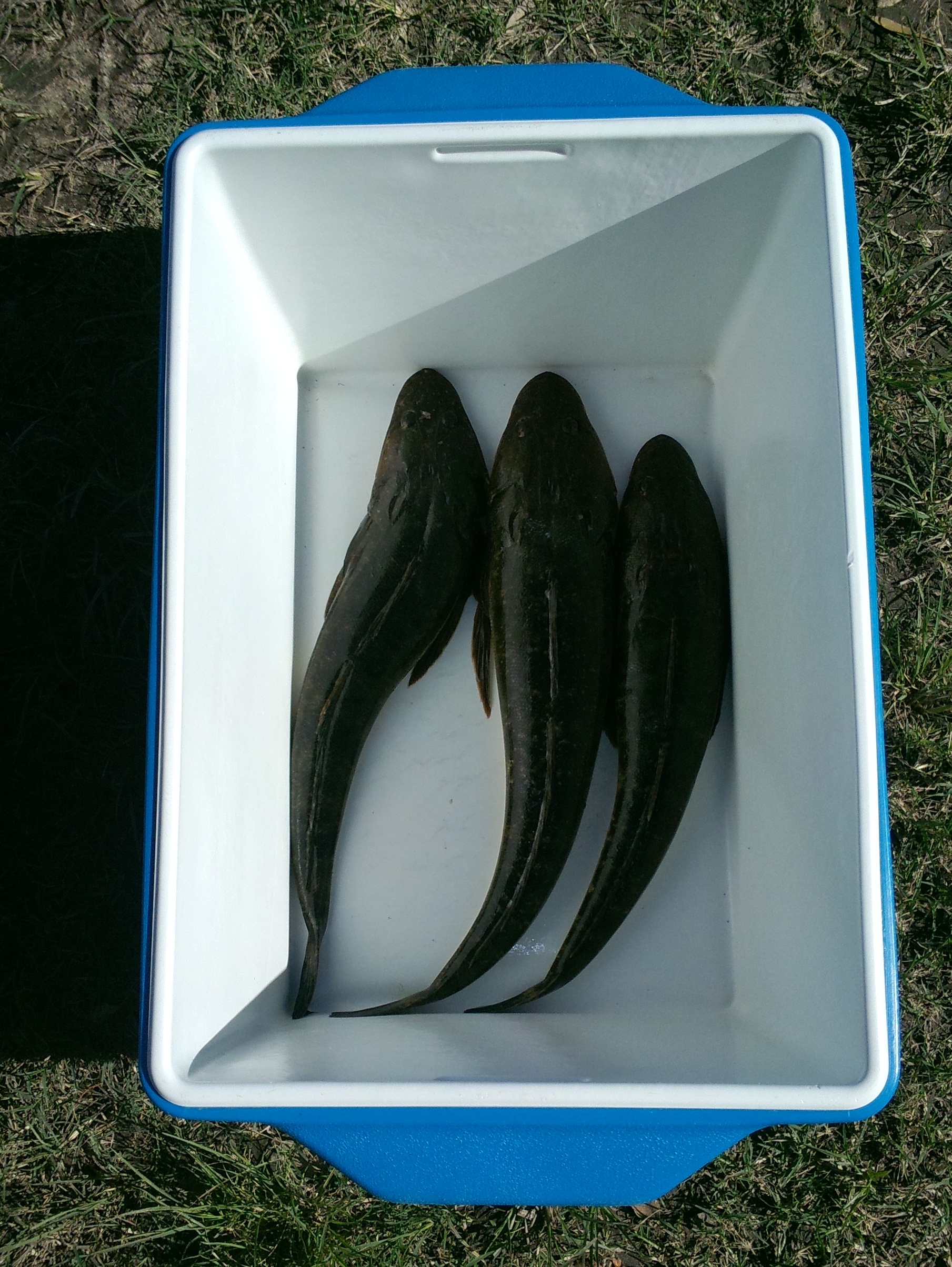
I arrived on the rock platform just before first light and rigged up my heavy rod. Low tide would be about 5.00 am.  I was using 30lb fluorocarbon leader and I put a GULP 5” Jerkshad in the Peppered Prawn colour on a 1/6th ounce, size 1/0 hook jighead. The swell had settled considerably and I could safely get fairly close to the edge of the rock ledges.  I knew where to cast – as close as I could to the edge of the rocks. Sure enough, on my third attempt I felt the gentle pull of a jewfish mouthing the plastic. I paused, then struck. With the big rod and light swell, this fish was fairly easy to subdue. It was 5.30 am and I had my first jewfish of the day. It was probably just over 70 cm, but I had left over fish from the day before, so I speared it back into the foamy wash.

I stayed with the heavy rod for about another thirty minutes  and caught a great bream but I was having trouble keeping in touch with the soft plastic, so I swapped to the lighter rod with a 14lb fluorocarbon leader. I moved to the south along the rocks, casting at any likely looking water. I soon found a few more good bream. I caught about 6 over the next hour – most were over 35cm. I used both big and small soft plastics in various patterns and colours.

At one point something bit hard on a 3 “ minnow soft plastic and took off, after a few seconds the line went slack and I retrieved just half a jighead. You need good teeth to bite clean through the jighead – mackerel? Shark?

At about 8.30 am the rain started falling and gradually got heavier until I decided to stop for the morning.

Afternoon

At about 3.00 pm the rain stopped and I went back to Woody Head to fish the afternoon low tide. The wind had picked up a bit from the north. I caught a few more bream on soft plastics all along the front of the rock platform. I caught one 35 cm on a GULP Jerkshad, but in general the fish where smaller than they had been in the morning.

As the sunset behind the headland the wild weather turned the sky a great colour. I fished through dusk and kept catching small bream and a couple of dart. At about 6.30 pm I decided I had had enough and walked back to the carpark.

Iluka – Middle Bluff and the Clarence River – 23 November 2014

Sunday

With another year almost over I was determined to get in a few more days of fishing down at Iluka. The weather looked good so on Saturday, I drove down from Brisbane in the afternoon. I rented a unit in the Riverview Apartments – which look straight out on to the Clarence River. I love to camp at Woody Head, but the weather looked a bit tricky so I chickened out. I arrived in time for a beautiful sunset. I sorted out my rock fishing gear, checked the weather forecast for the morning and went to bed early, with the alarm set for 3.30 am, NSW time.

On Sunday morning I got up in the dark had a cup of tea. Then I drove round to Frazers Reef beach car park. I walked down the path and onto the beach. There was not much moon in the sky – it had been ‘new’ on Saturday. There were a few clouds along the horizon and there was a light north-easterly wind blowing. A couple of kangaroos were close to the water but they decided to bounce back to the undergrowth, when they saw me walking along the beach.

I walked north, past Frasers Reef to Middle Bluff. This rocky platform sits about half way between Iluka Bluff and Woody Head. My favorite spot to fish is at the north end. Before I start, I will offer my words of warning. The wind and swell are very unpredictable here, so always take care. I now wear a pfd and felt-soled rock fishing boots. The wave sets and swell heights vary dramatically between high and low tide, so tread carefully and watch what’s coming all the time.

This morning the swell was fairly tame but every 15 minutes a big set would come through and slap against the rocks. The tide had been low at about 3.30 am and it was now running in. I rigged up the heavier of my two rock fishing outfits – the Daiwa Demon Blood 962H rod matched with a Shimano Stradic FJ 8000 reel.

Now a whinge for Shimano – I have had a lot of trouble with the drag clicker arrangement on your reels. On the previous Stradics – the problem was the part kept breaking. This has now been changed to a more robust part. But it keeps going silent on me.  Aside form the springs and clips that keep failing or popping out, I think the basic problem is the clicker is metal and the wheel it clicks against, is plastic. I know I use my reels a lot and I treat them mean, but I think this sort of basic design fault should not keep appearing.  To add to my disappointment in Shimano it took three months for you to find a new bearing for my Stella, last year. I could have flown to Japan (Kuala Lumpur, Shenzhen) myself and machined one. The folks at Jones Tackle have done a great job of repairing the reels and covering for you, but overall the product is not robust enough for Australian conditions. I have decided my next reel of this size will have to be another brand.

Back to Middle Bluff – I started by casting big shallow diving hard bodies without much luck. You can catch just about anything off these rocks. Tailor are around all year, as are jewfish, dart, trevally and some monster bream.  I have seen a 25 kg Spanish mackerel caught off here, on a 40 cm live tailor. It’s a very fishy place.

However, this morning it was proving tough. I swapped from the hard bodies to big soft plastics – a GULP Jerkshad in the Lime Tiger colour. To counter the swell I initially rigged it on a ¼ ounce jighead and later dropped down to a 1/6th ounce jighead. I moved up and down the rocks without much luck. I was fishing with 30lb fluorocarbon leader. The water was murky because of the big tides of the last few days.

I fished through the dawn with hardly a bite. I swapped rods to my lighter rock fishing rig – the N.S Black Hole Cabin II – S-862 L Spin Rod. It is 2.59m long (8’6”) and rated 8-14 lb. I dropped the leader down to 20lb fluorocarbon. I put on a smaller GULP 3” Minnow, also in the Lime Tiger colour. The smaller soft plastic immediately attracted attention, with a couple of grabs and even a solid bite, but I did not hook anything. After another 20 minutes of casting I connected with a fast fish, I soon subdued it and pulled it clear of the water. It was a dart.

I moved a little further south. I cast down into some foamy water and let the plastic sink to the bottom. I paused for about 20 seconds and as I lifted it – bang – something grabbed it and took off. It went hard and fast and I struggled to slow it down. I tightened the drag a little and it paused, then took off again. I just kept pumping and winding, whenever I could and eventually it started back towards the base of the rocks. I suddenly realized I was a long way away from anywhere I could safely land this fish. I was standing about four or five metres above the water on the rocks and there was no way the 20lb leader would pull this fish up. I saw a flash of blue/silver as it headed in to try and bury itself. Kingfish/ Tailor/ Salmon – I am not sure, but it was a good size. I started to walk it towards the south, where I might be able to land it. I got about 20 metres along the rocks and after a big surge, the line went slack. I pulled up the mashed plastic. The hook must have just fallen out.

Now I had found some fish I decided to go back to the bigger soft plastic and tied on a 5” Lime Tiger jerkshad. I fished this around the rocks hoping to find the fish that got away. It was only about 7.00 a.m. but it felt like I had been fishing all day. The sun was high in the sky and it was very hot. At about 7.15 am a fish grabbed the lure close in to the rocks. After a brief site it pretty much gave up. It was a small jewfish about 45cm long. After a few pictures I threw it back. At about 8.00 am I set off back to the car, stopping for a morning swim on the way.

The wind picked up during the day and the sky clouded over. I decided to try fishing the rock walls just to the south of the boat ramp, in town. I started at about 4.00 pm. It was almost low tide. I dropped down to my light spin rod with a 10lb fluorocarbon leader. I was expecting a few bream to be swimming around this area, so I started fishing with a GULP 3” Minnow in the Smelt colour. I had it rigged on a 1/8th ounce, size 1 hook jighead. I cast parallel with the base of the rock wall and soon found a few bream. I moved to cast at a gap in the wall and swapped to a GULP 3” Minnow in the Peppered Prawn colour. I felt a few bites, so I left the plastic to sit in the bottom for a while. This did the trick and when I lifted the rod tip there was a fish on it. It was heavier than a bream and after a while I saw a longer flash of silver – it was a school jewfish, about 40 cm long. On the way back along the rock wall, I caught a small flathead.

With good weather and a few fish, it had been a good start to the week.

1770 – Deepwater Creek – 4 November 2014

Tuesday

On Tuesday I had some work to do in the morning and the wind was blowing hard. By lunchtime, I was keen for a fish, so I decided to drive down to Deepwater Creek, which is just south of 1770 and see what I could catch.

At about 3.00 pm I set out to explore. I have fished a few sections of the creek. It has both freshwater and saltwater parts with a weir separating the two. When it rains heavily, the water runs over the weir and it would be possible for fish who can survive in both, to move up stream. Last year I caught my first tiny barramundi in this creek. I am sure that there are some bigger ones lurking in this system.

It’s important to protect yourself from the bugs. You want to be fishing at dawn or dusk and unfortunately this is the time when they are at their fiercest.  This is a fresh/ saltwater swamp, so after a bit of rain it is buzzing. I find minimising your exposed skin is really the best solution, so I wear long trousers and a long sleeve shirt and fishing gloves. I then use a good repellent on my neck and face.

I started on a section of the fresh side of the creek. Finding a spot to cast from is always a challenge. There are overhanging branches and vegetation everywhere. There are also fallen trees and stumps at regular intervals. You must be prepared to lose plenty of gear. I was fishing light. I was using my G.Loomis TJR fast action, light spin rod, Shimano Stella 2500 reel, 10lb braid with a 10lb fluorocarbon leader. There was no movement and the wind was ruffling the tree tops. I decided it was time to think out of the box – the DUO lure box. With so many snags I decided to give a small surface popper a try. I tied on the DUO Tetraworks Pocopoco in the Clear Rainbow colour. This is a very small popper that is great for catching bream over weed beds. It is well made with the usual great DUO paint job and excellent finish – but its real strength is its noisy blooping action.

I cast it out to mid-stream and let it sit for about ten seconds. I took up the slack and it loudly blooped towards me. After each jerk with the rod tip there was another bloop and splash and then I would pause. After three pauses, there was a swirl in the tea tree stained water behind the lure. On the next bloop a fish attacked and ran for bit but then spat the lure out. I could not see what it was.

I cast out to the same spot, there was another swirl and then a surface strike but the fish missed the lure. Popper fishing is always like this – you swing from delight to disappointment, all within a 10 second retrieve. I cast out again and again and I had another bite and run but no hook up. I decided to return later.


I moved down to the saltwater section and found a good looking stretch of bank with sunken timber and lots of mangrove roots. I swapped to a soft plastic lure – a GULP 3” Smelt Minnow and as the water was hardly moving, I dropped down to 1/12th ounce, size 1 hook jighead. As I cast along parallel with the bank, small bait fish hopped along in front of my lure. It was now about 4.30 pm and there were a few surface bust ups, in close to the mangrove roots. I lost a few jigheads and leaders to the submerged timber, but I kept re-rigging.  At about 5.00 pm something slammed my lure just before I was going to lift it clear of the water. The rod bent over and it tried to head straight back towards the mangrove roots. With 10lb leader I was not going to force the fish out once it buried itself – so I quickly tightened the drag and gambled that the G.Loomis would be a good enough shock absorber. This worked and I turned the fish back towards mid-stream. It pulled hard but after a minute or two it was tired and I carefully pulled it clear of the water. It was a Mangrove Jack and measured 38cm. I took a few pictures and released it.

After another 30 minutes I decided to turn my attentions back to the fresh water section of the creek. I wanted to see if I could catch what had been chasing my popper, earlier. I went back to the other spot and I tied the popper back on. It was now about 5.30 pm and the shadows where getting longer. I cast into the middle of the stream, where the fish had been earlier, but with no luck. I cast closer to some tall swamp grass on the far bank and saw a faint swirl behind the popper. I put the next cast back in the same spot and this time the fish took it in one great gulp. It was a chunky spangled perch – about 30 cm long. There is obviously plenty to eat in this system.

I don’t think the strikes earlier in the day had been from this species, they had been much more aggressive. Perhaps they were from some tarpon, which can be caught all through this system.  By about 6.30 pm it was too dark to carry on so I stopped for the day. Exploring new systems can be hit and miss but this afternoon was definitely a hit!

Bribie – the old oyster jetty flats – 23 April 2014

Wednesday

It was a late start for me again on Wednesday – juggling work and fishing is hard.  But then most of my readers are probably well aware of that!

I arrived at the Bribie Bridge at about 9.00 am and waded out towards the flats to the south of the old oyster jetty. The sun was shining and there was a light south westerly wind. It is definitely getting cooler and the wind had some bite in it. The moon was 37% full and waning. It would be a 0.6m low tide at about 10.30 am.

I started fishing with a GULP 2” Shrimp soft plastic in the Peppered Prawn colour and this soon found a fish. It was a Flathead – just over 40 cm. I released it and went looking for more.  The water was clear but there were still a lot of black clumps of ‘snot’ weed floating around. There were sand crabs everywhere. Plenty of them seemed to be in romantic embraces.

As the tide slowed, I moved further south. In one of the sandy hollows, I caught another fish. This flathead had the brightest coloured tail I have ever seen. I released it and carried on wading south. I swapped to a GULP Jerkshad in the Peppered Prawn colour and as the tide started to run in, I caught another 45cm flathead.


I briefly tried fishing with a few small hard bodied lures, but they kept getting clogged with weed. I swapped back to a GULP Jerkshad in the Lime Tiger (orange and green colour) and at about 11.00 am I found a couple more small flathead that were probably just under 40 cm.

This had not been a bad fishing session – especially as the school holidays have just finished and this area has been fished pretty hard. All fish were released today.

Bribie – the old oyster jetty flats – 26 March 2013

Wednesday

A strong south easterly would bring more showers on Wednesday and low tide at Bribie was not until noon. New moon would be in three days time. I drove up and started fishing to the south of the bridge, at about 11.00 am.

The wind was blowing 20 knots from the south east and the skies were grey. I had no luck, just to the south of the bridge, so I moved to the area to the south of the old oyster jetty. This has been the most consistent spot for me in recent sessions.

I caught a couple of legal flathead on the Japanese Ikajako 3 ½ inch Powerworm. I then got a shock as a Pied Cormorant surfaced right next to me. Normally when this happens they are as surprised as I am and they swim off pretty quickly.  But this one was not in the least bit startled. It was looking hungrily at the soft plastic on the end of my rod. Each time I cast, it lunged off after the soft plastic.

I swapped to a 5” Powerbait Rippleshad soft plastic. The cormorant got hold of the plastic but I managed to pull it free. I cast it out and after a few hops I connected with a fish. As I wound it in, the cormorant started chasing it around. The fish was a 50 cm long and looked far too big for the cormorant, but it swam around pecking at it. I won the fight and released the fish.

I swapped to a Gulp Jerkshad in the Pink Shine colour. The cormorant kept swimming around close by and kept trying to grab the soft plastic. Each time I caught a fish it would try to grab it. This and the wind was making the fishing pretty hard. I caught a smaller flathead – about 35cm long and the cormorant grabbed it, as it surfaced. It wriggled free, but then the bird grabbed it again and this time it pulled the fish off the jighead. It swam off towards the shallows with the flathead secured in its beak. It was now out of the picture while it figured out how to swallow the fish.


I swapped to a Lucky Craft Pointer X D 75 hard bodied minnow in the Disco colour. I typically use this when fishing for barramundi up north but I thought I would try it on the flathead. It is a suspending lure and the X D stands for extra deep – so it would bump along the sandy bottom. It did the trick and as soon as I found a patch of sandy bottom a flathead grabbed it. I unhooked and released the fish and caught another, a few casts later. This one had really slammed the lure and broken off one of the trebles. I carried on fishing with just the rear treble and caught a few more flathead 40 – 50 cm flathead over the next half an hour.

At about 1.30pm, I finished the session by catching a couple more flathead on the 3 “ Powerbait Rippleshad in the Perch colour with a red paddletail. The fish were plentiful and only the wind and the wildlife had slowed me down.

Bribie -still at the oyster jetty flats – 13/14 March 2014

Thursday – Friday

I accept that these reports are getting predictable but it is very hard to stay away when the fish are so prolific. So on both Thursday and Friday, I returned to Bribie to fish the last few hours of the run out tide.

The tides would be low at 1.50 pm on Thursday and 2.36 pm on Friday.  The tides were getting bigger, as we headed for the full moon on Saturday. The water was therefore running in and out faster. It was the same wind pattern – east-south-easterly, building through the day. A northerly change was forecast to raise temperatures and blow up on Sunday.

On Thursday, I started at about 10.15 am. There was plenty of water at the base of the mangrove roots, so I started off by casting in to the shallows, just north of the bridge. There is a nice weed bed here and a few sand banks. I started with the GULP 2” Shrimp in the Peppered Prawn colour. I was fishing with 12lb leader and my light spin rod. After a couple of casts, I found my first flathead at about 10.20 am. It was just about 40cm long. I released it and five minutes later I had a much more aggressive bite. I reeled in a tiny moses perch, which had been hovering close to the first bridge pylon.

I moved south past the old oyster jetty and at about 10.45 am, I caught a bigger flathead – about 50 cm long,  on a Gulp 3” Minnow in the Peppered Prawn colour. It was about three hours from low tide and the band of sandy hollows and weed beds, where I have been catching most of the fish in recent sessions, was now within casting range.

I caught a few more fish on the Gulp 4” Minnow and Jerkshad soft plastics and at about 11.30 am, I decided to give the DUO Tetraworks Toto a work out. This is a 2.8 gram, 42mm sinking minnow. It has a tight rolling action. You just cast it – count to five to let it sink, then start a slow and steady retrieve, hop it along the bottom in short bursts like a soft plastic.

This slideshow requires JavaScript.

My first cast with the Toto connected with a fish. This lure caught 5 more flathead over the next 30 minutes. The largest was just over 60 cm. At about noon, I swapped to the DUO Realis Shad 59 MR – a slightly larger, suspending minnow. This really is a great flathead lure and will also catch bream, if they are around. It has a good rattle and the buoyancy balance is perfect. It will suspend in the water column for about 5 seconds, before slowly floating upwards – giving a bottom dwelling predator plenty of time to strike.

First cast with the Realis Shad also produced a fish and over the next hour it produced a fish every 3 or four minutes. On average the hard bodies seemed to attract slightly bigger fish than the soft plastics had done.

Just before 1.00 pm, I was playing a decent flathead that had locked on to the DUO Realis Shad. It was a big fish – well over 60cm, so I decided to pull it in to the shoreline to unhook and photograph. I was a bit impatient and had the drag set a little too tight. When it saw that we were heading for the mangroves, it turned, shook its head and snapped the leader. When you are catching plenty of fish the leader gets worn very quickly, so it pays to keep checking it. At this point I gave up for the day.

On Friday it was a similar story. The fish were a little less plentiful, but the wind was far stronger, which may have made them a little harder to catch. I focused my efforts on an area further to the south of the oyster jetty and again found that the hard bodies – particularly the Rio Prawn lure, found the bigger flathead of the day.

I must go and explore if the fish are everywhere or just clustered over on this side of the Passage. Maybe next time.

Bribie – the old oyster jetty shark adventure – 02 January 2014

Thursday

After a short break from fishing over Christmas and far too many mince pies and hangovers, I was anxious to clear my head and wet a line.

Some big blows were forecast but the best weather looked like Thursday morning. I did not have much time, so I decided I would carry on at Bribie, on the flats around the old oyster jetty, on the mainland side of the Pumicestone Passage.

The new moon had arrived on Wednesday. As a result we are in the middle of some very big daytime high tides which provide advantages and disadvantages. On the positive side, my experience suggests the fish feed more confidently when there is good tidal flow. Also, as a land-based fisherman you get to examine more of the terrain you regularly fish, as more of it is exposed on the really low tides that follow/ precede the big highs. On the negative side, the water and the fish move very quickly, so you often can only fish safely in one spot, for about 30 minutes. The big flows also lift a lot of sediment, weed and other debris – which can make the water very cloudy.

I walked out to the water’s edge, under the Bribie Bridge, in the dark, at about 4.15 am. Low tide had passed at about 3.30 am and there water was fairly still. There was not much weed floating around so I decided to fish with the DUO Realis Shad 59 MR. As I have mentioned, I have tried a few alternative,  small hard-bodied lures but I keep coming back to this one. It is a shallow running, suspending bibbed minnow, I was using the bronze colour and even on the first cast, the small moses perch attacked it. I was standing ankle deep in the water, casting into the shadows around the bridge pylons. On the next couple of cast the nudges and bumps from small fish continued. I think the rattle in this lure really gets them fired up.

After about 10 more casts I waded out a bit further, to about waist deep and put in a long one to the north of the bridge. As the lure hit the water I gave it a couple of pulls to get it running below the surface. Then there was a slight feeling of tension and it was gone. I wound in to find the leader cut cleanly by something.

I was fishing with only 10lb fluorocarbon leader, so I upped it to 14lb, the heaviest I had, and tied on a GULP soft plastic jerkshad on a 1/8th ounce, 1/0 jighead in the Lime Tiger colour. I lobbed this out to approximately the same spot and on my second cast, the same thing happened. I re-rigged and it happened again. There was something toothy out there so I backed up a little.

The sun was now peeping over the horizon and the tide was running in, fast. I decided to move quickly to the south of the old oyster jetty and look for some fish. Just after first light I caught a 40cm flathead on the GULP Lime Tiger jerkshad soft plastic. At this point, I realised I had my camera but I had forgotten to put the battery back in.

I moved further south, casting in to the incoming tide. There was now a lot of weed around and it was hot and still. The water was very murky. As the birds flew over the shallows they spooked some big bait schools. For an hour I swapped soft plastics and fished along the edge of the sand banks, but I could not get a bite. At about 5.30 am, I noticed a bit of movement in the water about 30 metres to the south, in the shallows. I thought I saw a few fins but assumed they were just the tips of rays’ wings which you often see in this area.

By 6.00 am I still had not had a bite. The tide was now running in quickly and I was standing about 3 metres from the edge of the long weed bank that runs along this part of the flats. At the edge of the weed there is a sloped sandy drop off. The water beyond the drop off is only a couple of metres deep but this is where the bait tends to school up.

As I stopped to swap plastics again, a fin broke the surface just a few metres in front of me. At first I thought it was a dolphin, but then I saw the tail fin and realised it was a decent sized bull shark, moving very slowly along the edge of the bank. I immediately started slowly wading backwards from the edge. It was followed by another shark, a couple of metres behind that was also swimming with its fins above the surface.

After covering a few metres I looked back and to my disappointment I realised that the tide had been coming in so fast that I now had a good 30 metres of waist deep water to walk through, before I could reach the safety of the sand bank. I waded as fast as I dared and as you can imagine, I covered the ground pretty quickly.

From the safety of the sand bank, I counted at least 8 fins – so perhaps four sharks – in the group. I expect there were a few more.  On reflection it is difficult to work out how big, but they were certainly all over 2 metres and the first one that I saw quite clearly would have been 2.5 + metres long. I knew there was plenty of bait around but they did not seem to be hunting. They just cruised slowly up and down the edge of the banks and the fins would only break the surface when the water got too shallow. They stayed over the sandy areas and did not seem to venture up over the weed beds. I watched them for 30 mins and decided I would leave that area to them.

I waded back to towards the bridge and stopped under it to have a few casts in the shallows. I was now fishing with a GULP 2” Shrimp soft plastic on the Banana Prawn colour, on a 1/8th ounce, size 1 hook jighead. I was back down to 10lb fluorocarbon leader. I was about ankle deep in the water (I was reluctant to go any further – for obvious reasons). I was standing to the north of the bridge and I cast close to the pylons and hopped the shrimp back to me, across the rubble on the bottom. As the lure hopped over a sandy patch, no more than 20 cm deep, there was a big surge and something grabbed it and turned away.


The tide was running fast across these shallows and the fish drifted with it for a few metres. I then lifted my rod tip and set the hook. It carried on drifting for a few moments and then it took off towards Caloundra. The rod tip bent over and the reel started screaming.  There was rubble on one side, mangroves on the other and the barnacle covered bridge pylons in the middle (and probably a selection of sharks, further out). I walked north with the fish, away from the bridge and let it take line. It was very heavy and slow and initially I thought it might be a ray. The two initial runs were long and powerful but the rod kept soaking up the lunges and eventually it calmed down. After about 5 minutes of steering I had it close enough to the shore to grab the leader. As soon as the leader took the full weight of the fish it snapped but I was able to push it onto the shore with my boot.

I was now under the bridge, so I raced to the car that was now only a few metres away and grabbed the phone and tape measure. I measured her at about 77 cm, and after a couple of pictures, she swam away, unharmed. It had been quite an eventful session. Wherever you are fishing take care!
Yeppoon – Emu Park – 27 October 2013

Sunday

Finally a morning with virtually no wind forecast. I decided to head for Emu Park to fish the rocks. Low tide would be around 9.30 am and the moon was in its last quarter. I started at one of the headlands towards Zilzie and climbed out on to the rocks just after first light, at about 5.00 am.

There was virtually no wind and the sea was still. The water was not particularly clear and there was the bad smell of a recent algal bloom on the rocks. I was fishing light – actually I did not have a choice – as I had noticed, the night before, the tip on my heavier rod had snapped off during my recent travels.

I rigged up with 12lb fluorocarbon leader and a 1/8th ounce, size 1/0 hook jighead with a GULP 4” Minnow in the Watermelon Pearl colour. I was using my trusty Loomis GL2 light spin rod and Shimano Stella 2500. I have fished here a few times in the cooler months and found some good Bream. This morning the first taker was a tiny greedy estuary cod. I caught a few of these and swapped through a few colours and styles of soft plastics.

After about 45 minutes the cod where the only thing biting, so I moved round to the rocky outcrop in front of the ‘Singing Ship’ at Emu Park. It was now about 6.15 am and already getting warm. I stuck with the same light rod but swapped to a lighter, 1/12th ounce, size 1 hook, jighead. I put on a 3” GULP Minnow in the Peppered Prawn colour. I positioned myself right on the end of the outcrop and cast to the north of a large bommy that sits a few metres offshore. If you are fishing land-based, you can only reach this spot for a few hours either side of low tide.

After a couple of casts in various directions, I felt a very solid and obvious thud as the lure sunk. I paused and then lifted the rod tip fairly quickly. I had hooked the fish and now it took off for the submerged rocks and caves, which are all over the seafloor in this area. I could not really muscle it in with my light rod, so I let it take line when necessary and very slowly tightened the drag. I gradually started to move it towards me. It managed to get behind the rocks a couple of times but, on both occasions I let it swim out and then successfully took up the slack.

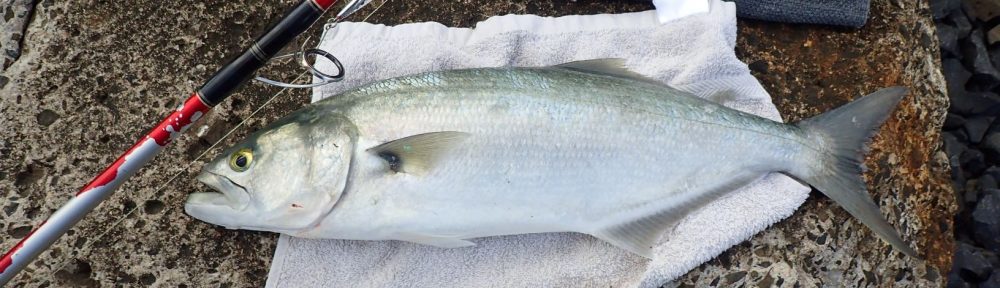
It was soon in the wash at my feet and I could see it was a good sized Fingermark with the tell-tale black dot on its side. I grabbed the leader and pulled the fish clear of the water. I recovered the soft plastic with the aid of my pliers. It was a long way down its throat. The fish was about 50 cm long and it looked like the perfect size for dinner, so I put it in a nearby rock pool that was big enough to act as a live well.

I re-loaded the soft plastic on the jighead and cast into the same area. Just a few retrieves later, I was on to another fish. This one was bigger and put up a more spirited fight. My 2 to 4 lb Loomis rod was working pretty hard. I saw a big tail flap over and thought I had it, but as I increased the pressure the jighead came free.

I re-rigged – same small 1/12th ounce jighead, same small soft plastic. 12lb leader was all I had with me, so that had to do. Things went quiet for 30 minutes and I mover around the rocks in either direction looking for more good spots. I had another solid bit but did not hook the fish.

Just after 7.00 am I was back where I had caught the first fish. I lobbed out a long cast and again, as I lifted the plastic off the bottom I felt that very solid whack! This was another good fish. It did not do much initially but as soon as it realised something was wrong, it went mad and leapt clean out of the water. It remained on the line but tried to bury itself under a weedy ledge. After a few minutes I pulled it clear with a great lump of weed on its nose. It was about 55cm – so I added it to the live well. I decided to stay in this spot and was soon rewarded with another smaller Fingermark – about 40cm. I let this one go and carried on fishing.

It was now about 7.30 am. I lobbed a cast up close to the edge of the bommy and let it sink. I paused and gave it a couple of slow lifts and then paused again. Next time, I felt a very light tap as I lifted the rod tip and then a solid whack! The fish took the lure and turned for open water. It stripped perhaps 25 metres of line in two long, straight runs and I began to think it might be some kind of pelagic. I held on, tightened the drag as much as I dared and held the spool to slow it ever so slightly, each time it to tried run again. I gradually tired it out and fortunately it had stayed clear of the worst structure. After a few minutes it was close to the sloping rock where I had pulled the other fish ashore. Bit this would be tricky. Its tail flapped over and I could see it was a big Fingermark. I waited for a surge in the light swell and heaved the fish up. Crack! My beloved G.Loomis GL2 light spin rod made the ultimate sacrifice in the line of duty. It snapped just above the join but the leader was intact and still attached to the fish. I grabbed the line and pulled the fish up the rocks and it just reached safety before the leader also snapped.

I sat clutching the fish with one hand and broken rod in the other, with my heart still pounding from the fight. It had been a fantastic capture and it was a marvellous fish. We do not get to sample much reef fish in my house, so I decided to keep the three in the live well. The big one measured in at 63cm and it probably weighed in somewhere between 3 and 4 kg – maybe more.
Needless to say that was the end of the session – but what a session it had been!

Rockhampton – Fitzroy River – 25 October 2013

Friday

I arrived in Rockhampton late in the afternoon and decided to go fishing on the banks of the Fitzroy River, right in town. I drove over to the Bowls Club and worked my way down to the shoreline just as the sun was dropping, at about 5.00pm. Low tide would be a few hours later. This area, below the ‘new’ bridge, across the river, has lots of rocky channels and drains with muddy/sandy bottom in between.

I could see the fish rising to slurp up bait or perhaps small prawns. The locals prefer to fish this area with large hard bodied minnows. I had no idea what the pattern of the rocks beneath the water, so I started with soft plastics. I decided to initially fish with a 3” Gulp Minnow in the Peppered Prawn colour with a 1/8th ounce, 1/0 jighead.

I had a few touches and as the tide receded and the sun fell, I got a better view of the terrain. This far up the river is obvious fish territory. About 800 metres further upriver, the salt water is stopped when it meets the Fitzroy River Barrage. Presumably the fish follow their natural impulse to swim upriver to spawn and then get stuck in this area (unless they work out how to climb a fish ladder – which seems unlikely!). I concentrated on casting next to the rock bars and into the channels and lost a bit of tackle in the process.

Dusk on the Fitzroy River at Rockhampton

Dusk on the Fitzroy River at Rockhampton

Caught just after sunset on a run out tide

Caught just after sunset on a run out tide

A baby - but still a barra

A baby – but still a barra

At about 6.30 pm, when it was almost too dark to fish, I felt something grab the soft plastic and drop it. I had now swapped to a 2” GULP Shrimp in the Banana Prawn colour on the same light , 1/8th ounce, 1/0 jighead. I carried on peppering the area with casts and a few minutes later I connected again. It was a very small saltwater barramundi, I photographed and released it.

It was now too dark to fish and so I retraced my steps back to the car. Only a baby – but I had found a Fitzroy River barramundi.

Bedford Weir – Blackwater – The Mackenzie River – 17 October 2013

Thursday

Back to Blackwater – theoretically to do some work but, of course, my true purpose was to have a go at those fussy saratoga, swimming around down-stream of Bedford Weir. I arrived on Wednesday and got the paid work out of the way. On Thursday I had some time in the afternoon.

It was full moon. I had fished the full moon last time I was here and I had found a few good fish. This time I drove down the four wheel drive track, which runs to the east, alongside the Mackenzie River downstream of the weir wall. I followed it almost to the end – about 6 kms in total. The track is reached by turning to the east, off the Blackwater Cooroorah Road (right – if you are coming from Blackwater) just before you reach the weir.

Take care on this track. It is fine while the ground is dry and solid but it would be fairly tricky once it has rained. Also be aware there is a very high fire danger at this time of year, with tall dry grass lining the river banks and tracks.

At this point the banks of the river are quite steep and there is wide pool that has formed as the river runs against a rock bar, which slows it to a trickle, beyond this point. It looks like the fish cannot comfortably travel beyond this pool so it should be a good fishing spot.

Sure enough, as I approached the bank I could see several large saratoga lurking under the overhanging branches. The only thing that had worked on them before was a GULP soft plastic with arms and legs flailing everywhere – the 3 inch Ghost Shrimp. The hard bodies had just spooked them. I was out of suitable plastics so I started with a ¼ ounce spinner bait in a yellow and white colour. The fish were very well protected by the overhanging branches and it was pretty difficult to approach them without spooking them. I managed to get the spinner bait quite close to them a couple of times, before they dived down out of sight. These are very cautious fish.

I moved a little further along the bank and loaded a 1/11th ounce/size 2 hook jighead with a 2” GULP Shrimp in the Banana Prawn colour. I hopped this along the bottom around the snags and soon connected with a small catfish. I caught three of these.

I moved a bit further along and switched to the same soft plastic in the Peppered Prawn colour. I cast this at some sunken branches, which were close to the bank and felt a slightly more urgent tap, as I retrieved the lure. I cast back in the same spot and this time I hooked up. It pulled hard and fast, faster than the catfish. But it was not big enough to be a saratoga. I kept the rod tip up and pulled it clear of the snaggy timber. It was a respectable golden perch/ yellow belly.

I looked for a few more and may have had one on, that I did not land. After a while I could see the saratoga out in the middle of the stream, again. I swapped back the spinner bait and even though I pulled a few directly past their noses, I could not entice them to strike. They would turn towards the lure as it hit the water and sometimes swim towards it – but then lose interest. Its pretty tough fishing in the fresh water but I learn a little more on each session.

At about 5.30 pm, having caught a couple more catfish – I gave up for the day.

Gayndah – Claude Wharton Weir – 1 September 2013

Sunday

Back to work for a while, but it is not all bad. I decided to take the scenic route to the Bowen Basin and try some freshwater fishing along the way. I have no experience of tempting our freshwater species, in Queensland. Every time I drive across a bridge over one of our rivers or creeks, I am tempted to stop for a fish. The high rainfall of recent years has left a lot of water courses looking like they must hold fish.

I decided to stop and fish the Burnett River at Gayndah. The Claude Wharton Weir is about 2km upstream of the town and there is currently plenty of water flowing over it. I arrived in the late morning about 10.15 am and drove along the north bank of the river, to the weir.

I have seen people fishing here before, when I have passed through and there is plenty of structure. The big floods knocked over thousands of tree and these are now half submerged, all along the banks. The weir is carved out of a rocky gully with lots of submerged rock outcrops. I thought of fishing in the reservoir, above the weir but this looked featureless so I decided to try beneath the wall.

I was using my light spin rod – G.Loomis GL2 – Fast Action and my Shimano Stella 2500 reel. I was loaded with 4 kg Fireline Exceed, in the new, yellow colour and I tied on a 6lb fluorocarbon leader. I chose a 1/8th ounce, 1/0 jighead and a Gulp 3” Crazylegs Grub in the Smelt colour. I love this lure in clear still water. The twin tails have a great action as it sinks.

I scrambled down the bank and started casting around some submerged branches. I lost one rig to the timber and re-tied with the same set up. I let the soft plastic lure pause on the bottom, for about 30 seconds after the cast and when I lifted it, there was a good solid weight on the end. The weight started wiggling and then took off into the structure. I let the drag do its work but it felt like the fish had got itself nicely wrapped around a branch. I let the drag off a little and each time the fish moved I put on a bit more pressure. After a minute or two, it swam out. I tightened the drag back up and pulled it out from under the branch. It was not done yet but it was just under the surface and out of danger. I gradually pulled it up to the bank.

It was a big brute of a cat fish – between 2 and 3 kg. I had caught my first freshwater fish in Queensland – not very handsome, but great fun. I photographed and released it and carried on fishing up to the weir. I put in another hour and a half and saw some small silver fish come and make a grab at the soft plastic, a couple of times, but I could not catch them. I gave up at about noon and went to do some reconnaissance of other spots, for the next morning’s session.

Bribie – the old oyster jetty flats – 25 August 2013

Sunday

I had caught a few good fish around Bribie Island through the week. There was plenty of variety – Estuary Cod, Mulloway, Bream, Flathead, Whiting, and Pike all put in an appearance. Despite some good catches, the fishing had actually been quite tough with a long time between bites.

On Sunday I decided to stay on the mainland, opposite Bribie and fish the old oyster jetty flats. Low tide had been would be at 6.02 am and I arrived just before first light at about 5.30am. There was no wind to speak of. I waded out to a point about half way between the green channel marker and the oyster jetty and started casting with a GULP 4” Minnow in the New Penny colour, on a 1/8th ounce, #1/0 hook, jighead. I was sticking with the light 8lb fluorocarbon leader as fishing light had worked well, earlier in the week.

I tried everything; big plastics, small plastics, different retrieve. At one point I thought I had found some fish but the rabbit like bite marks showed they were probably those revolting spiny toad/ puffer fish, which sometimes float around here.

The tide eventually started to run in but this did not stir things up. There is a big trawler moored in this area at the moment and for some reason it was running its engines – perhaps this noise did not help.

The weather has been so good that that by 9.00 am, when I gave up, there were boats and kayaks everywhere. It had been a tough morning but it is always better to have tried and failed than to not have tried at all!

Bribie Island – the Seaside Museum drain and Buckleys Hole – 17 July 2013

Wednesday

New look site – hope you like it.

Things looked pretty good for Wednesday – there was a bit of rain forecast but the wind would be light, turning into a northerly. The moon would be about 65% full and low tide would 0.5m at 9.43am. These are ideal conditions to fish at Bribie Island. Arriving before dawn, I could fish the second half of the run out tide.

I arrived on the island side of the bridge at about 5.30 am. The water was running out pretty fast. I put on my waders and clambered down the rock wall to the south of the bridge. The bridge lights often bring the smaller fish or prawns into this area but there was no evidence of their presence. The water was clear, but there was a fair amount of weed floating around. I tried dark and light, big and small soft plastics but did not get a bite. Just after first light at about 6.00 am I decided to move south.

I drove down to the car park in front of the Seaside Museum. Conditions were perfect – I could see where the fresh water drain was pouring over the ledge into the channel and I positioned myself just south of this point.

I was fishing with my light spin rod and running 8lb fluorocarbon leader down to a 1/8th ounce, 1/0 hook, jighead. I started with a GULP 4” Minnow in the Smelt colour. I cast over the ledge, let it sink and bounced it back along the bottom, parallel with the shore. After about three casts, there was a solid bite, then line started peeling. It was slow at first but then it took off, as it realised it was hooked. It took about 10 metres, paused and then took another 10. It was a heavy fish. It turned and swam back towards the ledge. I tried to apply some pressure and lift it over but it put its head down and swam under an overhang. I tightened the drag a little and then slowly dropped the rod tip. As the line slackened, the fish swam out. I put the pressure on again but it went straight back under. I could feel the line rubbing on something and then pffffft – it was gone. When I wound in the line, the jighead and plastic were gone.

I swapped through a few soft plastics and hard bodies as the tide ran out. A small school of Tailor passed through and I lost a couple tails from my lures. I dropped down to a GULP 3” Minnow in the Pearl Watermelon colour on the same size jighead. On the first cast this soft plastic was hit as it sank. There was a quick initial run, towards me. I tightened the drag and started wading backwards. I did not want the fish to swim back over the ledge. I pulled a little too hard and caught site of a good sized Bream swimming away.

I carried on peppering the area with casts. I made sure I gave the soft plastic plenty of time to sink to the bottom. On a couple of casts I felt a faint bite, as I lifted the lure off the bottom. At about 7.35 am I cast out and paused. When I lifted the rod I felt some resistance. Suddenly line was peeling again. This time it was heading out into the channel. I moved closer to the ledge and gradually recovered some line. It was another slow powerful fish. It gradually tired and as I pulled it over the ledge, I could see it was a Jewfish. It made few more runs but I soon had it safely on the sand. It was about 55cm long. Unfortunately it had completely swallowed the jighead, so I left it in, cut the leader and released it, after a few pictures. I could not find anymore, so I moved on.

I waded to the south, casting along the edge of the drop off. Things were uneventful for about 45 minutes. I was now standing in front of the tidal lagoon at Buckley’s Hole. Suddenly, something grabbed the soft plastic as it dropped into the water. It took off and then let go. I continued retrieving the lure, quickly and just before it reached me, the fish grabbed it again. It jumped around and made plenty of lunges and short runs. It was a small Tailor. As it came over the ledge, it had two other fish following it. It was only about 30cm long but nicely hooked. I picked it up and took a few pictures before releasing it.

Things went quiet so I slowly waded back along the shore line to where I had started. It was now almost low tide and the water was getting dirtier and weedier. I was still using the GULP 3” Minnow soft plastic. At about 9.00 am I was ready to give up. As I speeded up my retrieve to pull the lure clear of the ledge, a fish grabbed it and pulled away. It went straight back over the ledge and headed for the bottom. It took a bit of line but soon calmed down and after a minute or two, I had a nice 36cm Bream to finish the session.

As I drove home the heavens opened again.

Bribie Island – Museum drain & oyster jetty flats – 8 July 2013

Monday

Monday was dry and sunny, with not much wind forecast. I could not get out early but I was determined to fish. I drove up to Bribie Island. As I drove over the bridge I could see the wind rustling in the trees – but at least there were no clouds around.

Monday was the new moon and I had arrived just after high tide at about 9.30 am. This was the smaller high tide of the day. I wanted to survey the area around the Seaside Museum drain and fish the run out tide. The mouth of the tidal lagoon that was emptying near the museum drain, has now almost closed up and a lot of sand has moved around.

I waded out to the south of the drain and cast around. I was using the GULP 4” Minnow soft plastic in the Pearl Watermelon on a 1/8th 1/0 jighead and fishing with 8lb fluorocarbon leader. A Dolphin soon appeared and put on a fairly impressive leaping show. It was a great sight but I doubt it did much for the fishing.

After about 45 minutes with no bites and a steadily building south-westerly wind, I decided to give up on this spot. I stopped for a cup of coffee to consider my options. I then drove back over the bridge to the mainland and parked up. The flats on this side of the Pumicestone Passage are a little more sheltered in a strong south-westerly wind.

I did not have much time left so I waded south, past the old oyster jetty and along the exposed sand spit, towards the green channel marker. I planned to wade back towards the bridge casting along the edge of the weed beds.

The tide was now running out very quickly and lifting big clumps of the ‘snot’ weed off the sea grass. I kept catching them which was really annoying, but even more annoying – my drag on the Stella 2500, was only clicking intermittently. At first, I thought the line might be slipping on the spool but I checked and it wasn’t. The clicker seemed to make a noise if I jerked a bit of line off quickly but not if I pulled it off in a slow, smooth motion.

I started fishing with a Gulp 3” Minnow in the Lime Tiger colour. My first customer was decent Pike who grabbed the plastic after about 20 minutes of casting around. The drag was working but not making any noise. It’s surprising how disconcerting this can be. Although you can feel the fish taking line, the noise that the drag usually produces really helps you gauge where you are in the fight.

After a while I swapped to the Zman range of soft plastics and tied on a Minnowz paddle tail in the Houdini colour. After 20 minutes this had not found the fish so I swapped to a GULP 5” Jerkshad in the Cajun Chicken colour (black and pink). After a few casts, I connected with a fish. I knew it was on but the intermittent drag was confusing me.Almost as a reflex, I reached down to tighten the drag and as I pulled the rod tip up, the 8lb leader snapped.

I re-rigged with the same set up and checked the drag was set right. I cast around in the same spot for about 15 minutes before I had another bite. This time I hooked the fish nicely and left the drag alone. It was a flathead, just under 40cm long. I released it.

It was now about 12.30 pm and we were approaching low tide. It was a bright sunny afternoon but the wind was getting stronger and stronger. I slowly waded back to the car, stopping occasionally to cast at the sandy patches on the weedy bottom. I soon felt another bite, but did not hook up. I stayed in the same place and three casts later, I had another 40cm flathead.

By 1.30pm I was just north of the old oyster jetty. I felt a grab at the soft plastic and suddenly there was an angry, head-shaking flathead coming towards me, across the surface. I wound in quickly and the hook stayed in its mouth. After a minute or two, the fish was beaten. It was the best one of the day, well over 50cm.

I had found a few fish but it had been hard work. I was delighted that the rain had moved on, now we just need the wind to calm down.

Yeppoon – Byfield National Park – Kellys Landing – 8 June 2013

Saturday

On Saturday, I was back in Byfield National Park, so I decided to try fishing further up Water Park Creek, near Kelly’s Landing. There are thick mangroves lining the creek with only a few openings on to the muddy banks, along this stretch. A few visitors had arrived to camp beside the river and although we are well into the ‘dry’ season, the day started with rain patches, grey skies and drizzle.

This is another muddy spot and I was soon ankle-deep in the stuff. I squelched up river, using the same technique as I had on Wednesday. I was fishing with 8lb fluorocarbon leader, my light spin rig, small soft plastic minnows and shrimps on a 1/8th ounce, # 1 hook jighead. It was a new moon so there was a big, powerful outgoing tide.

The water was fairly shallow but formed some deeper channels close to the bank. In a few places there were oyster covered rocky outcrops and I settled in the mud, a few metres short of one of these and concentrated my efforts casting close to it.

I was using the GULP 3” Minnow in the Pearl Watermelon Colour. This was as close as I could get to the small bait fish. They were cruising up and down beside the rocks in small schools. After a few minutes, there was a surge and splash as something hit them from below.

I dropped my lure as close as I could to the rocks and let it sink. After about 10 seconds, I hopped it up, off the bottom and felt some resistance. I had a small flathead, about 35cm long. I persisted, casting along the edge of the mangrove roots and I soon had another – a bit over 40cm. I had found a patch and I caught three more over the next 30 minutes, all about the same size, in the same general area.

I kept fishing this spot for more than hour. As the tide went out I was able to climb onto the rocks and cast further upstream, from them. I was soaked, muddy, cold and kept losing gear to the oyster covered rocks and mangrove roots. I was pondering the long squelch back to the car when a freight train smashed the soft plastic, very close to the base of the rocks.

The fish took off, but fortunately it swam out into mid-stream. I only had 8lb leader on so I left the drag alone but did everything I could to keep the fish way from the rocks. It darted back into the mangrove roots and I thought it was gone. I kept the pressure on, but did not try to pull it out – I would just have snapped the light leader. After what seemed like a few minutes but was most likely 30 seconds, I saw the leader wiggle and the fish swam out. I pulled it a little further out and then tightened the drag and quickly lifted it clear of the water. It was a handsome mangrove jack – no monster – about 30 cm long. I took a few pictures and released it.

I decided to finish the session on a high note and so I gradually squelched and slid my way back to the car. On the way, I caught a couple more small flathead. Despite several interludes with the Zman Minnowz, I had not been successful with them – it was a GULP day today. Perhaps a different profile Zman would have worked as well as the GULP Minnow, but I think in the muddy water, the GULP scent may have been an advantage.

Yeppoon – Byfield National Park – 3 June 2013

Monday

Sorry I have not posted a report in a while, but once again paid work has interfered with fishing. It has however, given me the opportunity to fish a few interesting spots.

In early June I found myself back in Rockhampton and decided to spend a few more days fishing in the Byfield National Park – just north of Yeppoon. Last time I was up this way the rain pretty much washed out the fishing. Unfortunately, this trip was not very different. Whilst it was not actually raining, the accumulated downpours had left the creeks and estuaries of Byfield very fresh and muddy.

On Monday it was also very windy with a 15 knot south-easterly forecast. I drove in to the national park across the causeway and along the four-wheel drive sand tracks. There was a big bog on the track in and someone had cut a crude bypass through the forest beside it – but this required the car to get over a few fallen logs and stumps. The car was up to the challenge and got through ok. I carried on over the sand hills and drove down Nine Mile Beach to Corio Bay.

I decide to fish the Corio Bay estuary where there had been a bit of action last time I was here. When I walked around to the inside of the headland the wind was blowing harder than 20 knots and it was coming from the south. This meant there was not much shelter. We were a few days off the new moon but the tide was running in, very strongly.

I started with my medium rod and reel combo – an N.S Black Hole Cabin II – S-862 L Spin Rod 2.59m long (8’6”) and rated 8-14 lb, matched with a Shimano Sustain 4000 reel. I had it spooled with 15lb Super PE Braid in the green colour. This will cast big and small soft plastics, small hard bodies and slugs.

The water was dirty and muddy and full of fresh and there was very little surface action. The water was considerably colder than it had been a month or so ago. I started with big soft plastic jerkshads on light jigheads and gradually swapped through heavier jigheads until I settled on a ¼ oz 2/0 jighead and a GULP 4” Minnow in the Rainbow colour. I cast into the incoming current and let the lure sink as it was carried past the rock bars by the current. I got snagged a few times and re-rigged. I had a couple of quite aggressive bites, but no hook ups. It was about 7.30 am and high tide would be at about 11.00 am. The sun was out but the wind was getting stronger and stronger.

I swapped to a suspending YOZURI Crystal Minnow hard body for about 20 casts, but this did not tempt the fish. I swapped back to the soft plastic minnow in the Rainbow colour and at about 8.10 am I felt a solid bite. On the next cast a fish grabbed the soft plastic as it landed in the water. It was quite powerful but small. After a couple of runs a pulled a very small blue salmon from the muddy water.

I carried on fishing through to the high tide and tried a number of the bays on the inside of the headland but after a few hours, the wind just made it too tough, so I gave up.

That afternoon I followed a very narrow four wheel drive only track down to Five Rocks Beach. This looks like a spectacular fishing spot and I tried a few casts, as I explored it. On the north side of the headland I was sheltered from the 25 knot southerly wind. But the water was now very stirred up and I did not get a bite. It was good fun exploring this area but it would have been better if I had caught something.

1770 – Eurimbula Creek – 8 May 2013

Wednesday

With the weather showing no signs of improving, I decided it was futile to keep trying on the rocks, so on Wednesday, I drove back out to Eurimbula Creek. I arrived a little after first light and the tide was running in. The water was not quite so dirty here. I went back to basics and started by fishing with small, lightly weighted soft plastics, first a GULP 3” Minnow in the Lime Tiger and then a 2” Shrimp in the Banana Prawn colour. After an hour with no luck I switched to a DUO Tetraworks Bivi, small, hard bodied vibe lure. This did not stir anything up either.

I decided to try a slightly bigger soft plastic and put on a GULP 4” Minnow, in the Pearl Watermelon colour. The tide was running in fast, so I also upped the weight to a 1/6th ounce, 1/0 hook jighead. The water had now come over the sandy edge of the main channel. I dropped the lure over the edge and then retrieved it, pausing for as long as I could, right at the edge. I felt the small bait fish attack the lure on each retrieve and then, after about 10 casts, a bigger fish grabbed it. It was a dusky Flathead – just over 40 cm. After a few pictures it went back.

I moved nearer to the mouth of the creek and put on a GULP 3” Jigging Grub in the Pumpkinseed colour. I lost a few of these to the fast flowing current and the fallen trees. I rigged up for the third time and aimed the soft plastic at eddies around one of the snags. It was hit on the drop and the fish went straight into the tangle of roots. With the Loomis GL2 light spin rod and 10lb fluorocarbon leader, I really did not have the power to fight a determined fish in heavy current – the fish was in charge. I backed off the drag a little and it swam out. I let it move about a metre away from the snag, tightened the drag and then increased the pressure again. It headed straight back in. We repeated this process 3 times until I eventually pulled out a 45 cm estuary cod. It was perfect cod terrain with overhanging mangrove roots and plenty of snags.

The rain showers kept coming. At about 10.00 am, I caught a couple of small grunter bream (javelin fish) – about 30 cm long. I had swapped back to the GULP 2” Shrimp in the Banana Prawn colour. I have caught plenty of these in the creeks around here, especially after heavy rain. I put them back and carried on fishing, up and down the creek bank, as high tide came and went.

By about 11.00 am I had had enough and drove back to Agnes Water.

Bribie – Oyster jetty flats again – 22 April 2013

Monday

After a good session at Bribie last week, I was keen to get back out there. The wind was light and the moon phase was good, with the tides getting bigger in the run up to the full moon, on Friday. I could not fish the dawn, but I could fish the run out tide for a few hours before low tide, at about 1.00 pm.

I arrived just before 9.00 am and decided to keep fishing the flats on the mainland side of the Bribie Bridge. There had been plenty of flathead around and I presumed they would still be there. There was not much wind and the sky was cloudy.

I understand it is New South Wales school holidays this week so I expected a bit more boat traffic than normal but as I walked out at about 9.30 am, there were crab pots as far as the eye could see. As I waded south from the bridge, they were everywhere. I counted 50 in sight before I gave up. It made casting a little difficult, in places. There were plenty of sand crabs around, as I kept kicking them. However the density of pots meant that there was a boat arriving to; figure out which were theirs, check them and reset them, every five minutes.

This did not do much for the fishing but after all the crap weather we have had, is was good to see boats out and about and the odd pot being pulled up with a few keepers in it. I decided to stay in the shallows and find some undisturbed areas to fish.

The tide was running out quite fast and so the boats and pots gradually retreated, leaving me to fish the edge of the sand and weed banks, which were now covered in only 800 mm of water. This is where I concentrated my casts. I tried to pause my retrieve right at the edge of the banks. This was where my first fish of the day hit just before 10.00 am. I was using a GULP Jerkshad in the red and yellow Curried Chicken colour on a 1/8th, 2/0 jighead. It was a good flathead but the sand banks where not yet exposed so I had nowhere to land it. I tried the tricky manoeuvre of pulling the fish into my body then grabbing it with a rag. The fish promptly spiked me hard, unhooked itself and wriggled free. It was a good spike right in the middle of my thumb. I could not rub some slime into it to ease the sting, as the fish had gone and taken all its slime with it! I wrapped it up in a bit of rag.

When you get spiked like this the blood does not clot very quickly, as the venom in the spike is slightly anti-coagulant. So if you are not careful, you end up dripping blood everywhere. This is not ideal in waist deep water! The thumb calmed down after a while and I carried on casting. I kept peppering the same spot with casts and I soon hooked up again. This was a slightly smaller fish and made sure it was tired out before pulling it in close and grabbing it with the rag. It ended up being a bit over 45cm.

I moved further south and was soon close to the green channel marker. I swapped to a GULP Jerkshad in the Cajun Chicken – the black and purple colour. I used the usual technique along the edge of the sand bank and soon caught two more undersized (35cm) flathead. I persisted in the same area and after about ten more casts, I felt a good bite. I paused and dropped the rod tip. When I lifted it I had another fish on. This one was about 45 cm again, and I safely grabbed it and put it in the bag.

It was now about 12.45pm and I turned back and waded towards the bridge. In the shallows, just short of the jetty, I hooked another flathead and pulled it up to the shore. It was also a keeper, at about 50cm long.

Three little flathead went swimming one day...

Three little flathead went swimming one day…

I had to give up at about 1.15 pm, just as the tide stopped moving. I had forgotten the camera today, so only one snap of the keepers is included, from my phone. Considering the late start and all the boat traffic, it had been another good session.

Bribie Island – Sandstone Point flats – 26 March 2013

Tuesday

A good run of predominantly south-easterly winds and not much rain had me feeling confident on Tuesday morning. It was also full moon which meant plenty of tidal flow. It would be a 2.3m high tide at 8.46 am, at Sandstone Point, on the mainland, opposite Bribie Island. The wind was forecast to switch from east-south-east to north easterly in the middle of the middle of the morning.

I arrived at about 4.45 am and found the water lapping around the feet of the third set of bridge pylons and just covering the patch of reef to the south of the fifth set. The pylons are smooth and polished and the cleaning / survey process has created a few new holes around the footings.

I started with soft plastics – the GULP 2” Shrimp in the peppered prawn colour on a 1/8th, size 1 hook jighead. I cast around north and south of the bridge without result. There was not really enough water here yet.

I moved south, past the old oyster jetty and stuck with the shrimp soft plastic. The tide was not moving very fast so I dropped back to 1/16th oz , size 1 hook jighead. I aimed at the sandy drain area, just south of the jetty. I was casting at around in just less than a meter of water. The sun came over the horizon at about 6.00 am and I immediately started to get a few hits. I caught a small bream about 25cm and then another two. The peppered prawn shrimp was hanging off the jighead, so I swapped to a banana prawn coloured version.

After a few casts, this produced a big Pike – perhaps 35cm long. Then, at about 6.45 am I felt a bigger fish attack the shrimp, as it sank. It took a little bit of line and then settled down. It had a strange tail beat and I could not figure out what it might be. After a few lunges I pulled it in closer and could see it was a nice tarwhine – about 35 cm long. It’s strange action in the water was probably due to the fact that it only had half a tail. I kept the tarwhine and caught a few more bream, all in the same spot, before the incoming tide pushed me back towards the mangrove line.

On a full moon the flats towards Sandstone Point are covered in a metre of water for a solid couple of hours around the high tide. This gives the fish plenty of time to move up in to the area looking for bait. I decided to wade along the mangrove line, in the direction of Sandstone Point and see if I could find them. I stuck with small GULP soft plastics in the natural colours, smelt, pearl watermelon, peppered prawn and banana prawn. There were plenty of long toms cruising around and they were the first takers. They are hard to hook but once they are solidly connected they put on an impressive aerial display – thrashing and leaping around. More often than not their sharp teeth just sliced through my 10lb fluorocarbon leader.

By about 8.00 am I had waded all the way round to Sandstone Point and the water was so deep that it was only just possible to continue fishing along the mangrove line. I turned around and started wading back to the north east. I pulled up one small (less than 35cm) flathead, who was lying close to the edge of the mangroves but the rest of the fish interaction was with the long toms. By the time the tide turned at 8.45 am I was back on the corner at the sandy drain.

As the tide started to run out I focused on this area. I tried a few brightly coloured GULP jerkshads but these did not produce anything so I swapped back to a natural coloured offering – the GULP 2” shrimp in the banana prawn colour. I also swapped to a heavier 1/8th 1 jighead, as the tide started to run out. This did the trick and after a few long tom hits, I connected with a sold fish that turned out to be a 55cm flathead. I kept casting around this area and after another ten minutes, I found two more 45cm versions.

By about 9.45 am I was close to the old oyster jetty again. I was now using a GULP 3” Minnow in the Pearl Watermelon colour. The water is still full of sediment on these big tides and the bridge cleaning barge was out again, further stirring things up. I was fishing from memory, aiming my casts at areas where I thought the weed beds thinned out and dropped off to sandy bottom. I pulled up another good flathead, about 60cm.

As I reached the bridge area I put in a few final casts with the same soft plastic and found my fifth keeper – a flathead – about 50cm long. My apologies, I did not have my camera with my while I was fishing today. You will have to make do with a couple of pictures of the bagful that I took with my phone, when I got back to the car.

It looks like the south-easterlies are gradually bringing the water temperature down which is firing up the traditional winter species. If the weather behaves there should be some great fishing over Easter.

Bribie Island – old oyster jetty flats – 6 January 2012

Sunday

Between the wind and the increased traffic, finding the fish has been far from easy over the Christmas period at Bribie. All you can do is keep trying your favourite spots, on your favourite tides and hope things improve. As I look back over the blog and my dairies, which precede it – I see that December and January have been my toughest fishing months in the Pumicestone Passage for the last few years. Partly because if this, I have often run away to fish the rocks at Iluka or elsewhere, at this time of year.

The only spot that has been consistently producing fish for me is the area to the south of the old oyster jetty on the mainland side of the Passage, so this is where I started on Sunday morning. To add to the challenge high tide was just on dawn (3.57 am at 1.9m) and there would be a fairly strong south-easterly blowing at about 10 to 15 knots. This had the advantage of frightening off the boat traffic but would make casting less simple.

I started with a hard bodied lure as there was not much weed around. I love the DUO Realis Shad 59 MR. It is another of DUO’s finesse range, probably designed with bass in mind, but it annoys the hell out the flathead. It is 59mm long and weighs a little less than 5 grams. This is rapidly becoming my favourite suspending lure. It casts a mile and it seems to be able to just hang for ages in the water column. It’s great in this terrain, where you want to stay off the bottom. I was using an olive coloured model.

I was fishing a stretch of sandy bottom about 6 metres out from the edge of the mangroves. It was covered in about 80cm of water. I was retrieving the lure over the edge of a weed bed when suddenly something grabbed it. First it ran away from me and then it changed direction and hurtled back towards me. This must have left some slack in the line and as it came tight again, the drag screamed and the lure pulled free. Not sure what it was but it seemed a bit fast for a flathead – who knows?

I carried on working the same area and about 10 minutes later, there was a tug and a splash and an angry flathead appeared, shaking its head on the surface. After a brief fight I had it subdued and pulled it over to a gap in the Mangroves. It was about 55cm with a small open wound on its back and a pattern on its scales that looked as if it had been mauled by something with a broad mouth. Perhaps a wobbegong had had a go at it. I have seen some big ones cruising these flats.

I let the fish go and carried on peppering the area with casts. I felt another tug and lunge but again the hook pulled after a brief fight. The weed was starting to become a nuisance so I decided to swap to a soft plastic lure. I picked out a GULP jerkshad in the lime tiger colour, which has been doing quite well lately. I was fishing with a 1/8th 1/0 jighead. On the first cast I saw a flathead appear from the weed, grab the lure and immediately roll over, flashing its white belly, to release itself. I kept going and soon hooked it again. This time I kept it on the line. It was another nice fish, about the same size as the first.

As the tide started to run out strongly I gradually followed it, casting over the weed and sand banks. The gradually increasing high tides and big south-easterly blow had lifted a lot of sea grass and this was now clogging almost every cast. I reached the green channel marker and walked slowly back towards the oyster jetty. About half way along I connected with another fish, but it shook out the hook. I carried on casting in the same area for about 10 minutes until I felt another solid thud. I paused and then lifted the rod. It was another flathead about 45cm. I released it and battled the wind and weed for a further 30 minutes before giving up. I had found a few fish but also lost a few – not a bad session.