Bribie – the bridge and the Seaside Museum creek mouth – 19 May 2014

Monday

It would be low tide at Bribie just after dawn. I could not resist a quick fish before work. With the water getting noticeably colder, I was sure the tailor would be around somewhere.

Small ‘chopper’ tailor often hang around under the bridge, just before dawn. The bait fish and prawns are drawn to the bridge lights and the tailor, pike, bream and flathead can’t resist trying to ambush them. To the north of the bridge there are some established weed beds which are good fish habitat. The bait is also drawn to the light of the big street lamp, near the boat hire spot, a little further up.

Low tide would be at 7.06 am. Unfortunately, this side of the Pumicestone Passage gets a bit more breeze when the wind is coming from the south, south-west, or south-east. Today it was a cool south-westerly, initially and then turned into to a much stronger south-easterly, later in the morning. There had been rain over night, but not much.

I arrived at about 5.00 am and the moon was completely blocked by some ominous looking clouds. It was growing smaller in its waning gibbous phase – a bit less than half way between full and new. The water was very clear but the wind had lifted a lot of weed.

The tide was running out, so I went round to the south side, and waded into the shallows, in the dark. I cast up, towards the circle of sandy bottom, lit up by the bridge light, nearest to the shore. I started with a DUO hard body that is perfect for clear, shallow water. The DUO Realis Minnow 80 SP is a suspending minnow. Because it is fairly long at 80mm and light at 4.7 grams, you need to rig it on a light leader (10lb breaking strain or less). This enables you to cast it over longer distances. You need to do this, as it is a fairly shallow diver and it takes a few metres to get down to its running depth, about 10 cm below the surface. I think this will be a great bream lure.

As always at Bribie, the floating sea grass was a pain in the neck. After a couple of casts, I saw the lure get knocked out of the water by a small fish. A few moments later, something grabbed it and started shaking its head. It was a tiny pike.


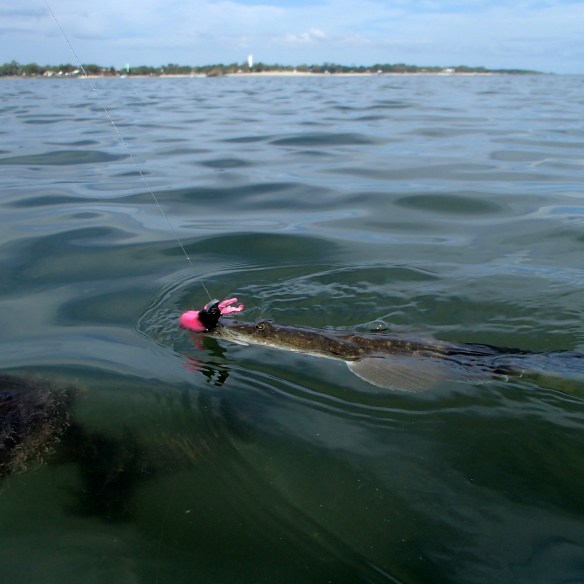
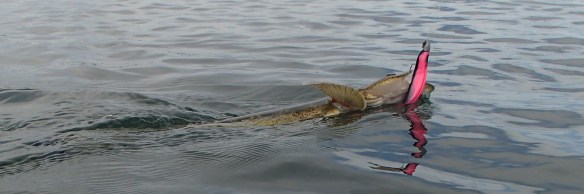
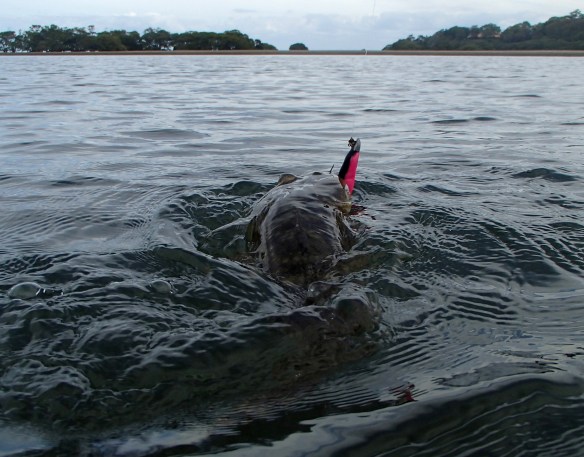
I carried on casting in the same spot and had obviously found a patch of them. I caught 3 more small pike before they decided to leave the Realis Minnow alone. I swapped to the DUO Realis Shad 59 MR  – another suspending minnow,  but this one dives a little deeper. I moved closer to the bridge and cast into the shadows underneath it. Once more, it did not take long for the Pike to find this lure. There were a couple of casts when nothing hit the lure, then a tiny flathead grabbed it and came to the surface angrily shaking its head.

It started to rain so I moved north in to the shadows, under the bridge. I cast over the shallows, on the south side and soon foul hooked a tiny bream. It was now about 5.30 am but with the clouds and rain, there was no sign of first light. The surface activity increased as the fish sensed dawn was on its way. I felt a few very aggressive knocks and bumps and decided to increase the speed of my retrieve. This produced immediate results and on the next cast, I saw a small tailor grab the back end of the lure, a few feet away from me. It fell off but on the next cast, I landed one. It was only about 25cm but I was delighted that it had been hanging out just where I thought it would be. I then had a frantic twenty minutes with my lure getting bumped and smashed on almost every cast. I connected with about 8 fish, but only 4 stayed on until they reached the shore. They were all small choppers, the largest of which might just have made 30cm long.

At about 6.00 am a grey dawn started to break and I decided to move down to the drain in front of the old seaside museum, to see what has happened to the terrain there. The works to secure the sea wall are continuing but clearly, the finished, stepped, wall is some months off. I waded out on to the patch of coffee rock that sits in front of the seaside museum. With about an hour to go until low tide, the rocky bottom was completely exposed.

I cast the DUO Shad 59 MR around, but it kept picking up weed so I changed it for GULP 2” Shrimp soft plastic in the Peppered Prawn colour and loaded this up on a 1/8th ounce, #1 hook jighead. I moved south, along the edge of the coffee rock, casting into the deeper what beyond. I got a couple of strong hits and then, at about 6.30 am I felt a solid bite and set the hook. The fish tried to run away under the ledge but I had the drag set quite tight and the rod absorbed its lunges. I soon saw a flash of silver. It was a chunky bream that I later measured at 34cm. I tried for more and had a few hits but could not land any.

At 7.30 am, the wind was up and another rain shower threatened. It was time to head back to work. But a day of work is always easier to bear, when you have caught a fish before it starts!

Bribie – the old oyster jetty to the channel marker – 21 April 2014

Monday

I am disappointed to report that once more the curse of paid employment has slowed down my posting and fishing. If the current government has its way, I shall be doing more work, for a lot longer than I had planned. I understand that when the pension was first introduced around 1910, the qualifying age was 65 and life expectancy was 58. So it was the ultimate healthy lifestyle bonus. Rarely did the government have to pay out for more than a few years. Now, most of us will get to our mid 80’s (especially if we eat plenty of fish). So we nearly all qualify for some portion of state funding for 15 years or more. Someone has to pay for it and the woeful performance of most people’s superannuation fund managers, means they will not be making much of a contribution. It’s a mess and it can only mean one thing – the current Australian age pension is probably as good as it will ever be.  So next time you see someone with more grey hair than you, whingeing about the cost of bait, remember you will be working long after they put their feet up, so ask them to shout you a beer. Of course, I can’t imagine who will employ me when I am 65 but that’s a whole another can of worms.

That’s enough social commentary. I was keen to see if the flathead glory days of early March would return. I drove up to Bribie on Monday, to fish the run out tide, which would be low at 8.00 am. It was still school holidays and during my last few visits, there has been plenty boat traffic. The wind has been changing between a light south-easterly and a northerly, with the occasionally cool westerly appearing, in the early morning. On Monday, it was light and cool from the south west. The overnight westerlies will start to bring the water temperature down quite quickly, if they persist. We were about half way between the full and the new moon.

I started in the dark and decided to head straight to the area to the south of the old oyster jetty, on the mainland side of the Pumicestone Passage. My last few sessions through the Easter Holidays had produced some quality fish, but the numbers were thinning out.  I decided to fish with neutral/ natural coloured soft plastics, just in case the fish were getting picky. I started with a GULP 2” Shrimp in the Peppered Prawn colour. I loaded it on to a 1/8th ounce, 1/0 jighead.  It was 5.30 am and the sky was just beginning to turn orange along the horizon. I cast the plastic a long  way out and after two hops, I felt a good bite. Then the line went slack. I wound up the slack and suddenly, I was in contact with a fish again. It was swimming towards me but now it turned away. As it pulled away, the hook struck home and it took off with a blistering first run. I gradually subdued it, but it was powerful and angry and this area has a big patch of rocky bottom, close to the shore, so I took it slowly. After a few minutes, I pulled the fish on to the sandy beach. It was a big female, just under 70 cm. After a few pictures, I let her go.

The sun came up and I waded further south, following the falling tide. It was pretty quiet and it was not until 6.25 am, that I got another bite. I had swapped to the GULP 2” Shrimp in the Banana Prawn colour and hooked another slurping, grunting, spiny puffer fish. I pushed it off the hook and continued fishing. I then caught a couple of undersized flathead in quick succession. Then things went quiet again. I swapped to a longer GULP Jerkshad in the Peppered Prawn colour and this soon attracted a few bites. About 10 minutes after the change, I caught a big (35cm) pike. I was now about half way to the green channel marker.

The water slowed and I turned back towards the jetty. At about 7.20 am I caught an almost legal size flathead, which I released. It was getting frustrating. By low tide at 8.15 am, I found myself back beside the old oyster jetty. I had swapped back to the Shrimp in the Banana Prawn colour. I put in a few last casts and then bang, a big fish grabbed the Shrimp soft plastic, just as it landed. The fish was lying in no more than 20 cm of water. It was big and powerful and as it was so near the surface, it immediately started shaking its head. It ran hard but after about four good runs, it was spent. I waded through the soft muddy weed and pulled it ashore. It was another 70 cm model, or perhaps it was the one I caught earlier. It looked a very different colour in full daylight, but you never know.

I had caught some good fish but I had released them all. It may be time to fish somewhere else for a while.

Bribie – the oyster jetty to the channel marker – 10 April 2014

Thursday

I only had time to fish the afternoon run-in tide on Thursday. I arrived at the mainland side of the Bribie Island Bridge at about 12.30 pm. It was a hot, humid day.  It had rained again, in the morning and there was a light northerly wind. Low tide had passed at 12.20 pm. It was a hot still afternoon.


Clumps of weed everywhere

I waded south past the oyster jetty. The water was hardly moving but it was very dirty. As the tide started to run in, it became difficult to fish as the jighead caught on clumps of black, rotting weed. I swapped through a few different soft plastic lures and decided to stick with the GULP Jerkshad in the Cajun Chicken (black & pink) colour.

Just one keeper

It was hard work and I waded further south. As the tide picked up pace, I caught a 45 cm flathead, about 50 metres to the south of the jetty. It was now about 1.30 pm. I carried on towards the green channel marker and caught another 30 cm flathead at about 2.00 pm.

OLYMPUS DIGITAL CAMERA

I swapped to the Mad Scientist Optishad paddletail soft plastic and I got a few bites on this but could not stay connected with anything. Just to the north of the big exposed sand bar I felt a bite. I hooked the fish but it was a slurping, spitting spiny puffer fish. This reminded me why I wear waders. I carefully retrieved my lure with the aid of my pliers.

Porcupine puffer

By about 2.30 pm the incoming tide was pushing me off the edge of the weed beds so I gave up and waded back to the car. It had been a tough session in the middle of the day.

Bribie – the old oyster jetty flats – 4 April 2014

Friday

There had been a few showers and more were forecast. There was also a cyclone forming, up north. The new moon, four days earlier had not really made any difference to the fishing but it had coincided with some heavy rain, which may have limited its effect.

I set off back to Bribie Island. For the last two months I have fished here, exclusively. I apologise to readers who would like a change. But it has been good to fish through a few moon cycles and big weather changes and notice how they the effect what I catch.

Since the first week in March, I have been catching a lot of flathead from the sand flats, on the mainland size of the Pumicestone Passage, to the south of the Bribie Island Bridge. The fish were probably most numerous and at their most aggressive, in the run up to the full moon on the 16th March. The size of the fish and the numbers then gradually dropped off, after the full moon.  We then had some heavy rain which may have pushed them out to saltier water.

Looking back over my archive of fishing reports, I see I have had a number of excellent flathead sessions at this time of the year, in this particular spot.  The large numbers, the aggressive feeding and the fact that a good proportion of the legal size fish I have kept are full of roe, suggests they had gathered to spawn. It seems unlikely that the flathead only schooled up in this one location and I have seen many reports of good flathead catches, through early March, in the fishing press.

According to the sparse research that has been undertaken on flathead (principally in New South Wales – see ‘Reproduction and growth of dusky flathead (Platycephalus fuscus) in NSW estuaries’ – July 2008. NSW Department of Primary Industries – Fisheries Final Report Series No.101 ), they spawn between – September and March.

This would put this particular spawning session right at the end of the window. This is interesting because most fishing pundits will suggest the end of the cooler months – September / November is when you more reliably catch large numbers of spawning flathead. Hopefully I will have time to fish then, as well and I will compare the results.

Back to Friday – low tide would be at 6.28 am and it would be a fairly high low tide, at 0.7 m. I arrived just before first light, at about 5.15 am. It was still warm and I had driven through a couple of showers on the way up from Brisbane. The wind, if there was any, was form the south east.

I waded out into the shallows beside the bridge and cast around with a GULP 4” Minnow soft plastic in the Smelt colour. It was still dark and a few fish were feeding under the bridge lights. On my second or third cast I felt a solid bite, paused and hooked a good fish. I steered it out of the rocks, which dot the area and dragged it to the shore. It was a solid 50 cm flathead.

The next fish came about twenty minutes later, just to the north of the oyster jetty. I was then treated to a really fantastic sunrise which lit up a rain squall that was coming my way. It was now about 6.00 am. I caught a few more flathead in this spot, but they were all under 40 cm.

I moved to the south of the jetty and pulled out another new favourite of mine. The Lucky Craft 4” Mad Scientist Optishad soft plastic lure, in the Pearl Vairon colour. This is the ultimate shape for a flathead soft plastic. It is a Jerkshad with a huge paddle tail. The slim body accentuates the paddle tail and you can really feel the lure moving as you hop it along the bottom. Thanks to the guys at Jones Tackle for introducing me to these – http://jonestackle.com.au/.  It did not take long to find the fish. Between 6.30 am and 8.15 am, I caught 8 more flathead on this soft plastic. However, only two of these fish were over 40 cm.

At about 8.30 am I was soaked by a rain squall and decided to give up.  There are still plenty of fish out there, but the bigger ones are getting harder to find.

Bribie Island – the oyster jetty flats – 6 December 2013

I was delighted to be back on home turf but shocked at just how early sunrise is. With first light just after four you have to be up at three. Low tide at Bongaree, on Bribie Island would be at 5.10 am. At first light, I would just catch the last of the run out tide – which is usually a very good time to fish.

As I pulled into the car park beside the bridge, on the mainland side, I saw Colin’s car already parked up. Colin is the local flathead specialist -great minds think alike! I pulled on my waders and wandered out for a chat. He was chucking a few hard bodied lures around under the bridge and soon found a small flathead. He gave me an update on what has happening in the Passage and, as always it was a comprehensive briefng.

It was now about 4.45 am, so I set off to fish the weed beds, to the south of the old oyster jetty. It was a big tide so I had a good view of how the drains and channels had changed in the the 3 months that I have not fished here. The weed beds are thick and healthy but the drain that used to run out round the corner from Sandstone Point, is now much less well defined. The persistent northerly winds may have flattened the sand banks, a little.

The breeze was light but quite cool, from the south-west. I started fishing at about 4.45am and the tide was still running out. I was fishing with my new G.Loomis Trout Series (TSR) spinning rod. I was using a 10lb fluorocarbon leader tied on to 10lb Super PE braid. This rod is excellent but I am still getting used to its sensitivity. Pulling a soft plastic through the weedy bottom was confusing at first, I thought I was getting bites but was not sure. Then I saw a few skid dart past and I realised they had been biting the plastic.

I kept moving south. The sun came up behind the clouds. I started fishing with a GULP 4″ Minnow in the Smelt colour. This caught a couple of small flathead just after 5.00 am. Then there was a pause, as the tide turned. I swapped over to a GULP 5″ Jerkshad in the Watermelon Pearl colour.

Flathead

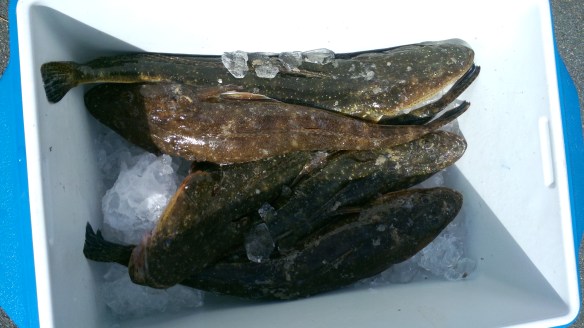
An esky full of Bribie flathead

At about 5.45 am the incoming tide picked up pace and I found a patch of keeper size fish. Over the next hour, I caught 12 fish along a 50 metre stretch of the weed beds. I kept five but forgot my camera. So all I have is the full esky to show you. The smallest fish was 44cm and the largest 59cm. I caught most of the keepers on the 5″ GULP Jerkshad but also found a few with the Zman Minnowz in the Redbone colour.

It was great to have such a successful first session back on home turf.

Bribie – Oyster jetty flats – 15 July 2013

Monday

Another fishing opportunity – and another miserable weather forecast, cold wet and windy. You just have to get on with it. I could not start early but I was able to reach the Bribie Island Bridge just as the tide was starting to really run in, at about 9.00 am. Low tide had passed at about 7.45am. There was a thick grey band on the horizon and a cool south-westerly breeze.

I wandered out past the jetty, heading south to my usual stomping ground. As I did so, the wind dropped and the drizzle started. I only had about an hour before the incoming tide would push me back, away from the weed banks.

A few weeks ago there were some good mullet schools in this area, but they seem to have moved on. I waded quickly south, to one of the more productive spots, along a big weed-covered sandbank. There are nearly always fish of some kind here. I started with a GULP Jerkshad in the Orange Tiger colour – bright orange and yellow with a black fleck. I was fishing with 8lb leader and a 1/8th ounce, 1/0 jighead. The water was still and fairly clear despite the wild weather so I was trying a high contrast soft plastic.

It did not take long. After a few casts, I felt a very slight grab. It could have been weed, but it felt a bit more solid. I dropped another cast in the same spot……….. nothing, except a clump of weed. I gave it one more try and bang, a flathead grabbed it and took off. The rod bent over and line peeled smoothly off the spool. The drag on the Shimano Stella 2500 had been expertly fixed by Neil at Jones Tackle – http://jonestackle.com.au/. It just required the adjustment of a small spring.

It was not a huge fish – about 50 cm, but it had plenty of fight in it. By the time it drew level with me, I could see it had completely swallowed the soft plastic. I pulled it over snipped the leader and slipped it into the keeper bag.

I re-rigged with the same plastic and peppered the area with casts. I did find another flathead so I moved about five metres further south. I put in a long cast and almost as soon as the soft plastic splashed through the surface of the water, there was a tug and then the line went slack. I wound it in to find the soft plastic Jerkshad and jighead gone. No idea what that was.

I tied on another Orange Tiger and cast it out. It was grabbed before it reached the bottom by an enormous Pike. It took plenty of line and made a few leaps, but it was nicely hooked in the side of the mouth, so the rod and drag soaked up the acrobatics. When I dragged it up close to me and unhooked it, I measured it at about 45cm.

I swapped over to a Zman Minnowz soft plastic in the Houdini colour. I thought the paddle tail might stir up the flathead. The tide was moving up fast and the drizzle kept falling. I only had 20 minutes left and then I would be pushed to far back to see where I was casting. After a few minutes of working the Zman I felt stop dead on the bottom. Then the fish started swimming. For the first time in ages I had a good fish hooked and I realised how little work my drag had been doing. I decided to pull it back to the shoreline – it was too big to grab while wading. After several good runs, I pulled a good 60cm flathead up, on to the sand and put it in the keeper bag.

The tide was now too high to carry on here, so I finished fishing at about 12.00 noon.

Yeppoon – Byfield National Park – Kellys Landing – 8 June 2013

Saturday

On Saturday, I was back in Byfield National Park, so I decided to try fishing further up Water Park Creek, near Kelly’s Landing. There are thick mangroves lining the creek with only a few openings on to the muddy banks, along this stretch. A few visitors had arrived to camp beside the river and although we are well into the ‘dry’ season, the day started with rain patches, grey skies and drizzle.

This is another muddy spot and I was soon ankle-deep in the stuff. I squelched up river, using the same technique as I had on Wednesday. I was fishing with 8lb fluorocarbon leader, my light spin rig, small soft plastic minnows and shrimps on a 1/8th ounce, # 1 hook jighead. It was a new moon so there was a big, powerful outgoing tide.

The water was fairly shallow but formed some deeper channels close to the bank. In a few places there were oyster covered rocky outcrops and I settled in the mud, a few metres short of one of these and concentrated my efforts casting close to it.

I was using the GULP 3” Minnow in the Pearl Watermelon Colour. This was as close as I could get to the small bait fish. They were cruising up and down beside the rocks in small schools. After a few minutes, there was a surge and splash as something hit them from below.

I dropped my lure as close as I could to the rocks and let it sink. After about 10 seconds, I hopped it up, off the bottom and felt some resistance. I had a small flathead, about 35cm long. I persisted, casting along the edge of the mangrove roots and I soon had another – a bit over 40cm. I had found a patch and I caught three more over the next 30 minutes, all about the same size, in the same general area.

I kept fishing this spot for more than hour. As the tide went out I was able to climb onto the rocks and cast further upstream, from them. I was soaked, muddy, cold and kept losing gear to the oyster covered rocks and mangrove roots. I was pondering the long squelch back to the car when a freight train smashed the soft plastic, very close to the base of the rocks.

The fish took off, but fortunately it swam out into mid-stream. I only had 8lb leader on so I left the drag alone but did everything I could to keep the fish way from the rocks. It darted back into the mangrove roots and I thought it was gone. I kept the pressure on, but did not try to pull it out – I would just have snapped the light leader. After what seemed like a few minutes but was most likely 30 seconds, I saw the leader wiggle and the fish swam out. I pulled it a little further out and then tightened the drag and quickly lifted it clear of the water. It was a handsome mangrove jack – no monster – about 30 cm long. I took a few pictures and released it.

I decided to finish the session on a high note and so I gradually squelched and slid my way back to the car. On the way, I caught a couple more small flathead. Despite several interludes with the Zman Minnowz, I had not been successful with them – it was a GULP day today. Perhaps a different profile Zman would have worked as well as the GULP Minnow, but I think in the muddy water, the GULP scent may have been an advantage.

Yeppoon – Byfield National Park – Fishing Creek – 4/5 June 2013

Tuesday/ Wednesday

Byfield is a beautiful spot and I spent Tuesday exploring. The wind was a howling south-easterly, all day, so I focused on scouting out some good sheltered spots. I tried the lee side of the headland that I had fished the day before, at the end of Nine Mile Beach. This looks like a great spot but the waves were crashing in and I could not keep my lures in the dirty water. After a few hours, I gave up on the fishing and climbed up the hill.

It looks like the water is generally quite shallow and the sediment that has poured out of the creeks and bays must get stirred up by the wind. I climbed to the top of the hill and surveyed the whole area. There were a few trawlers working just offshore. I concluded this would be an excellent area to fish land-based, so I will be back.

On Wednesday the wind was still up and it had rained heavily overnight. I decided to try fishing one of the shallow creeks that feed into Corio Bay. I chose Fishing Creek, which comes in from the south and drove down Fishing Creek Road until it petered out at a bend in the creek. It was just after high tide at about 7.00 am. There was a small ledge path on the muddy, mangrove lined banks and I squelched my way along it.

The guys at Barra Jacks in Rockhampton had suggested this spot, when I was in there a few days before. They reckoned that crocodiles were very unlikely to be around at this time of year but that I should keep my eyes peeled. That always adds a little excitement to the session!

I was fishing with my light spin rig (Loomis GL2 and Shimano Stradic 2500) and I dropped all the way down to 8lb fluorocarbon leader and a 1/8th ounce, size 1 hook, jighead. I decided to stick with natural colours and started with a GULP 4” Minnow in the Peppered Prawn colour. The water was not too dirty as the tide had just peaked. I dropped the soft plastic up current and bounced it back to me, along the bottom. I cast as close to the bank as I could and gradually lengthened the pauses on the bottom. After about ten casts, I felt a bite and was connected to a fast fish for a few seconds, and then it was gone. I stayed in the same area and after about 10 more casts, I landed a small flathead. A few casts later I found another, it was just under 40 cm.

I continued down the creek towards the estuary. The tide was running out quickly revealing various ponds and channel. I was wet and muddy but the sun was out and I was catching fish, so things were looking up. I concentrated on the patches of deeper water and the caught a steady stream of small flathead, over the next 4 hours. The 3” GULP Minnow in the Pearl Watermelon colour was the most successful lure of the day. I tried the paddle-tailed Zman Minnowz, in a couple of colours, but did not catch anything on them.

I gradually ran out of water as the creek emptied and at about 12 noon, I turned around and walked back to the car. I caught a couple of fish in the shallow pools on the way back. By the time I reached the car, I had caught 9 flathead – the majority were between 30 and 40 cm long and only two looked like they were big enough to keep.

It had been a much more successful session and had given me confidence that this is a very fishy area, when conditions allow you to get at it.

Bribie – Oyster jetty flats – 26 June 2013

Sunday

I was up early and even though it was cold and windy, I had to get my fishing fix. I drove up to Bribie and waded out under the bridge, on the mainland side, at about 6.00 am. Low tide had been at about 4.30 am. I had filled a bag on Thursday, so I was confident.

My target area would only be in range until about 7.30 am. The sky was clear but the wind made things tough and it was building. I waded straight to the north of the oyster jetty, to target the edge of the weed beds. This is where the fish are usually laying up.

I tried lots of different lures – Gulps, Z-Men, hard bodies, but I could not find the fish. Just as I was being pushed back by the incoming tide, I finally connected with a fish. It was a 46cm Flathead and I caught it with a 4” Gulp Minnow in the Pearl Watermelon colour.

The tide was too high to stay in this spot and the wind was making things tough, so I gave up. There was a big moon in the sky behind me and recent trips suggest the fishing is tougher in this spot when the moon is full. Maybe that is true – but I maybe had just failed to find them today.

Bribie – Oyster jetty flats – 23 May 2013

Thursday

I was back in Brisbane and keen to fish at Bribie Island again. I wanted to see if the Flathead were still around, so I drove up, just after dawn on Thursday morning. The wind was light, but cold from the southwest. I had come through lots of fog on the drive up but by the time I reached the Bribie Bridge, the sky was clear.

I started on the island side of the bridge, fishing from the bank, without my waders on. The water was very clear and the tide was slacking off. It was about 6.30am and it would be high tide at 7.32 am. I tried a few plastics here and felt a few bites, then lost a few tails form various soft plastic lures. Small Tailor or Pike are usually the culprits in this location.

At 7.30 am I decided to warm up with a coffee while the tide turned. This period of slack water does not produce many fish for me so I decided to wait 30 minutes. Then, I drove back over the bridge, to the mainland side and pulled on my waders.

It was now about 8.15 am and there was still plenty of water at the mangrove line. As I waded out into the clear water I was shocked at how cold it had turned in just a few weeks. Unfortunately, the bright sunshine and clear days have triggered the algal bloom (snot weed) in the weed beds and this will soon be a pain in the neck.

There was plenty of bait in the shallows and I waded south to the oyster jetty. I started with a GULP 4” Minnow in the Smelt colour. My legs were already cold after ten minutes in the water and I backed out on to the shoreline to warm up.

In the crystal clear water I could see a very fresh looking flathead lie. I paused at the jetty and put in a few casts just south of it in the shallows. On the second cast a fish hit the plastic hard and then dropped it. I dropped the rod tip hoping it would have another go – and it did. It took off but was nicely hooked. When I subdued it and pulled it closer I could see a nice, 60cm flathead in the clear water. I pulled it up on to the shoreline and put it in the bag for supper.

I moved to the south and swapped over to a Zman Minnowz in the Rednone colour and fished around the base of the mangroves, near the drain that empties off the flats. After a few casts I had another good flathead – this on measured just over 50cm.

As the tide receded I moved further south, towards the channel marker. Over the next three hours I fished with both the Zmen and the Gulps and caught another 9 flathead. I kept 3 more, all around 45cm, to fill my bag for a good family fish feed. Of the 9 only two were undersize.

The fish had been quite spread out but they kept coming. It was a couple of days before the full moon and the tide I was fishing had been the smaller of the two on that 24 hour period. This moon and tide combination seems to be proving pretty a pretty successful fishing period for me.

Yeppoon – Byfield National Park – Corio Bay – 12 May 2013

Saturday

Paid work had left me in Rockhampton on Friday, so I decided to have a go at fishing in Byfield National Park, over the weekend. I have a new car – an FJ Cruiser – the perfect fishing car. I love it – great clearance, plenty of power and a hose out interior. I needed to give it a workout and to get it dirty and Byfield, with its many creek crossings and sandy hills, looked like the perfect spot. There had been plenty of rain, so there would be water in the creeks, but the sand tracks would have firmed up.

I set out before first light on Saturday and drove from Rockhampton to Byfield. I grabbed a cup of coffee and breakfast in Yeppoon and arrived at the Waterpark Creek causeway, that leads into the park, at about 7.30 am. Water was flooding over the causeway. According to the depth markers it was about 400 mm deep – no problem for the new motor. You have to watch this spot when there are showers around, as a lot of rain runs off into this creek. The water level can rise very quickly and leave you stuck on the wrong side.

I had wanted to visit Five Rocks Beach but due to the recent wet weather, the tracks in that direction were closed. I headed for Nine Mile Beach, instead. It takes about 45 minutes to an hour to get to the beach from the causeway. The biggest obstacle is a climb up a big sand hill. The track was a bit churned up towards the top but it was fairly firm. I am not sure that the old Suzuki Grand Vitara would have had the clearance to make it, but the FJ rolled over the top.

Nine Mile Beach is spectacular and looked particularly wild with the grey clouds rolling in. The wind was howling so I decided to drive down the beach to find some shelter and fish in Corio Bay. At the end of the beach there is a small track that leads across the back of the headland. I took this and found some sheltered water. I believe this area is Corio Bay. The rain kept coming over in squally showers.

I took out my light spin rod and reel and wandered along the mangrove fringed banks of a sandy channel. In between the mangroves, rock bars protruded into the channel at regular intervals, forming a couple of small bays. The tidal variation is huge here, often rising 5 metres from low to high. By the time I started fishing it was about 11.15 am – low tide had passed at about 10.30 am. The water was dark grey and very muddy. The area looked very fishy and I heard a few big gulps, in the eddies around the edges of the rock bars – could have been cod or even a barra – who knows?

I started with a Zman Minnowz in the Houdini colour, on 1/8th oz, 1/0 jighead. I was fishing with 10lb fluorocarbon leader. I lost a few soft plastics and jigheads to the rocks. I re-rigged with the same plastic and cast out and suddenly a fish connected, tight against the rocks. It pulled hard and kept taking short determined runs. I thought it might be a cod but it did not stop still, like a cod would. I got some line back, but it was now under an overhanging rock and I could feel the line rubbing. I did not have the power to pull it out with the light rod. I saw a flash of silver but could not identify it and then it must have loosened the jighead against the rocks, and it was gone.

I decided to try something a little more colourful and tied on a GULP Jerkshad in the Satay Chicken colour – a mixture of yellow and pumpkinseed. I stayed with the 1/8th 1/0 jighead and light leader. I cast it into the fast flowing water, in the middle of channel and let it sink. It was hit on the drop by something very fast and powerful. The fish ran with the fast current and took plenty of line very quickly. Then it jumped clear of the water and I could see it was Queenfish. Every time I got it close to shore it took off again, but eventually I pulled it clear of the water. I am sure it would only be considered a baby in local circles – but it was the biggest Queenfish I have ever caught. I took a few pictures and let it go.

I tried more and swapped through hard bodied lures, vibes and a few more soft plastics. I ended up fishing with the Zman Minnowz again. I fished around the rockbars and felt a few bites. I left the lure on the bottom for long pauses. About an hour after the Queenfish capture, I hooked something else. It pulled hard and hugged the rocks. In the end I pulled up another fish I have never caught before. Not sure what it was – see pictures. I released it and decided to give up, as another shower was coming over the headland.

I drove back through the rain, safely crossed the causeway and drove back to Yeppoon. This is a fantastic spot. I will be back!

1770 – Workmans Beach – 7 May 2013

Tuesday

The wild weather continued; strong south-easterly winds and plenty of rain. On Tuesday morning I braved the rocks at the southern end of Workman’s Beach, near Agnes Water. This area is sheltered from a southerly and south-easterly and there is plenty of fishy looking territory.

After a few days of big seas, the water was all stirred up and a milky brown colour. I started with soft plastics and then switched to slugs and hard bodies, but nothing yielded results. The sun came out mid-morning, but not for long. As the day wore on, the wind picked up. It then brought the clouds back in. Just after lunch, there was another downpour, so I gave up. Tuesday had been my first zero fish session for quite some time!

Nothing seemed to work today

Nothing seemed to work today

1770 – Eurimbula Creek – 6 May 2013

Monday

Where did the weather come from? I had checked the forecast before I left Brisbane and apart from a bit of south-easterly wind there was virtually no rain forecast for the week. I woke up on Sunday night to a massive rain storm at 1770. By dawn on Monday the rain was pouring down and the wind was blowing 20 knots from the south-east.

At about 10.00 am I went for a drive down towards 1770 to try and fish the north, sheltered side of the headland. I parked by the Captain Cook monument and walked down the water’s edge. The water was already brown and muddy after all the rain and the tide was about half way through the run out. I fished for 30 minutes and then another heavy shower came over and soaked me so I gave up.

I dried off and drove back out of Agnes Water and down the track to the mouth Eurimbula Creek. This area is pretty flat and there was plenty of water over the road at various spots along the route. A few hours of solid rain and the drains and creeks soon fill up. I got through alright and parked at the edge of the camp ground. Unsurprisingly there were no campers around.

The sky looked ominous but it had briefly stopped raining. Eurimbula Creek mouth is also a bit sheltered from a south-easterly. The water was just as dirty as Round Hill Creek and the tide was still running out. As the tide drops it reveals a steep mangrove lined bank on the south side of the creek mouth. This is great fish holding structure but it is a little difficult to get to and fish from. The tide runs out fast creating some good eddies around the fallen trees and mangrove roots.

I fished with a few different soft plastics – bright colours, natural colours, paddle tails, shrimps and minnows. I had a few bites and whenever I pulled a lure in, it was surrounded by bait but I did not catch anything.

I swapped to a DUO Tetraworks Bivi, a small sinking vibe lure and hoped the vibrations might stir the fish up. There had been a few surface bust ups, so there were some fish around. The DUO Bivi weighs 3.8 grams and 40mm long. It casts like a bullet and has a great action. I cast it out, up-stream towards the far bank and let it sink. I then hopped it along the bottom with the current and tried to swim it as close to the snags as I could. I repeated this a few times and felt a few bumps. After about 20 minutes of fishing this lure, it was smashed close to the snags. Fortunately the fish took off towards the middle of the stream. I was fishing with the light spin rod so I did not have much power. The fish used the current and felt decent. After a little bit of back and forth, I pulled a trevally up the sandy bank. It was hooked through the tail.

That was it for the day – the rain came pouring down again and I headed home.

Bribie – Oyster jetty flats – 24 April 2013

Wednesday

The tide was all wrong but the fish were around, so I decided on Bribie again. We would have a 2.2m high tide at 8.05 am. This would mean the tide would be just over half way in, at first light.

I arrived just before sunrise and wandered south along the shoreline, on the mainland side of the bridge. I passed the oyster jetty, casting soft plastics on the flats on either side. I felt a few tugs in the area just south of the oyster jetty, but I could not hook up with anything. I was fishing with a GULP Jerkshad in the Lime Tiger colour, on a 1/8th 1/0 jighead. I was using 10lb fluorocarbon leader.

I find the last of the run-in tide the hardest to fish, land-based, at Bribie. You can no longer reach the various drop offs on either side of the Pumicestone Passage. The fish move up quickly but suddenly there is no obvious structure for them to hide in; they spread out over the open expanse of flats and it is difficult to know where to concentrate your efforts.

As I thought about where to fish a huge flock of cormorants came into land. I have never seen a group as big as this before. They settled on the water for a few minutes then took off again.

In this area the only obvious structure is the slight drain that runs round the corner from Sandstone Point. Even this seems to be gradually silting up at the moment. This is where I decided to focus my efforts. The water was flowing round the corner from the south. I stood beside the mangroves and cast to the south, in the direction of the long, now submerged, sandbar.

It was now about 7.00 am. After a couple of casts, a fish grabbed the plastic, made a short run then it let it go. This also happened on the next cast and I saw the familiar snout of a long tom, following my lure in. I cast a little more towards the south east and when I took up the slack I had a fish on the line. I set the hook and it took off with the current. I soon had it under control and waded back to a gap in the mangroves. It was a good flathead, about 50cm long. I let it go.

I waded back to the same spot and cast out again. I continued fishing this area as the tide came up. I swapped to GULP Jerkshad in the Curry Chicken colour. After a few casts the line pulled tight again and I had another flathead, about the same size. It was about 7.30 am. In the next twenty minutes I dropped two more fish and caught one smaller one.

Things went quiet around the tide change so I decided to wait out the slack water over breakfast and coffee. I waded back to the car and went off for breakfast. The wind was picking up from the south-east, but it was a beautiful morning.

By 10.00 am I had waded back to almost the same spot that I had been fishing earlier. The water level was much lower but I put in a few casts anyway. After about 10 casts, I caught another 45+ cm flathead, on a GULP Jerkshad, in the Satay Chicken colour.

The tide was now running out strongly and the big sand bar, down by the green channel marker, was clearly in view. With the wind behind me, I could reach the edge of the main channel and the sea grass beds, with some long casts. I started to make my way towards the green channel marker, casting as I went. I hooked a stingray which towed me around for a while and then broke me off. I also connected with an spiky puffer fish which grunted, spat jets of water at me and fluttered round in circles for a while before cut the line and got rid of it.

I re-rigged with a GULP Jerkshad in the Cajun Chicken colour. The water was now really running and lifting more and more sediment as the tide got lower. This did not seem to bother the fish. I averaged one every 15 minutes or so, for about the next three hours. The colour of plastic did not seem to matter. Most were around the 40 to 45 cm size, but there were several more 50+ cm models amongst them.

At about 1.30 pm, I had to tear myself away – always hard to do when you are catching fish. I had caught more than 15 flathead through the morning and it does not get much better than that!

Bribie Island – Oyster Jetty to the channel marker – 18 April 2013

Thursday

At last the cooler (and hopefully drier) weather is beginning to show itself. I love this time of year. Dawn is later so I become slightly less nocturnal and the fishing improves exponentially with the cooling water temperatures and the more consistent south-easterly winds.

It was back to Bribie Island – my home fishing territory. I was in position under the mainland side of the Bribie Island Bridge at 5.00 am, about an hour before dawn. Low tide would be just before 9.00 am. This is the ideal tide situation for fishing these flats. The tide is about halfway out and running nicely. The fish have moved up into the shallows during the night with the high tide and are now gradually retreating. They stay in shallower water in the pre-dawn light, as they still feel fairly safe.

I cast around but the water was already too shallow directly under the bridge lights, to warrant fishing that area, so I gradually moved up, past the old oyster jetty and concentrated on an area of weed banks, about level with the end of the jetty. There are sandy hollows in the weed and when the water depth is just right the flathead like this spot.

I started with a GULP 4” Minnow in the Smelt colour on a 1/8th oz, 1/0 jighead. I was fishing with a 10lb fluorocarbon leader and my Loomis GL2/ Shimano Stella 2500 spinning outfit. It was still dark. It was now just before 6.00 am. There was just a faint glow on the horizon. I put a few casts out into the shallows and the fun started. The first fish was a good one – a flathead, just over 55cm long. I was going to release them all today but this one had half a tackle shop hanging out of its mouth, so I put it in the keeper bag. It looked like it had swallowed at least one hook and had some pretty heavy trace with another broken hook hanging off it.

I cast out again and felt another bite, but did not connect. On the next cast, I caught it – another Flathead – but this one was just a baby – about 30cm long. I kept going in the same spot and about 5 minutes later, I felt a good fish connect. This was another good fish, a little over 60 cm.

The sun was now up and I gradually moved further to the south. There were a few long toms around and these would occasionally attack the soft plastic. I caught another undersized flathead at about 6.30 am and then things went quite for about an hour.

By 7.30 am I was about half way to the green channel marker. I had swapped to a GULP Jerkshad soft plastic in the Cajun Chicken colour. The water had started fairly clear but as we got closer to low tide it became murkier. Suddenly I felt a solid bite and I was on to another fish. I pulled it on to the sand. It was about 45cm. I then caught a couple more, of about the same size, on the same soft plastic.

I was sure there were more fish in the area but after another 20 minutes of casting, they seemed to have calmed down or perhaps, grown wary of the soft plastic. I swapped over to a small hard-bodied lure – the DUO Realis Shad 59MR. I have had success with the lure in this area before, but today I was using a new colour – purple/ silver called HD Gill. It is a 4.7 gram, 59mm suspending minnow with a great action. It will hover for a few seconds at the end of a swim and maintain its depth, to about 1.5 metres below the surface.

This soon stirred the fish up. I worked it along the edge of the weed beds, out by the channel marker and soon started hooking up. The first couple of fish were small. I turned back and covered the same ground I had been over with the soft plastic jerkshad and after an hour and half, I had caught six more flathead. They were all over 45cm and had all attacked the Realis Shad 59MR.

By about 9.45 am I was back at the bridge. I had three of the better fish in the keeper bag for a meal and I had really enjoyed the session. Early in the tide the water had been very clear and there had been no rain – let’s hope the fishing and weather stays this good.

Bribie – Under the bridge – 5 March 2013

Tuesday

The rain is easing but it is just being replaced by howling south-easterly winds. The only real option would be to fish the couple of hours either side of dawn, in a fairly sheltered location. So it was off to Bribie again, to fish the area under the bridge, on the mainland side of the Pumicestone Passage, as the tide fell.

I arrived at about 4-45 am to find I was not the only mad angler wetting a line. A couple of fishos were on the bridge casting to the north – a few pylons out. A couple of good jewfish have been landed from the middle of the bridge, at night, recently. The favoured technique is to fish with very heavy gear then drop a grappling hook down once the fish is worn out. This strikes me as a pretty tough proposition – but it does work.

I rigged up and waded along the edge of the mangroves, to the south of the bridge. The wind was from the south east and was blowing around 15 knots. The water was dirty and running out, against the wind. High tide had been at about 3.00 am.

I started by fishing with a GULP Jerkshad in the Orange Tiger colour, on a 1/8th oz, 2/0 jighead. There was a bit of surface action on the edge of the pools of light, cast by the bridge lights. Every so often, I could trace the path of a cruising predator by the scattering bait fish. There were some pretty big surges and splashes which made me reluctant to wade out further.

I had no luck with the brightly coloured Jerkshad, so I made a counter-intuitive switch to a 3” GULP Shrimp soft plastic in the Banana Prawn colour. This is a gold colour that would not really stand out at all in the sediment rich, murky water. After about ten minutes of casting without result, I switched my attention to the deeper water, just out of reach of the bridge lights. I carried on peppering the area and was about to swap soft plastics again when I felt a solid bite and a few moments later, I set the hook on a good fish. As I pulled it in between the mangroves, bait went flying everywhere. There is plenty of food around. It was a good flathead, about 55cm long and I kept it for dinner. It was 5.10 am and its possible that the sun was trying brighten the sky but the clouds were too thick.

The heavens opened and I retired under the bridge. The fishos on the bridge had disappeared – probably washed away by the relentless rain. I started casting to the north and gradually moved along between the pylons. It was now a little lighter and the rain had stopped. The water was getting dirtier as the tide ran out. As I cast out, around the base of the third bridge pylon, I felt a good bite, but did not connect. I cast back in exactly the same spot and got hit again, still no hook up. I cast another ten times in the same spot gradually slowing the retrieve right down and increasing the length of my pauses. On the eleventh cast I felt the solid bite of a committed fish. I dropped the rod tip and slowly counted to ten. After what seemed like an eternity, I lifted it and felt the lure lodge in the mouth of the fish. The rod bent over, I felt the resistance and the tip started wobbling. I waded back to the shoreline and safely landed my second flathead. It was a little smaller than the first, just under 50 cm. It was 5.23 am. I also kept this one for dinner.

I swapped to a 4” GULP Minnow soft plastic in the Smelt colour. I concentrated in the same area, around the third pylon. At 5.34 am I caught another flathead, almost exactly the same size. Three fish is about right to feed my mob for dinner.

It was now light but the sun could not break out above the clouds and the rain showers just kept coming. I persisted in the same area but things seemed to go a bit quiet, as the traffic on the bridge built up and the water receded. I swapped down to 3” GULP Minnow in the Smelt colour and moved a bit further out, to the south of the bridge. I felt a couple of taps and then hooked a small Bream. It was now just after 6.00 am. A few casts later the same plastic produced flathead number four. The smallest of the morning, but it was still a healthy fish, at 47cm.

I waded south, past the oyster jetty and on to the windy flats. The sun almost emerged above the clouds but the now howling south-easterly immediately blew some more rain clouds in, to block it out. One of these gave me a thorough soaking and despite casting around for more than an hour, I did not get a bite out here.

Just before 8.00 am another nasty black cloud opened above me and I decided to call it quits. It had been a successful morning but the wild weather had made it a challenge.

Bribie Bridge and surrounds – 3 February 2013

Sunday

After a trip up to Asia I had eaten plenty of good seafood but now I wanted to catch some. Unfortunately the cyclone and its aftermath had slowed me down a bit.

On Sunday morning I could wait no longer and I decided to drive up to Bribie to have a look at conditions and try some fishing. Things were far from ideal. There was a strong south-easterly blowing and the tide had been high at about 2.00 am. The moon was waning and about 50% full. I would be fishing a not particularly powerful run out tide through to a low of 0.8 m, at about 8.30 am.

After a flood it is best to fish around high tide as this is when the concentration of salty water is highest in the estuaries – unfortunately this was not really an option. I arrived at the west end of the Bribie Island Bridge just after 4.00 am and rigged up. The tide was about half way out.

As I waded out, under the bridge, there was plenty of surface action under the lights and the water, in the shallows at least, was fairly clear. I put on a GULP 3” Minnow in the Pearl Watermelon colour , on a 1/8th 1/0 jighead and cast out. There was a pull as the lure dropped in to the water and then nothing. I let the lure sink and as I lifted it from the bottom the line pulled tight and I wound in a 30cm Flathead. It’s always good to get a fish on your first cast – even a small one.

There were a few prawns skidding across the surface and so after a few more casts, I moved over to the shallows on the south side of the bridge. I cast at the pylons and wherever I saw a splash or a prawn jump. I retrieved the lure with the tide, hopping it over the sand and rubble bottom. Each time I cast in close to the pylons I would get a couple of hits. After a few repeats in the same spot I caught a small Moses Perch.

I decided to match what the fish were eating and swapped to a GULP 2” Shrimp in the natural colour. I was fishing with my light spin rod and reel combination. I had the reel spooled with 2.8kg Fireline and about 1.5m of 10lb fluorocarbon leader. I concentrated on the area around the base of bridge pylons. The water was running out fast and the sun was just coming over the horizon. I let the soft plastic lure bump along the bottom. At about 5.25 am I lifted the rod to cast again and felt a solid tug. I dropped the tip for a few seconds then struck. I had a fish and it turned out to be the only keeper of the day – a flathead, 42cm long.

As the sun came up I moved south to fish around the old oyster jetty. As the tide dropped the water got dirtier and dirtier, especially in the main channel. I tried a few different soft plastics but did not get a touch. I waded from the jetty to the green channel marker and all the way back but did not get any hits. At about 8.00 am the tidal flow dropped off and the Passage was pretty much a brown muddy soup, so I gave up.

It was encouraging to catch a few fish and hopefully by next weekend the water should have cleared considerably. The prawns were a good sign and hopefully they will bring the predators in.

Bribie Island – Banksia Beach and Whitepatch – 31 December 2012

New Years Eve

I was still at Bribie Island and the big south-easterly wind and swell would make it just too hard to fish on the surf side. This gave me an excuse to go over to the western side of the island and fish in the Pumicestone Passage.

The wind would still be a pain but usually it calms down for a few hours either side of dawn and this morning was no exception. I started at Banksia Beach, just to the north of the wading bird roost. There is a nice coffee rock ledge along here and the area produces snapper in the cooler months and plenty of Flathead, all year round.

Low tide was just before 5.00 am and this is when I arrived. I waded out to the ledge and cast around on top of it and just over it. I was using might light spin rod and reel and had rigged a GULP satay chicken Jerkshad on a 1/8th 1/0 jighead, on 10lb fluorocarbon leader. After a few casts a felt a solid thud and the rod tip started wriggling. I struck a bit too hard and the fish was gone. Too long between fish and this can easily happen!

I peppered the same area with about 50 casts but could not find the fish again. I gradually went smaller and lighter with my jighead and soft plastics, until I caught an angry 20cm moses perch, on a GULP 3” minnow, in the emerald shine colour. I got a good soaking from a passing shower and at about 7.30 am, decided to move locations. I drove up to the north end of Whitepatch and waded out into the water.

The tide was about half way in and I focused on an area where I had seen some flathead lies the week before. I had swapped to the more natural coloured GULP Jerkshad in the smelt colour but was still using a 1/8th 1/0 jighead. I was casting at the area, just on top of the ledge which now has some thick weed beds growing on it. I felt a very slight hit and decided to cast into the same spot again. As soon as the plastic hit the water the fish swallowed it and took off. It hooked itself and I just had to hang on. I soon had it back at the tree line and safely out of the water. It was a handsome 57cm flathead.

I was so relieved to have broken my duck that I decided not to push my luck. I took a few photos, released the fish and gave up for the 2012.

Bribie Island – The Oyster Jetty and White Patch – 21 August 2012

Tuesday

Monday’s session had not been very promising – there had been a distinct lack of Flathead in the usual locations at Bribie. Perhaps they were all in 1770.

So, on Tuesday I decided to fish the mainland side of the Passage, by the old oyster jetty. Low tide was around 5.30 am and at 0.3m it was a reasonably low, low tide. It is always good to see the areas you fish on a low tide as all of the fish holding structures, such as; banks, drains, gutters and holes, are revealed. The difficulty is remembering where they are once the tide comes in.

It was a cold morning with an overcast sky, the wind was in the process of switching from a south westerly to a northerly and was forecast to drop to nothing midway through the morning. Conditions were calm and I waded through the mud and exposed weed beds until I reached the water’s edge.

I was using my light rod and reel – G.Loomis GL2 4-8lb Fast Action 6’6” Spin Rod and a Shimano Stella 2500FE reel, 6lb braid, 10lb fluorocarbon leader. This set up has almost become an extension of my arm and I reckon it is difficult to beat as a combination for light fishing. Still, if you are reading this Mr. Loomis, I would be happy to give any of you models a try – just pop them in the post.

It was hard work. The tide had passed low but the water was not really moving yet. There was a fair amount of algae weed floating around that kept clogging the jighead. I started with a big GULP Lime Tiger Jerkshad on a 1/8th 1/0 jighead bit after no hits for 45 minutes I decided to try something different.

As you know I am a sucker for anything new in the Tackle Store and the GULP Swimmow caught my eye the other day. This is a welcome addition to the arsenal and GULP has been missing this profile. It is basically a Fry or Worm shape with a small thumping paddle tail. It is four inches long but unlike the various other shads on offer it is still fairly small and light. I picked up the Pumpkinseed, Peppered Prawn and Emerald Shine colours. I decided to try the Emerald Shine first. I watched the lure in the clear water and it has an excellent action. The paddle tail thumps furiously on the drop and whenever you jerk the lure through the water.

I moved further along the edge of the weed beds towards the green channel marker. About 10 cast after the lure change I felt the unmistakable thump of a Flathead bite just a few metres from my feet. I paused and then struck – I was on. After a few runs I had a dark, speckled, weed dwelling Flathead on the mud flats. Quite a colour contrast to those I had been catching the week before. It was 48cm long. A few casts later I caught another – just under 40 cm. I made it to the channel marker then turned back. The tide was coming in and it soon forced me back from the edge of the weed beds. I felt a few rapid bites and almost hooked something – Bream , Pike – not sure.

I had one good fish but needed at least one more to feed my mob. I decided to try White Patch and drove up there. The water was up to the tree line when I arrived, so I decided to concentrate on a few of the rocky/ sandy drain areas about 10 metres out. I could not cast over the edge of the drop off as it was now too far out. I was still fishing with the GULP Swimmow and the Pike were the first takers – I caught three in quick succession.

I moved along in the shallows, walking south and casting in front of me. It was now just after 11.00am. After about 30 minutes, a fish hit the plastic on the drop and took off. It was hooked straight away and after a few solid runs, I had it in the keeper bag. It was another Flathead, just under 50cm. I spread casts over the whole area and after another ten minutes I had another good bite and though the fish was hooked, but it got off.

Just after noon, with six hours of fishing under my belt, but only two fish in the bag – I gave up.

Yeppoon – Double Head, Emu Park, Rocky Point – 5 August 2012

Sunday

The weather and conditions were perfect once again. Virtually no wind, clear skies and clear water. Unfortunately it was probably a little too clear and a little too calm. I started the day at Double Head, fishing on the north side. I was hoping for another Fingermark but the sun came up and the tide ebbed and nothing much happened. Low tide had passed before dawn, at 5.18 am and now it had just started to come in. I swapped from my heavy rod to my light one. This worked and I caught a small Bream and a very small Trevally.

I decided to move on and try fishing at Emu Park. There are a number of good rocky outcrops along the coast here and I have been told they all hold fish. I had breakfast and by the time I had finished at about 9.00 am, the tide was running in strongly. I walked out on to the rocks in front of the beach boat ramp and looked for a good spot. The problem here is always the tide. It moves so fast that you really need to time you fishing session perfectly. I arrived just as the rocky causeway was getting covered by the incoming water so I only had about half an hour of access to good water.

I found a patch of Pike and caught about 4 but nothing else turned up, so I decided to move on again. I drove down to another set of rocks called – imaginatively – Rocky Point. There was some fishy looking water in front of these so I went to explore. It was now about 11.00 am and we were approaching high tide. I was fishing with the light rod but I had dropped down to 8lb fluorocarbon leader and a 1/8th 1/0 jighead. When the water is so clear I think you have to fish light. I cast around these rocks and again, caught a few Pike. I was now fishing with a GULP 4” Minnow in the Smelt colour. I dropped it close to a bommy and bang, it was hit as it floated down to the bottom. It was another good Bream, who measured 38cm. The next cast I was hit again but did not hook up. It was now high tide and middle of the day so I decided to call it quits.

Unfortunately just as I was beginning to get to know it, it was time to move on from Yeppoon. I will certainly be back.