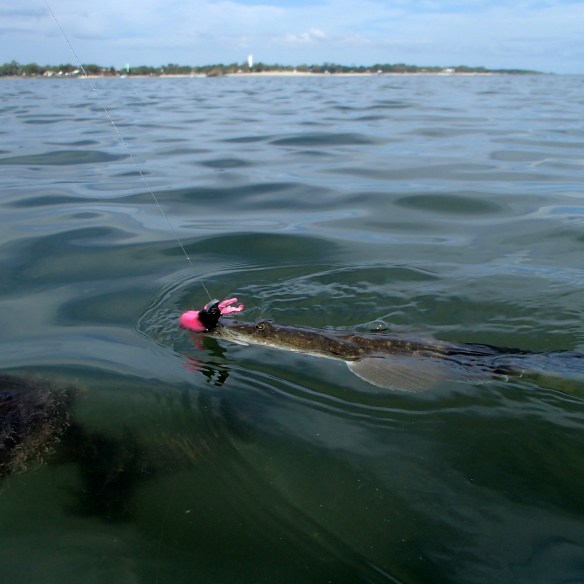
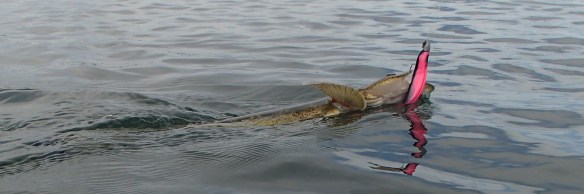
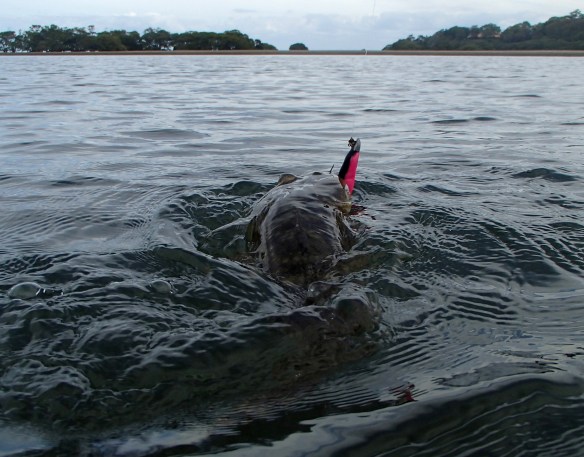
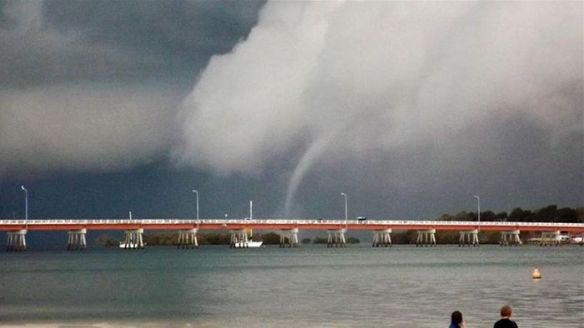
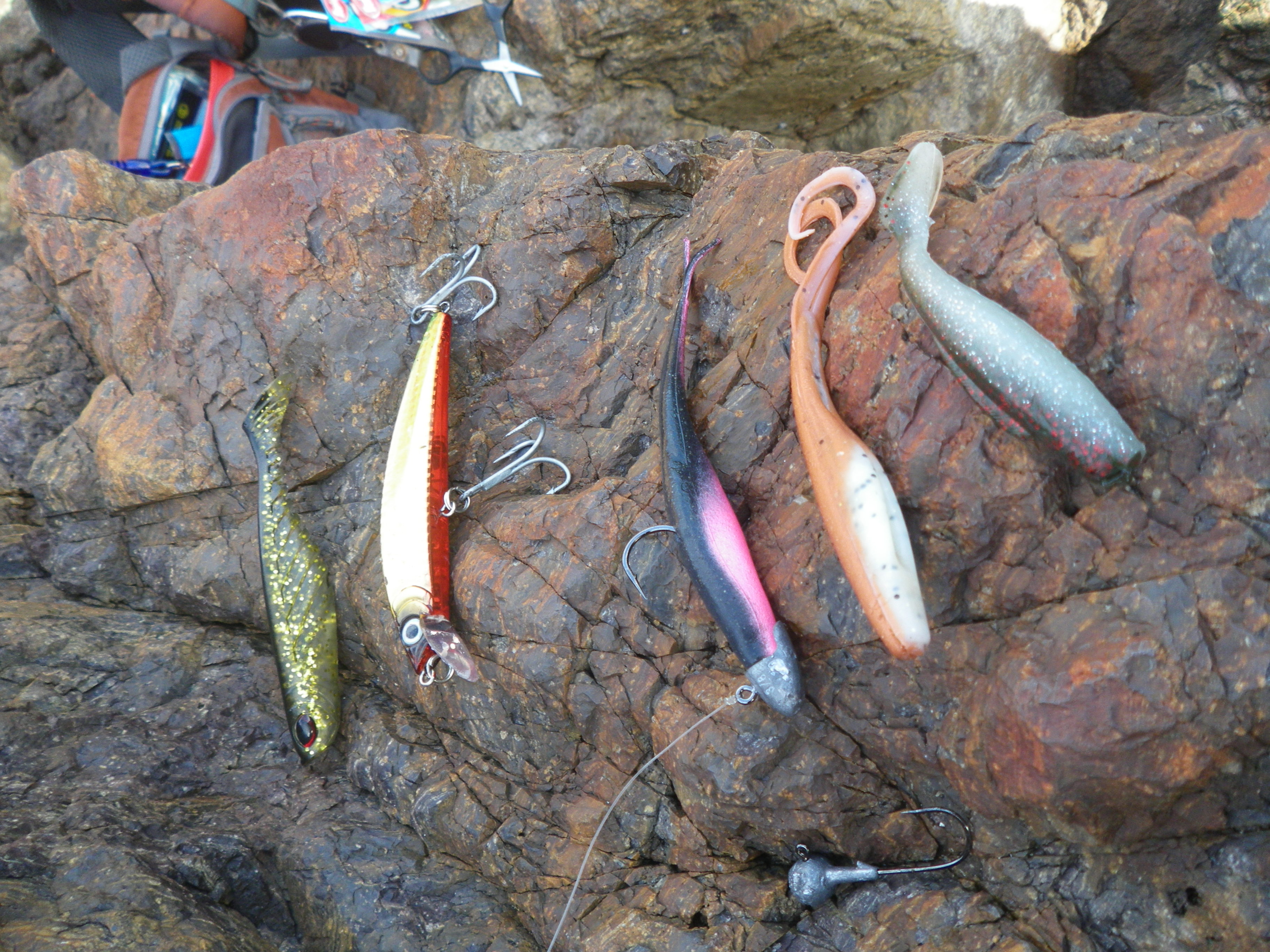
Iluka – Middle Bluff – 29 September 2104

Sunday – Morning

It was another mild morning in Iluka. A light northerly wind was doing its best to flatten the sea. I decided to fish Middle Bluff again and see if I could find a legal sized mulloway (jewfish).

At this point I will say my piece about the raising of the jewfish size limit in NSW. I have read a bit about the surveys that were done to determine whether or not the existing limit of 45 cm, was adequate to protect the species. They were very small surveys that relied on a lot of subjective judgments by local fisherman and fisheries officers, but it would have been financially impossible for them to be developed any other way. After putting together these surveys, NSW fisheries concluded that fish at 45cm were not having a chance to reproduce before being caught, so they have raised the legal size to 70 cm and set a bag limit of two. Commercial fishermen also have to obey by the new rules, although they are allowed to keep some smaller fish, under by catch rules. If I have got any of this factually wrong, please comment and correct me.

If we want sustainable fish stocks we need to carry out credible scientific research. Our duplicated state fisheries departments do not need any more boats, trailers, life jackets, uniforms or rulebooks. They need scientists and scientific rigour in their research processes. The science used to support this decision may be proved right but I would have liked to see much more comprehensive studies. We now have the ridiculous situation where on one side of the Tweed River the Mulloway size limit is 70cm and on the other, it is 75cm.

It was another spectacular sunrise at Middle Bluff. I decided to fish with the light rig from the beginning and stick to the soft plastics. I was using 16lb fluorocarbon leader and a ¼ ounce, size 1/0 hook Nitro jighead. I loaded up with a GULP 4” Minnow in the new Green Camo colour.

The sun came over the horizon at about 5.30am and by 5.45am, I had my first fish. It was another mulloway/ jewfish, but it would not be dinner because it was only about 45cm long. I unhooked it in a rock pool and took a few pictures, then speared it back down in to the wash. It had grabbed the plastic very close to the rocks again.

I put in plenty of casts but could not get another. I swapped down to a lighter 10lb fluorocarbon leader and put on a GULP 2” Shrimp, also in the Green Camo colour. I moved a little further north along the rocks and cast down into the wash. I let the soft plastic waft around, but I left it too long and got snagged. I re-rigged and put it back in the same spot. After a couple of casts I felt a solid hit and the rod bent over. Fortunately, the swell was light and I was able to get down quite close to the water. I let the fish take some line then tightened the drag a little and lifted it up, onto the rocks with the help of a wave. It was a very solid 37cm bream. So I would have something for dinner.


I fished on for another hour but the wind picked up and the tide started in, making fishing a bit hard. At about 9.00 am, I cleaned up the bream and walked back along the beach to the car.

Sunday Afternoon

On Sunday afternoon I decided to wade out on the stretch of the Clarence River – just in front of the Anchorage Holiday Park. There are sand banks and weed beds and it looks like an ideal flathead spot. I started just before 5.00 pm. The tide was running out and I waded across the sandy and muddy bottom until I came to the weed banks that fringe the deeper main river channel. As I was exploring, I started by fishing with a soft plastic that I am very confident using – the GULP 4” Minnow in the Pearl Watermelon colour. I was fishing with my estuary light spin rod, 10lb fluorocarbon leader and 1/8th ounce, size 1 hook jighead.

It did not take long to find the fish. I caught a couple of small flathead first and then a legal one (40cm), that was sitting in a sandy hollow. I waded up river and decided to switch to a DUO Realis Shad 59 MR hard bodied lure. This is a medium diving lure and the flathead and bream love it. As the sun set, I caught a couple more small flathead on this lure.

I had fished at dawn and dusk and caught fish at both sessions – and had a nice bream for dinner – living the dream!

Bribie Island – The old oyster jetty flats – 4 September 2014

Thursday

By Thursday I had time for a morning fishing session. I have been hoping to get down to Fingal Head or Iluka to chase some bream, tailor and mulloway. But I just cannot seem to carve out the time at present, so it was back up to Bribie.

It was another mid-morning low tide at 10.20 am. The moon was about 60% full. Strong southerlies had been blowing for a few days but these were forecast to drop off by lunchtime. It was a bright, sunny morning, when I arrived at about 8.00 am.

I did not really have time for exploring so I waded straight out under the bridge on the mainland side. The tide was already a fair way out and I could see plenty of fresh flathead lies in the sandy area, under the bridge lights. They were not big fish but there were plenty of them. There were also plenty of track marks from cast nets. There must be some prawns or squid around.

The water was very cool but clear. I headed straight for the sandy depressions just north of the old oyster jetty. This area is not as peaceful as it used to be. The new hotel is going up fast just behind the jetty and cement trucks are constantly coming and going.

I decided to start with a small hard body for a change. I selected the DUO Realis Shad MR62. A small diving minnow. After a few casts, something grabbed it, but after a few violent headshakes, it was off. On the next cast I found another fish and this time it stayed connected. It was about 45cm so it went in the keeper bag.

I was feeling confident. I stuck with the hard bodied lure for about another 15 minutes but I could not find any more. I changed to a GULP Jerkshad and then a GULP Shrimp soft plastic, but neither of these got a bite. It was turning into another fairly tough session.

After about an hour, I was using the GULP 3“ Minnow in the Smelt colour on a 1/8th ounce, size 1 hook jighead. I was fishing with about a metre of 10lb fluorocarbon leader tied on to a 10lb braid. I was now about halfway between the old oyster jetty and the green channel marker. I found a few sandy patches amongst the weed and hooked another flathead. This one was a more significant fish at about 55cm – another one for dinner. It was a confidence boost but I had to wait another 30 minutes to find another fish and this time it was just undersize, at about 38 cm.

At about 11.30 am the dolphins came in close and chased a bit of bait around. I had also seen some quite significant squid through the morning. It’s good to see a plentiful food source in the area.But the tide had turned and not much was happening so I made my way back to the bridge.

Just after noon I reached the bridge and stopped to cast around the pylons. This paid off and I caught another small flathead on the 3” Smelt Minnow. It was just under 40cm so I released it. That was it for the day.

Bribie Island – the old oyster jetty flats – 18 June 2014

Wednesday

Here is a very old report that I forgot to post. I am ashamed to say that I did not wet a line in July. It was not just because I was afraid of freezing my nuts off.  The requirement to find some money briefly diverted me from my true purpose. I was out again yesterday, at Bribie and things were very tough and cold. I will post that report later.

So here is a report for 18th of June. I arrived early – about 5.30 am and there had been some very could south westerlies in the preceding days. The forecast was for a 15 knot south-westerly, first thing, but the wind was actually much lighter.

I ran into Dave, a keen local fisherman who works for fisheries. He told me about the fisheries Keen Angler programme – you can find out more at http://www.daff.qld.gov.au/fisheries/monitoring-our-fisheries/recreational-fisheries/get-involved-in-fisheries-monitoring/keen-angler-program. The program website has links to research updates and species population structures, which are quite interesting.

It was a bright clear morning. The water was fairly clear but the big night time high tide had lifted the weed. I waded past a dead flathead carcass in the shallows. Perhaps it was a fish that had not survived a release. The pelicans, kites, cormorants and wobbegongs usually tidy these up pretty quickly. There were a couple of Pelicans cruising the flats and it looked like they were chasing the tiny squid that I keep coming across.


Low tide was at 7.37 am. In theory it should have been perfect session. I could access all the fish holding areas at the bottom of the tide and the wind was not strong enough to make things difficult. But, in practice it was pretty tough.

After cycling through a few bigger soft plastic jerkshads I swapped down to a 2” GULP Shrimp (floating) in the grey colour. I understand these new floating GULPS are designed for targeting Bream in the upper water column – but that only works if you put them on zero weight jigheads, which I have always found impossible to cast. I picked them up because I could not find any in my favorite Peppered Prawn colour. The floating ones are made of a different material (to make them more buoyant) and they do not look as appealing.

But Flathead will eat anything and about 30 metres south of the end of the old oyster jetty, I caught a 43cm model. I gradually waded all the way along the big sand bar to the green channel marker and after swapping back to a GULP Pearl Watermelon coloured jerkshad, I found a slightly smaller flathead. I turned back and about half way between the jetty and the marker I caught another, similar sized Flathead on the same soft plastic.

As I waded back to the car the dolphin family arrived and started hurling themselves around under the bridge.  Beautiful day, fantastic scenery but the fish were hard to find.

Bribie – the old osyter jetty flats – 7 June 2014

On Saturday it would be a morning high tide at 3.52 am on Bribie Island. So on past performance the fishing would start to get really good around 7.00 am, which sounded great. I arrived at my usual spot, beside the old oyster jetty, at about 5.45 am. The air was still but it was very cold.  The moon was just into its second quarter, so it would not be a very powerful or big tide.

The water was up to the mangrove roots, so I moved slowly south. I cast a GULP Crazylegs Jerkshad soft plastic, in the Curried Chicken colour, ahead of me, into the shallows, parallel with the shoreline.  There a few sandy patches in this area and they had been covered in flathead lies, the last time I was here, so I peppered the area with casts.

At about 6.30 am just before the sun came over the horizon, I felt a definite bite but did not hook up. I threw the lure back in exactly the same place and slowed things down. After a long pause on the bottom, I slowly lifted the rod and then flicked the tip. I wound in a little line and then repeated the pause. When I lifted the rod, the fish had already grabbed the plastic and it was hooked, instantly. It was a good flathead around 45 cm long. I released it and tried again and was instantly rewarded with another, slightly bigger one.

As the sun rose, I could see lots of small squid and I noticed the pelicans where swimming around picking them off. This might be what has brought the flathead in. I fished around the mouth of the drain that runs off the flats, from the direction of Pebble Beach. I did not get much interest here so I waded out on to the long sand bank, which runs to the south.  I swapped over to a GULP 4” Minnow in the new Green Camo colour. The sand bank was still was covered in water. From here, I cast at a sandy patch that sits about 30 metres directly south of the jetty. As soon as the lure hit the water it was snaffled. After a brief fight, I had another 45 cm flathead swimming beside me.

I released this one and cast straight back into the same spot. This area is always fishy because it is where the water running off the flats meets the water running down the main channel of the Pumicestone Passage. The current flow forms a bit of a depression with a sandy bottom. After a couple more casts I felt a fast solid hit. The rod tip bent over but this fish was faster than a flathead. It took a bit of line in a few quick runs then I saw the flash of silver and realised it was a good sized bream. It had seriously munched the 4” Minnow soft plastic. It was about 33cm long, I tried for another but could not find any. It was now just after 7.00 am.

As the tide ran out I gradually moved closer to the edge of the weed beds. I caught a couple more 35cm flathead on the GULP 4” Minnow and then decided to try something bigger. I loaded my 1/8th 1/0 jighead with a GULP 7” Jerkshad in the Peppered Prawn colour. This is a very big plastic for a flathead so I flicked it slowly along the bottom with plenty of pauses. I felt a definite bite but struck too soon and probably pulled the plastic out of the fish’s mouth. On the next retrieve I slowed it down even more. In exactly the same spot, I felt the bite and this time I dropped the rod tip and counted to ten. When I lifted it the fish was on. Amazingly, it was a just legal sized 40 cm flathead. I carried on with this soft plastic for a while but I could not catch anymore.

I swapped down the spectrum to a GULP 2” Shrimp in the Banana Prawn colour and fished around the same area. I caught a few more flathead that were just undersize. There were clearly plenty around but I had only caught 4 that would have been big enough to keep.

As I pondered what to try next an old timber bibbed minnow floated past. The front eyelet ring had pulled out. It was nice to get one back. I will have to try and fix it up. It was now getting close to low tide and I had to stop for the day.

In summary, the flathead are back in large numbers but they are mostly under 45cm. Size/ type of lure did not make much difference today. Perhaps they have followed the plentiful squid into the shallows.

Bribie – the bridge, the Seaside Museum creek, the old oyster jetty – 22 May 2014

Thursday

The wind was up again, making it hard to know where to fish. It can be unpredictable, as we move firmly into winter, but as the direction becomes more consistently from the south east, I find the fishing usually improves.

For some reason I could not sleep, so I got up at about 3.30 am and arrived at Bribie at about 4.30 am. The weather was not good. The wind seemed to be building and it was swapping between drizzle and real rain. There had been plenty of activity on the island side, under the bridge, early on Monday morning, so I started there.

The wind had blown the floating sea grass over to this side of the Passage and now it floated by in huge clumps. I loaded up a GULP 3” Minnow soft plastic in the Banana Prawn colour and threw this around for a while. I fished here for about an hour and the contrast with my pre-dawn session on Monday was stark. Despite changing through a few soft plastics, I did not feel a single bite. There was no surface activity and the water seemed completely devoid of fish. At about 5-15 am, I swapped to the DUO Realis Shad 59 MR – my current favourite suspending, hard bodied lure. After a few casts, I caught a small (35cm) flathead. I released it, tried a few more casts and then decided to move on.

At 5-30 am, I moved down to the ledge and the creek drain, in front of the Seaside Museum. The rain had stopped but it was so cloudy that it looked like there would be no real sunrise. Low tide would be at 10.03 am. I waded down to the point where I caught the decent bream on Monday and started casting, with a GULP 2” Shrimp soft plastic. The wind was up and making things tricky. I could see the ledge and I cast at the area both on top of it and beyond it, but did not have any luck. I waded south, following the tide out. I swapped through small and large soft plastics but nothing produced a result.

Then the excavator started up and dug a trench to release the tidal pool that had gathered overnight. I did not think this would do much for the fishing, so I switched locations again. I crossed back over the bridge to my old stomping ground – beside the old oyster jetty.

I swapped to a Powerbait Jerkshad soft plastic lure, in a grey/ silver/ neutral colour. I had also dropped my leader down to 10lb fluorocarbon. The tide was still running out, hard. The water was clear and the sun was trying to come out. It did not take long to find the fish here. I caught the first flathead sitting just behind a submerged weedy sand hill, about 30 metres south of the jetty. It was about 45cm long. I caught three more, about the same size, in quick succession. Then things went quiet.

I was pretty sure there were more fish in the area, so I swapped to a Mad Scientist 4” Optishad soft plastic in the Motor Oil colour. This is a great plastic with a whopping great shad tail that pounds along the sandy bottom. I could not find any more fish in the same spot, so I moved about 10 metres further south. The Optishad worked its magic and caught two more flathead in successive casts. They were almost exactly the same size as the others.


Over the next hour, I caught about 10 more flathead. Most were about the 40 cm size. Only two looked like they were over 50 cm. I swapped through a few more lures, to see if this would affect the size of the fish, but it did not seem to. I put on the new DUO Realis Shad 62DR – a slightly longer, deeper running version of the Shad 59MR. This also proved a hit and accounted for a few more fish.

Eventually I tied on a large timber Detonator 100 from Lethal Lures  – http://www.lethallures.com.au/ , that I bought at Barra Jacks (in Rockhampton) and gave that a go. It was awkward to fish on my light rod and picked up plenty of weed but, after about 10 casts, it caught another 45cm flathead.

At about 11.30am, with the tide running in, I gave up for the day. There were plenty of fish around on one side of the Passage, today, and none on the other. That’s why you have to keep moving.

Bribie – the bridge and the Seaside Museum creek mouth – 19 May 2014

Monday

It would be low tide at Bribie just after dawn. I could not resist a quick fish before work. With the water getting noticeably colder, I was sure the tailor would be around somewhere.

Small ‘chopper’ tailor often hang around under the bridge, just before dawn. The bait fish and prawns are drawn to the bridge lights and the tailor, pike, bream and flathead can’t resist trying to ambush them. To the north of the bridge there are some established weed beds which are good fish habitat. The bait is also drawn to the light of the big street lamp, near the boat hire spot, a little further up.

Low tide would be at 7.06 am. Unfortunately, this side of the Pumicestone Passage gets a bit more breeze when the wind is coming from the south, south-west, or south-east. Today it was a cool south-westerly, initially and then turned into to a much stronger south-easterly, later in the morning. There had been rain over night, but not much.

I arrived at about 5.00 am and the moon was completely blocked by some ominous looking clouds. It was growing smaller in its waning gibbous phase – a bit less than half way between full and new. The water was very clear but the wind had lifted a lot of weed.

The tide was running out, so I went round to the south side, and waded into the shallows, in the dark. I cast up, towards the circle of sandy bottom, lit up by the bridge light, nearest to the shore. I started with a DUO hard body that is perfect for clear, shallow water. The DUO Realis Minnow 80 SP is a suspending minnow. Because it is fairly long at 80mm and light at 4.7 grams, you need to rig it on a light leader (10lb breaking strain or less). This enables you to cast it over longer distances. You need to do this, as it is a fairly shallow diver and it takes a few metres to get down to its running depth, about 10 cm below the surface. I think this will be a great bream lure.

As always at Bribie, the floating sea grass was a pain in the neck. After a couple of casts, I saw the lure get knocked out of the water by a small fish. A few moments later, something grabbed it and started shaking its head. It was a tiny pike.


I carried on casting in the same spot and had obviously found a patch of them. I caught 3 more small pike before they decided to leave the Realis Minnow alone. I swapped to the DUO Realis Shad 59 MR  – another suspending minnow,  but this one dives a little deeper. I moved closer to the bridge and cast into the shadows underneath it. Once more, it did not take long for the Pike to find this lure. There were a couple of casts when nothing hit the lure, then a tiny flathead grabbed it and came to the surface angrily shaking its head.

It started to rain so I moved north in to the shadows, under the bridge. I cast over the shallows, on the south side and soon foul hooked a tiny bream. It was now about 5.30 am but with the clouds and rain, there was no sign of first light. The surface activity increased as the fish sensed dawn was on its way. I felt a few very aggressive knocks and bumps and decided to increase the speed of my retrieve. This produced immediate results and on the next cast, I saw a small tailor grab the back end of the lure, a few feet away from me. It fell off but on the next cast, I landed one. It was only about 25cm but I was delighted that it had been hanging out just where I thought it would be. I then had a frantic twenty minutes with my lure getting bumped and smashed on almost every cast. I connected with about 8 fish, but only 4 stayed on until they reached the shore. They were all small choppers, the largest of which might just have made 30cm long.

At about 6.00 am a grey dawn started to break and I decided to move down to the drain in front of the old seaside museum, to see what has happened to the terrain there. The works to secure the sea wall are continuing but clearly, the finished, stepped, wall is some months off. I waded out on to the patch of coffee rock that sits in front of the seaside museum. With about an hour to go until low tide, the rocky bottom was completely exposed.

I cast the DUO Shad 59 MR around, but it kept picking up weed so I changed it for GULP 2” Shrimp soft plastic in the Peppered Prawn colour and loaded this up on a 1/8th ounce, #1 hook jighead. I moved south, along the edge of the coffee rock, casting into the deeper what beyond. I got a couple of strong hits and then, at about 6.30 am I felt a solid bite and set the hook. The fish tried to run away under the ledge but I had the drag set quite tight and the rod absorbed its lunges. I soon saw a flash of silver. It was a chunky bream that I later measured at 34cm. I tried for more and had a few hits but could not land any.

At 7.30 am, the wind was up and another rain shower threatened. It was time to head back to work. But a day of work is always easier to bear, when you have caught a fish before it starts!

Bribie – the old oyster jetty to the channel marker – 21 April 2014

Monday

I am disappointed to report that once more the curse of paid employment has slowed down my posting and fishing. If the current government has its way, I shall be doing more work, for a lot longer than I had planned. I understand that when the pension was first introduced around 1910, the qualifying age was 65 and life expectancy was 58. So it was the ultimate healthy lifestyle bonus. Rarely did the government have to pay out for more than a few years. Now, most of us will get to our mid 80’s (especially if we eat plenty of fish). So we nearly all qualify for some portion of state funding for 15 years or more. Someone has to pay for it and the woeful performance of most people’s superannuation fund managers, means they will not be making much of a contribution. It’s a mess and it can only mean one thing – the current Australian age pension is probably as good as it will ever be.  So next time you see someone with more grey hair than you, whingeing about the cost of bait, remember you will be working long after they put their feet up, so ask them to shout you a beer. Of course, I can’t imagine who will employ me when I am 65 but that’s a whole another can of worms.

That’s enough social commentary. I was keen to see if the flathead glory days of early March would return. I drove up to Bribie on Monday, to fish the run out tide, which would be low at 8.00 am. It was still school holidays and during my last few visits, there has been plenty boat traffic. The wind has been changing between a light south-easterly and a northerly, with the occasionally cool westerly appearing, in the early morning. On Monday, it was light and cool from the south west. The overnight westerlies will start to bring the water temperature down quite quickly, if they persist. We were about half way between the full and the new moon.

I started in the dark and decided to head straight to the area to the south of the old oyster jetty, on the mainland side of the Pumicestone Passage. My last few sessions through the Easter Holidays had produced some quality fish, but the numbers were thinning out.  I decided to fish with neutral/ natural coloured soft plastics, just in case the fish were getting picky. I started with a GULP 2” Shrimp in the Peppered Prawn colour. I loaded it on to a 1/8th ounce, 1/0 jighead.  It was 5.30 am and the sky was just beginning to turn orange along the horizon. I cast the plastic a long  way out and after two hops, I felt a good bite. Then the line went slack. I wound up the slack and suddenly, I was in contact with a fish again. It was swimming towards me but now it turned away. As it pulled away, the hook struck home and it took off with a blistering first run. I gradually subdued it, but it was powerful and angry and this area has a big patch of rocky bottom, close to the shore, so I took it slowly. After a few minutes, I pulled the fish on to the sandy beach. It was a big female, just under 70 cm. After a few pictures, I let her go.

The sun came up and I waded further south, following the falling tide. It was pretty quiet and it was not until 6.25 am, that I got another bite. I had swapped to the GULP 2” Shrimp in the Banana Prawn colour and hooked another slurping, grunting, spiny puffer fish. I pushed it off the hook and continued fishing. I then caught a couple of undersized flathead in quick succession. Then things went quiet again. I swapped to a longer GULP Jerkshad in the Peppered Prawn colour and this soon attracted a few bites. About 10 minutes after the change, I caught a big (35cm) pike. I was now about half way to the green channel marker.

The water slowed and I turned back towards the jetty. At about 7.20 am I caught an almost legal size flathead, which I released. It was getting frustrating. By low tide at 8.15 am, I found myself back beside the old oyster jetty. I had swapped back to the Shrimp in the Banana Prawn colour. I put in a few last casts and then bang, a big fish grabbed the Shrimp soft plastic, just as it landed. The fish was lying in no more than 20 cm of water. It was big and powerful and as it was so near the surface, it immediately started shaking its head. It ran hard but after about four good runs, it was spent. I waded through the soft muddy weed and pulled it ashore. It was another 70 cm model, or perhaps it was the one I caught earlier. It looked a very different colour in full daylight, but you never know.

I had caught some good fish but I had released them all. It may be time to fish somewhere else for a while.

Bribie – the old oyster jetty flats – 16 April 2014

Wednesday

On Wednesday I drove up to Bribie and arrived just before first light at about 5.30 am. On Tuesday night we had a lunar eclipse and the full moon was huge and bright in the west. There was a surprisingly cool south-westerly wind blowing. Low tide had passed just after 4.00 am so by the time I waded out on to the flats, the tide was really running in.

Just before dawn there was some surface action under the bridge lights so I cast a GULP 3” Minnow in the Smelt colour around the pylons. This soon produced a couple of small Pike. I witnessed another beautiful sunrise and then continued wading south.

The big moon and meant a fairly big tide. The big tide had lifted all the storm debris from the previous week and it was soon clear that this would be the major obstacle to fishing the incoming tide. Seagrass, weed clumps, bait bags, floats and plastic bottles all started to passed by.

The only advantage of all the floating debris was that it allowed me to examine the water currents in the area. There is obviously a slightly sheltered area just to the south of the old oyster jetty and this is often where you find fish. It is protected by a couple of patches of rocky reef to the east and the tree line, on shore, to the west. At certain points in the tide cycle the water in this area slows right down and the debris gathers in a big clump.

I cast around the edges of this slow moving water looking for fish but I got virtually no bites. Just before 8.00 am it was getting too hard to fish into the strike zone, so I started back for the car. I was casting a GULP Jerkshad soft plastic in the Cajun Chicken colour on a 1/8th ounce , size 1/0 hook jighead. Suddenly the line went tight and the rod tip started to wriggle. I set the hook but the fish took a while to register – this often means it’s a big one. It swam towards me for a few seconds and then realised something was amiss. It took off with a long, blistering run towards the jetty. I let it take line and then gradually started to get some back. There were a couple more long runs but after a few more minutes I caught site of a very decent flathead. I steered her up to the beach and took a few photos.  She was just under 70 cm but I let her go. They really can be a bit tough to eat at this size and if I want to still be catching plenty of fish in future seasons, it makes sense to let these big breeding females go.

This final fish rescued what would have been a pretty dismal session. They seem to be far easier to find on the run out tide in this area. The sudden cool south westerly wind may also have put them off their food.

Bribie – the oyster jetty to the channel marker – 10 April 2014

Thursday

I only had time to fish the afternoon run-in tide on Thursday. I arrived at the mainland side of the Bribie Island Bridge at about 12.30 pm. It was a hot, humid day.  It had rained again, in the morning and there was a light northerly wind. Low tide had passed at 12.20 pm. It was a hot still afternoon.


Clumps of weed everywhere

I waded south past the oyster jetty. The water was hardly moving but it was very dirty. As the tide started to run in, it became difficult to fish as the jighead caught on clumps of black, rotting weed. I swapped through a few different soft plastic lures and decided to stick with the GULP Jerkshad in the Cajun Chicken (black & pink) colour.

Just one keeper

It was hard work and I waded further south. As the tide picked up pace, I caught a 45 cm flathead, about 50 metres to the south of the jetty. It was now about 1.30 pm. I carried on towards the green channel marker and caught another 30 cm flathead at about 2.00 pm.

OLYMPUS DIGITAL CAMERA

I swapped to the Mad Scientist Optishad paddletail soft plastic and I got a few bites on this but could not stay connected with anything. Just to the north of the big exposed sand bar I felt a bite. I hooked the fish but it was a slurping, spitting spiny puffer fish. This reminded me why I wear waders. I carefully retrieved my lure with the aid of my pliers.

Porcupine puffer

By about 2.30 pm the incoming tide was pushing me off the edge of the weed beds so I gave up and waded back to the car. It had been a tough session in the middle of the day.

Bribie – the old oyster jetty flats – 8 April 2014

Tuesday

Stormy weather

Stormy weather

A massive storm hit Bribie Island on Sunday – dumping significant rain and really stirring things up. So I left it until Tuesday to go fishing again. It was now about half way between the new moon and the full moon. The wind was forecast to be a light south-westerly. It felt noticeably cooler as I got out of the car, by the bridge at about 5.30 am. The water was definitely cooler, as I waded out on to the flats beside the old oyster jetty. Low tide would be at about 10.30 am.

Just to the south of the jetty I concentrated on a patch of weed that has produced a few flathead in the past. I was fishing with a Gulp 4” Minnow in the Smelt colour. I had it rigged on a 1/8th ounce, size 1/0 hook jighead. As it is now possible that there are a few Tailor around, I am consistently fishing with a 12lb fluorocarbon leader. This won’t stop big fish but it might give me a chance with some good sized choppers.

At about 6.00 am, I felt a few very aggressive bites but did not hook up. I persisted in the same spot and after about 10 minutes, I felt a solid yank and line started peeling. I had hooked a big Long Tom and it promptly leapt out of the water for the camera. I let it get rid of some energy then released it, recovered my jighead and chewed soft plastic. The leader was completely lacerated. So I cut off the last 10 cm and tied my jighead back on. I straightened the soft plastic and carried on casting.

The fishing was very tough. I tried a couple of small hard bodies and jerkshads with no success. By about 7.15am I had dropped down to a GULP 2” Shrimp soft plastic in the Banana Prawn colour. I managed to catch a couple of very small flathead on this plastic.

I waded all the way down to the big sand bar beside the green channel marker, but the fish were elusive.  I swapped to a GULP 3” Minnow in the Smelt colour and this enticed another 30 cm flathead, but it was a long time between bites.

As the tide continued to run out I waded back closer to the oyster jetty and decided to swap to a Z Man Minnowz soft plastic in the Red Bone colour. As I have mentioned before I am no longer a fan of the Headlockz Jigheads. They hold the lure in place but I think they are a bit clunky for this type of estuary fishing. I therefore chose to put the plastic on a Nitro Bream Pro 1/8th ounce, size 1/0 jighead. I hoped the vibration of the paddletail might be more obvious to the fish. It took a while, but after about 30 minutes I did finally catch a 45cm flathead. I swapped to a Minnowz in the Opening Night colour and after about another 30 minutes I caught another, about the same size.

By 10.00 am I had had enough and the wind had picked up. As I waded back towards the bridge a came across plenty of flathead lies – so the fish are around, somewhere. It had been another tough session.

Bribie – the channel marker to the bridge – 31 March 2014

Monday

With massive downpours all along the Sunshine Coast on Friday, Saturday and Sunday, I was concerned that the recent flathead bonanza might come to an end. On Monday, I found myself driving up to Bribie to see how the big flush of freshwater had affected things.

I have been doing well fishing the last few hours of the run out tide, over the last few weeks. But after a major rain event this is not ideal. The water is at its freshest and cloudiest in the estuaries, as the tide runs out. All of the water that is running off the surrounding land changes the salt levels quite dramatically and this can force the fish or what they are eating, out to sea.

The trouble is the best drains and hiding spots around Bribie are hard to reach at high tide. So even though the incoming tide makes the water saltier and more comfortable for the fish, you cannot get at them from the shore.

I decided to fish as close as I could to the mouth of the Passage, next to the green channel marker, on the mainland side. This involved a long walk from the Bribie Bridge. I arrived at the sand spit, beside the channel marker at about 1.30 pm. Low tide would be at 4.00 pm. It would be a very low low tide at 0.3m, as we were only a couple of days off the new moon.

I tried a few GULP soft plastics – the 4” Minnow in Pearl Watermelon and the 2” Shrimp in the Banana Prawn colour, with no luck. The water was running out quickly, but it was very dirty. I swapped to a 5” Powerbait Minnow in the Pumpkinseed colour and started casting close to the green channel marker pole. This worked and just before 2 pm, I got my first flathead of the day. It was a decent 55cm fish.

I slowly moved back towards the bridge, casting into the run out tide and following the fringing weed beds. It took almost an hour to find the next fish. By this time, I had swapped to a GULP 4” Minnow in the Smelt colour. It was another flathead, just over 40cm.

As the tide ran out, the fishing got harder and harder and the water got dirtier and dirtier. I dropped another fish, closer to the old oyster jetty but, by low tide I had really only had three serious bites in 3 hours.

Finally, I picked up a few tiny (under 30cm) flathead near the bridge, but overall it was a disappointing session. It is too soon to say that the fish are gone for good. I suspect that if there is no more rain, we may well see them build up again after the new moon.


Bribie – the old oyster jetty flats – 8 March 2014

Saturday

After an extraordinary session on Friday, I had to get back up to Bribie again to fish the low tide. Fortunately, I could squeeze in a session on Saturday morning. The wind was forecast to be pretty lively again, with a couple of tropical cyclones hovering off the coast, up north. Low tide would be at 8.40 am. The moon was a week away from full.

I arrived just after first light at about 5.30 am. I ran into Matt, another keen fisho who had had the same idea. We walked out towards the old oyster jetty and swapped a few fishing stories. He headed south along the sandbank towards the channel marker and I settled on a spot just to the south of the jetty.

It took a while to find the fish. The sun came over the horizon and the wind started to pick up. The tide was running out quickly. I started by fishing with a GULP Jerkshad in the Satay Chicken on a 1/8th 2/0 jighead. I was using my G.Loomis TJR fast action, light spin rod and a 15lb Super PE braid and 10lb fluorocarbon leader. At about 6.20 am I dropped a small flathead, but on the next cast, I felt the bite and paused. When I lifted, the fish was attached.

Now I had found the fish and I caught a fish on almost every cast for the next 30 minutes.  A hot bite is a great time to experiment. A gent named Charles Talman from Mount Gambier in South Australia makes his own soft plastics and recently was kind enough to send me some to try out. There were plenty of prawns jumping so I decided to start by rigging up one of his 4” Shrimp soft plastics. These plastics do not quite have the finesse of the major brands, but as you will see from the pictures, they are cleverly designed and have good actions and texture – both essential characteristics. I rigged the first one on a 1/8th ounce, 2/0 jighead and cast it out. I knew the fish were here but I wasn’t sure they would go for it. There was no need to worry – half way into the retrieve a fish hit it. I dropped the rod tip and paused. About five seconds later, I struck and I pulled up a flathead, about 45cm long. A few casts later, I caught another. Over the next hour, they kept coming. I cycled through a couple more of Charles’ lures and then put in a GULP 4” Shrimp in the Natural colour. There was no difference in the catch rate between the two types of shrimp soft plastic.

I now decided to try the DUO Tetraworks Koikakko tiny hard bodied squid imitations. These are made with the usual DUO care and attention to detail. They can be used in deep water as a jig or hopped across the bottom like a traditional sinking hard body. They are only 34mm long and weigh 4.6g. They are ideal to cast across the flats in crystal clear water, on light leaders and will tempt almost any species.  I knew there had been a lot of small squid around this area so I thought they would be perfect. My only concern was that perhaps they would be too small for the flathead to notice. I checked my knots and decided to slow everything down and increase the pauses on the bottom.

Success was not immediate, but after about 15 minutes I saw a flathead come up behind the lure and then turn away at the last minute. I cast back in the same spot and left the lure on the bottom for about 20 seconds. On the second hop, I felt the violent thud of a flathead mouth crunch down on my lure. The fish took the lure and slowly swam away with it. It took a while for it to register that this was not an ordinary squid and when I lifted the rod tip to ensure the tiny treble was lodged, it took off.

It was obviously bigger than the small flathead that had swiped at the lure on the previous retrieve and it made couple of blistering runs out towards open water. You cannot muscle a fish with the fast and flexible G.Loomis TJR rod. It absorbs the lunges beautifully but you have to be patient and let the reel’s drag do the rest. I have traded up the single tiny treble hook on the DUO Tetraworks Koikakko for a slightly tougher Gamakatsu version. I waded back to the shoreline with the fish. It was tired now, but as we reached the shallows, it continued to try and turn and then shake its head. I pulled it across the weed in the shallows and on to the sandbank. It was the biggest fish of the day – a 68cm flathead. I released this one and carried on fishing.

The Koikakko lure caught plenty more flathead and its tiny size did not seem to have much bearing on the size of fish it attracted.  By low tide I had five good fish in the keeper bag – all between 50 cm. and 60cm.

By 9.00 am, the wind was howling and making it pretty hard to fish. I decided to finish the session with a couple more of Mr Talman’s soft plastics. I particularly like his small, three legged monster – not sure what it is but the flathead love it. I lost the green version to a fish that wrapped itself around an abandoned crab pot.  Fortunately, there was also a fluorescent gold/creamy coloured one, so I re-rigged with this. The flathead could not resist and I caught about 5 more, all good sized fish, on this soft plastic lure. I finished up with a 5” worm in a green colour. This also delivered and after a few casts it connected with a 50cm flathead.


I am not really sure why the fish have suddenly appeared but I hope they hang around for a while. I’ll be back.

Bribie – Oyster jetty flats – 15 July 2013

Monday

Another fishing opportunity – and another miserable weather forecast, cold wet and windy. You just have to get on with it. I could not start early but I was able to reach the Bribie Island Bridge just as the tide was starting to really run in, at about 9.00 am. Low tide had passed at about 7.45am. There was a thick grey band on the horizon and a cool south-westerly breeze.

I wandered out past the jetty, heading south to my usual stomping ground. As I did so, the wind dropped and the drizzle started. I only had about an hour before the incoming tide would push me back, away from the weed banks.

A few weeks ago there were some good mullet schools in this area, but they seem to have moved on. I waded quickly south, to one of the more productive spots, along a big weed-covered sandbank. There are nearly always fish of some kind here. I started with a GULP Jerkshad in the Orange Tiger colour – bright orange and yellow with a black fleck. I was fishing with 8lb leader and a 1/8th ounce, 1/0 jighead. The water was still and fairly clear despite the wild weather so I was trying a high contrast soft plastic.

It did not take long. After a few casts, I felt a very slight grab. It could have been weed, but it felt a bit more solid. I dropped another cast in the same spot……….. nothing, except a clump of weed. I gave it one more try and bang, a flathead grabbed it and took off. The rod bent over and line peeled smoothly off the spool. The drag on the Shimano Stella 2500 had been expertly fixed by Neil at Jones Tackle – http://jonestackle.com.au/. It just required the adjustment of a small spring.

It was not a huge fish – about 50 cm, but it had plenty of fight in it. By the time it drew level with me, I could see it had completely swallowed the soft plastic. I pulled it over snipped the leader and slipped it into the keeper bag.

I re-rigged with the same plastic and peppered the area with casts. I did find another flathead so I moved about five metres further south. I put in a long cast and almost as soon as the soft plastic splashed through the surface of the water, there was a tug and then the line went slack. I wound it in to find the soft plastic Jerkshad and jighead gone. No idea what that was.

I tied on another Orange Tiger and cast it out. It was grabbed before it reached the bottom by an enormous Pike. It took plenty of line and made a few leaps, but it was nicely hooked in the side of the mouth, so the rod and drag soaked up the acrobatics. When I dragged it up close to me and unhooked it, I measured it at about 45cm.

I swapped over to a Zman Minnowz soft plastic in the Houdini colour. I thought the paddle tail might stir up the flathead. The tide was moving up fast and the drizzle kept falling. I only had 20 minutes left and then I would be pushed to far back to see where I was casting. After a few minutes of working the Zman I felt stop dead on the bottom. Then the fish started swimming. For the first time in ages I had a good fish hooked and I realised how little work my drag had been doing. I decided to pull it back to the shoreline – it was too big to grab while wading. After several good runs, I pulled a good 60cm flathead up, on to the sand and put it in the keeper bag.

The tide was now too high to carry on here, so I finished fishing at about 12.00 noon.

1770 – Baffle Creek – Flat Rock Ramp – 10/11 June 2013

Monday/ Tuesday

By Monday work was done and I was on my way back to Brisbane. I did have time for a quick stop at 1770. The weather was far from encouraging with heavy rain and persistent strong southeasterly winds. So on Monday morning I trekked round to the stretch of coast between Workman’s Beach and the beach I call Getaway Beach. This area is quite sheltered in a strong southerly. The top of the tide was just before dawn and I tried everything, big and small soft plastic and hard bodies – nothing raised a bite. The water was stirred up and murky and the swell made things tough. Every time I fished with heavy lures, I pulled up lots of weed and displaced rubbish from the bottom. When I fished lighter, I could not keep the lures in the water. After a few hours I gave up.

The weather looked good for Jewfish at 1770

The weather looked good for Jewfish at 1770

Tried everything in the tackle bag

Tried everything in the tackle bag

In the afternoon I decided to drive back to Brisbane, via Baffle Creek. I arrived at the Flat Rock boat ramp, just after lunch, at the top of the incoming tide. The wind was still a strong southerly and the rock bars to the east of the boat ramp were all covered in at least 30 cm of water. This area took a pummeling from the flooding, earlier in the year and there was plenty of evidence, with grass and debris still high up, in the mangroves. The ramp and picnic area were badly damaged but have now been repaired.

I waded out on the biggest rock bar just west of the picnic area and cast around the edges. The tide turned and started to run out just after 1.00 pm. There are big rock bars on either side of this channel. They form a funnel in the middle and on a big tide the water really races through. The water was quite clean at high tide, but got dirtier and dirtier as it ran out.

I started with GULP and Zman soft plastic on 1/6th oz, 1/0 jigheads. I had a few bites and watch the bait fish follow the lures in. Across from me on the other side of the channel, something was feeding in the eddies, formed by the opposite rock bar. I tried to land a few long casts in the right spot but I could not tempt them.

After about an hour, I move back upstream to the west of the boat ramp and cast around in the shallows. I was now fishing with my all-time favourite plastic, the humble 4 “ GULP Minnow in the Pearl Watermelon colour, on a 1/8th oz, 1 jighead. I was now down to 8lb leader, in the hopes of attracting a fish. After a few casts I did. It was a small dusky flathead. I continued along the sandy banks, casting at the base of the mangroves and soon found some more. I caught six in the next hour, but only two would have been just over 40 cm.

At about 3.00pm it was time to pack up. Overall, I had had a pretty disappointing couple of weeks on the fishing front. The fish had been small and hard to find. However, I had enjoyed exploring some new territory and as always, learning what does not work can be as important as learning what does. I found that when the going gets tough small, natural coloured soft plastics, like the GULP 4/3″ Minnows and light leaders, still produce results. The Zman Minnowz did not produce a fish on this trip – and they had plenty of outings. I will have to try their natural coloured minnow shaped range, but I still think the GULP scent and softer texture give their lures the edge. The weather had made things very hard but I believe the big flush out will set the area up for some great fishing in late winter. I am planning to get back up here as soon as I can.

Yeppoon – Byfield National Park – Kellys Landing – 8 June 2013

Saturday

On Saturday, I was back in Byfield National Park, so I decided to try fishing further up Water Park Creek, near Kelly’s Landing. There are thick mangroves lining the creek with only a few openings on to the muddy banks, along this stretch. A few visitors had arrived to camp beside the river and although we are well into the ‘dry’ season, the day started with rain patches, grey skies and drizzle.

This is another muddy spot and I was soon ankle-deep in the stuff. I squelched up river, using the same technique as I had on Wednesday. I was fishing with 8lb fluorocarbon leader, my light spin rig, small soft plastic minnows and shrimps on a 1/8th ounce, # 1 hook jighead. It was a new moon so there was a big, powerful outgoing tide.

The water was fairly shallow but formed some deeper channels close to the bank. In a few places there were oyster covered rocky outcrops and I settled in the mud, a few metres short of one of these and concentrated my efforts casting close to it.

I was using the GULP 3” Minnow in the Pearl Watermelon Colour. This was as close as I could get to the small bait fish. They were cruising up and down beside the rocks in small schools. After a few minutes, there was a surge and splash as something hit them from below.

I dropped my lure as close as I could to the rocks and let it sink. After about 10 seconds, I hopped it up, off the bottom and felt some resistance. I had a small flathead, about 35cm long. I persisted, casting along the edge of the mangrove roots and I soon had another – a bit over 40cm. I had found a patch and I caught three more over the next 30 minutes, all about the same size, in the same general area.

I kept fishing this spot for more than hour. As the tide went out I was able to climb onto the rocks and cast further upstream, from them. I was soaked, muddy, cold and kept losing gear to the oyster covered rocks and mangrove roots. I was pondering the long squelch back to the car when a freight train smashed the soft plastic, very close to the base of the rocks.

The fish took off, but fortunately it swam out into mid-stream. I only had 8lb leader on so I left the drag alone but did everything I could to keep the fish way from the rocks. It darted back into the mangrove roots and I thought it was gone. I kept the pressure on, but did not try to pull it out – I would just have snapped the light leader. After what seemed like a few minutes but was most likely 30 seconds, I saw the leader wiggle and the fish swam out. I pulled it a little further out and then tightened the drag and quickly lifted it clear of the water. It was a handsome mangrove jack – no monster – about 30 cm long. I took a few pictures and released it.

I decided to finish the session on a high note and so I gradually squelched and slid my way back to the car. On the way, I caught a couple more small flathead. Despite several interludes with the Zman Minnowz, I had not been successful with them – it was a GULP day today. Perhaps a different profile Zman would have worked as well as the GULP Minnow, but I think in the muddy water, the GULP scent may have been an advantage.

Yeppoon – Byfield National Park – Fishing Creek – 4/5 June 2013

Tuesday/ Wednesday

Byfield is a beautiful spot and I spent Tuesday exploring. The wind was a howling south-easterly, all day, so I focused on scouting out some good sheltered spots. I tried the lee side of the headland that I had fished the day before, at the end of Nine Mile Beach. This looks like a great spot but the waves were crashing in and I could not keep my lures in the dirty water. After a few hours, I gave up on the fishing and climbed up the hill.

It looks like the water is generally quite shallow and the sediment that has poured out of the creeks and bays must get stirred up by the wind. I climbed to the top of the hill and surveyed the whole area. There were a few trawlers working just offshore. I concluded this would be an excellent area to fish land-based, so I will be back.

On Wednesday the wind was still up and it had rained heavily overnight. I decided to try fishing one of the shallow creeks that feed into Corio Bay. I chose Fishing Creek, which comes in from the south and drove down Fishing Creek Road until it petered out at a bend in the creek. It was just after high tide at about 7.00 am. There was a small ledge path on the muddy, mangrove lined banks and I squelched my way along it.

The guys at Barra Jacks in Rockhampton had suggested this spot, when I was in there a few days before. They reckoned that crocodiles were very unlikely to be around at this time of year but that I should keep my eyes peeled. That always adds a little excitement to the session!

I was fishing with my light spin rig (Loomis GL2 and Shimano Stradic 2500) and I dropped all the way down to 8lb fluorocarbon leader and a 1/8th ounce, size 1 hook, jighead. I decided to stick with natural colours and started with a GULP 4” Minnow in the Peppered Prawn colour. The water was not too dirty as the tide had just peaked. I dropped the soft plastic up current and bounced it back to me, along the bottom. I cast as close to the bank as I could and gradually lengthened the pauses on the bottom. After about ten casts, I felt a bite and was connected to a fast fish for a few seconds, and then it was gone. I stayed in the same area and after about 10 more casts, I landed a small flathead. A few casts later I found another, it was just under 40 cm.

I continued down the creek towards the estuary. The tide was running out quickly revealing various ponds and channel. I was wet and muddy but the sun was out and I was catching fish, so things were looking up. I concentrated on the patches of deeper water and the caught a steady stream of small flathead, over the next 4 hours. The 3” GULP Minnow in the Pearl Watermelon colour was the most successful lure of the day. I tried the paddle-tailed Zman Minnowz, in a couple of colours, but did not catch anything on them.

I gradually ran out of water as the creek emptied and at about 12 noon, I turned around and walked back to the car. I caught a couple of fish in the shallow pools on the way back. By the time I reached the car, I had caught 9 flathead – the majority were between 30 and 40 cm long and only two looked like they were big enough to keep.

It had been a much more successful session and had given me confidence that this is a very fishy area, when conditions allow you to get at it.

Bribie – Oyster jetty flats – 23 May 2013

Thursday

I was back in Brisbane and keen to fish at Bribie Island again. I wanted to see if the Flathead were still around, so I drove up, just after dawn on Thursday morning. The wind was light, but cold from the southwest. I had come through lots of fog on the drive up but by the time I reached the Bribie Bridge, the sky was clear.

I started on the island side of the bridge, fishing from the bank, without my waders on. The water was very clear and the tide was slacking off. It was about 6.30am and it would be high tide at 7.32 am. I tried a few plastics here and felt a few bites, then lost a few tails form various soft plastic lures. Small Tailor or Pike are usually the culprits in this location.

At 7.30 am I decided to warm up with a coffee while the tide turned. This period of slack water does not produce many fish for me so I decided to wait 30 minutes. Then, I drove back over the bridge, to the mainland side and pulled on my waders.

It was now about 8.15 am and there was still plenty of water at the mangrove line. As I waded out into the clear water I was shocked at how cold it had turned in just a few weeks. Unfortunately, the bright sunshine and clear days have triggered the algal bloom (snot weed) in the weed beds and this will soon be a pain in the neck.

There was plenty of bait in the shallows and I waded south to the oyster jetty. I started with a GULP 4” Minnow in the Smelt colour. My legs were already cold after ten minutes in the water and I backed out on to the shoreline to warm up.

In the crystal clear water I could see a very fresh looking flathead lie. I paused at the jetty and put in a few casts just south of it in the shallows. On the second cast a fish hit the plastic hard and then dropped it. I dropped the rod tip hoping it would have another go – and it did. It took off but was nicely hooked. When I subdued it and pulled it closer I could see a nice, 60cm flathead in the clear water. I pulled it up on to the shoreline and put it in the bag for supper.

I moved to the south and swapped over to a Zman Minnowz in the Rednone colour and fished around the base of the mangroves, near the drain that empties off the flats. After a few casts I had another good flathead – this on measured just over 50cm.

As the tide receded I moved further south, towards the channel marker. Over the next three hours I fished with both the Zmen and the Gulps and caught another 9 flathead. I kept 3 more, all around 45cm, to fill my bag for a good family fish feed. Of the 9 only two were undersize.

The fish had been quite spread out but they kept coming. It was a couple of days before the full moon and the tide I was fishing had been the smaller of the two on that 24 hour period. This moon and tide combination seems to be proving pretty a pretty successful fishing period for me.

Bribie – flathead bonanza on the oyster jetty flats – 2 May 2013

Thursday

The moon was waning, the winds had dropped and the tides looked perfect. Low tide would be at 9.16 am, at 0.6 m. There had been a strong south-easterly wind the day before, but this would ease off in the morning and pick up as a pure southerly, later.

I was confident that the fish would be in my favourite spots – so I drove back up to Bribie at about 4.30 am. I was hopeful that I would find some flathead under the bridge lights. I waded out just after 5.00 am. The sky was clear and the moon was about 40% full.

There has not been much surface activity under the lights in recent weeks and today was no exception. I cast around the drains and weed beds on the edges of the illuminated pools created by the lights. I caught one very small flathead on a GULP 2” Shrimp soft plastic in the Banana Prawn colour.

After about 30 minutes, I waded south, past the oyster jetty and started casting around the Sandstone Point corner drain. The water over this area was already pretty shallow – only about 50 cm, in most places. I moved to the edge of the sand bank and launched a few casts directly into the main drain. After three or four – I felt the lure stop dead. I thought it had snagged on the tufty seagrass at the edge of the drain. Then there was a tug and powerful, long, initial run. This was a good fish and it towed me around for a bit. I wanted to tire it out, as there were a few boulders and abandoned crab pots between and a gap in the mangroves, where I planned to land it. It soon tired and I pulled it up, on to the mangrove roots. It was a great start to the day – a good flathead – 66cm. I was still using the GULP 2” Shrimp soft plastic in the Banana Prawn colour.

I stopped for a chat with a keen local angler who had also waded out along the mangrove line – very keen – he is in his mid-eighties! He took to soft plastics after many years of fishing with an Alvey and bait, and now loves them. I hope I am still embracing change at his age – fantastic!

I wandered out a bit deeper, in front of the long sand bank and put in a few casts back towards the oyster jetty. The sun was up now. I hooked a couple of fish but dropped both. I was still fishing with the GULP 2” Shrimp. I stayed put and methodically sprayed the areas, where I had dropped the fish, with casts. I soon found one again and it was just under 40 cm, so I shook it free. A couple of casts later I had a better fish on and after a few solid runs, I decided to walk it back to the sand bank. It was just under 60cm.

As the tide dropped, I waded down towards the green channel marker and back again. The fishing got better and better. I caught another nine fish between 7.00 am and 8.20 am on GULP Jerkshads in the Cajun Chicken and Satay Chicken colours.

It was my turn to try something new. Many readers have been asking why I don’t use the Z-Man soft plastic lures. Steve, at Jones Tackle – http://jonestackle.com.au/ (and many others) have been trying hard to persuade me of their brilliance. I recognise they are cheaper and more durable than the GULP range but I have not really got used to their colours and I find their texture a lit too ‘rubbery’. I think the colours look very good in the water, but not very good on the packets. Steve insisted I buy a packet of Minnowz in the Houdini colour and try them out. I chose this moment to give them a work out. The Minnowz have a standard minnow shape with an additional paddle tail.

Well you can probably guess what happened. On the first cast, a fish hit the lure on the drop and I pulled in a tiny, 25cm flathead. On the second cast, I pulled up a 40cm flathead and from then on the Z-Man Minnowz caught a flathead about once every 10 minutes, until I gave up at about 10.00 am. At first they appeared to be catching smaller fish than the GULP Jerkshads but then I caught two 50cm+ specimens towards the end of the session.

So Steve, and everybody else – you are right, they do catch fish. Could this be the end of Landangler’s exclusive love affair with GULP? Well, one swallow does not make a summer. I have a feeling anything would have caught fish today. But I was impressed enough to buy a few more packets!

Bribie – oyster jetty to the channel marker – 28 April 2013

Sunday

When the fish have been biting in a particular spot it is hard to tear yourself away, so it was back to Bribie Island. It is also good to fish the same spot for a few weeks, so that you can see if any patterns appear in fish behaviour.

Sunday looked more promising than Friday had been. The moon was still pretty full but low tide was at 5.21 am. I would not be able to fish much of the run out tide, but I could reach my favourite target area, for a couple of hours, as the tide started to run in. In general, I have had more success on the ‘run out’ rather than ‘run in’ tide, in this area, on the edge of the main channel. The moon is also a factor. As I mentioned in my previous post the big moon means a very big tidal flow and this is not very helpful here.

There are a different current flows that run over and around the sand banks, at different times of the tide. You feel this very obviously in your waders, as you move between cold water – rushing in from Moreton Bay and warmer water, flowing out, off the sand flats and shallows, from the Pumicestone Passage. This can make deciding which direction to cast in, quite confusing. If possible, you should always cast up, in to the current and hop the lure back along the bottom, towards you.

I started early, around 5.30 am and made straight for the green channel marker. It took about 20 minutes to get out there and I started by fishing with GULP Jerkshads in various colours, but these did not find the fish. I swapped down to a GULP 4” Minnow soft plastic in the Watermelon Pearl colour. I was using a 1/8th 1/0 jighead and the usual 10lb fluorocarbon leader. By 6.45 am the tide was running in and I found a small flathead in a sandy patch, about half way between the channel marker and the oyster jetty. I could only find one in this spot so, after 10 minutes of casting, I moved on.

It took more than hour to find the next one – at about 8.00 am. This one was over 40 cm, but I was releasing them all today. I covered the surrounding area with casts but could not find any more.

The incoming tide was now starting to push me out of reach of the main edge of the weed beds. I swapped to the GULP Jerkshad in the Cajun Chicken colour – black and pink colour. At 8.15 am I caught another small flathead – about 35cm long.

At about 9.00 am I was back at the bridge and had not caught any more. The combination of full moon and incoming tide had stirred the sediment in the water up and it was very murky again. I had only caught three fish. It seems that fishing the incoming tide is not working so well for me. We will have to see what happens when I get a chance to fish the ‘run out’ tide, next week.

Bribie – Oyster jetty flats – 24 April 2013

Wednesday

The tide was all wrong but the fish were around, so I decided on Bribie again. We would have a 2.2m high tide at 8.05 am. This would mean the tide would be just over half way in, at first light.

I arrived just before sunrise and wandered south along the shoreline, on the mainland side of the bridge. I passed the oyster jetty, casting soft plastics on the flats on either side. I felt a few tugs in the area just south of the oyster jetty, but I could not hook up with anything. I was fishing with a GULP Jerkshad in the Lime Tiger colour, on a 1/8th 1/0 jighead. I was using 10lb fluorocarbon leader.

I find the last of the run-in tide the hardest to fish, land-based, at Bribie. You can no longer reach the various drop offs on either side of the Pumicestone Passage. The fish move up quickly but suddenly there is no obvious structure for them to hide in; they spread out over the open expanse of flats and it is difficult to know where to concentrate your efforts.

As I thought about where to fish a huge flock of cormorants came into land. I have never seen a group as big as this before. They settled on the water for a few minutes then took off again.

In this area the only obvious structure is the slight drain that runs round the corner from Sandstone Point. Even this seems to be gradually silting up at the moment. This is where I decided to focus my efforts. The water was flowing round the corner from the south. I stood beside the mangroves and cast to the south, in the direction of the long, now submerged, sandbar.

It was now about 7.00 am. After a couple of casts, a fish grabbed the plastic, made a short run then it let it go. This also happened on the next cast and I saw the familiar snout of a long tom, following my lure in. I cast a little more towards the south east and when I took up the slack I had a fish on the line. I set the hook and it took off with the current. I soon had it under control and waded back to a gap in the mangroves. It was a good flathead, about 50cm long. I let it go.

I waded back to the same spot and cast out again. I continued fishing this area as the tide came up. I swapped to GULP Jerkshad in the Curry Chicken colour. After a few casts the line pulled tight again and I had another flathead, about the same size. It was about 7.30 am. In the next twenty minutes I dropped two more fish and caught one smaller one.

Things went quiet around the tide change so I decided to wait out the slack water over breakfast and coffee. I waded back to the car and went off for breakfast. The wind was picking up from the south-east, but it was a beautiful morning.

By 10.00 am I had waded back to almost the same spot that I had been fishing earlier. The water level was much lower but I put in a few casts anyway. After about 10 casts, I caught another 45+ cm flathead, on a GULP Jerkshad, in the Satay Chicken colour.

The tide was now running out strongly and the big sand bar, down by the green channel marker, was clearly in view. With the wind behind me, I could reach the edge of the main channel and the sea grass beds, with some long casts. I started to make my way towards the green channel marker, casting as I went. I hooked a stingray which towed me around for a while and then broke me off. I also connected with an spiky puffer fish which grunted, spat jets of water at me and fluttered round in circles for a while before cut the line and got rid of it.

I re-rigged with a GULP Jerkshad in the Cajun Chicken colour. The water was now really running and lifting more and more sediment as the tide got lower. This did not seem to bother the fish. I averaged one every 15 minutes or so, for about the next three hours. The colour of plastic did not seem to matter. Most were around the 40 to 45 cm size, but there were several more 50+ cm models amongst them.

At about 1.30 pm, I had to tear myself away – always hard to do when you are catching fish. I had caught more than 15 flathead through the morning and it does not get much better than that!