Bribie Island – Bongaree Flats – 21 October 2012

Sunday

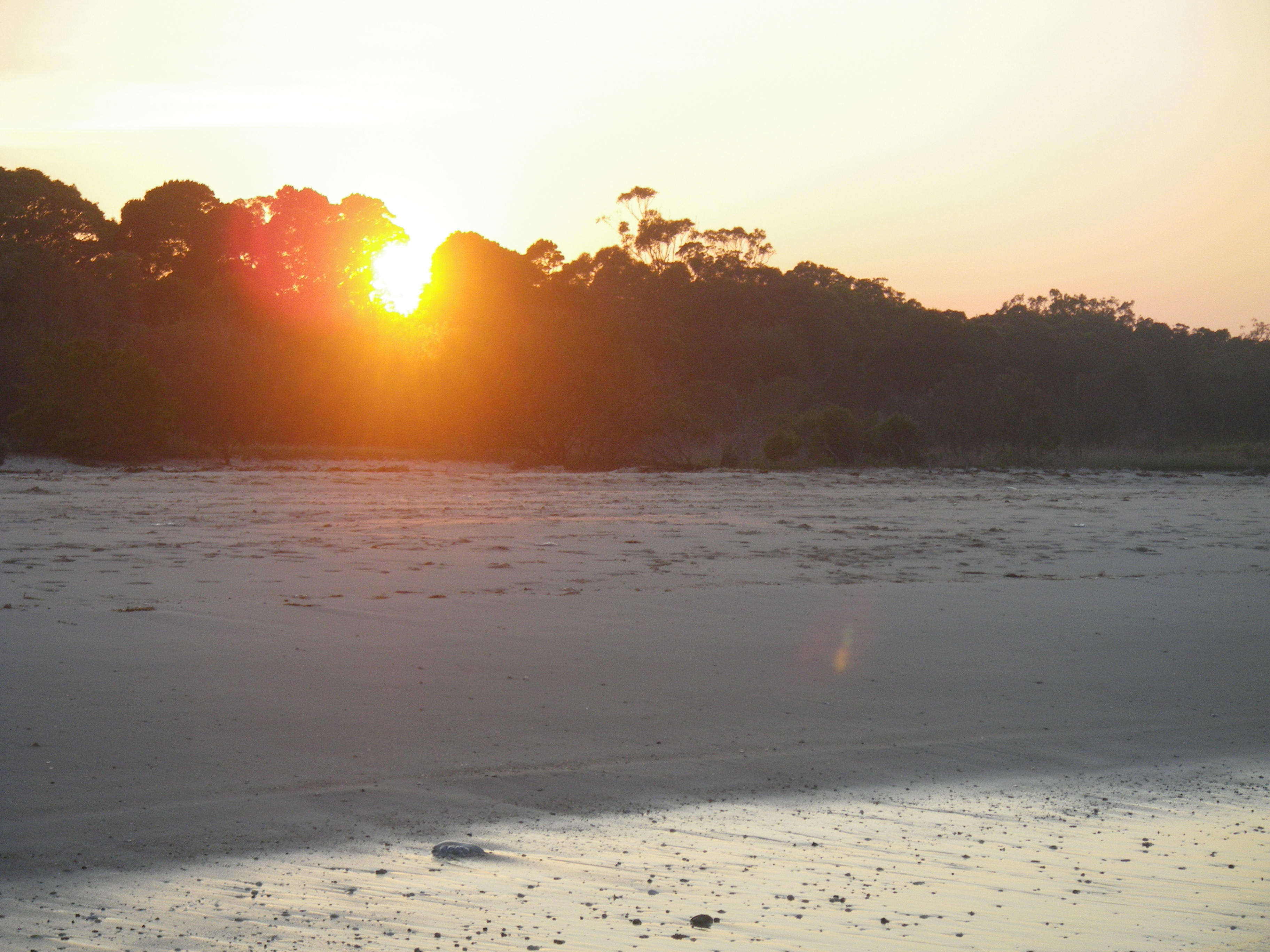
Sunday saw me back at Bongaree on Bribie Island, again. It was another morning low tide at about 7.00 am. I arrived at about 4.45 am and started fishing on the flats in front of Buckley’s Hole. The water was almost completely still and the midges were everywhere. The sun came up behind me and lit up the school of Mullet, that were finning around on the flats.

The first fish came just after the sun rose

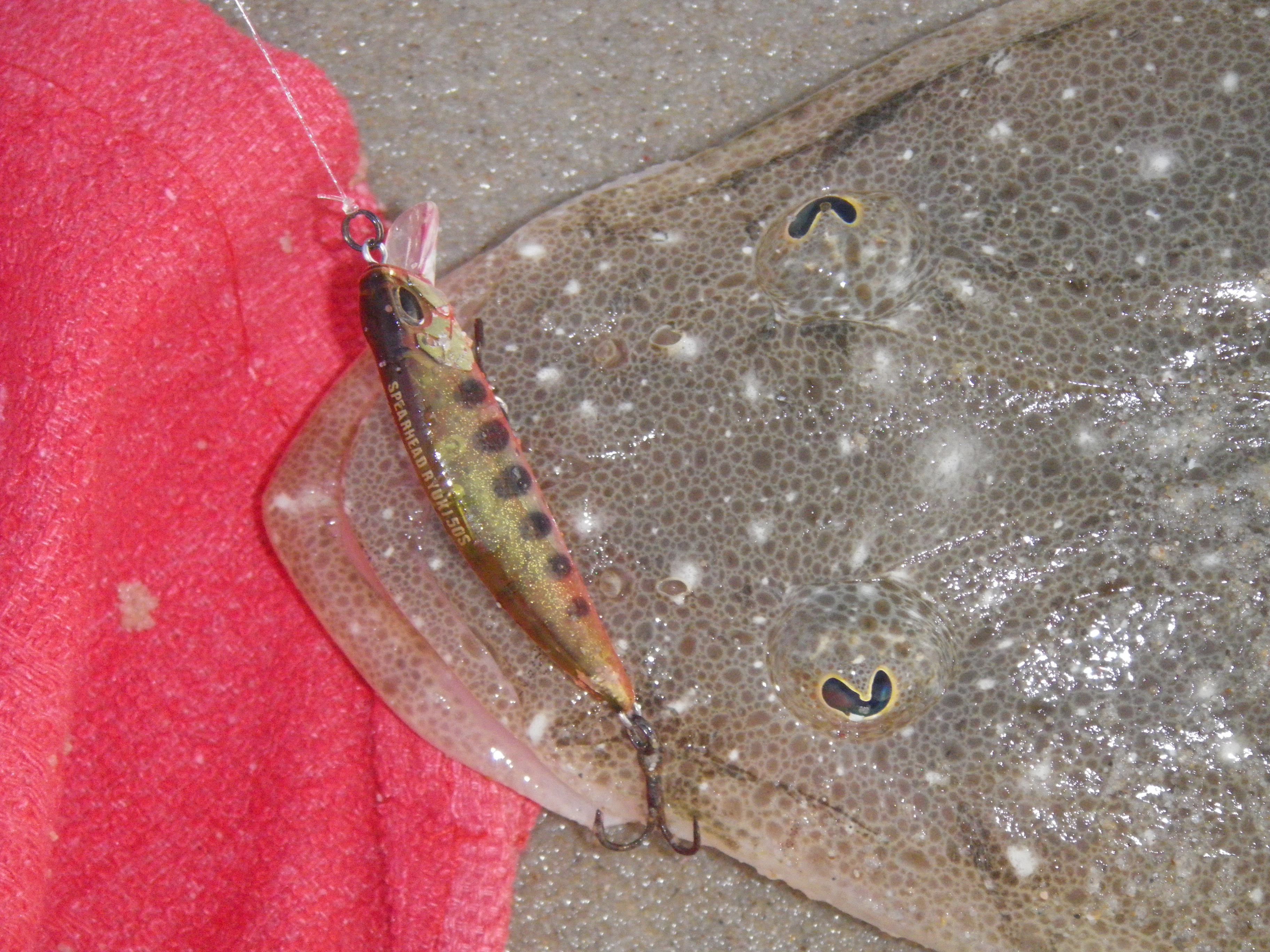
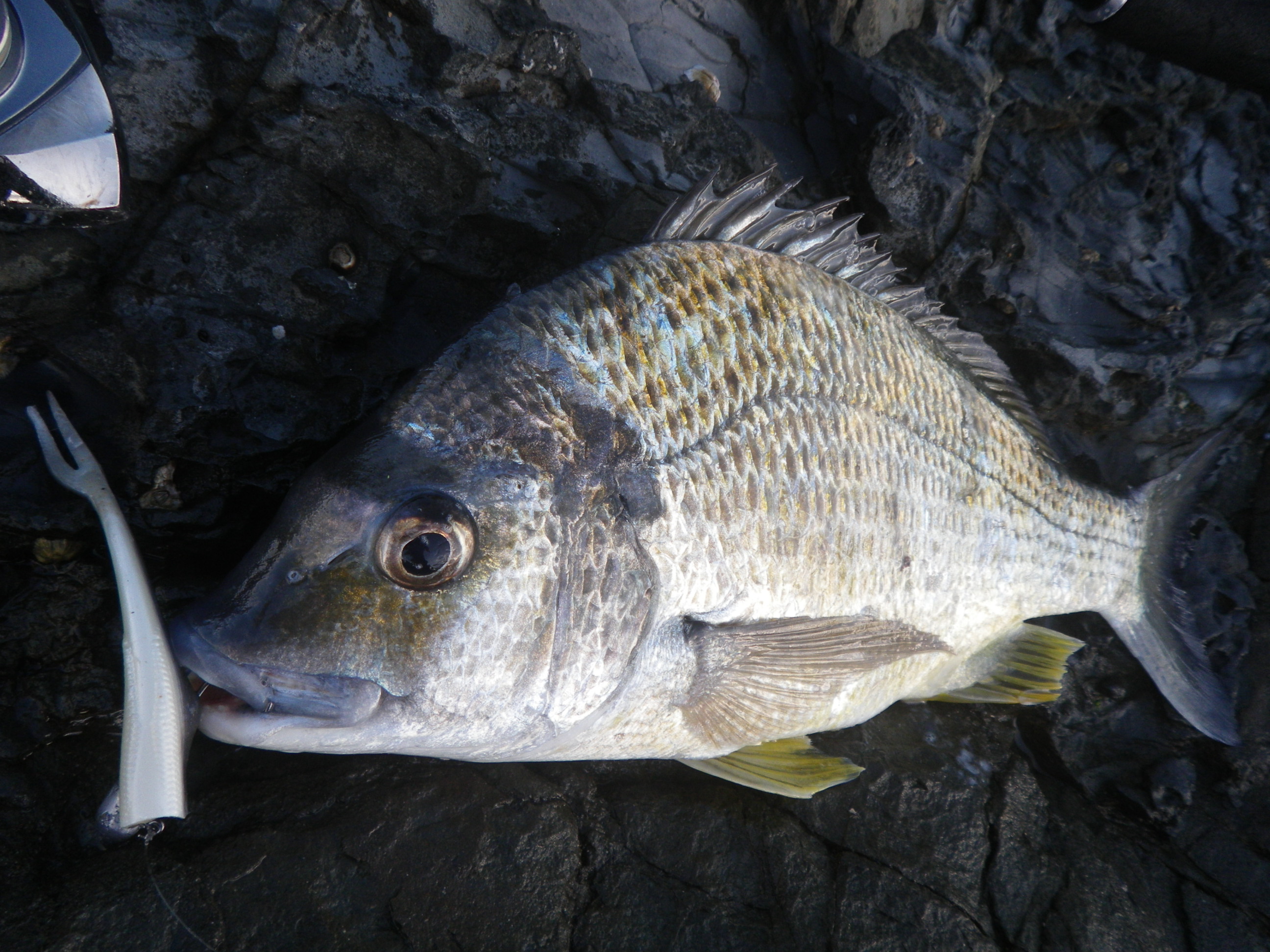
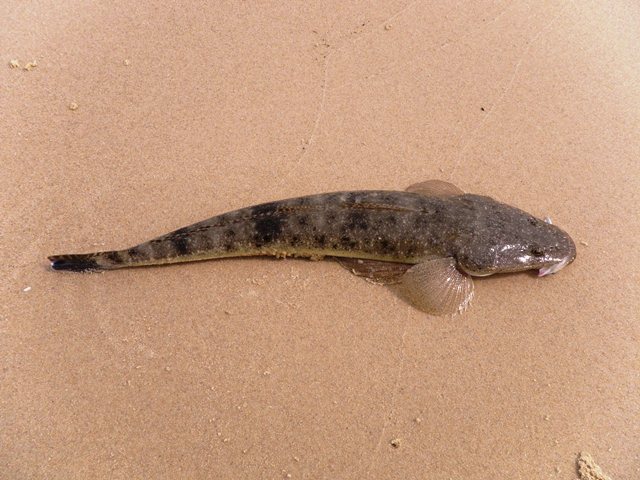
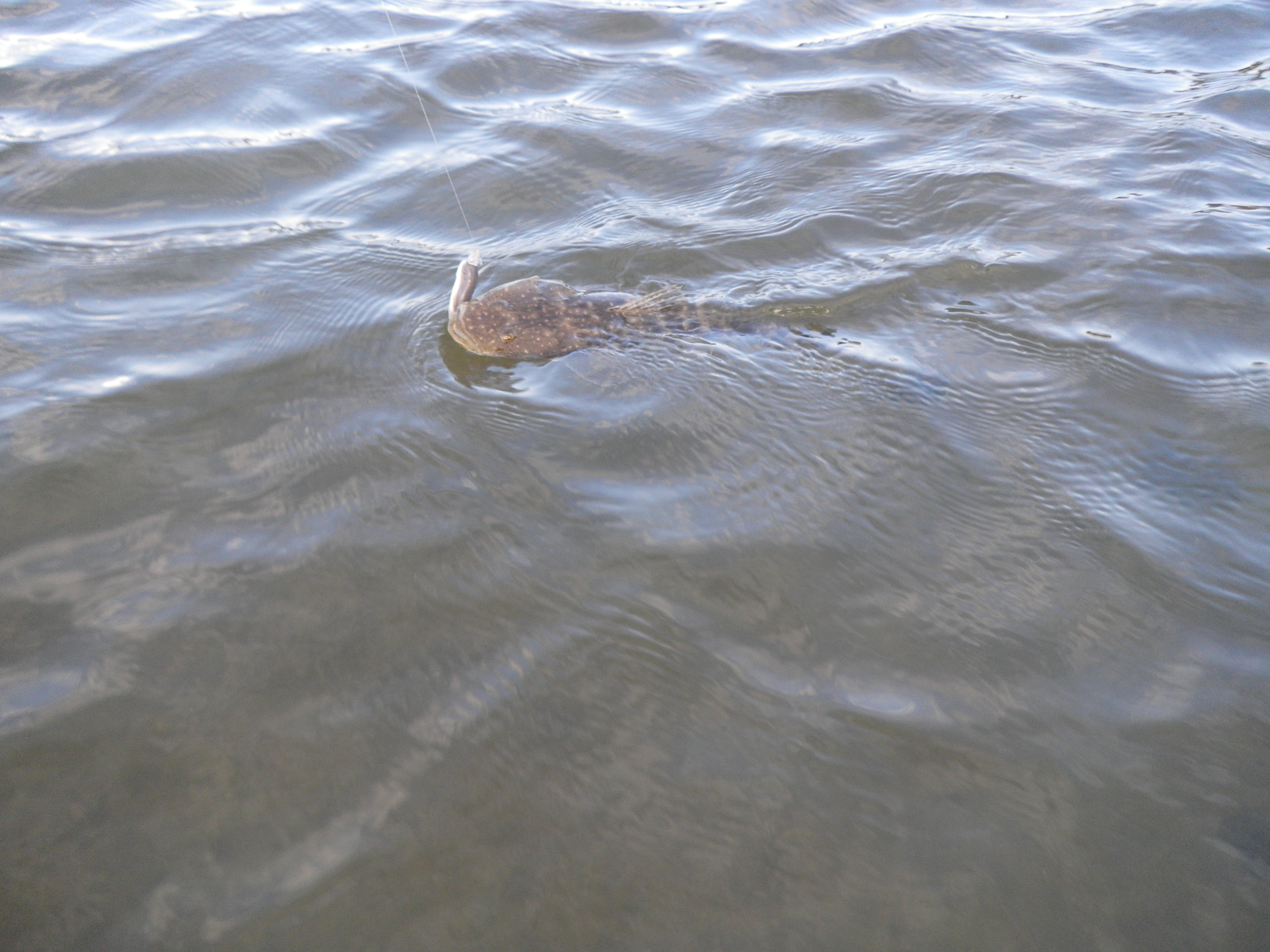
I put on another small DUO hard bodied lure – the Spearhead Ryuki 50s. This is designed as a freshwater trout lure but it will catch just about anything. It is a 50mm long, sinking minnow and weighs 4.5 grams. It has a great wiggling action and is perfect when there is no weed floating around. I cast it towards the drop off and hopped it back along the sandy bottom. After about three casts I connected with a fish. The start of the fight is often very lively with the hard bodied lure – I think the trebles are more painful when they first get lodged and the fish reacts accordingly. It settled down and after a few runs, I had it on the beach. It was a 55cm Flathead. It was just before 6.00 am.

A 55cm Flathead on the DUO Spearhead Ryuki

Kenny arrived and explained that the Jewfish had been breaking the surface to lunge into the Mullet on Saturday morning. The fish were clearly listening because about ten minutes later there was a huge surge about a metre in front of us and loud boof, as a big Jew tried to engulf a Mullet or Pike. It must have missed, as it chased the bait over the ledge and up towards the beach before turning away.

DUO Spearhead Ryuki 50S – annoys the Flathead into striking

Kenny caught some Pike on a bait jig and put one out. We saw the Jewfish repeat its bait attack about 30 metres further north. I decided to wade north and fish around the drain in front of the Seaside Museum. I picked up another small Flathead – just under 40cm. A couple of guys had landed three good ones, a little further north. There were bust ups every 15 minutes or so at various points along the ledge. The bait was everywhere and the bigger fish were making the most it.

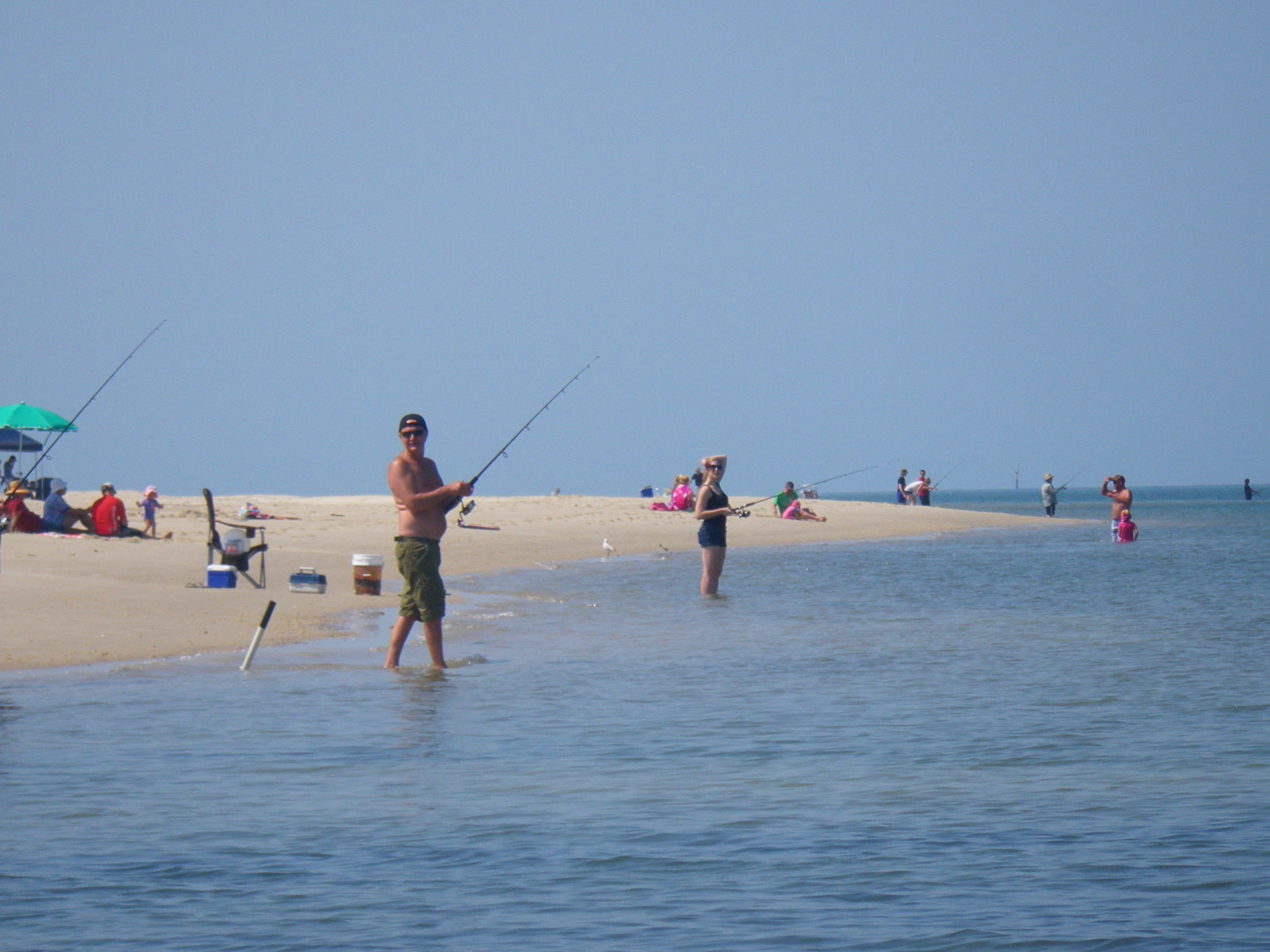
Plenty of rods in the water by 9.30 am

By 9.00 am there were rods everywhere and boats, kayaks and jet skis humming up and down. I decided to give up for the day.

Bribie Island – Buckleys Hole Flats Jewfish – 19 October 2012

Friday

Friday was a very fishy day. I drove up to Bribie and headed straight for Bongaree and the sand flats in front of Buckley’s Hole. The large amount of bait that had been hovering over the flats on Monday and Wednesday had convinced me this was the place to fish.

I arrived just before 4.40 am and it was already light enough. The tide would be a very low one again, at about 5.40am. There was no wind, although it was forecast to pick up from the north, later.

I started at the drain in front of the museum. The water was completely still and the midges were thick. I started the day with another of my favorite DUO finesse lures. A small brightly colored hard bodied bibless lure – the Tetraworks Yurameki. It weighs about 7 grams which makes it about 1/5th of an ounce and DUO describes it as a ‘sinking pencil’. I like to retrieve it with a series of hops just above the bottom, with lots of pauses.

On such a low tide the surface of the ledge was covered by only 30cm of water. At the mouth of the drain this water was very muddy, where the run out from the creek was lifting the sediment. It was in this shallow water that I got the first fish of the day on the Yurameki lure. It was a Flathead – it was just about legal size but I threw it back in hope of a bigger one.

I fished this area for a while. There were several surface bust ups and each time herring or mullet would go flying in all directions. I swapped to a GULP Jerkshad in the Cajun Chicken color on a 1/8th 1/0 jighead and started to move south along the edge. I caught a few Pike in front of the car park, by the tidal lagoon but things went pretty quiet, as the tide slowed and turned in.

By about 7.00am I had reached the new opening at the southern end of the tidal lagoon. I was sure there would be Flathead around the drop off here. The water was clearer so I decided to swap to a 2” GULP Shrimp in the Banana Prawn color. I caught a good size Pike and offered it to a fisherman soaking a Pilchard nearby named Kenny. He put it out on three good sized hooks and we swapped a few fishing yarns.

I cast along the top of the ledge, into the run in tide and hopped the lure across the bottom, back towards me. On the third cast the line came up tight on a Flathead. It was just too small to keep – a little under 40 cm, so I let it go. A few minutes later I caught another in the same spot – this one was about 43cm, so it went in the bag. I swapped to a bigger GULP Jerkshad in the Cajun Chicken colour and caught three more Flathead about the same size, from the same location.

I swapped to a brighter coloured Satay Chicken Jerkshad and immediately lost the tail to what I think was a small Tailor. I cast out another and this time I landed a keeper size Tailor. Kenny had just pulled in the Pike. It had a chunk out of its tail and had been sucked clean of scales, like a lollipop. We decided the small Tailor would make a good replacement. Hooked through the nose, back and tail, out went the Tailor.

I carried on fishing with the Jerkshad and caught three more Flathead. I added the first to the keeper bag and released the others. A big mullet school was finning around, sometimes just on top of the ledge and sometimes out over the deeper water. Every now and then there would be a swirl and thrash, as something attacked from below.

The Tailor was still kicking then Kenny pointed to his rod tip which was slowly bending over. There were a couple of slow lunges as the fish mouthed the bait. Kenny waited patiently for a few moments. The fish started to pull and he let it have a bit of line, then he struck. The initial run was slow. Perhaps the fish had not realised it was hooked. Then, as it noticed there was a problem with its latest meal, it powered up and started a serious run. This was a big fish but Kenny’s gear was a match for it – good hooks, good knots, a big spool of solid braid and a 50lb leader. He tightened the drag slightly and settled in. Every time he applied pressure the fish did the same and initially it looked like stalemate. Then he started to get back some line and slowly, moved further north, where the drop off is smoother and sandier.

All this had happened in the space of about 4 minutes but it felt much, much longer. Now Kenny was making steady progress but as soon as the fish saw the ledge it put in another blistering run. We still had no idea what it was. It had been so slow initially that I had thought it might be a ray or shark but its subsequent runs had convinced me otherwise.

Kenny stayed calm and got the fish back to the ledge but it was not interested in coming over the top. On the third attempt we saw a great flash of silver and realised it was a big Jewfish. Kenny kept the pressure on. He got it over the ledge and walked slowly backwards towards the beach. The fish still had plenty of kick in it and there was some serious thrashing as it was pulled through the shallows to the sand. The whole process had taken about 8 minutes from start to finish.

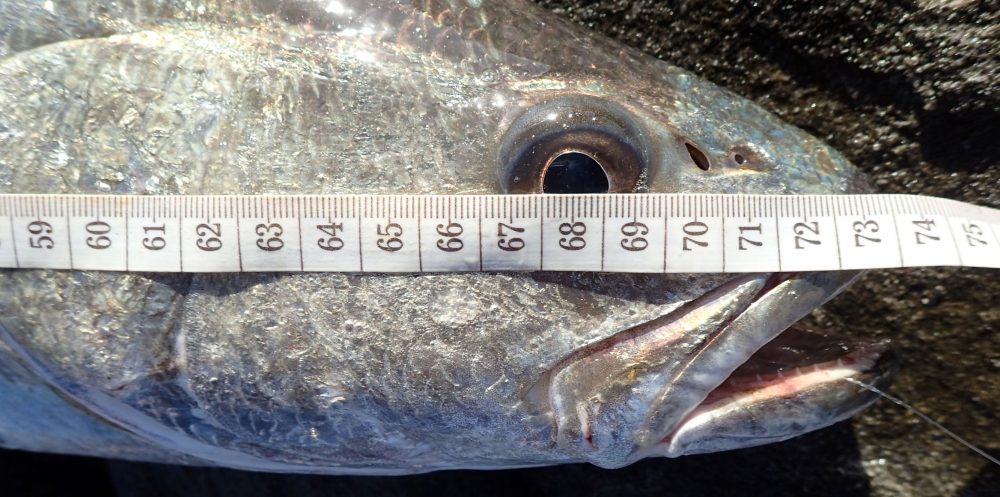
It was a beautiful Jewfish that later weighed in at 13kg but looked a good deal fatter than that, lying on the beach. Kenny was stoked and I was delighted to have witnessed the capture. Hands shaking and hearts racing we took photos and then he set out to show the beast off. There is nothing better than converting small fish into big ones.

I had my bag of five Flathead but I carried on fishing for a while. I found a couple more small Flathead. As I was wading back north to the car I saw Pike flying everywhere then clearly saw a good sized green backed Mackerel chasing them up into the shallows. Before I could cast at it, it was gone. It made several more passes causing chaos amongst the bait schools, but it was moving too fast to target.

At about 9.00 am I decided to get the Flathead to the esky. It had been a very fishy day!
Bribie Island – The Oyster Jetty flats – 15 October 2012

Monday

A week away from fishing is far too long. I had time for a quick fish on Monday morning, so I drove up to Bribie at about 4.00 am and arrived just after first light at about 4.50 am. The tide was coming in. It would be a 2.3m high at about 9.00 am. The wind was forecast to be a southerly but it seemed to be a cool south-westerly.

A quick look at the flats on the mainland side of the bridge showed that I would be able to fish along the edge of the weed banks, to the south of the (newly repaired) Oyster Jetty, for an hour or so, as the tide came in. It is nearly new moon so it would be coming in fast.

The tide would run in fast


I was fishing with my Loomis GL2 light spin rod again. Unfortunately there was plenty of snot weed around, especially close to the jetty. I started with a 1/8th 1/0 jighead and a GULP 5” Jerkshad in the Curry Chicken colour (red and yellow). I had a 12lb leader on, in case I came across any Tailor. The water was warm but the wind was cold.

The grey cloud masked the sunrise


The Loomis lets you feel everything the jighead touches and it took some time to get used to it. After a while, I could tell that the difference between a nibble and a jighead stuck in the weed again. Then, about 50 metres south of the jetty, just before 6.00 am, I had a solid bite and the line pulled tight. I was too eager and wrenched up the rod tip, pulling the jighead out of the fish’s mouth. Patience, patience – sometimes you have to go back to the beginning and slow everything down. If it was a Flathead, it was probably still there, or one of its friends was. I cast back in the same spot and after two hops I felt the faintest of bites. I dropped the rod tip and counted slowly to 10, then lifted it sharply. I had it this time. It was a small Dusky Flathead – just about 40 cm long. I let it go, hoping the fishing Gods would reward me with a better fish.

Back amongst the Flathead


Suddenly, there was a big surge about 10 metres away to the north and the baitfish went flying everywhere. Then there was another, about 5 metres further away. I wound in furiously and hurled the plastic in the direction of the splashes. It went quiet for a few minutes and then the same thing happened to the south of me. This time I saw the broad shoulders of a good size Tuna as it smashed into some Herring. I cast where I thought they were travelling but again I could not tempt them – they were moving too fast.

Swallowed that

I carried on casting around for Flathead, walking gradually further south. At about 7.30 am I was considering giving up when there was a swirl a few meters in front of me and another bait spray. Then I saw a good size Tuna coming right for me. I thought it would hit me but it swerved at the last minute and the small school flashed by, on either side of me. I was wading in just over a metre of water.

I have hooked Tuna from the rocks and beach but I have never landed one – so this got me really fired up. I have to get back out again soon with some heavy gear and bigger lures! Watch this space
Brooms Head Tailor – 29 September 2012

Thursday / Friday / Saturday

On Thursday I was still at Brooms Head and the northerly wind was forecast to blow hard. This had the advantage of flattening out the sea and, on the southern tip of the headland, you could still fish in the morning.

I started at about 5.15 am, just after first light. I had a look at the Bream spot. The water was not washing over it but with high tide just after dawn it was a bit too dangerous – a rogue wave could easily turn up and leave me soaked, if not worse. I cast a few soft plastics on the inside of the razor back but and lost a few tails but did not hook up with a fish.

The difference however, was the bait. Everytime the lure hit the water, in close to the rocks, bait would go flying everywhere. I thought there might be some Tailor around and another guy confirmed it by catching a 40cm Tailor, on a 65g Raider, on his first cast of the day.

I quickly swapped over to a DUO Tide Minnow in the purple colour, which has caught plenty of fish for me. After a few casts, I came up tight on a small Tailor – around 40 cm. I brought it into the rocks, but I was too keen, with the Catana light rod and I pulled the treble out of its mouth, just as I was about to lift it up.

I carried on casting and the bait kept scattering. A couple of times I even speared a baitfish with the DUO Tide Minnow. I carried on until about 8.30 am when I lost my beloved purple Tide Minnow to a rock. I gave up and vowed to come back the next day.

The northerly had been blowing powerfully all night on Thursday and it was still going on Friday morning but the south side of the Brooms Head platform remained sheltered and if anything, the swell had eased a little. I put on a GULP 4” Minnow soft plastic in the Smelt colour and cast out next to the ‘razorback’. There was still plenty of push around the rocks so I swapped from a 1/8th 1/0 jighead to a 1/6th 1/0 jighead and cast out again. This did the trick and I soon had another good 32cm+ Bream at my feet. The tide was coming in so I decided to retreat and try casting a few slugs around. I had heard that someone had caught a couple of Kingfish the day before so I was keen to try for one.

I cast a few forty gram slugs and hard bodies and felt a few hits but I could not hook up. The bait was still there, but it was more patchy, hanging around close to the bommies. I think a forty gram slug is about the limit of the Catana’s casting capability and I doubt it would be able to subdue a Tailor or Salmon over about 45cm.

Saturday was my last morning and I was hopeful that the bait would bring in some bigger predators. I decided to try bigger slugs and use the heavy rig, 9’6” the Daiwa Demon Blood with the Shimano Stradic 8000. I found the Tailor but unfortunately they were all about 25cm long. I caught fish after fish on a whole range of slugs but they never got any bigger. Finally I threw out a GULP Jerkshad on a 1/6th 1/0 jighead and it was monstered close to the rocks. The fish took off on a solid run but then suddenly it was gone – it had spat the hook. That was it for the day.

I feel I am gradually getting to know this spot. Who knows, in 20 years I may have mastered it.

Brooms Head – 25/26 September 2012

Tuesday/Wednesday

At Brooms Head on Tuesday morning the wind was up from the south east and so was the swell. I could not reach my Bream spot without risking my neck and I was not prepared to do that – especially when there was plenty of fish in the fridge.

Because of the wind and swell I had to switch to a ¼ oz 1/0 jighead. I put on a GULP 4” Minnow in the Smelt colour. I managed to put a few casts out from the top of the ‘Razorback’ towards the Bream spot and after losing a few jigheads, I did hook up with a nice 30cm+ Bream, but the wind and swell made it really difficult to fish and at about 8.00 am I was forced to give up.

The Bream were still there but hard to reach

On Tuesday night we had a thunderstorm and the swell and wind was still up on Wednesday morning. It was a solid south easterly wind. I walked down to the ‘Razorback’ but there was no point fishing. The waves were crashing over the top of the rocks and the whole area was covered in white water. I watched the surf for a while and then decided to head home for a hot cup of tea.

On Wednesday it was just too hard

Brooms Head – the Lagoon ridge – 22 September 2012

Saturday

It was on to Brooms Head in Northern New South Wales for our family holiday. Fortunately this represented another fishing opportunity. I have fished here a few times and never found it very easy. The terrain looks incredibly fishy but it often fails to deliver. It is also a very exposed stretch of coast, so the swell can make things tough.

Now September can be particularly tricky when fishing from the rocks. The wind keeps changing around and the water can be cool and clear or brown and dirty (if it has rained a lot). Fortunately it was cool and clear at Brooms Head. But it was so crystal clear that it would be difficult to fool the fish.

I started on Saturday morning trying to fish the mouth of the lagoon on the north side of the headland. I say trying because the north easterly was producing enough chop to give me a good soaking every 10 minutes or so. I was fishing with the Shimano Catana Coastline light rod with the Shimano Stella 2500. I soon swapped from hard bodies to soft plastics and from 20lb to 10lb leader.

This slideshow requires JavaScript.

I was fishing with a 1/8th 1/0 jighead and a GULP 2” Shrimp when I caught the first fish. It was sitting right in the mouth of the lagoon – a Pike – followed by another, on the next cast. I threw them back and then cast out a bit further. I lost a few jigheads to the rocks and then re-rigged with a GULP 3” Minnow in the Lime Tiger colour. I cast close into a bommie and let the lure sink. It was hit hard by a small angry Bream. It was about 25cm but would not be much of a meal so I threw it back.

At about 8.00 am I was soaked through, cold and no longer getting any bites so I gave up. A few fish, but not a very promising start.

Hat Head – ‘The Death Hole’ & ‘The Island’ 20 September 2012

Thursday

Hat Head was turning into a Jewfish expedition. Apart from a single Trevally, I had caught only Jewfish. On Thursday, I was determined to explore some different spots around the headland and hopefully, catch some different species. There was distinct lake of bait around and the water was very cold, perhaps this was making it hard to catch anything else.

I started at the Jewfish spot (could not resist), at dawn. This produced nothing but I did watch a small pod of Tuna swim by just after dawn – of course, they stayed well out of casting distance. By 7.00 am I had not had a bite. The wind was a light northerly so I decided to take the track over to the other side of Hat Head and have a look at the ledges around ‘the Island’.

The Island is on the eastern side of the headland and is reached down a steep path. It’s logical to fish this side during strong northerly winds, as it is sheltered. You can walk across a sand spit to reach the Island at low tide but by the time I arrived it was the second half of the run in tide and I could not get out to it.

There are rock ledges, channels and drains all around. They looked like they would all hold fish but, try as I might, I could not get a bite. Admittedly, it was neither dawn nor dusk but I was really surprised that there was nothing around.

I carried on to the rock ledges around Connors Beach and fished the one known as ‘No.1’. This also looked very promising but produced nothing. After wandering around all day, I had nothing so I marched back to the Jewfish spot, in time for dusk.

I arrived about 5.00 pm. I had the heavy rod this time and was fishing with a GULP 4” Pearl Watermelon Minnow on a ¼ oz 2/0 jighead. I was using 20lb fluorocarbon leader. I fished for half an hour with no result and then, right on 5.30 pm, I felt a solid bite. I paused and then struck and there was a fish on the line. I played it out and pulled it round to the easier landing point, at my feet and gently pulled it up the rocks. It was another keeper sized Jewfish – about 60 cm long. There was enough in the fridge, so I released it. I fully expected a few more, but that was it, all over. I fished on for 45 minutes, until it was completely dark and tried a range of soft plastics without another hit.

I had wandered around fishing from dawn to dusk for only one fish. It appears I could have rested my weary legs and just fished half an hour at dusk, to achieve the same result. But that is how fishing works, you put in the hours of exploring so that next time, you will have more idea of where to fish and when to fish.

I fell into bed after a shower, a few Jewfish fillets and a mug of red wine. Only one fish but that is all you need sometimes.

Bribie Island – White Patch & Bongaree – 10 September 2012

Monday

I promised to take a friend fishing and introduce him to soft plastics on Monday. Unfortunately the weather was far from perfect and we arrived at Bribie to find the wind blowing from the south-east at about 15 Knots.

I decided to start at White Patch, as it is sometimes just a little less exposed to the elements. I showed my mate the basic plastics rig and set him to work with a 3” Minnow in the Smelt colour. I started with the same.

Why is it always so bloody hard to catch a fish when you need to? I tried all the usual spots and swapped through a load of different soft plastics. I don’t think I managed to prove it was worth getting him up at 4.00 am by catching one small Pike in 3 hours.

The wind did drop off a little, so we moved down to Bongaree to fish around the Seaside Museum drain until low tide. This was a bit more exciting as after about 20 minutes there was a big swirl and splash in between us, as something slammed into the bait just in front of the drop off. This process was repeated every few minutes, as whatever it was moved up the edge, heading north. The angler a bit further north, thought it was a small group of Tuna – difficult to say, as I did not get a look.

Whilst it made interesting viewing I still had not caught anything and nor had my mate. I was about to give up when I felt the solid ‘thud’ of a Flathead. In the end he had grabbed the lure I had started the day with – the GULP 3” Minnow in the Smelt colour. It was a decent fish – approximately 50cm long and it was immediately donated to my patient, but cold, fishing guest.

Finally a fish

At about 10.30 am we gave up – I take my hat off to fishing guides everywhere – and will not be calling myself a ‘Gillie’ any time soon.

Fingal Head – Tailor, Bream, Dart, Dolphins – 5 September 2012

Wednesday

A duck on Monday, but I was having fun and close encounters with fish are better than no encounters with fish. So on Tuesday night I could not sleep and I was up at 3.30 am, Wednesday and back in the car, driving down to Fingal Head.

I arrived about 4.45 am, loaded up and walked out, onto the rocks to the usual fantastic view. The wind was a north westerly, as forecast. It was less than 10 knots when I arrived and stayed very light through the sunrise, as it often does. The horizon was bright orange by 5.10 am and there was plenty of light to rig up in. I had my usual heavy spinning rig; 9’6” Daiwa Demonblood rod, Shimano Stradic 8000 FJ reel, 30lb braid and 30lb fluorocarbon leader. The tide had just turned and was running in. It would be high just after 11.00 am.

There was to be no messing about with the poppers this morning – we needed a fish for dinner. I decided to stick with what had been working – the DUO Beachwalker MD 120 hard bodied, shallow diving minnow. I have lost a few of these recently and only have two more in the box, so I tied it on very carefully.

I moved round to the eastern edge of the platform and cast out towards the south east. The water was foamy but clear. The sun was not yet over the horizon. I put in about 30 casts with no result. I moved around the platform, casting in every direction. Finally, just as the sun was breaking the horizon, I was back where I started. I threw out another long cast. I retrieved it slowly, with 5 second pauses between jerks of the rod. About 3 metres out, I felt the solid tug of a fish and then line was peeling. After a few runs the fish jumped and I could see it was a Tailor, I brought it to the foot of the eastern side of the rocks and grabbed the leader. I had changed all my split rings for tougher models and there was no problem lifting the fish up the rocks. It was a fat 48cm Tailor – dinner was secure.

I carried on with the same lure for another hour with no luck. The dolphins arrived in a pod of 10 and did a bit of surfing but then just sat about 40 metres off the rocks – ready to intercept any unlucky fish that passed by. I saw another small school of Tailor swim by – perhaps 10 or 12 fish, but I was re rigging at the time so did not get near them. I tried slugs and big and small soft plastics but I could not get any more interest.

I decided to move a little further to the south side of the Fingal headland. The sun was now high in the sky and it was just after 9.00 am. The wind was now blowing about 20 knots from the north but this side of the headland was fairly sheltered. I swapped over to my Shimano Catana Coastline Light 3.2m 3-5kg rod to which I attach a Stradic 3000 reel. This is a great rod for casting lighter lures – particularly from the beach. The water was crystal clear and the swell was crashing against the barnacle covered rocks. With each surge I could see plenty of bait, close in to the rocky edge.

I decided to try one of my smaller DUO lures; the Spearhead Ryuki 45S. This is another perfectly crafted small sinking lure for bream, bass, trout, etc. It is ideally suited to Australian estuary fishing. It has quite a thick, solid shape and a very tight action. It weighs just 4.0g and is 45 mm long. Like all the DUO lures it casts very well. It is just about robust enough to throw around with the lighter Shimano Catana rod.

I cast it out parallel with the shoreline, counted to ten, to let it sink. The water was clear enough to see a steady procession of bait fish following behind it, on each retrieve. After about five minutes the line pulled tight and there was lunge. I had caught a small Bream – and yet another DUO lure had scored for Landangler. I caught two more using a similar technique but they were all around 25cm, so I let them go. I made a mental note to try the Spearhead Ryuki 45 out on the Flathead and moved further along the rocks.

There was a big group of birds working about 800 metres off shore – they were very slowly moving towards me but they never got close enough to cast at. The Dolphins took up residence between me and the birds, just to make sure I had no chance.

I swapped to a small GULP soft plastic 3” Minnow and threw it around in the wash, on a 1/8th 1/0 jighead. I lost the tail after a few casts and put on another. A fish grabbed the new plastic almost as soon as it hit the water and took off. It was not big but it was fast. After a few pulls it settled down and I pulled a 35cm Dart out of the water.

By 11.00 am it was time to get the Tailor on ice, so I packed up. It had been an interesting morning and once more the DUO range had delivered. Northerly winds rarely leave me with a great fishing experience but this morning had been ok. It would appear that the real bite is only between about 5.00 am and 7.00 am, at the moment – so if you want to catch them, get used to no sleep!!

Fingal Head – Popper Frustration – 3 September 2012

Monday

Friday had wet my appetite and I still had a load of new lures I wanted to experiment with. So on Monday, I chose Fingal Head again. I was hoping to find the Tailor, once more. We are back at that time of year again – the sun is coming up sooner and the starts are getting earlier. To get down to Fingal Head, from Brisbane, for a fish at first light, you need to wake up at about 3.45am – that’s early, even for me.

Bit lively at Fingal Head

It was now three days on from full moon. Low tide had passed at about 4.00 am and I arrived just before first light at about 5.10 am. There was a light southerly breeze blowing as I safely crossed the causeway on to the rock platform. I love fishing with poppers and I don’t often get the opportunity. This morning looked good so I tied on my favorite – the 110mm River to Sea Dumbell Popper in a silvery colour. I have yet to find a popper with a better action than this one. It only weighs approximately 30 grams but its casts beautifully. I have tangled with plenty of Trevally, Tailor and Kingfish on this lure. I have not landed many fish on it because when it does entice a strike – the fish is often too big to subdue from the rocks.

Tailor like the rough stuff

I started casting to the east and after a few retrieves I saw a big bow wave behind the popper and then some serious shoulders broke the surface. It looked like a big Tailor but it could have been anything. It didn’t strike. I cast out again and this time there was a boil and a splash as a good sized Tailor narrowly missed the lure. A few casts later, another big fish knocked the popper clean out of the water and then another tried to hit it in mid-air, but no hook up. Exciting stuff – but I had not connected with a fish.

Crystal clear water at the moment

After another 15 minutes without a hit, I swapped to an 85g Raider metal slug, but got no interest. I then worked my way through the DUO hard bodies but also could not raise a bite. By 6.00 am with the sun now blazing and the wind picking up – the action was finished. I fished on with soft plastics and every other lure in my tackle box but the fish did not come back. At about 11.00 am I had to admit defeat and record a duck.

Fingal Head – Tailor – 31 August 2012

Friday

It was time for a change of scene. Despite the clear sunny days the water is still very cold. I wanted to give the waders a rest and fish from dry land. It was full moon and I had heard a few reports of decent Tailor on the Gold Coast beaches. I looked at wind and tides and thought the rocks around Fingal Head would be as good a place as any to try. The wind was forecast to blow hard from the south and then drop off for a few hours around dawn. High tide would be at 8.00 am.

I arrived just before first light and walked across the causeway on to the main platform. There were a couple of keen anglers already in position. But no-one had landed anything yet. Now the good folks at DUO lures sent me a great selection of big hard bodied lures to try out. On recent trips, conditions have not been right for them, but I have been itching to get them in the water. This morning looked perfect.

I started with the Beachwalker Vib 100. This is a 100mm sinking vibe lure with a very tight action. It casts like a bullet and weighs 21g. I had the Chigamori Sardine colour (silver/blue). I was fishing with my heavy rock fishing rig. The reel is a Shimano Stradic 8000 spooled with 30lb Platypus braid and a 30 lb fluorocarbon leader. The rod is the 9’6” Daiwa Demonblood. This rig is great for throwing lures from about 10g to 85g, from the rocks. I cast the Beachwalker Vib 100 and let it sink, a little. I took up the slack and retrieved the lure in short jerks, to get the most out of its tight action.

The sun was about to come over the horizon and I felt the lure get nudged a couple of times. I moved round from the eastern side to the northern side but kept casting parallel with the edge of the rock platform. There was not much swell but the wind was picking up fast from the south and this was creating plenty of foamy water, at the base of the rocks.

I had been casting for a good half an hour and the arms were getting tired. Then, suddenly a fish slammed the Beachwalker Vib about three metres from the rocks and took off. It’s been a while since I tussled with a Tailor and there is plenty to remember, especially when trying to land them from the rocks. Perhaps the most important thing to keep in mind is that Tailor have soft mouths, so you need to apply constant but steady pressure. If you lock up the drag and try to use brute force you will just pull the hooks out. But you must balance this slow and steady approach with the need to get the mad, leaping, head shaking fish out of the water, before it snaps your line on the rocks or shakes itself free. Both trebles on the Beachwalker Vib 100 had lodged in this fish so I did not have too much trouble. I gradually worked the fish to the base of the rocks and then grabbed the leader. It was a 44cm Tailor. I bled it and then started looking for another.

After a few casts I lost the Beachwalker Vib 100 to a rock on the bottom so I had to try something else. One of the other fisherman had just caught a slighty bigger tailor on a 45g slug. I looked at my DUO selection and decided to stick with the DUO Beachwalker range. I pulled out the Beachwalker 120 MD. This is essentially a sinking Minnow designed to swim about 1m below the surface. It has three trebles, weighs 21g and is 120mm long. It is specially designed with internal Tungsten weights to cast well in windy conditions. It proved itself immediately as I cast it directly into the southerly wind that was now up at about 20 knots. It travelled almost as far as 60g slug would have. I had chosen a rainbow coloured model with a red belly, black back and just about every other colour down the sides.

I moved around to the northern edge of the platform to get out of the wind. I cast around without success so I decided I would have to brave the wind on the eastern edge. I moved over and cast to the east. The lure shot straight out into the wind. DUO had sent the lures without hooks so I had added the split rings and the trebles. I felt a solid hit and the fish was on for a while then it was gone. When I pulled in the lure, the middle treble was missing. I checked the split rings and realized they that I had put on some lightweight, Force 10 ones. The Tailor had just pulled the treble off the lure buy straightening the ring. I did not have replacements so I carried on. On the next cast, the fish hit the lure a few moments after it hit the water. It was another Tailor, about the same size as the previous one – about 45cm. I played it carefully to the rocks and pulled it clear of the water. The trebles had held but the split rings were starting to stretch.

The rough water on the eastern edge seemed to be where the fish were. I cast slightly south-east and could see the dark silhouette of the lure wobbling its way over the sandy bottom. I repeated this trajectory about 4 times and then, about 5 metres from the rocks I saw three fish swerve up to attack the Beachwalker 120 MD. One connected and I was on. This was a bigger fish and the swell and steeper rocks on this side of the platform made landing it more difficult. I got it to the foot of the rocks but as I lifted it, by the leader, another of the split rings gave way and it dropped down into a crevice. I grabbed it through the gills and got a knee full of barnacles, as I did so.

This was the best fish of the day at about 55cm. The wind was now howling and the Beachwalker 120 MD only had one treble left on it so it was time to give up. The DUO lures had performed well. They are superb quality and really do what DUO say they will. They seem to consistently catch fish for me so I would not hesitate to recommend them. I see they are now appearing on the shelves in many more tackle stores in Australia and a few online retailers are also stocking them. If you want to know more about the range – contact Steve at sales@swldistributions.com.au.

I went home to nurse my knee and change the split rings on all my DUO lures (my fault, not theirs). It had been a great session and I will be back for more soon.

Caloundra – Gemini Towers sand flats – 27 August 2012

Monday

The forecast was for wind and that’s what we got. I decided to try the flats at Caloundra to avoid the worst of the blow. I arrived just after first light at about 5.45 am. I was struck by an icy blast as soon as I got out of the car. It was a north-westerly wind and probably blowing 10 to 15 knots already.

Cold and breezy on the sand flats


I rugged up and waded into the shallows in front of the Power Boat Club. The water was really cold and felt colder because of the westerly wind chill. I was fishing the run out tide. Low would be at 10.20 am. I started by fishing all around the weed beds with a GULP Jerkshad in the Cajun Chicken colour on a 1/6th 1/0 jighead.

Permanent fixtures


This did not produce anything so I switched to a GULP 4” Minnow in the Smelt colour. I kept fishing with this one and after about 30 minutes I felt a solid bite but did not connect. Next cast I hooked up. Mad head shakes and skittering runs – it was a Tailor. Now I was stuck – I caught sight of the fish it was a decent size – about 45cm, but I was a good 35 metre wade from the sand. I loosened the drag a little but the 10lb fluorocarbon leader was not going to hold and about 10 metres into my walk the leader snapped and the fish was gone.

I changed directions and started wading over the weed beds in front of the Gemini Towers resort. I was seriously cold now but the loss of the fish had annoyed me too much to allow me to give up, just yet.

It took a while


This area was a little more sheltered from the wind and the recent weather has hollowed out a nice area full of weed on the edge of the channel. I was casting over into the channel and pausing just at the weed edge. This eventually produced a 45 cm Flathead. I caught a few more, smaller Flathead, a bit further along. The wind was howling and I was too cold so at about 10.30 am, I gave up.

Hard work

Bribie Island – The Seaside Museum drain – 24 August 2012

Friday

The wind is starting its undecided phase with a big northerly blow predicted for Friday afternoon. Friday morning looked ok, so I decided to revisit my favorite Bream location – Bongaree, on Bribie Island.

In years gone by, the Bream have shown up along the coffee rock ledge that runs along the edge of the Pumicestone Passage. They have often schooled up to spawn in the areas around the mouth of the tidal lagoon, in front of Buckley’s Hole. Typically, the best time to chase them has been either side of the new moons in July and August. Sometimes they are also around in June and September, depending on the water temperature.

The GULP 3” Minnow or 2” Shrimp have always been my favorite soft plastic lures for Bream. I prefer the more natural colours. When I am fishing the rocky headlands, I have caught plenty of big Bream on Jerkshads and other big soft plastics, but in the estuaries these fish can be fussy.

I started just after first light at about 5.45am. I was in front of the Seaside Museum again. The tide was running out and would be low at 7.45 am. This is the perfect time to fish this spot. I stopped about three metres from the drop off and cast over it, to the north. I was fishing with my light spin rig, with 10lb fluorocarbon leader and 1/8th, 1/0 jighead. I thought there might be some Flathead around so I had chosen a compromise soft plastic – the GULP 4“ Minnow in the Smelt colour. Big Bream should still be interested in it and if I passed over any Flathead, they would also go for it.

I counted to ten and let the lure sink. I am not sure how deep it is here but I would guess no more than 2.5 to 4 metres, in most places. The first couple of casts produced nothing and then the dolphins swam buy. It is always a pleasant sight but I presume the fish head for cover. About twenty minutes later there were some surface bust ups and just as I pulled the lure over the top of the ledge, there was a fast snatch and I was on. Playing fish here is tricky. It’s best to get close to the edge and play them out in the open water. If you have to hall them over, you risk sawing off your leader when they lunge back down, close to the edge.

This was a good Bream – 32cm and I pulled it safely onto the sand. I waded back out and cast over the edge again. The lure was hit on the drop but the mad head shakes meant it was not a Bream or Flathead. A few moments later I pulled a 35cm Chopper Tailor onto the sand. I fished for another 30 minutes with a few bites but no hook ups.

The wind, a north westerly, was now picking up. I moved to the south of the lagoon mouth and tried a few different soft plastics. I swapped back to the Smelt Minnow and started casting again in the same spot where I had caught the first Bream. At about 7.30 am, I cast out and let the lure sit on the bottom for a while. When I lifted it, I had a fish on. It was another good Bream just over 30cm long. I landed it and decided to pack up.

I had a coffee then decided to try fishing at Whitepatch, further up the Island. I stuck with the same soft plastic and jighead and walked along the drop off casting and retrieving. There was quite a bit of bait in the water and the birds kept turning up for a dive, but I could not find the fish. I did however, pull up a Stonefish – seriously ugly.

It had been a tough session but I had caught two quality fish and had dinner organized – so no complaints.

1770 – Wreck Rock – 9 August 2012

Thursday

The weather was perfect for fishing, so I decided to stop in the town of 1770 for a few days. I love camping here, at Wreck Rock beach, but I did not have my tent this week. It was also a bit too cold. I decided to stay at the 1770 Getaway Resort – http://www.1770getaway.com.au/. It’s a great spot, just out of Agnes Waters. It has its own café with fantastic food and a number of upscale cabins. You can walk 10 minutes to a great fishing beach close to the resort or drive a few kilometers back to 1770. The four wheel drive track to Deepwater National Park is also only a few kilometers to the south.

The most important thing about the resort is that Michael, the owner, is a keen fisherman, so he can give you an excellent update on what is biting. Michael showed me a few pics of some 10kg + Jewfish he has been catching off the local rocks and I could hardly wait to get down there. We went down to the local beach on Wednesday afternoon. The terrain looked perfect for Jewfish with bommies, gutters and overhangs everywhere. I tried some big GULP Jerkshads in some promising locations but did not get a touch. The water was very clear and the moon phase was not ideal for Jew – but the area looks very promising.

On Thursday I was up at about 5.30 am. It was a clear cool morning and low tide would be at about 7.30 am. I drove down the four wheel drive track into Deepwater National Park. I stopped at Middle Rock and fished the rocks through the dawn with my light spin outfit. I tried a number of soft plastics but I only had a few touches. At about 8.30 am I moved down to Wreck Rock.

It was just after low tide and I have always found this is the best time to fish here. You can walk out on to the rocks on the north and south sides of the small bay and cast around the submerged bommies and into the channels between them. I started at the north side. There is always a fair amount of swell here so I opted for a 1/6th 1/0 jighead and tried a few soft plastics. I was flicking a GULP 3” Minnow in the lime tiger colour. I have had a few big bust offs here, so I had 16lb leader in place.

I felt some solid bites, on the bottom close to the edge of the rocks, I slowed everything down and let the plastic float to the bottom. I paused and counted to ten slowly. When I lifted the rod the fish had swallowed the plastic. I pulled it up – a small Flathead around 35cm long. I have caught a few Flathead around these rocks – usually the Flagtailed, sand Flathead. This one was a Dusky with the tell-tale spot on its tail.

The next cast produced a slightly bigger one and then another. They were all Dusky Flathead, just under 40cm. I put on a bigger soft plastic – a GULP Jerkshad in the Cajun Chicken colour. On the second cast, I connected with a bigger fish. This one was over 40cm so it went into the keeper pool. They kept coming, every second or third cast. I caught 12 over the next hour. I put 4 into the keeper pool.

This slideshow requires JavaScript.

I was about to stop fishing, as the advancing tide would soon stop me from getting back across the rocks. I cast the Jerkshad back out. A fish grabbed it at the foot of the rocks and, initially it felt like another small Flathead. It took a bit of line and then paused. Then all hell broke loose and the fish charged off towards open water. I tightened the drag and started winding. The whole area is surrounded by barnacle covered rocks so I had to try and subdue this fish quickly. The leader was holding, but the fish was going mad. I caught a glimpse and realized I had found the big mother Flathead that all the others had been hanging out with. She turned sideways in the wave and I could see she was a 70cm + fish. I pulled her round a bommie and miraculously the leader held, but she took off again. I almost had the drag locked up and eventually got her to the base of the rocks at my feet. But as soon as I tried to drag her free of the water, the jighead bent open under the strain and the fish slowly waved goodbye with its tail as it slunk off.

She would have been too big to keep but it would have been nice to have a photo. I kept the two biggest fish in the keeper pool and released the other two. I gutted the fish and washed them out in the salt water and then lay them on their backs on the rocks beside me. I moved about a metre away to rinse my knife and suddenly saw a shadow above me. In the flash of an eye the bird swooped and grabbed one of the fish. It flew off but only just stayed clear of the water and eventually perched on a far off tree to enjoy its free meal. So I ended up with just one.

Yeppoon – Double Head, Emu Park, Rocky Point – 5 August 2012

Sunday

The weather and conditions were perfect once again. Virtually no wind, clear skies and clear water. Unfortunately it was probably a little too clear and a little too calm. I started the day at Double Head, fishing on the north side. I was hoping for another Fingermark but the sun came up and the tide ebbed and nothing much happened. Low tide had passed before dawn, at 5.18 am and now it had just started to come in. I swapped from my heavy rod to my light one. This worked and I caught a small Bream and a very small Trevally.

I decided to move on and try fishing at Emu Park. There are a number of good rocky outcrops along the coast here and I have been told they all hold fish. I had breakfast and by the time I had finished at about 9.00 am, the tide was running in strongly. I walked out on to the rocks in front of the beach boat ramp and looked for a good spot. The problem here is always the tide. It moves so fast that you really need to time you fishing session perfectly. I arrived just as the rocky causeway was getting covered by the incoming water so I only had about half an hour of access to good water.

I found a patch of Pike and caught about 4 but nothing else turned up, so I decided to move on again. I drove down to another set of rocks called – imaginatively – Rocky Point. There was some fishy looking water in front of these so I went to explore. It was now about 11.00 am and we were approaching high tide. I was fishing with the light rod but I had dropped down to 8lb fluorocarbon leader and a 1/8th 1/0 jighead. When the water is so clear I think you have to fish light. I cast around these rocks and again, caught a few Pike. I was now fishing with a GULP 4” Minnow in the Smelt colour. I dropped it close to a bommy and bang, it was hit as it floated down to the bottom. It was another good Bream, who measured 38cm. The next cast I was hit again but did not hook up. It was now high tide and middle of the day so I decided to call it quits.

Unfortunately just as I was beginning to get to know it, it was time to move on from Yeppoon. I will certainly be back.

Yeppoon & Emu Park – 30 July 2012

Monday

Once again I had arrived in time for a cold snap. Fortunately there was not much wind and the high tides were falling around dawn so, apart from the sudden temperature drop – conditions looked very good.

I started on the rocks just around from Rosslyn Bay harbour. There are some excellent ledges here and with a big tide there is plenty of water in front of them. I ventured out just after first light at around 6.10 am. I started with the big rod – the 9’6” Daiwa Demon Blood, and a new Stradic 8000 FJ, spooled with 30lb braid and a 30lb fluorocarbon leader. This is my heavy gear and I was hoping to find some big fish. The moon was coming up to full and as I walked across the rocks there was a huge pile of scales and big set of blood stains. I recognized the scales as Jewfish – so things were looking promising.

I walked as far along the rock ledge as I could to the mouth of a cave, which has an inlet in front of it. I rigged up with a 3/8th oz, 2/0 jighead and a GULP 5” Jerkshad in the Satay Chicken colour. I cast out and waited for a while. I let it sink then hopped the lure back across the bottom.

I carried on for 30 minutes without success. Before the sun came cleared the horizon I felt a quick grab about 4 metres out from the shore. I stopped the retrieve, waited – nothing. I slowly wound it back to the base of the rocks – bang. Just as I was lifting the plastic from the water the fish struck.

The drag was set pretty tight but this fish hardly noticed it. It put its head down and went straight down under the rocks. I got right down to the edge of the water and tried to put some pressure on. I thought I was getting somewhere as the fish slowly came out. But it was just looking for a better hiding place and this time it effortlessly took more line and headed further under the rock ledge. I could feel the line rubbing whenever I tried to put more pressure on. Stalemate – I waited hoping it might swim out but it was in control of the encounter and after a few more tugs, the line snapped at the leader to braid join. Not sure what it was – it felt a bit faster than a Jewfish – perhaps a Jack or Cod or some other reef species.

I was left with a pounding heart and shaking hands watching a magnificent sun on the horizon. I re-rigged and carried casting all around these ledges for another 3 hours and did not get another bite. I swapped to slugs for a while and also tried smaller soft plastics on the light rod, but nothing could interest the fish. There did not appear to be any bait around – which might have been a problem or perhaps the cold south westerly breeze had shut things down.

I decided to drive down to Emu Park. I had breakfast and then walked out to survey the rocks. The big tidal variation in this area makes planning where and when to fish essential. There will be four metres of water coming and going with each tide, at this phase of the moon. So you have to follow the shore line out and in, and make sure you don’t get stuck. The big run can be beneficial, as the fast running water creates draining pools and eddies which give the fish ambush spots.

The rocky headland in front of Emu Park has a small bay and it was now almost low tide – around noon. I took the light rod and put on a 1/8th, 1/0 jighead and a 3” Minnow Grub soft plastic in the Peppered Prawn colour. I dropped down to 10lb leader. The grub tail plastic will often entice a strike in shallower water, especially outside of normal fish feeding times.

I found the Pike first, then a few tiny cod, then a passing school of small Trevally came marauding through. All the fish were small. I tried bigger soft plastics but the fish did not get any bigger. It was encouraging that all these fish were here. I would need to come back closer to dawn or dusk or perhaps when there is a little more water.

Just after 12.30 pm I gave up for the day. When fishing in unfamiliar territory you have to expect some tough days. I think I am beginning to work this area out.

Yeppoon – Causeway Lake – 29 July 2012

Sunday

I was heading up to Central Queensland again this week, so I decided to break my journey in Yeppoon. I would stay for a couple of days and try my luck fishing from the rocky headlands along this coast.

On Sunday afternoon I drove down to Causeway Lake to flick a soft plastic lure around at dusk. It had been a beautiful afternoon and everybody in Yeppoon and the surrounding area seemed to have had the same idea. There were lines everywhere along the bank and quite a few boats and kayaks further out.

This looks like a great fishing spot – it is a large lagoon that always has water in it. It fills from the ocean every time there is a high tide over about 3.6 metres. During these tides the water rushes in, and then out, over the rock bar at the entrance to the lake. This big tidal flow often produces some good fish near the rock bar, but there also plenty around the edges of the lake.

I started with a GULP 3” Minnow in the Pearl Watermelon colour, loaded on a 1/8th, size 1 jighead. I was using my light spin rod and reel. I had about 1.5m of fluorocarbon leader tied on to a spool of 4kg braid.

I cast all along the edge of the lake, beside the main road, gradually working my way towards the rock bar. There were too many other anglers at the rock bar itself, so I concentrated on the area close to the bank, where the mangroves start to grow. I felt a few bites and after about 30 minutes I found a small Flathead.

I let it go and switched to a small DUO Tetraworks Bivi, hard bodied vibe lure in a blue/ silver colour. I continued casting until well after sunset but could not persuade any fish to eat this one.

It was not a very impressive performance but on a quiet day I am sure this location would produce good fish!

Bribie Island – The Seaside Museum drain – 18 July 2012

Wednesday

The weather and fishing Gods take a dim view of those of us who put work before fishing. So I should not have been surprised that Wednesday’s forecast of little wind and a few showers was completely wrong. I arrived at Bribie Island around 6.30 am. As I rigged up there was a break in the rain, but as I wandered out on to the sand flats, in front of the Seaside Museum, the rain started.

It was not very heavy, but it was persistent. It was not the best tide for this spot, either. The 1.7m high tide would be at about 8.00 am, so there was already too much water for me to safely cast over the coffee rock drop off, that runs along this section of the Pumicestone Passage.

I started right in the mouth of the drain that runs out of the big lagoon to the south. I was fishing with a GULP 4” Minnow in the Smelt colour –a typical Pilchard imitation. I think Flathead society maybe facing a junk food epidemic just like we are. Instead of eating healthy organic pilchards, junior Flathead are increasingly lured towards artificially coloured/ flavored food in appealing shapes – soft plastics.

I had a quick chat with Colin – local Bribie Island fishing aficionado who brought me up to speed on a few recent land-based captures of Jewfish and Squire, at locations that shall remain confidential, until I catch one. Colin is one of the few other mad individuals who will brave all weather to catch a fish. He was soaked having fished since 5.30 am, but had a good Flathead to show for it.

This slideshow requires JavaScript.

I had no luck in the mouth of the drain, so I moved up to the big sand bank, right in front of the Seaside Museum and cast around in this area for a while. Eventually the line came up tight on a fish. It was a very small, annoyed Flathead, about 35cm long. It was about high tide and the rain was solid and getting heavier. I had had enough.

Not a great morning, but, as always, the fish were there. Today, the problem was getting too them without drowning.

Bribie Island – The Oyster Jetty flats – 8 July 2012

Sunday

Saturday’s gusty winds were forecast to die away for Sunday morning. When I arrived at Bribie Island at about 5.15 am, the wind was still blowing at about 15 knots and it had just stopped raining. The water was pretty choppy and the wind appeared to be coming from the southwest. It would be fairly hard to fish into the wind on the island side. I decided to drive back over the bridge and fish the more sheltered mainland side of the Pumicestone Passage.

I walked out under the bridge just before first light. The tide was running out and low would be at about 7.00 a.m. As I walked across the exposed sand/ mud, I could see the scaring from the cast nets that had been thrown from the bridge. Netting from the bridge at night died right down with the introduction of the bridge cameras, but for some reason it seems to have picked up again – there are a few squid around – perhaps these are the target.

I fished around the reefy area by the fifth bridge pylon but this did not produce anything. It was a cold but fantastic sunrise. I waded along on the shallows casting a 3” GULP Minnow soft plastic in the Pearl Watermelon colour, all around me. The tide was slowing now and the water was very murky. I hooked in to something slow moving and as I pulled it towards me it squirted a jet of water and grunted. It was a good size squid. My first on a soft plastic and it went in the bag.

I continued south and increased the size of my plastic to a 4” Minnow in the same colour. I fished along the edge of the weed banks but there was no run now, and I did not get a touch for the next hour. I reached the green channel marker and turned around to wade back. The tide had started to run in now and was picking up pace. The wind had dropped and the sun was now out.

I swapped to a brighter coloured, larger soft plastic. The GULP Jerkshad in the Lime Tiger colour, on a 1/8th, 1/0 jighead and I dropped down to a 10lb fluorocarbon leader. The water was clearing with the run in tide. I felt a couple of bites and caught a 20cm Flathead about half way back to the Oyster Jetty.

I slowed everything down, letting the plastic sit for longer between hops. I felt a couple of quick bites and then had a few runs, but I could not hook up. Then I had a fish – it was a big Pike.

I moved a bit further north and at about 8.30 am I finally found a patch of Flathead. I caught two in the same spot, both about 45cm long. I concentrated on the area, casting in a semi-circle and at about 8.45 am I caught another, bigger one – about 55cm long. This was ground I had covered an hour earlier with no result. Either the Flathead had moved in quickly with the tide or the tidal flow had persuaded them to eat.

That was it for the day and the end of the school holidays. Things will get a bit quieter next week – but it won’t get any warmer for a while!

Bribie Island – The Seaside Museum Drain – 30 June 2012

Saturday

On Saturday morning everything had calmed down and the weather looked perfect again. The fish were singing to me in my sleep and I woke up at about 4.00am. It was a cool morning but not as cold as forecast. There was a slight breeze from the west.

I decided on Bribie Island again and started under the bridge on the island side at about 5.30 am. I could not find anything here so just before first light I moved down to Bongaree, in front of the old seaside museum. It was just about on the 1.9m high tide and I waded out along the sand bank beside the mouth of the drain. The water here was still slowly running in.

I started with the GULP 4” Minnow in the Smelt colour, on a 1/8th oz 1/0 jighead and 12lb fluorocarbon leader. I cast all around but I could not yet reach over the edge of the drop off that runs along here. The water slowed down. There were a few bust ups at the edge of the main channel and there was a large flock of birds following a school of something around. I could not find anything. I tried a few other plastics then reverted to the Smelt Minnow again.

It was now about 7.30 am and the tide was really running out, I cast nearer to the edge of the drop off and felt a bite. I paused then struck. It was a Flathead about 35cm long. It was nothing spectacular but it was good to get started. I released it and cast back in the same spot. After a few more casts I was on to another fish. This time it was about 40cm long. I let it go and then things wnet quiet. There was still too much water to fish where I wanted too so I went and bought a cup of coffee. I came back to the water and sat on the sloping rockwall, just in front of where I had been fishing. The water was clear and as I sipped my coffee, I looked down to see a couple of big swirls right at my feet. The water was less than a metre deep and cruising slowly along the bottom of the wall was a large (80cm plus) Jewfish. I was stunned and by the time I got the rod, it was long gone.

Recharged, I grabbed my rod and waded across to the sand bar, to the south. I stuck with the GULP Smelt Minnow and after a few casts and slow retrieves to the north, I felt a solid bite. I paused and set the hook. This time it was a bigger Flathead at about 45cm. I waded back out and on the next cast, in the same spot, the lure was hit on the drop. It was another Flathead, 50cm long. Things were now going in the right direction.

I tried for more but could not find any, so at about 10.00 am I moved across to the mainland side, to fish the sand/ mud flats, by the Oyster Jetty. I decided to try out another of the DUO hard bodied lures I have in the tackle bag. It is another beautifully crafted fish tempter called the DUO Tetraworks Toto 42. It is a 42mm long, 2.8 g sinking, bibbed lure with a tight rolling action. As with all of the DUO range it has a great action and finds its rhythm as soon as it hits the water. It comes in a range of hues but I was using a bronze backed, orange bellied TS03 colour. It is a very light lure and therefore it suspends in the water column quite effectively.

I cast along the edge of the weed beds and predictably, as we approached the bottom of the tide, the water turned murky. I kept picking up weed, but you need to be close to the weed to find the fish. After about 30 minutes of wading and casting, and a few Pike, I found my target. I felt a whack on the lure and then an angry head came shaking out of the water as the trebles bit. It was another good Flathead – just over 50 cm long. DUO strikes again!

It had been another perfect fishing day – plenty of fish and fantastic weather – get out and catch them while you can!