Unknown's avatar

About Landangler

I am a mad keen fisherman - but I am also a seasick one. So I fish the estuaries, beaches, rocks, bays and rivers of the Queensland and NSW coast - from the shore. I like to fish with soft plastics lures, but I will resort to anything to catch dinner!

Fish stealing friends – Shark Bay – November 2014

Every time I fish at Shark Bay, near Iluka in Northern New South Wales,  I clean my fish in the rock pools. It is not uncommon to have an octopus stick a tentacle out and grab some floating fish guts or watch a crab sneak out to grab a free meal. But without fail, about three to five minutes after first drawing blood, the wobbegongs arrive.

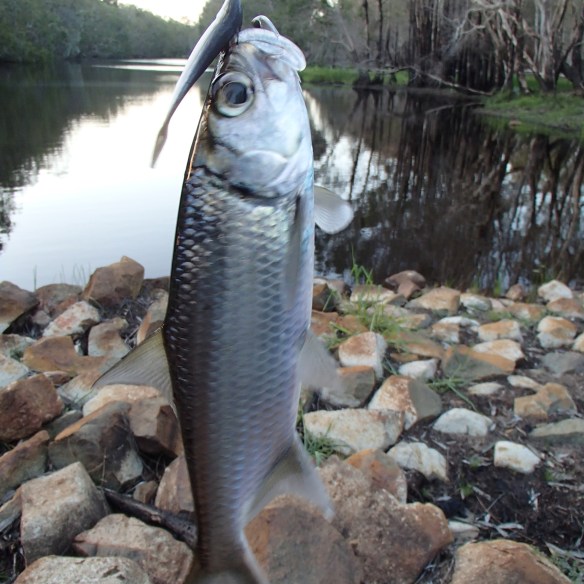
Last time I was down there I caught a tiny moses perch on a big DUO lure and got mugged as I reeled it in. Watch where you are paddling in those rock pools!


1770 – Deepwater Creek – 4 November 2014

Tuesday

On Tuesday I had some work to do in the morning and the wind was blowing hard. By lunchtime, I was keen for a fish, so I decided to drive down to Deepwater Creek, which is just south of 1770 and see what I could catch.

At about 3.00 pm I set out to explore. I have fished a few sections of the creek. It has both freshwater and saltwater parts with a weir separating the two. When it rains heavily, the water runs over the weir and it would be possible for fish who can survive in both, to move up stream. Last year I caught my first tiny barramundi in this creek. I am sure that there are some bigger ones lurking in this system.

It’s important to protect yourself from the bugs. You want to be fishing at dawn or dusk and unfortunately this is the time when they are at their fiercest.  This is a fresh/ saltwater swamp, so after a bit of rain it is buzzing. I find minimising your exposed skin is really the best solution, so I wear long trousers and a long sleeve shirt and fishing gloves. I then use a good repellent on my neck and face.

I started on a section of the fresh side of the creek. Finding a spot to cast from is always a challenge. There are overhanging branches and vegetation everywhere. There are also fallen trees and stumps at regular intervals. You must be prepared to lose plenty of gear. I was fishing light. I was using my G.Loomis TJR fast action, light spin rod, Shimano Stella 2500 reel, 10lb braid with a 10lb fluorocarbon leader. There was no movement and the wind was ruffling the tree tops. I decided it was time to think out of the box – the DUO lure box. With so many snags I decided to give a small surface popper a try. I tied on the DUO Tetraworks Pocopoco in the Clear Rainbow colour. This is a very small popper that is great for catching bream over weed beds. It is well made with the usual great DUO paint job and excellent finish – but its real strength is its noisy blooping action.

I cast it out to mid-stream and let it sit for about ten seconds. I took up the slack and it loudly blooped towards me. After each jerk with the rod tip there was another bloop and splash and then I would pause. After three pauses, there was a swirl in the tea tree stained water behind the lure. On the next bloop a fish attacked and ran for bit but then spat the lure out. I could not see what it was.

I cast out to the same spot, there was another swirl and then a surface strike but the fish missed the lure. Popper fishing is always like this – you swing from delight to disappointment, all within a 10 second retrieve. I cast out again and again and I had another bite and run but no hook up. I decided to return later.


I moved down to the saltwater section and found a good looking stretch of bank with sunken timber and lots of mangrove roots. I swapped to a soft plastic lure – a GULP 3” Smelt Minnow and as the water was hardly moving, I dropped down to 1/12th ounce, size 1 hook jighead. As I cast along parallel with the bank, small bait fish hopped along in front of my lure. It was now about 4.30 pm and there were a few surface bust ups, in close to the mangrove roots. I lost a few jigheads and leaders to the submerged timber, but I kept re-rigging.  At about 5.00 pm something slammed my lure just before I was going to lift it clear of the water. The rod bent over and it tried to head straight back towards the mangrove roots. With 10lb leader I was not going to force the fish out once it buried itself – so I quickly tightened the drag and gambled that the G.Loomis would be a good enough shock absorber. This worked and I turned the fish back towards mid-stream. It pulled hard but after a minute or two it was tired and I carefully pulled it clear of the water. It was a Mangrove Jack and measured 38cm. I took a few pictures and released it.

After another 30 minutes I decided to turn my attentions back to the fresh water section of the creek. I wanted to see if I could catch what had been chasing my popper, earlier. I went back to the other spot and I tied the popper back on. It was now about 5.30 pm and the shadows where getting longer. I cast into the middle of the stream, where the fish had been earlier, but with no luck. I cast closer to some tall swamp grass on the far bank and saw a faint swirl behind the popper. I put the next cast back in the same spot and this time the fish took it in one great gulp. It was a chunky spangled perch – about 30 cm long. There is obviously plenty to eat in this system.

I don’t think the strikes earlier in the day had been from this species, they had been much more aggressive. Perhaps they were from some tarpon, which can be caught all through this system.  By about 6.30 pm it was too dark to carry on so I stopped for the day. Exploring new systems can be hit and miss but this afternoon was definitely a hit!

1770 – Getaway Beach and Wreck Rock – 3 November 2014

Monday

By a lucky twist of fate I found myself stuck in Gladstone for a few days – so I disappeared to 1770. Gavin and Kim at Loka Santi – http://www.lokasanti1770.com.au – had an apartment free at a good rate, so I decided to stay there, again.

The weather looked unpredictable and that was how it turned out. On Monday a strong south-easterly blow appeared from nowhere and brought some rain with it. I started just after dawn at Getaway Beach where I caught a few small stripey perch and dart, mainly on small soft plastics. After a few hours, I did not have much to show for my efforts, so I went off to find some breakfast.

High tide had been at about 5.30 am so by lunch time I could get to fish my favourite spot at Wreck Rock. I arrived at about 11.30 am and wandered out onto the rocks with my NS Blackhole light rock fishing rig. It was lunch time so I kept things light – 10lb fluorocarbon leader, 1/8th 1/0 jigheads and GULP 3” Minnow soft plastics.

The sky was grey and it started to rain. Fortunately the rain dampened down the wind. I caught a steady stream of dart and even a couple of whiting, but there were no bream or trevally around. The rain stopped and the wind picked up again. The water felt much warmer than a couple of weeks earlier which may explain why the tailor and bream had moved on. By about 1.00 pm I was soaked through and decided to call it quits for the day.

Bribie – The old oyster jetty flats – 31 October 2014

Friday

On Friday I was back on home turf and had a few hours clear in the morning. I set the alarm for 4.00 am and drove up to Bribie to see what I could find. I passed through a few showers on the way up from Brisbane, but by the time I waded out under the bridge, at about 5.00 am, the rain had stopped.  The tide would be running out and would be low at 8.20 am. There was not much of a sunrise but the sky was getting lighter, as I waded south towards the old oyster jetty. I was fishing with my light spin rig – Loomis TSR rod, Shimano Stella 2500 reel, 10lb braid and 10lb fluorocarbon leader.

I started by fishing with a GULP 4” Minnow in the Pearl Watermelon colour. This is always what I start with when I am not sure what to start with. It’s a consistent performer and looks just like a small pilchard or mullet.  I was using a 1/8th ounce, size 1/0  hook jighead. At about 6.15 am, I was 30 metres to the south of the jetty, I felt the tug of a flathead, dropped the rod tip and paused. I lifted and hooked it. It was a decent fish just over 50cm, I photographed and released it.

The clouds thickened and I got a light soaking. I waded further south. The bites were few and far between. I swapped to a GULP Jerkshad in the Cajun Chicken colour and this produced a bite on the first cast. I threw it back in the same direction and paused for a little longer. This time I hooked it. It was a small flounder. I have never really found one big enough to eat here, but I live in hope.

By about 7.00 am I had reached a point about half way to the green channel marker. I was hopping the jerkshad along the bottom towards me. Just as it reached me a flathead popped up and engulfed it. It turned as it tried to swallow and hooked itself. It was a very solid fish, so I let it take some line and started slowly wading back to the sand bank, behind me. It pulled hard but after a few determined runs it gave up and came with me. It was a great flathead probably just under 70 cm. I took a few pictures and released it.

I returned to about the same spot and swapped to a GULP Jerkshad in the Orange Tiger colour. After a few more cast, this lure caught another 45cm flathead and, a few casts later, a slightly smaller one. It was now about 7.30 am so I waded back towards the bridge. I caught two more very small flathead on the way.

By 8.00 am  with more rain threatening and a slowing tide, I gave up.

1770 Getaway Beach and Wreck Rock – 24 October 2014

Friday

With the wind and swell dropping and turning into a light north-easterly, Friday looked like the perfect fishing day. I was awake at 4.00 am and decided to fish at Getaway Beach. I walked down to the small bay in the pre-dawn light.

I started at the north end of the beach on the rocky promontory. The tide was coming in and would be high at about 8.30 am. I cast at a semi-submerged bommie. I started with a GULP Jerkshad in the Lime Tiger colour on a 1/8th 2/0 jighead. I was still hoping there might be a jewfish/mulloway lurking somewhere around here. The first taker was a small stripey perch – not much longer than the jerkshad. I cast out again and got another. I moved further round and caught another. After about 30 minutes I had caught and released about 10 fish – all too small for a meal. The tide was coming in and I had to get off the rock if I wanted to avoid getting stranded.

I walked back to the south side of the rocky headland. I was now fishing with a GULP 4“ Minnow in the Pearl Watermelon colour. I cast it at a bommie and let it sink. N.B – The word ‘bommie’ is unique to Australia and is derived from a local aboriginal word – ‘bombora’ which can be loosely translated as coral reef outcrop. The sea was settling down but it was still not very clear and I could smell and see the algal bloom in the water. As I lifted my rod tip a fish attacked and hooked itself. It turned and tried to bury itself in the rocks. I pulled it out and landed it. It was a chunky stripey perch about 35cm long – I kept it. I believe these fall under the ‘all tropical sea perch’ category and have a minimum size of 25cm (but please correct me if I have misinterpreted the current Queensland rules).

I did not find another one but I did pull out small, bream, dart and trevally, after swapping down to smaller 3” GULP Minnows in various colours. I swapped to a small DUO hard bodied vibe lure and this caught also caught a few small dart. By about 9.00 am, as we passed the top of the tide, the sea was calm and the fish seemed to stop biting. I decided to go for breakfast and a sleep.

At about 2.00 pm I drove back down to Wreck Rock to fish the bottom of the tide. This was another good session. I caught plenty of dart and small bream and the catch rate picked up as the afternoon moved on and the tide started to run in. At about 3.30 pm, I upgraded to 15lb leader and swapped to a slightly heavier 1/6th ounce jighead, to counter the strong afternoon north-easterly wind, which had picked up. I was now fishing with a GULP 4” Minnow, in the Pearl Watermelon colour.

Just on 4.00 pm I felt a sudden hit and line started peeling. It felt like a chunky fish but in the swell it was hard to tell. It was fast and trying get down into the rocks. I felt more confident with the 15lb leader and I tightened the drag and put some pressure on. It fought hard but after a few minutes I pulled it up on a wave and grabbed it. It was another decent trevally, about 50cm long. They must cruise up and down these rocks. I have seen some much bigger shapes in the waves out front but they could be anything in this spot. By 4.30 pm the incoming tide pushed me off the rocks so I gave up for the day.


1770 – Flat Rock at Baffle Creek and Wreck Rock – 23 October 2014

Thursday

On Thursday the seas were still up and low tide would not be until about 2.30 pm. The wind would hopefully have dropped by then and I could try fishing the beaches and rocks again. In the morning I decided to drive back out to Flat Rock on Baffle Creek and see if I could have some more fun with the Tarpon.

It takes about an hour to drive south from 1770, down the four wheel drive sand track, past Flat Rock, Middle Rock and Wreck Rock beaches, across Deepwater Creek and on to Flat Rock boat ramp on Baffle Creek.

By the time I arrived, the sun was already up and the insects were humming in my ears. You need plenty of insect repellent in these parts! The wind had dropped away and the tide was coming in. It would be high at about 9.00 am.  There were a few surface strikes and the bait was jumping around. I worked through a few different soft plastics on the light rod. The usual minnows, jerkshads and shrimps did not work, so I swapped to a Watermelon coloured GULP Minnow grub. I slowed the retrieve and let it flutter around in the current. After a few casts, there was a solid bite and I hooked up. The fish headed for the rocks and immediately tried to get under them. I was still fishing with 14lb leader so I tightened the drag and pulled it out. It was an estuary cod – about 45cm long. I released it and after another hour with no luck, I went off to the Baffle Creek Township, to find some breakfast.

The wind had dropped off so I decided to make my way to Wreck Rock to fish the last few hours of the run out tide. It would not be possible to get out to the spots I like to fish there, until two to three hours before low tide, from about 10.30 am onwards. So I drove back up the sand track and stopped for a nap in a shady spot. I woke to some rustling and found a mother emu and three chicks walking past. This really is a very unspoilt spot!

I drove on to Wreck Rock and walked out on to the beach. The sun was out and there was no one else around. The wind was now a 10 to 15 knot north-easterly and the swell was dropping. I decided to stay with the light spinning rod and 10lb leader. It was the middle of the day and I thought the fish would be fairly picky.

I started fishing on the calmer side of the rocky peninsula that sticks out to the north of the little bay. I put on a 1/8th ounce, size 1 hook jighead with a 2” GULP Shrimp soft plastic, in the Banana Prawn colour. After a few casts, the first taker was a small stripey perch, this was followed by an equally small bream. Both these fish where sitting at the base of the rocks in a few feet of water. About 20 minutes later, I dropped a bigger bream, as I tried to land it.

It was pretty warm so I decided to risk getting wet and wandered a bit further out along the rocks. I wanted something chunkier to throw out into the breaking waves, in front of the rocks and I chose a GULP Jerkshad in the Waremelon Pearl colour. I also upped my jighead to a slightly bigger 1/6th ounce with a 1/0 hook. I cast this out in to the gaps between the rocks and let it sink for as long as I could before hopping it back towards me. I lost a couple of rigs to the rocks and gradually moved further out as the tide dropped. At about noon I was almost at the end of the rocky peninsula. I cast clear of the rocks and let the jerkshad sink. On the drop, it was slammed and line started peeling. The swell was still significant and this fish new how to use it. As soon as I applied some pressure, it took off. There were rocks everywhere and I had a 10lb fluorocarbon leader on the end of a very light, fast action trout spinning rod. Patience – Patience – Patience would be necessary. I got a little line back and tightened the drag, very slightly. I watched the swell and used the waves to steer the fish towards me. I took several tries but eventually I had it out of the water and at my feet. It was a trevally, about 50cm long.  I love to eat fresh trevally, so I killed and bled it and put it in a keeper pond, about 10 metres back from the shoreline.

A climbed back out along the rocky peninsula and put on another Jerkshad soft plastic. This time it was in the green and orange Lime Tiger colour. I cast around for another trevally but could not find any out the front. I started casting into the foamy water right at the end of the line of rocks. Small dart kept attacking the soft plastic just as it reached the rocks and on a few occasions they almost beached themselves trying to eat it. On the next cast there was a solid hit and then a clean bite off. I re-rigged with 14lb fluorocarbon leader and put the same soft plastic/ jighead combination on again.

I cast out wide again and let the jighead sink but then I added some urgency to the retrieve, a few quicker, more violent jerks. This did the trick and just before I got the soft plastic back to the rocks, a fish grabbed it, dropped it, and then grabbed it again. I felt the hook set in the jaw and then the fish went ballistic. I knew it was a Tailor before I could see it and I suspect this was what had bitten me off, before.


I pulled up a wriggling 40 cm tailor – I photographed it and released it. I shortened the mashed soft plastic then cast it out again. After a few jerks of the rod tip I had caught another slightly bigger one. Over the next 20 minutes I caught 4 more and dropped a few. The biggest was about 45cm. I am not sure how long they would stay in this area, but I suspect they are nearly always around until the water really warms up.

By 1.30 pm I was soaked and the fish seemed to slow a bit, as the wind and swell picked up again. I waded back towards the keeper pool, where I had left my trevally but I could not find it. Then I saw a big brahminy kite circling the shallows, about 50 metres away towards the beach. I watched as it swooped and plucked up the trevally – which it or another bird must have dropped halfway back to its nest. It struggled to get airborne again but eventually it got its full wingspan deployed and made it to the tree line. That was the end of my fish supper.

I decided to give up for the day and drove back up to 1770.

1770 – Baffle Creek – Flat Rock – 22 October 2014

Wednesday

After a windy and stormy night with a fair amount of rain, I woke to grey skies on Wednesday. Agnes Water and 1770 can be a tough place to fish. Half the problem is that everywhere just looks so fishy. The mangrove lined creeks, the rocky headlands and unspoiled beaches. It raises your expectations but as with fishing everywhere, you still need to put in the hard work. That means fishing at dawn and dusk – when the fish eat. It also means trying everything in the tackle box and trying lots of different locations.

Wednesday morning would be wet with rough seas but it was still worth a fish. I was up at 4-15 am and drove down to Flat Rock Beach in Deepwater National Park. I walked out on to the beach and watched the sun come up as I cast a few soft plastics around. The water was murky and it was just too windy, so I retreated and put plan B in to action.

Plan B was to drive further down the sandy track and head for Flat Rock boat ramp on Baffle Creek. It is a fairly wide stretch of Baffle Creek with a few scattered rock bars and mangrove lined edges. The main attraction is a wide rock bar that juts out into the channel and is submerged on high tide. Sadly, despite its fairly remote location, this spot seems to get fished quite a lot and there is a fair amount of boat traffic coming and going from the nearby ramp, especially at weekends and later in the day. When its windy out on the ocean this is the only option.

I arrived at about 11.00 am and only had to share the space with one other land based fisherman – a friendly Kiwi called Chris – who was camping nearby at Wreck Rock. He had had a fair bit of success using flesh baits and pilchards, he had landed a nice mangrove jack, a day previously.  There was sickly sweet smell and I could see it was coming from the nasty green algal bloom covering the mud and the sand, as the tide receded.


I started with my light spinning rig and 10lb fluorocarbon leader. I was fishing with a 1/8th 1/0 jighead and a GULP 2” Shrimp in the Banana Prawn colour. I cast along parallel with the mangroves. The tide was running out. I soon picked up a dusky flathead – 50 cm long. A few casts later the lure was slammed by a fairly significant fish. I hooked up instantly and it took off. On the first leap I could not see what it was. On the second, its black back gave it away as a pretty big (60cm +) Tarpon. It leapt three or four times and kept making blistering runs. With 10lb leader I could not muscle it in so I let it have its head. Unfortunately, as soon as I tried to tighten the drag and put some pressure on, it snapped the leader.


I fished for a little longer with the GULP Shrimp, then swapped to a Jerkshad in the Lime Tiger colour. I had now re-rigged with 15lb leader. After a few casts I had a solid bite and about 3 casts later, another smaller Tarpon hit hard. I set the hook and let it take line and leap around for a few minutes. When it had worn itself out I reeled it in, unhooked it and released it. These are tough fighting fish with small hard mouths, so they can be hard to hook.

I fished on through the falling tide but the wind got stronger and stronger and even made fishing this sheltered spot hard. I had a few bites from smaller fish but at about noon. I gave up for the day.

1770 – Getaway Beach – 21 October 2014

Tuesday

On Tuesday, I was up early to fish the rocks at Getaway Beach. This can be reached from Springs Road along a walking track, or by walking north around the headland from the new road that was constructed for the desalination plant inlet.

I have caught and dropped a few jewfish/mulloway here in the past. There are lots of spots that look promising, in fact it is pretty much perfect with rocky overhangs and sea caves all around the headlands. But I am much less confident in my ability to find them here than I am down south, in Southern Queensland or Northern New South Wales. They are very much creatures of habit but the more I think about it and the more I fish for them, I realise that there must be ready supply of bait for them to hang around. The moon and tides are also important. The run up to the full and new moons both seem to make them more active but, like most fish, it is a constant food supply that they are most interested in. I agree that they also prefer the water to be stirred up and foamy but not necessarily dirty.

The new moon was only a few days away.  The tide was running in. I started fishing about 5.30 am, a little after sunrise (late for work again!). I started with my lighter rock and beach fishing combo, based on the N.S Black Hole Cabin II – S-862 L Spin Rod. It is 2.59m long (8’6”) and rated 8-14 lb. I match this rod with a Shimano Sustain 3000 reel. This is rigged with 15lb braid and I usually fish it with a 12lb to 16lb fluorocarbon leader. Today I had some 14lb. When I am looking for a jewfish I start with the lightest jighead that will sink in the swell. That varies between a 3/8th ounce, down to a 1/8th ounce. A ¼ ounce was perfect for the conditions – a light south-easterly swell. I started with some big GULP Crazylegs Jerkshads and then regular Jerkshads, then 4” Minnows and finally 3 “ Minnows. Nothing produced a jewfish.

This slideshow requires JavaScript.

I caught plenty of stripey perch and lost tails to small dart/ whiting. At one point, I hooked the resident turtle – who set off for New Zealand, before unhooking himself. I moved around the rocks and cast into every crevasse and at every bommy – but nothing produced what I was looking for.

The wind started to build and by 9.00 am it was a 25 knot south-easterly so I gave up. No fish pictures because you all know what a dart and stripey perch look like by now.

1770 Round Hill Creek – 20 October 2014

Monday – Dusk

On Monday afternoon, the south easterly wind was blowing hard and the beaches south of 1770 were impossible to fish. I decided to fish on the northern side of the 1770 headland, in Round Hill Creek. I drove to the car park by Captain Cooks Monument and followed the path down to the creek.

1770 is one of the few places you can actually see great sunrises and sunsets. I started fishing with small soft plastics at about 4.00 pm. I moved along the shoreline towards the mouth of the creek. At one point a small school of what looked like trevally came by, busting up into some bait on the surface. As is so often the case, they remained just out of casting range.

The shoreline is rocky, interspersed with patches of sandy bottom. As with everywhere in this town it looks very fishy! I swapped to a slightly bigger 4” GULP Minnow in the Pearl Watermelon colour. As I pulled this carefully over the top of the submerged rocks a small cod shot out and grabbed it. It did its best to bury itself in the rocks but I just let the pressure off and waited for it to swim out. It was about 30 cm long – so I sent it on its way.


I swapped to a bigger soft plastic a GULP Crazylegs Jerkshad in the Lime Tiger colour. I was still fishing with my light rig – 10lb fluorocarbon leader and a 1/8th, 1/0 jighead. After a few casts, I felt a solid bite at the foot of the rocks and was sure I had a fish on for a few seconds. But it must have dropped the soft plastic. I carried on along the shore and turned back as the sun began to drop towards the horizon. I stopped where I had felt the bite previously and put in another cast. I slowed it all down and let the plastic sit on the bottom for a good 10 seconds. I then hopped it back towards the shore. On the third attempt the fish hit the plastic hard.  It hooked itself and started thrashing around in the fairly shallow water. I let it make a few runs then tightened the drag and pulled it up on to the pebbly beach. It was another flathead – but a dusky this time. It was a little bigger the mornings version at about 55 cm. By the time I had photographed and released it, I had a violent red sunset to watch.

Nothing spectacular but a decent fish and sunrise at the beginning of the day and a decent fish and sunset at the end of the day – perfect!

1770 Deepwater National Park – Flat Rock – 20 October 2014

Monday

I had managed to get a few days off near Gladstone. The weather looked a bit windy but you have to take the cards you are dealt. I pointed the car in the direction of 1770 and set off. This time I decided to stay at Loka Santi Beachside Apartments – www.lokasanti1770.com.au . They are about mid-way between Agnes Waters and 1770, tucked in the sand dunes, 100 metres or so behind the beach. They have three bedroom / two bathroom units with kitchens and laundries but can offer these for singles and couples, at very reasonable rates, by locking off the extra rooms. All of the units have bbq’s, big balconies and outdoor spaces. There is a pool and the beach is only a stone’s throw away. Gavin and Kim run the place and will give you a very warm welcome. Gavin is a keen fisherman and has a side console Polycraft boat, on a trailer, that you can rent to explore the local creeks, if you have a boat license.

I arrived late on Sunday afternoon, after a long drive and decided to go to bed early and make the most of the fishing in the morning.  The wind was forecast to pick up from the south east on Monday afternoon and then blow fairly hard for a few days. In common with so many areas, I have lots of spots around Agnes Waters/ 1770 that are better to fish on a low or falling tide. Dawn on Monday morning would be just after 5.00 am and high tide would be at about 6.30 am on the beaches/ rocks to the south. I decided to fish at Flat Rock, in Deepwater National Park – about 10 kms to the south of Agnes Waters.

Flat Rock, Middle Rock and Wreck Rock are reached by passing along a 4 wheel drive only sand track that turns off the road just south of Agnes Water. The track can be very variable. I used to do it in my Suzuki Grand Vitara and rarely got stuck – but it was challenging.  With a little extra clearance, the FJ Cruiser has no trouble. At the moment the track is in great shape and the tough, steep sandy slope, which used to cause problems, has been filled in with some road base and firmed up.


It took about 25 minutes to drive from Loka Santi to Flat Rock beach. Flat Rock is a spectacular spot and, unsurprisingly at 5.00 am on a Monday morning – I had it to myself. The beach is named for the long Flat Rock that runs parallel with the shore for almost its entire length. The rock creates a huge gutter at high tide and great fishing platform at low tide. My preference is to stand on the rock on a run out tide and fish into the drains that run through the rock as the tide drains.

This morning I was using my light spinning rig – 8lb braid and 10lb fluorocarbon leader, 1/8th 1 or 2, sized hook jigheads. I was not expecting anything too big as I would be mainly fishing the gutter on the inside of the rock. Small soft plastics – GULP Minnows, Minnow and Jigging Grubs and Shrimps are the best choices along here. I started with a 3 inch GULP Minnow in the smelt colour. The water was clear but foamy and the Flat Rock was completely submerged. Ideally you would like to cast a very light jighead here, perhaps 1/12th of an ounce or 1/16th, but fishing in surf/beach conditions nearly always makes the lightest castable size a 1/8th ounce. This is what I selected.

I walked north along the beach casting towards the inner edge of the Flat Rock. Straight away my plastic was getting hit at the foot of the beach, where the wave breaks. I assumed this was Whiting or Dart. This was confirmed as I pulled out a few tiny Dart.

I moved down to an area about 500 metres to the south of the beach entrance, where there is a break in the rock. At this point the water was rushing in through the break, as the tide filled the inside gutter.

I cast right into the centre of the gap, level with the rocks on either side and let the plastic sink. When I lifted the rod I felt a light tug and then a solid bite. I set the hook and the fish took some line. Fishing in the surf takes some getting used to. The pull of the waves makes it difficult to gauge what you are dealing with. It is essential to try to maintain the tension, as a large wave can lift the fish and give it some slack, then the hook falls out and the fish is gone. You also need to be careful as you pull the fish up the beach. Basically, patience is the key.

I tried to be patient but it has never been my strong point. I kept winding and after a few minutes I had a nice sandy coloured flag tail flathead at my feet. It was a nice fat fish about 50cm long. I took a few pictures and released it.

I carried on fishing this area and swapped to a slightly bigger 4” GULP Minnow in the Green Camo colour. I kept getting hits from fish in the mouth of the drain but could not hook up. I slowed everything down and let the plastic waft around a bit on the bottom. This strategy worked and I felt a good bite and struck. I was surprised to see a fat whiting; about 30 cm long had swallowed the 4” Minnow. I released it and was hopeful of more.

I fished for another hour or so but the wind was building from the south east and this eventually made the fishing too difficult. I caught several more dart, and a couple of really tiny flathead. I think I may have also dropped a couple of larger flathead, but it was difficult to tell. At about 9.00 am, I surrendered the beach to the wind and went for breakfast.

Iluka – Woody Head – 1 October 2014

Wednesday

Many claim it was Einstein who said the definition of insanity is doing the same thing over and over again and expecting different results. But there is no evidence that he ever said it, thought it or wrote it.  However as with all good clichés, there is an element of truth in it, especially for fishermen.

For this reason I decided not to return to Middle Bluff on Wednesday morning and to go instead to Woody Head – the next headland to the north. When the swell is light and the tide is low or falling, there are few better fishing spots.

I parked up and walked out on to the rock platform at about 5.00 am. The wind had stayed a northerly and the swell was fairly gentle, but there was still the odd large set of waves coming through. Boots with felt soles or studs, or both are essential, if you intend to venture out here, as is a PFD. The tides ensure almost every surface is a suitable home for green and black slimy weed and the barnacles here are responsible for plenty of long term scar tissue. So it is only relatively safe when the swell is under 1 metre and the tide is about half way out and falling.

It was another magnificent sunrise. I wandered out to the front of the rock platform to a spot called the Barnacles. I rigged up the light rod (NS Blackhole) with 14 lb fluorocarbon leader and ¼ ounce, 1/0 size hook jighead and a GULP Crazylegs Jerkshad, in the Curry Chicken colour. I lost the first rig to the rocks – fishing is expensive in this kind of terrain. I rigged up again with the same set up. I cast out and let the jig head sink. I left it as long as I dared and then hopped it in a little closer to the rocks. As I lifted it again I felt it stop and then line started peeling. The fish ploughed off to the south, parallel with the rocks. This was tricky as I could not stay lined up with it for long. I Let it run and then fairly quickly took back some line and tightened the drag a little. It turned but tried to bury itself at the foot of the rocks. It was now weakening but the leader was caught on some rocks and I could feel it rubbing. I loosed the drag right off and waited. Fortunately it swam out and freed the leader. Now I tightened again and pulled it up on the next surge of water. After a couple more waves I had it at my feet. A solid mulloway –  it was 76 cm and legal size in both Queensland and NSW. At last we would have a taste of the fish I had been catching all week and releasing.

I dispatched it, gutted and cleaned it. Then I headed back to the rocks for another try. It had destroyed my last GULP Crazy Legs Jerkshad so I put on a 4” Minnow in the Green Camo colour. Back to the same spot – bang, first cast and I have a fish on again. The drag was still set too tight from the final stages of the fight with the last one and after a big initial run, before I realised, it found a rock and snapped me off.  I assume it was another mulloway. I re-rigged and continued fishing for another 30 minutes with no result. The swell was building and the tide rising. So at about 7.45am, I gave up and took my prize back to the cabin.

Iluka – Middle Bluff – 30 September 2014

Tuesday – Morning

I had not given up on finding a keeper size mulloway at Iluka, so at 4.45 am on Tuesday, I walked along the beach towards Middle Bluff. I surprised a couple of Kangaroos who were up on the rocks. Conditions were similair to the day before (light northerly) but the sea seemed a little more stirred up and foamy. Low tide would be at about 5.20 am – just on sunrise. The beginning of the run in tide offers good fishing in this spot, so I was hopeful.

I started with my big rod and a big GULP Crazylegs Jerkshad in the Curry Chicken colour, on a ¼ ounce, size 1/0 jighead. I was fishing with 20lb fluorocarbon leader. I flicked this around, close to the base of the rocks and it soon came back minus its curly tail. I swapped to a GULP 4” Minnow in the Pearl Watermelon colour. The sun was up and the sky and water were very clear. After about 20 casts with the GULP Minnow I was getting pretty good at leaving it in the wash at the base of the rocks, without getting snagged. As I was about to lift it, at the end of a retrieve, I felt a grab. The fish swam for a bit with the plastic then let it go. A few casts later I connected with another fish. This time I dropped the rod tip as soon as I felt the resistance and paused. When I struck, the fish was hooked. Once more the light swell made things easy and I soon had a mulloway/ jewfish of about 48cm at my feet. I took a few pictures and threw it back.

I was starting to see a bit of bait jumping around close to the base of the rocks and it all looked pretty small.  I dropped down to my lighter rod and a 14lb fluorocarbon leader. I swapped down to a 2 inch GULP Shrimp soft plastic in the new Green Camo colour, but stuck with the ¼ ounce jighead.

A fish struck this hard on the first cast, but I did not hook up. About ten minutes later, I swapped to a 3 inch GULP Minnow in the New Penny colour. I had another hit on the first cast. This fish was not big but by the way it started pulling, I knew it was a tailor. They thrash about very hard and never give up. It was only small, about 35 cm long. It was good to see they are around. I took a picture and threw it back.

It had mashed up the plastic so I put the 2 inch GULP Shrimp in Green Camo on again. The tailor had obviously moved on. But after about 20 minutes of cast into the wash, I felt a good bite and was onto another fish.  This time it was another solid bream – a little over 34cm. I decided to keep this one for supper.

I continued fishing and kept felling small bites. Eventually I pulled up a butter bream. I had caught no trophy fish but had found great variety. The session had been a good example of how changing soft plastics can often produce results. At about 9.30 am I gave up and walked back to the car.

Tuesday  – Afternoon

In the afternoon I waded back out on to the flats beside the Clarence River, at dusk. They are covered in yabby holes which is a good sign for a fisherman. I flicked around a GULP Jerkshad in the Pearl Watermelon colour. I caught three flathead – the first would have been big enough to keep, the rest were too small. The sun dropped behind the trees on the horizon at about 5.40 pm and the midges and mozzies became unbearable, so I waded back to the cabin.

Iluka – Middle Bluff – 29 September 2104

Sunday – Morning

It was another mild morning in Iluka. A light northerly wind was doing its best to flatten the sea. I decided to fish Middle Bluff again and see if I could find a legal sized mulloway (jewfish).

At this point I will say my piece about the raising of the jewfish size limit in NSW. I have read a bit about the surveys that were done to determine whether or not the existing limit of 45 cm, was adequate to protect the species. They were very small surveys that relied on a lot of subjective judgments by local fisherman and fisheries officers, but it would have been financially impossible for them to be developed any other way. After putting together these surveys, NSW fisheries concluded that fish at 45cm were not having a chance to reproduce before being caught, so they have raised the legal size to 70 cm and set a bag limit of two. Commercial fishermen also have to obey by the new rules, although they are allowed to keep some smaller fish, under by catch rules. If I have got any of this factually wrong, please comment and correct me.

If we want sustainable fish stocks we need to carry out credible scientific research. Our duplicated state fisheries departments do not need any more boats, trailers, life jackets, uniforms or rulebooks. They need scientists and scientific rigour in their research processes. The science used to support this decision may be proved right but I would have liked to see much more comprehensive studies. We now have the ridiculous situation where on one side of the Tweed River the Mulloway size limit is 70cm and on the other, it is 75cm.

It was another spectacular sunrise at Middle Bluff. I decided to fish with the light rig from the beginning and stick to the soft plastics. I was using 16lb fluorocarbon leader and a ¼ ounce, size 1/0 hook Nitro jighead. I loaded up with a GULP 4” Minnow in the new Green Camo colour.

The sun came over the horizon at about 5.30am and by 5.45am, I had my first fish. It was another mulloway/ jewfish, but it would not be dinner because it was only about 45cm long. I unhooked it in a rock pool and took a few pictures, then speared it back down in to the wash. It had grabbed the plastic very close to the rocks again.

I put in plenty of casts but could not get another. I swapped down to a lighter 10lb fluorocarbon leader and put on a GULP 2” Shrimp, also in the Green Camo colour. I moved a little further north along the rocks and cast down into the wash. I let the soft plastic waft around, but I left it too long and got snagged. I re-rigged and put it back in the same spot. After a couple of casts I felt a solid hit and the rod bent over. Fortunately, the swell was light and I was able to get down quite close to the water. I let the fish take some line then tightened the drag a little and lifted it up, onto the rocks with the help of a wave. It was a very solid 37cm bream. So I would have something for dinner.


I fished on for another hour but the wind picked up and the tide started in, making fishing a bit hard. At about 9.00 am, I cleaned up the bream and walked back along the beach to the car.

Sunday Afternoon

On Sunday afternoon I decided to wade out on the stretch of the Clarence River – just in front of the Anchorage Holiday Park. There are sand banks and weed beds and it looks like an ideal flathead spot. I started just before 5.00 pm. The tide was running out and I waded across the sandy and muddy bottom until I came to the weed banks that fringe the deeper main river channel. As I was exploring, I started by fishing with a soft plastic that I am very confident using – the GULP 4” Minnow in the Pearl Watermelon colour. I was fishing with my estuary light spin rod, 10lb fluorocarbon leader and 1/8th ounce, size 1 hook jighead.

It did not take long to find the fish. I caught a couple of small flathead first and then a legal one (40cm), that was sitting in a sandy hollow. I waded up river and decided to switch to a DUO Realis Shad 59 MR hard bodied lure. This is a medium diving lure and the flathead and bream love it. As the sun set, I caught a couple more small flathead on this lure.

I had fished at dawn and dusk and caught fish at both sessions – and had a nice bream for dinner – living the dream!

Iluka – Middle Bluff – 28 September 2014

Sunday

On Saturday, I packed up the car and drove 3 hours south, from Brisbane, to Iluka. It is about a year since I was here last and it feels like much longer. At last I had the opportunity to get away and fish for some different species. The weather was forecast to be pretty good for most of the week – with limited swell and wind and plenty of sunshine.

I arrived on Saturday night and ate at the Sedgers Reef Hotel. The food in here continues to go steadily downhill, while the prices go up. Everything is deep-fried (mostly from frozen) and hot chips are really the only thing worth eating. Still, the beer is cold and the location is fantastic. It’s a great place to watch the sunset across the mighty Clarence River.

The Clarence River empties into the ocean between Iluka to the north shore and Yamba to the south. The Clarence is a huge river and there is always activity at its mouth and on the rocky headlands, on either side. I prefer to fish the Iluka side of the river mouth, as it is quieter and has the beautifully unspoiled Bundjalung National Park.

This time I was staying at the Anchorage Holiday Park www.anchorageholidaypark.com.au in one of their deluxe cabins. I love to camp at the Woody Head camp ground, but they were booked out for the school holidays and its nice to have a proper fridge and running water, if you are planning to keep a few fish, to take home. There is also good fishing on the river, right in front of the park.

I went to bed early on Saturday night and as usual I found it hard to sleep. At about 4.00 am I woke before the alarm, had a quick cup of tea and set off for the rocks. I decided to start by fishing just to the north of Frazers Reef, at what is known as Middle Bluff (or sometimes Second Bluff). This is a rocky headland in between Woody Head and Iluka Bluff. I walked along the beach in the pre-dawn light and I was relieved to feel only a very light south easterly wind blowing. As the sky grew lighter I could see there was not much swell, which would make things much easier (and safer). I arrived at the northern end of Middle Bluff at about 5.15 am and started to rig up.

I had two rod and reel combos with me. The first – my heavy rig – is a Daiwa Demonblood 962H rod matched with a Shimano Stradic FJ 8000 reel. This is rigged with 20lb braid and I usually fish it with a 25lb or 30 lb fluorocarbon leader. The second is the much lighter, N.S Black Hole Cabin II – S-862 L Spin Rod. It is 2.59m long (8’6”) and rated 8-14 lb. I match this rod with a Shimano Sustain 3000 reel. This is rigged with 15lb braid and I usually fish it with a 12lb to 16lb fluorocarbon leader.

Around dawn I tend to fish with the heavy rig and try a few hard bodied lures or poppers. This morning I tied on a small but fairly heavy (31g) sinking bibbed minnow from Maria – called the Duplex. It is designed for long casts and high speed retrieves and it is ideal for casting from the rocks. I threw it out about 15 times and felt a few bumps. The sun was just coming over the horizon when I felt my first solid hit. I had the drag set quite tight as I did not want to get dragged down into the rocks. I did not hook up, so I cast out again and cranked up the retrieve. This time the hit was much more solid and the rod bent over, there was a fairly slow initial pull followed by a massive yank and the lure pulled free. When I got it back the rear treble had been completely pulled out – not happy.

I continued to fish with another Maria Duplex for about 15 minutes, but I could not find that fish again. I decided to switch to a soft plastic and chose the trusty GULP 4” Minnow in the Pearl Watermelon colour. I started fishing on a ¼ ounce, 2/0 hook jighead. The swell was light and the ¼ ounce jighead ensured the lure would drift around in the water column, before it reached the bottom. I tried to keep the jighead on the bottom for as long as possible without getting snagged. After about five casts a felt a faint bite, very close to the rocks. I dropped the plastic straight back down, only a meter or so away from the rock ledge. I paused for about 10 seconds as it sank to the bottom. When I lifted the rod, the line pulled tight and the rod tip started wriggling. I had the drag set tight as I was fishing very close to the barnacle covered rocks, but the fish predictably tried to swim under the rock ledge. It was no match for the heavier Daiwa rod and 25lb leader and I muscled it out and up on to the rocks beside me. It was a small Jewfish/ Mulloway – I estimated it at just under 50cm – a long way off the new NSW legal size limit. I let it recover in the rock pool for a bit, so that it might avoid becoming a shark snack. Then I speared it back in to the water. I continued with the same rig for about another half hour and had another faint hit, but did not hook up.

I decided to swap to the lighter fishing rig with a 14lb fluorocarbon leader. I had tried a number of bigger soft plastics but none of these had created any real interest. I now swapped down to a GULP 3” Sardine Minnow which I rigged on a ¼ ounce, size 1/0 hook, Nitro breampro fine wire jighead. I lost a few of these to the rocks but at about 8.30 am I felt a solid bite in very close to the rocks. This was a stronger fish but the swell had dropped off a little, which made things easier. I could not muscle this one in, so I let it play itself out and then landed it with the help of a good wave surge. It was bigger than the last at about 55cm – but still not big enough to keep. I took some photos and threw it back in.

I continued fishing for another 90 minutes without any more success, but the birds were working a few hundred metres away. The dolphins came through a couple of times – so I assume that there was some bait around. At about 10.00 am, I gave up for the morning. There was no fish for supper but it was a great start to the week.

Bribie Island – the old oyster jetty flats – 14 September 2014

Sunday

After a pretty good session on Friday, I decided to go back up to Bribie and try again on Sunday morning. Low tide would be a couple of hours later at 6.39 am. The moon was in the waning gibbous stage – about half full. The wind was light from the south west and there were a few clouds around.

I was fishing the flats by the old oyster jetty, as usual and as I waded out under the bridge, there were plenty of flathead lies on the sandy bottom. I was pretty confident but my first fish was a tiny whiting, just north of the jetty.

I put on a larger Mad Scientist Optishad soft plastic and started flicking it around, to the south of the jetty. This is a paddle tailed soft plastic which the flathead seem to love. The water was very shallow and clear. After a few casts, I felt a good bite. I paused and set the hook. It was a flathead just under 40 cm. I released it and moved on.

Then things went very quiet for about an hour. I waded all the way down to the green channel marker, gradually changing through a few soft plastic lures. As the tide started to run in, I was fishing with a GULP 2” Shrimp in the peppered prawn colour. First I caught a couple of small Pike. Then, a few casts later. I found a 30cm flathead.

I turned back and started wading back towards the bridge. I felt a couple of hits on the shrimp soft plastic and then a double tap and the rod tip bent over. It was a solid 32cm bream. I released it and carried on back towards the jetty.


On the way out I had felt a couple of bumps as I moved my soft plastic over a sandy hole in the weed beds. I stopped to give it another try. On the first cast I felt another light tap, then nothing. I was sure a fish was lying there. I put in about 20 more casts with no response. I was about to give up, when I decided try a different soft plastic. I swapped to a 3” GULP Minnow in the Sardine colour. On my first cast, with the new plastic – bang – a massive hit and an instant hook up. This was a solid flathead and it angrily came to the surface straight away, shaking its head and trying to spit the lure. It stayed hooked and I slowly turned towards the shore. It made a couple of determined runs but it was nicely hooked. I pulled it into the shallows and paused to admire it. It was a big female, well over 75 cm. I unhooked her and she paused momentarily before swimming away (see video).

That was it for the day. I waded back to the bridge with nothing for supper, but it had been a great session.

Bribie – the bridge and the old oyster jetty flats – 12 September 2014

Friday

Another late report – but it may be relevant for anyone planning to fish at Bribie over the school holidays, to get a feel for what is going on. I am planning to get down to Iluka in the next few weeks, so watch this space for a bit more variety.

So I drove back up to Bribie Island to fish my favourite spot on the mainland side of the Pumicestone Passage. I arrived just after first light at about 5.00 am. Low tide would be at 5.25 am. There was a light southerly wind blowing and it was cloudy.

There was a fair amount of bait jumping around under the bridge lights so I decided to start fishing in that area. As I walked out under the bridge I noticed plenty of ‘lies’ showing where the flathead had moved up to feed on the night time high tide.

I started with a small 3” GULP Minnow soft plastic in the Smelt (Grey & white) colour. This plastic looks like just about any small profile bait fish and has a nice soft texture. I cast it towards the edge of the reef, just to the south of the fifth bridge pylon. I waited for it to sink to the bottom and as I lifted, a fish attacked. There was no hesitation and this one hooked itself, as soon as it bit down. It can be a challenge to keep your fish in this area. There are lots of big clumps of weed and rocky outcrops. This fish was a good size and it wrapped itself around a few large weed clumps. Fortunately, the water was shallow enough and I was able to walk up close and free it. After a few minutes of back and forth, I pulled it safely to shore. A solid 57cm flathead, on my first cast – it was a great start.


I tried in the same area for another, but I think my wading around had spooked any remaining fish. It was now low tide and the water was not really moving. I waded to the south. I moved past the old oyster jetty and swapped to the paddle tailed Mad Scientist 6” Optishad soft plastic. I was fishing with a 1/8th ounce, size 1/0 hook jighead and 10lb fluorocarbon leader. At about 6.30 am, I found another flathead, about 40cm long. Then about ten minutes later another smaller fish.

As the tide started to run in, I made my way slowly down to the channel marker, casting into the current and found four more fish – all on the Mad Scientist soft plastic. Only two were about 45cm so I added these to the first one for a family supper. At about 9.00 am I stopped for the day.


Bribie Island – The old oyster jetty flats – 4 September 2014

Thursday

By Thursday I had time for a morning fishing session. I have been hoping to get down to Fingal Head or Iluka to chase some bream, tailor and mulloway. But I just cannot seem to carve out the time at present, so it was back up to Bribie.

It was another mid-morning low tide at 10.20 am. The moon was about 60% full. Strong southerlies had been blowing for a few days but these were forecast to drop off by lunchtime. It was a bright, sunny morning, when I arrived at about 8.00 am.

I did not really have time for exploring so I waded straight out under the bridge on the mainland side. The tide was already a fair way out and I could see plenty of fresh flathead lies in the sandy area, under the bridge lights. They were not big fish but there were plenty of them. There were also plenty of track marks from cast nets. There must be some prawns or squid around.

The water was very cool but clear. I headed straight for the sandy depressions just north of the old oyster jetty. This area is not as peaceful as it used to be. The new hotel is going up fast just behind the jetty and cement trucks are constantly coming and going.

I decided to start with a small hard body for a change. I selected the DUO Realis Shad MR62. A small diving minnow. After a few casts, something grabbed it, but after a few violent headshakes, it was off. On the next cast I found another fish and this time it stayed connected. It was about 45cm so it went in the keeper bag.

I was feeling confident. I stuck with the hard bodied lure for about another 15 minutes but I could not find any more. I changed to a GULP Jerkshad and then a GULP Shrimp soft plastic, but neither of these got a bite. It was turning into another fairly tough session.

After about an hour, I was using the GULP 3“ Minnow in the Smelt colour on a 1/8th ounce, size 1 hook jighead. I was fishing with about a metre of 10lb fluorocarbon leader tied on to a 10lb braid. I was now about halfway between the old oyster jetty and the green channel marker. I found a few sandy patches amongst the weed and hooked another flathead. This one was a more significant fish at about 55cm – another one for dinner. It was a confidence boost but I had to wait another 30 minutes to find another fish and this time it was just undersize, at about 38 cm.

At about 11.30 am the dolphins came in close and chased a bit of bait around. I had also seen some quite significant squid through the morning. It’s good to see a plentiful food source in the area.But the tide had turned and not much was happening so I made my way back to the bridge.

Just after noon I reached the bridge and stopped to cast around the pylons. This paid off and I caught another small flathead on the 3” Smelt Minnow. It was just under 40cm so I released it. That was it for the day.

Bribie – the old oyster jetty flats – 20 August 2014

Wednesday

Apologies for another long gap between reports – no excuse is adequate for neglecting ones passions, so I wont offer one.

On Wednesday the rain would take a break and it looked like the south westerlies would drop off a little, in the morning. I have not had much time to fish lately, so this small window was good enough for me. Low tide would be at 0.7 m at 11.00 am, so I did not need to rush out too early.

I arrived at the west end of the Bribie bridge just before 9.00 am. I pulled on my waders. The wind was up but the sky was an amazing blue. The sun was out and this took the edge off the cold westerly wind.

It was about a week after full moon. It had been raining fairy constantly over the last week but it had not been very heavy. The water still looked clear. I was expecting the fishing to be pretty tough so I started with an 8lb fluorocarbon leader and a GULP 2” Shrimp soft plastic lure in the Peppered Prawn colour. I waded towards Moreton Bay, casting my soft plastic back towards the bridge.

I felt a few grabs and swipes from what I assume where pike or small Moses perch, but I could not find any flathead to the north of the old oyster jetty. By 9.30 am, I was about 50 metres to the south of the jetty and I felt a bite from a sandy patch in the shallows. I did not hook up so I put the soft plastic back in the same place. On about the 5th cast in the same area, I connected and this time I successfully set the hook. It was a 35cm flathead which I released, after a couple of photos.

After 20 minutes more in this area I decided to move further south and swapped to a 5 inch, GULP Jerkshad in the Cajun Chicken colour. At about 10.10 am, I caught the first keeper size fish of the day. It was lying close to the edge of the large sand bank, which is gradually exposed in this area, on the run out tide. It was about 45cm long and went in the bag for dinner.

I hoped I had now found the fish but it was not to be. In fact, it took almost hour to find another flathead that was big enough to keep. Just after 11.00 am, I had almost reached the green channel marker. The tide had slowed right down and was about to turn. I cast out towards a patch of sandy bottom beyond the weed and let the plastic sink. Just as I hopped it over the edge of the weed, a flathead shot up and grabbed it. After a good initial strike and long run, I was very conscious of the 8lb leader, but I soon had the fish subdued and slid it into the keeper bag. Having caught so few fish of late, it felt much bigger than it was – it measured just 46cm.

That was it for the day I kept casting on the way back to the car, but caught nothing more.

Bribie Island – The old oyster jetty flats – 11 August 2014

Monday

After a disappointing outing on Friday I was up earlier on Monday.  It was full moon. In fact, it was a super moon. That is probably why I could not sleep. I did not have much time, so I drove up to Bribie Island for a quick morning session.

The fish are always out there somewhere, so when they are elusive, it is not a bad idea to go back to basics. I decided to drop the leader down to 8lb fluorocarbon, use the fine wire Bream Pro 1/8th ounce, #1 hook jigheads and start with 2” and 3” GULP soft plastics in natural colours – Peppered Prawn, Banana Prawn, Smelt, Pearl Watermelon, etc. This set up should at least attract a few pike and bream.

I started under the bridge lights, on the mainland side of the Bribie Bridge. There was a very light south-westerly wind blowing and the moon was amazing. It was so bright that the fish would certainly have been confused by it. It was just after 5.00 am and low tide had passed at 3.53 am. It had been one of the years lowest at 0.2 metres. The tide was running in fast but there was no sign of any bait under the bridge lights. I cast around with a GULP 2” Shrimp in the Banana Prawn colour. I felt a couple of grabs and half hooked a couple of pike, but they both wriggled off. I had one solid bite, that might have been a small flathead, but it let go before I could find out.

At about 5.30 am, I decided to swap back to the mainland side of the bridge. I drove back over and waded out into the shallows. I stayed about 10 metres north of the bridge and cast towards it. I soon found the pike hiding in amongst the weed clumps and rocks.

I gradually moved south, under the bridge. The mad moon was creating a fantastic bright orange sky, as dawn was breaking. I think the sunrises on the east coast of Australia are the best in the world and this one was as good as they get. My camera does not do it justice – but I am sure if you are as mad about fishing as I am, you will have seen a few of these.

The tide was moving in quickly and the water coming in from the bay was very cold.  I made my way south to the fast disappearing sand bank and fished around this area. It is tough to fish here when the sun is low in the sky, as you cannot see where the sandy patches and weed beds are. You just have to slowly and methodically cover the ground.

I swapped up to slightly bigger GULP Jerkshad in the Cajun Chicken colour. After just a few casts this produced results with a definite hit. I paused but there was no fish there. It was just about 7.00 am. I did not have much more time in this spot as the tide was running in very quickly. I slowed everything down and tried to put the next cast back in exactly the same spot. I left the lure on the bottom for a good ten seconds. I hopped it slowly back towards me – nothing. I cast about a metre to the left and repeated the process. This time after my second pause on the bottom, whack, another solid flathead bite. This time I dropped the rod tip and counted (fairly quickly) to ten. When I lifted the rod the fish was hooked. It felt much bigger than it was (about 45cm) but it was a relief to finally get one.

As the morning progressed the wind picked up a little. The scenery was fantastic and the weather very good but I just could not find the fish. I swapped from small plastics to big plastics, jerkshads to paddletails to grubtails. I tried my DUO hard bodies but nothing worked.

At about 9.00 am I had to give up. It looks like I am going to have to put in a lot of practice to find my form again!

Bribie Island – The oyster jetty flats and Pacific Harbour flats – 8 August 2014

Friday

After more than a month away from the water, I was in a hurry to get out and do some fishing. I finally had a morning off on Friday and jumped in to the car and drove up to Bribie. I arrived at about 5.30 am, just as the sky was beginning to brighten. I pulled on my waders and realised I had forgotten my camera  (which turned out to not really be a problem). I admired the new picnic tables the council has installed on the mainland side of the bridge. I presume they realised I needed a proper area to eat my lunch and drink my coffee.

Bribie Island - just before dawb

Bribie Island – just before dawn


High tide would be at 6.59 am and full moon was due on Monday. There was virtually no wind – perhaps a slight cold south-westerly. I cast around under the bridge lights and caught a Pike on a small minnow soft plastic. I had a few more bites but did not hook any more. The sun came up and I moved to the south. I fished around the sandy patches, drains and weed banks, hoping to locate a flathead, but it seems the fishing gods were punishing me.

I fished for hours  and watched the tide run out until I could reach all my favorite spots, but I could not raise a bite. At 10.30 am I drove over the bridge to the sandy flats, just north of the entrance to Pacific Harbour. The tide was now more than half way out and I fished all along the coffee rock drop off, that runs along this stretch of shore. I tried everything in my tackle pouch – big and small soft plastics and hard bodies but again, I did not feel a bite.

After seven hours without success I finally gave up at 12-30 pm. No fish – I may have lost my mojo!