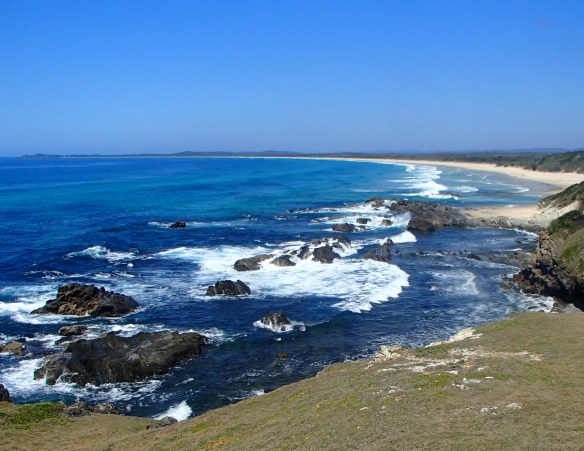
Bribie – the old oyster jetty flats – 1 February 2016

Monday

The start of February usually marks the beginning of the real change in wind patterns on my home fishing patch – South East Queensland. The hot summer northerly winds are attacked by the cooler winter south-easterlies. The water temperature starts to drop very slightly and there is often some wild weather.

On Monday strong south-easterly winds were forecast to pick up from mid-morning. It was about a week after full moon and not a particularly big tide. I arrived at Bribie at about 5.15 am, to very grey skies that showed only the slightest evidence of first light. Low tide would be at 8.40 am, so sunrise at 5.20 am was about the perfect time to start fishing.

I waded out under the bridge and started casting with a GULP Jerkshad in the BBQ Chicken colour on a 1/8th ounce, 1/0 hook jighead. I like to concentrate on the area just south of the bridge when the lights are still on. There is a large piece of rocky reef which keeps boats away from this patch so it is usually undisturbed, overnight. This morning all I could catch was a piece of that reef, so I re-rigged with a GULP jerkshad in the Satay Chicken colour and moved on.

I passed the jetty and moved along the big sand bar that runs south, towards the furthest channel marker, that you can walk to. There were rays everywhere – they like to sit in the shallow water as the run out tide washes dinner into their path. Just where this sand bar turns left the water becomes slightly deeper and the weed beds are a little thicker. I was now standing in less than 50cm of water. I was casting along the edge of the weed when I clearly saw a flathead launch itself at the soft plastic. It missed. I dropped the rod tip and paused as the stirred up sand washed past. When the water cleared the flathead was sitting about 10 cm behind the clearly visible lure. It did not seem to want to strike. I decided to make the first move. I hopped the lure off the bottom, it lunged forward and grabbed the plastic. I dropped the rod tip, to let it get the soft plastic well inside its mouth and then lifted it again and set the hook in its jaw. It was a respectable 50cm flathead.

I fished around this area and moved further down towards the channel marker but could not find anymore. I saw a big shovel nose shark swimming in the shallows and a few small schools of squid. At about 7.45 am I turned for home and slowly walked back towards the bridge, casting as I went.

I swapped to my old favourite soft plastic – the GULP 4” Minnow in the Pearl Watermelon colour. Just to the south of the jetty something fast hit the lure and I hooked up. It was a small bream, about 28cm long. I released it.

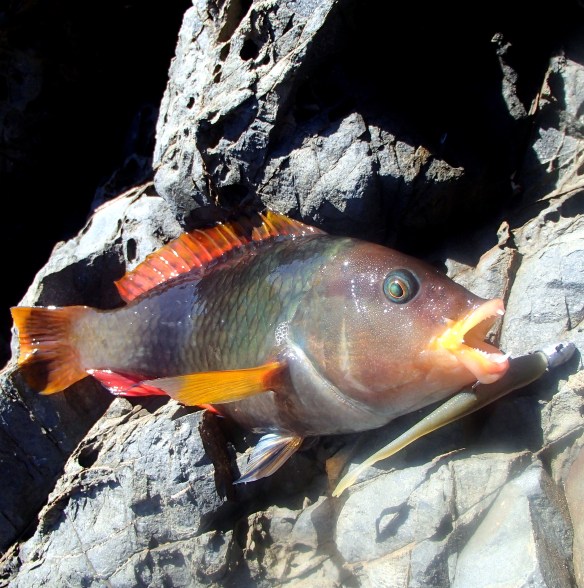
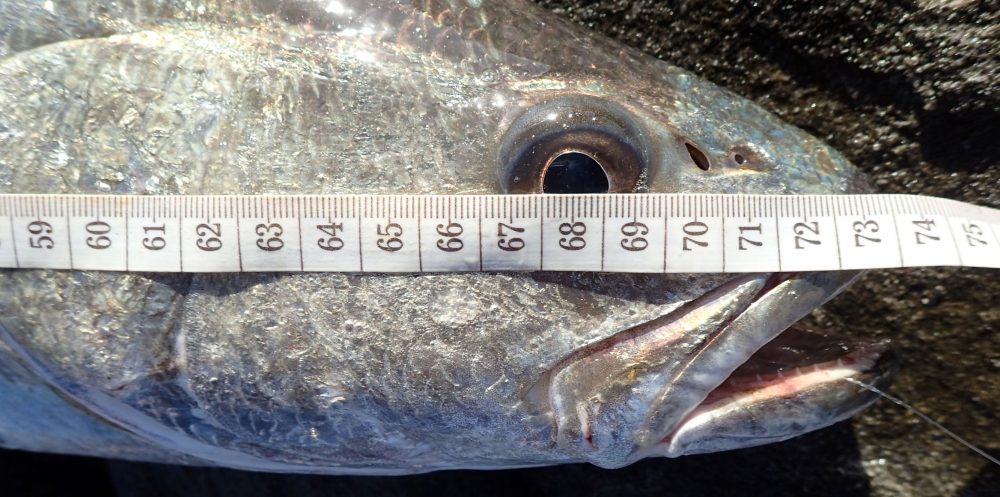
By 8.45 am I had passed the under the jetty and was fishing around the base of the stranded pylons, just to its north. My lure struck something and stopped dead. I pulled hard assuming it was the base of the pylon or an old crab pot. Gradually the object started to move and then wriggle and then it took off in a slow but powerful run. I thought it might be a ray but it was moving a little too quickly. I let it take line. There was no way to muscle a fish like this in on my light spin rod. I was pretty sure I had last re-rigged with 10lb fluorocarbon leader, so I would just have to be patient. We went back and forth for a few minutes and then I started to walk slowly backward towards the shore. This area is littered with rocks and bordered by the jetty pylons to the south, so it was a nerve racking fight. Eventually a big flathead appeared from the stirred up bottom and surrendered. I pulled her into the shallows and took a few photos. I did not have my tape, but by lining her up next to the rod I could see she was well over 75cm. I took a few quick photos and then watched her swim away. A great finale to what could have been a pretty slow session.

Bribie – Whitepatch and the old oyster jetty flats – 22 January 2016

Thursday’s fishing had not been that great but when I woke up on Friday I was confident that the fish would be there. The moon was virtually full and it would be a big high tide at about 8.30 am. More importantly the wind had dropped off considerably.

I decided to fish the first half of the run out tide at Whitepatch on Bribie Island. On a big tide the water comes right up to the tree line and the fish will often move up with it. There are often good whiting in the shallows here and where there are whiting there are usually flathead.

I started at the north of end of Whitepatch beach, fishing with a GULP 3 inch Minnow in the New Penny colour. I waded off to the north casting in the direction of the outflowing tide and then hopping the lure back towards me. I soon caught a tiny flathead that was sitting right next to a ledge of coffee rock at the foot of the tree lined beach. When I cast the lure out further it was grabbed a few times by what I think where the cruising long toms. I fished for about two hours but could not find any more fish.

At about 11.15 am I moved down to the old oyster jetty flats. The tide was still fairly high so I waded along close to the mangrove line, casting out towards deeper water. I was now fishing with a GULP Jerkshad in the Satay Chicken colour on a 1/8th ounce, 1/0 hook jighead. The wind was picking up and there was lots of weed floating around. The tide was running out fast and by about 12.30 pm I was about 30 metres to the south of the old oyster jetty. I felt a solid bite and hooked a nice 55cm flathead. When I pulled it in it had a nasty scar on its back.

I carried on towards the channel marker and about 40 minutes later picked up another 45cm flathead. As I moved south I caught two more, a 48 cm and a 50cm in fairly quick succession. By 2.00 pm I was hot and knackered and the wind was really blowing so I decided to give up. It had been a long session but I had found some decent fish.

Bribie – the Sandstone Point flats – 21 January 2016

Thursday

The forecast was for a 10 knot northerly wind which looked good for a quick fishing session. So I drove up to Bribie, to fish the run out tide on the old oyster jetty flats. It was a few days before full moon and the tides were getting big. It had been a 2.39m high tide at 7.35 am. Ideal fishing time on the flats would therefore be between about 10.00 am and 1.00 pm.

I started fishing at about 9.30 am. I rigged up my light spin ring and waded out under the bridge. There was still plenty of water so I cat around under the bridge for a while. I did not get any bites and the high tide meant there was a lot of weed floating around so I decided  to wade south alongside the mangroves and fish around the corner on the Sandstone Point flats.

On a big tide these flats are covered in 2 metres of water in places and there is plenty of structure and food for the fish that move up into these areas. There are a number of piles of oyster covered rocks and the remains of some old fish traps and old oyster racks.  There are also some big weed beds and patches of sandy bottom.

Today I could see some big mullet schools finning around and as I came around the corner I saw a couple of small tuna, of some kind, chase a school of smaller baitfish into the shallows. I was initially fishing with a GULP 4” Minnow in the Lime tiger colour. I was using 10lb fluorocarbon leader and a 1/8th ounce, size 1/0 jighead. I saw a few long toms grabbing at the plastic and hooked and then dropped one. They seem to love this area.

The wind was picking up and now coming from the north-east at about 20 knots. I was about waist deep behind a mangrove island and fishing alongside a small submerged rockwall. I felt a solid bite but struck a little too quickly and probably pulled the lure out of the fish’s mouth. I cast back in the same spot about five times and on the sixth the fish struck again. This time I dropped the rod tip for a full ten seconds and when I lifted it again I hooked the fish. It was a healthy looking 45cm flathead and I kept it for dinner.

It was now about 10. 45 am and I could not find any more fish around the mangrove island so I wandered back towards the main channel. There was still plenty of bait around and a cormorant was successfully fishing in the shallows. I waded along the sand bar that runs down towards the green channel marker, casting along the edges of the weed. I was now in less than a metre of water and the tide was running out quickly.  I felt a very aggressive smash and grab and a fish took off with the same Lime Tiger Minnow. It was a bigger fish and after a short fight I pulled it up onto the sand. I later measured it at 63cm.

By about 11.45 am the wind and weed were making fishing just too hard. I am sure the fish were there but I did not have the patience to carrying on battling the elements to find them.

Bribie – The old oyster jetty flats – 2 January 2016

Saturday

With Christmas done and dusted and the New Year underway. It was time to find an interesting activity other than eating and drinking. When your waders are getting tight you know you are in trouble. I needed to get moving and a morning fishing session is a great way of doing that.

The weather has been far from ideal for the trailer boat based angler over the Christmas and New Year holidays. High winds and seas have pushed a lot of boats into the Pumicestone Passage. This means things have been fairly busy during daylight hours.

On Saturday I was up at 3.45am and drove up to Bribie Island for a 4.30 am start. Low tide would be at about 8.30 am and the wind was forecast to pick up to a 10 knot south westerly. The moon was waning and had been full about a week earlier. I decided to fish the flats in front of the Sandstone Point Hotel and waded out under the bridge just as the light went out.

I started fishing with a GULP Jerkshad in the Pearl Watermelon colour, mounted on a 1/8th ounce, size 1/0 hook jighead. After a couple of tough sessions in this area I chose a 10lb fluorocarbon leader. I cast around under the bridge without any luck.

I waded towards the old oyster jetty and swapped to a smaller GULP 3” Minnow soft plastic in the Smelt colour. I felt couple of bites from small fish and then a solid thud from a flathead. I struck a bit too soon and missed hooking the fish.

I swapped soft plastic lure again just as the sun broke the horizon. This time I chose a Jerkshad in the BBQ chicken colour. I was now just to the south of the jetty standing about 15 metres form the mangroves casting in to the areas of sandy bottom between the weed beds. There was lots of bait around and every now and then something would smash into it from below. I slowed down my retrieve and paused longer between hops. This worked and at about 5.15 I safely landed a 45cm flathead.

About ten minutes later I caught another. This one was about 50 cm long and things were now looking good. I continued to pepper the area with casts but I could not find another. I moved slowly south casting as I waded. At about 6.00 am the wind started to pick up and by the time I reached the green channel marker at about 7.00 am, it was really blowing. Despite the wind there were now plenty of boats running out into the bay. I caught a tiny bar-tailed (sand) flathead by the green channel marker and then turned to wade back towards the bridge.

I got all the way back to the jetty before I got another bite and infuriatingly, after a brief run the fish slipped off or spat out my plastic. I was now fishing with the GULP 4 “Minnow soft plastic in the Pearl Watermelon colour. Just as I came close to the bridge and was about to wade out of the water, I felt a good bite and dropped the rod tip. I paused for what seemed like eternity but was actually about 5 seconds and then lifted the rod tip. The jig head’s hook set in the fish’s mouth and it took off. After a short run it settled and I pulled it ashore. It was another flathead, about 50cm long.

I had three good fish for dinner. As always the key was getting out early, before the boat and recreational traffic got going. I am looking forward to some more peaceful sessions in the near future.

South Golden Beach – Marshalls Creek – 23/24 December 2015

Wednesday

On Wednesday morning I was up before dawn to have another shot of catching something decent in the surf. The wind had changed to a strong northerly over-night. When I walked out on to South Golden Beach at about 4.45 am, I could see the water was pretty stirred up.

The wind was up and gusting between 10 and knots. As the water hit my feet I noticed it had cooled down considerably overnight. I was fishing with my Daiwa Air Edge rod and Shimano Sustain reel combination again. This time I tied on about 1 metre of 10lb fluorocarbon leader. The wind and surf was going to make it very hard to cast a lightly weighted soft plastic lure any distance, so I decided to rig up a hard bodied lure.

I chose the DUO Realis Vib 62. This is a Bass lure made by my favourite Japanese lure manufacturers DUO – http://www.duo-inc.co.jp/bass/en/realis/vibration62/ . I have tried plenty of cheaper imitations but I keep coming back to this one. It is an 11g sinking vibe lure with a loud rattle and comes in some great colours. There is something about its action and its ability to instantly find its rhythm that I really love. Even when bumping along a shallow, sandy bottom it keeps vibrating. The other advantage in the surf is that it casts like a bullet. I have found these lures at Jones Tackle http://jonestackle.com.au/ and also at Motackle http://www.motackle.com.au/. I understand that DUO has just secured a new Australian distribution deal so I hope this means they will become more widely available.

I wandered south as the horizon started to light up. I felt a few bumps and nudges in each new gutter but did not connect. At about 5.00 am the sun came over the horizon. I was now standing at the south end of a very long gutter that had a pronounced sand bank lip. I could see the small dart shadowing the lure as I pulled it towards me. I put in a long cast and started to jerk the lure back towards me. After about three pulls something smashed into the lure. I struck hard but the line felt slack. Then I realised the fish was just swimming towards me. It changed direction and I could feel that it was solidly hooked. It travelled sideways for a bit. I had the drag fairly loosely set. This is important in the surf as the pull of the waves will snap a light leader very easily.  I soon had a respectable 30 cm bream at my feet. I released it and looked for some more without any luck.

On Christmas Eve I decided to fish the big incoming morning tide in the section of Marshalls Creek that is open to fishing. This is a very beautiful stretch of water just off the Brunswick River. Its lower reaches are closed to all types of fishing but there is a section opposite the New Brighton shop where fishing with rod and line is still permitted. This area is fairly shallow on all but the biggest tides but it looks very fishy. There are big sand bars, overhanging trees and dense mangroves. I waded around through the early morning high tide and got a few bites. I saw plenty of bream, luderick and mullet swimming around but I could not hook any. It was peak holiday time and there was a constant flow of small boats which did not improve my chances of catching anything. After a few hours I gave up, but I will definitely be back.

Happy Christmas to all

New Brighton beach fishing – 22 December 2015

Tuesday

In the run up to Christmas I spent a few days fishing on the beach at New Brighton, just north of Brunswick Heads.

On Tuesday I wandered out for an afternoon fish and decided to walk towards New Brighton from South Golden Beach. I started at about 3.00 pm. I was using my Daiwa Air Edge 96L light surf rod and initially fishing with a 1/6th ounce, size 1 hook jighead. I was fishing with 10lb fluorocarbon leader. The moon was building up to full around Christmas Day, so the tidal flow was quite big. The wind was a fairly lively south-easterly, but the water was warm and still fairly clear.

This beach has very little structure apart from a few rocks half buried in the sand near New Brighton. However there are plenty of deep clearly defined gutters that are formed by the wind, tide and strong rips.

I cast around into the incoming tide. I was fishing with a GULP 3” minnow soft plastic in the Lime Tiger colour and I concentrated on the areas at the entrances and exits to the gutters. Each time I moved, I would get faint bites on the first couple of casts and then nothing. As the waves rolled over I could see these were coming from tiny dart.

I paused at the exit to another gutter and cast my lure so it would come back past as it was washed out to sea. After a couple of hops a fish grabbed it. There was a brief fight but I soon pulled it ashore. It was bream about 28 cm long.

I moved south and eventually arrived at the small patch of rocks in front of New Brighton.  I swapped to a GULP 3” Shrimp soft plastic in the neutral grey flecked peppered prawn colour. I cast around the rocks and again felt a few small bites.

The wind was now blowing very hard so I moved to the south side of the biggest rock and put a few casts in around its base. This paid off and on about my third one I felt the unmistakeable solid thud of a flathead bite. After another fairly brief fight I landed a 43 cm flathead. I took a few pictures and sent it on its way.

By 4.30 pm the wind was a howling southerly so I decided to give up. As I walked back to South Golden Beach I noticed a young gent throwing a small slug into the surf and witnessed him catch some small dart, as his hungry dog looked on.

Bribie Island – White Patch – 11 December 2015

Friday

The flats in front of the old oyster jetty at the Sandstone Point Hotel had not produced much action during my last fishing session. So on Friday I decided to fish somewhere else on Bribie. Wild weather was forecast and it was very hot – 33 C. There was a strong northerly wind blowing and there was plenty of cloud around. A storm seemed likely in the late afternoon.  I decided to give White Patch a try. This is a stretch of shore on the inside of Bribie Island where the 2 to 3 metre coffee rock drop off into the Pumicestone Passage, is quite pronounced. I have caught just about everything here over the years – snapper, trevally, queenfish, flathead, bream, whiting, estuary cod, moses perch, pike, long toms, tailor and jewfish. Flathead, whiting, bream and pike are by far my most common catches.

I wanted to fish the falling/ low tide. As regular readers will be aware, I much prefer fishing a run out tide at Bribie. That is not to say fish do not bite on the run in. I am just more confident of where to find them when the tide is running out. Fish, (especially flathead) move back in surprisingly fast with the run in tide. Both flathead and whiting love to eat soldier and other small crabs. As the tide runs into the shallows, they have a very good chance of finding them. If you are fishing with children over the holidays, soldier crabs are a great bait. They are plentiful, fun to collect and if you slide two or three on to a #4/#6 hook, at the end of a lightly weighted 6 to 10 lb line, you should find a few fish in the shallows.

Low tide would be at about 4 pm. I arrived at about 2.30 pm and wandered down the steps to the beach. The shoreline has a mixture of weed, sand and flat rocky areas. The edge of the main channel is only exposed on the very lowest of tides. I like to fish on top of the ledge, in the shallows before later casting over it, as the tide recedes.

This is a beautiful spot but this afternoon the fishing was very tough. I walked up and down casting everything I had in the tackle bag without much luck. At about 3.00 pm I caught a very grumpy bream who slammed my GULP 3” Lime Tiger coloured soft plastic minnow. I had dropped right down to 8lb fluorocarbon leader in the clear water.

I waded a long way along the shore almost to the south end. At this point there was plenty of bait in the shallows and each time I cast, it would scatter as the lure passed overhead. It was now about 4.30 pm and the tide was starting to slowly run in. There was a big surge about 5 metres in front of me and the bait scattered in all directions. I was now fishing with a bigger GULP Jerkshad in the Cajun Chicken colour. I cast in the direction of the surge. After about five casts something grabbed the soft plastic and took off at a tremendous pace. Fortunately the drag was not set too tight so it could easily take line. It stripped off about 20 metres of line in a solid fast run. Then after just a few seconds, it was gone. It looked like it had just dropped the soft plastic. I suspect it was a trevally, which I have caught in this area before.

I carried on casting but it did not come back. The sky got blacker and blacker, so at about 5.00 pm I decided to retire. Fishing in our estuaries is tough in the summer months but persistence is the key.

Bribie – the old oyster jetty flats – 7 December 2015

Monday

I had time for a quick fishing session on the flats at Bribie Island. School holidays had not really started so I was still hopeful that I would find dinner. I wanted to fish the run out tide. Low tide would be at 12.40 pm. It had been fairly windy with strong northerlies blowing for the few previous days. Today a strong south-easterly was forecast and it was blowing at about 20 knots from that direction, when I arrived at the Bribie Island Bridge.

I parked on the mainland side and walked out under the bridge.  The new café is now open at the old oyster jetty so there is now plenty of space to observe the fishing opportunities in this area. I don’t think there will be a sudden flood of anglers, as the mud and oyster covered rocks will put all but the diehard flathead hunters off.

I was fishing with my light rod and reel spinning combination. I have swapped back to the NS Blackhole 6′ SGII 602L trout rod. This rod picks up even the slightest of bites and although it does not have any grunt it can handle a good sized flathead. I was using the 2500 size Shimano Stella reel with it. I think the braid on the reel is about 8lb breaking strain Sunline Super PE in the bright green colour. I was using about 1.5m of 10lb fluorocarbon leader.

I started fishing with a large GULP Jerkshad in the Cajun Chicken colour on a 1/8th ounce, size 1/0 hook jighead. After twenty minutes, I had passed the jetty with no bites, so I swapped down to GULP 4” Minnow in the green camo colour. Perhaps I had just found the fish or the change of lure and the fresh scent it contained, woke the fish up, but I almost immediately got a bite. I thought I had the fish hooked but after a couple of runs it was gone. I cast back at the same spot and slowed things down. On about my sixth repeat cast the fish grabbed the soft plastic again. I paused and dropped the rod tip for a few seconds. It took off again and I was sure it was hooked but unfortunately it wriggled off again.

I waded slowly south. Just before I reached the green channel marker, I saw a couple of big squid hovering in the shallows. I cast my plastic at them and managed to hook one through the wing. I slowly pulled it in, relieved that I would at least bring home something for supper.

The tide slowed and then started to run in. The wind made things very tough but I just could not find the fish. I swapped through lots of different shaped and coloured soft plastics but did not stir up any interest.

Finally at about 1.50 pm, with the tide running in and the water very stirred up, I felt an obvious bite. I was now fishing with the GULP 4” Minnow in the Pearl Watermelon colour (probably my all-time favourite flathead soft plastic). This time the jighead pulled home and I reeled the fish in. It was only a 30cm flathead – but at least it was a fish! I photographed it and let it go.

I waded slowly back across the exposed flats. There were soldier crabs everywhere so there is plenty of food for the fish here. I did not see any flathead lies so maybe the persistent northerly winds have blown them off to another spot for a while. The northerlies seem to have flattened out the terrain quite a bit in the last few months. At about 2.30 pm I gave up for the afternoon.

New Brighton – the beach – 19 October 2105

Monday

On Monday I decided to fish the beach a little further north of the Brunswick River mouth, between South Golden Beach and New Brighton. When there is a fairly regular wind pattern some good gutters form along this stretch of beach. There are also a few small patches of exposed rocks which are good to fish on the higher tides.

This time I woke before first light and walked out onto the beach about 20 minutes later. I was hopeful that something big might be hanging around so I started fishing with a GULP 5” Jerkshad in the Pearl Watermelon colour. The dart were everywhere. I felt hits from the first cast. They were small but this did not stop them attacking the big jerkshad. I caught a few but they were all tiny.

As the sun came over the horizon I decided to drop down to a smaller 3” Minnow soft plastic in the Lime Tiger colour. The dart attacked this but they were still only an average of 15 cm long.

I reached a small patch of exposed rocks and swapped to GULP Shrimp soft plastic in the Peppered Prawn colour. I cast this around the rocks and felt a few bites. I started to let the plastic sit on the bottom, between hops for longer periods – hoping there might a flathead lurking nearby.

After a few casts there was suddenly some dead weight on the end of the line. Then the rod tip started to wiggle and I realised it was a fish. I thought it might be a ray of some kind as it was moving very slowly. I let it take line initially but soon turned its head and had it swimming towards the beach. As I pulled it clear of the surf and up the beach I could see it was a very strange looking fish called a stargazer. As soon as it was clear of the water it gradually buried itself in the soft sand. I had to wait for another wave to cover it, so that I could dislodge it from the sand. I am told these fish taste delicious (often referred to a ‘poor mans lobster’) but they just look far too weird to eat. I took a few snaps and then sent it on its way.

That was it for another tough beach/ surf fishing session. I am not much good at this type of fishing but that just gives me a good excuse to keep at it, until I am.

Brunswick Heads – the beach – 18 October 2015

Sunday

Half way through October, I managed to get down to Brunswick Heads for the weekend and had a few mornings fishing on South Golden Beach. Earlier in the year, in the cooler water, I had found plenty of tailor and bream down here.

The moon was in its first quarter and the tides were not big. The wind was a light south easterly, turning northerly in the afternoons. As you all know I love to fish with soft plastics lures. On the beach, success with plastics requires a bit of persistence – especially in the warmer months.

As usual you have to be up early or be prepared to fish through dusk. I prefer the dawn session, as I am an early riser and you know the water has not really been fished/ surfed/ disturbed overnight.

In spring and summer I fish with very light gear. The predominant summer species; dart, whiting, bream can be very picky and the water is often clear. I rarely use more than a 12lb fluorocarbon leader and will often go down to 8lb to get the bites. This means you have to have a good, functioning drag on your reel and make sure it is set correctly. You will certainly lose a big bream/ or dart in the surf, if your drag is set to tight. If you get a fish hooked you have to bring it in patiently, using the rhythm of the surf. If a big mackerel is passing through, your are doomed, but that is fairly unlikely.

I like to use small brightly coloured soft plastics when the water is clear. My favourite for dart is the GULP 3” Minnow in the lime tiger colour. If the water is stirred up I swap to paddle and grub tailed soft plastics in darker colours. In these conditions it is often the vibration that will bring the fish to the lure.

On Sunday, I decided fish the rocks and beach on the north shore of the Brunswick River mouth. There is often a nice big gutter here and the rocky/ reefy area on the north side of the river rock wall also provides some good structure to fish around. I arrived at the carpark at about 5.30 am, just after first light.

The water was a little stirred up so I started with a GULP 3” Minnow soft plastic in the Pearl Watermelon colour. I was using my Daiwa Air Edge 96L light surf rod and initially fishing with a 1/6th ounce, size 1 hook jighead. I was fishing with 10lb fluorocarbon leader. After a while I was not getting any bites, so I swapped down to a lighter 1/8th ounce jighead. I moved a little closer to the rocks.

The fishing was tough. I had a couple of bites from what I assume were dart. Low tide had passed at about 5.40 am and the water was now starting to run in. Perhaps this was the catalyst for action and I hooked a small bream (about 25cm long) and then another.

There was a pause of about 20 minutes then I caught a few more. At about 8.15 am the sun was high in the sky – and my fishing spot was right at the start of the surfer route out to their favoured spot. They kept, very politely, swimming through the fishing zone, so I decided to give up for the morning.

Brooms Head – 3 October 2015

Saturday

On Saturday we were heading back to Brisbane. The looming thought of returning to work forced a right turn at Brooms Head. This coastal area in the Yuraygir National Park is a land-based fisherman’s paradise. There are plenty of estuaries, rocky headlands and beaches to choose from. You can catch all the common species; tailor, kingfish, mulloway, trevally, dart, bream, whiting and flathead.

We drove up to the Brooms Head lookout. It was a beautiful day and just as we arrived a whale and its calf swam by, stopping for a brief tail slapping session.

Brooms HeadBrooms Head fishingMagnificent view from the lookout

It was just about lunch time but I could not resist getting the fishing rod out and clambering down the rocks for a quick cast. I put on a small soft plastic and felt a few small bream bites, close to the foot of the rocks. After about twenty minutes, I pulled up a tiny wriggling tusk fish of some kind.

The sun was out, the water was crystal clear and I could have stayed here another week – but unfortunately there are bills to pay.

Hat Head – Connors Beach– 30 September 2015

Wednesday

On Wednesday conditions where calm again with a light northerly wind blowing. First light was about 5.00 am. I could not face another tramp out to the spinning ledge so I decided to try fishing the rocks at the north eastern corner of Connors Beach.  This area always looks very fishy and there is often a long gutter that drains out through a group of rocky bommies, from the northern corner of the beach.

There are a couple of rocky outcrops that you can safely stand on in light seas. About 45 metres to the east of these ledges there is a circle of large rocks which are riddled with overhangs and caves. They are pretty hard to cast at, but they are full of fish.

I started with a 65g Raider, tied on to the main line with 30lb breaking strain fluorocarbon leader. I was using the heavy rod – Daiwa Demonblood, and I was casting a metal slug about 40 to metres out towards the edge of one of the semi submerged rocky outcrops. I was reeling in line pretty quickly on my retrieve.

The sun was not yet over the horizon, at about 5.20 am, when I hooked and landed the first tailor of the day. This was quickly followed by a few more. Then, as the sun up and the glare started to build, the bites slackened off and having caught four 40 cm tailor in quick succession, it took an hour to catch another.

By about 7.30 am all was quiet. The water was crystal clear and my metal slugs, hard bodied minnows and poppers could not rustle up a bite. I decided to give up for the morning.

At about 5.00 pm I came back and carefully climbed down the rocky headland that sticks out between Gap Beach and Connors Beach. There is a small inlet here that looks very fishy and with a fairly light swell I could cast right into it.

I started with a 40g HALCO Streaker metal slug. I cast it out into the foamy water around the rocks.  After a few casts, I hooked a fish but it wriggled off at the base of the rocks. I hooked a couple more that also got off. At about 5.30 pm, just as the sun was dropping to the horizon I finally held on to one. It was another 35cm tailor. As the sun set I hooked what felt like a smaller fish. After a short fight I was surprised to see a solid bream on the end of the Streaker.

I fished on through the amazing sunset but did not catch anything else.

Hat Head – mixed bag – 29 September 2015

Tuesday

By Tuesday morning conditions were very different. The wind and swell had almost completely dropped away and the skies were clear. At about 5.00 am I set off for the rocks at the far tip of the Hat Head headland. As I walked along the pathway I could clearly see the current line snaking across the surface of the bay. It would be another very big tide as the moon was huge.

When I reached the spinning ledge I put in a few casts with the 110mm River2Sea Dumbbell Popper, as soon as I could see where I was throwing it. I generally use my Daiwa Demonblood rod to throw this surface lure around. The popper blooped nicely across the shimmering water but there were no hits.

I swapped to the lighter, Daiwa Air Edge Surf 96 L rod, rigged it with a 20lb fluorocarbon leader and tied on a ¼ ounce , size 1/0 jighead. I put on a GULP Crazylegs Jerkshad soft plastic in the curry chicken colour. The tailor seemed to have vacated the area directly in front of the spinning ledge and the calmer conditions made the rocks further round the headland accessible. I moved around to the front of the headland and reeled in a small bream. I swapped through a few different size and coloured soft plastic and found a few more small bream. Perhaps the calmer seas had turned the tailor off.

I paused to re-rig and as I did so there was a loud blow about 40 metres out in front of me. A whale and its calf arched their black humps and continued past. A few moments after they disappeared, their very fishy blow cloud blew ashore – a wonderful site but a very unpleasant smell.  Next time they surfaced they were about 350 metres away – but they paused to put on a short tail slapping show. A close encounter with a whale is always great and it is about the only time I stop fishing and just watch the ocean for a while.

I decided to change tactics – perhaps the whales and dolphins (who followed them past) where following some fish. I swapped lures to a MARIA Mar Amigo 65mm 15 gram sinking vibe lure. This is another one of those carefully crafted Japanese lures that casts like a bullet, sinks fast and has a great action.

I cast into the foamy wash, just in front of the rocks and after about three casts I felt the mad head shakes of a hooked tailor. It was only a small one, about 30 cm long, but they were clearly still hanging around. They came and went every 15 minutes of so for the next couple of hours. They never got much bigger than 30 – 35 cm so I did not keep any. I swapped to the DUO Realis Jerkbait 110 SP hard bodied minnow which also caught a few, but the smaller profile and deep diving nature of the MARIA lure probably enticed more hits.


At about 9.30 am I moved back round to the Spinning Ledge and decided to try a soft plastic again. I chose the GULP 4” Minnow soft plastic in the Green Camo colour. I rigged it on a slightly lighter 1/6th ounce, size 1/0 hook jighead and I had swapped down to 16lb fluorocarbon leader. I cast out and let the lure reach the bottom. I paused, then gave it a few hops along the bottom. As I speeded up the retrieve to lift the lure clear of the rocks a fish struck. It put a nice bend in the rocks ad initially I thought it was a decent tailor. It soon slowed however and after a brief fight, I pulled a small trevally clear of the water.

A few more casts in this spot yielded no more fish so at about 10.00 am I gave up for the morning. No trophy fish but plenty of action and plenty of whales to watch.

Hat Head – Korogoro Creek – 28 September 2015

Monday

On Monday I did not have time for the walk out to the headland so I decided to see what the monster, full moon morning high tide would push up Korogoro Creek. On the low tide the day before the water had looked like gravy, as the tannin stained water drained off the surrounding swamps. As I walked along the edge of the creek the contrast was stunning. I was about an hour off high tide but the water was crystal clear and the current was pushing up the creek.

I had my waders on. The sun had come out but the water was still pretty fresh. I was fishing with my current light estuary fishing rig – a very light NS Blackhole trout rod. I was using 10lb fluorocarbon leader, a 1/8th of an ounce, size 1/0 jighead and I stared with a GULP 2” Shrimp soft plastic in the Banana Prawn colour. It was very early but people were popping up all along to bank to fish or launch kayaks or stand up paddle boards or even have a swim.

I walked and waded along the northern bank, stopping at each gap in the vegetation to throw a few casts. I could see schools of small bream and Blackfish cruising the now submerged tree roots and some big whiting out nearer the centre of the main channel. Even on a big tide the creek is rarely more than 1.5m deep. I moved slowly northwards and stopped at a small bay about 100 m east of the road bridge. The water was so clear I could see the bream inspecting the shrimp soft plastic, each time it hit the water. But I could not entice them to strike. A whiting followed the lure all the way to my feet, but also would not bite.

I swapped soft plastic to the GULP 3’ Minnow in the Pearl Watermelon colour and started to pepper the far bank with casts. The tide was slowing but the water was still crystal clear. After a few casts I felt the solid thud of a flathead bite. I dropped the rod tip and paused for about 8 seconds then struck. The fish was hooked. I reeled it in and took a few snaps before releasing it. It was a flathead about 40cm long.

It was only 7.00 am but the creek was getting busy with the kayaks, canoes, swimmers, and other fishermen. I decided to retire for breakfast. The creek would definitely fish well on the big tides when there is a little less traffic around.

Hat Head – Tailor, Tailor, Tailor – 26 September 2015

Saturday

The September school holiday is a great time to go south from Brisbane. The weather can be unpredictable but the water is usually still cool and the winter species; kingfish, tailor, bream, jewfish, snapper – are all possible from the shore.

The coast of northern New South Wales has great fishing spots. They are liberally spaced all the way down to Newcastle and beyond. Fingal Head, Woody Head, Brooms Head, Crescent Head and our destination – Hat Head are all fantastic rock fishing locations.

The tricky thing with September is often the weather. The winter wind pattern of southerly blows is gradually giving way to the more consistent summer northerlies, which warm up the seas. These two patterns clash and this can bring storms, big seas and rain.

We were fortunate. We drove down from Brisbane in the rain and wind. By the time we reached the house we had rented, the rain had stopped. It soon started again, through Friday night but by Saturday, the sun was out. There had been a big southerly blow raging all week with lots of rain.

By dusk, I could wait no longer. I pulled on my fishing boots and set off to for the Spinning Ledge at the far eastern point of the Hat Head promontory. It takes me about 30 to 40 mins to walk from the township out to the ledge. The path is quite challenging and slippery in parts, so shoes with good grip are essential. Waterfalls lined the route as the recent heavy rain drained off the hill. There were plenty of frogs singing at each small water crossing. A large echidna wobbled along the path in front of me at one point before rolling into a ball in a not particularly cunning attempt to disguise itself.

I arrived at the end of the end of the headland at about 5.00 pm. There were a couple of fisherman already on the ledge. The birds were circling just offshore, to the north east and one of the fisherman was pulling in a 40cm tailor on a metal slug.

I only had about 30 minutes until sunset so I had to get on with it. The swell was up and there was still a strong southerly wind blowing. I was trying a new longer, slightly lighter rock fishing rod. It is the Daiwa Air Edge Surf. 96L (supplied on the recommendation of Steve at Jones Tackle). Which I matched with my Shimano Sustain 4000 reel, 15 lb breaking strain Aldi braid and 30lb fluorocarbon  leader.

This is what Daiwa have to say about it:

96L

Finesse and shore based spinning don’t generally mix but with the 96L is the perfect mixture of weight, action and taper to make the perfect light game spin and estuary baitfishing rod. Ideally suited for fishing small metals, bibbed minnows, poppers, sliders and plastics. Best suited to a 2500 – 3000 sized spinning reel.

I agree with most of that – but I will need to give it a good workout before I am prepared to agree that it’s “perfect”.

I could see the slugs where working but I decided to start with a soft plastic lure. I tied on ¼ ounce #1/0 hook jighead and loaded a GULP Crazylegs Jerkshad in the curry chicken colour. I tried to use the rocks behind me as a bit of shelter from the very strong southerly but from my first cast, I could see that getting the jighead to sink would be difficult.

I cast out at low level and manage to land the soft plastic about 12 metres from the shore. I let it sink and started to hop it back towards me. As soon as it moved off the bottom, the fish were all over it. I could feel it being pulled in all directions before a solid fish finally took possession. I played the fish for a while keeping the line tight and safely pulled it over the oyster covered section at the base of the rocks. Then I grabbed the leader and slowly pulled it to my feet. It was a solid 43 cm tailor.

The soft plastic was destroyed so I swapped to a GULP 4” Minnow in the Lime Tiger colour. Two or three casts later I managed to get it back into about the same spot and the same thing happened. This was a slightly bigger one, just short of 50 cm. I decided to dispatch it and keep it for dinner. The fish kept coming and I caught three more over the next 20 minutes. However they were all between about 30 and 40 cm.

By now the sun had dropped below the horizon and to avoid walking back along the track in complete darkness, I decided to pack up. I am sure the bite would have continued but fishing lures in the dark is pretty hard. By the time I reached the path higher up the hill, the southerly wind must have been blowing well above 30 knots.

It was a great first session.

Bribie – the old oyster jetty flats – 8 September 2015

Tuesday

It looks like winter maybe behind us and we are in to the sub-tropical spring which usually lasts all of two weeks. I was back in Brisbane and decided to drive up to Bribie Island on Tuesday, to look for some flathead.

I chose to fish the flats in front of the old oyster jetty at the newly opened Sandstone Point Hotel. I thought it would be easy but initially at least, the fish were quite hard to find. I started at about 8.45am with low tide set for about 11.30 am. The wind was forecast to be light at first rising quickly to 15 knot north easterly. However, within 20 minutes of my arrival the wind was gusting 15 to 20 knots and the water was weedy and very stirred up.

I moved south from the bridge fishing with a GULP 5” Jerkshad in the Cajun Chicken colour on a 1/8th ounce size 1 hook jighead with a 12lb fluorocarbon leader. This yielded absolutely no bites. After an hour, I was south of the old oyster jetty battling the weed and wind. I decided to swap to a GULP 4” Minnow in the Lime Tiger colour. After a few casts, I felt a solid bite but pulled the rod tip up too quickly and did not connect with the fish. I slowed things down and cast out to the same spot. I paused and let the plastic stop for a while, just where I thought the fish was. This time it worked. I lifted the rod tip and the fish was there. It was a small flathead just over 40cm long.

It was now 10.10 am and I was wading steadily to the south as the tide ran out. I followed the edge of the weed beds but as the water got shallower and murkier it became difficult to see where to cast. Gradually I started to find the fish. I caught a couple more small flathead at about 10.30 am and then a 50cm fish just before 11.00 am.

I had now reached the green channel marker. I swapped to a GULP Mantis Shrimp soft plastic in the Lime Tiger colour and this almost instantly got a bite. It was another smaller flathead. I waded slowly back to the bridge and caught another six flathead on the journey. They were fairly spread out but seemed easier to tempt at the bottom of the tide.

I ended up with 4 fish over 40cm which is a good dinner. But the wind and weed had made it hard.

Dune Rocks – Tailor – North Stradbroke Island – 15 July 2015

Saturday

I was still on North Stradbroke Island and delighted with my first session, the day before. It was still cold and fairly breezy on Saturday morning. The wind was blowing from the south-west but it would slacken off through dawn before turning south-east and picking up, mid-morning. Low tide had passed at about 3.00 am. It had rained overnight.

I walked down on to Deadman’s Beach just after first light and headed for Dune Rocks. It was about 5.45 am. I had decided that I would fish the pre-dawn period with a popper. It is my experience that the fish are more comfortable attacking a surface lure in the pre-dawn light. I stayed slightly to the north of where I had been fishing the day before.

There was already a keen fisherman in position reeling in a tailor on a metal slug, as I came round the corner. I joined him on the rocks and threw out the River2sea 110mm Dumbbell Popper in a pink colour. I had upgraded to 40lb fluorocarbon leader. Almost as soon as I started the retrieve, the lure was being pulled in all directions by a number of different fish, I kept up the pace of the retrieve and eventually solidly hooked one of them. It was a tailor about 35cm long. I threw it back and cast again. For the first few casts the fish whacked the popper as soon as it hit the water. Then they eased off a little. I slowed the retrieve and added a few long pauses after each big bloop of the popper. This got them fired up and they would hit the lure each time it paused. In the 30 minutes between first light and dawn I had tangled with 12 fish but landed only 4. They were all between 35 cm and 45 cm.

Post dawn by about 6.30 am the popper was no longer working. I tried a soft plastic jerkshad which was grabbed by something close to the rocks but I could not set the hook – cold have been anything – bream/ butter bream/ dart.  There were now a few fisherman on the rocks and they were still catching tailor from time to time. A curious Kangaroo also appeared to watch the fishing show.

I cleaned up my fish and walked back to the car at about 7.15 am.

North Stradbroke Island – Tailor – Dune Rocks – 14 August 2015

Friday

I had managed to arrange a weekend away at Stradbroke Island with the family. Although there would be the inevitable expectation that I would spend some time with them, in the usual holiday fashion, I felt confident of sneaking off at dawn each day for a quick fish.

Thursday had been clear and sunny but with a strong, cold westerly wind. On Friday morning I woke just before first light. It was pretty cold – around 9 Celsius. I put on a few layers and pulled on my Cabela’s stocking foot chest waders. I then put on my felt-soled rock fishing boots, also from Cabela’s http://www.cabelas.com/ . Cabela’s seem to be one of the few retailers that produces excellent quality own label gear. I have yet to find these in Australia, so if you want some you will have go online. This combination works well on both the rocks and the beaches. The felt soles give excellent grip on wet rocks and from the chest down, they keep me completely dry. The water is rarely very cold in Queensland but once you get wet on a breezy day, it feels a lot colder.

I walked down to Deadman’s Beach as the horizon started to glow, just after 6.00 am. It was still cold but the westerly had dropped off and flattened the sea. I was fishing with my light rock/ beach fishing rig. The NS Black Hole Cabin II – S-862 L Spin Rod matched with a Shimano Sienna 4000 (a substitute for my Sustain 4000 which is in for an overdue service). Just to prove I will try anything I had loaded the Sienna with ALDI 15lb yellow braid. This stuff looks like you could pull a tractor with it and the breaking strain must be way above 15lb.

I started with a GULP Jerkshad in the Cajun Chicken colour on a 1/6th ounce, size 1/0 jighead tied on with a 14lb fluorocarbon leader. I cast around the rocks and into the gutters as I walked along the beach towards Dune Rocks. At the submerged rocks, about half way along Deadman’s Beach something quick had a couple of grabs at the soft plastic, but did not take it.

As the sun gradually broke the horizon I saw a big flock of birds feeding just out in front of the rocks. I could not cast that far but perhaps there were also fish closer in. I swapped to a GULP 4” Minnow in the lime tiger colour and cast out as far as I could. Something grabbed the soft plastic just after it hit the water and I soon had it hooked. I assumed it was a tailor and I wound it to a few metres away. But as the swell pulled back and forth the jighead fell out of its mouth. I cast straight back out and was soon connected to another fish. However the line suddenly went slack and I wound in my leader minus my jighead and soft plastic.

I went back to the rocks to re-rig. I tied on some 30lb fluorocarbon leader (the heaviest I had) and a 55g HALCO Twisty metal slug. After a few long casts and a fairly slow and steady retrieve I felt a couple of hits on the lure and then hooked up. This time the fish stayed attached and I had a 35cm tailor at my feet. I released it and cast out again in the same spot. I hooked six fish on the same slug over the next thirty minutes but only managed to get 2 to the shoreline. They were all about 35cm to 40cm long. After a while one of them chewed through the leader and I lost the Twisty. I tied on a YOZURI suspending hard bodied Crystal Minnow lure and cast it around for a while, but this drew a blank.

I did not have another HALCO Twisty but I did have a 65 gram SPANYID Raider metal slug. I tied this on and put in another long cast. It took about three casts to find the fish again. I caught another couple and then things slowed right down. I looked out beyond the rocks and could see the birds had stopped feeding and moved on.

I tried moving around the rocks and tried a few different spots but by about 7.30 am the fish also seemed to have moved on. It had been a great introduction to land-based fishing on Stradbroke Island.

Brunswick Heads – Birds Working – 3 August 2015

Monday

People often ask me about birds and what do fishermen mean by “look out for the birds working”. Whilst fishing off the beach at Brunswick Heads recently I managed to film a good example.

It is hard to say exactly what was going on but the most like scenario is that there is a large school of bait – mullet, anchovies or something similair, that has drawn the attention of a big school of tailor that are migrating north to spawn. The tailor are attacking the bait school from below whilst the birds are dive bombing from above. Pretty soon this leads to a lot of blood and fishy residue in the water and the larger predators, sharks, trevally, mackerel will start to get involved.

The key challenge for the land based fisherman is getting a cast out to where the action is. You can watch this type of activity going on all day but it often is just out of reach. My advice is to make sure you tie on a very tough leader and a heavy metal lure and then hurl it out in the direction of the fish. There is often a big school under the water that you cannot see and it could be a hundred metres ahead of where the birds are.

If you can get you lure in amongst this kind of action you are definitely going to hook something.

Brunswick Heads – Joe Blake – 3 August 2015

Monday

I could not resist returning to the same beach gutter at Brunswick Heads on Monday evening to see if the fish were still there. The gutter that had produced so many tailor in the morning now only seemed to hold a few dart. After a while I caught one tiny flathead on a small soft plastic. The birds were nowhere to be seen and the wind had turned to a northerly.

As the sun dropped below the horizon I walked to the car and drove back along the dirt road that runs alongside Marshalls Creek. I slowed down when I saw what looked like a big stick on the road in front of me. The stick suddenly moved so I jumped out to have a look. It was a good sized python of some kind. It was fairly sluggish in the cool evening and after sticking its tongue out at me, it slowly slithered off into the undergrowth.

Remember – it’s a jungle out there!

A bit slow in the cold Marshalls Creek - Python Snake in the grass Stuck its tongue out